
Overhead Crane Installation Services Complete Guide
Bridge cranes are the core lifting equipment in the fields of factory workshops, warehousing and logistics, and heavy industry manufacturing. Their installation quality directly determines the operating safety, service life, and operating efficiency of the equipment. At the same time, it is also the core link of the annual inspection and compliance of special equipment and the acceptance of safe production.In the process of plant renovation, new equipment procurement, and production line upgrading, many enterprises often encounter a series of problems such as unclear installation scope, insufficient pre-preparation, deviation in construction period estimation, cost overruns, and service providers choosing to step on pits.This article helps companies to complete bridge crane installation projects in one stop.
What Is Included in Overhead Crane Installation Services?
The formal and complete Henan Mine Crane manufactured bridge crane installation service is by no means a simple equipment assembly, but a set of integrated special equipment engineering services including pre-survey, structural installation, track construction, electrical wiring, commissioning and acceptance.The compliance installation service conforms to the national special equipment installation standards throughout the process, covering the whole process of the project, and specifically includes four core sectors.
Site survey
Site survey is the basis of all installation work, and it is also a key pre-step to avoid late installation deviations, structural conflicts, and safety hazards.The professional survey team will on-site verify the overall structure of the plant, the strength of the load-bearing beams and columns, the clearance height of the workshop, the reference position of the track installation, the ground construction space and other core parameters, and at the same time combine the production layout of the enterprise, the material lifting trajectory, and the frequency of operations to customize the appropriate installation plan.During the survey process, all on-site data will be accurately recorded, potential problems such as insufficient bearing capacity of the plant structure, limited installation space, and unreasonable power supply points will be investigated, and suggestions for rectification and optimization will be given in advance to build a solid foundation for subsequent standardized installation and compliance acceptance.
Crane assembly
The main body assembly of bridge cranes is the core link of equipment forming. It strictly follows the equipment assembly drawings and industry special equipment specifications, covering the precise assembly of all core components such as the main beam, end beam, operating trolley, lifting hoist, walking mechanism, protective device, etc. of single-beam and double-beam bridge cranes.The construction personnel will strictly control the docking accuracy of the parts, the bolt fastening torque, the parallelism and level of the structure, so as to eliminate the problems of misalignment, loosening, and excessive clearance of the parts.At the same time, the anti-corrosion coating of the equipment and the fitting and debugging of the accessories are completed to ensure that the main structure of the bridge crane is stable and the mechanical transmission is smooth, and the long-term stable operation of the equipment is guaranteed from the hardware level.
Runway and electrical installation
The track and electrical system are the two core supports for the safe operation of bridge cranes, and they are also the key verification links for the high incidence of installation accidents and acceptance.Track installation includes the installation of supporting facilities such as driving track leveling, fixing, docking calibration, buffer devices, track stone sweepers, limit stops, etc., strictly control the deviation of track spacing, level, and straightness, and avoid equipment operation caton, gnawing rails, deviation, structural wear and other failures.The installation of the electrical system covers a full set of configurations such as cable wiring, control cabinets, operating handles, emergency stop devices, limit switches, overload protection, alarm devices, and grounding systems. The wiring is standardized throughout the process, insulation protection is done, and safety hazards such as leakage, short circuit, and signal failure are eliminated to ensure that the electronic control system of the equipment is sensitive and reliable.
Testing and commissioning
Testing and commissioning is the final link to verify the quality of installation and ensure that the equipment is put into production in compliance, and it is also an essential process for the acceptance of special equipment.The complete commissioning includes four modules: no-load trial operation, static load test, dynamic load test, and safety device verification. The full-stroke operation status of the equipment walking, lifting, and lifting is tested during the whole process of no-load.1.25 times the rated load static load hover test to verify the residual deformation of the main beam.1.1 times the rated load dynamic load cycle test to verify the braking, transmission, and stability performance.At the same time, check the sensitivity of safety devices such as limit protection, overload limit, emergency stop, sound and light alarm one by one.After all tests meet the standards, complete installation self-inspection reports and commissioning records will be issued, and special equipment acceptance will be completed to help enterprises apply for equipment use registration certificates to achieve equipment compliance and production.
What Should Be Prepared Before Overhead Crane Installation?
The completeness of the preliminary preparations for the installation of bridge cranes directly affects the installation period, construction quality, acceptance rate and project cost.Most companies have problems such as delayed installation, failure to pass acceptance, and additional additional costs, which are all due to insufficient preparation in the early stage.Combined with the industry's landing experience, it is necessary to focus on three major dimensions of preparatory work before installation.
Building and runway requirements
The plant structure and track foundation are the hard basic conditions for the installation of bridge cranes.First of all, it is necessary to confirm the bearing capacity of the load-bearing beams, columns and roof support structures of the plant. It must match the rated load and operating impact of the bridge crane. The old plant needs to be tested and reinforced in advance to avoid safety accidents caused by insufficient load-bearing.Secondly, clean up obstacles in the track installation area in advance, ensure that the track laying datum is flat and solid, and reserve standard track installation space and safe spacing.At the same time, plan the safety area of equipment operation, divide the construction isolation area, avoid conflicts between the installation process and the existing production equipment and materials in the workshop, and ensure construction safety and installation accuracy.
Crane specifications and site dimensions
Before installation, the matching between the equipment parameters and the on-site dimensions must be accurately checked to eliminate rework problems caused by inconsistent parameters and dimensional deviations.It is necessary to confirm the core specifications of the bridge crane such as tonnage, span, lifting height, operating speed, working level, and control method in advance, and at the same time accurately measure the site dimensions such as the headroom height of the plant, the track span, the effective working length, the safe buffer distance at both ends, and the operating limit range of the trolley.Compare equipment drawings and on-site measured data one by one, and customize the adaptation installation plan in advance for non-standard factories and special-shaped workshops to avoid problems such as equipment cannot be installed, operation is limited, and space interference.
Power supply and installation access
A stable power supply system and smooth construction channels are the key to ensuring the smooth progress of installation.In terms of power supply, it is necessary to confirm the industrial power voltage, load power, and power supply stability of the workshop in advance, reserve a dedicated power supply point, and equip it with suitable leakage protection and grounding protection devices to meet the power requirements of equipment installation and commissioning and later long-term operation, and prevent commissioning failures and equipment failures caused by unstable voltage and insufficient power.In terms of construction channels, clean up the entrances and exits of the workshop, equipment transfer channels, and high-altitude construction areas in advance to ensure the smooth entry of large components such as the main beam, end beam, and hoist of the bridge crane, and build a safe construction platform to meet the site requirements of high-altitude assembly and hoisting operations.
How Is an Overhead Crane Installed?
Henan Mine Crane manufactured bridge crane installation is a set of standardized and process-based special equipment projects, each step has strict process standards and accuracy requirements.Regular manufacturers strictly follow the industry-standardized construction process, and the overall construction process is mainly divided into three core stages.
Site preparation and runway installation
The first stage is site rectification and track construction, which is the basis for ensuring the smooth operation of the equipment.First, comprehensively clean up debris and obstacles on the installation site, level the construction site, and do a good job of construction safety barriers, warning signs and high-altitude safety protection measures.Then, according to the survey reference line, accurately locate the installation position of the track, carry out track lay-off, leveling, and fixed construction, and strictly control the level, straightness, and spacing errors of the track to ensure that the two-track parallel is unbiased.After the track installation is completed, install supporting accessories such as buffers, track pressure plates, and limit stops, and polish and level the track joints to avoid equipment running stuck and gnawing on the track. Finally, complete the acceptance of the track foundation and enter the next construction link.
Bridge, hoist, and electrical installation
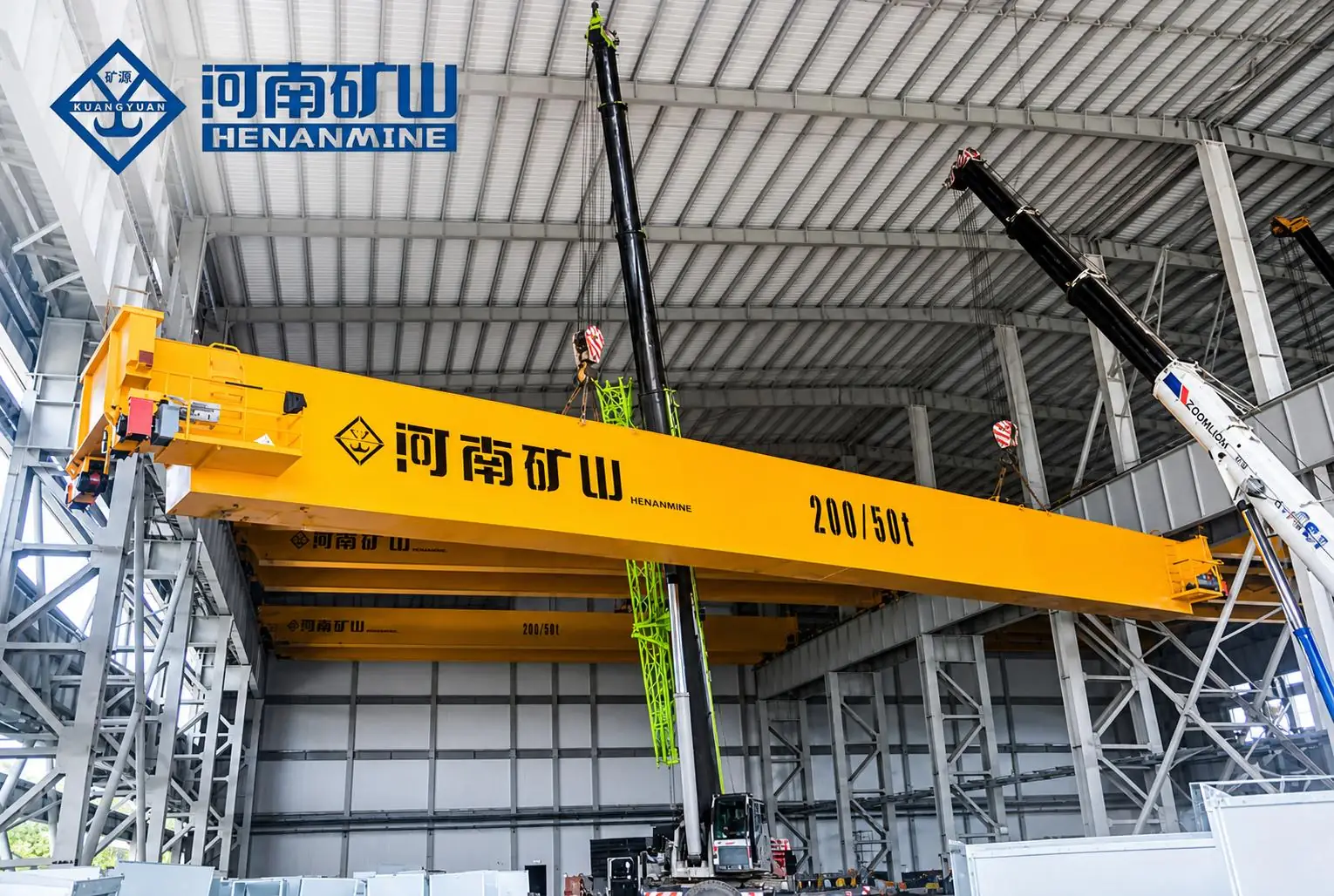
After the site and track have passed the acceptance, the assembly and construction of core equipment will be carried out.First, the main beam and end beam are accurately hoisted to the designated position of the track through large-scale hoisting equipment, butt fixing, bolt locking, and structural calibration are completed, and the main body of the complete bridge crane bridge frame is built, and the level and stability of the bridge frame are strictly verified.Then complete the assembly and commissioning of moving parts such as the operating trolley, lifting hoist, transmission mechanism, and walking wheel to ensure flexible mechanical transmission and uniform clearance.Finally, carry out the construction of the electrical system, standardize the laying of cables, the installation of control cabinets, operating devices, and various safety protection components, complete line wiring, insulation testing, and grounding testing, and comprehensively investigate circuit hidden dangers to ensure the safety and compliance of the electronic control system.
Alignment, testing, and commissioning
After all the equipment assembly is completed, it enters the stage of precise calibration and commissioning acceptance.First, perform a full range of mechanical calibration of the whole machine, adjust the coaxiality of the wheels, the level of the bridge, and the operating gap of the hoist, correct the installation deviation, and ensure that the operation of the equipment is free of deviation, no caton, and no abnormal noise.Subsequently, hierarchical testing work was carried out, from no-load test operation, rated load test to overload safety test, one by one to verify the operating performance, braking performance, and lifting stability of the equipment.At the same time, the sensitivity and reliability of safety devices such as limit, emergency stop, overload alarm, etc. are fully verified.After all test data meet the standards, organize a full set of construction materials, test reports, and equipment certificates, cooperate with Party A and special equipment testing institutions to complete the acceptance, formally deliver it for use, and provide operation and maintenance training.
How Long Does Overhead Crane Installation Take?
There is no fixed standard for the installation period of bridge cranes, which is affected by multiple factors such as equipment specifications, on-site conditions, construction difficulty, and project matching.Small conventional equipment can be completed quickly, and the construction period of large-scale non-standard equipment and old factory renovation projects will be greatly extended.Accurate estimation of the construction period can help enterprises reasonably plan the production line and production plan to avoid delays in the construction period affecting production.
Key factors affecting installation time
The core factors that affect the installation period of bridge cranes mainly include five categories, and they are also the main reasons for fluctuations in the construction period of the industry.The first is the equipment parameters. The larger the tonnage, the wider the span, the higher the working level, and the double-beam non-standard structure of the bridge crane, the more complicated the assembly and commissioning process and the longer the construction period.The second is the on-site construction conditions. In scenarios where the headroom of the plant is insufficient, the construction space is small, the access is limited, and high-altitude auxiliary operations are required, the construction efficiency will be greatly reduced.The third is the basic supporting situation. Additional projects such as plant structure reinforcement, track foundation rectification, and circuit transformation are required, which will increase the additional construction cycle.The fourth is the weather and operating environment. The construction of outdoor and semi-open factories will be suspended in rainy, snowy and windy weather.The fifth is the acceptance process, the regional special equipment acceptance process and the progress of data review will also affect the overall delivery cycle.
New construction vs. existing factory
There is a significant gap between the installation period of bridge cranes in the new plant and the old plant.The basic equipment of the new plant is complete, the construction conditions are standard, no additional rectification is required, and the construction period is controllable. It takes 3-5 working days to install a 5-20-ton single-beam bridge crane, 5-8 working days for 20-50-ton double-beam equipment, and about 8-15 working days for 100-ton large-scale equipment.However, there are widespread structural, orbital, circuit aging and space constraints in old factories, which need to be rectified and reinforced in advance, and the construction period is basically doubled. It takes 7-15 working days for small and medium-sized equipment, and 20-30 working days for complex and large-scale non-standard projects.
How Much Does Overhead Crane Installation Cost?
The installation cost of bridge cranes is the core concern of enterprise procurement and landing. There is no unified fixed quotation in the industry. The cost is affected by multiple factors such as equipment specifications, construction difficulty, on-site conditions, and service standards.Many low-cost packages only include basic assembly, and there are frequent additional charges in the later stages, which has caused the overall cost to soar.A clear understanding of the cost composition can effectively avoid quotation traps and accurately control the project budget.
Main cost factors
The first is the equipment specifications and structural complexity. The larger the tonnage, the longer the span, the higher the lifting height, the double-beam non-standard, frequency-conversion intelligent bridge crane, the more complex the installation process, the longer the construction time, the higher the commissioning standards, and the higher the labor and technical costs.The second is the on-site construction conditions. The renovation of old factories, high-altitude restricted construction, the need for structural reinforcement, and the construction of remote construction sites in different places will generate additional rectification fees, high-altitude work fees, and travel expenses.Moreover, the project compliance requirements require special acceptance of special equipment, issuance of a full set of compliance information, and customized safety plans. The cost is slightly higher.Finally, the service standard includes one-stop services for after-sales quality assurance, regular inspections, and operator training. The cost performance is much higher than that of simple assembly services.
Installation, electrical work, testing, and additional equipment
The complete installation cost is composed of four core sectors, with no invisible additions.The first is the main installation and construction costs, including site survey, equipment assembly, track laying, structural calibration, and labor and equipment costs for the assembly of the whole machine.The second is the electrical construction fee, which covers the cost of cable procurement and laying, electronic control system installation, circuit debugging, grounding protection, and safety electrical accessories.The third is the testing and commissioning fee, which includes special expenses for graded load testing, safety device verification, machine commissioning, data collation, and acceptance cooperation.The fourth is the additional supporting costs, including construction safety protection equipment, large-scale hoisting auxiliary equipment, plant foundation rectification, adaptation of non-standard accessories, transportation and hoisting and other additional just-needed costs.The quotation of regular manufacturers will list the details item by item, open and transparent, to prevent the industry chaos of low-cost drainage and later additions.
How to Get an Overhead Crane Installation Quote?
If you want to obtain accurate, no invisible additions, and fit the actual Henan Mine Crane manufactured bridge crane installation quotation of the project, there is no need to repeatedly communicate and compare prices. You only need to provide core project information, and the manufacturer can quickly issue detailed and accurate quotations.Accurate quotation can effectively avoid budget deviations, late additions, and ensure the smooth landing of projects. The core required information is divided into three categories.
Crane specifications
Providing accurate equipment specifications and parameters is the basis for quotation. It is necessary to clarify the core parameters of the bridge crane type, rated lifting tonnage, span, lifting height, working level, operating mode, control mode, whether it is a frequency conversion smart device, non-standard customization requirements, etc.If there are equipment procurement contracts and equipment drawings, they can be provided directly. Manufacturers can accurately calculate the construction difficulty, working hours, and accessories costs based on the parameters to eliminate quotation deviations caused by inconsistent parameters.
Factory drawings and site conditions
On-site working conditions directly determine the construction cost and construction period. It is necessary to provide the building drawings of the plant, the layout drawings of the workshop, and the drawings of the load-bearing structure. At the same time, explain the type of plant (new construction plant/old renovation plant), the clearance height of the workshop, the status quo of the track foundation, the size of the construction space, the channel conditions, whether structural reinforcement is required, circuit transformation and other on-site conditions.If you need an accurate quotation, you can cooperate with the manufacturer to complete the on-site survey and verify the working conditions on-site to ensure that the quotation fully meets the needs of on-site construction, with no missing items and no invisible charges.
Installation requirements and project schedule
Clarify the individual needs of the enterprise and the construction schedule plan, so that the quotation can be more in line with the project expectations.It is necessary to explain the project construction period requirements, whether urgent construction is required, whether it needs to be accepted by the agency throughout the process, whether it needs supporting operator training, quality assurance service upgrade requirements, etc.The manufacturer will customize the exclusive installation plan and detailed quotation according to the urgency of the construction period, service standards, and construction difficulty, and specify the construction content, construction period, cost details, warranty scope, and acceptance service content, so that the company can clearly know the purpose of each expense and cooperate with confidence.
Henan Mine Crane Factory Custom Custom
The installation of bridge cranes is a professional, compliance, and extremely safe special equipment project. From pre-survey preparation, standardized construction, commissioning and acceptance to post-sales maintenance, every link is essential.Mastering the complete installation process, cost composition, and influencing factors of the construction period can help enterprises efficiently advance projects, avoid various industry pitfalls, and achieve safe, compliant, and efficient production of equipment.If you need a dedicated installation plan, accurate quotation, and estimated construction period, you can contact Henan Mine Crane Factory at any time. The source manufacturer provides one-stop bridge crane installation customization services.