
Designing from Operating Conditions: Advantages of Customized Overhead Cranes in Complex Facilities
Bridge cranes are the core equipment for material transfer and equipment hoisting in heavy industry manufacturing, precision machining, energy and chemical industry. Traditional standard bridge cranes adopt a universal design and are only suitable for the conventional working conditions of standardized factories.With the transformation and upgrading of factories, complex working conditions such as non-standard structures, limited space, high-frequency heavy loads, and harsh environments have become more common, and the disadvantages of poor adaptability, many failures, and high transformation costs of standard equipment have become more prominent.Henan Mine Crane Factory supply customized bridge crane designed based on actual working conditions can be accurately adapted to various complex scenarios. It is the optimal lifting solution for improving quality, efficiency and safe production in industrial plants.
What Makes an Operating Condition “Complex” for an Overhead Crane?
Whether the lifting conditions of an industrial plant are complex or not, the core lies not in the size of the lifting tonnage, but in whether the working space, plant structure, production process, and operating environment exceed the design threshold of general equipment.Conventional standard bridge cranes are adapted to the basic scenarios of structured factories, dust-free at room temperature, low-frequency operations, and fixed processes, while the lifting conditions of complex factories are mainly concentrated in the four core special scenarios, which are also the core source of the difficulty of adapting lifting equipment for most enterprises. The root cause.
Non-standard workshop structures
A large number of old factories, renovated and expanded factories, and special industrial plants do not have the regular span, column spacing, and roof structure of standardized factories.Some factories have problems such as offset columns, scattered beams, special-shaped walls, irregular track foundations, and irregular plant spans. There are also some double-layer factories, mezzanine work areas, and special-shaped workshops. There is no unified equipment installation benchmark.The length of the main beam, the size of the end beam, and the installation and fixed structure of the standard bridge crane are all fixed parameters, and they cannot be adapted to the structural layout of the non-standard plant. Forced installation will have uneven force, poor fixation, and poor fit. There are great safety risks, and it is completely unable to meet the needs of long-term stable operation.
Limited headroom and dense obstacles
Many production workshops, storage workshops, and equipment integration workshops have extremely low headroom problems. Roof trusses, ventilation ducts, cable trays, and fire-fighting equipment are densely arranged, which compresses the installation and operation space of bridge cranes.At the same time, large-scale production equipment, tooling molds, fixed operation platforms, and material stacking racks are densely distributed in the workshop, forming a large number of shading areas.The hoist height, main beam thickness, lifting stroke, and operating trajectory of the standard bridge crane are fixed, and they cannot be installed normally in a low-clearance environment. It is easy to collide with obstacles during operation, and the blind spots of the operation are huge. It is impossible to achieve global coverage.
Multi-process and high-frequency operations
The lifting operations of heavy industry manufacturing, precision assembly, and assembly line production plants are no longer a single hoisting and transfer process, but cover multi-process cross-cutting operations such as raw material warehousing, station loading, process transfer, finished product cutting, equipment maintenance, and mold replacement.Such scenarios have extremely high requirements for the start-stop speed, positioning accuracy, continuous operation ability, and reversing flexibility of bridge cranes, which belong to 24-hour high-frequency and uninterrupted operation conditions.Standard bridge cranes are designed for intermittent operations. The motor, reducer, and control system cannot withstand the intensity of high-frequency start-stop and frequent reversing operations. Long-term high-frequency operation will quickly cause component wear, heat caton, positioning offset and other failures, which seriously affect the production beat.
Heavy loads and harsh environments
Industries such as steel smelting, chemical industry, energy, and heavy machinery manufacturing generally have the characteristics of heavy-duty hoisting and extreme environmental operations.On the one hand, the large weight of a single piece of workpiece, the large eccentric load, and the large hoisting span require strict requirements for the rigidity, carrying stability, and deformation resistance of the equipment structure.On the other hand, the factory area has been in harsh environments such as high temperature, high dust, high humidity, corrosive gases, and low temperature frost for a long time.The standard bridge crane adopts conventional materials and basic protection design, and has no special configuration for anti-corrosion, high temperature resistance, dust-proof, and moisture-proof. When operating in such environments, it is prone to paint shedding, metal corrosion, electrical component failure, structural aging and deformation. The service life of the equipment is greatly shortened, and the failure and shutdown rate remains high.
Why Do Standard Overhead Cranes Struggle in Complex Facilities?
The core advantages of standard bridge cranes are strong versatility, low mass production costs, and adaptability to conventional scenarios. However, for the above-mentioned complex factory conditions, their fixed and standardized design defects will be infinitely magnified, not only unable to enable production, but also bring a series of problems such as low efficiency, soaring costs, and safety risks. The specific shortcomings are concentrated in four dimensions.
Structural and dimensional mismatch
The main beam span, end beam size, lifting height, and overall equipment height of the standard bridge crane are all fixed standardized parameters, which are adapted to the standard installation benchmarks of the regular plant.The non-standard structure, low headroom, and special-shaped space of the complex factory area do not match the size parameters of the standard equipment at all.Either the height of the equipment is too high to be installed, or the span of the main beam does not match and cannot be fixed, or the size of the end beam is limited and cannot walk normally.Even if the installation is barely completed, there will be problems such as uneven equipment force, poor track fit, and serious operation shaking, which cannot guarantee the stability of basic operations.
Limited coverage and operating blind spots
The operating trajectory and operating coverage of standard bridge cranes are fixed areas, and cannot be flexibly adjusted according to the layout of workshop equipment and process distribution.In complex workshops with dense obstacles and scattered multi-stations, standard bridge cranes have a large number of blind spots, which cannot cover the hoisting needs of corner stations, mezzanine areas, and narrow passages.Many enterprises have to rely on manual-assisted handling and small chain hoists to fill positions, which not only breaks the automated operation process, but also greatly increases labor costs and operational risks, and the integrity and efficiency of lifting operations cannot be guaranteed at all.
Difficult and costly modifications
In order to adapt to complex working conditions, many companies will choose to carry out late-stage transformation of standard bridge cranes, but the actual transformation is extremely difficult and cost-effective.The main beam structure, transmission system, and electrical system of a standard bridge crane are integrated and standardized designs. The parameters of each component match each other, and the span, lifting height, operating speed, and protection configuration cannot be individually modified in a targeted manner.To adapt to special working conditions, it is often necessary to disassemble the core structure and replace a large number of accessories. The transformation period is long, the labor cost is high, and the structural integrity of the equipment after the transformation is destroyed, the stability and safety are greatly reduced, and subsequent failures occur frequently, falling into a vicious circle of transformation, maintenance, and re-failure.
Poor adaptability to future upgrades
Modern industrial plants are in a state of continuous upgrading and iteration, and production process optimization, equipment renewal, capacity expansion, and workshop layout adjustment are the norm.The standard bridge crane has a single function, fixed parameters, and extremely poor expandability. There is no reserved upgrade interface, which cannot be adapted to the future automation transformation, production capacity improvement, and process addition needs of the factory.Once the working conditions and production requirements of the factory area are adjusted, the original standard bridge crane is likely to be directly scrapped, and it needs to be re-purchased and installed. The reuse rate of equipment is extremely low, and the investment in fixed assets of the enterprise is seriously wasted.
How Are Customized Overhead Cranes Designed for Actual Operating Conditions?
The core design logic of Henan Mine Crane Factory supply customized bridge cranes is to adapt to working conditions first, and then define the equipment. It is different from the fixed parameters and general adaptations of standard equipment. Customized equipment takes the field working conditions, production processes, and operating requirements of the factory as the only design standards. Through the full-dimensional refined customization, the equipment is 100% matched with the working conditions of the factory, and the lifting problems of complex scenarios are solved from the root cause.The complete customized design process includes four core links, which fit the actual operation scenarios in all directions.
Site measurement and lifting path planning
The first step in custom design is not to finalize the equipment parameters, but to conduct a comprehensive field survey.Professional engineers will go deep into the workshop site to accurately measure the core data such as the headroom height, actual span, column position, obstacle distribution, basic orbital parameters, and operating area boundaries of the plant, and at the same time conduct in-depth research on the company's production process, hoisting frequency, load characteristics, operating hours, and future transformation plans.Based on the measured data and production requirements, plan the optimal lifting path, avoid all fixed obstacles, eliminate blind spots in the operation, ensure full coverage of lifting operations, no conflicts, and high efficiency, and provide accurate data support for subsequent equipment customization.
Customized span, lifting height, and girder design
Relying on field survey data, the core structure of the equipment is non-standard customized.For low-headroom workshops, optimize the hoist structure and the overall height of the compression equipment to ensure the rated lifting height in a limited space.For non-standard span factories, the length of the main beam and the structure of the end beam are customized to adapt to the layout of irregular tracks and columns.For heavy-duty and high-frequency operation scenarios, the design of high-strength box-shaped main beam, partial rail main beam, and reinforced end beam is adopted to improve the rigidity and deformation resistance of the equipment structure.For the transformation of old factories, the deviation compensation structure can be customized to adapt to the irregular track foundation, solve the problems of equipment installation in old factories, and adapt to various non-standard space and load conditions in all directions.
Hoist and operating speed configuration
Combine the process requirements of the enterprise with the frequency of operations to fine-tune the operating parameters of the equipment.For precision assembly and precise hoisting of small pieces, a low-speed stable and micro-speed fine-tuning mode is configured to ensure the positioning accuracy of hoisting.According to the high-frequency operation scenarios of raw material transportation and finished product transportation, the lifting speed of the hoist and the running speed of the cart are optimized to match the production beat and improve the transportation efficiency.For intermittent heavy-duty hoisting scenarios, optimize the motor power and load-bearing ratio, taking into account equipment stability and energy consumption control.At the same time, it is equipped with a frequency conversion speed control system to achieve stable start-stop and stepless speed regulation, eliminate load shaking, and adapt to the differentiated operating needs of different processes.
Control and safety system customization
The control system and safety system are the core guarantees for customized bridge cranes to adapt to complex working conditions.Conventional scenarios can be configured with basic ground operation and remote control operation modes.Automated assembly line scenarios can be customized with PLC intelligent control system, one-key hoisting, automatic tracking, and precise positioning functions, and support linkage with factory MES and automation equipment.In terms of safety configuration, anti-corrosion, dust-proof, high-temperature-resistant, and moisture-proof protection systems are customized for harsh environments to improve the environmental adaptability of equipment.For complex obstacle scenarios, intelligent anti-collision, load anti-shake, and blind spot monitoring systems are installed.For heavy-duty and high-risk working conditions, it is equipped with dual braking, overload limit, emergency shutdown, fault alarm, and real-time monitoring system to strengthen the operation safety line in all directions.
What Are the Advantages of Customized Overhead Cranes?
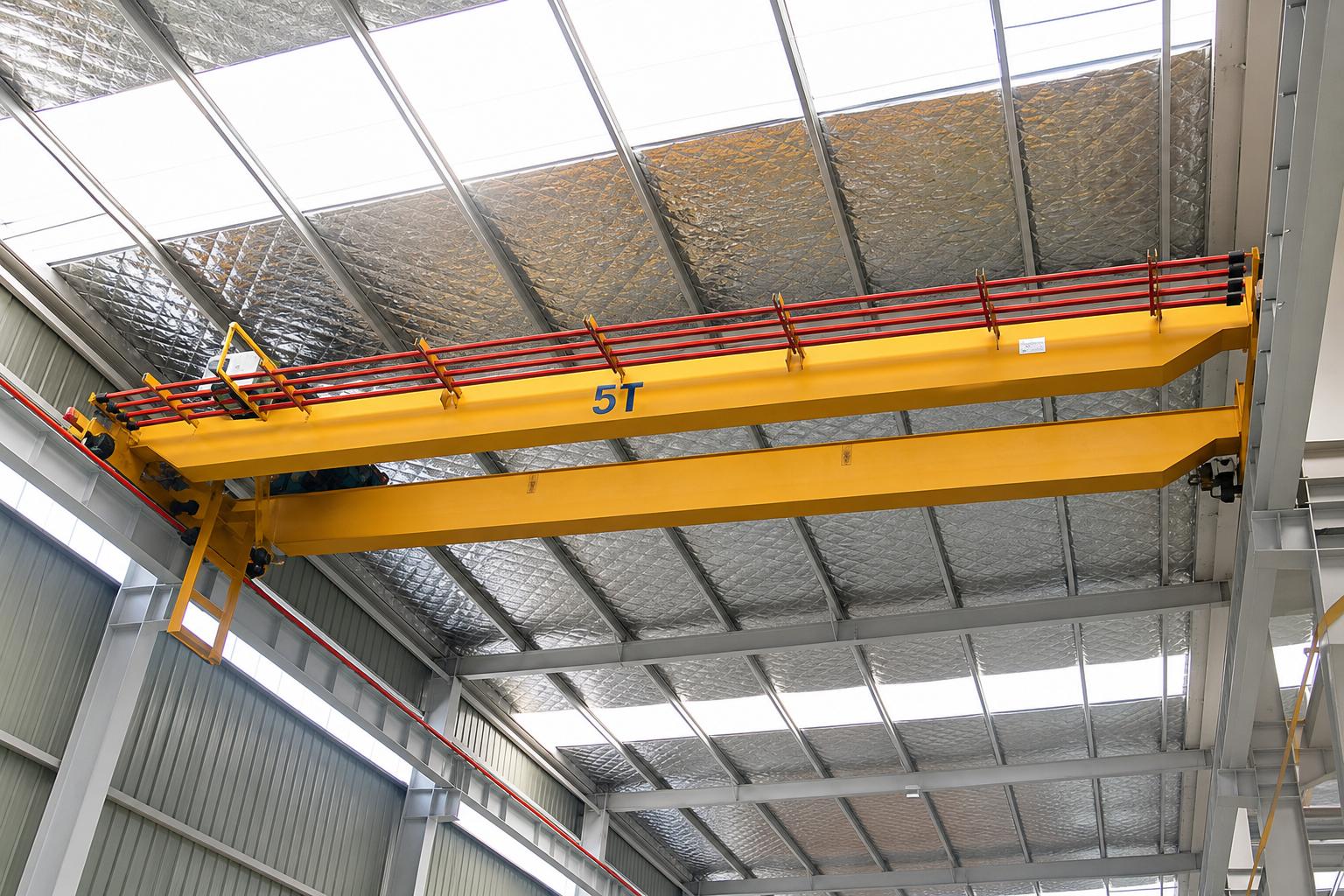
The customized bridge crane based on the full dimension of working conditions completely solves the shortcoming of standard equipment adaptation in complex factories, and creates core values for enterprises from the five dimensions of space utilization, operating efficiency, safety and security, intelligent adaptation, and full-cycle cost. It is also the core reason why customized lifting equipment is preferred in high-end industrial plants.
Better use of limited workshop space
Through structural optimization, size adaptation, and path planning, customized bridge cranes are perfectly adapted to complex workshops with low headroom, dense obstacles, and non-standard layout, completely breaking the rigid requirements of standard equipment for installation space and plant structure.The equipment fits the existing layout design of the workshop, does not take up excess working space, has no operating conflicts and no blind spots, and activates all the limited hoisting space and idle space in the workshop, so that every factory space can realize the value of the operation, without the need for enterprises to transform the plant to adapt to the equipment, greatly saving the cost of plant transformation and space expansion.
Higher material handling efficiency
The customized equipment fully matches the production process and operation beat of the enterprise, and accurately covers the hoisting needs of all stations. There is no need to manually fill the position, no need for secondary transportation, and no need to repeatedly adjust the hoisting position.The customized parameters of frequency conversion speed regulation, intelligent tracking, and fast start and stop greatly shorten the single hoisting cycle.The operation mode has full coverage without blind spots, opens up the whole process transfer link of raw materials, processes, and finished products, and completely solves the problems of standard equipment operation stuck, efficiency lag, and process disconnection. The overall material handling efficiency can be increased by more than 30%, effectively enabling enterprises to upgrade their production capacity.
Improved safety and positioning accuracy
Customized bridge cranes are equipped with scenario-based dedicated safety protection systems and high-precision control modules, and safety configurations such as anti-shake, anti-collision, overload protection, limit protection, and fault monitoring are matched on demand to eliminate safety accidents caused by equipment failures and human operation errors from the hardware level.At the same time, through the functions of micro-speed fine-tuning, intelligent positioning, and trajectory calibration, the positioning accuracy of hoisting is controlled at the millimeter level, which is perfectly adapted to harsh scenarios such as precision equipment assembly, high-precision mold installation, and precise hoisting in small spaces, and completely solves the pain points of large shaking of standard equipment, large positioning deviations, and unsafe high-risk working conditions.
Easier integration with automated systems
Customized bridge cranes reserve a complete intelligent upgrade interface, which supports seamless docking with industrial robots, automated assembly lines, intelligent warehousing systems, and intelligent control platforms in factories, and can realize intelligent functions such as automatic loading, automatic transfer, automatic unloading, real-time data upload, and remote monitoring and operation and maintenance, and adapt to the upgrade needs of intelligent factories in Industry 4.0.Compared with standard equipment that cannot be expanded or linked, customized bridge cranes can be used as the core carrier of intelligent logistics in the factory area, helping enterprises to realize unmanned and intelligent upgrading of lifting operations.
Lower lifecycle and retrofit costs
From the point of view of short-term procurement, the unit price of Henan Mine Crane Factory supply customized bridge cranes is slightly higher than that of standard equipment, but from the point of view of the whole life cycle cost, the cost performance of customized equipment far exceeds that of standard equipment.The adaptability of customized equipment to working conditions is 100%, and there is no high-frequency failure caused by forced adaptation, which greatly reduces the cost of maintenance, replacement, and downtime.The equipment structure fits the layout of the factory area, without the need for later transformation, eliminating the need for high transformation costs.At the same time, the equipment can be adapted to the future production capacity expansion and process upgrading of the factory, support functional iteration and parameter fine-tuning, the equipment reuse rate is extremely high, and the service life is longer. It completely avoids the frequent replacement of standard equipment and the waste of resources invested repeatedly, and reduces costs and increases efficiency for enterprises in the long term.
Which Facilities Benefit Most from Customized Overhead Cranes?
Customized bridge cranes are not general-purpose equipment, but they are indispensable core equipment for industrial plants with complex working conditions, high operating requirements, and strong intelligent requirements.The following four types of factories have the highest degree of adaptability and the most significant landing effect, which can maximize the core advantages of customized lifting equipment.
Steel and heavy manufacturing plants
Iron and steel plants, heavy machinery plants, foundries, forging plants and other factories have long faced heavy-duty hoisting, high-temperature radiation, high dust, and high-frequency impact conditions, and the workshop equipment is dense, the hoisting span is large, and the load is uneven.Henan Mine Crane Factory supply customized bridge cranes can be targeted with high temperature resistance, dustproof and anticorrosive, high-strength structural design, suitable for large-tonnage heavy-duty hoisting and harsh environment operations, equipment stability and fatigue resistance far exceed standard equipment, can effectively cope with the needs of continuous high-intensity operations, is the best choice for heavy-duty manufacturing plants.
Machining and assembly workshops
Precision machining, large-scale equipment assembly, and mold manufacturing workshops have extremely high requirements for hoisting and positioning accuracy, smooth operation, and no blind spots, and the precision equipment and fixtures inside the workshop are dense, and the space layout is complex.Customized bridge cranes can be controlled with high precision, anti-shake design, and exclusive path planning to achieve safe and accurate hoisting of small spaces and precision workpieces, avoid workpiece bumps and positioning deviations, ensure product processing and assembly accuracy, and help enterprises improve product yield.
Warehouses and logistics facilities
Large-scale industrial warehousing and intelligent logistics transit plants generally have the characteristics of limited headroom, dense material stacking, high frequency of entry and exit, and complex transit processes.Customized bridge cranes can customize the operating scope and operating parameters according to the storage layout, adapt to high-frequency and multi-batch material transfer operations, and can be connected to the intelligent storage system to realize automatic material inventory, accurate transfer, and zoning stacking, greatly improving the efficiency of warehousing and logistics turnover, and solving the pain points of large blind spots and lag in transportation of standard equipment.
Energy, chemical, and other special-industry facilities
In factories in special industries such as new energy, chemical industry, electric power, and environmental protection, the working conditions are very special. There are extreme environments such as corrosive gases, flammable and explosive, low temperature and humidity, and high altitude, and the safety requirements of hoisting operations are extremely high.Customized bridge cranes can be specially customized for explosion-proof, anti-corrosion, moisture-proof, insulation, and low temperature adaptation. They are equipped with special safety protection systems, which fully comply with special industry safety production standards, eliminate equipment failures and safety accidents caused by environmental factors, and meet the stringent operating and compliance requirements of special industries.
Henan Mine Crane Factory Custom Custom
The core value of industrial lifting equipment is not only to meet the basic needs of use, but also to achieve adaptability, high efficiency, high safety and long-term stable operation.At a time when standardized factories are becoming increasingly saturated, industrial scenarios continue to be diversified and complicated, the adaptation shortcomings of general standard bridge cranes are becoming more and more prominent, and the customized design of working conditions has become an inevitable trend for the upgrading of lifting equipment in complex factories.
Customized bridge cranes take the actual working conditions of the factory area as the core, and are accurately adapted from all dimensions of structure size, operating parameters, control system, and safety configuration. They perfectly solve the lifting problems of non-standard space, restricted working conditions, high-frequency heavy loads, and harsh environments, and have absolute advantages in space utilization, operating efficiency, safety protection, intelligent upgrading, and full-cycle cost control.For complex factories such as heavy industry manufacturing, precision assembly, warehousing and logistics, and special industries, choosing Henan Mine Crane Factory to customize bridge cranes is not only an equipment upgrade, but also the core layout of enterprise cost reduction and efficiency, safe production, and intelligent iteration.