
Grab Crane Selection Guide for Biomass, Sand, and Clinker Bulk Handling
Grab cranes are widely used in biomass, cement building materials, sand and gravel yards, ports and other scenes. They are the core bulk material equipment for handling biomass, sand and gravel, and cement clinker.The density, wear resistance, and temperature properties of the three types of materials vary greatly, and general cranes generally have problems of low efficiency, fast wear, easy overload, and high failure rate.
In order to help enterprises accurately select types, reduce costs and improve efficiency, this article combines the principle of equipment, material characteristics, working conditions, environment and intelligent configuration to comprehensively disassemble the selection plan of special grab cranes for biomass, sand, gravel and cement clinker, and comb through the selection misunderstandings and supplier screening points.
What Is a Grab Crane
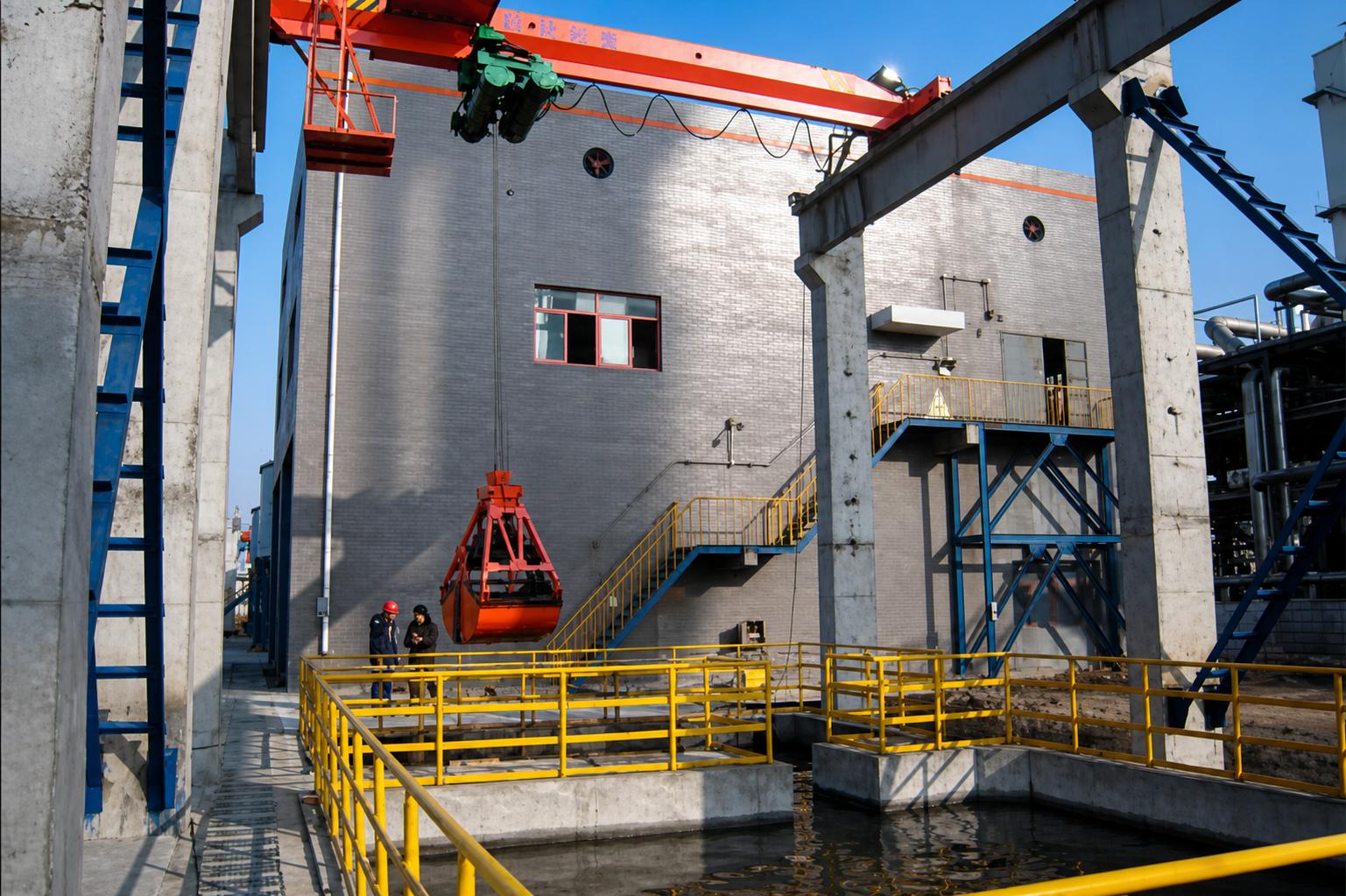
Grab crane is a special lifting equipment equipped with a special grab device. It is different from ordinary hook crane. It can independently complete bulk material grabbing operations without manual assistance. It is widely adapted to various loose and non-fixed bulk material handling scenarios. It has the core advantages of high degree of automation, flexible operation and strong adaptability.
Core infrastructure
The complete set of equipment consists of five core systems, and each module operates in concert to ensure efficient and stable operation.:
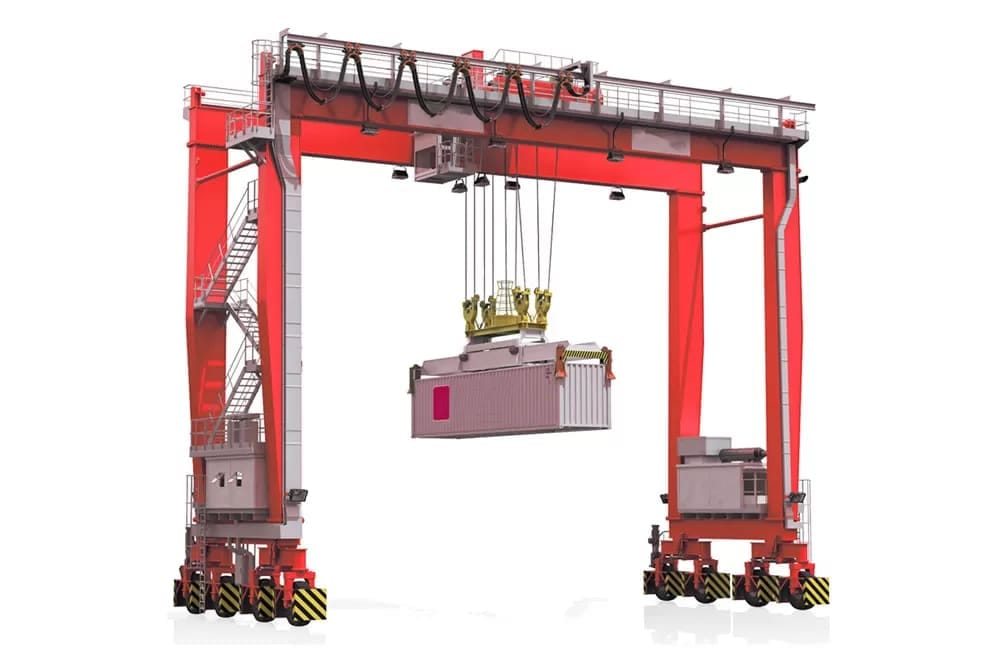
- The main structure of the bridge/gantry: it is divided into two mainstream models, bridge type and gate type, including single-beam and double-beam structures.The double-beam structure has stronger stability and higher load-bearing upper limit, which is suitable for heavy-duty and high-frequency operations; the single-beam model is cost-effective and suitable for light and medium-load and intermittent operation scenarios.The equipment can be landed in indoor factories, outdoor depots, and port yards, and does not occupy additional ground work space.
- Lifting mechanism: As the core of the power, the grab is suspended through four wire ropes, which is responsible for the lifting and closing power output of the grab.After the grab is closed to grab the material, the lifting mechanism is evenly forced to complete the material lifting operation smoothly, which is a key module to ensure the safety of the operation.
- Trolley operating mechanism: equipped with a lifting mechanism and a grab, it moves smoothly laterally along the bridge frame, cooperates with the main cart to walk, realizes the three-dimensional space transfer of materials, and completes the whole operation from the reclaiming point to the unloading point, and adapts to the needs of irregular material yards and multi-regional material handling.
- Grab device: The core operating component of the equipment is composed of double-lobed and multi-lobed jaw plates, which complete the material excavation, grabbing and unloading through the opening and closing action.According to the characteristics of the material, the grab of different structures can be replaced to adapt to various bulk material working conditions.
- Electrical control system: integrated operation, speed regulation, protection, and monitoring functions, responsible for precise control of grab opening and closing, equipment walking, and lifting speed, and equipped with overload protection, fault early warning and other functions to ensure the automated and safe operation of the equipment.
Bulk material handling operation process
The core operating logic of the grab crane is "opening and closing cycle operation", the whole process is automated without manual assistance, and the specific process is divided into four steps.:
- Alignment and decentralization: The equipment accurately hoists the no-load grab directly above the material pile, and the hook is smoothly dropped through the control system, so that the grab fits the surface of the material completely, avoiding problems such as floating grabbing and partial reclaiming, and laying the foundation for a sufficient amount of material.
- Closed reclaiming: The grab relies on a stable closing force to cut into the inside of the material pile, and uses a scientific jaw structure to dig deep into the material, and adapts the bite according to the compactness of different materials such as biomass, sand, gravel, clinker, etc. To ensure that the material is full and free of empty materials, and the throughput of a single operation is improved from the source.
- Smooth transfer: After the reclaiming is completed, the lifting mechanism lifts the fully loaded grab at a uniform speed, cooperates with the cart and trolley to walk smoothly together, and relies on the anti-swing and frequency conversion speed control system to suppress the shaking of the equipment, avoid material spilling and load fluctuations, and safely and efficiently transfer to the preset discharge point.
- Gravity unloading: After arriving at the designated location, the grab accurately opens the jaw plate, relying on the gravity of the material itself to quickly complete the automatic unloading, without manual intervention throughout the process, the operation cycle is consistent and smooth, and it can be adapted to high-frequency and continuous industrial bulk material handling conditions.
Among them, the shape structure of the grab and the size of the closing force directly determine the full material rate and whether the material is leaking, which are the key factors affecting the efficiency of the operation.Reasonable bucket geometry and sufficient closing torque can ensure that the material is fully grasped and transported without leakage.
Grab crane vs other bulk material handling equipment
There are many types of bulk material handling equipment on the market. Compared with traditional equipment, grab cranes have significant advantages in flexibility, adaptation scenarios, and material compatibility.:
- Comparison of conveyors: The conveyor is only suitable for fixed route and continuous material transportation, and cannot flexibly switch the reclaiming and unloading points, and the site adaptability is poor.The grab crane can cover the entire site without retrofitting the infrastructure, and can be flexibly adapted to multi-area and irregular material pile handling.
- Compare bucket hoists: bucket hoists only support vertical point-to-point material transportation, and the operation dimension is single.The grab crane can realize all-round three-dimensional operations in horizontal, vertical and lateral directions, and is suitable for complex yard and multi-condition cross-operation scenarios.
- Comparison with electromagnetic cranes: Electromagnetic cranes can only absorb iron materials, and material compatibility is extremely limited.The grab crane can be adapted to all dry bulk materials, not affected by the magnetism of the material, and perfectly covers mainstream bulk materials such as biomass, sand and gravel, and clinker.
Overall, in multi-material, multi-point, non-fixed route, and high-frequency bulk material handling scenarios, the flexibility and practicality of grab cranes are irreplaceable.
Material Characteristics: The Starting Point for Grab Crane Selection
The physical properties of the material such as density, particle size, wear resistance, temperature, moisture content, etc. directly determine the grab structure, equipment load, protection configuration and the working condition level of the whole machine.The characteristics of the three materials, biomass, sand and gravel, and cement clinker, are significantly different, and the selection needs to be tailored.
Biomass materials
Biomass is a lightweight, irregular bulk material. The core operating difficulties are fluffy, easy to wrap, and unstable material volume. The specific characteristics are as follows:
- Low bulk density: biomass materials have light texture, high fluffiness, and small load capacity per unit volume.If combined with conventional small-volume grabbers, the amount of material grabbed in a single time is limited, which will directly reduce the overall handling throughput and cause low operating efficiency.
- Irregular particle size and morphology: The types of materials are complicated, covering various forms such as fine sawdust, broken wood chips, large pieces of wood, and strips of straw. The particle size span is large, the material uniformity is poor, and the adaptability of the grab is more demanding.
- The moisture content fluctuates greatly: the moisture content of biomass materials that are freshly harvested and stacked outdoors is high, and the materials are easy to stick and clump; the air-dried materials have loose texture and strong fluidity, which can be easily scattered, greatly increasing the difficulty of grasping and controlling.
- Easy to entangle, easy to bypass and block materials: Fibrous biomass such as stalks, bark, vines, etc. can easily intertwine and bite each other, forming a bypass blockage inside the jaw plate of the grab, resulting in lax closure of the grab, inaccurate reclaiming, and greatly reducing the material filling rate, resulting in frequent false grasping and inefficient operations.
The core requirements of selection: large-volume grab, anti-winding jaw structure, and precise control system adapted to lightweight materials.
Sand and gravel material
Sand and gravel are high-density, high-abrasive fine-particle bulk materials. The core difficulties of the operation are fast wear, easy leakage, and large dust volume. The specific characteristics are as follows:
- High bulk density: The compactness of sand and gravel materials is large and the load per unit volume is heavy, which is significantly different from the load of biomass materials.If the conventional volumetric grab is used, it can easily exceed the rated load of the crane, causing safety hazards such as equipment overload and fuselage strain.
- Extremely wear-resistant and corrosive: The sand and gravel particles are hard in texture and have sharp edges and corners. During long-term grasping, friction, and impact operations, they will continue to wear and tear the core vulnerable components such as grab jaws, edges, pins, and bushings, greatly shortening the service life of the equipment and increasing the cost of frequent maintenance and replacement.
- Outstanding dust pollution: fine sand operations can easily produce a large amount of suspended dust, dust permeability is strong, and it can easily invade precision electrical structures such as motors, brakes, and electric control cabinets, causing component caton, short circuit, failure and shutdown, which seriously affects the operating stability of the equipment.
- Strong material fluidity: sand and gravel are fine-grained loose materials with excellent flow performance. If the closure and sealing of the grab is insufficient, it can easily leak and spill from the gap in the jaw plate, which not only causes waste and loss of materials, but also pollutes the work site and increases the cost of on-site cleaning.
Core requirements for selection: wear-resistant accessories, sealed grab, dust-proof electrical protection system, and precise load control.
Cement clinker
Cement clinker is an intermediate material in cement production. It belongs to heavy-duty, high-wear, and high-temperature bulk materials. It is the category with the most demanding operating conditions among the three types of materials. The specific characteristics are as follows:
- High-density, strong wear characteristics: Cement clinker agglomeration has a hard texture and extremely high compactness. During continuous grasping, friction, and impact, it will cause high-intensity wear and scour on the grab jaw, edge, and transmission components. Long-term operation can easily lead to aging and loss of components and equipment performance degradation.
- High-temperature operating conditions: The residual temperature of the clinker just after the kiln firing and cooling process is high, and thermal radiation and heat conduction are continuously released. Close-range operation can easily burn equipment cables, insulated motors, and steel structural parts, which can easily cause electrical failures, structural deformation and other problems.
- Severe impact load: Clinker is mostly hard large pieces of uneven size and irregular shape. It will produce high-intensity instantaneous impact load on the grab at the moment of grasping. Long-term repeated operations can easily cause deformation of the grab parts, structural fatigue, and damage to the welds, greatly shortening the service life of the equipment.
Core requirements for selection: high-strength, heavy-duty grab, high-temperature protection, full wear-resistant configuration, and heavy-duty fuselage.
Choosing the Right Grab Bucket for Biomass, Sand, and Clinker
Mechanical grab vs hydraulic grab
The grab is divided into two types: mechanical rope type and hydraulic type, with obvious differences in operating principle, adaptation scenarios, and operation and maintenance costs.:
Mechanical grab: relying on crane wire rope and pulley block to control the opening and closing, the structure is simple, the failure rate is low, the operation and maintenance are convenient, the cost is high, there is no complex hydraulic system, and it is durable.It is suitable for low-frequency and intermediate-frequency operation scenarios such as sand and gravel, conventional biomass, etc., and is an economical choice for general bulk materials.
Hydraulic grab: It comes with a hydraulic drive system, which has a large opening force, stable movement, and strong controllability. The closing force can be accurately adjusted, and the fullness of the grab is higher.It is suitable for complex and high-frequency operation scenarios such as cement clinker and fluffy biomass, and can cope with irregular materials and heavy-duty impact operations.
Volume and load matching
Grab payload calculation formula: effective material load = crane rated safety load-grab weight, combined with the bulk density of the material, the adapted grab volume can be calculated.
With low biomass density, large-volume lightweight grabbers need to be selected to increase the amount of single grab and avoid low operating efficiency; high density of sand, gravel and clinker, large-volume grabbers cannot be blindly selected, and the rated load needs to be strictly matched to prevent overload damage to the fuselage.The selection should be based on the actual material density, not the general reference value, to avoid long-term under-load inefficiency or hidden dangers of overload.
Customized shape and jaw plate structure
Different materials need to match the exclusive jaw plate structure to improve work efficiency from the root cause:
- Special for biomass: The multi-petal/orange petal large opening structure is adopted, the bucket body has a large volume and the gap between the jaws is reasonable, which can effectively avoid the entanglement and blocking of straw and wood chips, and ensure that the material is fully filled and there is no residue.
- Special for sand and gravel: the double-lobed flat-mouth sealing structure is adopted, the jaw plate is tightly closed and the edge has a high degree of fit, which effectively reduces fine sand leakage, dust, and material loss.
- Special for clinker: it adopts a double-flap structure with heavy load, reinforced jaw plate and strengthened edge, which can resist the impact and friction of large pieces of clinker, and has strong structural stability.
Wear-resistant configuration selection
Wear is the most important source of loss for grab equipment. A full set of wear-resistant accessories must be standard for sand, gravel and clinker working conditions: the jaw plate is made of high-strength wear-resistant steel, the edge is made of replaceable wear-resistant alloy parts, the pin shaft and bushing are made of high-alloy quenching technology, and all wearing parts are designed as removable and replaceable structures, which greatly reduces operation and maintenance costs and reduces downtime.
Crane Capacity and Duty Class Selection
Calculation points of rated safety load (SWL)
The grapple cannot only be selected on-site, and the rated safety load of the grapple crane that matches the reasonable grapple crane cannot be determined only by the nominal parameters. It is necessary to comprehensively calculate the weight of the grapple, the weight of the fully loaded material, and the dynamic impact load, and reserve the standard safety margin.
The selection of equipment must strictly follow FEM and ISO international industry standards, scientifically reserve safety margins, effectively avoid the deformation of the fuselage structure, fatigue damage to components and various safety hazards caused by heavy-duty operations, and ensure the long-term stable operation of the equipment.
Optimization of lifting speed and operating cycle
The lifting speed directly determines the job throughput, but it is not that the faster the better.High-speed operation will increase dynamic impact, reduce the positioning accuracy of the grab, and intensify component wear.It is necessary to combine the material type and operating process to balance the lifting speed, walking speed, and unloading accuracy, optimize the single operating cycle, and achieve efficient, stable, and low-loss operations.
Crane condition level matching
According to international general industry standards, grab cranes can be divided into four operating condition levels: light load, medium load, heavy load, and continuous heavy load according to the average number of daily operating cycles and actual load rate. Different levels correspond to completely different operating adaptation scenarios.
Among them, the light-load and medium-load models are only suitable for intermittent and low-frequency auxiliary operation scenarios, and cannot be adapted to long-term continuous operation conditions.
However, biomass power plants, cement clinker production lines, and large sand and gravel depots mostly implement 2-3 shifts of continuous operation around the clock. The working conditions are high in load and the frequency of cycles is intensive. Heavy-duty or continuous heavy-duty cranes must be selected, which can effectively avoid the fatigue of the fuselage structure caused by high-frequency operations, premature aging of core components, frequent equipment failures and other problems, and ensure the long-term stable operation of the equipment.
Environmental Conditions That Affect Grab Crane Design
High dust environment
During the loading, unloading and transportation of sand, gravel and cement clinker, a large amount of fine dust will be generated. The dust is highly permeable and can easily invade the precision core components such as motors, braking devices, and electronic control systems, causing caton, short circuit, accelerated aging and other failures, seriously affecting the continuous operation stability of the equipment.
Therefore, grab cranes under dust conditions must be equipped with dust-proof and sealed electrical cabinets as standard, and the basic protection level shall not be lower than IP54. Clinker workshops and sand and gravel yards with high concentrations of dust are recommended to be upgraded to IP65 and above fully sealed protection standards. Through the closed design of the electrical system of the whole machine, dust intrusion is effectively blocked and the equipment failure rate is greatly reduced.
High temperature environment
In high-temperature clinker gripping conditions, waste heat will continue to produce thermal radiation and heat conduction, and long-term close-range operation can easily accelerate the aging of motors, cables, and steel structures.Therefore, the equipment needs to be equipped with a dedicated thermal insulation protection structure, equipped with an F/H-class high-temperature resistant motor, heat-resistant steel wire rope and heat-insulating cable tray, which effectively blocks the invasion of high-temperature heat sources, protects the core components of electrical control and power in all directions, and guarantees the continuous and stable operation of the equipment under high temperature conditions.
Outdoor corrosive environment
Grab cranes deployed in outdoor depots and ports are exposed to wind, rain, humidity and salt spray corrosion for a long time, and are prone to structural corrosion, aging of accessories, and electrical moisture failure.
To this end, the steel structure of the whole machine needs to be protected by hot-dip galvanized technology and epoxy anticorrosive coating. The key fasteners are equipped with stainless steel anticorrosive configuration. At the same time, the cables and electrical systems are fully sealed, waterproof and moisture-proof. The design strengthens the weather resistance and corrosion resistance of the equipment in all directions, and significantly extends the service life of outdoor equipment.
Control and Automation Features for Modern Grab Cranes
Frequency conversion speed regulation (VFD) control system
Equipped with a frequency conversion drive system, the equipment can start and stop smoothly, eliminate the mechanical impact of traditional start and stop, reduce fuselage fatigue and component loss, while improving positioning accuracy, saving energy consumption, and adapting to precise loading and unloading operations.
Anti-swing control system
The intelligent anti-swing algorithm can suppress the shaking of the fully loaded grab operation, greatly improve the positioning accuracy of the discharge, reduce the loss of material spilling, shorten the operating cycle, and improve the overall operating efficiency and safety.
Remote automation operating system
It supports three modes of cab operation, remote control, and fully automatic operation. It can be adapted to low-visibility, high-dust, high-temperature and high-risk working conditions without manual on-site duty. It can be connected to the central control system of the factory to realize the control of the whole process of automatic feeding, stacking, and unloading.
Intelligent sensing and condition monitoring
It is equipped with sensors such as load monitoring, position detection, grab opening and closing feedback, and equipment vibration monitoring to collect equipment operation data in real time to achieve overload early warning, fault prediction, and predictive maintenance to reduce unplanned downtime.
Common Grab Crane Selection Mistakes to Avoid
- Omissions in the calculation of load selection: the specifications of the grab are matched purely based on the rated lifting weight of the crane, and the weight of the grab itself is not deducted, resulting in insufficient actual effective loading capacity, low operating efficiency, or long-term hidden overload, which accelerates the loss of the fuselage structure.
- Material density is one size fits all: ignoring the density differences of biomass, sand, gravel, and clinker, the same type of grab is used for general operation. The low-density biomass is insufficient to grab, the production capacity is inefficient, and the high-density clinker can easily be overloaded, laying equipment safety risks.
- Underestimate the wear strength of materials: Underestimate the strong wear and scouring characteristics of sand, gravel and clinker, and do not configure special wear-resistant grapple and wear-resistant accessories, resulting in frequent loss of jaw plates, edges, and pins, and equipment failure rates and late operation and maintenance costs have risen significantly.
- The selection of working condition level is low: For high-frequency continuous operation scenarios, the model of light-load working condition level is selected by mistake. Long-term high-load operation can easily cause fatigue of the fuselage structure and premature aging of components, and equipment failures and safety accidents can be caused in severe cases.
- Ignoring the protection of environmental working conditions: the corresponding protection configuration is not matched according to special working conditions such as dust, high temperature, outdoor corrosion, etc., and the electrical sealing, heat insulation, and anti-corrosion levels are insufficient, resulting in the equipment being susceptible to moisture, dust accumulation, and aging, and the operating stability is greatly reduced.
- One-sided emphasis on the purchase price of equipment: the selection only compares the initial purchase cost of equipment, ignoring the comprehensive operating costs such as long-term operation and maintenance, energy consumption, and replacement of accessories.Low-cost and low-profile equipment tends to wear out quickly and shut down a lot, and the long-term comprehensive cost is much higher than that of high-profile and high-quality equipment.
- Ignoring accessories and after-sales system: ignoring the versatility of wearing parts, the convenience of replacement and the manufacturer's after-sales capabilities, the late parts procurement cycle is long, the maintenance response is slow, and the equipment failure and downtime are greatly increased, which seriously affects the continuous operation efficiency of the production line.
Key Specifications to Include in a Grab Crane RFQ
- In-depth practical experience in the industry: Suppliers with landing cases in subdivided fields such as biomass power generation, cement clinker, sand and gravel yards are preferred. They are familiar with the difficulties of various bulk material handling conditions and equipment pain points, and can accurately match the actual operation needs of the site, rather than applying a general solution.
- Professional customized R&D capabilities: according to the density, wear resistance, temperature characteristics and site environment of different materials, the grab structure, wear-resistant protection configuration, electrical protection level and intelligent control system can be customized to adapt to non-standard complex working conditions and solve the problem of poor adaptability of general equipment.
- Independent core technical strength: It has an independent equipment research and development, structural design and process optimization team, independently masters the core technologies of grab wear-resistant technology, fuselage structure optimization, and intelligent control, and has the ability to self-research and produce the whole machine, which is different from pure assembly OEM manufacturers, and the stability and adaptability of the equipment are more guaranteed.
- Perfect production quality control system: it has a standardized production process and a strict quality inspection system, from raw material selection, structural welding, component processing to machine load testing, factory trial operation, the whole process is controlled layer by layer, effectively avoiding process defects and ensuring stable and reliable quality of equipment leaving the factory.
- One-stop full-process service: it can provide one-stop services for site survey, program design, equipment production, transportation and installation, commissioning and acceptance, and operator training in the whole chain, and follow-up throughout the process, eliminating the cumbersome multi-party docking, and ensuring the efficient landing and commissioning of the project.
- Reliable after-sales operation and maintenance guarantee: equipped with sufficient inventory of original vulnerable parts to support rapid parts replenishment; has a professional after-sales maintenance team, can quickly respond to fault repair, regular inspections, equipment upgrades and other needs, provide normalized operation and maintenance guidance, minimize equipment downtime, and ensure the continuous and efficient operation of the production line.
Conclusion
The material characteristics of biomass, sand, gravel, and cement clinker are very different from the operating conditions. The selection of grab cranes cannot only refer to the rated lifting weight. It is necessary to integrate material attributes, grab model, load parameters, working level, environmental protection and intelligent configuration to match the working conditions as needed.
Exclusive customized solutions can effectively reduce equipment wear, improve operating efficiency, reduce hidden dangers in operation and maintenance, avoid problems such as poor adaptability of general equipment, high failure rate, and insufficient production capacity, and significantly compress long-term operating costs.
Enterprises need to abandon the general selection thinking and customize exclusive handling solutions as needed.Henan Mine Crane can provide customized grab cranes and supporting handling solutions for various bulk material working conditions. If you have project planning needs, you can consult at any time to obtain professional selection plans and accurate quotations.