
RTG vs RMG for Container Yard Projects: Which Is Better for Your Terminal?
Many project developers of container terminals, inland dry ports, and intermodal yards face the same dilemma: Should they choose RTG (Rubber-Tired Gantry) cranes or RMG (Rail-Mounted Gantry) cranes? Both types of equipment can handle container stacking and yard handling, but choosing the wrong one can lead to a series of problems, including wasted infrastructure investment, low yard utilization, subpar throughput capacity, high long-term operational and maintenance costs, and even an inability to accommodate future automation upgrades.
Most procurement mistakes stem from focusing solely on equipment quotes or following trends without considering the specific layout of the yard, the volume of operations, and long-term operational planning. There is no one-size-fits-all answer to the RTG vs RMG for container yard projects selection. The only valid criterion is aligning with the actual operating conditions and long-term development needs of your specific project.
Based on years of experience with container yard projects both domestically and internationally, we provide a comprehensive comparison of the real differences between RTG and RMG to precisely match the right crane solution for your yard.
Core Application Scenarios for RTG and RMG
Seaport Container Terminals
Seaport container terminals, characterized by high operational frequency and orderly container stacking, represent the core application scenario for container yard crane comparison. Terminals require equipment to consistently and reliably perform container stacking, inter-block transfer, and block organization tasks, placing stringent demands on the equipment’s continuous operational capability.
Large, standardized seaport terminals flexibly combine RTG and RMG equipment based on overall yard planning to meet high-density storage and high-frequency handling demands, ensuring stable terminal throughput.
Inland Container Yards
Inland container yards primarily handle container storage, loading/unloading, and inter-zone transfers. Site planning is flexible, without the strict standardized block restrictions found in seaports. In these scenarios, equipment mobility is prioritized, and fixed tracks are not required.
RTG cranes for container yards, with their outstanding mobility, have become the mainstream choice for inland yards. They can adapt to dynamic adjustments in operational areas and accommodate diverse operational needs.
Rail-Intermodal Logistics Terminals
Container transfer operations at rail-intermodal logistics terminals feature fixed routes and well-organized work areas, placing higher demands on equipment stability and positioning accuracy. Equipment must precisely align with fixed loading and unloading points.
The RMG crane for container terminal, which operates on fixed tracks, perfectly aligns with the standardized operational processes of rail-intermodal terminals, reliably handling container transfers between trains and yards, as well as between yards and trucks.
Inland Dry Ports and Multimodal Hubs
Inland dry ports and multimodal hubs feature stable cargo volumes and are typically organized into standardized, uniformly planned zones. They focus on large-scale warehousing and transshipment operations, placing high demands on site utilization and operational stability.
Most newly constructed smart dry ports prioritize the use of RMG equipment to establish standardized, efficient container storage and transshipment systems based on standardized operating models.
Large-Scale Industrial Logistics Yards
Large logistics yards located near ports or industrial zones primarily handle the on-site handling and stacking of foreign trade container cargo. Their operational models are flexible, and site layouts are dynamically adjusted based on cargo volume.
Such yards are generally reluctant to invest in high-cost fixed infrastructure. RTG equipment, which offers strong adaptability and low retrofitting difficulty, can effectively control costs associated with site modifications and equipment upgrades.
Common Core Requirements for Container Yard Projects
High Container Storage Utilization
Yard land resources are limited. Whether for new projects or retrofitting existing yards, optimal equipment selection is essential to increase container stacking levels and block utilization. Equipment span and stacking height parameters directly determine the yard’s storage capacity and land utilization efficiency.
Appropriate equipment configurations can maximize container storage capacity within limited space and streamline on-site cargo flow.
Stable, Routine Operational Performance
Container yards operate continuously around the clock, with extremely high frequencies of equipment start-up, transfer, and stacking. Equipment failures directly cause container backlogs and logistics bottlenecks, disrupting the overall operational rhythm.
Purchasers generally prioritize structural durability and component reliability to ensure low-failure, continuous year-round operation at the yard.
High Compatibility Between Equipment and Yard Layout
The lane layout, spacing between container blocks, and rail connection points vary from yard to yard, making one-size-fits-all solutions impractical. The equipment’s operating range, span, and travel paths must align with the actual site layout.
Mismatched parameters can lead to operational blind spots and traffic interference, significantly reducing the yard’s overall operational efficiency.
Safe and Smooth Container Handling
Containers are heavy, uniform cargo. Swaying or shifting during lifting can easily cause collisions or deformation, which not only affects positioning accuracy but also poses safety hazards.
The equipment’s anti-sway capabilities, precise control, and operational cushioning performance are key to ensuring safety and stability throughout the entire process of container lifting, transfer, and stacking.
Controllable Long-Term Operating Costs
Most buyers focus solely on the initial purchase price of equipment, overlooking hidden costs such as long-term maintenance, energy consumption, spare part replacements, and infrastructure upkeep. Since yard cranes have a service life of over a decade, long-term operating expenses far exceed the one-time purchase cost.
Details such as tire wear, track maintenance, and energy consumption differences directly drive the gap in full-cycle operating costs between RTG and RMG.
Compatibility with Future Automation Upgrades
Many traditional yards currently rely primarily on manual operation, but long-term plans call for a gradual transition to semi-automated and fully automated modes. When selecting equipment, it is essential to consider scalability to avoid premature obsolescence due to the inability to adapt to intelligent upgrades in the short term.
Models designed for automation integration can be directly upgraded later, significantly reducing the cost of intelligent upgrades for the yard.
Detailed Comparison of RTG and RMG Models and Their Suitable Applications
What Is an RTG (Rubber-Tired Gantry Crane)?
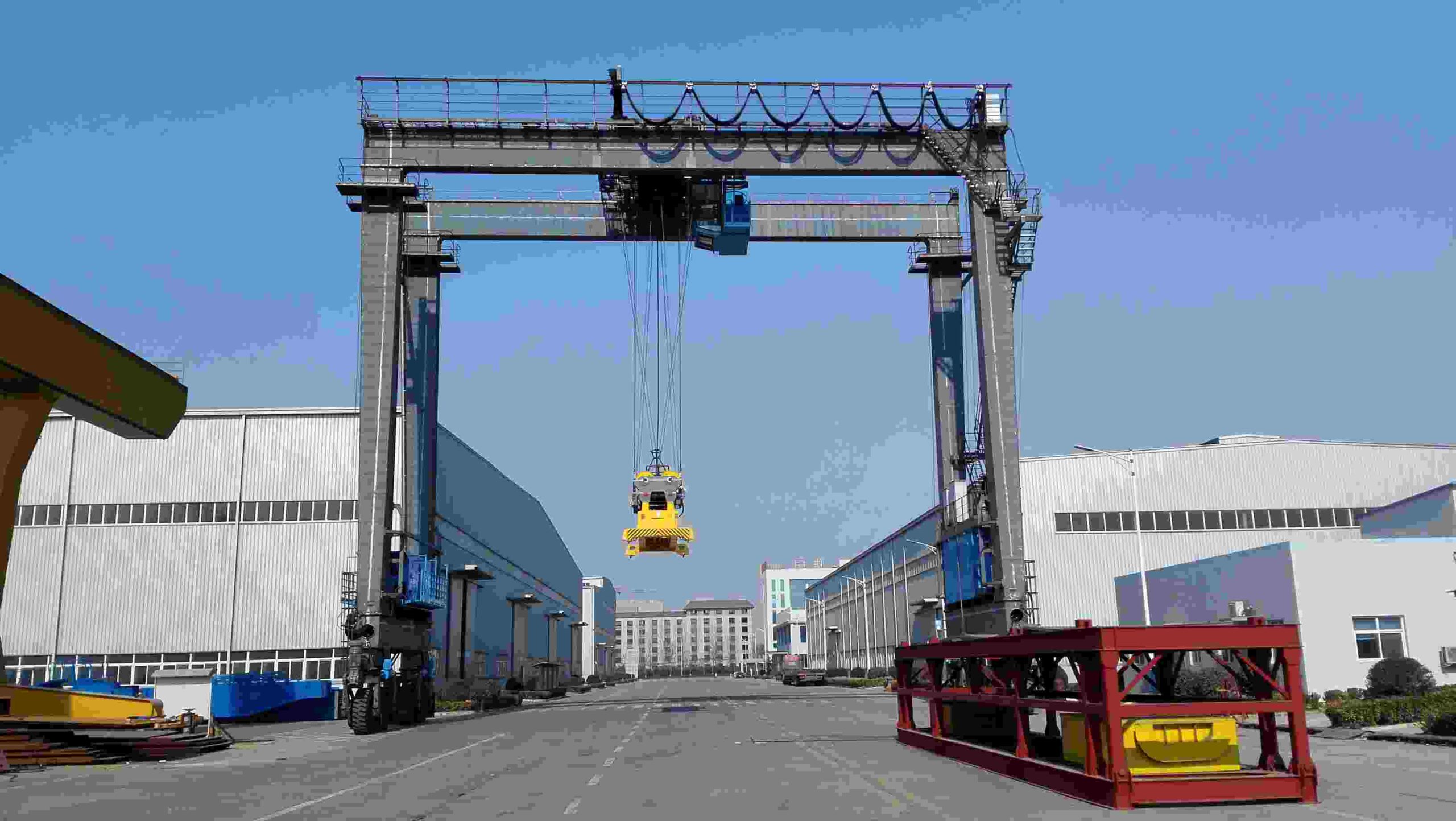
RTG (Rubber-Tired Gantry Cranes) rely on rubber tires for mobility and do not require fixed tracks, making them the model that stands out for flexibility in the rubber-tired gantry crane vs. rail-mounted gantry crane comparison. The equipment can freely turn and operate across zones on paved surfaces, unrestricted by fixed travel paths.
RTG require no large-scale civil engineering work, making site modifications straightforward. Operational zones can be adjusted at any time to meet yard requirements, making them well-suited for dynamic operational models.
What is an RMG (Rail-Mounted Gantry Crane)?
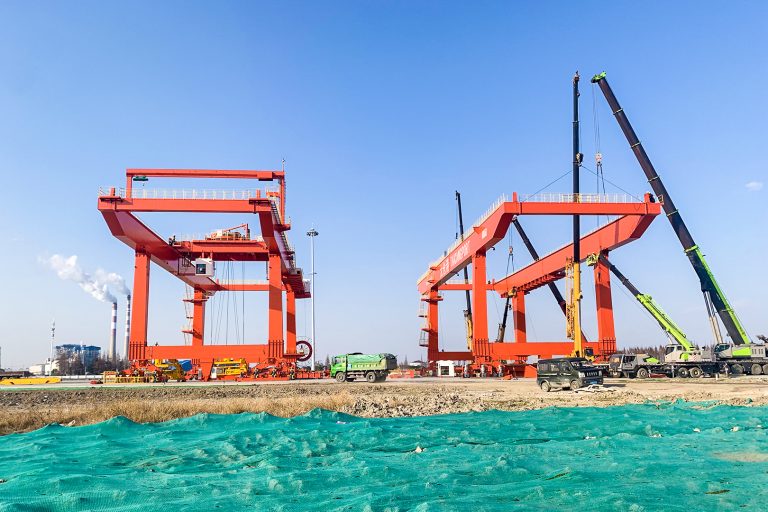
RMG rail-mounted gantry cranes operate on pre-embedded ground tracks, offering fixed paths, precise positioning, and stable operation. As core equipment for standardized container yards, they feature uniform and consistent operational zones with virtually no tracking deviation issues.
This equipment requires upfront infrastructure work such as track laying and foundation reinforcement, resulting in higher initial investment. However, it offers standardized and stable operation, making it suitable for large-scale, high-throughput fixed yard projects.
Project Scenarios Where RTG Is the Preferred Choice
Yards with undefined layouts or those requiring phased expansion are highly suited for RTG equipment. In later project phases, container zones can be flexibly adjusted and operational areas expanded, leveraging the RTG maneuverability to adapt to dynamic site modifications.
For older yards or temporary operations where track construction is not feasible, selecting RTG eliminates high infrastructure costs and enables rapid deployment and production.
Multi-purpose logistics yards with fluctuating operations and frequent adjustments to working areas also commonly choose RTG to ensure operational flexibility.
Project Scenarios Where RMG Is the Preferred Choice
For newly constructed, standardized container terminals with comprehensive planning and fixed layouts, RMG equipment is the preferred choice. The fixed rail operation mode eliminates positioning errors and is well-suited for high-density, high-frequency, large-scale stacking operations.
Rail intermodal hubs and smart yards planned for intelligent upgrades are better suited for RMG models. With fixed equipment trajectories and stable data collection, they facilitate integration with automated control systems to achieve unmanned operation upgrades.
For large port areas seeking long-term stable operations and low O&M variability, the stability and durability advantages of RMG will continue to stand out over the long term.
Core Technical Parameters to Verify During Procurement
Rated Lifting Capacity
The equipment’s rated tonnage must match the maximum load of standard containers, loaded containers, and over-height containers, accounting for the lifting gear’s own weight and allowing for a sufficient safety margin. For yards with high volumes of loaded container throughput, load capacity standards should be appropriately increased to avoid long-term full-load operation of the equipment.
Equipment Span
The equipment span determines the number of container rows covered in a single pass and must align with the dimensions of the yard blocks and the layout of truck lanes. A reasonable span allows for the simultaneous coverage of multiple container rows and access lanes, reducing the number of round trips required.
Stacking Height
Stacking height directly affects yard storage density, and storage standards vary significantly across different terminals. The equipment’s lifting height must match the planned number of stacking levels to meet daily stacking and storage requirements.
Cantilever Length
Models equipped with a cantilever can cover side truck and rail loading/unloading areas, enabling the transfer of side-loaded containers without moving the main unit. The cantilever length must strictly match the lane width and the scope of transfer operations.
Gantry Travel Length
Gantry travel length determines the equipment’s operational coverage area. It must align with the total length of each individual operational zone within the yard to ensure no blind spots and achieve full-coverage stacking and transfer operations.
Operational Speed
Lifting, trolley, and gantry travel speeds collectively determine the duration of a single operational cycle. High-throughput terminals may opt for higher speeds, while standard logistics yards should select conventional speeds to balance equipment stability and operational efficiency.
Power and Drive Systems
RTG support various power supply modes, including diesel, electric, hybrid, and battery-powered, making them suitable for sites without fixed power sources. RMG typically use slip ring or busbar power supply, offering stable power and lower energy consumption, making them suitable for long-term continuous operation scenarios.
Actual model selection should be flexibly matched based on site power supply conditions, average daily operating hours, and energy consumption budgets.
Control and Automation Levels
Manual, remote, or semi-automatic control modes can be selected based on the project’s current status. For projects with long-term automation plans, interfaces for fully automated systems can be pre-installed to reduce future retrofitting costs.
Site Environment Adaptability
Coastal terminals require equipment with protection against wind, salt fog, and dust, while inland yards prioritize high-temperature resistance and protection against sand and dust. The equipment’s environmental protection rating directly determines its long-term service life outdoors.
Key Differences Between RTG and RMG (Key Considerations for Procurement)
Yard Layout Flexibility
RTG have no track restrictions and offer exceptional site flexibility, allowing for free adjustment of operational areas. They are suitable for various projects involving site modifications, block adjustments, and phased expansions.
RMG have fixed operating paths and a regular layout, making it impossible to arbitrarily adjust operational blocks. They are better suited for standardized yards that are planned in one go and remain unchanged over the long term.
Infrastructure Requirements
RTG have minimal site requirements; they can begin operations with only a paved surface, eliminating the need for costly track construction. This results in lower upfront infrastructure investment and faster deployment.
RMG require precise track laying, foundation reinforcement, and the installation of supporting power facilities. Consequently, upfront infrastructure costs are higher, and the construction cycle is relatively longer.
Automation Compatibility
RMG is the preferred model for automated yards. With fixed trajectories, precise positioning, and stable operational data, its control system is easy to integrate, making unmanned conversion less challenging and more likely to succeed.
RTG automation conversion is more difficult. Because the equipment’s travel paths are not fixed, it requires complex positioning and navigation systems, resulting in higher conversion costs and technical barriers.
Long-Term Operating Costs
RTG have relatively high long-term maintenance costs, including ongoing tire wear, steering system maintenance expenses, and consistent energy consumption for diesel and hybrid models, along with numerous minor maintenance tasks.
While RMG require higher initial infrastructure investment, they have no tire wear in the long term, low track maintenance frequency, and stable energy consumption, offering a cost advantage for large-scale, long-term operations.
Site Utilization and Block Design
RMG are suited for highly standardized block planning, enabling neat stacking with controllable spacing, high land utilization, and suitability for high-density container storage operations.
RTG can adapt to irregular sites and allow for flexible arrangement of operational blocks, but their level of standardization is insufficient, resulting in slightly lower stacking uniformity for high-density storage compared to RMGs.
Differences in Maintenance Focus
RTG daily maintenance focuses on mobility-related components such as tires, steering mechanisms, travel drives, and hydraulic systems, involving numerous wear-and-tear parts and high maintenance frequency.
RMG maintenance centers on track alignment, power supply systems, and fixed travel mechanisms, featuring simple procedures and low frequency, making long-term maintenance more hassle-free.
Optimal Project Types
RTG are suitable for flexible container yard projects involving phased development, limited space, temporary operations, and dynamic operational requirements.
RMG are better suited for high-end container terminals with fixed layouts, high throughput, rail integration, large-scale operations, and a need for automation upgrades.
How to Select a Reliable RTG/RMG Container Crane Supplier
Verify Manufacturing Capabilities at the Source
RTG and RMG are large-scale port machinery with manufacturing precision and safety standards far exceeding those of ordinary industrial cranes. Since distributors cannot guarantee equipment quality or customization, procurement should prioritize original manufacturers with in-house R&D, production, quality inspection, and export delivery capabilities.
Original manufacturers can precisely tailor equipment to withstand heavy-load, outdoor port environments and harsh operating conditions, ensuring operational stability from the outset.
Verify Implementation Experience with Similar Yard Projects
High-quality suppliers must be familiar with the operational logic of seaports, inland ports, and intermodal yards, possess extensive experience with intermodal yard crane solutions, and understand specialized requirements such as port infrastructure, corrosion and wind resistance, and automation integration.
Sufficient experience with similar projects allows for the early avoidance of common implementation issues such as site compatibility, operational interference, and parameter mismatches.
Evaluate Professional Engineering Customization Capabilities
A professional engineering team can accurately determine the appropriate crane model based on yard drawings, block layouts, throughput requirements, and automation plans, and optimize equipment parameters specifically for the application, rather than simply applying generic standard models.
Verify Complete Set of Technical Documentation
Reputable export manufacturers can provide a complete set of English technical documentation, including assembly drawings, wheel load data, electrical schematics, parts lists, and factory quality inspection reports, to meet the customs clearance, acceptance, and operation and maintenance registration requirements for overseas projects.
Verify Core Component Brands and Specifications
Core components such as motors, gearboxes, brakes, PLC control systems, and container spreaders directly determine equipment stability and service life. When purchasing, clearly specify component brands and protection standards to prevent substandard or downgraded configurations.
Verify Factory Quality Inspection and Testing Procedures
Prior to shipment, the equipment must undergo weld inspection, dimensional verification, no-load and full-load testing, and functional commissioning. Complete inspection records must be retained to ensure the equipment can be put into stable operation immediately upon arrival.
Define the Scope of Installation and Commissioning Services
The supply model must be confirmed in advance, distinguishing between options such as equipment-only supply, installation guidance, and turnkey commissioning. Port machinery requires high installation precision, and professional technical support can help prevent operational failures later on.
Confirm Long-Term After-Sales Support and Spare Parts Availability
Yard equipment operates continuously year-round, requiring manufacturers to provide long-term spare parts supply, software updates, fault diagnosis, and rapid after-sales response to minimize downtime losses at the yard.
Common Procurement Pitfalls in Container Stacker Crane Selection
Selecting equipment based solely on low price will significantly increase long-term operational and maintenance costs.
Blindly following trends or ignoring yard traffic flow and block layout will result in poor equipment compatibility, creating operational blind spots and traffic interference issues, thereby reducing overall operational efficiency.
Focusing only on current operational needs while ignoring long-term automation plans will render equipment incompatible with future smart upgrades, leading to additional costs for replacement.
Focusing solely on the initial purchase price while ignoring long-term expenses such as energy consumption, spare parts replacement, and infrastructure maintenance will cause the project’s total lifecycle costs to far exceed the initial budget.
Failing to verify site infrastructure, power supply, and ground load-bearing capacity in advance can result in equipment being unable to be installed and put into operation upon arrival, necessitating secondary site modifications.
The incorrect practice of selecting equipment models before planning yard blocks will directly reduce site utilization and cause混乱 in on-site operational workflows.
Selecting a manufacturer without experience in non-port yard projects may result in equipment that is ill-suited for port heavy-load and harsh outdoor conditions, compromising long-term operational stability.
Incomplete site, operating condition, and throughput data provided during the quotation process can lead to customized solutions that do not match on-site realities, triggering repeated modifications and project delays.
Frequently Asked Questions
What is the core difference between RTG and RMG?
The core differences lie in operating modes, infrastructure requirements, flexibility, and compatibility with automation. RTGs are tire-mounted, track-free, have lower infrastructure costs, and offer greater flexibility; RMGs are rail-mounted, follow fixed paths, provide precise positioning, and are better suited for automated operations, though they require higher upfront infrastructure investment.
Which is better for container terminals: RTG or RMG?
There is no absolute superiority; it depends entirely on project suitability. New, standardized, high-throughput large-scale terminals with automation plans should prioritize RMG; terminals built in phases, with flexible layouts, undergoing retrofits, or with infrastructure constraints are better suited for RTG.
Does RTG offer greater site flexibility than RMG?
RTG offers significantly greater flexibility than RMG. Unrestricted by fixed tracks, it allows for free adjustment of operational areas and adapts well to diverse scenarios such as site expansion, block adjustments, and temporary operations.
Is RMG more suitable for automated yards?
Yes, RMG is the preferred model for automated container yards. Its fixed travel paths and precise, stable operational data simplify integration with control systems, enabling seamless implementation of semi-automated, fully automated, and unmanned operations.
Which model has lower long-term operating costs?
For small-scale, short-term yard projects, RTG offers lower overall costs; for large-scale, long-term operations in standardized high-throughput yards, the RMG offers a more significant advantage in total lifecycle costs due to its low maintenance, low energy consumption, and high stability.
Which model is suitable for rail-intermodal terminals?
Rail-intermodal terminals have fixed operating points and orderly traffic flow, making the RMG rail-mounted gantry crane the preferred choice. It can precisely align with rail loading and unloading points, ensuring stable operation and standardized work procedures.
What project information should be prepared before requesting a quote?
Before requesting a quote, please prepare complete data including yard layout drawings, block dimensions, lane and rail locations, planned stacking heights, average daily throughput, power supply conditions, and long-term automation plans to ensure the solution is implemented accurately.
Summary
Which is better: RTG or RMG? There is no standard answer; both types of equipment have their own suitable scenarios. The core of selection does not lie in the superiority of the equipment, but in aligning with the project’s site conditions, operational model, throughput targets, and long-term plans.
For yards with flexible payment terms, infrastructure constraints, and dynamic operational models, RTG offer better value for money; for high-end yards that are standardized, large-scale, and pursue automation upgrades and long-term stable operations, RMG provide greater value.
Professional container terminal yard crane selection requires a comprehensive assessment that combines infrastructure conditions, operational frequency, maintenance budgets, and long-term planning. Relying on the manufacturer’s engineering experience helps avoid selection pitfalls and ensures the long-term stable operation of the equipment.
Henan Mine (Crane Industrial) has specialized in port yard crane equipment for many years, with extensive experience in implementing projects at domestic and international terminals, dry ports, and intermodal hubs. We can customize dedicated RTG and RMG solutions based on project conditions and provide a full set of English technical documentation along with cross-border after-sales support.
Unsure whether an RTG or RMG is the right fit? Provide us with your yard drawings, block layout, stacking height requirements, throughput, and automation plans, and our engineering team will precisely match you with the optimal yard crane solution.