
How to Choose an Intelligent Warehouse Crane for a Logistics Center?
Logistics centers are running out of two things at once: floor space and workers. As order volumes climb and warehouse footprints stay fixed, more operators are turning to an intelligent warehouse crane to solve both problems at the same time ; going vertical while cutting the manual labor needed to move goods.
This guide walks through what an intelligent warehouse crane actually is, the components that make it work, the types available, the ten factors that should drive your decision, the software and safety features that matter most, how to match equipment to your physical layout, the mistakes that most often derail a selection process, and the ROI logic that justifies the investment — so you can choose a system that fits both today's operation and tomorrow's growth.
What Is an Intelligent Warehouse Crane?
Definition and Working Principle
Henan Mine Crane manufactured intelligent warehouse crane is automated lifting and handling equipment that stores, retrieves, and transports goods within a warehouse with minimal human intervention. What separates it from a conventional crane is the layer of control, sensing, and software that lets it operate autonomously rather than under constant manual direction.
Most intelligent warehouse cranes function as the mechanical core of an automated storage and retrieval system (AS/RS). Rather than an operator directing every lift, the crane receives a task from a control system, calculates the fastest path, positions itself automatically, and confirms completion back to the software, all without manual input. The operator's role shifts from "driving" the equipment to monitoring exceptions and confirming that the system is running as expected.
Three capabilities define this behavior:
- Automatic positioning:the crane locates the correct rack position using sensors rather than operator judgment
- Automatic lifting and traveling:hoist and travel motions are computer-controlled, not manually driven
- Automatic inventory handling:every movement is logged, so the system always knows what is stored where, down to the individual bin or pallet position
This last point is worth emphasizing: in a manual warehouse, inventory accuracy depends on a human correctly scanning, recording, or remembering a location. In an intelligent warehouse crane system, the location is generated and confirmed by the machine itself, which removes an entire category of human error from the process.
Main Components
An intelligent warehouse crane is built from several interdependent subsystems, each of which contributes to overall reliability and performance:
- Crane bridge:the structural frame that spans the aisle or bay and carries the mast and hoist assembly
- Hoisting mechanism:the motor, drum, and rope or chain assembly that lifts loads vertically
- Intelligent control system:the onboard computer (typically a PLC or industrial controller) that executes tasks and coordinates motion across all axes simultaneously
- Servo motors and frequency converters:precision drives that control speed, acceleration, and positioning far more tightly than a standard induction motor
- Positioning sensors:laser or encoder-based systems that confirm exact location along the rail and mast
- Barcode/RFID readers:used to identify and verify individual loads before storage or retrieval
- Communication system:wireless or trailing-cable links to the central control network that transmit task assignments and status updates
- WMS interface:the software connection that turns warehouse-level orders into crane-level tasks, and reports back inventory movements in real time
Each of these subsystems can fail independently, which is why vendor support and spare parts availability matter as much as the initial specification.
Typical Applications
Intelligent warehouse cranes are used across a range of facility types, each with different priorities and constraints:
- E-commerce fulfillment centers:high SKU counts, fast turnover, and heavy peak-season volume swings
- Third-party logistics (3PL):flexible storage that must accommodate multiple clients with different product profiles
- Manufacturing warehouses:feeding components directly to production lines on a just-in-time basis
- Cold storage warehouses:automation reduces worker exposure to extreme temperatures and improves throughput in low-visibility conditions
- Automotive parts warehouses:high accuracy needed for dense parts catalogs with thousands of similar-looking SKUs
- Pharmaceutical distribution centers:traceability, controlled handling, and audit-ready inventory records are often regulatory requirements, not just efficiency goals
Why Are Intelligent Warehouse Cranes Becoming the Standard in Logistics Centers?
Higher Warehouse Storage Density
Because Henan Mine Crane manufactured intelligent cranes operate with millimeter-level positioning accuracy, they can run in narrow aisles that would be unsafe for a forklift or manually operated crane. Narrower aisles mean more racking fits into the same building footprint. Combined with the ability to fully maximize vertical warehouse space, often reaching heights well beyond what a forklift mast can safely achieve, this typically allows facilities to store significantly more inventory without expanding the building itself.
Faster Order Fulfillment
Automated material handling removes the delays inherent in manual operation: walking to equipment, manually navigating aisles, and manually confirming locations. Cranes travel direct, computer-calculated paths with minimal wasted motion, and because they don't need breaks, shift changes, or rest periods, many systems support continuous 24/7 operation, a meaningful advantage during peak season surges when order volume can spike several times over baseline. For operations running compressed fulfillment windows, same-day or next-day shipping commitments, for example — the ability to run unattended overnight shifts can be the difference between meeting a cutoff and missing it.
Improved Inventory Accuracy
Every movement an intelligent crane makes is logged automatically. Real-time inventory updates and automatic location confirmation remove the manual data entry errors that come with paper-based or scanner-dependent processes, which is one of the most consistently cited benefits in industry case studies. This matters most in operations with strict cycle-count requirements or regulatory traceability obligations.
Lower Operating Costs
Automation also cuts time required for repetitive handling tasks by reducing manpower requirements and using accurate, sensor-guided movements, meaning lower levels of product damage and improved equipment use than manual handling fleets, which often sit idling between tasks or need a multitude of operators on multiple shifts in order to function.
Enhanced Workplace Safety
Crane accidents, whether mobile or stationary are heavily skewed to human error miscalculated clearances, fatigue, blind spots when operating cranes manually. Intelligent systems are minimizing this risk by automatic detection of obstacles, and collision avoidance, as well as remote monitoring for abnormal conditions abnormal vibration or torque, increased motor temperature that prevent incidents before they happen, rather than after.
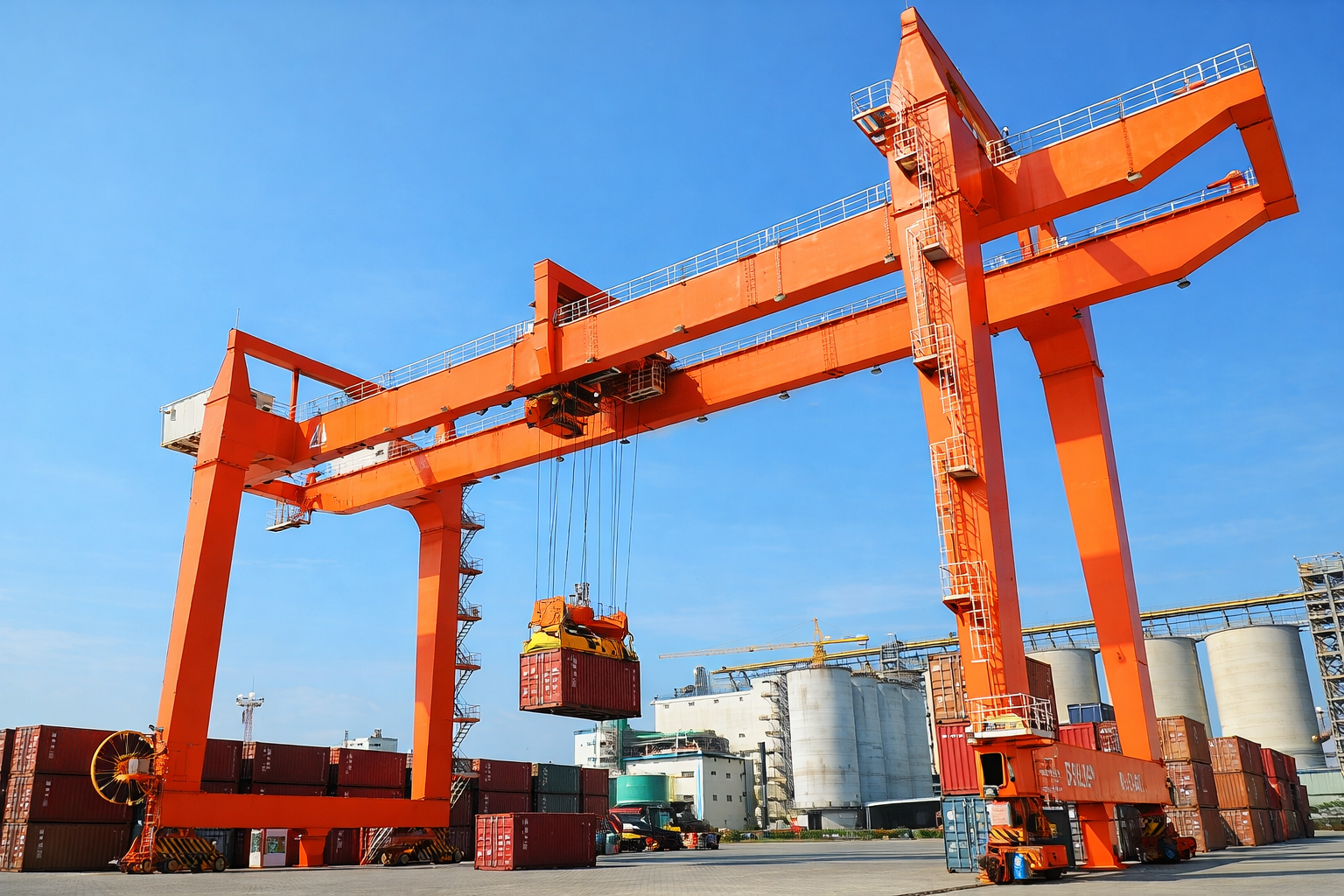
Types of Intelligent Warehouse Cranes
Choosing the right category is the first real decision point, since each type is engineered for a different load profile, aisle configuration, and warehouse layout.
| Crane Type | Best For | Typical Load | Typical Aisle Width |
| Stacker crane | High-rise AS/RS pallet warehouses | Pallets, up to several tons | 1.4–1.8 m |
| Mini load crane | Small parts, cartons, bins | Light loads, under ~500 kg | 0.8–1.2 m |
| Double-deep stacker crane | Higher-density layouts, deeper racks | Pallets | 1.4–1.8 m |
| Multi-shuttle system | High-throughput distribution centers | Mixed, high cycle rates | Varies (shuttle-based) |
| Customized solution | Oversized or non-standard cargo | Varies | Varies |
Stacker Crane
The workhorse of most high-bay warehouse operations, a stacker crane runs on fixed rails within a single aisle to place and retrieve pallet storage loads at height, often exceeding 20–30 meters in high-bay AS/RS installations. Cycle times for a well-specified stacker crane commonly fall in the range of one to two minutes per single-cycle pallet movement, though this varies with lift height and travel distance.
Mini Load Crane
Built for smaller, lighter items, cartons, plastic bins, and small parts, mini load cranes are common in parts distribution and e-commerce piece-picking operations where SKU density matters more than raw load weight. Because the loads are lighter, mini load systems can often achieve faster cycle times than pallet-handling equivalents.
Double-Deep Stacker Crane
By reaching two positions deep into a rack instead of one, this configuration increases storage density in warehouses with suitable layouts, though it adds complexity to retrieval sequencing, the crane may need to relocate the front pallet before accessing the one behind it, which increases average cycle time even as it improves overall space utilization.
Multi-Shuttle Crane Systems
For high-throughput logistics centers and large-scale e-commerce distribution, multi-shuttle systems combine crane movement with independent shuttle carriers that travel within the rack structure itself, decoupling vertical lifting from horizontal placement. This architecture can hit far higher aggregate cycle rates than a single stacker crane alone, at the cost of a more complex control system and a higher initial investment.
Customized Intelligent Warehouse Crane Solutions
Facilities with heavy-duty storage, unusual environmental conditions, or oversized cargo handling needs often require a purpose-engineered system rather than an off-the-shelf configuration. This is common in industries handling coils, molds, or oversized industrial components that don't fit standard pallet or bin dimensions.
In practice, most logistics centers end up combining more than one crane type within a single facility rather than standardizing on a single configuration. A distribution center might run mini load cranes for a fast-moving small-parts zone alongside standard stacker cranes for bulk pallet storage, with a multi-shuttle system reserved for the highest-velocity SKUs. Mapping which product categories belong in which zone, based on velocity, weight, and dimensions, is a useful exercise before finalizing equipment counts and types.
10 Key Factors to Consider When Choosing an Intelligent Warehouse Crane
Selecting the right system means matching ten interdependent variables to your operation, get these right, and the rest of the buying process becomes straightforward.
- Warehouse Dimensions: Building height, rack height, aisle width, and available installation space set the physical envelope every other decision must fit inside. A crane that is mechanically ideal on paper is useless if it cannot physically be installed within your existing structural clearances, so a site survey should happen before, not after, equipment is specified.
- Load Capacity:Assess maximum load weight, typical average load, and realistic future expansion requirements,undersizing capacity is one of the costliest mistakes to correct later, since it often requires structural rework rather than a simple component swap. It's also worth understanding standardized duty classifications at this stage: systems such as CMAA (Class A through F), FEM, and ISO 4301 rate cranes by how intensely they can be used based on load percentage and cycle frequency. Selecting a crane rated for occasional light service but operating it at near-continuous heavy-duty cycles is one of the fastest ways to shorten equipment life.
- Lifting Height:Confirm the maximum storage level the crane must reach and the total travel distance per cycle, since both affect cycle time,a crane that must travel further vertically on every cycle will inherently move fewer pallets per hour than one serving a shorter rack, all else being equal.
- Operating Speed:Hoisting speed, traveling speed, fork extension speed, and positioning accuracy together determine how many cycles the crane can complete per hour. These specifications should be evaluated together rather than individually, since a crane with a very fast travel speed but slow fork extension may not deliver the throughput gain its top-line speed rating suggests.
- Storage Throughput:Model expected pallets per hour, especially during peak operating periods, against realistic order processing requirementsrather than average-day volume alone. Many operators size equipment to average daily volume and then discover it cannot keep pace during seasonal peaks, throughput modeling should always be based on the busiest sustained period the operation expects to face, not the annual average.
- Automation Level:Decide whether the operation needs semi-automatic assistance,where an operator still confirms or triggers key actions, or fully automatic, lights-out warehouse capability, where the crane operates without any human presence in the aisle. The software and safety requirements differ substantially between the two, and retrofitting from semi-automatic to fully automatic later is typically far more expensive than specifying the correct level upfront.
- Software Integration:Confirm compatibility with your WMS, Warehouse Control System (WCS), ERP, and any existing IoT connectivity,a crane that can't talk to your systems creates a manual bottleneck regardless of its mechanical capability. This is frequently the single most underestimated line item in a crane procurement budget, since integration work often requires custom middleware development rather than an out-of-the-box connection.
- Positioning Accuracy:Compare laser positioning, encoder systems, and RFID technologyoptions, since accuracy requirements scale with how tightly you plan to pack your racks. A facility running standard single-deep pallet racking has more tolerance for positioning variance than one running narrow-aisle or double-deep configurations, where a few centimeters of error can mean a failed placement.
- Energy Efficiency:Search for regenerative braking, VFDs and otherwise low energy consumption designs that will really make a difference in operating cost over a number of years of operation. Regenerative braking especially will inject a meaningful proportion of energy expended during slowing back into your power system, especially when multiplied up for the hundreds of cycles a day a crane might undertake.
- Maintenance Requirements:Evaluate remote diagnostics, predictive maintenancecapability, spare parts availability, and the vendor's service support network before signing — this factor is consistently underweighted during purchasing decisions, yet it directly determines how much unplanned downtime the operation will experience over the equipment's service life. Henan Mine Crane manufactured crane with excellent specifications but a distant, unresponsive service network can cost more in lost throughput during a single extended outage than the entire annual maintenance budget for a better-supported alternative.
Intelligent Features That Matter Most
Beyond the core mechanics, the software layer is what actually delivers on the "intelligent" label:
- Automatic route optimization:calculates the fastest travel path for each task in real time, adjusting dynamically as other tasks are added to the queue
- AI-based task scheduling:sequences multiple pending tasks to minimize total cycle time, often batching nearby storage and retrieval operations to reduce empty travel
- Real-time equipment monitoring:gives operations teams live visibility into crane status, current task, and performance metrics through a dashboard rather than relying on periodic manual checks
- Predictive maintenance:analyzes vibration, temperature, and motor load data to flag component wear before it causes downtime, shifting maintenance from a fixed calendar schedule to an as-needed basis
- Automatic fault diagnosis:speeds up troubleshooting when an issue does occur by identifying the likely failure point rather than requiring a technician to manually isolate it
- Cloud-based data management:centralizes performance data across multiple cranes or sites, which is particularly valuable for operators managing several distribution centers under one operations team
- Digital twin technology:allows layout changes and throughput scenarios to be simulated before physical implementation, reducing the risk of costly design mistakes discovered only after installation
Safety Features Every Intelligent Warehouse Crane Should Have
Automation reduces certain risks, but it introduces its own safety-critical dependencies. A properly specified system should include:
- Anti-collision system to prevent contact with racking, other equipment, or personnel, typically using a combination of laser scanning and software-enforced exclusion zones
- Load monitoringto detect and respond to overload conditions in real time, halting operation before a mechanical failure can occur
- Emergency stop functionsaccessible both locally at the crane and remotely from a central control room
- Overspeed protectionon hoist and travel motions, which prevents runaway conditions in the event of a control system fault
- Rope and hoist monitoringto catch wear before failure, since wire rope and chain degradation is a leading cause of catastrophic crane incidents
- Obstacle detectionfor both fixed and moving objects in the crane's path, including personnel who may enter the aisle unexpectedly
- Redundant safety controlsso a single sensor or component failure doesn't create an unsafe condition, critical safety functions should never depend on a single point of failure
How to Match the Crane with Your Warehouse Layout
Even the right crane type will underperform if it isn't matched to the physical facility. Before finalizing a purchase, confirm:
- Rack configuration:single-deep, double-deep, or shuttle-compatible racking each require different crane capabilities and control logic
- Warehouse ceiling height:actual clearance versus theoretical lift height, accounting for sprinkler systems, lighting, and structural beams that may reduce usable height
- Floor flatness:rail-mounted systems have tight tolerance requirements, and an out-of-spec floor can require costly remediation before installation
- Material flow design:how goods physically move from receiving to storage to shipping, since the crane's aisle position and orientation should minimize unnecessary cross-warehouse travel
- Inbound and outbound frequency:peak-hour load versus average daily load, which determines whether a single crane per aisle is sufficient or whether multiple cranes or a shuttle system are needed
- Future warehouse expansion:whether the layout can accommodate additional aisles, a taller rack structure, or additional cranes later without a full system redesign
Common Mistakes to Avoid When Selecting an Intelligent Warehouse Crane
Procurement teams that skip due diligence on these points tend to regret it within the first operating year:
- Choosing based only on initial price:the cheapest quote rarely reflects total lifecycle cost, and a lower-spec system often requires earlier replacement or more frequent repair
- Ignoring software compatibility:a mechanically excellent crane is still a bottleneck if it can't integrate with your WMS, forcing manual workarounds that erase much of the automation benefit
- Underestimating future throughput growth:sizing for today's volume alone often forces an early retrofit that costs significantly more than specifying adequate headroom from the start
- Selecting insufficient load capacity:a common and expensive error, especially when product mix changes over time and average pallet weight increases beyond original assumptions
- Overlooking maintenance and service support:remote systems with no local service network create long downtime windows that can outweigh any upfront cost savings within the first significant breakdown
- Neglecting operator training:even highly automated systems need trained staff for oversight, exception handling, and safety response; treating the crane as fully "hands-off" from day one is a common cause of avoidable incidents
How Intelligent Warehouse Cranes Improve ROI
The financial case for automation tends to rest on a handful of measurable outcomes, and evaluating them together, rather than any single metric in isolation, gives the clearest picture of payback timing:
- Reduced labor costs:fewer operators needed for repetitive handling tasks, particularly valuable in labor markets where warehouse staffing has become increasingly difficult
- Increased warehouse capacity:higher storage density within the same building footprint, which can defer or eliminate the need for a facility expansion
- Faster order processing:shorter cycle times translate directly into fulfillment speed, which matters increasingly as customer expectations around delivery windows tighten
- Reduced inventory errors:automatic tracking reduces costly stock discrepancies that otherwise require manual cycle counts and write-offs
- Lower product damage:sensor-guided handling reduces mishandling incidents compared with manual forklift or crane operation
- Long-term operational savings:energy-efficient drives and predictive maintenance reduce both utility and repair costs over the equipment's service life
Documented deployments in steel and electronics warehousing have reported storage density gains and labor cost reductions in the double- and triple-digit percentage range, underscoring why automation investment has accelerated across logistics operators facing tight labor markets. When modeling ROI internally, it's worth building a simple comparison: total installed cost of the intelligent crane system against the combined savings from reduced headcount, reduced facility expansion need, and reduced error-related write-offs over a five- to ten-year horizon. Most operators find that the software integration and training costs — not the crane hardware itself — are the largest variable in how quickly that payback is realized, which is another reason software compatibility deserves early attention in the selection process rather than being treated as an afterthought.
It also helps to separate ROI into "hard" and "soft" categories when presenting the business case internally. Hard savings, reduced headcount, reduced facility square footage, reduced error write-offs, are straightforward to quantify and typically drive the initial payback calculation. Soft benefits, improved workplace safety, better customer satisfaction from faster and more accurate order fulfillment, and greater resilience during labor shortages, are harder to put a dollar figure on but often prove just as important once the system has been operating for a year or more. Facilities that track both categories from the start tend to make a stronger case for expanding automation into additional aisles or zones later.
Why Choose a Customized Intelligent Warehouse Crane Solution?
Standard configurations work for many facilities, but Henan Mine Crane Factory customized intelligent warehouse crane solution is often the better fit when requirements fall outside typical parameters:
- Tailored to warehouse dimensions:engineered to your exact height, span, and aisle constraints rather than forcing your facility to fit a standard product line
- Optimized for industry requirements:cold chain, pharmaceutical, or heavy industrial applications each have distinct needs around temperature rating, traceability, or load handling that off-the-shelf systems may not fully address
- Scalable automation:designed to add aisles, shuttles, or throughput capacity as the operation grows, avoiding a full system replacement down the line
- Integration with existing systems:built to connect with legacy WMS or ERP platforms rather than forcing a costly and disruptive system replacement just to accommodate the new crane
- Long-term technical support: a dedicated service relationship rather than a one-time equipment sale, which matters considerably given how much lifecycle cost is tied to maintenance and downtime
Frequently Asked Questions (FAQ)
What is the difference between a warehouse crane and a stacker crane?
A warehouse crane is the broad equipment category, bridge, gantry, and jib cranes all qualify. A stacker crane is a specific type built for automated storage and retrieval, running on fixed rails within a single aisle.
How much weight can an intelligent warehouse crane lift?
It varies by application: mini load cranes typically handle 50–500 kg, pallet stacker cranes commonly handle 500–1,500 kg per pallet, and customized heavy-duty systems can exceed several tons.
Can warehouse cranes integrate with WMS and ERP systems?
Yes. Most intelligent warehouse cranes connect to a WMS through a Warehouse Control System layer, and many also exchange data directly with ERP and MES platforms.
How accurate are intelligent warehouse cranes?
Laser and encoder-based positioning systems typically achieve placement accuracy within a few millimeters, enabling narrow-aisle and double-deep storage configurations.
How long does installation usually take?
A single-aisle stacker crane with WMS integration commonly takes several weeks to a few months from delivery to commissioning; multi-shuttle systems across multiple aisles take longer.
How often should intelligent warehouse cranes be maintained?
Most manufacturers recommend daily visual checks, monthly inspection of brakes and structural components, and a full annual service, supplemented by remote monitoring where available.
Are intelligent warehouse cranes suitable for cold storage warehouses?
Yes, with modifications such as low-temperature-rated motors, lubricants, sensors, and condensation-resistant electrical enclosures.
What is a crane duty class and why does it matter?
Duty class is a standardized rating, such as CMAA A through F, FEM, or ISO 4301 — that describes how intensely a crane can be used based on load percentage and cycle frequency. Selecting the wrong duty class for your actual usage pattern accelerates wear and increases the risk of premature failure.
Do intelligent warehouse cranes require a dedicated IT infrastructure?
Most installations require a stable local network, a server or cloud instance to run the Warehouse Control System, and integration middleware to connect with the existing WMS or ERP. The scale of this infrastructure depends on the number of cranes and the level of automation deployed.
Henan Mine Crane Factory Custom
Selecting the most appropriate intelligent warehouse crane involves weighing up the dimensions of the warehouse, load requirements, throughput, degree of automation, software integration, safety, energy efficiency and long term maintenance requirements. The most suitable solution is not the one with the highest specifications, but the one that is designed to work with your workflow today while allowing the capacity and capabilities to grow into the future. This considered approach can often result in a more efficient warehouse and cost effective automation solution.
Every logistics center is different, with various storage configurations, levels of handling and automation objectives. That’s why there is no “one size fits all” answer. If you are designing a new automated warehouse or considering automating an existing one, a knowledgeable crane manufacturer will help you find the most effective system for your intelligent warehouse crane. Partnering with a specialist offering everything from crane design to software integration, installation and commissioning, and support for the life of your warehouse will ensure you get a high quality, dependable, easy-to-operate system that meets your needs and continues to support your growth.