
How to Improve Efficiency with Container Straddle Carrier?
Henan Mine Crane do harbor straddle car equipment service these years, I have seen too many terminals fall into a misunderstanding: always think that the efficiency of bank bridge up, the throughput capacity of the whole terminal will go up. But the actual run down to find that the efficiency of short-distance container transportation is the core bottleneck stuck in the throughput of the entire terminal.
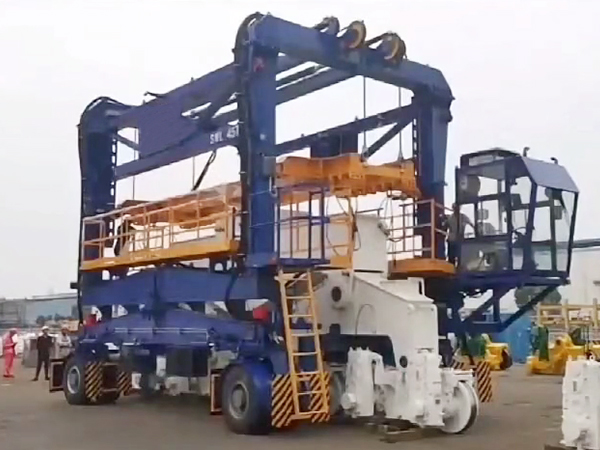
Cross-traffic car as the core equipment of the terminal short-distance transportation, the biggest advantage is that it can independently complete the container pickup, transportation, storage of the whole process, without additional with tractor and yard crane, eliminating the middle of the transfer link. But I have contacted the vast majority of terminals, have not been able to cross-transportation trucks to fully play out the ability.
Common problems are only these categories: too many yard channel crossings, peak blockage; equipment idling rate remains high, running a lot of invalid mileage; stacking strategy is unreasonable, frequent dumping lengthened the operating cycle; and fuel costs run higher and higher, devouring the terminal's profit margins.
Today, I will take the perspective of a front-line engineer, combined with Henan Mine Crane's practical experience in serving terminals in more than 50 countries and regions around the world, and talk to you about how to raise the efficiency of trans-carrier trucks from the core dimensions of operation indexes, yard layouts, scheduling logics, energy management, fleet operation and maintenance. Help you solve the pain points in actual operation.
Understanding Straddle Carrier Operational Workflow
Typical Container Handling Cycle
If you want to improve the efficiency, first of all, you have to figure out the complete operational cycle of the straddle carrier, and the time consumption of each link will directly affect the final operational efficiency.
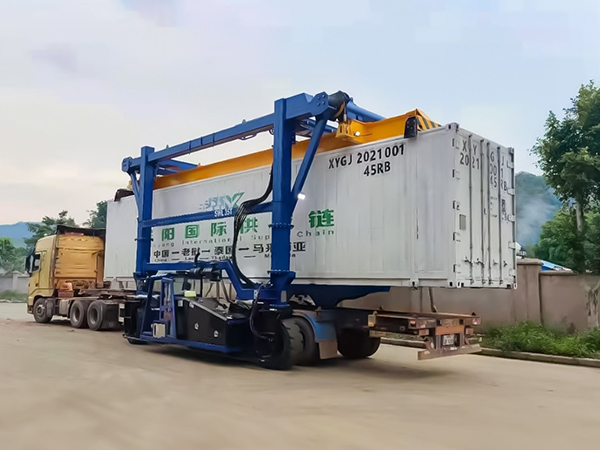
The most basic operation cycle starts with the unloading of containers from the shore bridge (STS). The bridge unloads the container from the ship to the shoreline handover area, and the transporter drives to the designated location to pick up the container and put it into its own gantry.
Next is the transportation segment, where the straddle carrier carries the container and drives from the shore to the designated yard block. The driving distance and route smoothness of this link are the key variables that determine the length of the cycle.
After arriving at the yard, it is the stacking operation, the trans-carrier stacks the containers accurately to the designated box position. If the container needs to leave the port, there will be a second extraction link, cross-transportation vehicle from the yard to take out the container, transported to the gate or railroad station, to complete the entire operation of the closed loop.
A lot of terminal efficiency can not go, is because only focus on the storage and take the box link, ignoring the transportation and scheduling optimization. In a complete operation cycle, the driving time often accounts for more than 60% of the time, the optimization space of this link is much larger than just improving the lifting speed.
Key Efficiency Indicators
To judge the efficiency of a straddle carrier, you can't just look at the parameters of the equipment itself, but also focus on these core indicators in conjunction with the actual operation of the terminal.
The first one is Moves per hour (MPH), which is the most common efficiency indicator in the industry, directly reflecting the operational capacity of straddle carriers. Under regular working conditions, a cross-traffic truck in good condition, MPH can do 25-35 times, automated equipment in ideal working conditions can be close to 40 times. If the MPH of your equipment is lower than 20 times for a long time, it means that there is an obvious bottleneck in the operation link.
The second is the single cycle time, that is, to complete a “pickup - transportation - storage” of the whole process time. This indicator can directly reflect the rationality of the yard layout and scheduling logic, the shorter the cycle time, the higher the operational efficiency of the equipment.
The third is the fuel consumption of single operation, which is directly related to the operation cost of the terminal. Especially diesel-powered transporter, fuel costs can account for more than 40% of the operating costs of the equipment, even if a single operation only save a little oil, the whole year running down is also a small amount of money.
The fourth is the yard congestion rate, that is, cross-traffic trucks in the operation process, because of the meeting, avoidance, route blockage generated by the waiting time ratio. The higher the congestion rate, the less effective operating time of the equipment, the efficiency naturally does not go up.
The last is the equipment utilization rate, that is, the proportion of the actual operating hours of the equipment to the operable hours. This indicator not only depends on whether the equipment is on or not, but also how much time is spent doing effective work after it is on, excluding the ineffective hours of waiting, idling, and downtime.
Improve Moves Per Hour (MPH)
MPH is the most intuitive reflection of the efficiency of the cross-traffic trucks, to improve this indicator, the core is not to make the equipment run faster, but to reduce the ineffective waiting and driving, so that each operation is smoother.
Optimize Travel Routes
I've seen too many terminals with yard layouts that don't take into account the traveling characteristics of cross-traffic trucks, with intersections everywhere and two-way lanes mixing up, and when rush hour arrives, the whole yard is jammed up and can't move.
Want to solve this problem, the most direct way is to design a one-way traffic flow. The access to the yard is divided into one-way traffic lanes to avoid traffic jams and opposite blockage, especially the shore to the yard of the main channel, must ensure one-way traffic to reduce cross-conflict.
The number of intersections should also be minimized. When we optimized a medium-sized terminal in Southeast Asia, we reduced the number of intersections in the yard from 28 to 12, and at the same time set up a priority right of way for the main access road, which alone shortened the average cycle time of cross-haul trucks by 18%, and the MPH was directly increased from 22 to 28 times.
Then there is the zoning operation. Each transporter is assigned to a fixed operation area, responsible for a fixed shore bridge and yard area, avoiding the transporter from running around in the whole yard, and significantly reducing the ineffective mileage of inter-area traveling.
Reduce Empty Travel Time
Empty traveling is the biggest hidden killer of the efficiency of trans-shipment trucks. We have done statistics, many terminals in the world's intermodal trucks, empty driving rate can be more than 35%, which is equivalent to one-third of the daily driving mileage is ineffective, not only a waste of fuel, but also occupy the yard access, exacerbating congestion.
To reduce idling, the core is to optimize the task allocation logic. You can't let the trans-carrier run back to the shore empty after unloading boxes and wait for the next task. Instead, through intelligent scheduling, to return to the empty car near the assignment of the box task, such as the gate of the inbound box, the yard in the dump box task, assigned to the return of the empty car, so that the equipment “to have boxes, return cargo”, to minimize idling.
When we did the scheduling optimization for an inland port in Europe, we reduced the idling rate of cross-docking trucks from 32% to 18% through this task allocation logic of “bringing containers along the way”, and the number of daily operations of a single piece of equipment directly increased more than 40 times, which is a very obvious effect.
Balance Quay and Yard Operations
Often, the efficiency of the trans-carrier cannot be improved, not because of the equipment itself, but because of the mismatch between the operating rhythm of the quay and the trans-carrier.
Either the bridge unloading speed is too fast, trans-carrier can not keep up, the bank piled up a bunch of containers no one to pick up, the bridge can only stop work and wait; or trans-carrier are waiting for boxes on the bank, no one to do the task of picking up boxes in the yard, resulting in congestion at the gate, trucks lined up in a long queue.
To solve this problem, we should do a good job of linkage between shore bridge operation and cross-truck scheduling. In advance, according to the ship's berthing plan, unloading order, to the cross-truck task scheduling, shore bridge unloading fast tempo, on the deployment of a few more units of equipment to the shore; unloading operations into the trough, the excess equipment to the yard to do the pickup and dumping operations, so that the capacity of the equipment to get the full use of it.
At the same time to set up a reasonable buffer zone on the shore. Even if there is a short-term mismatch between the rhythm of shore bridge and trans-shipment trucks, containers can be unloaded to the buffer zone first, avoiding shore bridge downtime and giving trans-shipment trucks a buffer time for scheduling.
Reduce Cycle Time
The shorter the cycle time is, the more operations can be accomplished per unit of time by trans-shipment trucks, and the efficiency will naturally increase. To reduce cycle time, the core is to reduce the ineffective action in each operation, so that the pick-and-drop, stacking, and traveling are all smoother.
Improve Pick-and-Drop Efficiency
Pick-and-drop time is a point that many terminals tend to overlook. I've seen many operators spend half a minute just aligning and adjusting boxes, which is a huge amount of wasted time in a day.
Want to improve the efficiency of pick and place the box, the most direct way is to add the equipment to the precise positioning system and visual aid system. Henan Mine Crane's cross-traffic trucks, standard with a centimeter-level positioning system and box position identification camera, can help operators quickly align the container and box position, the length of a single alignment compressed from 30 seconds to less than 10 seconds, significantly reducing the ineffective adjustment action.
There is also to standardize the operator's operating habits. Many operators like to park the car far away, and then adjust the alignment a little bit, which not only wastes time, but also increases the wear and tear of tires. When we give training to customers, we will teach operators to predict the box position in advance and park in place at one time to reduce repeated adjustments, which can effectively compress the time of picking and placing boxes.
Optimize Stacking Strategy
Stacking strategy directly determines the traveling distance of straddle car and the difficulty of stacking operation, unreasonable stacking strategy will make straddle car do a lot of ineffective action, and lengthen the cycle time.
Many terminals like to stack containers as high as possible, thinking that this can improve the utilization rate of the yard. But in fact, 1-over-3 stacking height, although more than 1-over-2 stacked one layer, but the cross-truck stacking and pickup time will increase by more than 30%, but also increase the probability of reversal of the container.
The correct approach is to develop different stacking strategies according to the frequency of container turnover. High-frequency turnover of import and export containers, placed in 1-over-2 of the low-level stacking area, to facilitate the transporter to quickly pick up and place, reducing the time of stacking and picking up boxes; low-frequency turnover of empty containers, spare containers, placed in 1-over-3 of the high-level stacking area, maximizing the use of yard space.
At the same time, we should follow the principle of “close stacking and storage”, stacking the containers unloaded from the ship to the yard block closest to the corresponding shore bridge, and stacking the containers to be loaded on the ship to the area close to the shore in advance, so as to minimize the driving distance of the trans-shipment trucks and compression of the cycle time.
Minimize Rehandles
Rehandling is an important reason to lengthen cycle time and reduce efficiency. Many terminals have a rehandling rate of more than 20%, which is equivalent to one rehandling for every five boxes picked up, and the transporter has to do a lot of ineffective work, so the cycle time naturally goes up.
Want to reduce the reversal of boxes, the core is to use advanced yard planning algorithms, in advance to the container allocation of box space. For example, the same ship's export box, centralized stacking in the same block, and in accordance with the order of loading, from inside to outside stacked in order, when loading the ship can be in order to take the box, do not have to reverse the box.
There is also the pre-allocation of export container space. In advance, according to the berthing plan of the ship, the containers that are about to leave the port are transferred to the loading area near the shore in advance, so as to avoid loading the ship, taking the boxes from the deep box space in the yard, and also dumping the boxes above, which greatly compresses the cycle time of loading operation.
When we optimized a coastal terminal in China, through the optimization of yard planning algorithms, we reduced the dumping rate from 22% to 9%, and shortened the single cycle time of a single straddle carrier by 22 seconds on average, which is a significant improvement in operational efficiency.
Improve Fuel and Energy Efficiency
Fuel and energy costs are one of the largest fixed expenses in the operation of cross-docking trucks. Especially nowadays, the global fuel price fluctuates greatly and the environmental protection requirement is getting more and more strict, improving energy efficiency can not only reduce the operation cost, but also meet the environmental protection compliance requirement.
Diesel vs Hybrid vs Electric Straddle Carrier
Choosing the right type of power is the basis for improving energy efficiency. The energy cost and application scenarios of different power straddle carriers are very different, there is no absolute good or bad, only suitable or not suitable.
Diesel-powered straddle carrier has the most mature technology and the lowest initial procurement cost, which is suitable for small and medium-sized terminals with unstable operation volume and scattered sites. However, it has the highest fuel cost and large emission, and the energy expenditure will be very considerable in the long run.
Hybrid transporter is the mainstream choice nowadays. Through the cooperation of lithium battery and diesel engine, it can recover the kinetic energy during braking and descending, and convert it into electric energy for storage to provide auxiliary power for the equipment.
Pure electric transporter is the future development trend. Its single operation energy cost is only about one-third of the diesel model, and with zero emission and low noise, it is suitable for large terminals with fixed charging facilities and stable operation volume.
Henan Mine Crane can customize three kinds of power transporters, namely diesel, hybrid and pure electric, according to customer's working condition and energy planning, and help you choose the most suitable power type to reduce energy cost from the source.
Engine Idle Reduction
Engine idling is the worst area of fuel waste. Many terminal operators do not turn off the engine when they stop and wait, and the equipment idles for a long time, which not only burns diesel for nothing, but also accelerates the wear and tear of the engine and increases the maintenance cost.
Want to solve this problem, the most direct way is to equip the equipment with automatic idling management system. This system can monitor the operation status of the equipment in real time, when the equipment stops for more than a set time, it will automatically reduce the engine speed, or even automatically shut down; when the operator starts to operate, it can be quickly started, without affecting the operation.
We give the customer's diesel cross-traffic trucks retrofitted with this system, the idling time of the equipment has been reduced by more than 60%, a single device can save nearly 10,000 yuan of fuel costs per month, the effect is very obvious.
At the same time, we also need to give operators standardized training, so that they can develop the habit of turning off the engine when stopping and reduce unnecessary idling, so as to reduce fuel consumption from the operating habits.
Smart Power Management
In addition to reducing idling speed, smart power management can also significantly improve energy utilization efficiency and reduce unnecessary energy consumption.
For example, the kinetic energy recovery system, hybrid and purely electric transporters can use this system to convert the kinetic energy generated during braking and container descent into electrical energy for storage, which can be used for driving and lifting the equipment, and can reduce energy consumption by about 20%.
There is also the optimization of the acceleration curve. Many operators like to slam on the gas pedal and brake sharply, which will not only aggravate the wear and tear of tires and components, but also cause a lot of energy waste. Through the PLC control system, the acceleration and deceleration curves of the equipment are optimized, so that the driving and lifting movements of the equipment are smoother, which not only reduces energy consumption, but also extends the service life of the equipment.
Our transporters will optimize the matching of the power system in advance according to the customer's working conditions, so that the engine and motor are always running in the most efficient zone, avoiding the waste of energy caused by “big horse-drawn carts”.
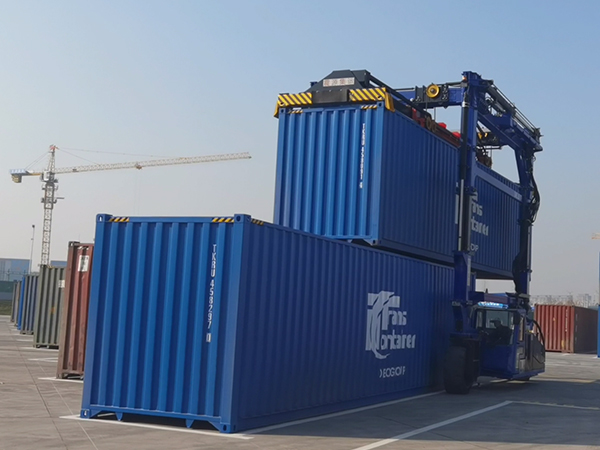
Fleet Management Optimization
No matter how high the efficiency of a single piece of equipment is, without reasonable fleet management, the operational efficiency of the whole yard will not go up. The core of fleet management is to let the right number of equipment, at the right time, appear in the right place, maximize the ability of each piece of equipment.
Right Fleet Size Planning
Fleet size planning is the foundation of fleet management. If there are fewer equipments, the operation volume can not keep up, the yard and the shore will be congested, and the throughput capacity can not be increased; if there are more equipments, a large number of equipments will be idle, which not only wastes the purchase cost, but also aggravates the traffic congestion in the yard, which in turn lowers the overall efficiency.
To determine the appropriate fleet size, we cannot only look at the annual throughput of the terminal, but also combine the number of shoreline bridges, operating shifts, yard layout, and the MPH of a single piece of equipment comprehensive calculation. Routinely, a bridge needs to be matched with 3-4 straddle carriers in order to match the operational rhythm of unloading boxes and loading ships.
When we do the planning for our customers, we will simulate the actual operation scenario of the terminal through discrete event simulation model to figure out the optimal number of equipments required under different operation volume, so as to avoid the problem of insufficient or excessive equipments.
Real-Time Fleet Monitoring
If you want to manage your fleet well, you must first be able to see the real-time status of each piece of equipment. If you don't know where the equipment is, what it is doing, and whether it is malfunctioning, you can't talk about rational dispatching.
Through GPS positioning and remote diagnostic system, we can monitor the location, traveling speed, operation status, fuel level, equipment fault code and other information of each cross-traffic truck in real time. Dispatcher in the center control room, you can see the entire fleet of running status, where there is congestion, which equipment failure, can be the first time to make adjustments to avoid the expansion of the problem.
For example, if a small fault occurs in a piece of equipment, the remote system can warn in advance, and the dispatcher can immediately assign the task of this piece of equipment to other equipment, and at the same time arrange for maintenance personnel to overhaul, so as to avoid equipment downtime, which affects the whole operation process.
Preventive Maintenance Strategy
Equipment downtime is an important factor that affects efficiency. When a piece of equipment suddenly breaks down, not only will it be unable to operate itself, but it will also disrupt the entire scheduling program, causing a chain reaction. To avoid this, you need to do preventive maintenance, not wait for equipment to break down and then fix it.
Tires are the most easily worn parts of a straddle carrier, and they are also the biggest part of the maintenance cost. The weight of the truck plus the weight of the container are all on the tires, and unreasonable driving, harsh braking, and uneven road surfaces will accelerate the wear and tear of the tires. We provide our customers with a tire life management program, which regularly checks tire wear, adjusts tire pressure and alignment, extends tire life, and reduces downtime due to tire failure.
There is also predictive maintenance of key components. Through the sensors on the equipment, real-time monitoring of the operating status of the engine, hydraulic system, lifting mechanism, and through data analysis, the wear and tear of the components can be predicted in advance, and maintenance and replacement can be arranged before the components fail, so as to avoid sudden breakdowns and downtime, and to increase the effective utilization rate of the equipment.
The preventive maintenance program we provide to our customers can reduce the downtime rate of cross-trucks by more than 70% and increase the equipment utilization rate from 60% to more than 85%, which is a very obvious effect.
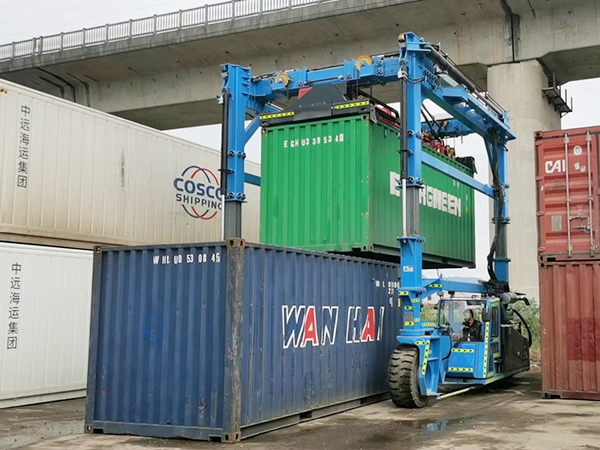
Yard Design and Pavement Considerations
In many terminals, the efficiency of straddle carriers cannot be improved because of the design of the yard and the road surface. Unreasonable yard layout will make cross-docking trucks run a lot of wrong way; substandard road surface will accelerate the wear and tear of the equipment, and even cause safety hazards, which can be avoided in the preliminary planning.
Pavement Strength and Ground Pressure
The axle load of trans-carrier is very high, when fully loaded, the ground pressure of a single wheel can be more than 10 tons, which requires very high strength of the road surface. Many pavements in terminals are designed without considering the ground pressure of trans-carrier, and after one or two years of use, settlement, cracking and rutting will occur, which will not only accelerate the wear and tear of the tires, but also make the trans-carrier move in a bumpy way, which will affect the operational efficiency and even cause potential safety hazards.
The choice of road surface, mainly two kinds of concrete and asphalt. Concrete pavement has high strength, strong bearing capacity, long service life, and is not prone to rutting, which is suitable for large terminals with high-frequency operation of cross-traffic trucks, and although the initial construction cost is high, the later maintenance cost is very low. Asphalt pavement has low up-front construction cost and fast paving speed, but the bearing capacity is not as good as concrete and is prone to rutting and settlement, suitable for small and medium-sized terminals with low operation volume and requires regular maintenance.
When we do the yard planning for our customers, we will give the design suggestions for the thickness and strength of the pavement according to the type of straddle carrier, full load grounding pressure, and the annual operation volume, so as to avoid the pavement being damaged in the later stage, which will affect the operation of the equipment.
Lane Width Optimization
The design of lane width directly affects the driving efficiency and turning time of straddle car. If the lane is too narrow, the transporter has to be careful when meeting and turning, slowing down and lengthening the driving time; if the lane is too wide, it will waste the space of the yard, reduce the storage space and lower the utilization rate of the yard.
Routinely, cross-transportation vehicle one-way driving lane, the width should be wider than the maximum width of the equipment 0.8-1 meters, two-way lane should be about 2 meters wide, both to ensure the smooth passage of the equipment, but not a waste of space. Turning position, according to the minimum turning radius of cross-transportation trucks, to design enough turning space, to avoid repeated adjustments when the equipment turns, wasting time.
In one of the terminals in the Middle East that we have served, the previous lane design was not reasonable and there was not enough turning space, so the transporter had to back up every time it made a turn to get through. After we helped them optimize the lane width and turning radius, the cross-haul trucks could pass through in one turn, and the duration of a single turn was shortened from 40 seconds to 10 seconds, which greatly improved the traffic efficiency of the whole yard.
Traffic Flow Planning
Reasonable traffic flow planning is the core of solving yard congestion and improving traffic efficiency. Congestion in many terminals is not due to insufficient lanes, but to unreasonable traffic flow planning, resulting in many bottlenecks and conflict points.
Bottleneck areas should be avoided first. Shore to the yard of the main channel, the width should be enough, can not appear “wide road into the narrow mouth” situation, otherwise the peak period all the cars are blocked in the narrow mouth, the whole yard can not move. The number of main channel should be determined according to the number of shoreline bridges and the amount of work, generally every 2 shoreline bridges should be supported by a main channel.
Then the buffer zone should be set up. In the shore handover area, gate, yard entrance to these easily congested location, set up enough waiting buffer zone, to avoid waiting for the vehicle occupies the passing lane, resulting in channel blockage.
There is also the need to separate different flows of traffic. Separate the inbound and outbound traffic, and separate the transportation channels for heavy and empty containers to avoid cross conflicts of vehicles in different directions, reduce the waiting time for meeting and avoiding, and improve the efficiency of the whole yard.
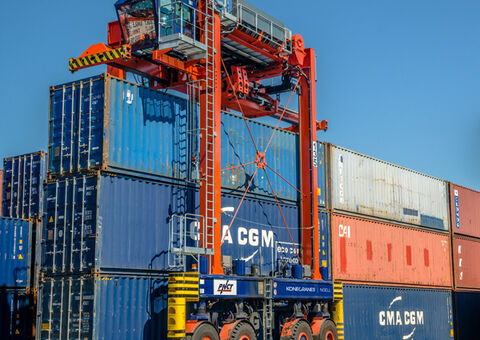
Automation and Smart Technology Trends
Nowadays, terminals around the world are developing in the direction of intelligence and automation. Automation technology not only reduces labor costs, but also makes the operation of straddle carriers more stable and efficient, and reduces human errors and fluctuations in operation.
Remote-Controlled Straddle Carriers
Remote-Controlled Straddle Carriers are the easiest and fastest automation solution to implement today. Operators do not have to sit in the cab of the equipment, but can remotely control multiple straddle carriers from the center control room to complete the whole process of picking up, transporting and stacking.
Firstly, the safety of the operation has been improved. Operators do not have to run in the yard, away from the risk of high temperature, noise, collision, the operating environment has been greatly improved. Secondly, it reduces the labor cost, an operator can manipulate 2-3 sets of equipment at the same time, the labor demand is reduced by more than half, especially in Europe and the United States where the labor cost is high, it can save a very considerable amount of manpower expenditure.
There is also a higher stability of operation. Remote control system with precise positioning can reduce human errors, so that each pick and place boxes, driving are more standard, less fluctuations in operating efficiency, the overall MPH can be stabilized at a higher level.
Henan Mine Crane's straddle carriers can be adapted to the world's mainstream remote control systems, and can be customized according to customer needs, semi-remote or fully remote control solutions, to help customers smoothly realize the automation upgrade.
Semi-Automated Routing Systems
Semi-automated Routing Systems can solve the irrationality of manual scheduling, make the routes of cross-docking trucks better, and significantly reduce idling and congestion.
This system can automatically plan optimal routes for cross-docking trucks according to real-time operation tasks and yard traffic conditions, avoiding congested road sections and choosing the shortest driving distance, without the need for dispatchers to manually assign routes. And can be adjusted in real time, such as a channel congestion, the system will automatically give the equipment to plan a new route to avoid vehicles piled up together.
The semi-automated route optimization we did for a terminal in Europe, after landing, the average driving distance of cross-trucks was shortened by 22%, the idling rate was reduced by 19%, and the congestion rate of the whole yard was reduced by more than half, which is a very significant effect.
Integration with TOS (Terminal Operating System)
The scheduling and operation of trans-shipment trucks can only be realized through the terminal operating system (TOS), which contains all the core data such as vessel plans, container information, gate plans, operation instructions, etc. Only by seamlessly integrating the scheduling system of trans-shipment trucks with the TOS system can data-driven intelligent scheduling be realized.
After the integration, the operation instructions of TOS system can be directly sent to the scheduling system of trans-carrier, automatically assigning tasks to the equipment without manual entry and communication, reducing the errors and delays in the intermediate links. The operation status and box position information of the trans-carrier can also be transmitted back to the TOS system in real time, so that the terminal managers can grasp the operation progress in real time and make more reasonable planning.
For example, before a ship berths, the TOS system can synchronize the unloading plan and loading plan to the scheduling system in advance, so that the scheduling and route planning of trans-shipment trucks can be done well in advance, and the operation can be started as soon as the ship berths, so that there is no need for temporary scheduling, which greatly improves the operation efficiency.
Lifecycle Cost Optimization
Enhancing the efficiency of trans-shipment trucks ultimately comes down to reducing operating costs and improving return on investment. Many terminals only look at the initial purchase price when selecting a model, ignoring the whole life cycle cost, and as a result, it is cheaper to buy, but more and more expensive to use.
CAPEX vs OPEX Analysis
The whole life cycle cost, mainly including the initial procurement cost (CAPEX) and operating cost (OPEX) two parts.
Initial Purchase Cost. Diesel transporters have the lowest CAPEX, hybrids are 15%-20% higher, and electrics are 30%-40% higher. Many customers only focus on this figure, choose the cheapest diesel model, but ignored the subsequent operating costs.
Operating costs, which are the costs incurred continuously during the use of the equipment, include fuel/electricity costs, maintenance costs, tire replacement costs, labor costs, losses from breakdowns and downtime, and so on. A straddle carrier has a service life of 15-20 years, and operating costs often add up to several times the initial purchase cost.
For example, a diesel transporter, the initial purchase cost is 2 million, the annual fuel, maintenance, labor costs are 800,000, 15 years of operating costs is 12 million, plus the initial purchase, the whole life cycle cost is 14 million. While a pure electric transporter, the initial procurement cost is 2.8 million, the annual cost of electricity, maintenance, labor costs is 300,000, 15 years of operating costs is 4.5 million, the full life cycle cost is only 7.3 million, far more cost-effective than diesel models.
Therefore, when selecting a model, you can't just look at how much money you spend when you buy it, but you should calculate the total account of 15-20 years to see which program has a lower life cycle cost.
10-15 Year ROI Perspective
From a 10-15 year ROI perspective, efficiency gains and cost reductions will eventually translate into tangible benefits.
There are also reductions in energy and labor costs. For example, replacing a diesel transporter with a hybrid model will save $300,000 per year in fuel costs per unit, and a fleet of 10 units will save $30 million over 10 years. Remote control systems can reduce operators by half, saving millions in labor costs each year, all of which is a real return on investment.
There's also the improvement in land utilization. By optimizing the stacking strategy and yard layout, the storage capacity of the yard can be increased without expanding the land, which is of immeasurable value to ports with tight land resources and expensive land prices.
Straddle Carrier vs RTG for Efficiency Improvement
Many terminals in the selection of models, will be torn between straddle carriers and RTG (tire gantry crane) in the end to choose which. In fact, there is no absolute advantage or disadvantage of these two types of equipment, the core is to look at your terminal's operating scenarios and efficiency improvement goals.
| Factor | Straddle Carrier | RTG |
| Short-distance Transportation | Obvious advantage, capable of independently completing the full-process transportation from STS to yard | Relies on tractors for horizontal transportation, requiring multi-equipment coordination |
| Stacking Density | Medium, usually 1-over-2 to 1-over-3 | High, usually 1-over-5 to 1-over-6, with higher land utilization rate |
| Flexibility | High, can move freely throughout the yard, adapting to flexible operation needs | Medium, can only move within fixed yard blocks |
| Automation Maturity | Rapidly improving, with remote control gradually popularized | More mature, with wider application of fully automated solutions |
Efficiency improvement is never only look at the parameters of a single piece of equipment, but look at the system design of the entire terminal.
If your terminal is small or medium-sized, with medium operation volume, yard layout needs to be flexibly adjusted, and you want to simplify the operation process and reduce the types of equipment, the advantage of straddle carriers is very obvious. It doesn't need to match with tractor and yard crane, one equipment can complete the whole process of operation, reducing the waiting time of multi-equipment coordination, and the efficiency of short-distance transportation is higher.
If your terminal is a large deep-water port with high annual throughput and tight land resources, and you want to maximize the storage density of the yard and have a clear plan for full automation, then RTG will be more suitable. It has higher stacking density, can store more containers on limited land, has a more mature automation program, and is more stable for long-term operation.
Henan Mine Crane can produce both straddle carriers and RTGs, and we will recommend the most suitable equipment solution according to the customer's terminal size, yard layout, and throughput target, rather than just selling a certain product.
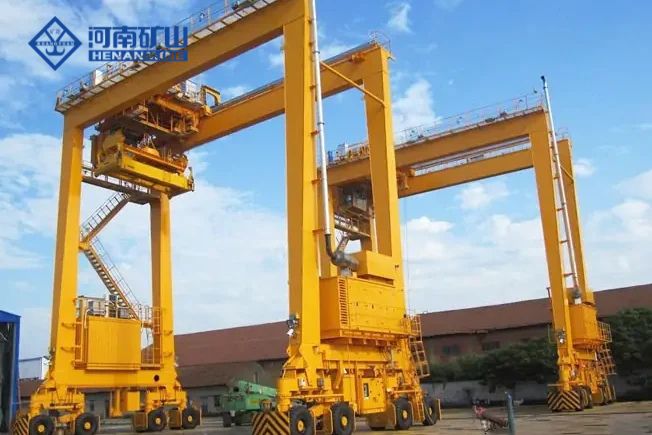
Common Efficiency Bottlenecks
In the course of serving our customers around the world, we have summarized the most common efficiency bottlenecks in the operation of trans-shipment trucks, and most of the efficiency problems in terminals are found in these places.
The first is traffic conflicts. There are too many intersections in the yard, the two-way lanes are mixed, the traffic flows in different directions cross, congestion is easy to occur during peak hours, and a large amount of time is wasted on waiting for the cross-traffic trucks to avoid, and the effective operation time is reduced dramatically.
The second is unreasonable scheduling. Task allocation is unscientific, high idling rate, equipment piled up in the same area, while other areas of the task no one to do, not only a waste of equipment capacity, but also exacerbate the local congestion, the entire operating rhythm of the yard has been disrupted.
The third is excessive heavy container stacking. Do not distinguish between the frequency of container turnover, all boxes are stacked high, resulting in high-frequency turnover of the box is pressed under the box, every time you pick up the box have to frequently pour the box, lengthening the operating cycle time, reducing operational efficiency.
The fourth is that tires wear out too quickly. Road surface unevenness, operator operation is not standardized, tire maintenance is not in place, resulting in frequent replacement of tires, increased equipment downtime, maintenance costs, affecting the effective utilization of equipment.
The fifth is inadequate operator skills. The operating habits of different operators vary greatly. While a skilled operator can do more than 30 MPHs, a novice may only be able to do 20 MPHs, and the artificial differences in operation lead to great fluctuations in the efficiency of the entire fleet, which cannot be stabilized at a high level.
Efficiency Improvement Checklist
In order to facilitate you to quickly check the problems of your own dock, I have compiled an Efficiency Improvement Checklist, against which you can quickly find out where your bottlenecks are and clarify the direction of optimization.
- What is the current average Moves per hour for your transporter? How far off is it from the industry average of 25-35 Moves?
- Does your fleet have a high idle rate? Does the idle rate exceed 20%?
- What is your fuel cost as a percentage of operating cost? Is fuel consumption for single-tank operations higher than the industry average?
- What is your equipment utilization rate? Is the ratio of effective operating hours to operable hours below 70%?
- Is your yard congestion rate too high? Is the percentage of equipment waiting hours more than 15%?
- Do you have a clear automation upgrade plan? Do you need to upgrade to hybrid or electric transporters?
Frequently Asked Questions
Q1: What is the average productivity of a straddle carrier?
Under normal working conditions, a manually operated straddle carrier is capable of completing an average of 25-35 operations per hour (MPH), depending on the yard layout, operating distance and dispatch level.
Semi-automated equipment operated remotely will have a more stable operating efficiency of 30-35 MPH, while fully automated straddle carriers will be able to complete close to 40 MPH under ideal working conditions.
Q2: How can I reduce fuel consumption?
The most direct way is to replace the diesel-powered straddle carrier with a hybrid or pure electric model, which has been tested to reduce fuel consumption by about 40%. Besides, optimizing driving routes to reduce idling, installing automatic idle management system, optimizing acceleration curves to reduce harsh acceleration and braking, and doing regular engine maintenance can all effectively reduce fuel consumption.
Q3: Are automated straddle carriers worth it?
For terminals with high throughput and high labor costs, automated straddle carriers are worth it. It significantly reduces labor costs, allows one operator to control multiple pieces of equipment at the same time, and has a more stable operating efficiency, which reduces the number of human errors and reduces the accident rate. For small and medium-sized terminals with fluctuating workloads, it is possible to start with a semi-automated solution that is remotely operated, with lower investment and faster results.
Q4: What affects straddle carrier efficiency the most?
Yard layout and scheduling system are the two factors that affect straddle carrier efficiency the most. Unreasonable yard layout will lead to longer traveling distance and increased congestion; unreasonable scheduling will lead to high idling rate and waste of equipment capacity. If these two problems are solved, the efficiency of straddle carriers can be increased by more than 30%, which is far more obvious than simply increasing the traveling speed of the equipment.
Q5: How long does a straddle carrier last?
With regular maintenance and preventive care, a straddle carrier can last 15-20 years. Many of our customers have equipment that has been in use for more than 15 years and is still working stably. If not properly maintained and operated, the service life of a straddle carrier can be drastically shortened, with severe structural wear and component failures occurring in less than 10 years.
Conclusion
The efficiency of a straddle carrier is never determined by the parameters of the equipment itself, but by the system design, scheduling logic, operation and maintenance management of the yard. Even if you use the most advanced equipment, but the layout of the yard is not reasonable, scheduling is a mess, the efficiency will not go up.
If you want to really improve the efficiency of cross-docking trucks, you can't just focus on the equipment itself, you have to start from every link of the operation process, optimize the driving route to reduce idling, optimize the stacking strategy to reduce the inverted boxes, optimize the fleet management to improve the utilization rate of the equipment, and optimize the energy scheme to reduce the operation cost.
Reasonable optimization will enable you to significantly increase the terminal's throughput capacity and operating income without expanding land or adding a large amount of new equipment. And intelligent fleet management and automation technology is the core direction of the future terminal to improve efficiency, which can help you solve the core pain points of rising labor cost and fluctuating operation efficiency.
Henan Mine Crane Factory Custom
Henan Mine Crane has been focusing on the design, production and service of heavy-duty port equipment for more than 20 years, and has provided a full range of port equipment such as straddle carriers, RTGs, shore bridges and other port equipment, as well as complete efficiency optimization solutions for terminals in more than 50 countries and regions around the world.
If you have your own terminal layout plan, you can submit it to us and we will give you a free efficiency assessment and customized optimization solution; you can also contact our port equipment experts to apply for a straddle carrier optimization proposal, which will help you find the efficiency bottleneck of your terminal and achieve a double increase in throughput capacity and revenue.