
Which Double Girder Gantry Crane is Suitable for Port Outdoor Heavy-duty Hoisting
Outdoor heavy lifting operations in harbours have high requirements on the load carrying capacity, wind resistance, working level and anti-corrosion standards of lifting equipment.
This article focuses on the core of the selection of double girder gantry cranes, and systematically sort out the core parameters and the key to the selection of the four mainstream models of MG type, RMG type, truss type and shipbuilding, to provide scientific references for the port-related decision makers, and help accurate selection.
Structural Advantages of Double Girder Gantry Cranes
Core structural components
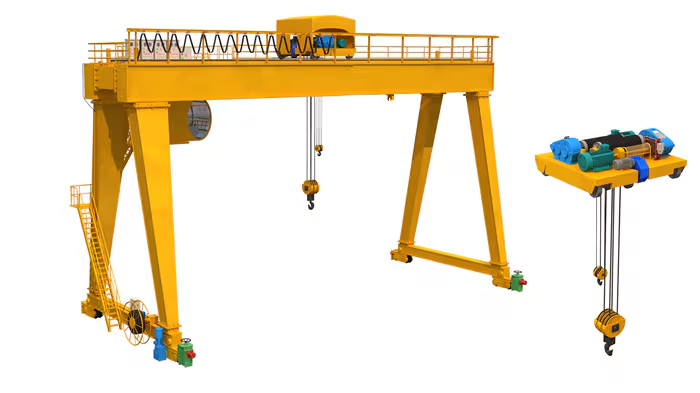
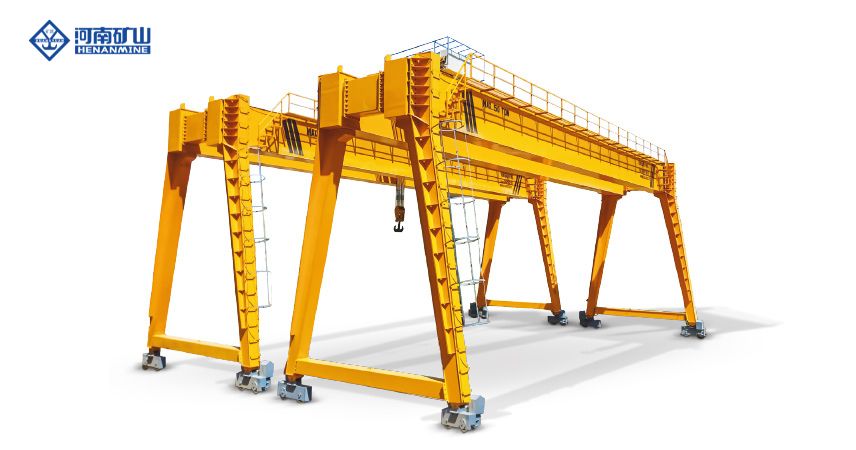
The core structure of Double Girder Gantry Crane consists of four main components, namely two parallel main girders, outriggers on both sides, ground track travelling mechanism and hoisting trolley system.
Among them, the hoisting trolley runs along the top rail of the main girder. Compared with the single girder design, the hook position can be lifted above the plane of the main girder, obtaining an additional hook height of 450mm to 900mm, which is especially critical in scenarios such as multi-layer cargo stacking and lifting of tall components in ports, and can effectively adapt to the height requirements of port operations.
Load-bearing performance advantages
The core load-carrying advantage of the double girder structure lies in the load dispersal design. The two main girders bear the load independently, which makes the static deflection and dynamic deflection of the whole machine much smaller than that of a single girder crane of the same span, and the structural rigidity is better.
According to the industry standard, when the lifting capacity exceeds 20 tonnes or the span exceeds 20 metres, a double girder structure must be used to meet the rigidity and fatigue life requirements.
The basic working conditions of outdoor heavy lifting in ports are cargo weights of 20 tonnes to hundreds of tonnes and spans of 12m to 50m, so single girder structures cannot meet such operational requirements from the design level, and double girder structures become the inevitable choice.
Functional expansion and maintainability advantages
Double girder gantry cranes have greater functionality and expandability. The bridge deck space between the two main girders can be installed with an access platform to provide a safe working platform for the main maintenance personnel;
The top of the main girder can also be integrated with cabs, lighting systems, windproof anchorage devices and other ancillary facilities, solving the single girder structure space constraints, unable to accommodate a variety of ancillary configurations of the pain point.
Combined with the high-intensity, 24-hour continuous operation characteristics of the harbour, the maintainability of the equipment directly affects the annual downtime and comprehensive operating costs, and this advantage of the double girder design can effectively reduce operational losses and improve operational continuity.
MG Universal Double Girder Gantry Crane
MG double girder gantry crane is the most widely used general-purpose gantry crane model in China's crane industry, and it is also the standard equipment in many harbours and freight yards, railway freight stations and open yards around the world.
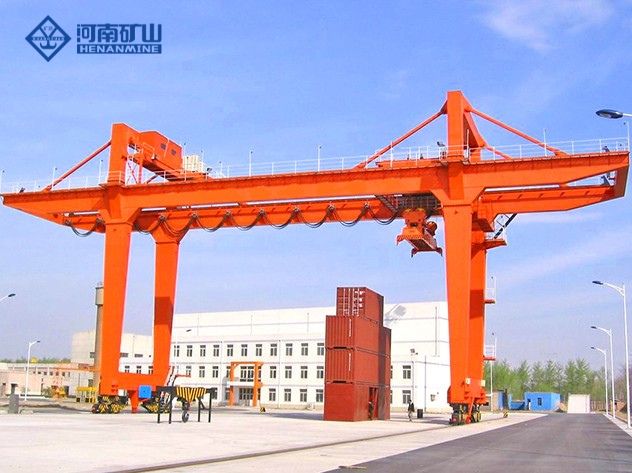
It adopts box main girder, rigid leg and flexible leg (or double rigid leg) design, the whole machine travels along the track, and the hoisting trolley runs on the top of the main girder; MG type covers a wide range of lifting capacity of 5-500 tonnes, span can be customised to more than 35m, and the working class includes A5, A6 and A7.
The MG model is mainly responsible for bulk cargo handling and bulk material stacking in port yards, which is a cost-effective choice for medium-sized general cargo ports, and the spreader can be flexibly changed to improve the utilisation rate.
From the parameter selection point of view, port outdoor open-air scene should give priority to the choice of working class A6 or A7 MG type gantry crane. A6 corresponds to the heavy duty working system, the number of working cycles per day, high utilisation rate, to meet the port of the daily multi-shift continuous operation of the intensity of the demand;
A7 is suitable for all-weather high-frequency operation of busy terminals. In terms of anti-corrosion treatment, coastal ports should require the whole machine structure to adopt anti-salt spray anti-corrosion coating system, and the electrical system is equipped with IP55 or above protection level to resist the corrosive attack of the marine atmosphere.
MG type universal double girder gantry crane core parameters reference
- Lifting capacity: 5 tonnes~500 tonnes, single hook or double trolley can be configured to flexibly adapt to different lifting needs.
- Span: 12m~35m, can be customised to a larger span according to the actual needs of the port yard, suitable for all kinds of site conditions.
- Lifting height: 6m~20m, can be flexibly customised according to the stacking height of the yard to meet the needs of multi-layer cargo lifting.
- Working class: covering A5, A6, A7, can be accurately matched according to the intensity of port operations, to ensure the stable operation of the equipment.
RMG (Rail Mounted Container Gantry Crane)
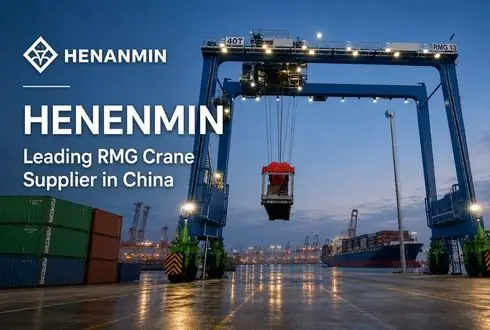
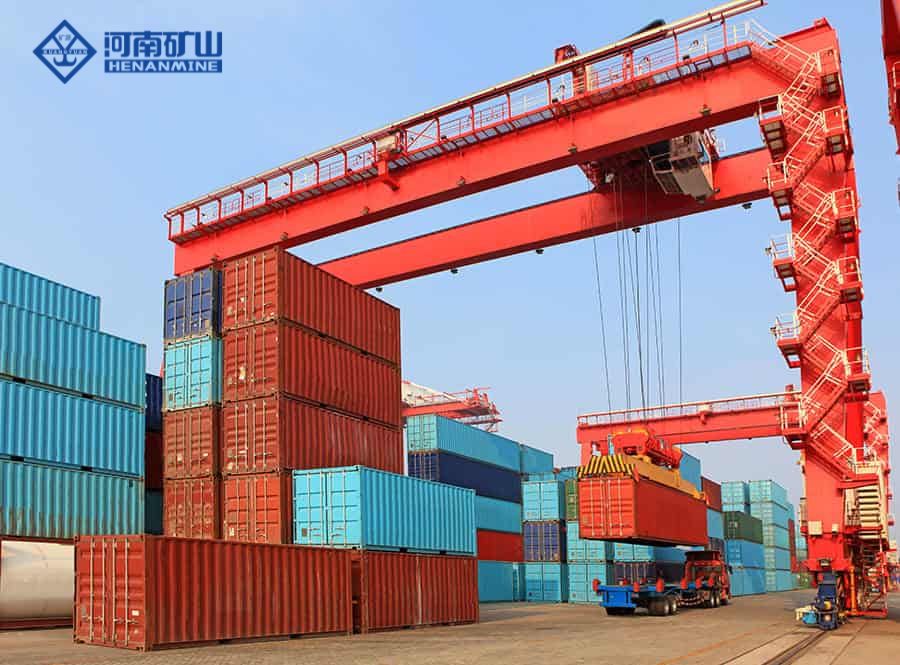
RMG (Rail Mounted Container Gantry Crane) is the core equipment of container port area, travelling along the ground track, equipped with automatic telescopic spreader, can accurately grab 20 feet, 40 feet standard containers, the operational efficiency is much higher than manual and forklift.
With a lifting capacity of 26-65 tonnes, a working class of A6-A8, a customised span of up to 50 metres, a lifting height of more than 30 metres, a travelling speed of 45-60 metres/minute, and a positioning accuracy of ±50 millimetres, the RTG is the mature and preferred solution for large-scale ports that handle more than 1,000 TEUs per day.
Compared with RTG, RMG has better stability, accuracy and lower energy consumption. Ground power supply can reduce annual energy cost by 30%-50%, and the automation transformation is mature, which can be upgraded to ASC seamlessly to match the digital transformation of ports.
RMG core parameters reference
- Lifting capacity: 26 tonnes ~ 65 tonnes (suitable for standard container operations), customised models can break through more than 100 tonnes, to meet the special lifting requirements
- Span: 20 metres ~ 50 metres (including cantilever), can cover 6 to 8 rows of container stacking area, suitable for different sizes of yard layout
- Main accessories: Equipped with cargo hooks, grabs, electromagnetic suction cups, lifting beams and other commonly used lifting tools, which can be switched on demand to enhance the utilisation rate of the equipment.
- Applicable port types: widely applicable to bulk cargo ports, integrated freight terminals, railway container freight stations and open-air cargo yards, with strong versatility.
- Lifting height: up to 30 metres, supporting the high-density stacking mode of ‘1 box pressing 5 boxes’, enhancing the utilisation rate of the yard.
- Working level: A6~A8, suitable for high-frequency and high-intensity continuous operation in container ports.
- Travelling speed: 45m/min~60m/min, with precise positioning system to ensure operational efficiency and safety.
- Applicable port types: large container ports, railway container loading yards, inland container transfer stations.
- Power supply: cable reel, slip line or bus duct power supply, all-electric drive design, green and low emission, in line with the demand of port environmental protection.
Truss Double Girder Gantry Crane
Truss double girder gantry cranes replace the traditional box girder with a triangular truss structure, which has outstanding wind resistance, and the hollow design reduces the wind load factor by 40%-60% compared with the box girder, which is preferred for typhoon-prone coastal ports and island ports.
It also has the advantage of light weight, reducing the steel consumption by 15%-25% under the same span weight, which can reduce the foundation cost; the rods can be overhauled individually and the maintenance is convenient, which is suitable for remote ports.
This model is suitable for shipbuilding segment lifting, steel transfer and other scenarios, working class A5-A6, lifting capacity of 20 tonnes to hundreds of tonnes, span can be customised, the procurement of manufacturers with mature truss welding qualification should be selected.
Heavy Duty Double Girder Gantry Crane for Shipbuilding
Shipbuilders have very high requirements on the span and tonnage of cranes, the construction of large ship segments requires hundreds of tonnes of lifting and millimetre positioning, so the shipbuilding special heavy-duty double girder gantry cranes with a lifting capacity of 100-1,000 tonnes and a span of 80-230 m are one of the categories of industrial cranes with a large volume.
Gantry cranes for shipbuilding usually use double trolley configuration: the main trolley is responsible for the lifting of the main segments, the deputy trolley is used for auxiliary positioning and turning, the two cars can work together to complete the super-long, super-heavy workpiece into the position of the precise.
In order to adapt to the outdoor marine environment, the structural steel is made of high-strength weather-resistant steel, and the thickness of the surface anticorrosion coating is usually more than 250 microns, and it is equipped with multiple safety systems such as high wind alarm, automatic windproof anchoring, and anti-deviation limitation.
From the technical parameters, shipbuilding heavy gantry crane travelling speed is relatively low (usually 2 to 10 m / min), but the positioning accuracy requirements are very high, need to be equipped with laser ranging, encoder feedback and PLC precision control system.
The procurement cycle of this type of equipment is usually 12 to 36 months, and it is necessary to synchronise the equipment selection and foundation design work at the dockyard design stage to ensure that the parameters between the track, foundation and crane are coordinated.
Five Key Dimensions in The Selection of Outdoor Double Girder Gantry Cranes for Harbours
Lifting capacity and span of the synergistic match
The selection of port lifting equipment must be based on the actual maximum cargo weight, while leaving a safety margin of no less than 15%. Special attention should be paid to the fact that the rated lifting capacity refers to the combined weight of the hook and all attachments below it (including spreaders, slings, stretcher beams, etc.).
If grabs or electromagnets are used, their own weight, which often accounts for 20 to 35 per cent of the rated lifting capacity, must be deducted from the net payload. The span should be determined by taking into account the width of the yard, the need for access between the legs (vehicle traffic or forklift operation) and the length of the cantilever, which usually requires special structural calculations for spans of more than 35 metres.
Precise positioning of work levels
The working level (defined as Class A by ISO standard, corresponding to GB/T 3811 by Chinese standard) is the most neglected but most far-reaching parameter in the selection of cranes.Class A5 is suitable for general yard operations with medium frequency and medium load spectrum;
Class A6 is suitable for high-frequency, heavy-load continuous port operations and is the benchmark configuration for most container ports and bulk terminals;
Class A7 is suitable for 24-hour, high-intensity, continuous production operations, such as coal loading in coal bunkers of power plants and raw material yards of steel mills, etc. Class A8 corresponds to the most severe continuous full-load working conditions. Selecting a low working class can lead to a serious reduction in the fatigue life of the equipment, often resulting in structural problems such as cracks in the main beam within 3 to 5 years.
Wind resistance and corrosion protection
In the open-air operating environment of the port, wind load and salt spray corrosion are the two major ‘natural enemies’ of equipment life. Coastal ports should require the whole machine according to the design of not less than 11 gusts of non-working wind resistance, and configure automatic wind anchorage device (typhoon anchorage piles);
The maximum allowable wind speed in working condition is usually 14 m/s (grade 6 wind), and the equipment should be automatically shut down when exceeding the limit. Anti-corrosion coating shall comply with C4 or C5-M grade in ISO 12944 (coastal and marine atmospheric environment), the surface treatment of steel structure adopts sand blasting and descaling of rust Sa2.5 grade, and the total dry film thickness of primer, intermediate paint and topcoat is not less than 240 microns, and it is recommended to carry out comprehensive anti-corrosion re-checking and re-coating once every 3 to 5 years.
Power supply and drive system
Large span, large tonnage double girder door crane electrical drive system is the key to influence the operational efficiency and energy consumption. Modern harbour gantry cranes generally use frequency conversion speed drive, compared with the traditional slip ring motor, wider speed range, smoother operation, energy saving effect of up to 20% to 35%.
Power supply should be based on the crane travelling distance and port power grid conditions comprehensive decision-making: travelling distance is short (within 200 metres) can choose the cable reel; distance is longer RMG or MG type large-span gantry cranes should be used in the sliding contact line or closed bus power supply, in order to reduce the cable wear and tear maintenance costs.
The degree of automation and future scalability
With the advancement of port intelligent upgrading, the potential of automation transformation of cranes has become an important dimension of the procurement decision. For new container ports, it is recommended to reserve automation interfaces during selection:
The control system adopts PLC architecture and reserves the communication protocol of the upper system (e.g. OPC-UA), the trolley and trolley travelling encoder reserves the absolute value signal output, and reserves the installation space and wire slots for the future addition of laser anti-shaking, machine vision alignment and other modules.
The initial investment of about 5% to 15% more hardware reservation can save more than 40% of the automation transformation cost in the whole life cycle of the equipment.
Selection and Procurement Precautions
Avoid the core misunderstanding when purchasing: Do not take the lifting capacity as the only reference and ignore the working level that determines the life of the equipment, the configuration and price difference between different working levels of the same tonnage (e.g. A5 and A7) can be up to 30%-50%, and choosing a lower level will accelerate the aging of the equipment, resulting in high losses.
Strict verification of the manufacturer's qualification is required: as special equipment, the manufacturer needs to have a class A crane manufacturing licence, the product needs to pass the relevant inspection and provide complete information; export equipment needs to comply with the corresponding international standards, give preference to ISO 9001 certified manufacturers, and in the contract, clear acceptance, installation and spare parts agreement.
Emphasis on after-sales service and spare parts supply: suppliers are required to commit to a 5-year local reserve of key spare parts, 2-4 hours on-site response, and give preference to vendors with local technical service outlets to shorten the troubleshooting cycle and reduce operational risks.
Conclusion
Selection of double girder gantry cranes for outdoor heavy lifting in ports needs to take into account multiple dimensions: MG type is suitable for general cargo and integrated ports, with strong adaptability and low investment;
RMG is suitable for container ports, with high efficiency and energy saving; lattice-type is suitable for high-risk areas with high wind resistance; and the heavy-duty model for shipbuilding is suitable for lifting of large ships and heavy equipment. The selection of the model needs to take into account the cargo, frequency of operation, environment and total life cycle cost, and there is no universal model.