
RTG Crane vs Straddle Carrier: Which is Better for Short Distance Handling?
Over the years of doing port equipment sales in Henan Mine Crane, I have received terminal planners and operation managers from all over the world, and the selection of short-distance container handling equipment is one of the most frequently asked questions.
Many people are torn between RTG cranes and straddle carriers, thinking that both of them can accomplish short-haul transfer and stacking, and it is the same to choose which one. In fact, it is not, these two short distance container handling equipment, core positioning and applicable scenarios are very different.
If you choose the right one, it can make the yard work smoothly and reduce the long-term operation cost; if you choose the wrong one, it will not only drag down the operation efficiency, but also increase the investment of later transformation, which will affect the overall competitiveness of the terminal.
Nowadays, the concept of automated yard and hybrid yard is becoming more and more popular, and more customers start to pay attention to the automation suitability and full life cycle cost of the equipment. Today, I will use the practical experience of front-line engineers, combined with the cases of Henan Mine Crane's global terminal services, to explain the differences between RTG crane vs straddle carrier, and the logic of selection thoroughly.
Let's not talk about the abstract, but focus on comparing the mobility, cost, stacking density, automation adaptability and return on investment of the two, to help you make the most suitable choice according to your own terminal size and needs.
Overview of Short-Distance Container Handling in Ports
Typical Workflow
In order to understand the difference between RTG and straddle carrier, first of all, we have to be clear about the complete workflow of short-distance container handling in ports, which is the basis for selection.
In the first step, STS crane unloads the container from the ship, which is the starting point of terminal operation and the key link between ocean transportation and land handling.
In the second step, the unloaded containers need to be transferred to the designated yard block through short-haul handling equipment, this process is what we call short-haul handling, which is also the core operating scenario of RTG and transporter.
In the third step, after the containers are transported to the yard, they need to be stacked or repositioned to ensure that the yard space is reasonably utilized, and at the same time to facilitate subsequent extraction.
In the last step, the containers are picked up from the yard according to the demand and transferred out of the port by truck or railroad, completing the whole short-distance handling closed loop.
Where RTG and Straddle Carriers Fit
In the whole short-haul handling process, RTG and straddle carriers are positioned completely differently, and each assumes different core functions.
The core positioning of RTG cranes is yard stacking equipment, which is mainly responsible for stacking and picking up containers after they are transported to the yard. It is more adept at efficiently completing the multi-layer stacking of containers in a fixed yard block to enhance yard utilization.
Transporter is a kind of “two-in-one” equipment, both transportation and stacking functions, can independently complete the short-distance transfer, stacking and extraction of containers, without relying on other horizontal transportation equipment.
Simply put, RTG focuses on “stacking” and transporter focuses on “transportation + stacking”, both of which have different operation logic and different terminal scenarios, which is also a key point to distinguish in container yard equipment selection. This is also a key point of distinction in container yard equipment selection.
What Is an RTG (Rubber Tyred Gantry) Crane?
Definition
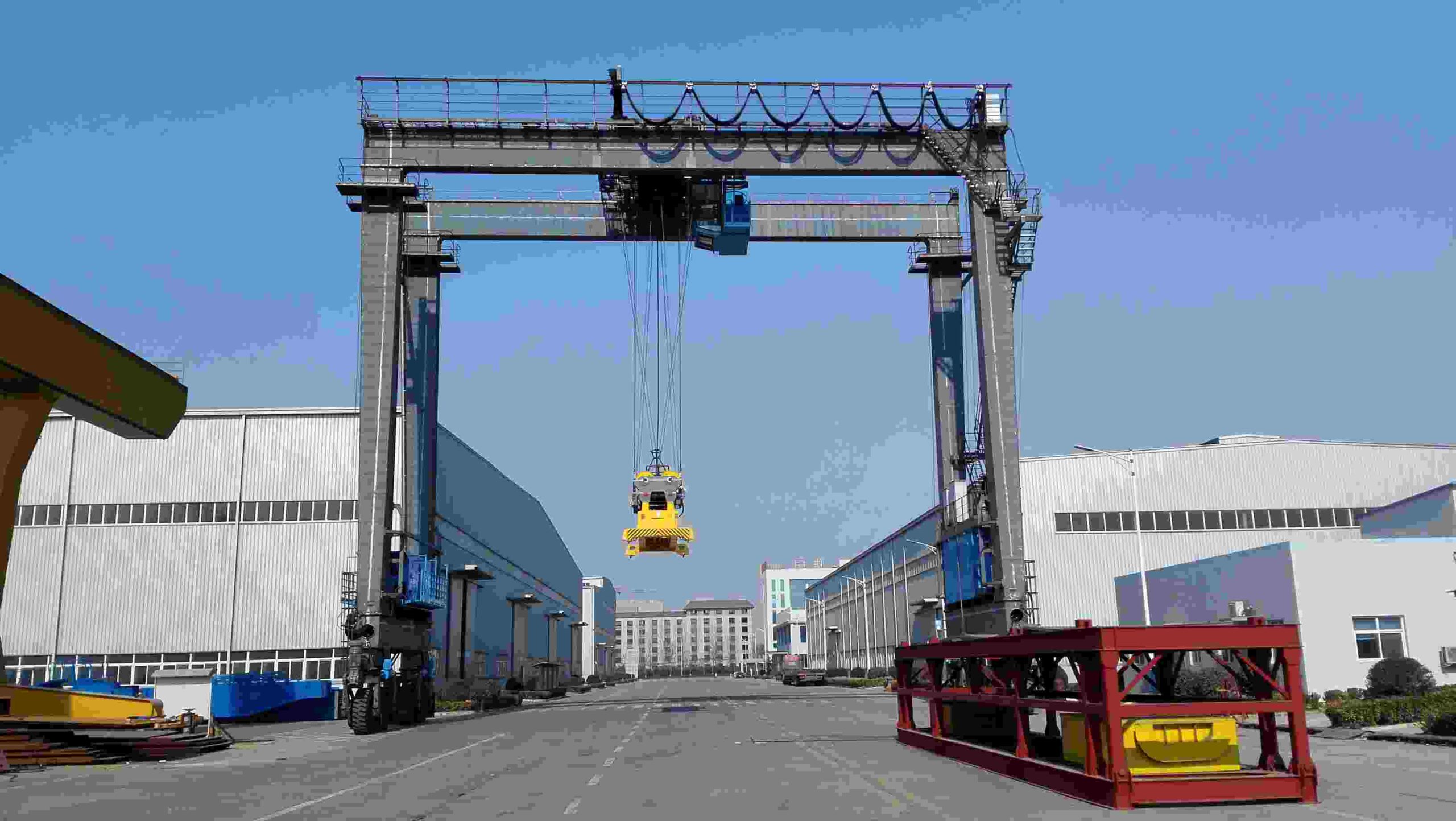
RTG crane, full name Rubber Tyred Gantry Crane (Rubber Tyred Gantry Crane), is a kind of gantry crane that relies on tires to support and move, and its core purpose is to stack containers in the yard block.
Unlike rail-type gantry cranes, it does not have to rely on fixed rails, and can move flexibly within the designated yard area, but the range of movement is mainly limited to the inside of the yard block, and is not suitable for long-distance transshipment across the block.
Henan Mine Crane's RTG cranes are suitable for different sizes of terminal yards around the world, no matter small and medium-sized inland ports or large coastal ports, they can be customized according to the actual needs of the stacking height and operating range.
Key Characteristics
RTG cranes are mainly powered by diesel-electric and hybrid models, and now more and more terminals tend to choose hybrid or pure electric models, which can not only reduce energy consumption, but also meet the requirements of environmental protection.
Its moving track is relatively fixed, mainly along the container rows, the operation range is concentrated in the fixed yard blocks, the turning radius is limited, not suitable for frequent adjustment of the operation area.
Stacking ability is its core advantage, usually can achieve 1-over-5, 1-over-6 stacking height, some large RTG can even reach 1-over-7, can greatly enhance the utilization of yard space.
It should be noted that RTG itself does not have long-distance horizontal transportation ability, must rely on the terminal tractor or trucks and other equipment, the container from the shore transfer to its operating area, which is one of the biggest difference between it and the straddle carrier.
What Is a Straddle Carrier?
Definition
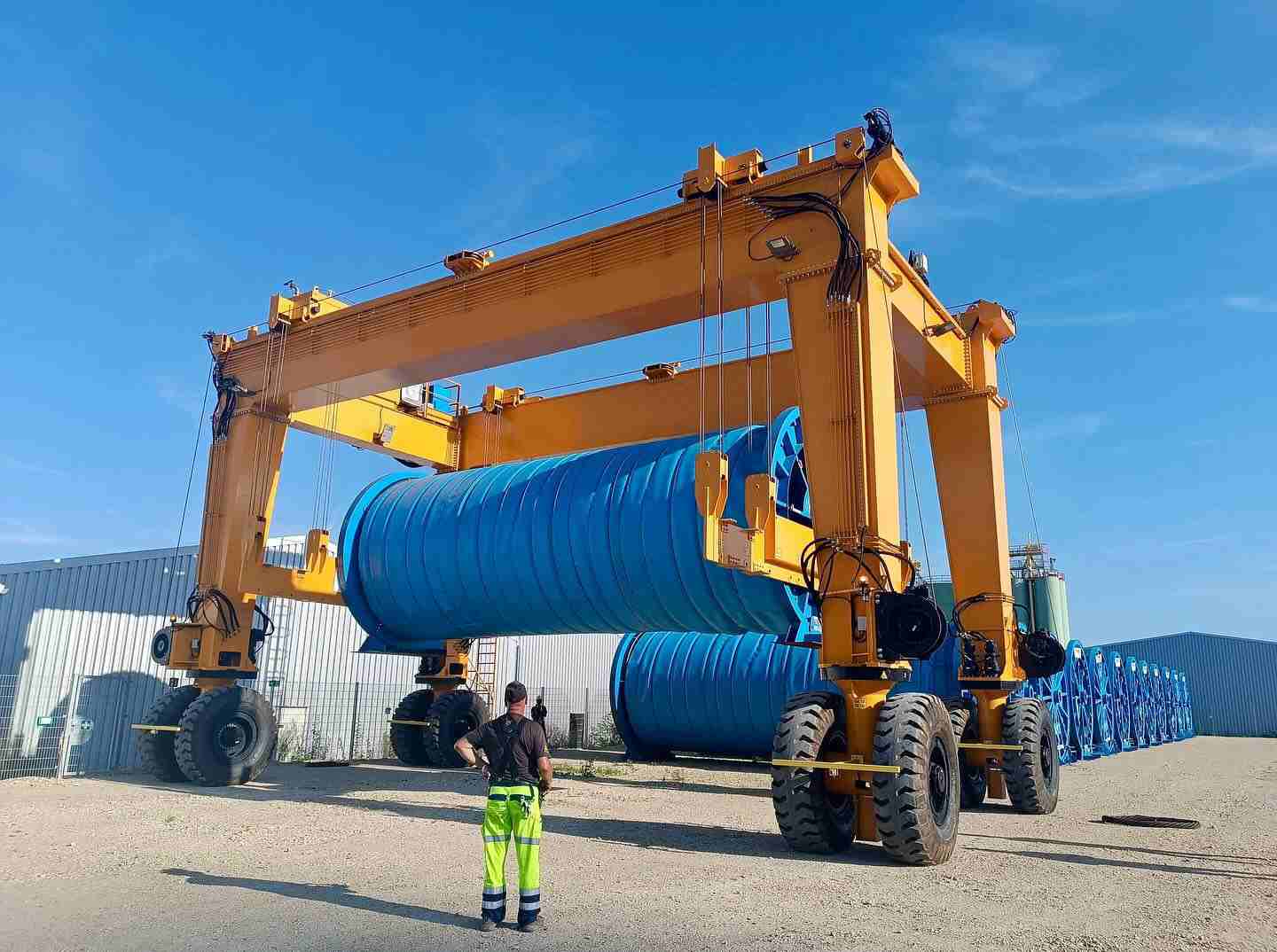
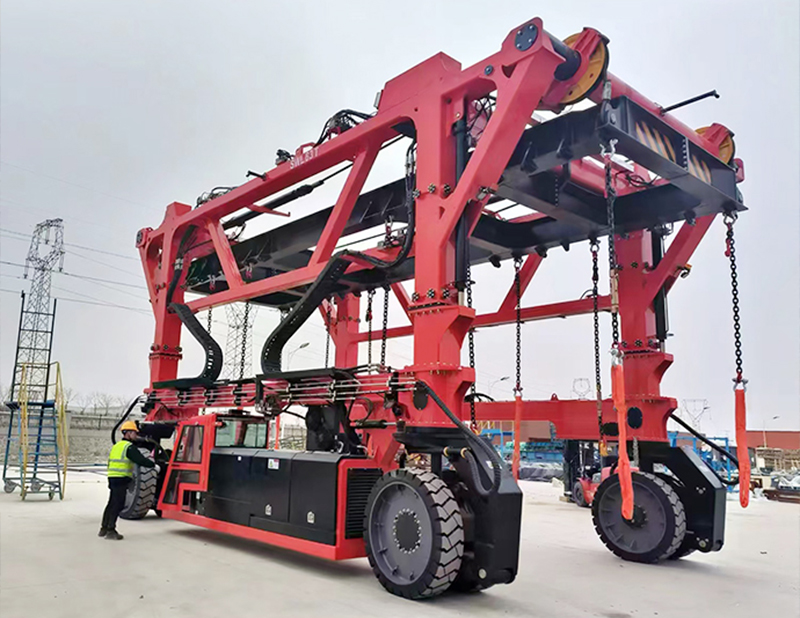
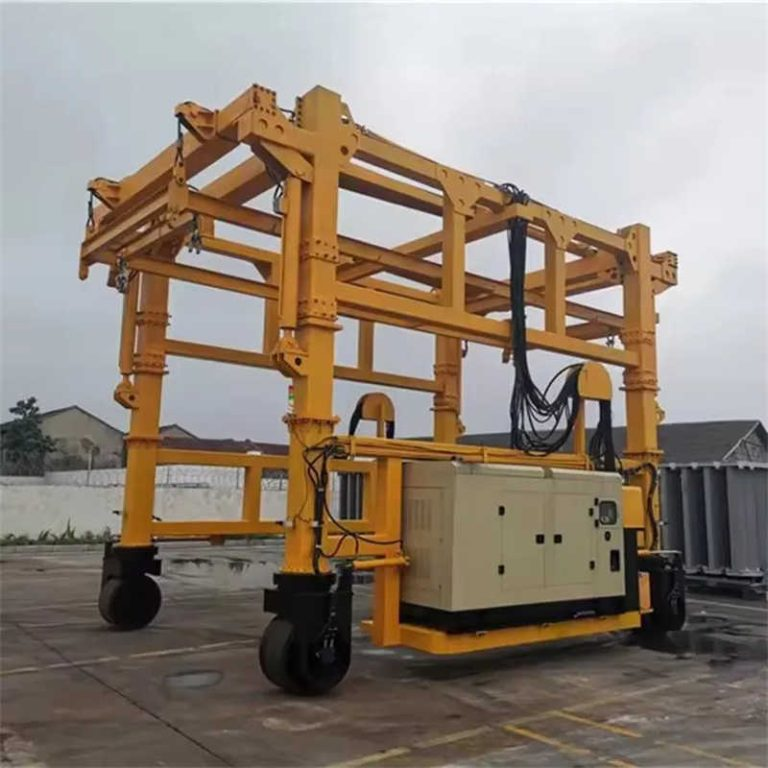
Straddle Carrier is a self-propelled container handling equipment, which, unlike RTG, can independently complete the lifting, transportation and stacking of containers without relying on other auxiliary equipment.
Its shape is similar to the “door” type, the container can be wrapped in its own frame, through the tires to achieve the full yard movement, not only from the STS crane under the box, but also directly to the designated location of the container stacking, to achieve the “one-stop” short-distance handling.
Henan Mine Crane also has straddle carriers for global terminals, which can be customized in terms of load capacity and stacking height for different short-distance handling needs, and are suitable for the flexible operation of medium-sized terminals.
Key Characteristics
Self-propelled is its core feature. It does not need rails or other traction equipment, and can be moved in any area of the yard, which is extremely flexible and suitable for terminals that need to adjust the operation area frequently.
Its container lifting method is completed within its own frame, and the lifting height is limited, usually can only realize 1-over-2 or 1-over-3 stacking height, which is far lower than RTG cranes.
The biggest advantage is the integration of transportation and stacking functions, can be directly from the STS crane under the box, and then transferred to the yard stacking, eliminating the intermediate horizontal transportation links, simplifying the operating process.
However, its operational efficiency is limited by the stacking height, which is suitable for terminals that do not require high density of the yard and pursue operational flexibility, and it is also a common flexible solution in the port horizontal transportation solution.
RTG vs Straddle Carrier - Technical Comparison
Below is a detailed comparison of RTG and straddle carrier from 7 core technical dimensions, combined with the actual operating scenarios, to help you more intuitively determine which equipment is more suitable for your terminal, which is also the core content of RTG vs straddle carrier comparison.
1. Mobility and Flexibility
The difference in mobility and flexibility directly determines the layout of the yard they are suitable for, the specific comparison is as follows:
| Factor | RTG | Straddle Carrier |
| Movement | Along yard rows | Full yard mobility |
| Turning radius | Limited | High flexibility |
| Block layout changes | Moderate | Highly flexible |
The flexibility of straddle carrier is much higher than RTG, it can move freely in the whole yard, with small turning radius, and can even turn around flexibly in the narrow area, which is very suitable for terminals with frequent adjustment of yard layout.
I have served a medium-sized terminal in Southeast Asia, whose yard needs to be adjusted at any time according to the arrival of ships, and finally chose the straddle carrier because of its high flexibility and its ability to quickly adapt to different operational needs.
RTG's movement range is mainly limited to fixed yard rows, with a large turning radius, and it takes more time to adjust the operation block, which is more suitable for structured yards with fixed layout and standardized operation flow.
2. Stacking Density
Stacking density directly affects the space utilization rate of the yard, especially in terminals with tight land resources, which is particularly important, the specific comparison is as follows:
| Factor | RTG | Straddle Carrier |
| Typical stacking height | 1-over-5 / 6 | 1-over-2 / 3 |
| Space utilization | High | Moderate |
| TEU per hectare | Higher | Lower |
The stacking density of RTG is much higher than that of straddle carriers, which can usually stack 5-6 layers of containers, and some large RTGs can reach 7 layers, and each hectare of yard can accommodate more TEUs, and the land utilization rate is extremely high.
Many small ports in Europe with tight land resources give priority to RTG cranes because it can maximize the yard capacity in a limited space, without additional land expansion, reducing land costs.
The stacking height of straddle carriers is low, usually only 2-3 layers can be stacked, the space utilization rate is medium, and the number of TEUs per hectare of yard is much lower than that of RTG, which is more suitable for terminals that have sufficient land resources and do not have high requirements for stacking density.
3. Infrastructure Requirements
The two types of equipment have different infrastructure requirements, which is also a key consideration in terminal planning and directly affects the pre-construction costs.
RTG cranes require heavy paved yard floor, especially the road surface in the operation area, which needs to be able to withstand the weight of RTG and the impact of the operation, and usually the road thickness needs to reach 15-20 cm.
At the same time, it is necessary to design dedicated yard lanes to ensure that the RTG can move along fixed rows and avoid conflicts with other equipment. In addition, as RTGs require separate horizontal transportation equipment, they also need to plan reasonable transportation routes to ensure smooth container transfer.
The infrastructure requirements of trans-loader are more complicated, it needs the whole yard floor to be reinforced and paved, and it cannot be limited to the operation area only, because it can move all over the yard, and any area may become the operation point.
And it needs wider traffic lanes to avoid collision with other equipment during operation, but it does not need additional horizontal transportation equipment, which can reduce the cost of transportation route planning.
Special attention needs to be paid to the issue of ground pressure, the ground pressure of the cross-traffic truck is large, if the road pavement is not in place, long-term operation will lead to ground subsidence, damage, and increase the cost of maintenance in the later stage, which is a point that many customers are prone to ignore. Henan Mine Crane will calculate the ground pressure in advance and give the reasonable pavement suggestion when doing the program for customers.
4. Capital Expenditure (CAPEX)
Many customers in the selection, only focus on the price of a single unit of equipment, ignoring the initial investment at the system level, which is a common misunderstanding. RTG and cross-traffic trucks need to be compared from the perspective of the entire system, not the price of a single unit of equipment.
An RTG system has a lower cost for a single piece of equipment, typically 15-20% less than a straddle carrier, but it requires additional horizontal transportation equipment such as terminal tractors or trucks, which also need to be factored into the initial investment.
For example, a medium-sized yard requires 10 RTG cranes and 20 terminal tractors to ensure smooth operations, and the overall initial investment is not low. Henan Mine Crane has done a program for a South American terminal, RTG single unit is cheaper than the transporter, but with the cost of the tractor, the initial investment in the system and the transporter system is basically the same.
The cost of a single unit of transporter system is higher because it integrates transportation and stacking functions, and the technical complexity is higher, but it does not require additional horizontal transportation equipment, which can reduce the number of equipment purchases and lower the initial investment at the system level.
For medium-sized terminals, the initial investment in a straddle carrier system may be more advantageous because it eliminates the purchase and maintenance costs of horizontal transportation equipment and simplifies the equipment management process.
5. Operating Cost (OPEX)
Operating cost is a core consideration for long-term terminal operations and includes fuel/energy costs, labor costs, and maintenance costs, which vary significantly.
In terms of fuel and energy, RTG mainly adopts diesel-electric or hybrid power, and some terminals will choose electrification transformation. After electrification, the energy cost of RTG is lower, and the electricity cost is only about 1/3 of the cost of diesel, which saves a lot of energy cost in long-term operation.
Cross-traffic vehicles are mainly diesel-powered, although there are also electric models gradually appeared, but the popularity is not high, diesel consumption is large, energy costs are relatively high, fuel costs usually account for about 40% of its operating costs.
In terms of labor cost, RTG needs a separate operator, each RTG is equipped with an operator, and also needs to be equipped with a terminal tractor driver, the labor cost is higher; transporter is an operator responsible for a piece of equipment, both to complete the transportation, but also to complete the stacking, do not need an additional driver, can significantly reduce the labor cost.
In terms of maintenance cost, RTG's maintenance focuses on tire wear, engine and lifting system, due to the fixed scope of operation, the wear of equipment is relatively uniform, the average annual maintenance cost is about 35,000 yuan; cross-transportation vehicle's maintenance focuses on tire wear, engine, steering system and lifting frame, with a wide scope of operation, tire wear is faster, the average annual maintenance cost is about 20,000 yuan, but the tire replacement frequency is higher, the long-term The average annual maintenance cost is about $20,000, but the tires are replaced more frequently, so the long-term maintenance cost is not low.
6. Automation Readiness
With the development of automated terminals, the automation suitability of equipment is more and more important, and the automation maturity of RTG and straddle carriers differs greatly, the specific comparison is as follows:
| Factor | RTG | Straddle Carrier |
| Remote operation | Common | Increasing |
| Full automation | Possible but complex | More challenging |
| Integration with TOS | Mature | Growing |
RTG's automation maturity is higher, remote operation has been very common, Henan Mine Crane's RTG cranes, can be easily docked to the terminal operating system (TOS), remote control and job scheduling, part of the RTG can also realize semi-automated operation.
Although the full automation of RTG is more complex to realize, but the technology has been relatively mature, many automated yards around the world, have adopted automated RTG systems, such as Kalmar's Kalmar One automation system, can be seamlessly integrated with RTG, to achieve the full yard automation operations.
The development of automation of cross-haul trucks is relatively lagging behind, and the application of remote operation is gradually increasing, but full automation is much more difficult to realize. Because it requires full yard movement, precise positioning and path planning are more difficult, and integration with TOS systems is not mature enough, it is more of a semi-automated operation mode at present.
If your terminal has a clear automation upgrade plan, give priority to RTG cranes, its automation adaptability is stronger, can be better integrated into the container yard automation equipment system.
7. Productivity and Throughput
The operational efficiency and throughput of the two, depending on the operational scenarios and processes, can not simply say which one is faster, the core difference lies in the operational logic.
RTG's stacking efficiency is very high, in a fixed yard block, it can quickly complete the stacking and extraction of containers, and it can complete 30-40 operations per hour, but its efficiency depends on the cooperation of horizontal transportation equipment.
If the turnover efficiency of the terminal tractor cannot keep up, RTG will have waiting time, affecting the overall throughput. For example, in a yard with an insufficient number of tractor-trailers, the RTG may be idle 30% of the time, preventing it from maximizing efficiency.
The advantage of straddle carriers lies in short-distance direct transfer, able to pick up boxes directly from under the STS crane and transfer them to the yard for stacking, eliminating the intermediate horizontal transportation link, moving faster over short distances, and shortening the cycle time from the shore bridge to the yard.
Especially in the terminals with shorter short-distance handling (within 500 meters), the transporter has higher operational efficiency, which can reduce the container handling link and improve the overall throughput. However, its stacking efficiency is low, and with the increase of yard density, the operational efficiency will obviously decrease.
Operational Workflow Comparison
The operational workflow of the two types of equipment is very different, which directly affects the operation mode and efficiency of the terminal. Below are two types of equipment-based yard operational workflow, which will help you determine the suitability more intuitively.
RTG-Based Yard Concept
RTG as the core of the yard operation process, the need for multi-equipment synergy, the specific process is: STS crane unloading containers → terminal tractor will be transferred to the container RTG operation block → RTG will be stacked to the designated location.
The advantages of this operation mode are obvious, the yard structure is clear, the stacking density is high, can maximize the use of yard space, suitable for high throughput, fixed layout of the terminal.
Henan Mine Crane serves a large domestic port, which adopts this mode, 10 RTGs with 20 terminal tractors, to realize the efficient operation of the yard, each hectare of the yard can accommodate more TEUs, and the throughput is greatly increased.
The disadvantages are also prominent. It is necessary to coordinate the operating rhythm of RTGs and tractor-trailers, and once the two are not properly coordinated, there will be waiting time, which affects the overall operating efficiency. For example, if the tractor is late, the RTG will be idle; if the RTG operates slowly, the tractor will wait in line.
Straddle Carrier-Based Yard Concept
Straddle Carrier-Based Yard Concept is a relatively simple yard operation process, which does not require the coordination of multiple equipment. The specific process is as follows: STS crane unloads the containers → Straddle Carrier-Based Yard Concept picks up the containers, transfers them to the designated location and completes the stacking.
The advantages of this mode of operation are fewer operational steps, high flexibility, transporter can independently complete the pick-up, transfer, stacking, without relying on other equipment, which can reduce equipment coordination costs, and at the same time can constitute an effective buffer between the shorebridge and yard operations to enhance the efficiency of shorebridge operations.
For example, for a medium-sized terminal, 3 sets of straddle carriers can be used to complete the operation with 1 set of shorebridge without additional tractor, which simplifies the operation process and reduces the management cost.
The disadvantage is that the stacking density is low, the utilization rate of the yard space is not high, and the straddle car is moving all over the yard, which requires good traffic management to avoid collision between the equipment, especially during the peak operation period, which is prone to traffic congestion.
Lifecycle Cost Analysis
10-20 Year Cost Perspective
Selection should not only look at the initial investment, but also pay attention to the full life cycle cost of 10-20 years, which is the key to determine the long-term return on investment. From the perspective of the whole life cycle, the cost differences between the two types of equipment are mainly reflected in the following aspects.
In terms of initial investment, the RTG system requires the procurement of RTG cranes and horizontal transportation equipment, with a higher initial investment; the straddle carrier system does not require additional horizontal transportation equipment, with a relatively low initial investment, but the price of a single straddle carrier is higher.
In terms of fuel/energy costs, RTG electrification has lower energy costs and can save a lot of money in long-term operation; cross-traffic trucks are mainly diesel-powered and have higher energy costs, especially in the case of rising fuel prices, the operating costs will increase significantly. Pure electric transporters have low energy costs but high initial investment, which is suitable for terminals with long-term planning.
In terms of tire replacement frequency, the tires of straddle car wear faster and usually need to be replaced every 1-2 years, while the tires of RTG wear relatively slower and need to be replaced every 3-4 years, which makes the tires of straddle car more costly to replace in the long run.
In terms of maintenance downtime, RTG's maintenance is relatively simple and the maintenance downtime is shorter, usually 10-15 days per year, while the maintenance complexity of straddle carriers is higher and the maintenance downtime is longer, about 15-20 days per year, which affects the terminal's operational efficiency.
As for the trend of labor cost, as the labor cost rises year by year, the pressure of labor cost of RTG will be more and more big, while trans-carrier can reduce the number of labor, in the long run, the advantage of labor cost will be more and more obvious.
Overall, in high density, high throughput terminals, RTGs have lower whole life cycle costs and can realize better long-term return on investment; in medium-sized, low density terminals, straddle carriers have more advantageous whole life cycle costs and can reduce operational complexity and costs.
Standards and Compliance
For global terminals, standards compliance is critical. Especially for export projects, it is essential to meet international standards and local port specifications, otherwise acceptance will not be possible and project progress will be jeopardized, RTGs and straddle carriers need to comply with the following standards and requirements.
Common International Standards
ISO 4301 is the common international standard for crane classification, of which ISO 4301-5:2025 is specifically for bridge and gantry cranes. RTG cranes need to comply with this standard, which specifies the classification of the equipment, safety requirements and design specifications.
FEM standard (European Material Handling Federation standard), mainly regulating the structure of cranes and working class classification, RTG and straddle carriers are usually working class A7-A8, this level of equipment, can withstand high-frequency, high-load continuous operation, in line with the terminal's high-intensity operational needs.
In addition, straddle carriers need to comply with relevant vehicle safety standards to ensure the safety of personnel and equipment during operation. Henan Mine Crane's RTGs and straddle carriers all comply with the above international standards, and we can provide complete certification documents to ensure that the projects of our global customers can pass the acceptance smoothly.
Port-Specific Requirements
In addition to international standards, different ports also have their own specific requirements, mainly focusing on three aspects.
Firstly, environmental regulations, the emission requirements of port equipment are becoming more and more stringent in different countries around the world, such as the EU's Euro V and VI emission standards, and North America's EPA emission standards, and Henan Mine Crane's RTGs and straddle carriers can be customized according to the local environmental protection requirements to meet the standard power system and avoid the risk of compliance.
Henan Mine Crane will optimize the design of the equipment according to the specific specifications of the ports to ensure that the equipment will not damage the road surface during operation and at the same time meet the road surface load-bearing requirements.
Henan Mine Crane will optimize the design of the equipment according to the specific specifications of the port to ensure that the equipment will not damage the road surface during operation and at the same time meet the requirements of road surface bearing. Thirdly, the safety and protection requirements of the equipment, such as wind-resistant system, anti-collision system, etc., especially in coastal ports, which require the equipment to have a strong wind-resistant capability.
When to Choose RTG for Short-Distance Handling
Combined with the practical cases of terminals around the world, in the following cases, RTG cranes are preferred to achieve a higher return on investment and better suit the needs of the terminal.
If your terminal has high container throughput and needs to handle a large number of containers every day, give priority to RTG, which has high stacking efficiency, can quickly complete the stacking and extraction of containers, together with the horizontal transportation equipment, can support the high throughput of operational needs.
When land resources are tight and the density of the yard needs to be improved, RTG is preferred; its high stacking height can store more containers on the limited land and reduce the cost of land occupation, which is also the reason why terminals in Europe, Asia and other areas with tight land resources prefer RTG.
Fixed yard layout with structured block design, RTG is preferred. it has a fixed operating range and can be better adapted to structured yards to improve operating efficiency and reduce equipment adjustment time.
For terminals with an electrified or hybrid energy strategy, RTGs are preferred, as their proven electrification technology reduces energy costs and meets environmental requirements, making them suitable for terminals that emphasize green operations.
When to Choose Straddle Carrier
When to Choose Straddle Carrier is preferred for the following situations, it can simplify the operation process, reduce the management cost, and adapt to the flexible operation requirements of the terminal.
For medium-sized terminals with medium throughput, straddle carriers are preferred. Its operation process is simple and does not require additional horizontal transportation equipment, which can reduce equipment purchase and management costs, and is suitable for the operation scale of medium-sized terminals.
If the yard operation needs to be adjusted flexibly, such as changing the operation block frequently, the transporter is preferred. It is highly maneuverable and can move freely throughout the yard, quickly adapting to different operational needs without frequent adjustments to the equipment layout.
If you do not require high stacking height and do not need to pursue high yard density, you should give priority to transporters. Although its stacking height is low, it can meet the storage needs of medium-sized terminals, and at the same time has higher operational flexibility.
If you want to simplify the operation mode and reduce the cost of equipment coordination, give preference to straddle carriers. It can pick up, transfer, and stack containers independently without having to coordinate the operating rhythm of RTGs and tractor-trailers, which reduces the difficulty of operation management.
Common Buyer Mistakes
Combined with so many years of global terminal consulting experience, I summarize five of the most common mistakes customers make when selecting a model, many terminals have stepped into these pits, and I hope you can avoid them.
Comparing only unit price instead of system cost
This is the most common misunderstanding, many customers only look at the price of a single unit of equipment, think RTG single unit is cheap, then prioritize RTG, ignoring the initial investment in the system level.
RTG needs to be equipped with additional horizontal transportation equipment, the investment of these equipment plus the purchase cost of RTG, the initial investment of the system may be higher than the cross-truck system. The correct approach is to compare the initial investment of the entire system, not the price of individual pieces of equipment.
Ignoring pavement engineering impact
Many customers only focus on the equipment itself, ignoring the requirements of the equipment on the yard pavement, resulting in damage to the pavement at a later stage, increasing maintenance costs.
The ground pressure of cross-truck is large, and the whole yard needs to be reinforced and paved; although RTG only needs to be paved in the operation area, it also needs to reach a certain thickness and load-bearing capacity. Henan Mine Crane will calculate the ground pressure in advance and give reasonable pavement suggestions to avoid problems in the later stage.
Underestimating tire lifecycle cost
Tires are the wearing parts of two kinds of equipments, and many customers underestimate the replacement cost of tires, especially for straddle trucks, the tires wear out faster and are replaced more frequently.
Tire costs for crossover trucks usually account for 15-20% of operating costs, which is a significant expense in the long run. When selecting a model, you need to account for the frequency and cost of tire replacement and incorporate it into the whole life cycle cost analysis.
Overlooking automation roadmap
Many customers do not consider the automation upgrading plan of the terminal when selecting the model, and choose the equipment with poor automation adaptability, resulting in the later inability to integrate into the automation system, and need to invest in additional transformation costs.
If your terminal has a long-term automation plan, give priority to RTG cranes, which have a higher degree of automation maturity, can be better integrated into the automated yard system, to avoid the trouble of later transformation.
Not calculating land utilization value
In terminals with tight land resources, many customers do not calculate land utilization value and choose straddle carriers with low stacking density, resulting in the need for additional land expansion and increased land costs.
RTGs with high stacking density can store more containers on limited land and reduce land occupation costs. In the long run, the value of land utilization is much higher than the price difference of the equipment itself.
Decision Checklist for Terminal Planners
In order to facilitate terminal planners to quickly determine which equipment to prioritize, I have compiled a decision checklist, against the check, you can quickly make a choice to avoid selection errors.
1. What is the annual TEU throughput target of the terminal? For high throughput, prioritize RTGs, and for medium throughput, consider straddle carriers.
2. How many hectares of yard space are available? If land is tight and high density is pursued, RTG is preferred; if there is sufficient land, intermodal trucks can be considered.
3. What is the design capacity of the yard surface? Can it meet the ground pressure requirement of trans-shipment vehicles? The road surface cannot be strengthened extensively, give priority to RTG.
4. Does the terminal have a clear automation upgrade plan? If there is an automation plan, RTG is preferred; if there is no automation requirement, cross-docking trucks can be considered.
5. What is the fuel/energy cost forecast for the next few years? High energy cost, prefer electrified RTG; low energy cost, consider trans-shipment truck.
6. What is the labor cost structure of the terminal? For high labor cost, prefer cross-dockers; for low labor cost, consider RTGs.
Frequently Asked Questions
Q1: Which is faster for short-distance movement?
The straddle carrier is faster for short-distance movement. It can pick up the boxes directly from the STS crane and transfer them to the yard for stacking, eliminating the intermediate horizontal transportation, which is especially advantageous for short-distance movement within 500 meters.
However, if it is a high-density yard, the stacking efficiency of RTG is higher, and the overall operational throughput is more advantageous than that of straddle carriers.
Q2: Which system offers higher stacking density?
RTG system offers higher stacking density. 1-over-5 or 1-over-6 stacking heights can be achieved, and more TEUs per hectare can be accommodated in the yard, thus the land utilization rate is much higher than that of straddle carriers.
The stacking height of straddle car is usually only 1-over-2 or 1-over-3, which has medium space utilization rate and is suitable for terminals that do not require high stacking density.
Q3: Which has lower lifecycle cost?
It depends on the size of the terminal and the stacking density. For high throughput, high density terminals, RTG has lower lifecycle cost because of its low energy cost and high stacking efficiency, which can dilute the initial investment and operation cost.
For medium-sized, low-density terminals, the TLC of a straddle carrier is more advantageous because it reduces labor costs and equipment coordination costs, and simplifies operational processes.
Q4: Can both be electrified?
Yes, they can. The electrification of RTG cranes is now very mature, and many terminals have opted for pure electric or hybrid RTGs, which can significantly reduce energy costs and meet environmental requirements.
There are also electric models of straddle carriers, but their popularity is not high at the moment, and they are mainly diesel-powered. The initial investment of electric transporters is higher, but the long-term energy cost is lower, which is suitable for terminals with long-term planning and focus on green operation.
Q5: Which is better for automation?
RTG cranes are better for automation. Its automation is more mature, remote operation, semi-automated operation has been very common, and it can be easily connected to the TOS system to realize the whole yard automation operation.
The automation of straddle carriers is more difficult to realize, and at present it is more semi-automated operation. Full automation technology is still under gradual development, and it is suitable for terminals without clear automation planning.
Conclusion
Talking about this, I believe you are already clear about the core differences between RTG cranes and straddle carriers, and also know how to choose the right short distance container handling equipment for their terminals.
In fact, there is no absolute “better”, only “more suitable”. RTG crane's core advantage is structured, high-density, scalable, suitable for high throughput, land constraints, automation planning of the terminal; cross-transportation truck's core advantage is flexibility, Integration, suitable for medium-sized, low-density, the pursuit of simplified operation of the terminal.
The core of selection is to combine the size of your terminal, throughput, land resources, automation planning and cost budget, comprehensive judgment, do not just look at the price of a single piece of equipment, but also focus on the initial investment in the system level and long-term life cycle costs.
Henan Mine Crane Factory Custom
Henan Mine Crane has been focusing on the design, production and service of heavy-duty port equipment for more than 20 years, and has provided RTG and transporter solutions for terminals in more than 50 countries and regions around the world, accumulating rich experience in selection and operation.
Whether you need RTG cranes with high stacking density or flexible and efficient straddle carriers, we can customize the equipment to meet international standards according to your specific needs, and provide professional support from selection consulting, design and production, to installation and commissioning, after-sales maintenance, to help you avoid selection misunderstandings and reduce operating costs.
If you have a yard layout plan, you are welcome to submit it to us, and we will do a customized RTG vs Straddle Carrier system analysis for you; you can also contact our engineering team to get a life cycle cost comparison report, or download the “Container Yard Equipment Selection Guide”, to help you make the most suitable choice.