
What Safety Features Does QDY Crane Have for Molten Steel Lifting
Lifting a ladle of molten steel at 1,600°C is not a task that tolerates equipment failure. A dropped load, a snapped wire rope, or an overheated motor in this environment can shut down a production line for weeks, or worse, put workers in the path of liquid metal. That is why steel mills and foundries don't rely on standard overhead cranes for this work. They use QDY cranes: a class of double-girder overhead crane purpose-built for handling molten metal, ladles, and other high-temperature materials.
This guide breaks down exactly what safety features a QDY crane has for molten steel lifting, why each one exists, and what to look for when evaluating a crane for your own steel plant, foundry, or metal processing facility. It's written for plant engineers, procurement managers, and project teams who need to understand crane safety specifications well enough to compare suppliers and write accurate procurement requirements.
What Is a QDY Crane?
Henan Mine Crane manufactured QDY crane is a double-girder overhead crane engineered specifically for lifting and transporting molten metal — most commonly molten steel and molten iron, inside steelmaking and foundry workshops. The "QDY" designation in Chinese crane manufacturing standards distinguishes this crane type from the general-purpose QD double-girder bridge crane by adding a defined set of safety upgrades for high-temperature, high-risk lifting.
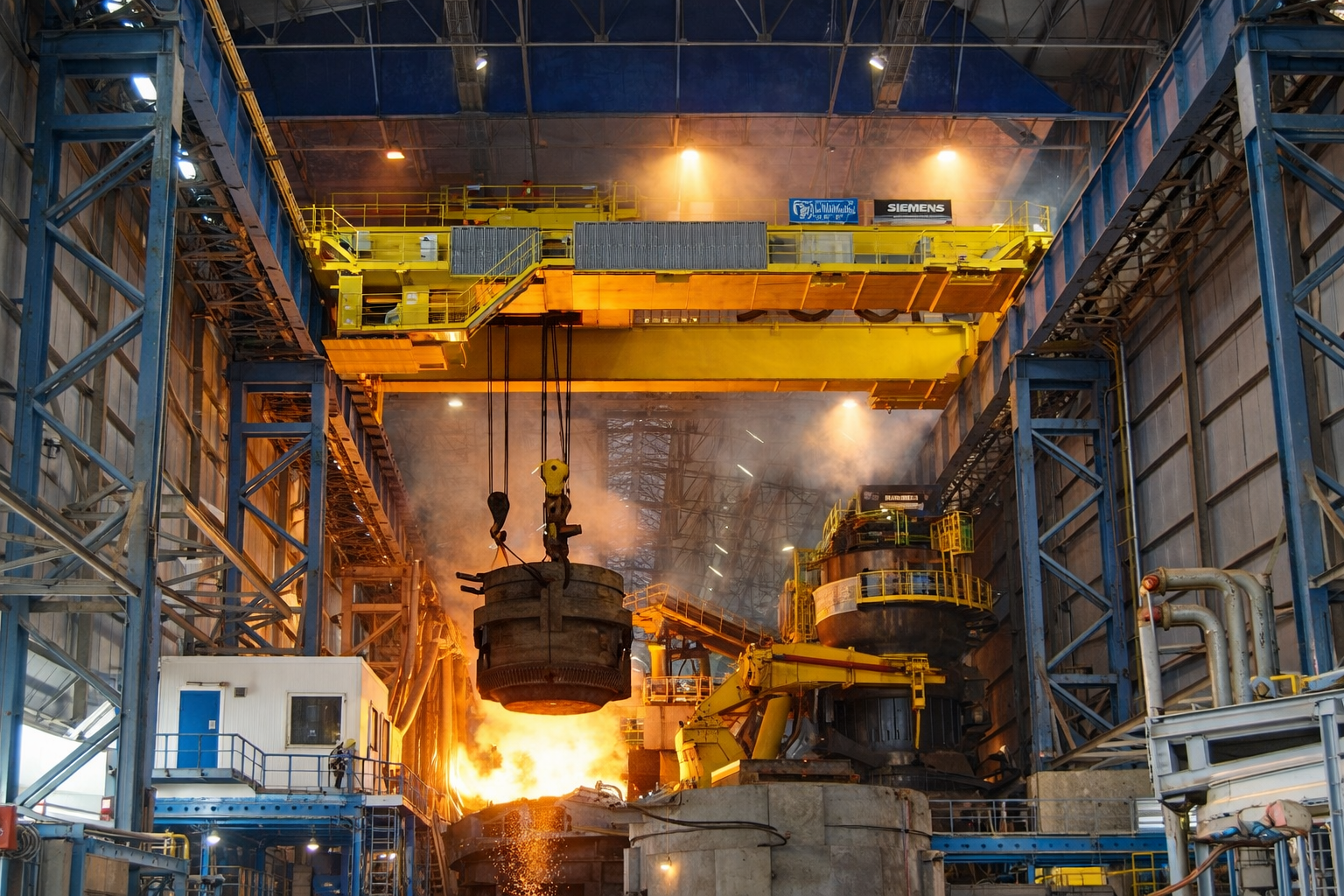
In a typical steel mill, a QDY crane moves ladles of liquid steel between the electric arc furnace (EAF) or basic oxygen furnace (BOF), the refining station, and the continuous casting machine. In foundries, the same crane design handles molten iron or molten metal ladles between melting furnaces and casting stations. Because the cargo is liquid metal rather than a fixed, rigid load, the crane has to manage risks that a standard industrial crane was never designed for.
The key difference between a QDY crane and a standard overhead crane comes down to redundancy and thermal protection. A standard crane has a single hoisting brake, standard-grade wire rope, and no special heat shielding, adequate for general material handling, but not for a load that radiates extreme heat and that absolutely cannot be dropped. A QDY crane is built around the assumption that any single point of failure in the lifting path could be catastrophic, so nearly every critical mechanical and electrical component has a backup.
Why Is Molten Steel Lifting So Dangerous?
Before looking at specific safety features, it helps to understand exactly what risks they're designed to address.
Extreme temperatures and thermal radiation: Molten steel sits in the 1,500–1,650°C range. Components positioned near the ladle, wire rope, the hook, the lower trolley structure, and nearby cabling, are exposed to continuous radiant heat that can degrade ordinary steel, insulation, and lubricants over time.
Risk of molten metal splashes: The potential also exists for a splash or spill of metal if there is a mechanical failure during pouring or transfer. This could damage plant, ignite other parts of the process and endanger operators and the floor staff.
Heavy concentrated loads: Ladle cranes generally carry loads in the range of around 5 tons up to several hundred tons in a single lift; the load is in these cases fully concentrated at a single hook and lifting point. There is no means of sharing out or passing the load mid-lift in case of a problem.
Prolonged operation production: Another characteristic of steel mill operation is 24-hour, 7-day-a-week operation. Cranes in such an environment are run under nearly continuous duty cycles instead of random lifts. This increased usage over time causes fatigue of brake, ropes and bearings, and safety factors must consider thousands of cycles of operation, not simply maximum load capacity.
Human safety and equipment protection requirements: Operators, ladle handlers, and floor crew all work in proximity to the lift path. Any safety system on the crane has to protect both the people nearby and the surrounding furnace, casting, and refining equipment, which represents a major capital investment in its own right.
Because every one of these risk factors can compound, a hot, heavy, continuously-cycled load with no fallback if a single component fails, QDY crane design treats redundancy as a baseline requirement, not an optional upgrade.
Core Safety Features of a QDY Crane
Dual Brake System
QDY cranes use two independent braking systems on the hoisting mechanism rather than one. If the primary brake fails or doesn't fully engage, the secondary brake holds the load. This single design choice is widely treated as the defining safety feature of a ladle crane, because it directly addresses the worst-case failure scenario: an uncontrolled load drop. The two brakes act independently, meaning a failure in one electrical or mechanical circuit doesn't disable both at once. In an emergency stop, both brakes also provide a faster, more reliable stopping response than a single-brake system could.
Double Hoisting Limit Protection
A QDY crane is fitted with both a primary and a backup (secondary) upper limit switch on the hoisting mechanism. The primary switch cuts power to the hoist motor when the hook reaches its upper travel limit during normal operation. The secondary limit switch exists purely as a backup, if the first switch fails to trigger for any reason, the second one cuts power before the hook block can be driven into the trolley structure. For cranes with significant hoisting height, a rotary or heavy-hammer limiting device is added as a further layer of protection. This double-limit design prevents over-hoisting accidents, which can otherwise damage the rope, the hook, and the trolley frame, or in a worst case, drop the load.
Heavy-Duty Heat-Resistant Hoisting Mechanism
Everything in direct proximity to the ladle is upgraded to handle sustained radiant heat. This includes high-temperature-rated steel wire rope (rather than standard-grade rope, which loses strength faster under heat exposure), heat-resistant hooks, and thermal protection sleeves or shielding on nearby mechanical components. These upgrades aren't cosmetic, wire rope and hooks are the components carrying 100% of the load, so any heat-related degradation here directly threatens lifting safety.
Dual Motor or Redundant Drive Design
On larger or higher-risk configurations, the hoisting mechanism uses a redundant drive arrangement rather than a single motor and gearbox path. If one drive component underperforms or fails, the backup transmission path can maintain control of the load or bring it to a safe stop, rather than leaving the crane with no power transmission at all. This redundancy also reduces unplanned production downtime, since a single motor or drive-train fault doesn't necessarily take the whole crane out of service.
Anti-Overload Protection
Such an overload limiter constantly compares the real load on the hook to the rated capacity of the crane. If the load is too high, it will halt hoisting and set off an alarm, rather than allowing the load to continue to lift into an overload state. Thus the wire rope, hook, the hoisting gear and the steel work of the crane are not subjected to loads they were not designed to take, and there is no human factor of misjudging the load, important when the pounds of load plus contents in the ladle is variable from lift to lift.
Variable Frequency Drive (VFD) Control
VFD control allows the hoisting and trolley motors to start, accelerate, and decelerate smoothly rather than in abrupt steps. For molten steel lifting, this matters in two ways: it minimizes load swing during transport (a swinging ladle near furnace or casting equipment is a serious hazard), and it gives the operator precise, fine-grained control when positioning a ladle directly over a casting mold or tundish — a step where a few centimeters of error can mean a spill.
Emergency Stop System
A dedicated emergency stop function allows the operator, or in some configurations a remote safety system, to immediately cut power to all crane motions the moment an abnormal condition is detected. This is typically integrated with the plant's broader safety system, so an emergency stop on the crane can be triggered from multiple points, not just the operator's cab. Combined with the dual brake system, the emergency stop function ensures the crane can reach a controlled, held stop rather than coasting or free-falling.
Electrical Safety Protection
Henan Mine Crane manufactured crane's electrical system uses insulated components rated for the ambient heat near a molten metal operation, along with heat-resistant cabling that won't degrade or short under continuous thermal exposure. Built-in short-circuit and overload protection on the electrical side prevents fires and equipment damage that could otherwise result from a fault in a high-temperature environment where standard cable insulation would be at risk.
Structural Safety Features Designed for Molten Metal Service
Reinforced Box Girder Structure
Henan Mine Crane manufactured QDY cranes are typically built with a reinforced box-girder main structure rather than a lighter I-beam or truss design. The box girder offers higher structural rigidity under heavy, repeated loading, reduces deformation over the crane's service life, and provides better long-term fatigue resistance — an important factor given that these cranes often run continuous 24/7 duty cycles for years at a time.
Heat Shield Protection
Heat shielding is added at points where the structure or electrical components sit closest to the ladle, most importantly along the underside of the main girders, where radiant heat from the load below would otherwise have a direct line to the steel structure. Motors and electrical cabinets located near the hoisting path are similarly shielded. This protection extends component lifespan significantly compared to an unshielded design operating in the same environment.
High Safety Factor Design
Structural calculations for QDY cranes use conservative safety margins well beyond what a standard-duty crane would require, specifically to account for the heavy, continuous-cycle, high-temperature conditions of molten metal handling. This higher safety factor is one of the main reasons QDY cranes are rated for the heaviest standard duty classifications, and it's a key point to verify when comparing manufacturer specifications.
Reliable Ladle Hook Design
The hook itself is not a modification of a more general purpose hook to serve the purpose of handling a ladle. It is specifically made to engage safe and firmly a ladle‘s lifting trunnions or ears so that it does not unhook itself midway through the transfer unlike general industrial hooks it is not specifically designed to prevent this.
Intelligent Safety Technologies Available on Modern QDY Cranes
PLC Intelligent Control
The crane incorporates a programmable logic controller that integrates all of the safety systems, allowing information about the status of the load, brake, motor and limit switches to be continuously fed back to the control system. When loaded conditions are outside acceptable limits, the job can be highlighted automatically by the PLC to the operator, and in certain cases stored for subsequent analysis by maintenance staff that allows individual mechanical safeties to function as part of a integrated monitored system.
Remote Monitoring System
Remote monitoring extends that same visibility beyond the cab, allowing maintenance and safety teams to track equipment status, receive maintenance alerts, and collect operating data for predictive maintenance. Catching early signs of brake wear or motor strain before they become failures is one of the most effective ways to keep a crane's built-in safety systems performing as designed over years of service.
Anti-Collision System
In workshops where multiple cranes share the same runway, an anti-collision system uses sensors to detect when two cranes are approaching each other and automatically slows or stops their movement before contact occurs. This is essential for multi-crane bays around continuous casting lines, where collision risk would otherwise limit how closely cranes can safely operate, and avoiding that risk directly improves workshop throughput.
Load Display and Monitoring
A real-time load display gives the operator continuous visibility into exactly how much weight is on the hook, rather than relying on estimation. This supports safer lifting decisions on every cycle and adds a layer of operational transparency that overload protection alone doesn't provide, since the operator can see the load approaching capacity before any automatic safeguard intervenes.
Safety Standards and Testing for QDY Cranes
Henan Mine Crane Factory supply QDY crane isn't safe simply because it has the right list of features on paper, it has to be manufactured, tested, and certified to confirm those features actually perform as designed. Reputable manufacturers put each crane through a defined testing process before it ships, including factory load testing at and above rated capacity, mechanical performance testing of the hoisting and travel mechanisms, electrical safety inspection of all wiring and control systems, non-destructive weld inspection on structural joints, and fatigue and reliability verification appropriate to the crane's duty classification.
Industry duty-class systems, including China's GB/T 3811 standard and Europe's FEM classification — categorize cranes from light duty (A1–A4) through heavy and extra-heavy duty (A7–A8). Ladle and foundry cranes handling molten metal are almost always rated A7 or A8, reflecting both their heavy, concentrated loads and their near-continuous operating cycles in steel mill environments. When evaluating a QDY crane, confirming its duty classification against your facility's actual production tempo, and confirming the manufacturer can show compliance documentation, not just a stated rating, is one of the most reliable ways to verify that the safety margins described above are real and not just marketing language.
Best Practices for Safe Molten Steel Lifting
Even the best-engineered crane depends on consistent operating and maintenance discipline to stay safe over its service life. Plants running QDY cranes should build their safety program around a few core practices:
- Daily pre-operation inspectionsof brakes, hooks, limit switches, and visible wire rope condition before the first lift of each shift.
- Regular brake maintenance, since the dual brake system's redundancy only protects the load if both brakes are independently maintained and tested,not just the primary one.
- Wire rope and hook inspectionson a defined schedule, watching specifically for heat-related wear that wouldn't appear on a rope rated for standard ambient conditions.
- Documented safe lifting proceduresfor each load type and lift path, particularly around furnace bays and casting stations where clearance is tight.
- Operator trainingfocused specifically on molten metal handling, not generic overhead crane operation, given how different the failure consequences and warning signs are in this environment.
- Scheduled preventive maintenanceon the drive systems, PLC controls, and electrical components, rather than a purely reactive maintenance approach.
- Emergency response planningthat covers crane-specific failure scenarios — a stuck brake, a load swing near a casting station, or a power interruption mid-lift — so floor staff know exactly what to do in the moments that matter most.
How to Choose a Safe QDY Crane for Your Steel Plant
Verify Working Duty Classification
Confirm the crane's rated duty class (A7, A8, or equivalent under your governing standard) actually matches your production tempo, lift frequency, average load, and hours of continuous operation, rather than accepting a generic "heavy duty" label without supporting documentation.
Evaluate Redundant Safety Systems
Ask suppliers to specify, in writing, exactly how braking, hoisting limits, and electrical protection are made redundant on the specific model you're quoting. Dual brake system and overload protection should be backed by component-level detail, not just listed as bullet points in a spec sheet.
Consider Environmental Conditions
Span, lifting height, ambient temperature at hook level, dust levels, and workshop layout all influence which safety and thermal-protection configuration is appropriate. A crane spec that works for one bay's furnace-to-caster distance and heat profile may be undersized or over-specified for another.
Work with an Experienced Manufacturer
Engineering customization, responsive technical support, documented quality control during manufacturing, and reliable after-sales service all affect whether a crane's safety features keep performing as designed years into operation — not just on delivery day. A manufacturer with direct steel-mill and foundry crane experience is far more likely to flag application-specific risks that a generalist crane supplier would miss.
Frequently Asked Questions
Can a standard overhead crane lift molten steel?
No. Standard overhead cranes lack the dual braking, heat-resistant components, and overload protection that molten steel lifting requires. Using a general-purpose crane for this application creates serious safety risks and typically falls outside what the crane was designed and rated for.
Why do QDY cranes use dual braking systems?
Because a dropped ladle of molten steel is one of the most severe failure outcomes possible in a steel mill. A second, independent brake ensures the load can still be held safely even if the primary brake fails or doesn't fully engage.
How often should safety inspections be performed?
At minimum, a visual pre-operation check should happen before each shift, with more detailed brake, rope, and limit-switch inspections on a defined weekly or monthly schedule depending on duty cycle. Continuous, high-duty operations generally warrant more frequent checks than occasional-use applications.
What is the typical lifting capacity of a QDY crane?
Capacities vary widely by application, from a few tons for smaller foundry ladles up to several hundred tons for large steel mill ladle handling. The right capacity depends on ladle size, production volume, and the specific bay it will operate in.
Are QDY cranes suitable for continuous steel production?
Yes, they're specifically designed for the high-frequency, continuous-cycle conditions typical of steelmaking and continuous casting operations, which is why they're commonly rated for the heaviest duty classifications.
Can QDY cranes be customized for different ladle sizes?
Yes. Henan Mine Crane manufacturers customize span, lifting height, hook design, and capacity to match specific ladle dimensions, weights, and workshop layouts, rather than offering a single fixed configuration.
Henan Mine Crane Factory Custom
Henan Mine Crane manufactured QDY crane delivers safe molten steel handling by combining redundant braking, heat-resistant components, overload protection, reinforced structural design, and intelligent control systems. Together, these features reduce operational risks, improve lifting precision, and support reliable performance in demanding steel mills and foundries where continuous production leaves no room for equipment failure.
Every steel plant has unique lifting requirements, from ladle capacity and span to workshop layout and operating conditions. Henan Mine Crane Factory can customize a QDY crane to match your application, helping you achieve higher safety standards, greater operating efficiency, and long-term reliability. Whether you're building a new facility or upgrading existing equipment, a properly engineered molten metal crane solution can provide dependable performance throughout its entire service life.