
Automated RMG vs Manual RMG Crane Which Improves Efficiency More
Rail gantry crane is the core equipment for container logistics, operational efficiency directly affects the yard turnover, operating costs and competitiveness. The current container throughput surge, site congestion is prominent, many enterprises are confused, automation and manual rail gantry cranes which can improve efficiency, we will combine industry data and hands-on experience from multiple dimensions to disassemble, to help enterprises choose the appropriate equipment.
Why RMG Efficiency Matters in Modern Container Yards
Accelerated integration of global trade and cross-border logistics upgrading, promoting container throughput year by year, especially coastal hub ports, inland waterless ports, often faced with intensive storage of goods, vehicle congestion, turnover lag and other pain points. According to industry statistics, every 10% improvement in the operational efficiency of the container yard, the overall logistics costs can be reduced by 8%, and RMG cranes, as the core equipment for container storage, loading and unloading, transshipment, directly control the core efficiency of yard operations.
In ports and intermodal hubs, RMG cranes have become the core equipment for vertical container storage and horizontal transshipment by virtue of the stability of rail travel and the advantages of large-span operation, assuming the role of a key hub connecting the quay bridge, collector trucks and railroad wagons, and its operational efficiency directly affects the smoothness of the entire logistics chain.
With the promotion of industry 4.0 and smart port construction, automation, digitalization, intelligence has become an inevitable trend of industry transformation, more and more ports and logistics enterprises began to layout automation RMG system, trying to crack the efficiency bottleneck through technological upgrading. But at the same time, manual RMG cranes still play an irreplaceable role in many scenarios by virtue of their flexibility and low-cost advantages.
What Is an RMG Crane?
Definition and core functions
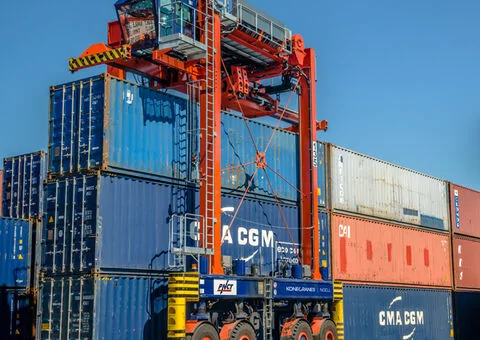
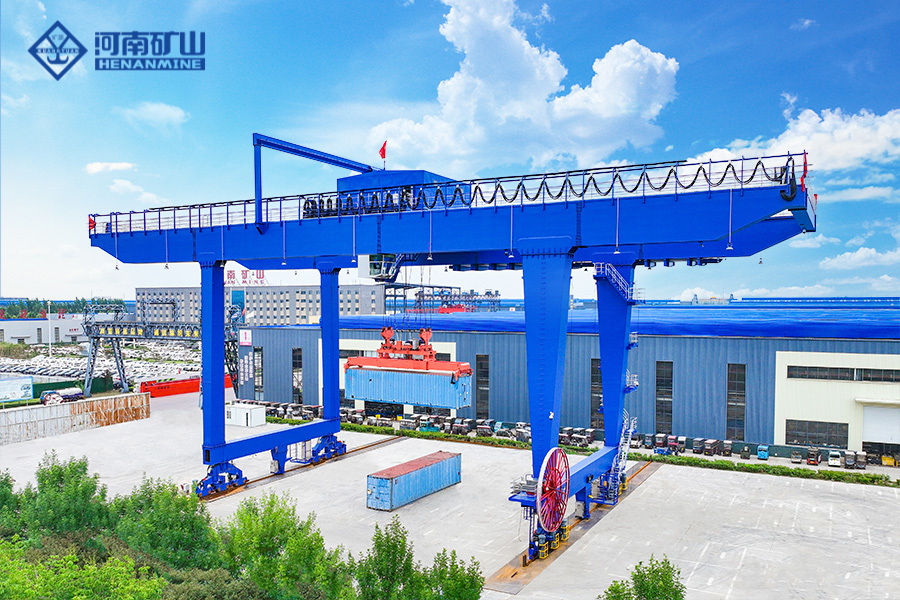
Rail Mounted Gantry Crane is a kind of large lifting equipment running along the rail, used for container storage and loading and unloading operations, the core function is to realize the vertical lifting, horizontal movement and precise storage of containers, which can be adapted to the standard containers of various types such as 20 feet, 40 feet, etc., as well as some of the special containers for the operational needs.
As the core equipment of the container yard, the typical application scenarios of RMG cranes cover. Coastal port container yard, inland anhydrous port, railroad container yard, large-scale logistics hubs, as well as chemical industry, cold chain and other professional container storage sites, is the key hub equipment connecting water, land, rail multimodal transport, directly determines the turnover capacity and operational efficiency of the yard.
Key components
An efficient and stable RMG crane supplied by Henan Mine Crane Factory, the configuration of its core components directly affects the operational efficiency and service life, mainly including five core parts, and at the same time, need to realize the seamless connection with the yard management system.
- Gantry structure: Welded with high-strength steel, it determines the span, stacking capacity and operational stability of the crane, and is the basic structure of RMG cranes, and the large-span design can realize simultaneous operation of multiple rows of containers and enhance the utilization rate of the site.
- Hoisting system: Composed of motor, wire rope, drum, spreader, etc., is the core of vertical lifting and lowering of containers, hoisting speed and load capacity directly determines the time of a single operation, high-quality hoisting system can be realized, “heavy load slow, light load fast” grading speed regulation, taking into account the efficiency and safety.
- Trolley and trolley running system: Trolley is responsible for transverse movement along the gantry beam, trolley longitudinal movement along the track, the two running speed and positioning accuracy, directly affecting the efficiency of the container transfer, frequency conversion speed control system can achieve smooth operation and accurate alignment.
- Control system: Divided into manual control and automatic control system, is the core control component of RMG crane, responsible for receiving operating instructions, control of all components of the coordinated operation, accurate control of the whole process of lifting, moving, dropping boxes;
- Yard management system integration: Whether it is manual or automated RMG, it needs to be docked with the terminal operating system to realize the real-time synchronization of the box information, operating instructions and equipment status, avoiding operational chaos and improving the overall efficiency of coordination.
Manual RMG Crane Overview
How manual RMG cranes operate
Manual RMG cranes rely on manual control by the operator to complete the whole process of operation, and there are two main modes of operation. First, the operator operates directly in the crane cab, through the joystick, buttons to control the lifting, trolley, trolley operation, real-time observation of the container and site conditions, complete positioning, grasping, stacking and other actions. The second is through the remote console operation, the operator on the ground or in the center control room, with the help of the camera real-time monitoring of the operating scene, remote control equipment operation.
The whole operation process relies entirely on the operator's skills and experience. From the alignment and lifting height control when grabbing containers, to the path selection during the moving process and the precise positioning when dropping the containers, each link requires manual judgment and operation, and the operator's proficiency and reaction speed directly determine the operation efficiency and safety.
Advantages of manual RMG
As the core equipment of the traditional mode of operation, manual RMG cranes can be used for a long time, the core lies in its strong adaptability, cost-controllable advantages, especially suitable for small and medium-sized scenes.
- Low initial investment cost: Compared with automated RMG, manual RMG does not need to carry complex sensors, automation control systems and AI scheduling module, equipment procurement, installation costs can be reduced by 30% -50%, the pressure of the initial investment is small, suitable for companies with limited budget.
- Strong adaptability to complex scenarios: Manual operation is more flexible when dealing with irregular and non-standard operation scenarios. For example, when dealing with oversized, overweight containers, damaged containers, or chaotic box position in the yard, temporary adjustment of the operation plan, the operator can flexibly adjust the operation rhythm according to the actual situation, avoiding the rigid limitations of automated systems.
- Convenient deployment and quick start: The operation logic of manual RMG is simple, the operator can be on duty after short-term training, the equipment installation and debugging cycle is short, no need for complex system integration and debugging, which is suitable for the rapid deployment of small and medium-sized yards.
Limitations of manual RMG
With the increase of container throughput and the improvement of operation standard, the limitations of manual RMG are gradually highlighted and become the core bottleneck to restrict the efficiency improvement.
- Operator fatigue: Manual operation requires operators to concentrate their attention for a long time, and long-time operation is prone to fatigue and distraction, which leads to operation errors. Such as container alignment deviation, grabbing instability, drop box offset, etc., not only affect the operational efficiency, but also may cause damage to the container, equipment failure and other safety hazards.
- Unstable efficiency: The efficiency of the operation depends entirely on the skills and state of the operator. Skilled operators can complete 15-20 operation cycles per hour, while novice or fatigue, the efficiency may drop more than 50%, the overall operating efficiency fluctuations, it is difficult to achieve a stable turnover of the yard.
- High long-term labor cost: Manual RMG needs to implement 24-hour three-shift operation, a single machine needs to be equipped with 3-4 operators, but also need to be equipped with on-site command, hooker to work with, long-term labor costs remain high, and with the shortage of skilled operators, the cost of manpower rises year by year, and has become a heavy burden on long-term business operations.
Automated RMG Crane Overview
How automated RMG systems work
Henan Mine Crane Factory supply automated RMG cranes, the core is through the software, sensors and intelligent algorithms to achieve the whole process of unmanned or semi-automated operation, without direct human operation, the overall operation relies on three core support.
- Fully automated control system: Through the PLC, industrial computers and other core equipment, receiving the yard management system's operating instructions, automatically complete the container positioning, gripping, lifting, moving, dropping and other full-process actions, without human intervention.
- Multi-sensor fusion technology: Equipped with GPS, laser positioning, OCR image recognition, infrared sensors and other equipment, real-time collection of container location, equipment operation status, site environment and other data, to achieve centimeter-level accurate positioning, to avoid collision, offset and other problems.
- Intelligent system integration: Deep fusion of AI algorithm, big data analysis and TOS system can realize automatic scheduling of operation instructions, automatic identification and tracking of containers, real-time monitoring of equipment status, and even collaborative operation with automatic guided vehicles, shore bridges and other equipments, to form a full-process automated operation link.
According to the degree of automation, it can be divided into fully automated RMG and semi-automated RMG, which can be flexibly selected by enterprises according to their own needs.
Key features of automated RMG
Compared with manual RMG, the core advantage of automated RMG lies in intelligence, efficiency and standardization, and its key features directly serve to improve efficiency and reduce costs.
- Remote monitoring and control: Managers can monitor the operation status of multiple automated RMGs in real time in the central control room, including operation progress, equipment parameters, fault warning, etc. Without on-site guarding, one monitor can supervise 4-8 pieces of equipment at the same time, which greatly improves management efficiency.
- Automated container identification and tracking: Through OCR image recognition, RFID technology, automatic identification of container number, size, weight and other information, real-time synchronization to the TOS system, to achieve the whole process of container traceability, to avoid confusion, misdirected shipments and other problems.
- Collision avoidance and safety system: Equipped with infrared sensors, laser collision avoidance devices, can automatically identify personnel, equipment, obstacles within the operating range, timely trigger stop warning to avoid collision accidents, while equipped with emergency braking, overload protection and other functions, significantly improve operational safety.
- Operation standardization: Each operation is executed by the system in accordance with the preset process, the action is standardized and precise, avoiding human error, while the system automatically records the operation data, which is convenient for subsequent statistical analysis and optimization.
Automated RMG vs Manual RMG: Efficiency Comparison
Efficiency comparison is the core basis for enterprises to choose RMG cranes, we are from the six core dimensions, combined with industry test data, comprehensively dismantle the efficiency differences between the two.
Operational efficiency
Automated RMG: It can realize 24-hour uninterrupted continuous operation, no need to rest, no fatigue, stable operating rhythm, not subject to the artificial state, rest and relaxation time limitations. Even at night and on holidays, it can maintain stable operational efficiency, which is especially suitable for the continuous turnover requirements of high throughput scenarios. The system can automatically optimize the operation path, reduce ineffective movement, and further enhance the operation continuity.
Manual RMG: Operational efficiency is completely dependent on the operator's work and rest and state, need to follow the three-shift system, the actual effective operating time is only 16-18 hours per day, and the efficiency of the operator will be reduced by 30%-40% after more than 4 hours of continuous operation, and at the same time by the impact of food, rest, emotions and other factors, poor operational continuity, prone to wasteful waiting, redundant movements and other issues.
Henan Mine Crane manufactured's automated RMGs provide far greater continuity and stability than manual RMGs, increasing time utilization to more than 95%, compared to 70%-80% for manual RMGs. Automation dramatically improves the consistency of the work cycle and avoids fluctuations in efficiency.
Productivity
Productivity is the core indicator of RMG efficiency. Taking the number of cycles per hour as the benchmark, combined with the industry's actual measurement data, the difference between the two is very obvious.
Automated RMG: Stable and predictable performance, not affected by human factors, under standard working conditions, 25-35 cycles per hour, some high-end automated RMG can exceed 35 cycles per hour, and the efficiency fluctuation error is no more than 5%, suitable for large-scale, high-frequency operation needs. Its high efficiency comes from the precise path optimization and fatigue-free operation advantages, single box operation time can be shortened to 1.5-2 minutes.
Manual RMG: The operating efficiency fluctuates greatly and is significantly affected by the operator's proficiency. Skilled operators can complete 15-20 operation cycles per hour, while novice operators can only complete 10-15 cycles, and in the peak of operation, fatigue, the efficiency will be further reduced, fluctuations in error up to 20%-30%, single box operation time of about 2.5-3 minutes, difficult to meet the needs of high throughput scenarios.
Safety and risk reduction
Operational safety has a direct impact on operational efficiency and cost, and the difference in safety between the two mainly stems from the difference between human factors and technical protection.
Automated RMG: Through multi-sensor fusion, intelligent collision avoidance, automatic warning and other technologies, it minimizes human involvement and avoids safety accidents caused by operator fatigue and misoperation. Such as container fall, equipment collision, personnel injury, etc., the accident rate can be reduced by more than 90%. At the same time, the automation system can real-time monitor the equipment operation status, timely detection of potential failures, early warning, reduce the efficiency interruption due to failures, and at the same time reduce the insurance costs and compliance costs.
Manual RMG: The safety risk mainly comes from the operator's human error and fatigue operation, according to industry statistics, the incidence of safety accidents in manual RMG is more than 10 times higher than that of automated RMG, and the common accidents include container alignment deviation, unstable gripping and falling, and collision of equipments, etc., which not only affects the operation efficiency, but also generates additional costs such as cargo damage, casualties, and equipment repairs, and at the same time, it needs to bear higher insurance costs and compliance risks. Insurance costs and compliance risks are also higher.
Automated RMG can significantly reduce downtime losses and compensation costs caused by safety incidents, and at the same time reduce insurance expenses, indirectly improving the overall operational efficiency. Manual RMG, on the other hand, requires more safety management costs and downtime due to accidents, which can further reduce operational efficiency.
Accuracy and yard optimization
The accuracy of RMG's operation directly affects the utilization of yard space and operational synergy, and the difference between the two is mainly reflected in the positioning accuracy and yard optimization capability.
Automated RMG: Automated rail gantry cranes are equipped with laser positioning, GPS and other technologies, which can realize centimeter-level accurate positioning, deviation of falling containers is no more than 10cm, stacking height is increased by 1-2 layers, and yard space utilization rate is increased by 20%-30%. The system can automatically optimize the planning of box position, reduce invalid movement, and also correct the operation position in real time to ensure accurate docking.
Manual RMG: Positioning accuracy relies on operator's experience, the deviation of falling boxes is usually 30-50cm, in order to avoid collision, the stacking height needs to reserve a certain safety space, and the utilization rate of yard space is lower; at the same time, the box position planning relies on manual judgment, which is prone to problems such as chaotic box position, repeated transfer, etc., and increases the ineffective operation time and affects the overall efficiency.
Automated RMG can improve the utilization of yard space and operation synergy efficiency through accurate positioning and intelligent box position planning, especially suitable for hub yards with limited space and high container throughput.
Maintenance and downtime
The downtime of the equipment directly affects the operational efficiency, and there is a significant difference between the maintenance mode and downtime frequency of the two.
Automated RMG: Automated rail-mounted gantry cranes adopt predictive maintenance mode, collecting equipment operation data through sensors, combining with AI algorithms to predict potential failures and maintain them in advance, which can reduce downtime by 5-15% and increase labor productivity by 5-20%, with an average annual downtime of no more than 50 hours, and with a high-end configuration of core components and a lower failure rate.
Manual RMG: Manual rail gantry crane adopts passive maintenance mode, equipment failure only after maintenance, no advance warning, sudden failure is frequent, the average annual downtime of 150-200 hours, and most of them occur at the peak of the operation, affecting the turnover of the yard, and its maintenance relies on manual troubleshooting, maintenance efficiency is low, which will further extend the downtime.
Henan Mine Crane manufactured's automated RMGs have 1/3-1/4 the downtime of manual RMGs, and through predictive maintenance, they minimize the loss of efficiency caused by breakdowns and downtime, and ensure the continuity of operations.
When Manual RMG Still Makes Sense
Despite the significant efficiency advantages of automated RMG, not all scenarios are suitable for deployment. In the following two types of scenarios, manual RMG can still give full play to its flexible, low-cost advantages, and achieve a balance between efficiency and cost.
Small or low-volume terminals
For small container yards, inland small anhydrous ports, and sites with low throughput, manual RMG is a more cost-effective choice.
- Low investment threshold: Small yards have limited budgets, and the initial investment in manual RMG is only 50%-70% of that in automated RMG, which significantly reduces the upfront investment pressure and eliminates the need for complex system integration and maintenance costs.
- Simple operational requirements: Small yards have a small amount of work, slow tempo, manual RMG efficiency can fully meet the demand, without the need to invest in high cost deployment of automation systems, to avoid the use of large materials.
- Flexible operation: The operation plan of small yards is easy to adjust, manual RMG can flexibly switch the operation mode according to the actual demand, to adapt to the demand of small batch and multi-batch operation, without complex system debugging.
Complex or non-standard handling scenarios
In some non-standard and complex handling scenarios, the flexibility of manual RMG is far superior to that of automated RMG.
- Oversized, overweight, damaged container handling: Such as handling special containers over 45 feet, overweight containers, or damaged and deformed containers, operators need to flexibly adjust the gripping method and positioning angle according to the actual situation, which is difficult to be adapted to the rigid operation of automated systems.
- Irregular operation process: Such as temporarily increasing the operation task, adjusting the box position planning, dealing with unexpected situations, manual operation can quickly respond without modifying the system program, to avoid the automated system process rigidity.
- Limited site conditions: Some old yards have uneven tracks, narrow sites, or no perfect TOS system, making automated RMG deployment difficult and costly, while manual RMG can be quickly adapted without complex site modifications.
When Automated RMG Is the Better Choice
When enterprises face high throughput, high labor costs, intelligent transformation and other needs, the efficiency and long-term cost advantages of automated RMG will be fully highlighted, and the following three types of scenarios are the most suitable for the deployment of automated RMG.
High-throughput container terminals
For coastal hub ports, large inland anhydrous ports, and yards with average daily container handling capacity ≥1000TEU, automated RMG is the core choice for improving efficiency.
- Demand matching: High throughput yards require 24-hour continuous operation, and the uninterrupted operation capability of automated RMG can fully meet the demand, significantly increase the turnover speed of yards, and avoid problems such as container pile-ups and ship stranding in the harbor. 2.
- Efficiency advantage: The number of operations per hour of automated RMG is more than 50% higher than that of manual RMG, which can quickly deal with the surge in container throughput, relieve site congestion and improve customer satisfaction.
- Scale effect: High throughput yards usually need to deploy multiple RMG, automation system can realize multiple equipment cooperative operation, intelligent scheduling, and further enhance the overall efficiency, while it is difficult to realize the scale of manual RMG cooperation.
Smart port development trends
With the development of Industry 4.0 and digital economy, smart port" has become an inevitable trend of industry transformation, and automated RMG is the core equipment for smart port construction.
- Demand for digital transformation: Automated RMG can be seamlessly integrated with TOS system, AGV, shore bridge and other equipment to form a whole-process automated operation chain, realize digitalization, visualization and intelligence of yard operation, and help enterprises complete digital transformation.
- Competitiveness Improvement: In the construction of smart ports, the deployment of automated RMG can improve the competitiveness of enterprises in the industry, attract more customers to cooperate, and at the same time, reduce operating costs to achieve quality and efficiency.
Labor shortage or high labor cost regions
Currently, ports and logistics industries are facing a shortage of skilled crane operators, and labor costs are rising year by year, in such regions, the advantages of automated RMG are particularly obvious.
- Reduce labor dependence: Automated RMG can greatly reduce the need for operators, only 1-2 supervisors are needed for a single machine, which can effectively solve the problem of labor shortage, and no need to worry about the problems of operator recruitment and training.
- Reduce labor cost: The long-term labor cost of automated RMG is only 30%-50% of manual RMG, which can save hundreds of thousands of dollars per year in high labor cost areas.
- Enhance operational stability: No need to worry about efficiency interruptions caused by operators leaving or taking leave, the automated system can maintain stable operations and guarantee the continuity of yard turnover.
Cost vs Efficiency: Which One Wins?
Enterprises choose RMG cranes, the core is to find a balance between cost and efficiency, we are from the initial, investment in long-term operating costs, the whole life cycle cost of three dimensions, to give a clear conclusion.
- CAPEX: Manual RMG wins. The initial investment of manual RMG is only 50%-70% of that of automated RMG, which is suitable for enterprises with limited budget and short-term investment, without the need to bear complex system integration costs.
- OPEX: Automated RMG wins. The long-term labor cost and maintenance cost of automated RMG are much lower than manual RMG, and a single unit can save 300,000-600,000 RMB per year. The higher the efficiency and the longer the operation time, the more obvious the cost advantage is, which is especially suitable for enterprises with long-term operation.
- TCO: Automated RMG is more advantageous. Although the initial investment of automated RMG is high, the investment can be recovered in 3-5 years, and the subsequent long-term operation cost is extremely low, and the total cost in the whole life cycle (15-20 years) is 30%-50% lower than that of manual RMG. Although the initial investment of manual RMG is low, but the long-term labor cost and failure cost keep accumulating, so the total cost of the whole life cycle is higher.
Henan Mine Crane Factory Custom
There is no absolutely more efficient RMG crane, only a more suitable choice. The improvement of efficiency depends not only on the equipment itself, but also on the scale of operation, operational needs, budget level and long-term strategy of the enterprise. For the pursuit of scale, efficiency, digitalization of the enterprise, automation RMG is the inevitable choice. For enterprises pursuing flexibility, low cost and short-term return, manual RMG is more advantageous.
Henan Mine Crane Factory, as a well-known large-scale crane manufacturer in China, can provide customized RMG crane solutions according to the actual needs of enterprises to achieve a balance between efficiency and cost, and help enterprises crack the efficiency bottleneck of yard operations and achieve high-quality development.