
Loading and Unloading of Large Container Ships: Selection Criteria for Ship-to-Shore Crane Boom Length
The selection of the length of shore bridge boom is a strategic consideration of the future ship type coverage capacity, its design life of 25 to 30 years, and the container ship large-scale trend is significant, if only according to the current mainstream ship type configuration, it is easy to lead to the functional obsolescence of the terminal facilities.
This paper starts from the structural principle of the shore bridge boom, systematically introduces the core content related to selection, and provides a scientific and forward-looking reference framework for port planning, operation and procurement decision makers to select the type.
Ship-to-Bridge Boom Structure Analysis
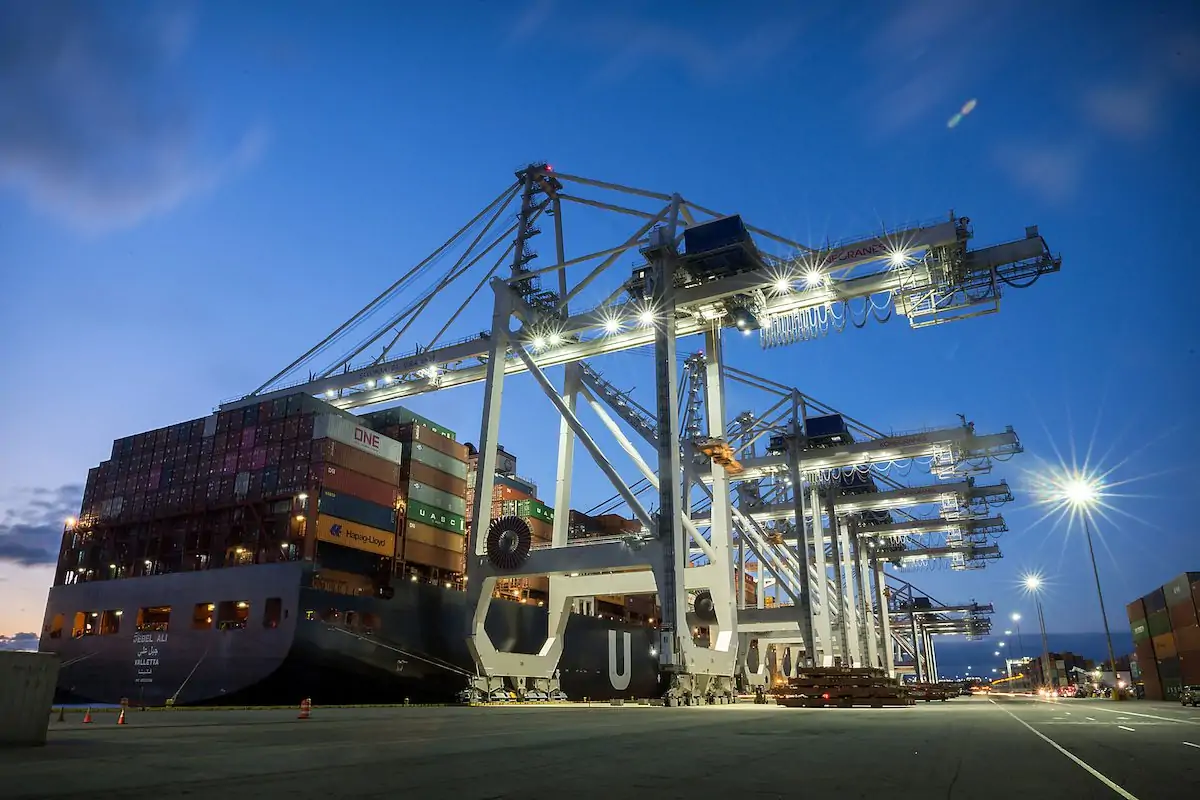
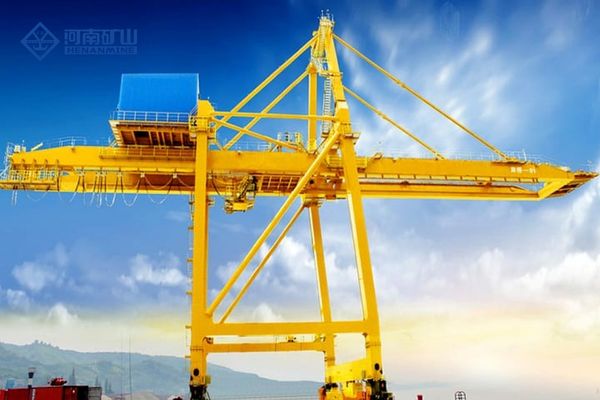
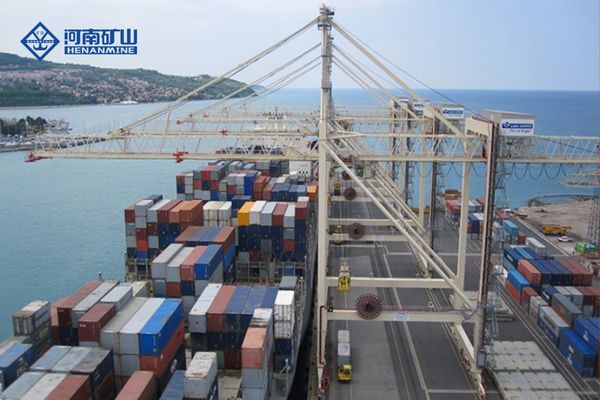
Ship-to-shore bridge (Ship-to-Shore Crane, referred to as STS crane) is an indispensable core loading and unloading equipment for modern container terminals, and the stable operation of its boom system directly determines the operational efficiency and safety, the core key components are as follows:
- Boom: the cantilever structure that extends horizontally from the shore to the sea side, as the core intuitive parameter of the service capacity of the shore bridge, it directly determines the width range of the ship that can be covered.
- Trolley: Installed on the top rail of the boom, the trolley can move back and forth along the rail, and accurately complete the core operations such as grabbing, lifting and horizontal transfer of containers through the suspended spreader.
- Main Gantry: solidly connected to the boom root, consisting of sea legs and land legs, it can move smoothly along the dedicated track along the quay line, providing solid support for the boom operation.
- A-frame: located on the top of the gantry, its core role is to bear and evenly distribute the huge bending moment generated by the boom when it is fully loaded, and it is the core load-bearing node to ensure the safe and stable operation of the whole structure of the quay bridge.
Core performance parameters
- Outreach: the core service parameter, defined as the horizontal distance from the centerline of the track to the outermost end of the boom (unit: meter).
- Backreach: The length of the boom extended to the land side, which determines the range of container placement on the land side and influences the setting of the buffer zone for spreader transfer at the quay.
- Lifting Height (Lifting Height): Divided into two directions, above and below the rail surface, it determines the vertical coverage capacity of the quay bridge, and needs to match the loading characteristics of the target ship type.
Note: The above three groups of parameters are interrelated and need to be optimized as system parameters, not isolated maximization of a single indicator.
Conversion Relationship between Boom Length and Outreach Distance
The physical length of the boom and the actual usable outreach are not exactly the same, and there is usually a difference of 5 to 8 meters between the two. In actual engineering design, the following geometric relationships need to be taken into account to determine the value of the outreach:
The distance from the center of the shore side rail to the front edge of the pier (usually about 6 to 7 meters), the spacing from the outer hull wall to the front edge of the pier after the vessel is berthed (about 1 to 2 meters depending on the fender configuration), and the horizontal coverage requirements corresponding to the vessel's width.
In addition, the longitudinal and transverse inclination of the vessel under full load or ballast (generally calculated at 1 to 1.5 degrees) may cause additional lateral displacement of the outermost row of containers, which translates into an additional margin of about 0.7 to 1 meter in the outreach requirement.
Therefore, designers need to clearly distinguish the difference between the physical length of the boom and the net outreach when determining the procurement parameters, so as to avoid coverage gaps in actual operation due to conceptual confusion.
Container Ship Scale Evolution and Breadth Parameters
The evolution of container ship scale is the fundamental reason for the lengthening of shorebridge boom: Panamax ship width is ≤32.3 meters (13 rows loading), corresponding to an outreach of 38-42 meters; after the opening of the new Panama Canal locks in 2016, the width of the new Panamax ship expands to 49 meters (17-19 rows loading), and the demand for outreach is raised to 50-55 meters;
The mainstream ship width in the post-Panamax era is over 45 meters, with an outreach demand of 55-65 meters, corresponding to Super Post-Panamax class shore bridges, which became the mainstream configuration of hub ports in the 2010s.
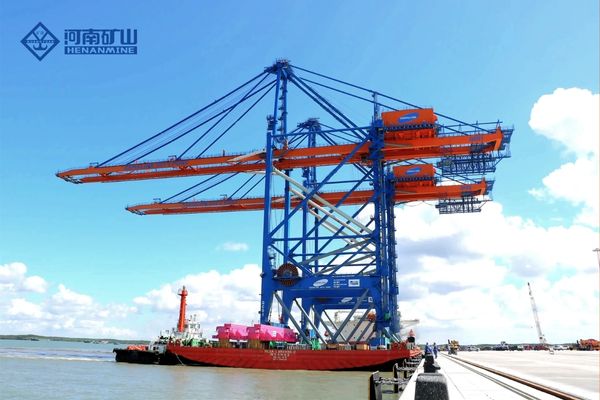
Ultra Large Container Vessels (ULCV, ≥20,000 TEU) are the current transportation frontier, with 131 ships worldwide by 2024, mainly deployed by head liner companies on the Asia-Europe mainline. With a vessel width of 58-62 meters (23-24 rows loaded), they are extremely demanding on port channels, berths, shore bridges and other infrastructure, with a single shortcoming that limits port capacity.
Emergence of the Megamax Vessel Type and Its Technical Significance
In the ULCV spectrum, the industry refers to the ship types with widths corresponding to 23 rows (MGX-23) and 24 rows (MGX-24) as “Megamax”, with rated capacities ranging from about 18,000 TEUs to nearly 24,000 TEUs, respectively.
The MGX-24 model has a beam of about 61.5 meters and a deck stacker height of 10 to 11 decks, which significantly increases the combined lifting height requirement. From the global shorebridge delivery data, the trend of newly built shorebridges concentrating on large outreach is very obvious:
Between 2011 and 2017, the proportion of newly delivered quay bridges with an outreach of 60 meters or more jumped from 38% to 81%, reflecting the irreversible mainstream trend of the industry's demand for support for oversized vessels.
For the MGX-24, a minimum outreach of 70 to 74 meters is usually required to effectively cover the full width of the vessel with sufficient safety margins.
Calculation of Outreach
Standard Outrigger Formula and its Calculation Elements
Quick estimation formula for outreach: required outreach (m) = number of deck loading rows x 2.5 + 5 (2.5 m is the standard width of each row of containers including spacing, 5 m is the amount of compensation from the center of the track to the side of the ship). 24 rows of the ship's basic outreach is 65 m, plus safety margin recommended ≥ 70 m, the actual case verification of the minimum requirement of 70.4 m, which is in line with the formula estimation.
Composition of Safety Margin
Dynamic safety margin needs to be superimposed on the outreach: 0.5-1.5 degrees of transverse inclination may be generated during loading and unloading of ULCV, corresponding to transverse displacement of 0.7-1 meter; tidal changes affect the relative height between the ship and the quay; fender compression leads to the distance between the ship and the quay of 1.2-2.0 meters, which all need to be reserved to ensure the safety of the operation.
Different types of Boats need to be Compared with the Requirements of Outreach Reference
Reference for the outreach of different ship types: Panamax (6000-8000 TEU) 38-42 meters, Super Panamax (10000-15000 TEU) 50-55 meters, large Super Panamax (18000 TEU class) 60-65 meters, 24 rows ≥ 70.4 meters, and the future ship type above 30,000 TEU needs 74-80 meters. At present, the world's largest shore bridge outreach is 80 meters, which can cover 26 rows.
Reach, Lift Height and Structural Load
Planning Logic and Depth Requirements for Backreach
Backreach often takes a back seat in the discussion of outreach, but its impact on terminal operational efficiency should not be underestimated. Backreach determines the extent to which the bridge can complete the container handover on the landside without berthing, and how far the trolleys can deliver the containers to the landside when the boom is in the horizontal position.
The professionally recommended reach is usually between 7 and 11 meters, which should meet the following functional requirements: sufficient buffer space for boom lifting when ships enter and exit the port, a working platform for temporary storage of hatch covers, and a reasonable depth for the chassis of container trucks or AGVs to wait at the pick-up point.
If the terminal adopts automation design, the reach distance often needs to be appropriately enlarged to match the running track of automated yard equipment and vehicle right-of-way allocation requirements.
Principle of Determining Lifting Height
The lifting height is divided into two directions, above and below the rail surface, both of which need to be synchronized to match the loading characteristics of the target ship type.
Above rail height (lifting height) needs to cover the top surface of the highest level of containers on the deck of the ship, plus the safety lifting spacing and the spreader's own height, generally according to “the maximum number of deck stacked high level × 2.6 meters + dry height + spreader height + safety spacing” cumulative calculation one by one.
To the current mainstream ULCV, for example, the deck stacker can reach 10 to 11 layers, the effective lifting height above the rail surface usually needs to reach 40 to 48 meters. The height below the rail surface determines whether the shorebridge can effectively enter the bottom of the deep compartment to pick up boxes, usually recommended minimum value of 12 meters, the total lifting stroke of the modern large ship shorebridge is about 50 to 55 meters.
Insufficient lifting height and insufficient outreach are equally hazardous, both of which will form a hard constraint in the operation of a particular ship type, and must be uniformly taken into account at the selection stage.
Engineering Constraints on Boom Structural Deflection and Fatigue Life
It is an inescapable physical law that the longer the boom, the greater the structural deflection (bending deformation) under full load conditions. In the design of ultra-long booms (over 65 meters), structural engineers need to accurately control the maximum deflection of the boom under static and dynamic loading conditions to ensure that the running track of the trolley always stays within the permissible straightness range, and to avoid accelerated fatigue damage of the track and structural nodes due to the additional dynamic loads.
Lattice Boom design is widely used in modern quay bridges. Compared with the traditional box girder structure, the lattice structure is lighter under the same strength level, which is conducive to the reduction of bending moment at the root of the boom;
The open structure also facilitates weld inspection, non-destructive testing and structural repair work. Fatigue life is the core checking item in the design of ultra-long boom, generally requiring that the cumulative fatigue damage rate of the key welded nodes does not exceed the normative permissible value during the design life, which requires that the expected annual loading and unloading capacity of the terminal and the average daily number of cycles of operation of a single machine be clearly defined at the selection stage, so as to provide reliable input boundary conditions for the calculation of structural fatigue.
Operational and Strategic Factors
Analysis of Target Route Structure and Ship Type Combination
The selection of the outreach should not only look at the peak parameters of the current docking vessel type, but also need a comprehensive analysis based on the route structure and vessel type combination that the terminal is expected to serve in the next 10 to 20 years.
Take a regional hub port as an example, if its main service object is feeder routes, the maximum ship type may be maintained at 8,000 to 12,000 TEU level for a long time, and the configuration of 55 meters outreach can satisfy most of the operational needs;
For deepwater ports that are positioned as hubs for Asia-Europe or Asia-US trunk routes, as liner companies continue to deploy larger vessels, shore bridges with an outreach of less than 70 meters may face obvious functional limitations in the next five years.
Therefore, before selecting a vessel type, it is an essential task to carry out a systematic analysis of vessel type forecasts and refer to the capacity renewal plans and hand-held order data of major liner companies.
Future-oriented forward-looking Design
The construction cycle and service life of port infrastructure determine that it must have a certain degree of foresight. The design life of a quay bridge is typically 25 to 30 years, during which time container ship types will continue to evolve, and some studies have conceptualized future ULCVs in the 30,000 TEU and even 40,000 TEU classes.
In practice, forward-looking design can be realized through two paths:
The selection phase directly determines the outreach by one class higher than the current maximum ship class (e.g., MGX-24 standard instead of MGX-23 standard);
Structural design to allow for interfaces for future boom extension modifications, requiring that potential modification loads be incorporated into the strength reserve calculations for the main structure early in the design phase.
The practice of the Port of Virginia provides a valuable reference: in its USD 1.4 billion comprehensive infrastructure upgrade program, the port specifically procured Suez-class all-electric shore bridges manufactured by ZPMC, with a clear focus on serving the current and future ULCV as the core design goal, which provides an equipment-level guarantee for the long-term competitiveness of the terminal.
Environmental Constraints
Ultra-long booms have a quantum difference in environmental load response from standard length booms.
Wind load is one of the most sensitive environmental factors: the longer the boom, the larger the horizontal exposed area and the significantly higher the combined horizontal wind pressure at the same wind speed, which directly affects the anchorage design of the gantry foundation and the track pressure distribution.
For ports located in typhoon prone areas or strong monsoon areas, special wind load checks should be conducted on the boom structure with reference to the local standard of wind speed of one in a hundred years, and the difference in structural response between the lifted and horizontally placed booms under extreme working conditions should be evaluated.
Seismic zoning is also an important design variable, especially for the ports in Asia-Pacific and America along the Pacific Rim seismic zone, which require seismic calculations of the whole structure based on the ground vibration parameters.
Marine corrosive environments have a particularly prominent impact on the whole life of ultra-long booms. The design life of the anti-corrosion coating system, the quality level requirements for critical welds, and the periodic testing program should be clearly defined in the procurement specifications and included in the assessment of the contract quality assurance provisions.
Infrastructure Impact and Whole Life Costs
Carrying Capacity
Boom extension will increase crane weight and operating load, different levels of quay bridge track gauge (Panama 12-16 meters, Super Panama 33 meters, Megamax 35-42 meters), Megamax quay bridge requires quay wall to be constructed to a higher standard, and substandard track infrastructure will result in loss of operational efficiency far beyond the initial investment.
Cost-benefit Trade-offs
Longer outreach bridges require higher initial investment, with a price increase of 10%-20% from 55m to 65m, but they can cover mainstream ULCV vessels and determine the qualification of terminal trunk lines. The comprehensive cost of boom modification or complete replacement is much higher than the incremental investment in the initial stage of over-selection.
Whole Life Maintenance Cost
The longer the boom, the higher the whole-life maintenance cost, mainly reflected in the wire rope replacement cycle shortened by 15%-20%, the difficulty and cost of inspection, and the need for specially designed maintenance facilities. When selecting a boom, it is recommended to ask the manufacturer to provide a whole-life cost model to facilitate quantitative comparisons and avoid simply looking at the purchase price.
Decision-making Framework for Terminal Planners
- Define port positioning and target ship type: Combine the port's positioning in the shipping network, route layout and liner company capacity development trend to determine the largest ship type that may call during the 25-year design service period, which serves as the core benchmark for boom outreach selection.
- Calculation of the outreach range: Referring to the industry common estimation formula of “number of rows×2.5m+5m”, the base value of outreach is derived, with a safety margin of 2-3 meters superimposed to accurately determine the target and minimum allowable values of the outreach, to ensure that the demand is covered.
- Evaluate infrastructure suitability: Comprehensively verify the quay wall's carrying capacity, wheel pressure suitability, gauge matching and electrical supply capacity, determine whether it is necessary to carry out foundation reinforcement works at the same time, and include the relevant costs in the total investment budget.
- Solicitation of manufacturers' solutions: Invite global mainstream quay bridge manufacturers to provide customized technical solutions and quotations to meet the actual needs of the port, focusing on the verification of core performance indexes such as reach and lifting height, and requesting the provision of fatigue life inspection report of boom structure.
- Determine the final program: Combine the results of business negotiations, whole-life cost analysis, clarify the acceptance criteria for boom outreach, structural fatigue life assurance and other key terms in the contract, and finally finalize a scientific and reasonable selection program.
Common Selection Misconceptions and Suggestions for Avoidance
- Misconception 1: Configure the outreach according to the current maximum ship type; Avoidance: Consider the 2-4 years equipment delivery cycle, combined with the trend of ship type upgrading selection, to avoid the equipment put into operation that is backward.
- Misunderstanding 2: Confusing “rated outreach” and “effective operating outreach”; avoidance: clarifying the difference between the two (about 1-2 meters), to avoid the coverage gap.
- Misunderstanding 3: Excessive attention to the outreach, ignoring the lifting height matching; avoidance: synchronized consideration of the lifting height, to match the number of layers of the ship deck containers, to avoid constraints on the full-load operation.
- Misunderstanding 4: Disregarding the quality of track foundation and installation accuracy; avoidance: strictly control the track installation standard, avoiding the accumulation of small deviations leading to structural damage and efficiency loss.
Conclusion
Shore bridge boom selection needs to be combined with technology, strategy and infrastructure, the current mainstream demand for ULCV outreach distance of 65-80 meters, the future needs to be reserved for more than 80 meters of capacity, moderately ahead of the selection of more economical, to avoid the “low price priority” of the high cost of the later.
It is recommended that the terminal planners joint manufacturers and professional consultants to participate in the selection of pre-selection seminars, integration of multi-dimensional analysis to form a decision-making chain, through the early professional argumentation, to achieve the optimal balance of technology and economy, and consolidate the long-term competitiveness of the terminal.
Henan Mine crane Manufacturers - Customized Services
If you are preparing for Ship-to-Shore Crane installation, are not sure whether the site meets the installation standards, or need a professional, compliant installation program, you can submit your site layout and equipment parameters, our professional engineers will provide you with free assessment of the installation conditions of the service, the whole one-on-one follow-up guidance.
Henan Mine Crane Factory, as a professional crane manufacturer, integrating R&D, design, production, sales and after-sales service, is committed to providing customers with one-stop crane customization solutions.
Welcome to contact us at any time, we will provide you with free design drawings, on-site surveys and other intimate services to help you efficiently promote the project.