
Diesel RTG vs Electric RTG Crane: Which Is More Cost-Effective?
In Henan Mine Crane's more than ten years of RTG crane sales and technical service, I have seen too many terminals stepping on the pit in equipment selection. Especially in these years, the global fuel price fluctuation is getting bigger and bigger, the carbon emission regulations of each country's ports are getting tighter and tighter, almost every customer who comes to consulting, will ask the same question: diesel RTG and electric RTG, in the end, which is more cost-effective?
Many people's judgment on this issue only stays on the comparison of equipment purchase price. But people who do port equipment are clear that the service life of RTG can be up to 15-20 years, the cost-effectiveness is never just look at how much money spent when buying, but to look at the more than ten years, the equipment in the end, how much revenue can be brought, and how much expenditure will be incurred.
Today I will combine Henan Mine Crane's hands-on experience in serving hundreds of ports around the world, and calculate the account of the two types of equipment from multiple dimensions, such as initial investment, operating costs, full life cycle benefits, and environmental compliance. We don't talk about false theories, but only talk about the real costs and benefits in the terminal operation, and help you choose the equipment that is really suitable for your terminal.
What Is a Diesel RTG Crane?
Definition
Diesel RTG, also known as tire gantry crane, the core power source is a diesel engine driven generator set. All of its traveling, lifting and trolley running movements are driven by diesel power generation, which is a mature model used in port yards for decades.
Most of the terminals we have contacted in developing regions have diesel RTGs as their initial equipment, which do not rely on external power grids, and can be used right away, with minimal infrastructure requirements, to quickly meet the needs of terminals in their initial operation.
Key Characteristics
Independent power source is the core feature of diesel RTG. It does not require external cables or skid wires, and can move freely throughout the yard without any restrictions on transfer operations, making it ideal for terminals where the yard layout is frequently adjusted or where the operating area is not fixed.
The lack of a fixed electrical infrastructure means that it has a very low entry threshold. There is no need to build substations, no need to lay slip lines, no need to do cable trench, as long as the yard road surface is up to standard, the equipment can be transported to the site and debugged to start work, which can help terminals to save a lot of time and cost of the preliminary infrastructure.
Typical Applications
Medium-sized ports are the most important application scenarios for diesel RTG. These terminals have medium throughput and large fluctuation in operation volume, and the flexibility of diesel RTG can be well adapted to the operation demand at different times.
There are also terminals in developing regions with limited infrastructure, such as some ports in Southeast Asia and Africa, where the capacity of the power grid is insufficient or the power supply is unstable. The self-powered nature of diesel RTGs allows them to be free from power grid constraints and to stably complete their operations.
In addition, the old terminals that do not have the supporting slip line system, when expanding or updating the equipment, they will also give priority to the diesel RTG, without having to do a large-scale renovation of the existing yard, it can directly replenish the production capacity of the equipment, and the cost of renovation is very low.
What Is an Electric RTG Crane?
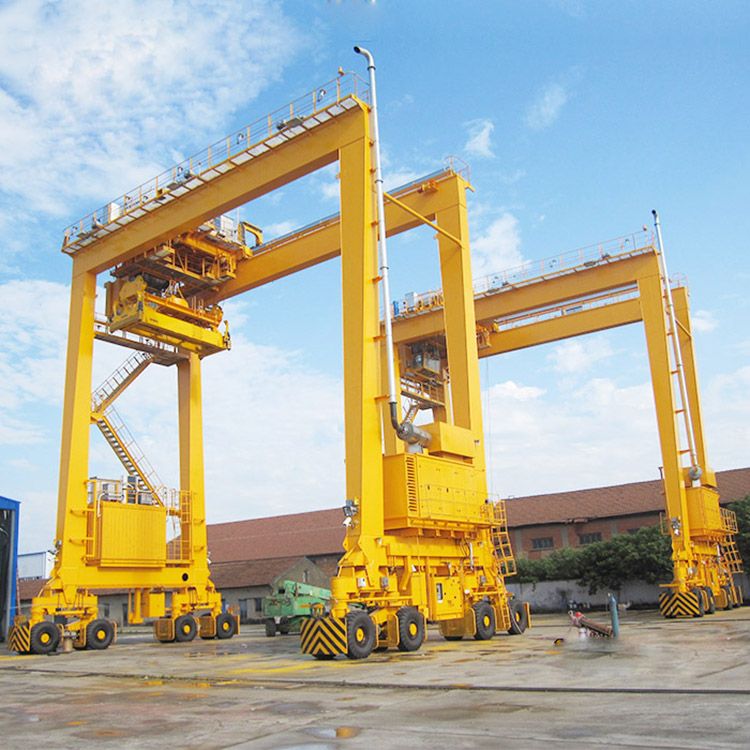
rubber tyred gantry crane maneuverability
Definition
An electric RTG is a tire-type gantry crane that relies on external grid power. There are three main forms of power sources: cable reel system, skid line system, and safety skid line system.
Unlike diesel RTG, it does not have a large diesel generator set, the core power comes from the power grid, through different power supply methods, the power is delivered to the driving mechanism of the equipment to complete all the operational actions.
Henan Mine Crane's electric RTG program for customers now will match different power supply methods according to the yard layout and operational requirements of the terminal. For example, for fixed block operation, the slip wire solution is more stable; for occasional transfer, the cable reel solution is more flexible.
Key Characteristics
Low emission is the most intuitive advantage of electric RTG. It has no diesel engine, so it does not produce exhaust emission directly during operation, and the noise level is much lower than diesel RTG, which can greatly improve the operating environment of the terminal, and it can also fit in the current green development trend of the global ports.
Zero fuel consumption is the core cost difference between it and diesel RTG. There is no need to purchase diesel fuel, and you only need to pay for electricity, which in the vast majority of the world is much more stable and lower than the cost of diesel fuel, helping terminals to lock in long-term energy expenditures.
Then there's the higher efficiency of energy utilization. Diesel engines have an energy conversion rate of only 30-40%, while electric drive systems can achieve an energy conversion rate of 80% or more, and even taking into account grid transmission losses, the overall energy efficiency far exceeds that of diesel models.
CAPEX Comparison: Initial Investment
Diesel RTG Capital Cost
Looking at the purchase price of the equipment itself, the initial investment of a diesel RTG is much lower. Its power system is a mature diesel generator set, the technology threshold is not high, and the manufacturing cost of the whole machine is 15%-20% lower than that of electric RTG.
More importantly, diesel RTG does not require additional electrical infrastructure investment. There is no need to build a substation, no need to lay slip wire, no need to make cable trench, and no need to do a large-scale remodeling of the yard's power supply system, which saves a large amount of infrastructure costs.
For many terminals with limited initial capital, the low-threshold advantage of diesel RTG is very obvious. No need to invest a large amount of money to do infrastructure, just buy the equipment can be put into production, can quickly return to the capital, to ease the early capital pressure.
Electric RTG Capital Cost
The purchase price of electric RTG is higher. It requires additional configuration of variable frequency drive system, power supply receiving device, and supporting electrical control system, and the manufacturing cost of the whole machine is higher than that of the diesel model.
In addition to the equipment itself, electric RTGs require additional infrastructure investment. Regardless of whether it is a slipline or cable reel solution, it requires the construction of a supporting substation, power supply lines, and the electrical infrastructure of the yard. This infrastructure cost, depending on the size of the yard, can be as little as several hundred thousand dollars or as much as tens of millions.
For a new terminal in China, the purchase price of 12 electric RTGs was nearly two million dollars higher than a diesel model of the same specification. Together with the infrastructure investment for the slip lines and substation, the overall initial investment was nearly ten million dollars higher than a diesel solution.
Infrastructure Investment Impact
The layout and construction status of the yard will directly affect the infrastructure cost of electric RTG. The cost advantage of a new terminal is much larger than that of an old one.
In the planning stage of new terminals, the electric RTG power supply infrastructure can be synchronized into the planning, without the need to do the second transformation of the yard, the cost of civil and electrical construction can be reduced by more than 30%, and will not affect the commissioning of the terminal schedule.
On the other hand, if an old terminal in operation is to be converted into an electric RTG, it is necessary to do a large-scale reconstruction of the existing yard pavement and power supply system, which is not only costly, but also affects the normal operation of the terminal, and the overall initial investment will be further increased.
OPEX Comparison: Operating Costs
Fuel vs Electricity Cost
Energy cost is the largest fixed expense in RTG operation, and is also the core cost difference between the two models.
| Factor | Diesel RTG | Electric RTG |
| Energy Source | Diesel fuel | Grid electricity |
| Energy Cost Stability | Volatile | More predictable |
| Cost per Move | Higher | Lower (in most regions) |
We have done a real test, for the same specification RTG, to complete a standard container lifting operation, the diesel model needs to consume 2-2.2 liters of diesel fuel, while the electric model only needs to consume 2-3 kWh of electricity. According to the current oil and electricity prices in most regions of the world, the energy cost of a single operation of the electric model can be about 70% lower than that of the diesel model.
This cost difference varies from region to region. Europe's diesel prices are high, the carbon tax is also high, the energy cost advantage of electric RTG is very obvious; the Middle East diesel prices are low, the cost advantage of the electric motor type will be weakened, and more depends on the terminal's sustainable development strategy; Southeast Asia and part of Africa, the power grid is unstable, the price of electricity fluctuates a lot, and diesel type of cost stability is better.
There is another important point, diesel price is affected by the international situation, the supply and demand relationship is very big, fluctuations are frequent, it is difficult for the terminal to lock the long-term energy cost; while the fluctuation of the price of electricity is much smaller, the terminal can more accurately do the long-term cost budget.
Maintenance Cost
The maintenance cost of diesel RTG is much higher than that of electric RTG. The core reason is that the maintenance workload of diesel engine is extremely high.
Diesel engines need regular maintenance, every 100 hours or so, we need to do a small maintenance, replace the oil, diesel filter, oil filter, air filter. Every 1,000 hours to do a major maintenance, check the engine block, piston, injector nozzle and other core components, a few years to do an engine overhaul, a single overhaul costs can reach hundreds of thousands of dollars.
There are also hydraulic systems, cooling system maintenance. Diesel-type cooling system working in a high-temperature environment for a long time, prone to clogging, leakage, need to be regularly cleaned and repaired, but also increase maintenance costs.
The maintenance workload of electric RTG is much smaller. It does not have a diesel engine, eliminating all engine-related maintenance work, no oil changes, no filter changes, and no engine overhaul.
The core components of the electric motor type are the motor and the electrical control system, with fewer moving parts, lower wear rate and lower maintenance frequency. Only need to do regular inspection of electrical wiring, lubrication and maintenance of the motor, the average annual maintenance cost can be 30%-50% lower than the diesel engine type.
Tire Wear
There is little difference in tire wear between the two models. Tire wear is mainly related to the road conditions in the yard, the operator's driving habits, and the steering frequency of the equipment, and there is no direct correlation with the form of power.
However, electric RTGs have smoother acceleration and deceleration control, without the frustration of diesel engines, so operators can control the equipment's movement and steering more smoothly, which to a certain extent reduces abnormal tire wear and prolongs the service life of tires.
10-20 Year Lifecycle Cost Analysis
Total Cost of Ownership (TCO) Model
To truly determine which of the two models is the better value, a 10-20 year Total Cost of Ownership (TCO) model must be used, and looking at the initial purchase price alone will make a complete misjudgment.
A complete TCO model must include these parts: initial equipment procurement costs, infrastructure investment costs, 15 years of energy costs, average annual maintenance costs, failure and downtime loss costs, and the residual value of the equipment after use.
We have done a calculation for a domestic terminal with an annual throughput of 1 million TEUs. For RTGs of the same specification, the initial procurement + infrastructure cost of the diesel model is nearly ten million dollars lower than that of the electric motor model. However, after 15 years of operation, the energy cost and maintenance cost of the diesel model is nearly 40 million higher than that of the electric model, and the whole life cycle cost of the electric model is about 30% lower than that of the diesel model.
Break-Even Analysis
Many customers ask how long it will take for an electric RTG to pay for itself with a higher initial investment. This break-even point is mainly affected by two factors: the difference between local diesel and electricity prices, and the annual operating hours of the equipment.
We have done some calculations, under the domestic oil price and electricity price level, the payback cycle of an electric motor is 3-5 years for an RTG with an annual operating time of 3,000 hours; if the annual operating time can reach 4,000 hours, the payback cycle can be shortened to less than 3 years.
In Europe, the price of diesel is high and there is carbon tax, the payback cycle of the electric model can be shortened to 2-3 years; while in the Middle East, the price of diesel is low, the payback cycle will be lengthened to 5-7 years, or even longer.
Simply put, the larger the terminal's operating capacity, the longer the annual operating hours, and the greater the difference between local oil and electricity prices, the faster the payback of electric RTGs, and the more obvious the long-term cost advantage.
Environmental & ESG Impact
Carbon Emission Reduction
The green transformation of global ports is no longer a trend, but a mandatory requirement, according to the IMO's Shipping Emission Reduction Report, about 3% of the world's carbon emissions come from port operations, and diesel RTG are one of the main sources of carbon emissions in ports.
Diesel RTG will directly emit greenhouse gases and pollutants such as carbon dioxide and nitrogen oxides during operation, and the carbon emission of a diesel RTG in a year can reach several hundred tons. An electric RTG has no direct carbon emissions at the operation site, and even counting the carbon emissions from grid power generation, the overall carbon emissions can be reduced by more than 70%, and if green power is used, near-zero emissions can be realized.
IMO and Port Environmental Regulations
Port environmental regulations around the world are getting tighter and tighter, which is at the heart of why many terminals are having to consider electric RTGs.
The European Union's Carbon Border Adjustment Mechanism (CBAM), as well as national non-road mobile machinery emission regulations, have imposed strict limits on carbon emissions from port equipment. Ports such as Hong Kong and Singapore have also introduced regulations to limit the use of high-emission diesel equipment in their ports.
The ports of Los Angeles and Long Beach in the United States have even made it clear that the goal of zero emission from cargo handling equipment will be realized by 2030. In the future, diesel RTGs that do not meet the emission requirements will face the risk of being restricted and forced out of use, and terminals will also have to pay additional taxes related to carbon emissions.
ESG & Green Port Certification
Electric RTGs bring not only cost and compliance advantages, but also ESG value. Nowadays, global shipping companies and cargo owners are more and more concerned about the green development capability of ports, and will prefer to cooperate with ports that comply with green standards.
Terminals with green port certification can not only enhance their brand influence, but also obtain more green financing channels. Many international financial institutions will provide low-interest loans for green port projects, which can help terminals reduce financing costs.
We have served several terminals in Europe, through the replacement of electric RTGs, to get the green port certification, not only to reduce operating costs, but also to attract more shipping companies to cooperate, throughput has increased significantly.
Automation and Smart Port Readiness
Integration with TOS
Nowadays, ports around the world are developing in the direction of automation and intelligence, and the integration capability of RTG, as the core equipment for yard operation, with the Terminal Operating System (TOS) is becoming more and more important.
Both models can be integrated with the TOS system, but the electric system is better adapted in the automated terminal. The electric RTG's drive system is fully electrically controlled, which can be more accurately interfaced with the TOS system and automated dispatching system, with higher control accuracy and faster response time, and is more suitable for automated operations.
It is difficult to accurately match the engine start/stop and power output of diesel RTGs with automation systems. In automated operation scenarios, there will be problems of untimely power response and increased energy consumption, and the adaptability is far less than that of electric RTGs.
Energy Management Systems
Electric RTG can be better connected to the port's intelligent energy management system to realize finer energy control.
Through smart grid integration, electric RTGs can adjust the operating power according to the load condition of the power grid, avoiding the peak of electricity consumption and utilizing the low valley tariff to further reduce the energy cost. It can also reasonably distribute the power load of multiple equipment through load balancing to avoid overloading the power grid and ensure stable power supply.
In addition, electric RTG can be equipped with a regenerative braking system, which converts the kinetic energy generated during the process of container descent and equipment braking into electrical energy and feeds it back into the power grid, further reducing energy consumption. This is something that cannot be achieved with diesel RTGs.
Future-Ready Infrastructure
The automation transformation of ports is not a short-term project, but a long-term plan for 10-20 years. By choosing electric RTGs now, we are actually preparing for future automation upgrades.
Nowadays, almost all newly built automated terminals adopt electric RTG or RMG as the core equipment of the yard. Laying out electric RTG now, when doing automation upgrading in the future, we don't need to do large-scale remodeling of the power system of the equipment, and we don't need to supplement the infrastructure investment, which can significantly reduce the cost of upgrading in the future.
Diesel RTG, almost no space for full automation upgrade. When ports promote automation in the future, diesel equipment will probably be eliminated, and terminals will need to re-invest funds to purchase new electric equipment, which will result in greater waste.
Regional Cost Comparison
Middle East Ports
The Middle East region is characterized by low diesel prices and abundant supply, and the energy cost advantage of electric RTGs has been significantly reduced.
For most terminals in the Middle East, diesel RTGs are still a very competitive option with low initial investment and low operating costs. But now that countries such as the UAE and Saudi Arabia are promoting the construction of green ports and smart ports, and Saudi Arabia's Vision 2030 includes a clear carbon reduction target for ports, the use of electric RTGs is gradually increasing.
In this region, the choice of which model to use depends more on the terminal's sustainable development strategy than on a mere cost comparison. Terminals with a long-term green development plan will gradually move towards electrification, while terminals with a short-term cost focus will continue to mainstream diesel RTGs.
Europe
Europe is the region with the highest penetration of electric RTGs, centered on high fuel costs and strict carbon regulations.
With the high price of diesel fuel in Europe and the carbon tax, the operating cost of diesel RTG is very high. At the same time, the EU's environmental regulations on port equipment emissions requirements are extremely strict, the old diesel RTG faces the risk of forced obsolescence.
In this region, electric RTGs are the preferred choice for almost all new terminals due to their obvious full life cycle cost advantages, short payback period and ability to meet environmental compliance requirements. Maersk Terminals has already completed the electrification of all its RTGs at several of its terminals in Europe.
Southeast Asia & Africa
Most ports in Southeast Asia and Africa are characterized by limited infrastructure, insufficient grid capacity and unstable power supply, making the flexibility of diesel RTGs an obvious advantage.
Many of the terminals in these regions do not have a stable power grid supply, and the stable operation of electric RTGs cannot be guaranteed. At the same time, the throughput of the terminals is generally not high, and the operation volume fluctuates greatly. The low initial investment and high flexibility of diesel RTGs can be better adapted to this scenario.
However, with the development of ports in these regions, the gradual improvement of power grid infrastructure, coupled with the transmission of global environmental protection requirements, the application of electric RTGs is also gradually increasing, especially in Singapore, Malaysia and other regions with better infrastructure conditions.
Diesel RTG Advantages
The core advantage of diesel RTG is the low initial investment and low entry threshold. There is no need to do complex electrical infrastructure, the equipment can be used as soon as it is delivered to the site, which is very suitable for terminals with limited initial capital and insufficient infrastructure conditions.
It does not rely on the power grid and can operate stably in areas with unstable power supply, which is an advantage that electric RTGs cannot match. In areas with poor grid infrastructure, diesel RTGs are almost the only option.
It also has high operational flexibility and can be freely transferred throughout the yard without being restricted by cables or skid wires, making it ideal for terminals with an irregular yard layout, frequently adjusted operating areas, or terminals that need to temporarily replenish production capacity.
Electric RTG Advantages
The biggest advantage of electric RTGs is their low long-term operating costs. Although the initial investment is high, the energy and maintenance costs are much lower than those of diesel models, and the total life cycle cost advantage is obvious over a 10-20 year life cycle.
It meets the requirements of increasingly stringent environmental regulations, has no tailpipe emissions and low noise levels, which can help terminals get green port certification, avoid carbon emission-related taxes and compliance risks, and take advantage of the competition in future ports.
There is also less maintenance work and higher equipment availability. Without the frequent maintenance of diesel engines, there is a lower incidence of breakdowns and less downtime for maintenance, which can be put into operation more often and improve the overall throughput capacity of the terminal.
Finally, it is better suited for future automated port upgrades, and is now the mainstream choice for new terminals, leaving plenty of room for long-term growth.
Common Buyer Mistakes
In the course of serving customers, I have seen too many terminals stepping into the pitfalls when selecting a model, and the most common mistakes almost always lead to a significant increase in costs later.
The first mistake is to compare only the purchase price of the equipment, ignoring the full life cycle cost. Many terminals only see the diesel RTG buy cheap, directly made the choice, did not count the subsequent more than ten years of fuel and maintenance costs, the results of a few years only to find that the overall expenditure is much higher than the electric model.
The second mistake is to ignore the impact of infrastructure costs. Some terminals, when planning electric RTGs, only count the price of the equipment but not the infrastructure inputs such as sliding contact lines and substations, and as a result, halfway through the project, they find that the budget has been overspent, and the project schedule has been seriously affected.
The third mistake is underestimating the fluctuation of fuel prices. Many terminals in the selection, in accordance with the low oil prices at the time to do costing, the results of subsequent oil prices rose sharply, the operating costs of diesel RTG directly doubled, the terminal's profits were seriously engulfed.
The fourth mistake, is not calculate the full life cycle cost of 15 years, only look at the short-term expenditure of 3-5 years, ignoring the long-term use of equipment costs. Many marinas use them for 5 years before realizing that the cost of the diesel model has exceeded that of the electric model, but there is no turning back.
The fifth mistake is to ignore future environmental regulations. Many marinas do not take into account future local emissions regulations when selecting a model, and as a result, within a few years of use, the diesel model does not meet the new emissions requirements, facing mandatory obsolescence, and having to re-invest in replacing the equipment.
Decision Checklist
In order to make it easier for you to quickly determine which model is suitable for your terminal, I have compiled a decision checklist, against which you can make a more reasonable choice.
- What is the annual operating hours of a single unit? Annual operating hours of more than 3,000 hours, the advantages of electric machine models will be very obvious.
- What are the local diesel and electricity prices? The greater the difference between the two prices, the faster the payback of the electric model.
- Does the terminal have a clear sustainability strategy and carbon reduction target? If so, electric models are a better choice for long-term planning.
- Does the terminal have sufficient grid capacity? Is the power supply stable? If the power grid is not stable, diesel engine is a more stable choice.
- Is there any automation upgrade plan for the terminal in the future? If so, electric models are better suited for subsequent upgrades.
- Are there any clear requirements on the emission of harbor equipment under local environmental regulations? If there are strict emission restrictions, an electric model will be better suited to meet the compliance requirements.
Frequently Asked Questions
Which RTG is cheaper to buy?
The initial purchase price of a diesel RTG is usually lower. It does not require an additional electrical package, the overall manufacturing cost is 15-20% lower than electric RTGs, and there is no electrical infrastructure to invest in, so the total upfront investment is lower.
Note, however, that this is only a cost comparison for the initial purchase, not a full life cycle cost comparison.
Which RTG is cheaper over 15 years?
In the vast majority of locations, especially high volume terminals, electric RTGs have a lower whole life cost. Although the initial investment is high, the energy and maintenance costs are much lower than for diesel RTGs, and the additional initial investment is usually recovered in 3-7 years, with ongoing operational savings for the rest of the life cycle.
Only in terminals with very low diesel prices and very low operating volumes will the long-term cost of diesel RTGs be advantageous.
Can diesel RTG be converted to electric?
Can diesel RTG be converted to electric? Yes, there are very mature diesel RTG oil-to-electric solutions in the industry. We have done similar conversion for many terminals, removing the original diesel generator set and replacing it with an electric drive system with cable reel or slip line power supply to realize electric operation.
This transformation program, without replacing the entire equipment, can help terminals save a lot of equipment procurement costs, while meeting the needs of environmental protection and cost reduction, is the mainstream choice for many old terminals to upgrade. The payback period for retrofitting is usually around 3.5-4 years.
Which is better for green ports?
Electric RTG is better for green ports. There is no direct exhaust emission during operation, which can significantly reduce the carbon emission of the port. Meanwhile, the noise level is lower, which can improve the operating environment of the terminal, and it is easier to get the green port certification, which can also meet the requirements of IMO and the environmental protection regulations of various countries.
Nowadays, most of the green port projects around the world will take electric RTG as the first choice of yard equipment.
How long is the ROI period for electrification?
The ROI period for electric RTGs is usually 3-7 years, depending on two core factors: the local oil and electricity price differential and the annual operating hours of the equipment.
The higher the oil/electricity price differential and the longer the annual operating hours, the faster the payback. For example, in the high oil price region of Europe, the payback period can be shortened to 2-3 years; while in the low oil price region of the Middle East, the payback period will be stretched to 5-7 years.
Henan Mine Crane Factory Custom
At the end of the day, there is no absolute who is better between diesel RTGs and electric RTGs, only who is more suitable for your terminal.
Henan Mine Crane has been doing port lifting equipment for more than 20 years, and has provided hundreds of ports around the world with diesel RTG and electric RTG equipment supply and retrofit programs. We will not simply push a certain type of equipment for you, but will do a complete life cycle costing based on your terminal throughput, infrastructure conditions, local oil and electricity prices, and long-term development plans, so as to help you choose a truly suitable program.
Whether you are a new terminal for equipment planning, or an old terminal for equipment renewal, you can contact our engineering team, we will give you free cost estimates and program planning, to help you avoid the selection of the pit, to achieve long-term revenue maximization.