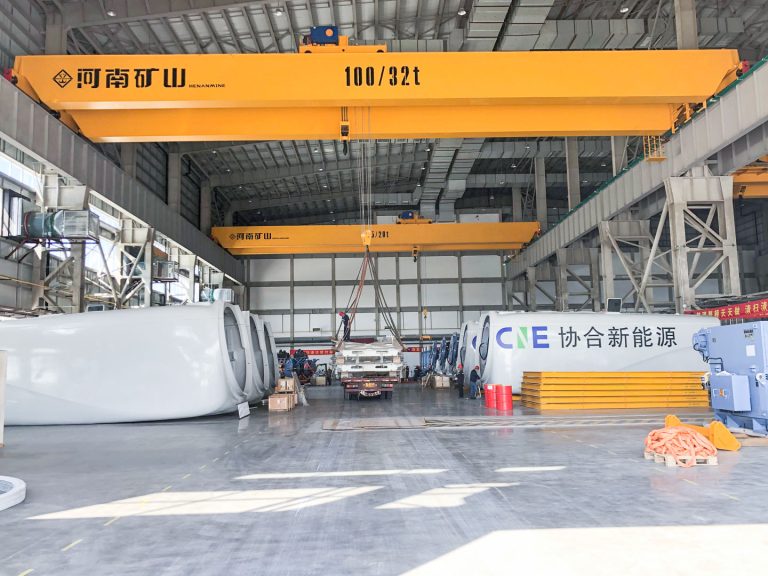

Custom Metallurgical Overhead Crane | Steel Plant Casting Crane Manufacturer
Casting Crane is the core lifting equipment in steel plant, often called ladle crane and Overhead Crane in the industry, which is mainly responsible for the transfer of ladle between converter, electric furnace, refining furnace, continuous casting machine and pouring station.
And ordinary workshop bridge crane is different, this kind of equipment is always in high temperature, heavy load, high frequency start and stop environment, lifting is high temperature molten metal, once the failure, light is to interrupt the rhythm of production, heavy is to cause safety accidents.
When purchasing, many steel mills tend to standardize only on rated tonnage and span, ignoring the adaptability to working conditions and safety redundancy design. A set of customized casting crane for steel plant that fits the process flow of the workshop needs to be customized from the tonnage accounting, structural selection, safety configuration, thermal protection design to the workshop dimensions to fit the whole dimension, in order to take into account the stability of production and long-term cost.
What is a casting crane
Crane is a special metallurgical overhead crane designed specifically for molten metal lifting scenarios, often called ladle crane, foundry crane, is the standard core equipment for steelmaking, continuous casting, foundry workshop.
It is the standard core equipment for steelmaking, continuous casting and foundry workshop. The difference between it and ordinary standard Overhead Crane is completely different from the bottom of design, and the following English comparison table can visualize the core difference:
| Item | Standard Overhead Crane | Casting Crane |
| Application | General material handling | Molten metal ladle handling |
| Working Environment | Normal workshop condition | High temperature, dust, strong radiant heat |
| Safety Standard | Basic safety design | High redundancy & fail-safe design |
| Duty Class | Light to heavy duty | Heavy-duty metallurgical service |
| Hoisting System | Standard hoist trolley | Special metallurgical hoisting mechanism |
| Brake System | Single standard braking | Dual redundant braking system |
| Electrical Protection | Common industrial grade | Heat-resistant & sealed protection |
| Core Risk | Load damage & equipment failure | Molten metal accident & production shutdown |
First run through the process, calculate the load rating
Many purchasers send inquiry only write “to 100 tons Casting Crane”, in fact, this parameter is too general. casting crane customization is the premise of the first clear equipment corresponding to the workstation and the complete workflow.
The working intensity, degree of heat radiation, and running path of different stations are completely different. For example, the frequency of operation, lifting range, and clearance requirements of each position are different in the electric furnace area, converter station, LF refining furnace, continuous casting rotary table, and slag ladle transfer area, and the corresponding equipment configurations will be adjusted as well.
Accounting for the rated lifting capacity of the main hook is not just about the weight of the molten steel. The complete load should include the weight of the molten metal, the weight of the ladle body, the weight of the internal refractory lining, plus the self-weight of the lifting beam and hook set, and finally a reasonable safety margin.
The load of the secondary hook should also be synchronized with the planning, usually mainly with the ladle tipping, maintenance lifting, intermediate package lifting and other auxiliary operations, do not have to pursue large tonnage, but to ensure that the action is flexible and reliable.
Tonnage margin is not a waste. Molten metal lifting belongs to high-risk operations, sufficient load margin can reduce structural fatigue, braking system and reducer load, reduce the probability of late failure and shutdown. For steel mills in continuous production, stable operation is much more important than saving a little purchase cost.
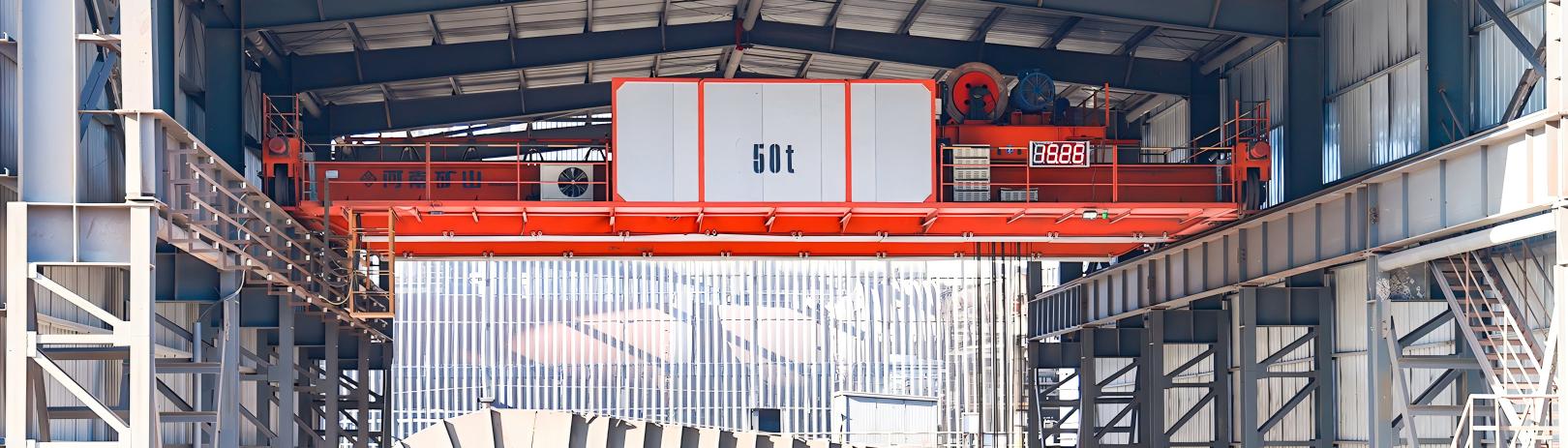
The right type of structure for different sizes of steel mills
There is no uniform standard for the main structure of steel mill casting crane, which should be selected according to the rated tonnage, workshop span and safety level.
Double girder casting crane is the most commonly used solution for small and medium-sized casting workshops and electric furnace steel mills. Double girder casting crane is the most commonly used solution. The double girder casting crane has mature technology, relatively controllable purchasing cost, convenient installation and maintenance, and can meet most of the medium tonnage ladle lifting requirements.
For large-scale combined steel mills and heavy-duty continuous casting plants, the four girder casting crane is recommended, i.e. the four girders and four rails structure. The four girders spread the load, the overall stability is stronger, the large tonnage ladle runs more smoothly, the safety redundancy is higher, and it is suitable for the continuous production of high-intensity working conditions.
The double trolley structure is optional for the work station that requires precise tipping of ladle and special pouring operation. The main trolley is responsible for the main lifting and transportation of the ladle, while the secondary trolley cooperates with the tipping and auxiliary operations, and the two work together to complete complex pouring operations.
In some workshops with compact layout, rotary hooks or special ladle lifting tools are also available to optimize the angle of ladle alignment and adapt to the restricted layout of the work station.
Work level can not be saved, to adapt to the rhythm of continuous production
The working level of the casting Crane is a point where many purchasers tend to step on the pit. Steel plant operations are characterized by a single lifting weight are very large, start and stop frequently, year-round continuous operation, even if the number of single-day lifting is not particularly high, the load level and fatigue strength requirements are much higher than ordinary crane.
Selection should be combined with the average daily operating hours, load ratio, production rhythm to determine the level of work, basically to use metallurgy-specific heavy grade work system design.
Absolutely not in order to reduce procurement costs, the choice of low working level configuration. Steelmaking workshop once the crane structure fatigue, component damage downtime, the entire production line to follow the stop, resulting in production losses far higher than the difference in the price of the equipment itself.
Safe and redundant design, the core of metallurgical Crane
Molten metal handling equipment, safety is always the first priority. Qualified molten metal handling crane must have a complete redundant safety design, can not rely on a single component to ensure safety.
The brakes of the hoisting mechanism are the most important and must be designed with dual brake redundancy.
Two sets of brakes work independently, and when one set fails, the other set can also steadily hoist the rated load to avoid the risk of falling ladles, which is also the most basic requirement of ladle crane safety design.
Large tonnage casting Crane can also do redundant lifting design, dual motor, dual reducer, dual wire rope system, load sharing, single set of system failure can also maintain the emergency operation, to the overhaul and emergency disposal leave enough space.The basic limit, overload and anti-collision protection can not be missing. Lifting up and down limit, large and small car travel limit, the same span of multi-vehicle collision avoidance, over-speed protection, these are standard, all-round limiting the dangerous action of the equipment.Also consider emergency scenarios.
Steel mills inevitably encounter sudden power outages, control system failures, the equipment must have emergency descent, standby mode of operation, the hanging ladle can be safely placed in the designated location, can not be suspended in mid-air jam -- below the furnace and continuous casting equipment, the consequences are unimaginable.
High-temperature dust environment, must do special protectionSteelmaking workshop heat radiation, metal dust, oxide skin splash, the crane's component loss is very large, customization must be targeted to do protection design.The bottom of the trolley should be equipped with heat-insulating baffles to block the heat radiation from the steel package upward, and protect the motor, reducer, brake and wire rope from high-temperature baking. The electrical cabinet should be sealed and insulated, and the internal temperature control system should be equipped with heat dissipation to avoid high temperature and accelerated aging of components.
Cables should be of high temperature resistant special type, and the location of alignment should avoid the direct heat radiation area. Wire ropes and bearings should be lubricated with high-temperature-resistant grease to meet the lubrication requirements under high-temperature working conditions.
For the metal dust and smoke in the workshop, the electronic control cabinet should improve the protection level, the sensing element to do dust sealing, maintenance platform to do easy to clean design, reduce the risk of failure caused by the accumulation of dust.
If it is coastal or corrosive gas workshop, but also additional heavy anti-corrosion coating to protect the steel structure and fasteners from corrosion, to extend the service life of the equipment.
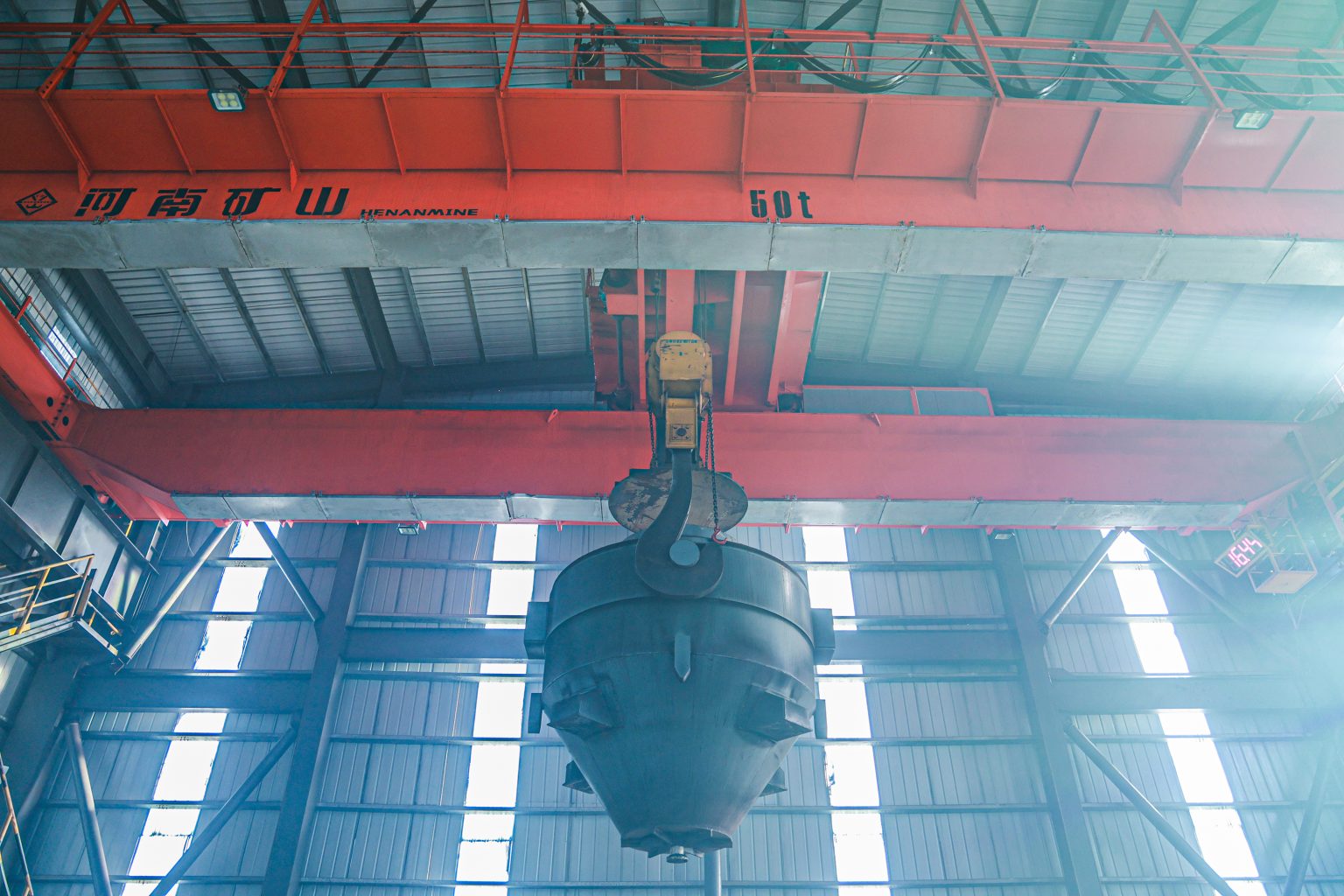
Maneuvering and Mechanism Configuration, Suitable for Field Usage Habits
The core components of the hoisting mechanism should be selected according to the metallurgical heavy-duty working conditions. The motor should have enough starting torque to match the operation rhythm of frequent starting and stopping; the reducer should be shock-resistant and have strong load capacity to adapt to the long-term operation under heavy load.
The mainstream control mode is still the cab control, the operator has a good vision, can observe the whole ladle running path, to deal with unexpected situations more directly. The cab should be heat and sound insulation, with air conditioning, to improve the working environment of the operator.
It can be equipped with remote control function, which can be used for maintenance, debugging and emergency operation, as a backup supplement to the main control.
With PLC + frequency control system, the starting and stopping can be smoother, reduce the shaking of the ladle, and the alignment can be more accurate, meanwhile, reduce the mechanical shock and prolong the service life of the equipment. If there is a need, it can be equipped with load monitoring and operation data recording function, which is convenient for equipment management and maintenance planning.
Matching workshop layout to avoid late installation jam
Many projects have problems, not the equipment itself is not good, but with the workshop size did not match. Before customization, we must provide complete workshop drawings and check the size parameters.
The span should correspond to the spacing of the centerline of the plant track, and the lifting height should meet the operating headroom of the furnace, refining furnace, continuous casting rotary table, and also reserve space for maintenance and lifting.
Wheel pressure parameters must be accurately calculated in advance to the civil engineering side of the plant to check the carrying capacity. Crane self-massive, wheel pressure is much higher than ordinary crane, plant tracks and beams and columns are not enough bearing, the later rectification costs are very high.
Also need to check the equipment and workshop facilities of the headroom distance, such as furnace roof, dust removal piping, pipe corridors, lighting, fire protection facilities, should leave enough safety clearance, can not run when the collision.
Full cycle cost is more important than just comparing prices
Many steel mills purchase only look at the initial offer, in fact, for casting cranes, the full life cycle cost is the key.
The initial procurement cost is only a part of the late brake pads, wire rope, wheel replacement, reducer maintenance, electrical component losses, are long-term fixed expenditures. More important is the cost of downtime, steel production line stop an hour of loss, may be worth half the difference in the price of the equipment.
Therefore, when selecting a model, the priority is to look at the reliability of the equipment, safety redundancy and ease of maintenance, reliable equipment can reduce downtime, reduce long-term maintenance investment, from the full cycle point of view, but more money.
Common Misconceptions in Selection
Many customers are prone to take the casting Crane as a common overhead crane to purchase, only than the tonnage and price, ignoring the design requirements of metallurgical specialties, with frequent failures in a short period of time.
Others only report the tonnage according to the weight of steel, not counting the weight of the ladle and refractory materials, resulting in the actual long-term overloading of the equipment operation, safety hazards.
Underestimating the effect of heat radiation, not checking the wheel pressure and plant load, ignoring the emergency descent function, and only comparing the total price without looking at the details of the configuration are all very common pitfalls.
FAQ
What is the difference between a casting crane and an ordinary Overhead Crane?
Ordinary overhead cranes are for general material lifting, casting cranes are specially designed for molten metal lifting, with higher safety redundancy, stronger thermal protection, higher working level, and the overall design standards are based on metallurgical working conditions, which is not a class of equipment at all.
How to account for the rated tonnage of casting Crane?
The weight of molten steel, ladle weight, refractory lining, spreader weight are added, plus a reasonable safety margin, not just the weight of molten steel.
Why casting Crane must be equipped with double brakes?
Because the lifting is high temperature molten steel, once the single brake fails, a fall accident will occur. Dual brake redundancy design, a set of failure of the other set can still stabilize the load, is the most basic safety requirements of metallurgical Crane.
Casting Crane with a good cab or remote control?
Mainstream or cab control, the operator has a good field of vision, to deal with complex working conditions more secure. Remote control can be used as a backup for maintenance, debugging and special operating scenarios.
What technical information do I need to ask the supplier before purchasing?
At least the general layout, wheel pressure diagram, electrical schematic diagram, list of safety devices, factory inspection report, load test procedures, operation and maintenance manuals, spare parts list.ConclusionHenan Mine Crane
Henan Mine Crane Factory supply Conclusion
For steel mills, the reliability and safety of the equipment is always more important than the lowest purchase price.
A tailor-made casting Crane can not only guarantee the safety of on-site operations, but also support the stable operation of the production line and reduce the hidden losses caused by downtime.
Henan Mine Crane metallurgical crane team has many years of experience in steel plant casting crane customization, according to the actual working conditions of different sizes of steelmaking workshop, continuous casting station, to provide a full set of programs from parameter accounting, structural design to installation and commissioning, after-sales maintenance.
If there is a need for procurement or transformation of ladle cranes, you can provide the ladle parameters, workshop drawings, working condition requirements, our engineers will be one-on-one to issue a customized program to fit.