
How to Choose a Straddle Carrier for Container Yard? Complete Buying Guide
With global container freight volumes still rising, both coastal hub ports and inland container depots (ICDs) are on the lookout for container handling solutions that can boost efficiency and cut labour costs. Straddle carriers are the best choice for handling equipment in many depots, because they can adapt to different yard layouts.
You'll get the hang of the equipment in no time.
Basic Understanding of the Equipment
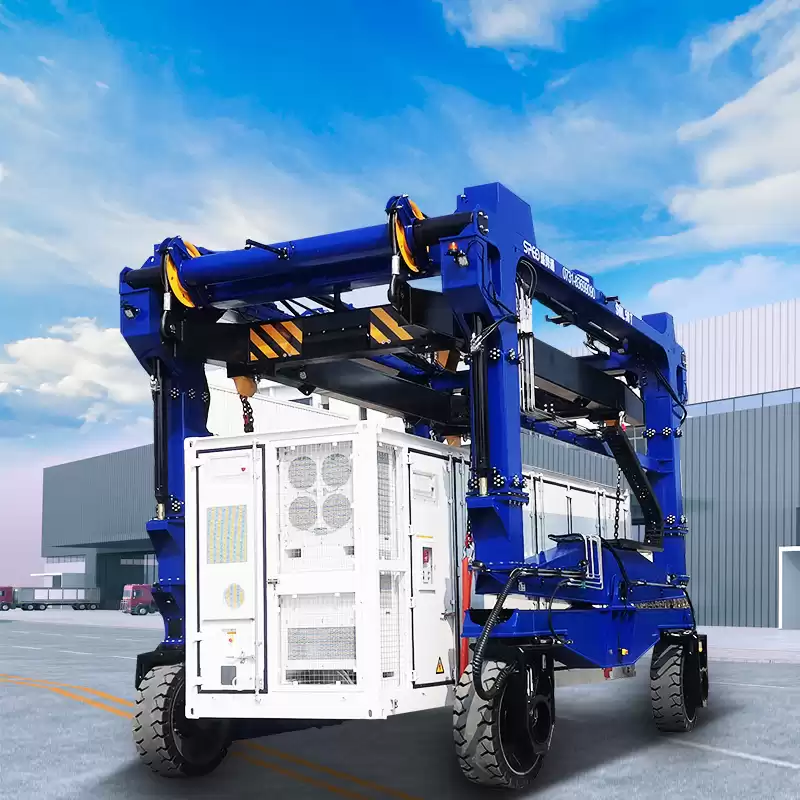
The main parts of the machine include the gantry structure, lifting frame, telescopic container lifting device, steering system, power unit, hydraulic system, operator cab, and safety sensors. It's pretty straightforward: you put a container to be retrieved, lift it to a safe height, move it around the yard, and then put it down to stack it – and all of this is done by one unit on its own.
Here are a few things to think about when choosing:
| Equipment Type | Initial Investment | Throughput | Labor Demand | Yard Flexibility | Stacking Height | Best For |
| Straddle Carrier | Medium | High | Low | Very high | 2-4 layers | Medium-large flexible yards |
| RTG Crane | Medium-high | Medium-high | Medium | Low | 4-6 layers | Fixed container blocks |
| Reach Stacker | Low-medium | Medium | Medium | High | 1-3 layers | Small yards & transfer |
| Terminal Tractor + Chassis | Low | Medium | High | High | 0 layer | Horizontal transport only |
When picking a container yard straddle carrier, the first thing to do is to work out the actual workload. First, you need to work out the average daily container throughput, peak-hour throughput, and truck turnaround time. Then, you need to work out the ratio of inbound to outbound containers, the proportion of empty versus full containers, and whether there are any special container types, like refrigerated or hazardous materials containers.
Things to think about when choosing:
Check how much work the yard can do and what it needs to be able to do that
When picking a container yard straddle carrier, the first thing to do is to work out the actual workload. First, you need to work out the average daily container throughput, peak-hour throughput, and truck turnaround time. Then, you need to work out the ratio of inbound to outbound containers, the proportion of empty versus full containers, and whether there are any special container types, like refrigerated or hazardous materials containers.
Find out how much weight your load can hold and what kind of container you need to use it in.
Stacker Truck Specifications: The rated payload is a key factor. For regular 20-foot and 40-foot standard containers, models with a 35–40 metric ton capacity are enough. But if you need 45-foot containers, double-container lifting or heavy-duty specialty containers, go for models with a 45–60 metric ton capacity.
Making sure the stacking height and yard utilisation match up.
The height you can stack them at directly affects how much space you have in the yard. The most common set-ups are 1-over-2 (2-tier stacking), 1-over-3 (3-tier stacking) and 1-over-4 (4-tier stacking).
The higher the stacking level, the more storage space you get per unit area. But this means you need equipment with a higher lifting height, which costs more to buy, takes longer to operate and means the operators need better visibility. High-level stacking is great for yards on the outskirts of cities where land costs are high, and in core port areas. But for inland yards with plenty of land and fast turnover, 2–3-layer stacking is a better option.
When picking the stacking height for straddle carriers, it's worth thinking about space reserves for business growth over the next few years. There's no need to go for the highest spec model straight away.
Choosing the Right Power Type: Diesel, hybrid, electric
Choosing the power type is a key part of the procurement decision. At the moment, the main options are diesel, hybrid, and fully electric. Lots of customers find it tricky to choose between diesel and electric straddle carriers.
Diesel models have the most mature technology, are cheaper to buy at first, and don't need as much extra infrastructure. They're great for places with limited power supply or irregular operations, like inland stockpiles in the mining industry.
Hybrid models add an energy recovery system to the diesel base, which reduces fuel consumption and emissions. They're perfect for yards that want to cut energy consumption but don't have charging infrastructure yet, making them a smart choice during a transitional phase.
Diesel vs. Hybrid vs. Electric Straddle Carrier
| Item | Diesel Straddle Carrier | Hybrid Straddle Carrier | Full Electric Straddle Carrier |
| Purchase Cost | Lower | Medium | Higher |
| Operating Cost | Higher (fuel) | Medium | Lower (electricity) |
| CO₂ Emissions | High | Medium | Zero on-site |
| Maintenance | More components | Medium | Fewer moving parts |
| Infrastructure Requirement | Low | Low | Charging station needed |
| Best For | Remote / high-duty yards | Transition scenarios | Green ports & urban yards |
We can adapt the steering systems to fit the yard layout.
The steering system has a big impact on how adaptable the equipment is to the yard layout. There are a few different types, like two-wheel steering, four-wheel steering, and crab-style steering. When picking a straddle carrier steering system, it's really important to make sure it's the right width for the aisle in your yard and that it can handle the density of containers.
For standard, open yards, two-wheel steering is enough, but for yards with narrow aisles and dense container areas, go for all-wheel steering straddle carriers, which have a smaller turning radius and are easier to manoeuvre.
When you need to move stuff around quickly and carefully, like when you're stacking things or working in narrow spaces, diagonal-steering straddle carriers are a better option. They mean you don't have to keep adjusting the vehicle's position, which saves a lot of time.
Choose the automation levels you need.
Lots of yards are currently upgrading digitally, and there are custom automated straddle carrier solutions available at different levels, so there's no need to implement everything at once.
The basic model that you drive yourself is great for small yards that need to be flexible.
Semi-automated models have automatic positioning and collision-avoidance assistance, which makes them easier to use and more stable.
With remote-control models, operators can control the vehicle from a central control room, keeping them away from harsh outdoor environments and reducing the number of on-site personnel.
Fully automated, driverless models are kitted out with GPS, LiDAR, and obstacle detection to automatically plan routes and get jobs done. They work with the Terminal Operating System (TOS) and are great for automated container terminals, cutting labour costs.
We can’t compromise on safety features.
Whatever model you choose, you'll need to make sure all the basic safety features are included. Stacker crane collision avoidance systems, load monitoring, wind speed alarms, emergency braking, automatic locking for lifting gear and panoramic video surveillance are all essential.
For yards on the coast or in open areas, we need wind speed alarms and automatic locking devices that kick in when wind speeds go past safe limits. For hazardous materials yards, we might also add automatic fire suppression systems. And for yards where lots of vehicles are operating at the same time, we need a vehicle-to-vehicle distance anti-collision interlock function. When picking STF safety configurations, upgrades should be made as needed based on the yard's risk level.
Getting used to the local climate and environment
The way plants do in different regions depends on the environment there.
High-temperature ports in the Middle East need heat-resistant cooling designs and dust-proof sealing configurations. Engines and hydraulic systems have to be adapted for high temperatures, and cabs need to be equipped with high-capacity air conditioning. We've already used our customised straddle carrier solutions for high-temperature ports on loads of overseas projects in the high-temperature sector.
In rainy yards in Southeast Asia, electrical sealing and rust/corrosion protection need to be strengthened to stop rainwater from eroding electrical components.
Vans used for moving stuff around in coastal salt fog need anti-corrosion coatings that are made for the sea, with important parts made of materials that don't rust to stop salt fog from damaging the equipment and making it last longer.
Inland yards with high wind and sand must improve air filtration and dust-proof sealing to reduce sand and dust wear on transmission components.
Just do the maths to work out the total cost of owning it.
A lot of procurement problems come from focusing too much on the purchase price and not enough on the long-term operating costs. When you're doing a total cost of ownership (TCO) analysis for straddle carriers, make sure you include the purchase price, fuel/electricity costs, maintenance expenses, tire wear, labor costs, downtime losses, and residual value.
For instance, electric models might cost more to buy, but they use less energy and cost less to maintain. In situations where they're used a lot, the extra cost can be made back in a few years. Diesel models might cost less up front, but you'll be spending more on fuel and maintenance in the long run.
When working out the total cost of ownership of an inter-yard truck, you've got to base it on a 10–15-year service life. That's the only way to make sure you're getting a good picture of the cost differences between the different options. It's also worth calculating the full return on investment (ROI) for the inter-yard truck, including the benefits of labour savings, efficiency gains and reduced downtime.
Assessment of the supplier’s capabilities
It's more important to choose the right supplier than to compare specs. When evaluating suppliers of inter-yard trucks, you shouldn't just base your decision on price.
It's important to look at how good they are at customising their engineering, and whether they can adapt their designs to your yard layout and operational needs. Next, have a look at their project case studies to see if they've got experience implementing solutions at yards of a similar type and size.
You should also check out their manufacturing qualifications and quality certifications, like international ones like CE and ISO. It's also really important to have experience with automation and remote diagnostics for container handlers. When it comes to overseas projects, it's really important to focus on after-sales support, like having a global network of spare parts, setting up and getting started on containers, and staff training.
As a professional straddle carrier manufacturer, Henan Mine Crane offers a full range of services, from designing solutions and manufacturing to installing, setting up, and maintaining your crane over its lifetime. We make customised container straddle carriers that are just right for yards in different regions around the world.
Here are some common mistakes to watch out for when choosing your models.
If you only compare the price you pay upfront, you might end up with a low-cost model that breaks down a lot and is off the road a lot, which can end up costing you more in the long run.
If you go for high-stack models without thinking about the yard layout, you might find yourself with too narrow aisles and difficulty moving equipment around, which can really mess up your efficiency.
If you don't think about how things might change in the future and only go for diesel models now, you might have to pay a lot more to adapt later when the rules about the environment get stricter.
If you don't think about how your supplier can help you after you've bought something, you might not get the parts you need when you need them. For example, you could be waiting months for replacement parts, which could cost you more than the price difference between the equipment models.
Not thinking the cost of replacing tyres will be as high as it is. If the ground conditions are poor, tyres wear out quickly, so when choosing models, check the tyre specifications and durability.
Here are some recommended configurations for different scenarios.
We've got these small inland container depots (ICDs). Go for 35–40 metric-ton diesel models with 2–3-layer stacking and basic manual operation – you'll get the best bang for your buck and it'll be a breeze to keep them in good nick.
Medium-sized dry port logistics parks: Go for 40–45 metric-ton hybrid or electric models with 3-layer stacking and semi-automated assistance. These are great for balancing efficiency and environmental sustainability, and they're perfect for medium-to-large-volume throughput.
Large international container terminals: Go for 45–60-metric-ton models with 3–4-layer stacking. You can upgrade these to remote control or fully automated operation, integrate with the terminal's TOS system, and they're suited for high-throughput operations.
High-Temperature Ports in the Middle East: Diesel or hybrid models with extra heat resistance, dustproofing and protection against corrosion, as well as stronger cooling systems, to handle extreme heat.
Inland Logistics Hubs in Africa: Choose proven diesel models with simple, reliable designs and readily available, interchangeable parts, suitable for environments with limited maintenance resources.
Frequently Asked Questions
How many containers is a straddle carrier able to handle in an hour?
With the standard settings, one machine can do between 15 and 25 lifts in an hour. The exact number depends on things like transport distance, stacking height, and how complex the container is. Shorter distances and lower stacking heights usually result in higher efficiency.
What stacking height offers the best bang for your buck?
For most medium-sized yards, a 1-over-3 stack (3 layers) is the best deal, giving you the best balance between storage space and how easy it is to use, so you get the best bang for your buck.
Which is better value for money, a diesel or electric model?
It depends on when it's open and how much energy it costs where you are. In places where they operate for longer on average and electricity is cheaper, electric models have a shorter payback period. In places where the power is not on all the time or you can't get to it easily, diesel models are a safer bet.
How long do you think a container handler usually lasts for?
With a bit of TLC, the main structure should last you 15–20 years, and the powertrain and wear-and-tear parts just need to be replaced every now and then. Pairing the equipment with a container handler predictive maintenance system can make it last even longer.
And finally, here’s the conclusion.
Choosing the right container handler is all about balancing how well it works in practice, how flexible it is, how much it costs to own, and whether it can be upgraded in the future. You shouldn't just choose the model with the highest specifications.
To choose a solution that matches your company's development needs and consistently delivers value over the next ten to twenty years of operation, you need to look at yard throughput, stacking strategies, powertrain type, automation requirements, and supplier service capabilities.
Get your own container handler solution just how you want it.
If you're picking a container handler for your yard, send us your annual throughput, yard layout diagram, stacking height requirements, average daily operating hours, powertrain preferences, and automation needs.
The engineering team at Henan Mine Crane will recommend the best straddle carrier configuration for you, and they'll also provide customised yard layout recommendations and a full life-cycle cost analysis.
You can also download the free "Container Yard Equipment Selection Checklist" to help your procurement team organise technical requirements and compare proposals from different straddle carrier suppliers more efficiently.