
Foundry Crane Selection Guide · Henan Mine Crane
What Operating Conditions Are Required for Foundry Crane Selection?
An accurate foundry crane specification requires more than capacity, span and lifting height. The crane must be selected from the complete suspended load, ladle and trunnion geometry, process route, production cycle, thermal exposure, runway limits, control philosophy, safety functions and destination requirements.
Purpose: RFQ and Technical Specification
Reviewed: September 2026
Direct Answer
A procurement-ready foundry crane enquiry should provide 12 groups of operating data: process duty, every permitted load case, ladle and attachment drawings, movement route, cycle and load spectrum, production availability, ambient and radiant heat, dust and other environmental conditions, building and runway geometry, motion and control requirements, destination standards and safety functions, plus installation, testing and documentation boundaries.
Load Basis
Complete suspended system
Classification Basis
Cycles, load spectrum and motion
Thermal Basis
Measured ambient and radiant heat
Commercial Basis
Defined supply and acceptance scope
Foundry workshops contain several distinct lifting duties. A production crane may transfer a filled ladle from a furnace to a pouring station; another crane may charge a furnace, turn a ladle, move moulds or support maintenance. These tasks can share a bay while imposing different loads, attachments, operating frequencies, heat zones and failure consequences.
The equipment name alone does not establish suitability. A foundry crane, ladle handling crane, charging crane and maintenance crane can require different load paths and safety functions. Direct molten-metal service must be stated explicitly; it cannot be inferred from the phrases “metallurgical crane” or “high-temperature crane.”
Complete operating data allow crane suppliers to calculate capacity, classification, motion speeds, heat protection, wheel loads and control functions on the same basis. They also make commercial quotations comparable by defining whether the scope includes the lifting attachment, runway, electrification, installation, testing, training and statutory documentation.
Operating-Condition Matrix
The 12 Data Groups Required for Foundry Crane Selection
The following information should be issued for each crane position. Where one crane has several duties, every approved operating mode and load combination should appear in the same schedule.
| Data Group | Information to Provide | Why It Changes the Crane |
|---|---|---|
| 1. Process duty | Ladle transfer, furnace charging, pouring, slag handling, mould handling, ladle maintenance or equipment maintenance | Defines the crane family, lifting attachment, trolley arrangement and risk category |
| 2. Load schedule | Maximum and minimum mass of metal, ladle, lining, residual slag, attachment, tooling and every permitted combined load | Establishes the rated-load basis, structural reactions and hoisting mechanism |
| 3. Ladle and attachment | Ladle GA drawing, diameter, height, trunnion geometry, centre of gravity, pickup clearances, beam or plate-hook drawing and tilt point | Determines engagement, hook approach, reeving, stability, headroom and pouring arrangement |
| 4. Movement route | Pickup, transfer, pouring and set-down coordinates; travel distances; elevations; obstacles; restricted areas and emergency set-down positions | Controls lift, approach, clearance, visibility, travel zoning and recovery planning |
| 5. Cycle and load spectrum | Lifts per hour, shifts per day, days per year, operating life, load-band percentages and movement distances | Provides the basis for crane and mechanism classification, motor thermal duty, brakes and fatigue life |
| 6. Availability target | Production consequence of crane outage, allowable recovery time, maintenance window, standby philosophy and emergency placement requirements | Influences redundancy, access, condition monitoring, spares and whether separate production and maintenance cranes are needed |
| 7. Thermal conditions | Ambient temperature at crane level, ladle/metal temperature, radiant-heat map, distance from heat sources, exposure duration and splash zones | Sets heat shielding, component location, insulation, cooling, cable type and operator protection |
| 8. Workshop atmosphere | Dust type and concentration, conductive dust, fumes, humidity, corrosive agents, indoor/outdoor exposure and documented hazardous-area classification if applicable | Determines enclosure, ventilation, sealing, coating and any certified hazardous-area equipment |
| 9. Building and runway | Span, runway length and elevation, rail section, alignment, allowable wheel loads, horizontal forces, clearances, approaches, platforms and erection access | Controls crane geometry, self-weight, wheel arrangement, end approaches and building modification scope |
| 10. Motion and control | Target cycle time, hoist/trolley/bridge distances, slow-speed positioning, acceleration, sway limits, cab/remote/automatic modes and visibility | Establishes motor sizes, drive control, positioning feedback, operator station and process interfaces |
| 11. Safety and compliance | Destination country, governing standards, statutory inspection, brake and limit philosophy, safe states, emergency recovery and personnel restrictions | Defines the safety architecture, verification methods, documents and acceptance responsibilities |
| 12. Project scope | Power supply, runway and conductor scope, installation, load-test weights, commissioning, training, spare parts, Incoterm, delivery location and document language | Prevents scope gaps and makes technical and commercial offers comparable |
Process Definition
1. Define the Process Duty and Every Permitted Load Case
The first line of a foundry crane specification should state exactly what the crane lifts and what it does with the load. “Foundry service” is too broad. Direct ladle transfer, crane-assisted pouring, furnace charging, slag-pot handling, mould movement and maintenance are different duties and may require separate cranes.
Ladle transfer
Identify the furnace, treatment, holding, pouring and set-down stations. State whether the crane only transports the ladle or also supports deslagging, alloying, treatment or other process operations.
Controlled pouring
Provide the pouring method, designated tilt point, permitted angle, pour rate, mould position and communication sequence. Main and auxiliary capacities and coordinated motion depend on this operation.
Charging and maintenance
List charging boxes, furnace covers, moulds, ladle covers, refractory tools and maintenance components separately. A crane approved for these duties is not automatically approved for a filled ladle.
Define the complete suspended system
The load schedule should separately state the maximum liquid-metal mass, empty ladle shell, refractory lining, expected residual metal or slag, ladle beam or gantry hook, plate hooks, process tooling and every approved combined load. The applicable standard and technical agreement should then identify which items form the rated load and which are treated as crane dead load.
Nominal furnace or ladle capacity is not sufficient. The heaviest physical condition may occur with a full lining, skull buildup, residual material or a special treatment attachment. Minimum loads also matter because drive control, brake response, load detection and automatic sequences must operate across the full range.
Required ladle and attachment drawings
Provide ladle outside diameter, total height, trunnion diameter and centre distance, trunnion elevation, centre of gravity, lifting-beam envelope, plate-hook throat and seating geometry, pickup clearances, allowed rotation, tilt point and wear limits. Drawings are more reliable than a text description for attachment engineering.
Production Duty
2. Provide the Operating Cycle, Load Spectrum and Availability Target
Foundry crane classification should be calculated from service conditions, not selected from a familiar class name. ISO 4301-1 uses working cycles, load spectrum and average movements as classification inputs. Other systems use different terminology, so a tender should identify the governing standard and provide the operating data behind the requested class.
Cycle histogram
Record lifts per heat, heats per shift, shifts per day, operating days per year and intended service life. Separate production, standby, maintenance and exceptional operations.
Load histogram
Estimate the percentage of cycles in defined load bands, including full ladles, partially filled ladles, empty ladles, attachments and auxiliary loads. Avoid describing every cycle as either empty or full when production records show a broader spectrum.
Movement profile
State typical and maximum hoist, trolley and bridge travel per cycle, waiting time over heat, number of starts, target transfer time and precision required at pickup, pouring and placement stations.
Production criticality changes the design
If one crane failure stops a furnace, holds a filled ladle or interrupts an entire pouring line, the project should state the allowable safe-recovery time. This requirement influences redundant functions, emergency lowering or set-down philosophy, maintenance access, condition monitoring, standby equipment and the recommended spare-parts package.
A high availability target is not achieved by assigning a higher structural class alone. Mechanism architecture, electrical segregation, component access, inspection intervals, trained response, critical spares and safe recovery procedures must be considered together.
Thermal and Atmospheric Conditions
3. Replace “High Temperature” with Measured Heat Data
A workshop air temperature does not fully describe thermal exposure. Radiant heat from furnaces, molten metal and hot ladle surfaces can create much higher local temperatures at the trolley, underside of the bridge, cabin, cables and electrical enclosures. The heat condition should therefore be mapped by location, duration and operating state.
| Condition | Required Site Data | Design Areas Affected |
|---|---|---|
| Ambient temperature | Minimum, normal and maximum air temperature at bridge, trolley, cabin and electrical-panel elevations | Motor and brake ratings, cabinets, ventilation, lubricants, cabin and component derating |
| Radiant heat | Source locations, surface or process temperature, crane distance, exposure time and shielding already provided by the building | Heat shields, trolley layout, cable routing, protected walkways, cooling and sensor locations |
| Splash and flame | Potential splash direction, pouring zone, furnace opening, flame path, incident history and exclusion boundary | Guards, protected access, cabin glazing, cable protection and emergency route |
| Dust and fumes | Composition, conductivity, concentration, deposition, extraction arrangement, humidity and corrosive content | Enclosure rating, cooling method, filters, seals, coatings and maintenance frequency |
The protection package should be selected from this measured profile. The separate guide to casting crane high-temperature protection explains how heat shields, protected cables, component locations, ventilation and monitoring respond to different exposure conditions.
Plant Interfaces
4. Define the Runway, Motion, Control and Safety Boundaries
A foundry crane is part of the building and the production process. Accurate crane selection therefore depends on interfaces that are often missing from short RFQs.
Runway and building
Issue the span, runway elevation and length, rail section, surveyed alignment, column spacing, allowable vertical and horizontal reactions, building clearances, platforms and access openings. Existing runways require condition and capacity verification.
Motion performance
Set the target cycle first, then determine hoist, trolley and bridge speeds. State creep-speed needs, positioning tolerance, acceptable sway, acceleration limits, approach distances and the sequence near furnace, ladle car or mould.
Control positions
Define cab, radio remote, remote control room and automatic modes separately. Include sightlines, cameras, operator communication, changeover permissions, restricted areas and the safe response to communication loss.
Process integration
List interlocks and handshakes with furnaces, ladle cars, treatment stations, pouring equipment, doors, other cranes and plant PLC/MES systems. Define signal ownership, network protocol and manual fallback.
Safety functions
Specify the required brake functions, upper limits, overload limiting, overspeed response, travel limits, anti-collision, load engagement confirmation, emergency stops and loss-of-power behavior by function and test method.
Recovery and maintenance
Identify safe set-down locations, emergency operating boundaries, rescue access, isolation points, inspection platforms, component-removal routes and the maximum repair window available during production.
Destination requirements must be named
The destination country, owner specification, crane design standard and statutory inspection process should appear in the RFQ. Terms such as CE, ISO, FEM and local occupational-safety rules do not represent one interchangeable approval. For example, U.S. hot-metal crane requirements include specific holding-brake provisions under 29 CFR 1910.179; other destinations use their own mandatory framework.
Configuration Comparison
How Operating Conditions Change the Foundry Crane Configuration
The following configurations are not capacity-only alternatives. The correct choice follows the load path, production criticality, auxiliary functions, runway limitations and safety assessment.
| Configuration | Consider When | Critical Data | Important Limitation |
|---|---|---|---|
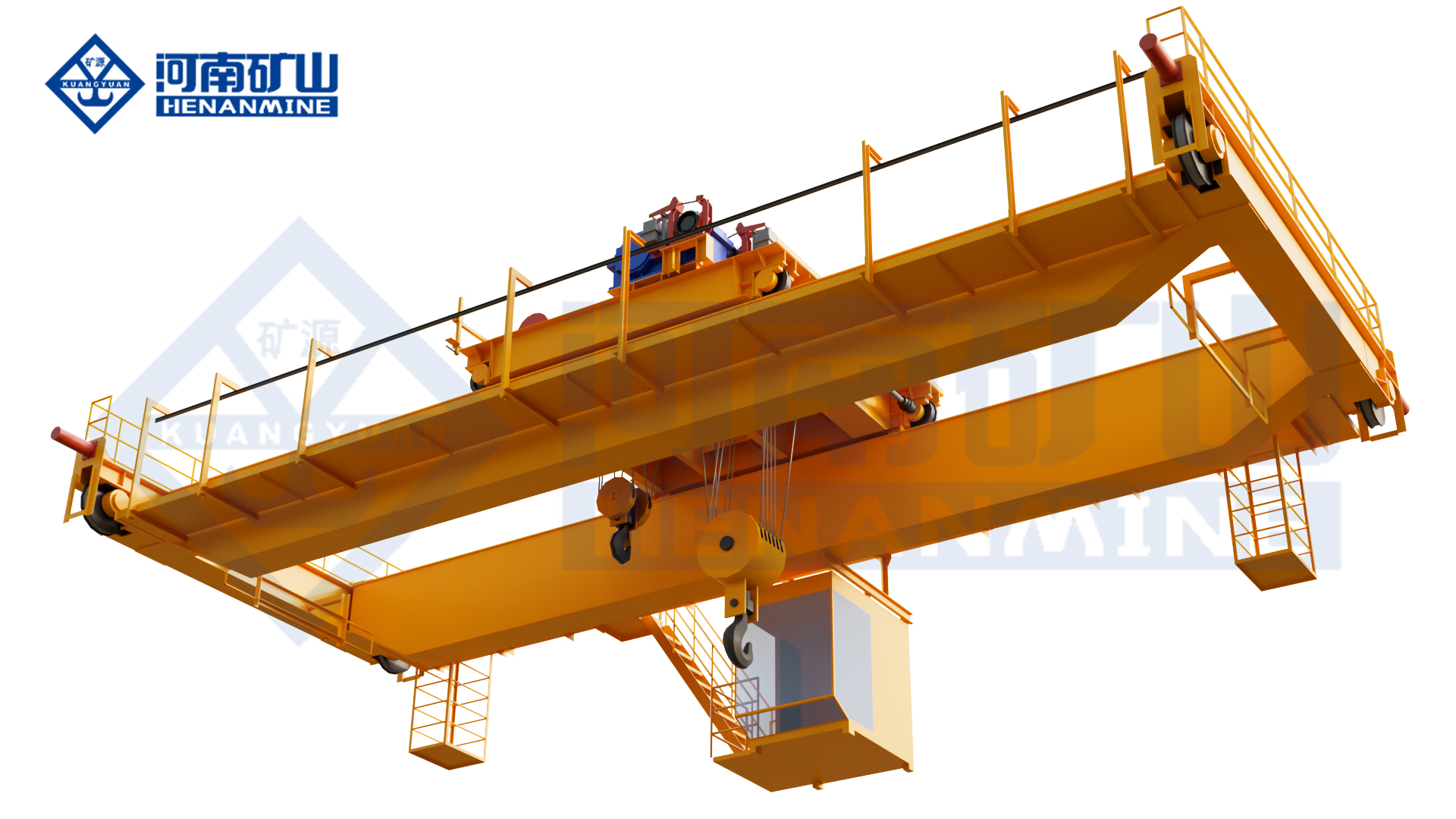
| Double-Girder Casting Crane | Defined ladle-transfer and pouring duty can be served by a double-girder metallurgical arrangement within verified structural and runway limits | Gross load, ladle beam, cycles, pouring method, span, lift, heat zones and runway reactions | Not automatically suitable for ultra-heavy, multi-function or exceptional-availability duties |
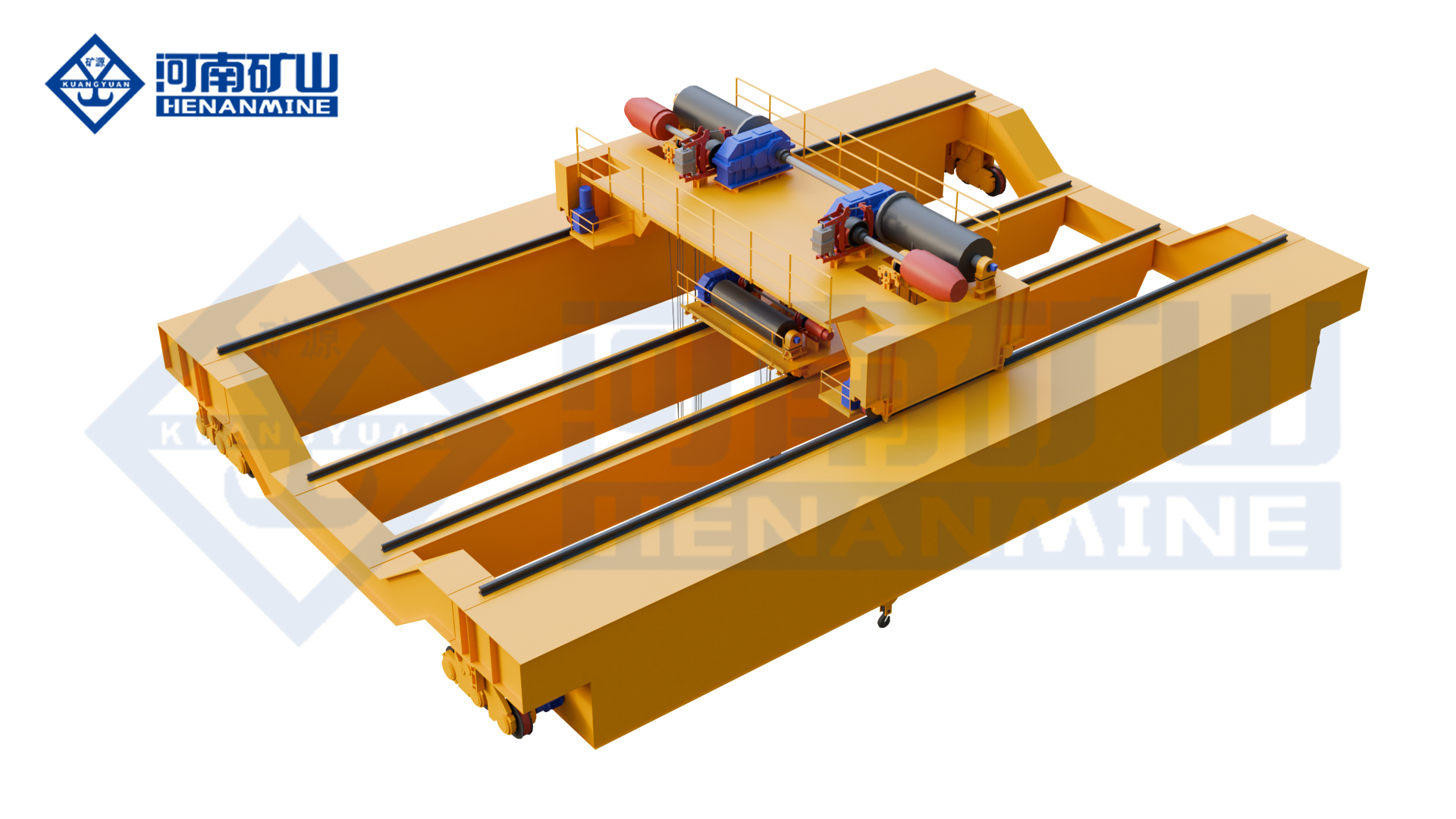
| Four-Girder Casting Crane | Ultra-heavy ladles, separate main and auxiliary trolleys, intensive operation or demanding stiffness and fault-tolerance requirements justify evaluation | Main/auxiliary loads, permitted combinations, trolley rail arrangement, off-centre cases, wheel loads and maintenance access | Greater self-weight, wheel reactions, building demand and project scope require early structural coordination |
| Metallurgical Bridge Crane | Hot components, furnace-area materials or a defined metallurgical duty require enhanced environmental protection | Exact load, attachment, temperature, duty, control and applicable molten-metal requirements | The product name alone does not confirm suitability for a filled ladle |
| Separate Auxiliary Crane | Moulds, furnace components, ladle covers and maintenance loads would otherwise interrupt the production ladle crane or require a conflicting attachment | Maintenance load matrix, shutdown plan, access, shared runway zones and inter-crane collision control | Must not lift molten metal unless specifically engineered and accepted for that duty |
Project Evidence
360-Ton Foundry Crane for a Heavy Casting Workshop
Why the operating data mattered
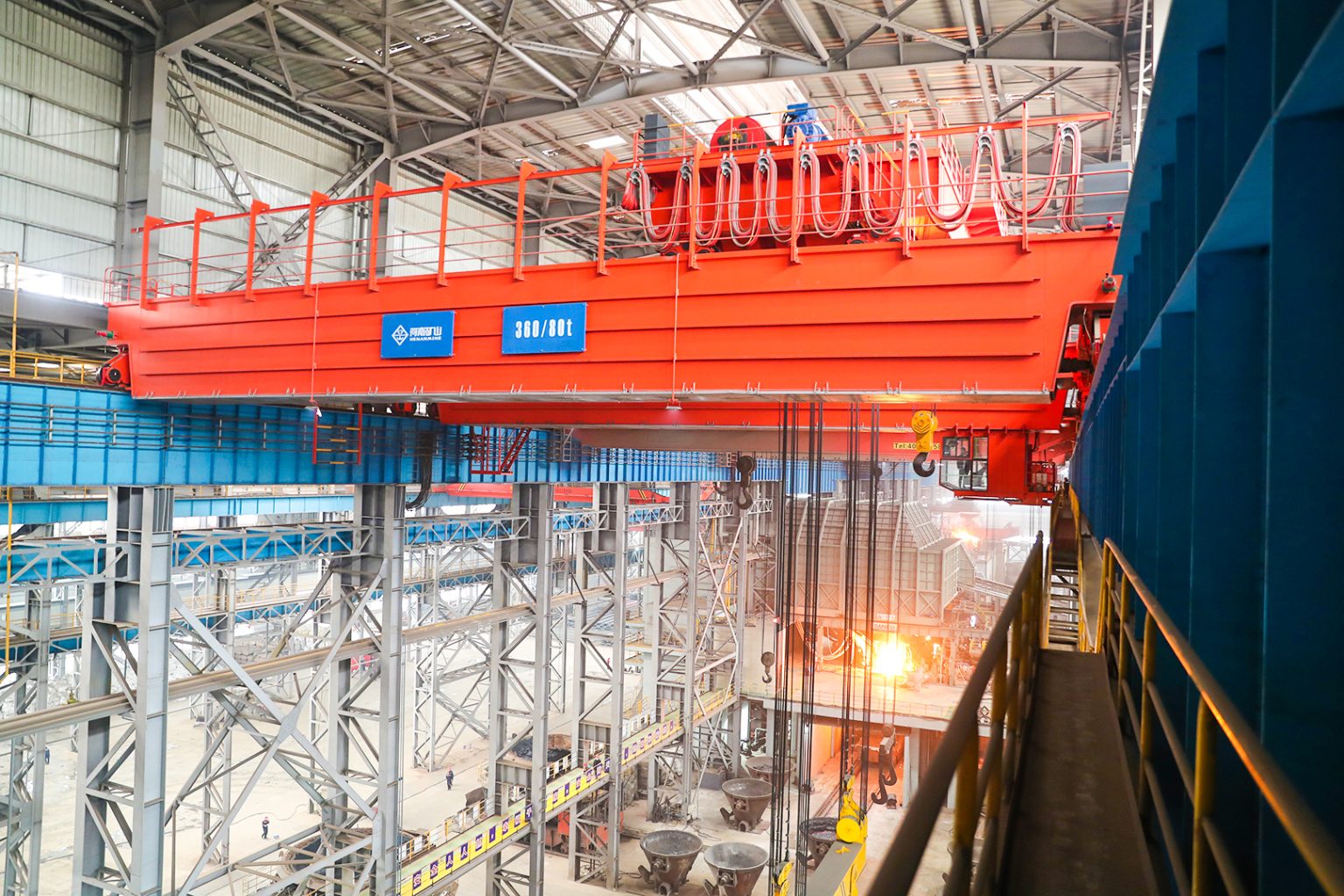
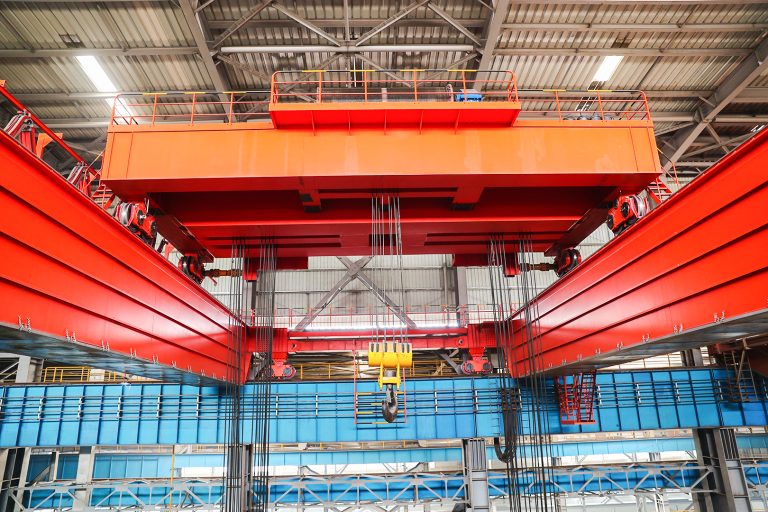
Henan Mine Crane’s documented 360-ton foundry-crane project for Jinsheng’an Group was configured for a heavy casting workshop. The disclosed structure comprises four girders, four rails and dual trolleys, supporting high-capacity molten-metal and foundry production duties.
- The main and auxiliary load cases required separate definition.
- Thermal exposure affected structural, mechanical and electrical protection.
- The crane and workshop runway had to be coordinated around a multi-rail load path.
- Production duties, mould handling and maintenance loads required an approved operating envelope.
This project demonstrates the relationship between operating conditions and configuration; it is not a standard specification for another plant.
Technical Enquiry
Foundry Crane RFQ Checklist
The following package provides a practical basis for a preliminary technical proposal. Final design should follow approved drawings, site verification, risk assessment and the applicable standard.
Process Documents
Foundry flow diagram; crane task list; furnace, treatment and pouring stations; ladle route; normal and emergency set-down points; operating procedure and personnel exclusion zones.
Load and Ladle Documents
Load schedule; liquid-metal and complete ladle masses; attachment mass; ladle and trunnion GA; lifting beam/plate-hook drawing; centre of gravity; tilt point and permitted combinations.
Production and Environment
Cycle and load histograms; shifts and annual hours; availability target; ambient/radiant heat map; load temperature; dust and fume data; corrosion and hazardous-area classification where applicable.
Building and Runway
Building and runway drawings; span, rail elevation and section; clearances; allowable reactions; electrification; maintenance platforms; installation openings; erection route and shutdown window.
Controls and Safety
Operating modes; speed and positioning targets; process I/O; communication protocol; safety-function specification; alarm and interlock matrix; power-loss response and recovery philosophy.
Commercial and Acceptance Scope
Destination and standards; power supply; Incoterm; runway/conductor boundary; installation; commissioning; load-test responsibility; FAT/SAT; training; spare parts; manuals and document language.
Frequently Asked Questions
What is the minimum information needed for a preliminary foundry crane selection?
At minimum: process duty, maximum complete suspended load, ladle and trunnion drawing, span, lift, movement route, cycles per hour, load spectrum, thermal conditions, runway data, control mode, power supply, destination and governing standard.
Is molten-metal weight enough to determine crane capacity?
No. The load schedule must include the ladle shell and lining, residual material, lifting beam or gantry hook, plate hooks, tooling and every permitted combined load. The rated-load definition must be stated in the technical agreement.
Does every foundry crane require A7 or A8 working class?
No universal class should be assigned from the industry name alone. Classification follows the governing standard, cycle count, load spectrum, movement and design life. Crane and individual mechanisms may also require different classifications.
How should foundry heat conditions be described?
Provide minimum and maximum ambient temperatures at crane level, the temperature and location of furnaces and ladles, distance from the crane, duration of exposure, radiant-heat measurements or heat map, and splash or flame zones.
Can a general metallurgical crane lift a filled ladle?
Only when the exact molten-metal load case, attachment, braking architecture, thermal protection, controls, inspection provisions and destination requirements have been engineered, verified and accepted. The product name is not evidence of suitability.
When should a separate maintenance crane be specified?
A separate crane should be evaluated when moulds, furnace components, ladle covers or repair work would interrupt production, require a conflicting attachment, enter a different heat zone or reduce the availability of the primary ladle crane.
Technically reviewed by: Henan Mine Crane Metallurgical Crane Engineering Team
Last reviewed: September 2026
Technical basis: Henan Mine Crane’s published foundry-crane, ladle-handling, double-girder casting-crane, four-girder casting-crane and 360-ton project information was reviewed for this guide. Classification principles were cross-checked against ISO 4301-1, and the inspection context against ISO 9927-1 and ISO 9927-5. Final capacity, safety functions, compliance and performance are governed by the approved project specification, risk assessment, destination requirements and contract.
Request a Foundry Crane Technical Proposal
Submit the process duty, complete load schedule, ladle and trunnion drawings, movement route, cycle and load histograms, heat conditions, span and lift, runway drawings, control requirements, power supply, destination standards and project boundary. Henan Mine Crane will prepare a condition-based crane configuration and commercial scope.