
Container Handling Gantry Cranes: Spreader Bar Selection and PLC Alignment Control
In ports and intermodal terminals, the operating accuracy of container gantry cranes directly determines the operating efficiency of the terminal.Most of the problems of shaking, alignment deviation, and frequent failures are due to improper selection of 20ft and 40ft container spreaders and mismatch with the integration of PLC alignment control system.
This article combines the different application scenarios of RTG and RMG gantry cranes to systematically explain the selection specifications of spreaders, the principle of PLC precise alignment control, the logic of hardware and software integration, common matching faults, and scenario-based configuration plans, so as to provide a professional and landing technical basis for port equipment procurement, operation and maintenance upgrades and automation transformation.
What Is a Container Handling Gantry Crane?
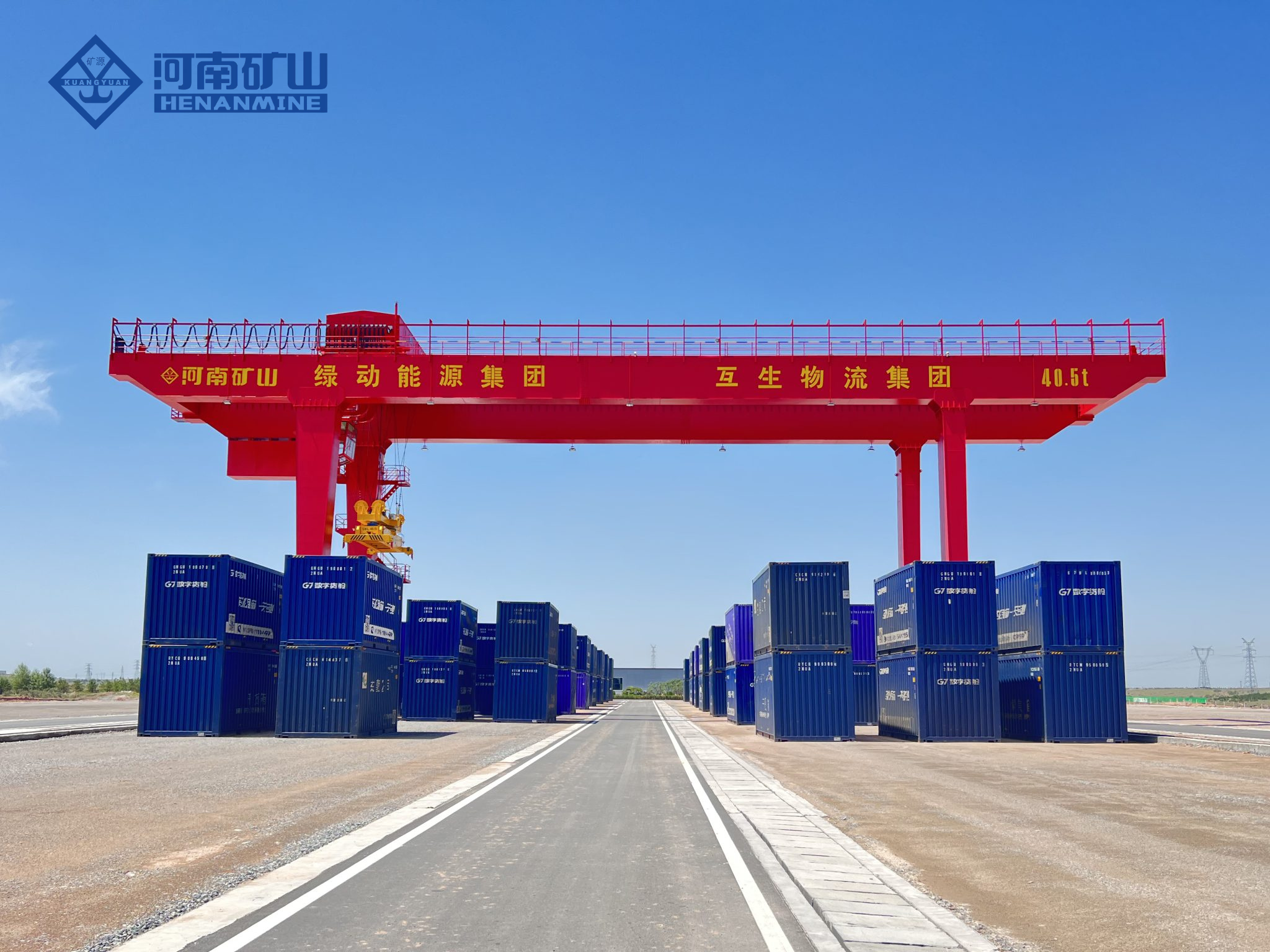
Container gantry cranes are large-scale industrial lifting equipment designed for container loading, unloading, transshipment, and stacking operations. They are the core infrastructure for modern operations in ports, logistics hubs, and inland depots, and support the circulation and transportation of millions of standard containers (TEU) around the world every year.
For container operation scenarios, the operating efficiency, safety and stability of gantry cranes depend entirely on the configuration of the equipment structure, the adaptability of the spreader and the coordinated matching of the control system.In-depth understanding of its structural principles, equipment differences and control logic is the core prerequisite for enterprise selection, equipment transformation, and site efficiency improvement.
Core structure
Container gantry crane is a complete set of equipment with highly integrated mechanical structure and electrical control system. The major subsystems work together to achieve safe, efficient and stable container operations. The core components are as follows:
- Gantry structure: As the core load-bearing steel structure of the equipment, it is formed by splicing the outriggers on both sides with the main beam on the top, carrying all the loads of all crane mechanisms, spreaders and containers, and transmitting the force to the walking foundation.The span, lifting height, and cantilever length of the gantry are all customized according to the site layout, container stacking height, and operating range, which are the basis for the stable operation of the equipment.
- Lifting mechanism: responsible for the lifting of spreaders and containers, the core includes lifting motors, reels, wire ropes, pulley blocks and other components.The lifting speed, working level, and wire rope configuration need to match the rated load of the equipment and the number of operating cycles per hour, which directly determines the operating efficiency of the site.
- Trolley operating mechanism: equipped with a lifting mechanism and a spreader, it walks laterally along the main beam to achieve precise horizontal alignment of containers within the span of the crane. It is the key mechanical structure for precise stacking and alignment.
- Cart operating mechanism: drive the entire crane to walk along the yard track or on the ground to realize the displacement of equipment across container columns and work areas, greatly expand the coverage of equipment operations, and adapt to the needs of large-area yard operations.
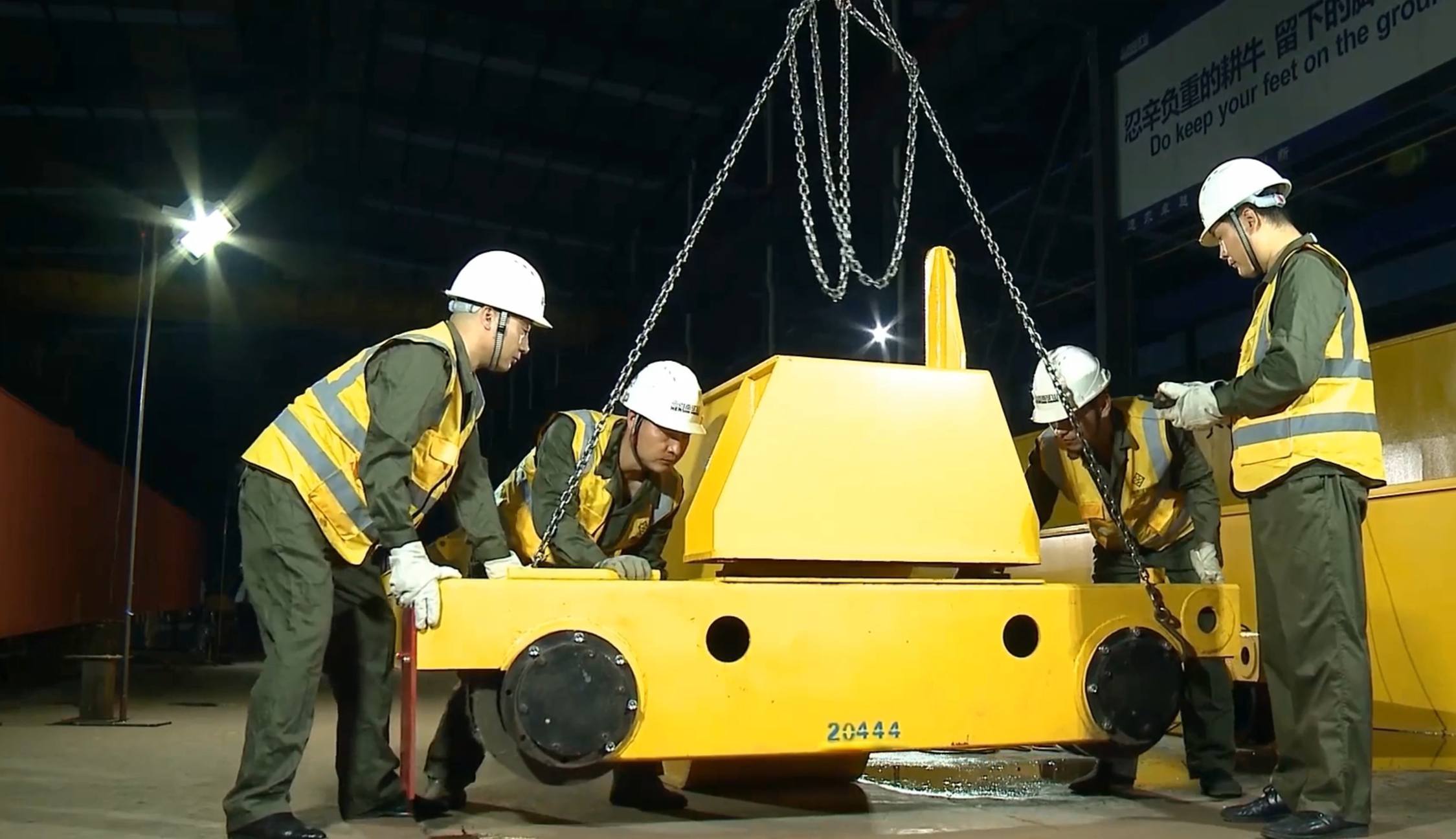
- Container spreader: The core operating accessories that are directly docked with the container, and the corners of the container are bitten by the rotary locking mechanism to complete the container grabbing and release.The type, parameters, and functional configuration of the spreader directly determine the container specifications and operating modes to which the equipment is adapted, which is the core focus of the selection.
- Electrical control system: it covers the power supply system, frequency conversion drive system, and PLC core control system, which is the “brain” of the entire equipment.Modern container gantry cranes rely on PLC to realize collaborative control of all actions, and can realize full-level automation operations from manual operation, semi-automatic circulation to fully automatic precise alignment.
Container gantry crane application scenarios
With the advantages of strong adaptability, large load and high degree of automation, container gantry cranes are widely used in all scenarios of multimodal transport. The core deployment areas include:
- Container terminal: As the core operating hub of the seaport, it mainly undertakes the loading, unloading, storage and transit of containers between ships, depots, warehouses, and railways. It is the core node of the flow of foreign trade shipping containers.
- Multimodal transport yard: it connects the core transit stations of the three major transportation systems of sea, railway and highway, and opens up the barriers to the connection of different modes of transportation to achieve efficient container turnover, rapid distribution and seamless circulation.
- Port and logistics center: A comprehensive logistics distribution hub, which can be adapted to the warehousing, turnover, sorting, and stacking operations of ordinary bulk cargo and standard containers at the same time, and can be adapted to diversified logistics and freight scenarios.
- Railway freight yard station: It focuses on the automated loading, unloading, storage and on-site reverse transportation of railway containers. It is the core supporting equipment scene for railway container trunk transportation and public railway intermodal transportation.
- Shipyard: It is mainly used for precise hoisting, shifting and transshipment of ship modular container components, marine supporting equipment and materials, and is suitable for the construction needs of heavy materials in shipbuilding projects.
- Industrial manufacturing and warehousing base: adapt to the needs of industrial-scale freight, and be responsible for the reception, transshipment and storage of containerized raw materials, semi-finished products, and finished products to ensure the efficient operation of the industrial supply chain.
It is worth noting that the operating environment (indoor/outdoor, open-air/closed site, wind conditions, stacking height) will directly determine the selection of spreaders and the configuration of the control system, which is the core basis for equipment customization.
RTG, RMG vs ordinary gantry crane
According to the walking mode, structural characteristics and applicable scenarios, container gantry cranes are mainly divided into three categories: tire type (RTG), rail type (RMG) and fixed yard gantry cranes. The operating environment of different equipment directly determines the selection criteria for spreaders and control systems.
Tire-type container gantry crane (RTG)
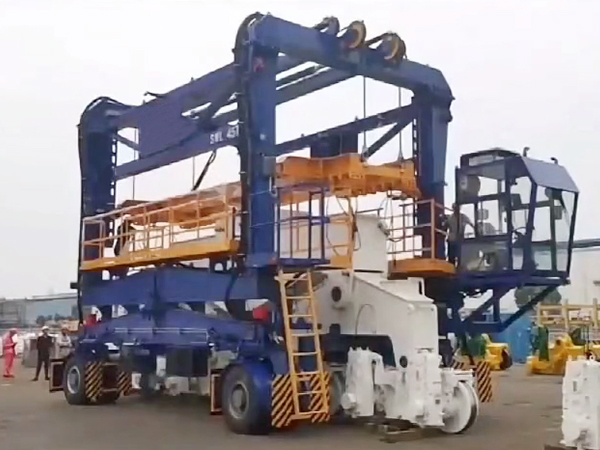
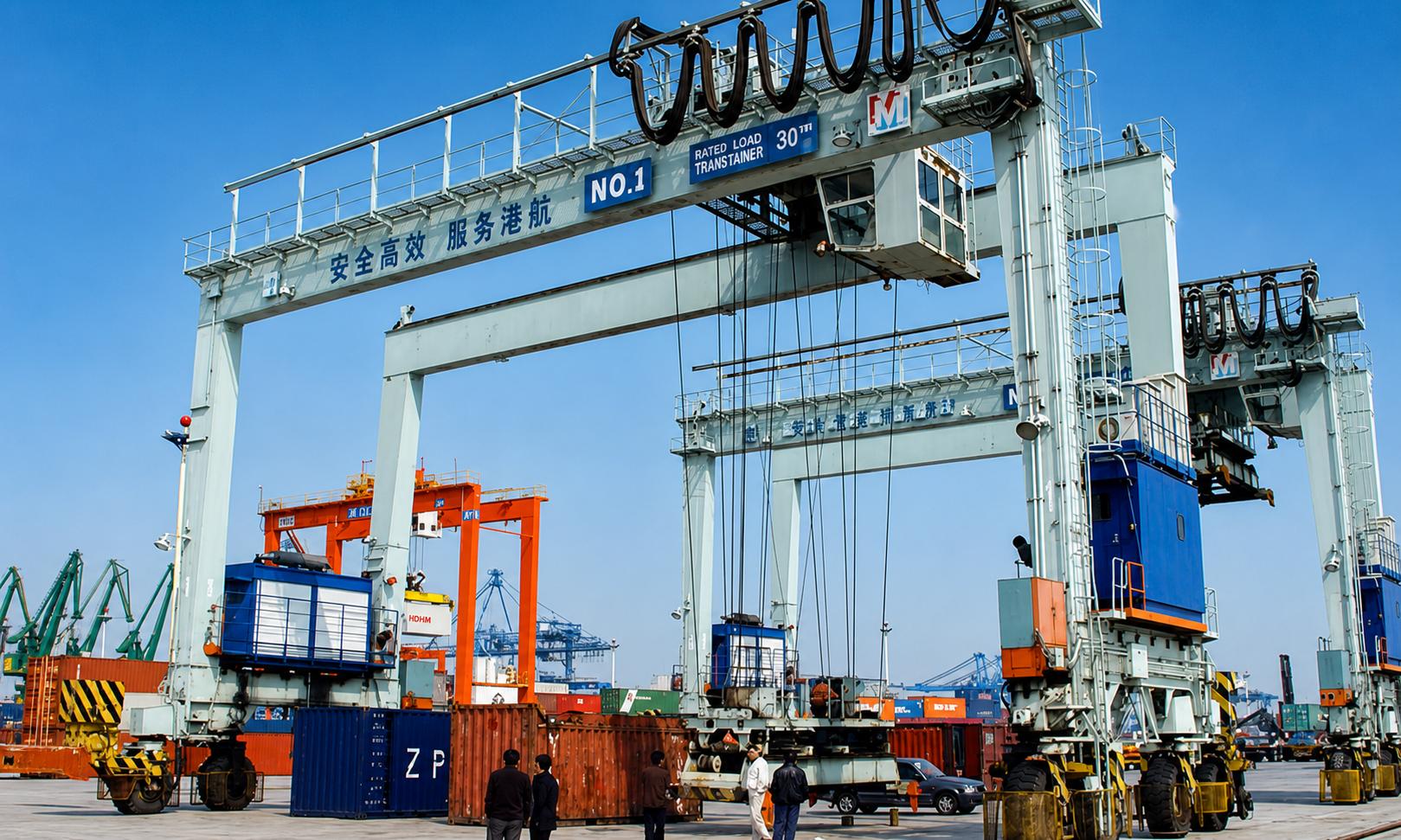
It uses rubber tires to walk without laying special tracks, and the site is extremely adaptable, and the working area can be flexibly switched and the layout of the yard can be adjusted.The equipment mostly uses diesel power generation for power supply, which is not limited by external power supply, and is suitable for open-air container depots and dynamic turnover scenarios.RTG comes standard with telescopic spreaders, which are suitable for multi-specification container operations. The core advantages are strong mobility and flexible deployment, which are suitable for small and medium-sized terminals and logistics depots.
Rail container gantry crane (RMG)
Rail container gantry cran Walking along a fixed track, it has strong structural rigidity, high operating stability, excellent positioning accuracy, and higher rated load and operating cycle efficiency.The equipment is driven by full electric power and is suitable for automated, high-throughput standardized container terminals. It is widely used in large ports, railway hubs, and automated depots. It can achieve millimeter-level precision stacking and adapt to high-density and high-frequency operations.
Fixed yard gantry crane
The operation span and area are fixed, there is no wide-range walking capacity, the structure is simple, the cost is lower, and the maintenance is convenient. It is only suitable for lightweight operation scenarios with a single operation area and fixed-specification containers, and it is mostly used for industrial warehousing and small special depots.
Impact of the environment on the configuration of the equipment
RTG for open-air operations needs to be adapted to wind, uneven ground, container placement deviation and other issues, and must be equipped with telescopic spreaders and anti-swing PLC control systems; orbital RMG automation stations have extremely high positioning accuracy requirements and need to be equipped with encoders and LASER sensing high-precision PLC alignment systems; indoor fixed operating equipment is stable in working conditions, and only fixed spreaders and basic control logic can be configured to meet the needs.
Container Spreader Bar Selection: What Should You Consider?
The spreader is the only docking carrier between the crane and the container. Whether the selection is reasonable directly determines the safety of the operation, the efficiency of the operation and the service life of the equipment.Mismatched spreaders can lead to problems such as alignment deviation, locking failure, and excessive load, causing safety hazards and loss of production capacity.
Adapt to container specifications
The mainstream specifications of international standard containers are divided into 20 feet, 40 feet, and 45 feet. The spreader needs to be accurately adapted to the position of the corner parts of the container in order to achieve stable locking and hoisting. It is also the core selection basis for 20-foot container spreaders and 40-foot container spreaders.
- 20-foot container spreader: it is divided into two types: fixed and telescopic. It is specially designed for 20-foot standard containers. It is suitable for special depots that only operate small boxes. It can also be used with a double crane mode to increase the amount of work.The structure is light, the response is fast, and the maintenance is simple.
- 40-foot container spreader: The most widely used standard spreader on the market, with a rated load of up to 35-50 tons, suitable for most ordinary container operation scenarios, and extremely versatile.
- 45-foot container spreader: customized for high-box and wide-body 45-foot containers, it is mostly used in European foreign trade logistics and special container transit stations, and is a special accessory for scene-oriented.
- -elescopic spreader: the length of the frame can be adjusted independently, compatible with 20/40/45-foot multi-specification containers, suitable for mixed-loading operation depots, flexible and full, and is the first choice for comprehensive logistics hubs.
- Fixed spreader: it is only suitable for single-specification containers. It has a simple structure, light weight, low failure rate and lower cost. It is suitable for special stations with fixed working conditions and single-box operations. The disadvantage is that it has no versatility and cannot be adapted to multi-specification container mixed operations.
Single crane vs double crane spreader
Single box spreader: The industry's general standard configuration, only 1 container can be hoisted at a time, suitable for most conventional operating scenarios, the equipment load pressure is low, the operation is stable, and the operating threshold is low.
Double-box spreader: dedicated and efficient configuration, which can lift two 20-foot standard containers at the same time. The core advantage is to greatly increase the throughput of operations. In ports and transit stations dominated by 20-foot small containers, the operating efficiency can be almost doubled and the number of crane operation cycles can be reduced.
However, the mechanical structure of the double crane system is more complex, and the load, structural strength, and control synchronization of the crane are more demanding.For 40/45-foot large box-based, low-throughput industrial depots, the operation and maintenance costs and equipment losses of the dual-crane configuration will be greater than the efficiency gains, and there is no need to choose blindly.
Load rating and safety design
The selection of the rated load of the spreader and crane cannot only refer to the nominal size of the container. The comprehensive total weight needs to be calculated, including the weight of the container, the weight of the cargo in the box, the weight of the spreader and the weight of all hoisting accessories.
The maximum total weight of a standard 40-foot container can reach 30,480 kg. After superimposing the weight of the spreader, accessories and the eccentric load of the cargo, the actual operating load is much higher than the nominal value.Sufficient safety margin must be reserved for the selection of models, and industry standards such as ISO 1161, ISO 3874, FEM, and ASME must be strictly followed.
If the load selection is too small, it will cause major safety accidents such as equipment deformation, hoisting failure, and falling boxes; if the load selection is too large, it will cause a waste of equipment resources and reduce the efficiency of the operation cycle. It is necessary to accurately match the selection of working conditions.
Rotary lock structure and control logic
The rotary lock is the core connecting component of the spreader and the container, and its locking feedback and control interlocking are the core guarantee of hoisting safety.
Fully automatic rotary lock: driven by hydraulic pressure or motor, the lock and unlock are uniformly controlled by PLC without manual intervention. It is a standard configuration of modern automated cranes with efficient operation and low error rate.
Manual rotary lock: relying on manual on-site manual completion of locking and unlocking operations, the process is cumbersome, the operating efficiency is low, and it is easily affected by human operating factors, and there are operating deviations and safety risks.It is only suitable for lightweight job scenarios with low job frequency, simple working conditions, and low automation requirements.
The equipment is equipped with a special position sensor, which can feedback the locking/unlocking status of the rotary lock in real time, and form a hard interlock with the PLC control system: the fully locked state is not detected, and the system prohibits lifting; the container is not fully landed, the load is not unloaded, and unlocking is prohibited, and dangerous operations such as unlocking and lifting the hanging box are eliminated from the root cause.
How PLC Alignment Control Improves Container Positioning
Gantry crane PLC control system and container alignment system are the core of modern crane automation operations. All actions are coordinated through programmable logic controllers to solve industry pain points such as container alignment deviation, shaking, and inaccurate positioning.
What is PLC alignment control
PLC (Programmable logic controller) is an industrial-specific core control unit that can collect sensor signals in real time, execute preset control logic, output precise action instructions, and coordinate the whole process of crane operations.In the container gantry crane, the PLC core coordinates and controls the following modules:
- Lifting system: it can carry out precise and closed-loop global control of lifting height, operating speed, acceleration and deceleration curves, dynamically optimize the operating attitude of load lifting, completely avoid lifting jitter, speed mutation and other problems, and ensure stable, accurate and controllable lifting operations throughout the process.
- Trolley walking: equipped with a high-precision horizontal alignment control system, with a flexible start-stop intelligent strategy, it effectively eliminates the start-stop impact and alignment deviation, greatly improves the horizontal alignment accuracy, guarantees the alignment fit of the box, and stably adapts to refined stacking operations.
- Cart walking: it has the ability of long-distance walking and dynamic positioning and calibration of the yard, which can effectively offset the cumulative positioning errors caused by long-distance operation, and ensure that the positioning accuracy of the equipment is consistent within the global operating range, the walking operation is stable, and it is suitable for large-area yard operation scenarios.
- Spreader adjustment: accurately control the telescopic stroke and alignment error of the telescopic spreader, and can be adaptively adapted to multi-specification container loading and unloading operations, with high adjustment accuracy and strong adaptability to meet the needs of diverse yard operations.
- Rotary lock mechanism: it can accurately output standardized locking and unlocking control instructions, and simultaneously collect data on the operating conditions and operating status of the mechanism in real time to realize the status monitoring and feedback of the whole process to ensure accurate response, safety and reliability of the rotary lock action.
- Safety interlocking: all-weather global monitoring of equipment operating parameters and operating conditions, relying on a mature intelligent logic interlocking protection mechanism, actively intercept illegal operations, avoid operational risks, and build a strong safety line of defense for container hoisting operations from the equipment control level.
Through millisecond-level data operation and command output, the PLC cooperates with the frequency conversion drive system to realize the smooth operation, precise alignment, anti-shake and shock absorption of the crane, and completely solves the accuracy shortcoming of manual operation.
The difficulty of precise alignment
Container automated stacking and alignment operation scenarios are complex, there are many external interference factors, and the equipment control accuracy and operating stability requirements are extremely high. It is the core difficulty of the automation control of the whole machine. The main operational interference factors on the site are as follows:
- Outdoor environmental interference: The equipment is operated in an open open-air yard without a closed protective structure. Natural wind and gusts of wind can easily disturb the floating containers, causing the box to shake and shift its position, which directly reduces the alignment accuracy and affects the stacking quality.
- Load shaking interference: During the start-stop and variable-speed walking of the equipment, the wire rope is prone to pendulum swing, which drives the hoisting container to continue to shake and shift, and cannot quickly complete the precise alignment and stable drop-off, which seriously affects the operating efficiency and stacking accuracy.
- Limitations of artificial field of vision: In long-distance, high-level stacking operation scenarios, the field of vision of manual operation is limited, the alignment accuracy is insufficient, the operating efficiency is low, and the fault tolerance rate is low.
- Long-distance positioning error: The yard operation has a large span and a long walking distance, and the operation of the equipment is prone to cumulative errors, which eventually leads to the offset of the container alignment.
- High-precision stacking requirements: Multi-layer container stacking operations have strict accuracy requirements, and they need to meet the millimeter-level standard. Small alignment deviations can cause safety hazards such as offset of the whole stack and collision of the box.
- Container placement deviation: The placement of containers at the bottom of the yard is prone to irregularities and misalignment, which puts forward extremely high requirements for real-time adaptive calibration and accurate alignment of equipment.
Core sensor configuration
The whole machine relies on a PLC closed-loop intelligent control system and is equipped with a full set of high-precision sensing equipment to collect core operating condition data such as equipment displacement, speed, attitude, and status in real time, and provide real-time feedback and dynamic correction of operating parameters to provide core data support for automated and accurate operations. The sensor configuration and core functions are as follows:
- Encoder: Collect the operating displacement and real-time speed of carts, trolleys, and lifting mechanisms with high precision in real time, build a full-dimensional position closed-loop control system, and correct the operating deviation in real time to ensure accurate positioning and controllable operation during the whole process of equipment walking and lifting.
- Proximity sensor: intelligent detection of the presence or absence of the container and the state of the spreader in place, accurate triggering of linkage actions such as dropping the box, rotating the lock and locking, to ensure the smooth connection of the operation process.
- Position sensor: real-time dynamic feedback on the extension length of the telescopic spreader, accurately adapt to different specifications of container operations, and ensure the adjustment accuracy of the spreader.
- Anti-sway sensor: collect load sway data in real time, and cooperate with PLC intelligent algorithms to correct the operating actions of the equipment, effectively suppress the sway of the box, and improve operation stability and alignment efficiency.
- Load cell: real-time monitoring of container load weight, overload protection, load balance detection and accurate determination of drop-off status, to avoid the risk of overload operations.
- Rotary lock position sensor: feedback the locking and unlocking working status of each group of rotary locks around the clock, monitor the locking reliability in real time, and ensure the safety of hoisting operations from the source
PLC Alignment Control Workflow: From Detection to Placement
Relying on standardized PLC closed-loop control logic, the system runs through the entire operation link of container grabbing, transshipment, alignment, and drop-off to achieve automation, high-precision, and high-safety control of the whole process. The entire operation process is divided into six closed-loop controllable steps.:
Step 1: target position detection
PLC integrates encoder position data, laser ranging sensor signals and yard management system coordinate information to accurately calibrate the container capture point and the target drop-off point to build an accurate and reliable operation coordinate reference to provide data support for subsequent automated operations.
Step 2: the crane moves in concert
The system adopts a multi-axis collaborative linkage control strategy, and the PLC synchronously dispatches the long-distance walking of the trolley yard, the precise horizontal alignment of the trolley, and the height adjustment of the lifting mechanism. The multi-mechanism synchronously cooperates and cooperates accurately to quickly complete the equipment in place, effectively shortening the operating cycle and improving the overall operating efficiency.
Step 3: Load ablation calibration
When the equipment approaches the target position of the operation, the PLC automatically activates the intelligent anti-swing algorithm, dynamically optimizes the acceleration and deceleration operation curve of the equipment, and actively suppresses the swing, offset and jitter of the container during the hoisting process, so as to achieve stable and controllable load attitude, and lay a solid foundation for high-precision alignment and smooth box drop.
Step 4: precise alignment of the spreader and the container
Relying on the dual high-precision verification mechanism of laser ranging sensor and proximity sensor, the bonding and alignment status of the spreader and the corner parts of the container is detected in real time.In view of the small position deviations that occur during the operation, the system can automatically perform low-speed and precise fine-tuning to completely eliminate the problem of misplaced hoisting and ensure the accuracy of alignment.
Step 5: Rotary lock lock confirmation
After the spreader is accurately positioned to fit the container, the PLC outputs a precise locking control command, which drives the rotary locking mechanism to complete the reliable bite locking.After the system receives all the feedback signals that the rotary locks are in place and locked, the lifting operation authority can be unlocked, and major safety hazards such as virtual locks and missed locks can be eliminated from the control level.
Step 6: Unlock the safe drop box
Throughout the drop-off operation, the load cell dynamically collects load data in real time and determines the force state.Only after confirming that the container is fully landed and the load is completely detached from the spreader load, the system will perform the unlocking action, effectively avoiding the risks of violations such as unlocking the hanging box and unlocking the load, and ensuring the safety and standardization of the entire operation.
Spreader and PLC Integration: Why the Two Systems Must Be Designed Together
The spreader is not a simple mechanical accessory, but the core terminal execution unit of the PLC control system.The deep integration, data exchange, and logical linkage of the two are the core of the safe, efficient, and stable operation of the crane, as well as the top priority of equipment design and transformation.
Data communication mechanism between spreader and PLC
During the whole operation, the spreader and the PLC system maintain high-speed two-way data exchange, synchronize the operating status of the equipment and operating conditions in real time, and build a closed-loop linkage control system. The core interaction content is as follows:
- Rotary lock status feedback: real-time collection and upload of rotary lock locking, unlocking and abnormal fault status signals, to provide the core data basis for the safety interlocking logic control of the whole machine and the operation safety determination, to ensure that the locking action can be monitored and traceable throughout the process.
- Telescopic feedback of the spreader: dynamically and synchronously feedback the actual stroke and in-place status of the telescopic spreader, accurately match the operating requirements of containers of different sizes, and realize rapid switching and precise adaptation of multi-specification boxes.
- Issuance of control instructions: relying on the PLC core control system, it accurately outputs various action instructions such as rotary lock locking, unlocking, and spreader expansion and adjustment. The instructions respond quickly and are executed accurately, and the whole process of equipment automation is stably realized.
- Fault early warning reporting: monitor the operating status of core components such as sensors and actuators around the clock, capture abnormal working conditions in real time, and trigger alarms and safety protection mechanisms in time to avoid equipment failures and hidden dangers in operations in advance, and ensure the stable operation of the equipment.
- Global sensor data synchronization: high-speed synchronous transmission of multi-dimensional sensor data such as position, load, and laser ranging, providing real-time and reliable data support for core operating functions such as precise alignment of equipment, stable load control, and flexible start and stop.
PLC input and output (I/O) core control logic
This container crane is equipped with a mature PLC intelligent control system and a standardized I/O signal configuration, which can realize the full-link closed-loop precise control of equipment operations and ensure the stable, safe and efficient operation of automated operations.
Input signal (acquisition feedback): real-time collection of container in-place status, rotary lock locking/unlocking working conditions, spreader telescopic position, spreader fault alarm, real-time load value, equipment alignment deviation and other core signals, capture equipment operating conditions in all directions, and provide accurate data support for intelligent system control.
Output signal (execution command): accurately output control instructions such as rotary lock lock/unlock control, equipment sound and light early warning, stepless speed regulation of cart/trolley/lifting mechanism, lock/release of lifting authority, etc., to achieve accurate response and coordinated linkage of the actions of each mechanism.
All operating data, status signals and fault information of the system can be visualized in real time through the HMI man-machine interface, which is convenient for operators to intuitively grasp the operating conditions of the whole machine, realize the seamless switching between fully automatic operations and manual intervention, and improve the flexibility and controllability of operations.
Core security interlocking logic
The PLC system has built-in multiple closed-loop safety interlock protection logic, which builds a safety protection barrier from the bottom of the program to avoid the risk of illegal operation and misoperation in all directions. The core interlock protection mechanism is as follows:
- Locking safety interlock: Before the rotary lock completes the full stroke and is locked in place, the system forcibly locks the lifting action authority, prohibits the execution of hoisting and transshipment operations, and eliminates the safety hazards of unpacking and dropping the box caused by the failure of the lock to bite from the root cause.
- Floating protection interlock: When the container is detected to be in a state of floating force, the system blocks all unlocking instructions, prohibits the rotary lock from performing unlocking actions, and completely avoids high-risk risks such as high-altitude falling of the box and heavy-duty decoupling of equipment.
- Precise alignment and speed limit interlocking: When the equipment enters the close-range precise alignment condition, it automatically switches to the low-speed stable control operation mode, which restricts the high-speed operation of the mechanism, effectively suppresses load shaking and position offset, and guarantees the accuracy of container stacking alignment and operation stability.
- Abnormal fault interlocking: When the core sensor data is abnormal, the signal deviation exceeds the limit, or the equipment working conditions are abnormal, the system immediately triggers emergency shutdown protection, locks all mechanism actions, and aborts the operation process to ensure the safety of equipment, goods and on-site operations in all directions.
HMI human-computer interaction and operation feedback
The HMI human-computer interface is the core of the interaction between the operator and the equipment. It displays core data such as the telescopic status of the spreader, the alignment of the container, the working status of the rotary lock, the walking position of the crane, fault alarm information, and emergency stop status in real time. The interface is simple and intuitive, and it is suitable for high-load and high-intensity operation scenarios in the port, greatly reducing the difficulty of operation and the cost of troubleshooting.
Anti-Sway and PLC Alignment: The Key to More Precise Container Handling
Alignment control and anti-swing control cannot be operated independently. They must be deeply coordinated through the PLC system in order to achieve high-speed, accurate and stable stacking operations.A separate alignment control cannot solve the problem of load shaking, and a separate anti-swing function cannot guarantee the positioning accuracy.
Through a unified algorithm, the PLC system cooperatively adjusts the lifting speed, trolley walking speed, trolley walking speed, and equipment acceleration and deceleration curve to suppress the container swing amplitude from the source: by predicting the load shaking law, the equipment action is corrected in advance to offset the offset caused by wind and start-stop inertia.
The data of the actual station transformation case show that the RMG crane equipped with an integrated anti-swing PLC control system has increased its operating efficiency by 15%-20%, the container alignment accuracy is controlled within ±5mm, and the service life of vulnerable parts such as wire ropes and spreaders is extended by 25%, greatly reducing equipment operation and maintenance costs and downtime losses.
At present, mainstream equipment adopts a hybrid scheme of ”mechanical shock absorption + electronic anti-shake", the mechanical structure provides basic stability, and the PLC intelligent algorithm realizes precise fine-tuning, which is perfectly adapted to the complex port scenarios of open-air high winds and high-frequency operations.
How to Select the Right Spreader and PLC Configuration
Working condition evaluation parameters
Before selecting the type, it is necessary to comprehensively sort out the operating parameters of the site and accurately match the configuration of the spreader and the control system: container specifications, maximum rated load, required lifting speed, hourly operating cycle volume, indoor/outdoor operations, site wind level, stacking height, positioning accuracy requirements, existing equipment control system architecture, automation level requirements.
Scenario configuration reference scheme
- Dedicated 40-foot container yard: suitable for single box type, stable working conditions, equipped with fixed 40-foot spreader, with basic PLC encoder alignment system and standard rotary lock safety interlock logic.The overall structure is simple and reliable, the operation and maintenance cost is low, and the stability is strong, taking into account the practicality of the operation and the cost performance of the project.
- 20/40-foot mixed operation logistics yard station: adapted to the needs of alternating operations of multi-specification containers, telescopic adaptive spreaders are selected, and PLC control systems with real-time feedback of spreader length and high-precision laser alignment sensors can be used to quickly switch operating modes and adapt to diversified and flexible operating scenarios in the yard.
- High-throughput port terminal: For high-frequency and high-throughput port operating conditions, it is equipped with dual-crane high-efficiency spreaders, with a high-end PLC integrated anti-swing control system, a multi-axis linkage precision positioning module and an HMI real-time working condition monitoring terminal, which greatly compresses the length of the operation cycle and improves the throughput capacity and operation stability of the yard in all directions.
- Fully automatic unmanned yard: adapted to intelligent unmanned operation scenarios, equipped with electric telescopic high-precision spreaders, integrated multi-sensor fusion positioning system, remote monitoring PLC control system, can be seamlessly connected to the intelligent management system of the yard station, to achieve unmanned, automated and accurate operation of the whole process of container grabbing, alignment, and stacking.
Common Problems When Spreader and PLC Systems Are Poorly Matched
The mismatch between the spreader and the control system is the core cause of equipment failure, low efficiency, and frequent safety hazards in the station. The five common problems need to be avoided.:
- Abnormal synchronization of the rotary lock signal: The electrical signal of the spreader does not match the parameters of the PLC module, and problems such as false locking and signal delay will occur. The system misjudges the hoisting state, resulting in dangerous lifting, which can easily cause safety accidents in falling boxes.
- Insufficient positioning feedback accuracy: the sensor configuration is insufficient and the accuracy is not enough. The PLC cannot accurately judge the position of the spreader and the container. There are frequent alignment deviations and misalignment of the drop box, which require repeated manual correction, greatly reducing operating efficiency, and wearing out the container corners and equipment structure at the same time.
- The control logic does not match the structure of the spreader: The fixed spreader is matched with the control logic of the telescopic spreader, or the telescopic spreader is adapted to a simple control program, which will cause chaotic instructions, frequent alarms, and equipment sudden stops, which will seriously affect the continuity of operations and increase the probability of equipment failure.
- No anti-swing collaborative control: the PLC system, which only has the basic alignment function and does not integrate anti-swing logic, cannot suppress the shaking of the container, the operation waiting time is long, the alignment efficiency is low, and the risk of collision during high-speed operation is extremely high.
- Excessive automation redundancy: blindly configuring a high-end fully automatic control system under simple and fixed working conditions will lead to complex equipment structure, increased failure points, significant increase in operation and maintenance difficulty and cost, and the problem of “excessive automation and extremely low cost performance”.
- Core summary: The higher the automation configuration, the better. The spreader and PLC system must fit the actual operating conditions, site conditions and operation and maintenance capabilities, and adaptability takes priority over the level of intelligence.
Safety and Reliability Considerations
The PLC control system is only responsible for the optimization of the operation process and the coordination of actions. The core safety protection must rely on independent hardware loops to ensure the safety of equipment operation. The core safety configuration includes:
- Overload protection: It is equipped with an independent weighing sensor overload circuit to monitor the load status in real time. Once the overload is detected, power failure and shutdown will be triggered immediately, and safety risks such as structural deformation and falling boxes caused by overload operations will be eliminated from the hardware level.
- Emergency stop system: equipped with an independent hardware safety circuit, it is not disturbed by the operating state of the PLC program. In case of emergency, the power can be cut off with one key and the emergency shutdown can be stopped to ensure the safety of personnel and equipment.
- Rotary lock hardware interlocking: Adopts a hardware-level locking protection mechanism, does not rely on software logic, and effectively avoids dangerous working conditions such as mislocking and false lifting caused by abnormal PLC programs and signal confusion.
- Stroke limit protection: Multiple limit protections are set up within the full walking stroke of lifting, carts, and trolleys to prevent over-range operation, structural collisions, and mechanical damage, and to ensure the safety of equipment operation boundaries.
- Anti-collision system: relying on high-precision ranging sensing to achieve regional protection, real-time monitoring of equipment spacing and surrounding environment, effectively avoid machine-to-machine, machine-to-yard structure collision accidents.
- Wind monitoring system: The open-air model is equipped with a standard wind speed monitor, which collects on-site wind data in real time, and automatically restricts high-speed operation or shutdown under windy conditions to avoid the risk of load offset and equipment instability caused by strong winds.
- Redundant safety feedback: For key safety parameters such as rotary lock status and overload signal, a dual-sensor redundant acquisition design is adopted to eliminate single-point failure blind spots and improve system operation reliability.
- Electrical protection: Integrate a full set of electrical protection functions such as short circuit, overload, leakage, and insulation monitoring to stabilize electrical operating conditions and avoid downtime and safety accidents caused by electrical failures.
- Preventive maintenance mechanism: through regular sensor calibration, control algorithm iteration, mechanical structure flaw detection and maintenance, the accuracy, stability and service life of the equipment are continuously guaranteed, and the probability of sudden failure is reduced.
Conclusion
The operating efficiency of container gantry cranes depends not only on the equipment body, but also on the collaborative integration of the spreader and the PLC control system.RTG is suitable for flexible yard operations, and RMG is more suitable for high-precision and high-throughput automated terminals. The selection should be combined with actual working conditions to match the spreader, sensor and control logic.
Synchronous planning of spreader parameters, PLC control, anti-shake system and sensor configuration from the project design stage can improve operation accuracy and operating stability, and reduce failure and maintenance costs.Henan Mine Crane can provide RTG/RMG customized lifting solutions according to terminal layout, operation requirements and automation level to help the port achieve efficient and intelligent operation