
5 Common Types of Jib Cranes and Their Industrial Applications
Cantilever crane is a commonly used lightweight lifting equipment for industrial assembly, material handling and equipment maintenance. It has the advantages of small size, flexible operation and high cost performance. It is suitable for local refined and repetitive hoisting operations, which can effectively improve workshop operation efficiency and reduce operation risks.
Cantilever cranes are divided into various types according to the structure and installation method, and the adaptability of working conditions is different.This article explains in detail the characteristics and industrial uses of the five mainstream cantilever cranes, floor-standing, wall-mounted, mobile, folding-arm, and mast-type, to help enterprises quickly select models.
What Is a Jib Crane?
Cantilever crane is a typical overhead lifting equipment. The core structure consists of a vertical support body, a horizontal spiral arm (boom), and an electric hoist/chain hoist walking mechanism.The equipment relies on vertical columns, walls or building structures to be fixed, and the boom can be rotated to complete the lifting, translation, and positioning of goods in a fan-shaped or circular working area. It is the core equipment for accurate lifting of industrial parts.
Core features
- Wide operating range: the boom can rotate at multiple angles from 180° to 360°, covering fan-shaped and circular operating areas in all directions, effectively eliminating dead ends in hoisting, and the operation coverage is comprehensive.;
- Comprehensive load adaptation: the load-bearing span covers hundreds of kilograms to 15 tons, taking into account the transfer of light materials and the hoisting of heavy equipment, and can be adapted to various light and heavy industrial operating conditions.;
- Accurate and stable positioning: optimized design for short-range, high-frequency repetitive hoisting scenarios, high alignment accuracy, perfect for precision assembly, equipment calibration and other refined operation needs;
- Economical and convenient operation and maintenance: the equipment has a streamlined structure and a small footprint. Compared with large-scale lifting equipment, the procurement is more cost-effective, and the installation, commissioning and daily operation and maintenance are easier and more efficient.;
Floor Mounted Jib Crane: A Heavy-Duty Industrial Lifting Solution
Floor-standing cantilever cranes, also known as self-supporting and pedestal cantilever cranes, are the most widely used heavy-duty lifting equipment in industry.The equipment is bolted to the reinforced concrete foundation of the workshop, supported by independent vertical columns, without relying on building walls, beams and columns, and can be rotated at a full angle of 360°. It is the preferred equipment for heavy material handling in open workshops.
Core advantage
- Excellent heavy-duty performance: the rated load of the standard model is 0.5–5 tons, and the customized enhanced model can reach up to 10-15 tons, which can calmly cope with the hoisting conditions of large–weight materials such as molds, heavy machinery parts, and casting raw materials.;
- No dead ends in the whole area: support 360° all-round free rotation, complete coverage of the circular work area, no structural shielding, and comprehensive and balanced work coverage;
- Strong independence and adaptability: it adopts a self-supporting structure design, without relying on external structures such as plant walls, building beams and columns, and can be flexibly arranged in open workstations, workshop areas and outdoor work sites.;
- Stable and durable structure: equipped with I-beam or closed track structure, with reinforced base design, it effectively suppresses deformation in heavy-duty operations, has strong bearing capacity and stable operation, and is suitable for high-frequency and continuous heavy-duty operations in factories.
Main industrial application scenarios
With the comprehensive advantages of large bearing capacity, 360° global operation, independent and stable, and strong adaptability, floor-standing cantilever cranes are the core equipment for industrial heavy-duty, high-frequency, and fixed-station hoisting. They are widely used in various heavy industrial production and operation and maintenance scenarios. The core subdivided application scenarios are as follows:
- Machining and mold workshop: suitable for large-scale machine tools and machining center operations, it can lift and transport heavy workpieces such as molds, castings, and profiles.Stable load-bearing, suitable for high-frequency mass production, instead of manual handling, effectively improve processing efficiency and production capacity.
- Heavy machinery and equipment assembly station: suitable for heavy industry, mining, pump and valve equipment assembly production lines, which can smoothly lift and accurately align heavy parts.Solve the problems of large deviations and high risks of heavy-duty assembly, and ensure assembly accuracy and operation safety.
- Casting, welding and thermal processing working conditions scenarios: suitable for high temperature, dust, high load and harsh working conditions, it can complete the mold release and transfer of castings, welded parts, and heat-treated workpieces.The equipment is sturdy and resistant to deformation, has strong stability, and is suitable for continuous high-intensity production of thermal processing.
- Fixed loading and unloading and material transfer area of the factory area: it is suitable for the yard, loading and unloading platform and cross-area transfer of the factory area. It can efficiently load, unload and transfer heavy equipment, steel coils, thick profiles and other materials.It is suitable for large-volume and large-tonnage assembly line operations, which greatly improves the efficiency of material flow.
- Large-scale industrial equipment maintenance scenarios: suitable for the maintenance of power plants, production lines and heavy equipment, and can be quickly disassembled and hoisted. Large equipment accessories.Solve the problem of cumbersome and time-consuming maintenance operations, shorten equipment downtime, and reduce operation and maintenance costs.
Wall Mounted Jib Crane: Space-Saving Lifting Equipment
Wall-mounted cantilever cranes (wall-mounted cantilever cranes) do not require independent columns, and can be directly fixed on the walls of factories and building columns. The core advantage is that they do not occupy ground space.The equipment is specially customized for workshop conditions with compact sites and intensive ground equipment. It is suitable for lightweight, high-frequency, and short-distance hoisting operations. It is the mainstream and preferred equipment for industrial flexible hoisting.
Core advantage
- The ultimate saving of ground space: the whole machine relies on the floating installation of the wall, with zero ground floor area, will not occupy the station passage and production area, does not interfere with the arrangement of workshop equipment and personnel passage, and is highly adapted to the compact workshop layout.;
- Cost-effective and efficient installation: no need to pour special concrete foundations, only load-bearing testing and anchoring construction of walls and structural columns are required. The construction process is simple and the cycle is short, which greatly reduces civil construction and installation costs.;
- High vertical space utilization rate: it can be arranged close to the low position of the ceiling, fully excavating the vertical clearance resources of the workshop, effectively freeing up the working space below, and perfectly adapting to the low-rise and space-restricted factories.;
- Light operation and labor-saving: the equipment has low operating resistance and sensitive control, and is suitable for high-frequency and repetitive short-distance hoisting operations of light workpieces, which significantly reduces the intensity of manual labor and improves the efficiency of station operations.
Parameter specifications
The rated load range of the equipment is 125kg-5 tons, and the load of the mainstream models adapted to most light industrial conditions is concentrated at 0.5-2 tons; the boom can achieve 180°-270° fan-shaped rotation, and the standard arm length covers 2-6 meters, which can completely cover all operating stations along the wall, and adapt to the needs of linear normalized hoisting operations.
Main industrial application scenarios
Wall-mounted cantilever cranes rely on the advantages of space-saving, lightweight, stable operation, and economical installation. They are highly adapted to the light and high-frequency hoisting conditions of fixed stations along the wall. The core industrial application scenarios are classified as follows:
- Assembly line parts assembly operations: adapt to various assembly production lines, carry out fixed-point lifting and shifting of small spare parts and semi-finished workpieces, to meet the high-frequency, repetitive and synchronous assembly rhythm of the assembly line, and effectively improve assembly efficiency and station standardization.
- Material transfer at the wall station: For the processing stations and operation platforms arranged against the wall of the workshop, the short-distance transfer and loading and unloading of light raw materials, tooling parts, and small finished products are completed. It does not occupy the ground channel and is suitable for the needs of compact workshop layout operations.
- Maintenance and maintenance of small equipment: it is suitable for the disassembly and maintenance and hoisting of small machine tools, auxiliary equipment, and tooling in the workshop. It can accurately assist in the disassembly, replacement and alignment of accessories, reducing the labor intensity and operating risks of light equipment maintenance.
- Warehouse wall-mounted loading and unloading operations: adapt to the wall-mounted loading and unloading points in the storage area to complete the stacking, loading, unloading and regular handling of light goods, replace manual handling, and improve the space utilization rate and material flow efficiency of the corner areas of the warehouse.
- Repeated hoisting of precision small pieces: designed for lightweight workpieces such as precision hardware, electronic accessories, and small molds, it has stable operation and accurate positioning. It can be adapted to high-frequency and high-precision precision hoisting operations for a long time to eliminate workpiece bumps and alignment deviations.
Portable Jib Crane: Flexible Lifting for Multiple Work Areas
The mobile cantilever crane is a portable and flexible lifting equipment, equipped with heavy-duty casters and forklift adapted to the base, without fixed installation or foundation transformation.It supports the convenient passage of a single person or the overall transfer of a forklift, and can flexibly switch operating scenarios across stations and workshops. It is perfectly adapted to dynamic working conditions such as temporary hoisting, mobile operations, and multi-point rotating construction. It has strong applicability and flexible use.
Core advantage
- Strong maneuverability and flexibility: the integrated machine structure is used with heavy-duty mobile casters, which supports displacement and instant positioning at any time, and can be quickly adapted to dynamic production conditions such as workshop layout adjustment and multi-station rotation operations.;
- No infrastructure construction required: no ground punching, no pouring of special foundations, zero plant structure transformation, perfect adaptation to leased factories, temporary production lines, and phased operation scenarios;
- High comprehensive price ratio: a single equipment can cover the lifting needs of multiple stations, effectively replacing multiple fixed small lifting equipment, greatly reducing equipment procurement and layout costs, and higher equipment utilization rate;
- Small storage space: the equipment has a compact structure, and when it is idle, it can be directly moved to the corner of the workshop and the spare area for storage and storage. It does not occupy the core operation channel and production space, and the site adaptability is excellent.
Parameter specifications
The conventional rated load range of mobile cantilever cranes is 50kg–1 ton, and the heavy–duty upgraded models can carry a maximum of 2-3 tons, which can meet most light and mediumsized temporary hoisting needs; the equipment boom supports 360° full-angle rotation operation, the standard arm length covers 0.6-5 meters, and the operating range is flexible and adjustable. It is widely adapted to all kinds of light, temporary, and multi-point industrial hoisting conditions.
Main industrial application scenarios
With the core characteristics of no infrastructure, flexible displacement, and easy deployment, mobile cantilever hoisting is highly adapted to changeable, temporary, and multi-point industrial hoisting conditions without fixed station constraints. It is the preferred equipment for flexible production, operation and maintenance. The core application scenarios are subdivided as follows:
- Temporary maintenance and maintenance of equipment: it is suitable for sudden and periodic maintenance operations of various types of equipment in the workshop, and can be quickly shifted to the operating point to complete the disassembly and hoisting of small accessories and tooling equipment, and efficiently solve the temporary maintenance and hoisting needs.
- Multi-station scattered hoisting operations: according to the scattered stations and multi-point sporadic moving conditions in the workshop, the working area can be freely switched, and a single equipment covers the lightweight hoisting needs of multiple stations to improve the comprehensive utilization rate of equipment.
- Temporary production line material transfer: suitable for material loading and unloading and short-distance transfer of phased temporary production lines and trial production stations, without civil construction transformation, it can be quickly deployed and flexibly evacuated with the adjustment of the production line, and adapted to dynamic production layout.
- Warehouse intermittent loading and unloading operations: it is suitable for non-high-frequency, intermittent loading and unloading and cargo stacking operations in the storage area. It can be stored in idle and does not occupy the passage, which is perfectly adapted to the fragmented and irregular hoisting and handling needs of the warehouse.
- Handling and shifting of small molds: it can accurately complete the handling, transposition, and loading and unloading of small molds and fixtures, with stable operation and convenient operation, effectively avoiding manual handling deviations and safety risks.
- Flexible operation of leased plant: no foundation punching is required, no damage to the structure of the plant, it is fully adapted to the operating specifications of leased plant areas and temporary work sites, and can be disassembled, assembled and migrated at any time to meet the lifting needs of temporary production and phased construction.
Articulating Jib Crane: Precision Lifting in Restricted Spaces
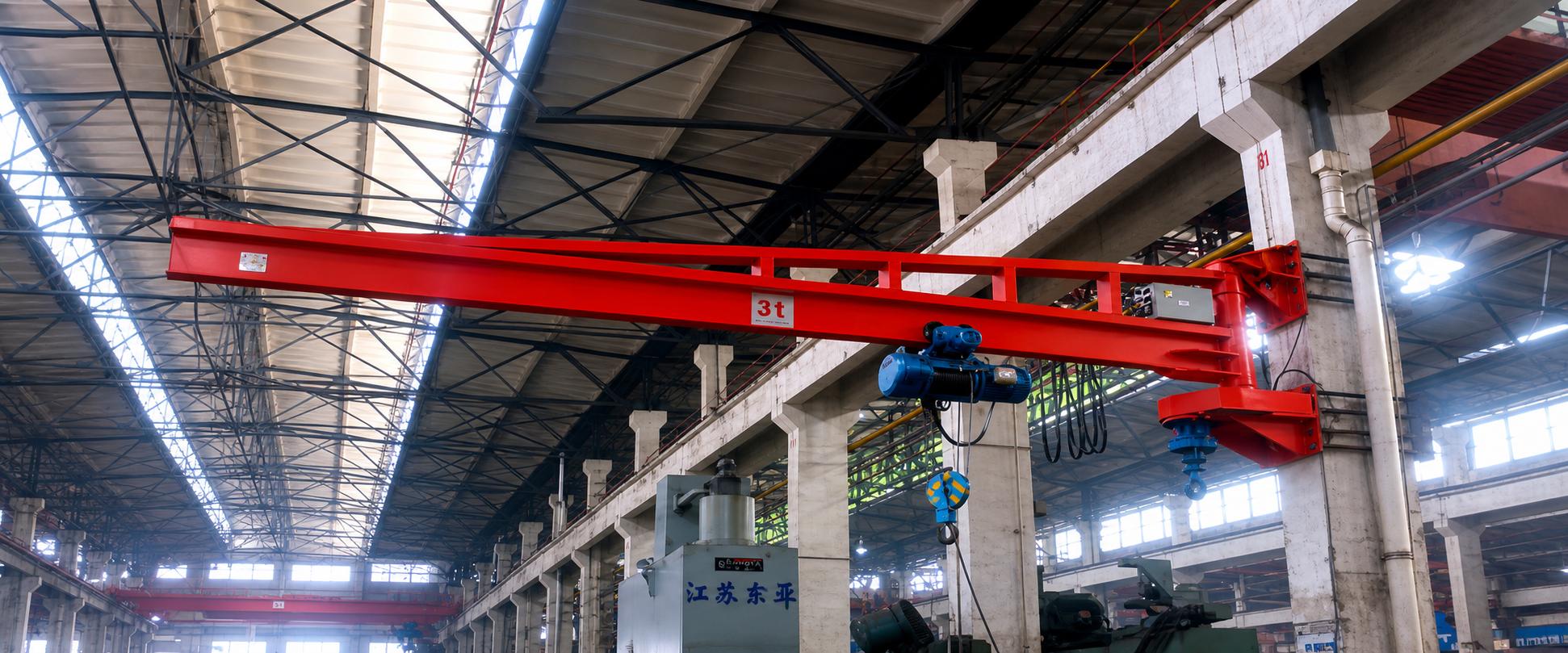
Folding arm cantilever crane is a refined lifting equipment designed for complex and restricted working conditions. It breaks through the operating limitations of traditional straight arm cantilever crane and adopts a two-stage articulated folding arm structure that supports multi-angle folding, telescopic and linkage rotation.The equipment can flexibly avoid various obstacles such as workshop columns, machinery and equipment, walls, etc., and go deep into small confined spaces to complete hoisting operations. It perfectly solves the pain points of the industry where conventional lifting equipment cannot get close and there are many dead ends in the operation. It is the core precision hoisting equipment for intensive stations and complex layout workshops.
Core advantage
- Super obstacle avoidance ability: The double-section joint boom can be freely bent and rotated at multiple angles, and can easily bypass equipment columns, wall barriers, and tooling obstacles. It can penetrate narrow passages and penetrate deep into the internal operation of the equipment cavity, completely eliminating the blind spots of traditional straight-arm cranes.;
- Multi-scene installation and adaptation: compatible with floor-to-ceiling fixed, wall-anchoring, and top-ceiling installation schemes, it can be flexibly selected according to the layout of workshop equipment and space structure, and is highly adapted to complex and irregular industrial operation scenarios.;
- Flexible control, labor-saving and efficient: The joint-type bending structure greatly reduces the operating resistance of the equipment, the control is light and smooth, and the long-term repetition of refined alignment operations is not easy to fatigue, effectively improving the efficiency and stability of hoisting operations in small stations.
- Precise alignment in small spaces: it supports close-range wall-to-wall and column-to-column bonding operations, and can complete fine-tuning and alignment in narrow stations that cannot be reached by conventional equipment. It runs smoothly and without shaking, and is accurately adapted to the needs of high-precision operations such as precision assembly and small-piece fitting and installation.;
- Flexible installation in multiple scenarios: compatible with the three mainstream installation methods of floor-to-ceiling fixed type, wall-to-wall anchoring type, and top-to-ceiling type, the installation plan can be flexibly customized according to the workshop equipment arrangement, space structure, and work site location, and can be adapted to all kinds of irregular and complex workshop layout.;
- Flexible control, labor-saving and efficient: The joint linkage structure greatly reduces the operating resistance of the equipment, the control is light and smooth, and the fine-tuning is accurate. It can be adapted to high-frequency, repetitive and refined hoisting operations for a long time, effectively reducing manual operation fatigue and improving the stability of station operations.
Parameter specifications
The standard rated load range of the equipment is 125kg–1 ton, and the enhanced model can be customized for special precision working conditions, with a maximum load of up to 2 tons; it adopts a segmented and independent rotating structure, the inner arm supports 180°-200° fan-shaped coverage, and the outer arm can achieve 360° global rotation without dead ends, and the two-arm linkage adjustment is flexible. It is specially tailored for light and medium-sized precision hoisting conditions in small and complex spaces.
Main industrial application scenarios
With its excellent obstacle avoidance ability, precise alignment performance and multiple installation forms, the folding-arm cantilever crane is specially adapted to special working conditions where obstacles are dense, space is small, and conventional equipment cannot operate. The core industrial application scenarios are subdivided as follows:
- Loading and unloading operations of closed equipment: it can go deep into the cavity of the closed equipment and inside the box to complete the loading and unloading, disassembly and transportation of workpieces, solve the problems that traditional equipment cannot get close and materials are difficult to enter and exit, and adapt to the supporting hoisting needs of various closed processing equipment.
- Internal maintenance and overhaul of equipment: For the maintenance, disassembly and replacement of internal accessories of large-scale units and complete sets of equipment, it can flexibly shuttle equipment gaps and small spaces, accurately complete the hoisting and shifting of precision accessories, and greatly improve the efficiency of equipment maintenance.
- Intensive precision assembly of stations: It is suitable for precision machining workshops with dense equipment arrangement and compact stations. It can complete the alignment assembly of small precision components and non-standard accessories in a small gap to ensure assembly accuracy and operational safety.
- Column blocking area operation: Perfectly avoid the blocking and blocking of workshop columns, beams, and large tooling, effectively use the equipment gap space, complete the material transfer and hoisting operations in the blocking area, and activate the idle working space in the workshop.
- Non-standard installation in small workshops: it is suitable for small non-standard workshops and narrow independent stations, which can complete the precise positioning and installation of special-shaped workpieces and customized accessories, and is suitable for small-space, high-precision, and non-standardized industrial hoisting scenarios.
Mast Type Jib Crane: Reliable Solution for Heavy-Duty Applications
Mast-type cantilever crane is a special industrial lifting equipment that takes into account heavy-duty performance, installation convenience and space adaptability. It adopts a two-way support structure of bottom ground load-bearing + top building structure auxiliary anchoring.
Compared with the traditional floor-standing cantilever crane, there is no need to dig deep to reinforce the concrete foundation, and the amount of construction projects is greatly reduced. At the same time, it can stably achieve 5-10 tons of heavy–duty and 360° global rotation operations. It is the preferred solution for heavy-duty hoisting in workshops with limited foundation conditions and low headroom.
Core advantage
- Heavy-duty adaptation, minimalist infrastructure: relying on the coordinated load-bearing of the top building structure, the pressure of the bottom foundation is greatly dispersed, and only simple ground reinforcement is required to stably carry 5-10 tons of heavy-duty workpieces, perfectly avoiding the cumbersome foundation construction of traditional heavy-duty equipment and the high cost of transformation.;
- Suitable for low-clearance factories: The whole machine has a compact structure and takes up little vertical space. The top support structure fits the beam and column layout of the factory. There is no need to reserve ultra-high operating floor heights. It is specially suitable for industrial plants with limited floor heights and tight vertical space.;
- Strong two-way support stability: the fixed structure of the upper and lower double-point positions effectively limits the shaking and deformation of the boom, greatly improves the stability of heavy-duty operations, can be adapted to high-frequency and continuous heavy-duty hoisting conditions, and the equipment has higher durability and safety.;
- Controllable comprehensive construction costs: no need to dig deep into the foundation in a large area, no need for large-scale plant transformation, short infrastructure construction cycle, low labor and material costs, taking into account the advantages of heavy-duty operation performance and lightweight installation, the cost performance far exceeds that of heavy-duty cantilever cranes of the same level.
Main industrial application scenarios
Relying on the unique advantages of low infrastructure, high stability, and heavy-duty global operations, mast-type cantilever cranes are accurately adapted to special industrial scenarios with restricted foundations, low headroom, and heavy-duty operations. The core application scenarios are as follows:
- Heavy-duty machining workshop: suitable for all kinds of heavy-duty machining stations, it can stably lift heavy-duty steel components, mechanical parts, and casting workpieces, and is suitable for continuous heavy-duty processing and production to meet the high-frequency operation needs of heavy industry.
- Steel structure welding conditions: For the welding and assembly of large steel structures and non-standard heavy industry components, heavy plates and frame structures can be hoisted smoothly to ensure the accuracy of welding alignment and improve the production efficiency of heavy industry welding.
- Large-scale equipment overhaul station: it is suitable for the overhaul and maintenance of heavy-duty units and core equipment of the production line in the factory area. It can efficiently disassemble and transport heavy-duty accessories to solve the problems of difficult heavy-duty maintenance and hoisting and long-term equipment downtime.
- Infrastructure-restricted plant operations: it is specially adapted to old factories and transformation workshops where the ground cannot be dug deep and large foundations cannot be poured. Heavy-duty hoisting can be achieved by relying on the original building structure, without the need to transform the plant foundation.
- Low-rise and high-global heavy-duty stations: suitable for production areas with limited floor heights but requiring 360° non-dead angle heavy-duty operations, taking into account space utilization and heavy-duty operation capabilities, and perfectly balancing plant structure and production needs.
Comparison of the Five Common Types of Jib Cranes
| Device type | Installation method | Rotation angle | Conventional load | Space occupied | Mobility | Core adaptation scenario |
| Floor-standing cantilever crane | Concrete foundation fixation | 360° | 0.5-15 tons | Higher | fixed | Heavy-duty, high-frequency hoisting in an open workshop |
| Wall-mounted cantilever crane | Wall/structural column fixing | 180°-270° | 0.125-5 tons | No ground occupation | fixed | Compact space, lightweight operation along the wall |
| Mobile cantilever crane | Movable base with wheels | 360° | 0.05-3 tons | Extremely low | excellent | Temporary, multi-station, changeable working conditions |
| Folding arm cantilever crane | Floor/wall/ceiling | Multi-angle composite rotation | 0.125-2 tons | low | fixed | Precise hoisting of small spaces and obstacles |
| Mast type cantilever crane | Ground + top double support | 360° | 5-10 tons | Medium low | fixed | Infrastructure constraints, low headroom and heavy-duty operations |
How to Choose the Right Jib Crane for Your Industrial Application
The load capacity, space adaptability, and operating form of different types of cantilever cranes are significantly different, and blind selection can easily cause idle equipment, insufficient production capacity, or safety hazards.Enterprises need to combine their own hoisting weight, working space, frequency of working conditions, and plant structure to accurately select the four core dimensions. While ensuring operation safety and production efficiency, they can maximize the control of procurement and operation and maintenance costs. The standardized selection guidelines are as follows:
Confirm hoisting load requirements
Based on the actual maximum hoisting weight as the core selection basis, 1.5–2 times the safety load factor is superimposed at the same time to avoid the risk of overloading operations.For light-duty precision hoisting and small-piece transfer conditions within 2 tons, wall-mounted, mobile, and folding-arm cantilever cranes are preferred; for medium- and heavy-duty and high-frequency continuous hoisting conditions above 5 tons, floor-standing and mast-type heavy-duty cantilever cranes are preferred to ensure equipment load matching and stable operation.
Evaluate workshop space
Accurately match the model according to the workshop floor space, vertical floor height, and building structure conditions: wall-mounted cantilever cranes are selected for compact ground space and dense workstations; mast-type cantilever cranes are preferred if the floor height of the workshop is limited and the ground infrastructure cannot be transformed.;
There are many obstacles in the workshop, the layout of the stations is complex, and obstacle-bypassing operations are required. It is suitable for folding-arm cantilever cranes; floor-standing heavy-duty cantilever cranes are directly selected for open and dust-free workshops and independent heavy-duty stations.
Determine job flexibility requirements
For fixed and normalized production stations, priority is given to floor-standing, wall-mounted, folding-arm, and mast-type fixed cantilever cranes to adapt to long-term stable production needs; for temporary trial production, multi-station rotation, frequent adjustment of production layout, and phased construction conditions, mobile cantilever cranes are preferred, relying on the advantages of flexible displacement and zero infrastructure to adapt to flexible production.
Working conditions and environment
For heavy industrial production with high frequency, continuity, and harsh working conditions (dust, humidity, and high temperature), floor-standing and mast-type cantilever cranes with strong structure, strong stability, and deformation resistance are preferred to adapt to the rhythm of high-intensity operations; for intermittent, lightweight, and low-frequency auxiliary hoisting conditions, wall-mounted and mobile economical equipment can be selected to reduce equipment energy consumption and loss.
Balance budget and long-term operation and maintenance
Considering the cost of the whole life cycle, wall-mounted and mobile cantilever cranes have low procurement costs, convenient installation, and simple operation and maintenance, which are suitable for lightweight and short-term production needs. The initial investment of floor-standing and mast-type heavy-duty cantilever cranes is relatively high, but the structure is strong, the service life is long, and the adaptability to a wide range of working conditions can meet the long-term large-scale and high-intensity heavy industry production needs of enterprises, and the overall price ratio is higher.
Conclusion
The five mainstream cantilever crane working conditions are accurately positioned and have complementary advantages: the floor-standing type is suitable for high-frequency heavy-duty operations, the wall-mounted type is space-saving and suitable for light-duty hoisting, and the mobile type is flexible and suitable for temporary and changeable working conditions. The folding arm type is good at precise operation around obstacles in small and complex spaces, and the mast type is suitable for low infrastructure, low headroom and heavy-duty restricted scenes.
Enterprises combine the precise selection of lifting load, workshop space, operation frequency and production needs to effectively optimize the workshop operation process, improve handling efficiency, reduce operating costs and safety risks, and realize efficient, safe and refined lifting operations. Landing, helping the workshop to flexibly and standardize production.