
What Are the Best Cranes for Different Facility Layouts?
Cranes are the core equipment for industrial handling, processing and assembly.Most companies only value the load, price and brand in the selection of models, and ignore the adaptability of the plant layout, which can easily lead to limited equipment installation, stuck operations, and even high plant renovation costs.
The layout of the plant is the core prerequisite of crane selection, which is related to equipment installation, operation safety, production efficiency and cost of use.This article combines common plant layout to organize scientific selection plans, core parameters and pit avoidance points to help enterprises accurately select types, reduce costs and avoid risks.
Why Facility Layout Should Be the First Consideration When Choosing a Crane
The load level, work level and functional configuration of the crane are of course important, but if the equipment cannot be adapted to the spatial structure of the plant, the material movement line and the carrying conditions of the building, no matter how good the parameters are, they will not be of value.The layout of the plant directly defines the adaptation type and practical application value of the crane from the three dimensions of physical boundary, production efficiency, and cost control.
Physical space constraints
The hardware conditions of the plant set an insurmountable hard standard for the installation and operation of the crane, which is the basic basis for the selection work. The core constraints are as follows:
- Headroom height and top obstacles: the height of the plant floor and the top facilities such as hvac, sprinklers, and lighting will limit the lifting height.In scenes with insufficient floor height and dense obstacles, conventional double-beam bridge cranes should not be used, and compact models such as low headroom, suspension, and single beam should be preferred.
- Plant span and space width: The span of the plant and the spacing between the columns determine the coverage of the bridge crane.The large-span structured plant is suitable for bridge cranes, and the narrow space and local stations are more suitable for jib cranes and monorail cranes.
- Ground and wall obstacles: the layout of plant columns, walls, fixed equipment and production lines will constrain the trajectory of the crane.The open factory building is suitable for full-coverage bridge cranes, and the complex factory area with dense equipment is more suitable for local fixed-point lifting equipment.
- The bearing capacity of the building structure: the bearing capacity of the steel beams, columns and foundations of the plant determines whether the overhead rail crane can be installed.The carrying capacity of old and light steel factories is limited, and the cost of installing bridge-type transformation is high. Floor-standing gantry cranes are a more economical and safe solution.
Ignoring the above-mentioned physical constraints can easily cause problems such as equipment installation failure, insufficient lifting height, and limited operating range. In serious cases, the plant structure needs to be modified and dismantled, resulting in great waste of funds and delays in construction.
Layout adaptability
Cranes are not independent operating equipment, but important supporting tooling for the production process.It fits the layout of the plant and the selection of material moving lines, and can seamlessly connect the whole process of raw material warehousing, processing and production, and finished product warehousing and outbound, effectively reducing the secondary handling of materials, shortening the operating cycle, and avoiding the congestion of on-site moving lines.
At the same time, the crane that matches the spatial layout can ensure sufficient safe operation clearance, and avoid the safety risks of collision and overturning between equipment and plant structures, assembly lines, and operators.
Overhead hanging lifting equipment can make full use of vertical space and completely release the ground operating area; floor-standing lifting equipment can be adapted to special scenarios such as non-top load-bearing structures and outdoor depots to maximize site resources and improve space utilization.
Types of Industrial Facility Layouts
Industrial plants are divided into four mainstream layout forms according to product type, production capacity scale, and production technology: assembly line type, functional partition type, fixed station type, and unit type.Most enterprises adopt a mixed layout model, and the material flow logic of different layouts directly determines the most preferred direction of the crane.
Linear Production Layout
The layout arranges the equipment and stations in sequence according to the production process, and the materials flow along a fixed linear path. It is suitable for standardized and large-scale mass production scenarios, and is widely used in automobile manufacturing, home appliances and electronic equipment assembly industries.
Open Warehouse Layout
The layout centralizes similar processing equipment and similar processes, such as lathe processing areas, welding areas, and grinding areas, and the materials are transferred across regions on demand. It is suitable for small-batch and multi-category customized production, and is mostly used for machining, customized sheet metal, and non-standard parts processing workshops.
Cell Manufacturing Layout
This layout is suitable for the production of large-scale, heavy-duty, and non-mobile products. The products are fixed in dedicated workstations, and personnel, equipment, and materials are deployed into the operation on demand. Typical scenarios include shipbuilding, aircraft assembly, large-scale unit installation, heavy machinery production, and large-scale infrastructure construction sites.
Multi-Bay Workshops
The unit layout integrates the advantages of assembly lines and functional partitions, and integrates equipment and stations into independent production units. Each unit is responsible for the full-process processing of a class of similar products. It is the mainstream model of lean production and is suitable for medium-batch and multi-category product production.
Best Crane Types for Different Facility Layouts
Combining the moving line characteristics, operating requirements and site constraints of various factories, and matching lifting equipment in a targeted manner can maximize material handling efficiency and minimize on-site safety risks.The following are the precise selection schemes that have been verified by a large number of industrial experiments.
Linear Production Layout
The core appeal of this type of layout is linear, repetitive, and stable standardized material transfer, which requires lifting equipment to fit the moving line of the production line, fully cover the operating area, and do not interfere with the normal production of the assembly line.
Optimal adaptation equipment: station bridge crane, monorail crane
Adaptation advantages: Bridge cranes can achieve full coverage of rectangular areas and run along fixed production line tracks, with accurate positioning and stable operation. The modular design supports the expansion of the length of the operation on demand; monorail cranes focus on point-to-point fixed-point material transfer, which can efficiently connect the material transportation of each station and adapt to high-frequency repetitive operations.Both types of equipment are installed above the ground, which does not occupy space on the ground production line, ensuring the continuous and stable operation of the assembly line.
Applicable scenarios: large-scale standardized production workshops such as automobile assembly lines, home appliance assembly lines, and electronic product production lines.
Precautions for selection: The operating path of the equipment is fixed, the flexibility is low, and it is more suitable for the long-term fixed production line layout. It can be used with conveyors to work together to further improve the overall circulation efficiency.
Open Warehouse Layout
There is no fixed pattern of material movement in this type of layout, frequent cross-zone operations, and changeable production scenarios. The core requirement is highly flexible, movable, and adaptable lifting equipment for multi-scene switching.
Optimal adaptation equipment: portable adjustable gantry crane, column/wall-mounted jib crane, light aerial lifting system
Adaptation advantages: Portable gantry cranes do not need to rely on the building structure of the plant, can be freely shifted, quickly adjust the operating range, and adapt to the temporary hoisting needs of each functional zone; jib cranes can achieve fan-shaped and circular local coverage, suitable for fixed-point hoisting of independent stations, flexible installation and small footprint.Both types of equipment can be transformed and shifted at any time with the adjustment of production layout, which is perfectly adapted to multi-category and changeable customized production scenarios.
Applicable scenarios: machining workshops, customized sheet metal workshops, non-standard parts processing plants, and small-batch customized production workshops.
Precautions for selection: Multiple small lifting equipment can be used for partitioning operations in complex multi-partition workshops, and models with adjustable span and height are preferred to improve scene adaptability.
Cell Manufacturing Layout
This type of layout product is fixed, large in size, and heavy in tonnage. It needs to continuously transport heavy parts and tooling equipment to fixed stations. The core demand is lifting equipment with large loads, global coverage, and flexible deployment of heavy materials.
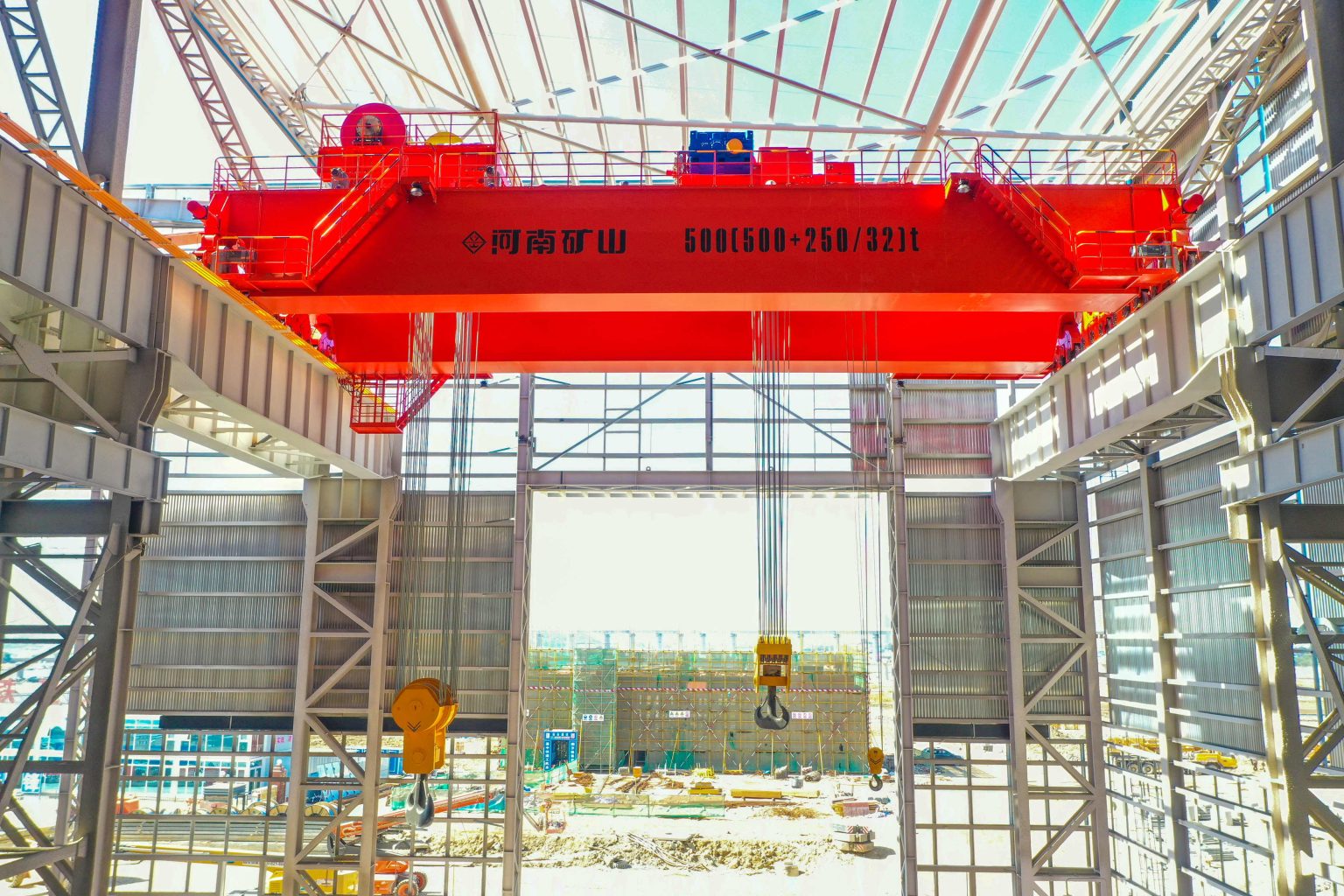
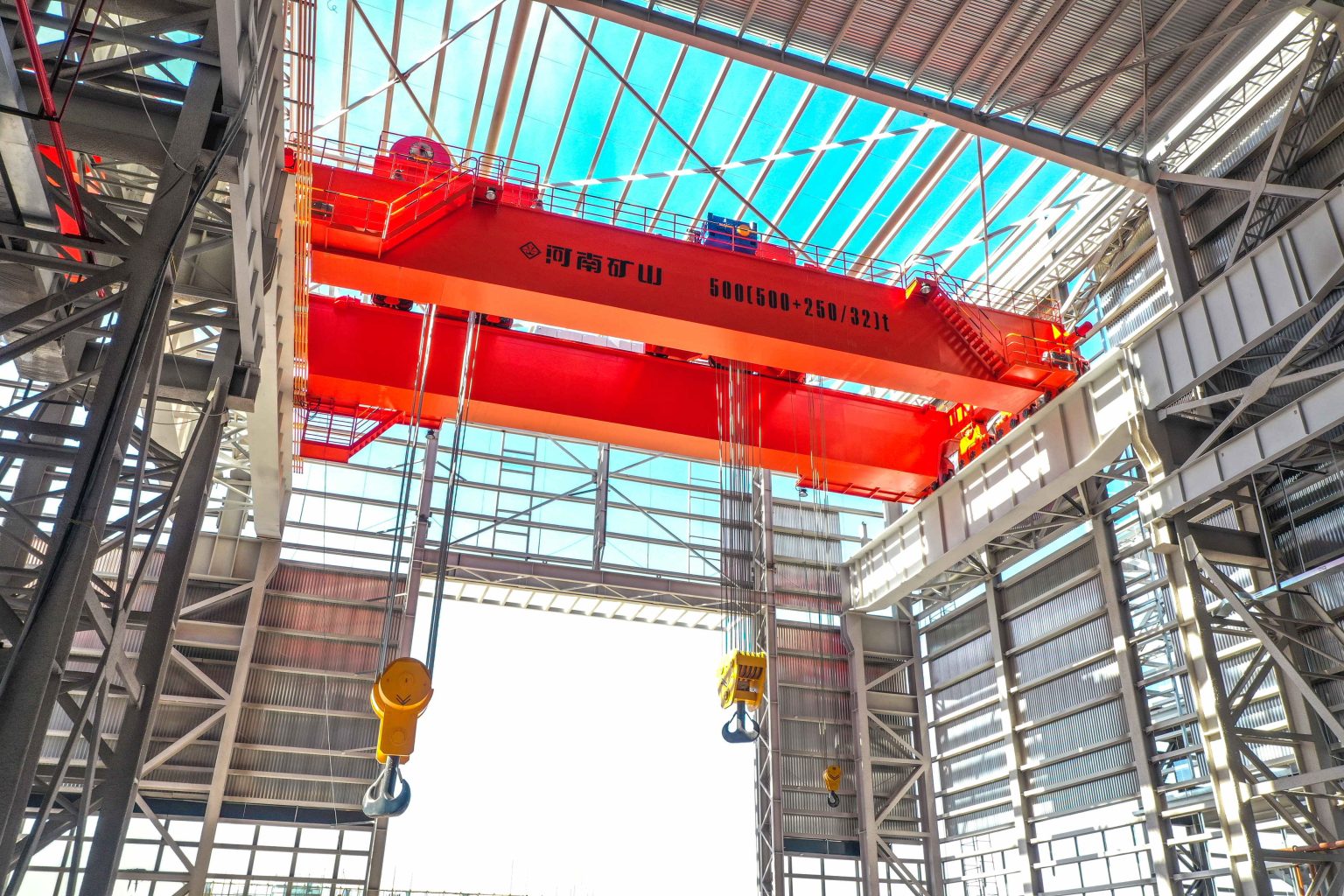
Optimal suitable equipment: heavy-duty gantry crane, heavy-duty jib crane, large-span bridge crane
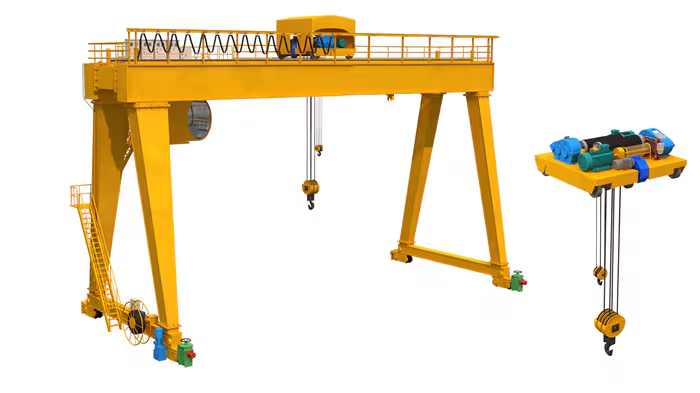
Adaptation advantages: large-span bridge cranes can achieve global coverage of the plant and meet the all-round hoisting needs of large-scale stations; heavy-duty gantry cranes do not require building structure support, and are suitable for indoor and outdoor fixed-station operations. The ground is unobstructed, making it easy for personnel and equipment to pass; heavy-duty jib cranes can realize precise fixed-point hoisting around the station to assist in refined assembly operations.The combination of multiple equipment can take into account the global heavy-duty transfer and local precise hoisting.
Applicable scenarios: shipbuilding, aircraft assembly, large-scale generator set installation, heavy machinery assembly, and large-scale infrastructure construction sites.
Precautions for selection: special models for large tonnage and heavy loads need to be matched. Multi-machine collaborative operation schemes can be used for large-scale engineering projects, and mobile car cranes can be used to assist construction in outdoor working conditions.
Multi-Bay Workshops
The unit layout takes independent production units as the core, and each unit independently completes the whole process of product processing. Miniaturized, specialized, and modular lifting equipment is required to meet the needs of single-element refined operations without interfering with the production order of other units.
Optimal suitable equipment: small station crane (jib, small bridge type, light gantry type), light monorail lifting system
Adaptation advantages: Each production unit can be equipped with dedicated small lifting equipment, which accurately matches the material hoisting and equipment assembly requirements in the unit, effectively shortens the handling distance and reduces the production line replacement time; modular equipment supports flexible increase or decrease and transformation and upgrading, adapts to production capacity iteration and layout optimization, and is highly in line with the production concept of lean cost reduction and efficiency enhancement.
Applicable scenarios: lean production workshop, parts batch processing unit, modular production workshop for small and medium-sized products.
Precautions for selection: match unit equipment on demand to avoid redundant and wasteful equipment, and give priority to modular and expandable models to facilitate later production capacity upgrades and layout adjustments.
General selection summary
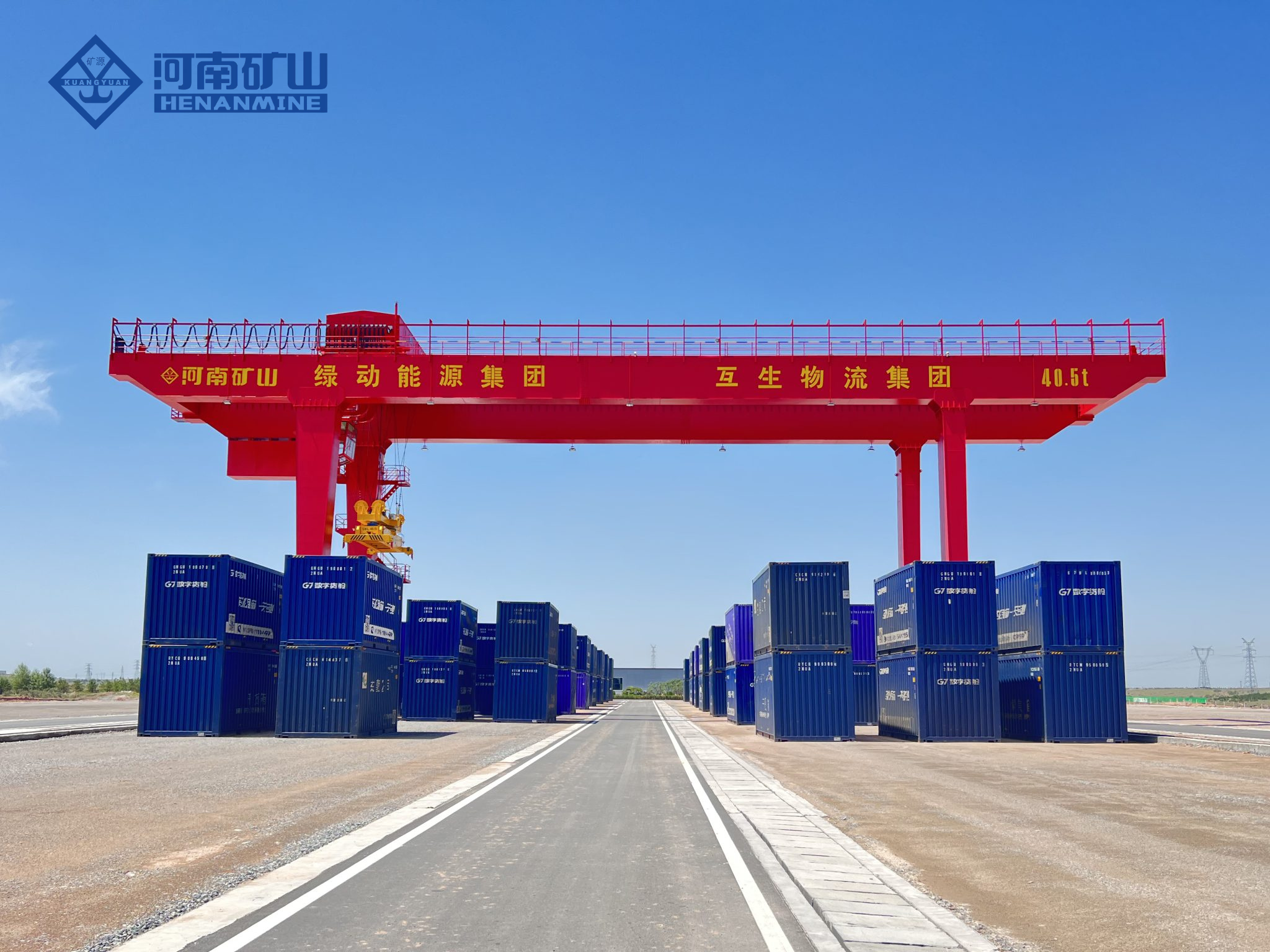
Gantry cranes have the strongest overall adaptability and are compatible with all kinds of plant layout; for mainstream hybrid plants, the combination scheme of "main work area bridge/gantry crane + station dedicated jib crane" can be used, taking into account global heavy-duty operations and local refined hoisting, suitable for most industrial production scenarios.
Key Factors to Consider Before Selecting a Crane
After determining the type of crane to be adapted, it is necessary to combine the ten core parameters to refine the selection, taking into account equipment safety, on-site practicality, investment economy and long-term expandability.
Load requirement
The selection needs to combine the conventional average load and the limit peak load comprehensive calculation, reserve 10%-25% safety redundancy, and fully consider the size, center of gravity position and morphological characteristics of heavy objects to avoid the risk of overload from the source, and eliminate problems such as excess equipment performance and waste of resources.
Work level and frequency of use
Strictly refer to the CMAA industry classification standards to match working conditions: Class A/B is suitable for low-frequency standby, light-load intermittent operation scenarios; class C/D is suitable for conventional single-shift, medium-load mass production conditions; class E/F corresponds to high-frequency, continuous heavy-duty operations.Accurate matching of work levels can effectively avoid premature equipment wear and frequent failures, while avoiding high redundancy and high costs.
Space size parameters
Accurately survey the core spatial parameters of the plant in advance, including the span of the plant, the effective clearance height, the rated lifting height and the safe operating clearance, combined with the distribution of columns, production equipment, and obstacles, accurately approve the crane specifications and effective operation coverage to eliminate space interference.
Site environmental conditions
Distinguish between indoor and outdoor operating scenarios, and for special working conditions such as high temperature, high humidity, dust, corrosive media, flammable and explosive, special models for anti-corrosion, explosion-proof, dust-proof, and high temperature resistance are selected as needed to ensure the stable and long-term operation of the equipment in complex environments.
Layout adaptation
Strictly conform to the layout of the plant and the law of material flow: the linear standardized production line is adapted to fixed rail-type lifting equipment, flexible customization, and mobile modular equipment is preferred for changeable moving lines. At the same time, the layout adjustment and capacity expansion space are reserved, taking into account the current adaptability and future expansion.
Automation requirements
According to the production beat and efficiency requirements, the operating speed of lifting, trolley, and bridge is reasonably matched; the intelligent workshop can optimize the automated lifting equipment, support the docking of AGV, three-dimensional warehouse and other intelligent storage systems, and adapt to the modern intelligent production system.
Safety compliance standards
The selection needs to strictly comply with OSHA, CMAA, ANSI and domestic industry safety specifications. The equipment needs to be equipped with core safety devices such as overload protection, travel limit, anti-collision, and emergency braking as standard to fully meet compliance standards and build a strong barrier to on-site safety operations from the hardware level.
Installation and power supply conditions
Combined with the actual carrying conditions of the steel beams, columns, and foundations of the plant, the above-ground fixed or ground-standing lifting equipment is scientifically selected; according to the on-site power supply configuration, it is adapted to electric, manual, pneumatic and other drive forms to ensure that the equipment installation is compatible and feasible, and the long-term operation is stable and reliable.
Full life cycle cost
Abandon the one-sided selection thinking that only focuses on the purchase unit price, comprehensively calculate the whole life cycle costs of equipment procurement, installation, energy consumption, maintenance, parts replacement, equipment depreciation, etc., and give priority to the selection of high-quality equipment brands with stable performance, excellent cost performance, and perfect after-sales system.
Operation and maintenance and extensibility
Priority is given to the selection of lifting equipment with low failure rate, convenient maintenance, and strong versatility of accessories. The selection stage reserves space for equipment installation, transformation, and expansion in advance, which can be flexibly adapted to the subsequent development needs of enterprises for capacity upgrading, process iteration, and plant layout optimization.
Common Crane Selection Mistakes
Most of the hidden dangers, efficiency shortcomings and cost waste of crane operation and maintenance in enterprises are due to selection misunderstandings.The following summarizes the industry's high-frequency errors and standardized avoidance schemes to help companies avoid pitfalls scientifically.
- Unbalanced load selection: blindly selecting small-tonnage equipment can easily cause overload safety hazards, and blindly pursuing large-tonnage equipment will cause a waste of funds and space resources.Avoidance method: carry out accurate load measurement, reserve standard safety margin, and comprehensively select models based on dynamic lifting conditions.
- Work level matching error: the selection of heavy equipment in low-frequency and light-load scenarios will increase input costs, while the selection of light equipment in high-frequency and heavy-load scenarios will accelerate equipment wear and cause frequent failures.Circumvention method: Accurately count the average daily lifting times, average load-to-weight ratio and equipment running time, and match the corresponding work level.
- Separation from the layout and selection of the plant: the installation of fixed bridge cranes in flexible customized workshops and the selection of mobile gantry cranes in standardized production lines will lead to poor equipment adaptability and low production efficiency.Avoidance method: Strictly rely on the layout of the plant and the matching equipment of the selection matrix, and give priority to the material movement line and site conditions.
- Ignoring site environmental constraints: the use of ordinary standard cranes in special working conditions such as corrosion, dust, explosion-proof, etc. can easily cause equipment corrosion, frequent failures, and safety hazards.Avoidance method: According to on-site working conditions, customize special configurations such as anti-corrosion, explosion-proof, dust-proof, and high temperature resistance.
- Just look at the low price and ignore the full cycle cost: one-sided reduction of the initial procurement cost and the selection of low-cost and inferior equipment will lead to high maintenance costs and large downtime losses in the later stage, and the overall gain is not worth the loss.Avoidance method: Take the whole life cycle cost as the core evaluation criterion, and give priority to brands with reliable quality and perfect after-sales service.
- Lack of security configuration: Lack of security configuration and insufficient compliance can easily lead to security accidents and compliance penalties.Avoidance method: strictly implement the standardization and compliance of safety configuration, complete the professional training of operators simultaneously, and standardize the operating process.
Conclusion
The key to the scientific selection of cranes is not to blindly pile up parameters, but to fit the layout of the plant and the production process, taking into account the safety of operations and the long-term cost of use.The assembly line is adapted to bridge and monorail cranes; the zoned customized workshops are adapted to gantry and jib cranes; the heavy-duty fixed stations are selected for global heavy-duty lifting equipment; the lean unit workshops are adapted to small modular lifting equipment.
The selection of enterprises needs to survey the working conditions of the plant in advance, analyze the moving lines and loads, and combine the selection matrix of this article to avoid misunderstandings.Precisely adapted lifting equipment can improve operating efficiency, ensure production safety, pressure drop transformation costs and operation and maintenance losses, and help enterprises improve production quality and efficiency.