
100 Rubber-Tyred Mobile Gantry Cranes (RTG): Outdoor Heavy Load Transport
The demand for outdoor heavy-duty handling in ports, shipyards and heavy industries is constantly growing. The 100-ton rubber-tryed gantry crane (RTG) gets rid of track restrictions and can move flexibly, adapting to the lifting of various large-scale components. The rated load of 100 tons is suitable for most outdoor heavy-duty working conditions. Compared with fixed gantry cranes, there is no need for infrastructure bases, and they can freely switch operating points, which significantly improves the material turnover efficiency of the yard.
What Is a 100-Ton Rubber-Tyred Gantry Crane?
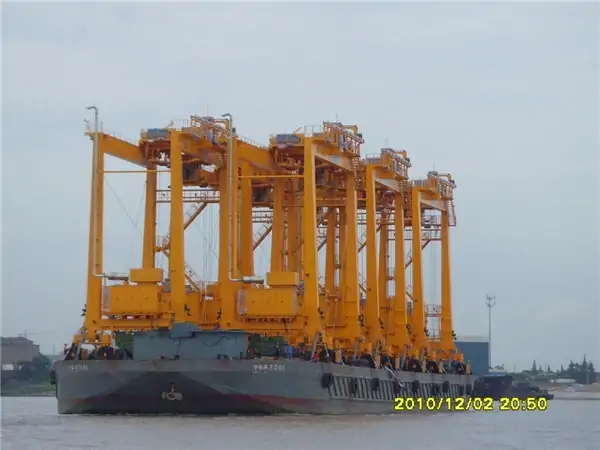
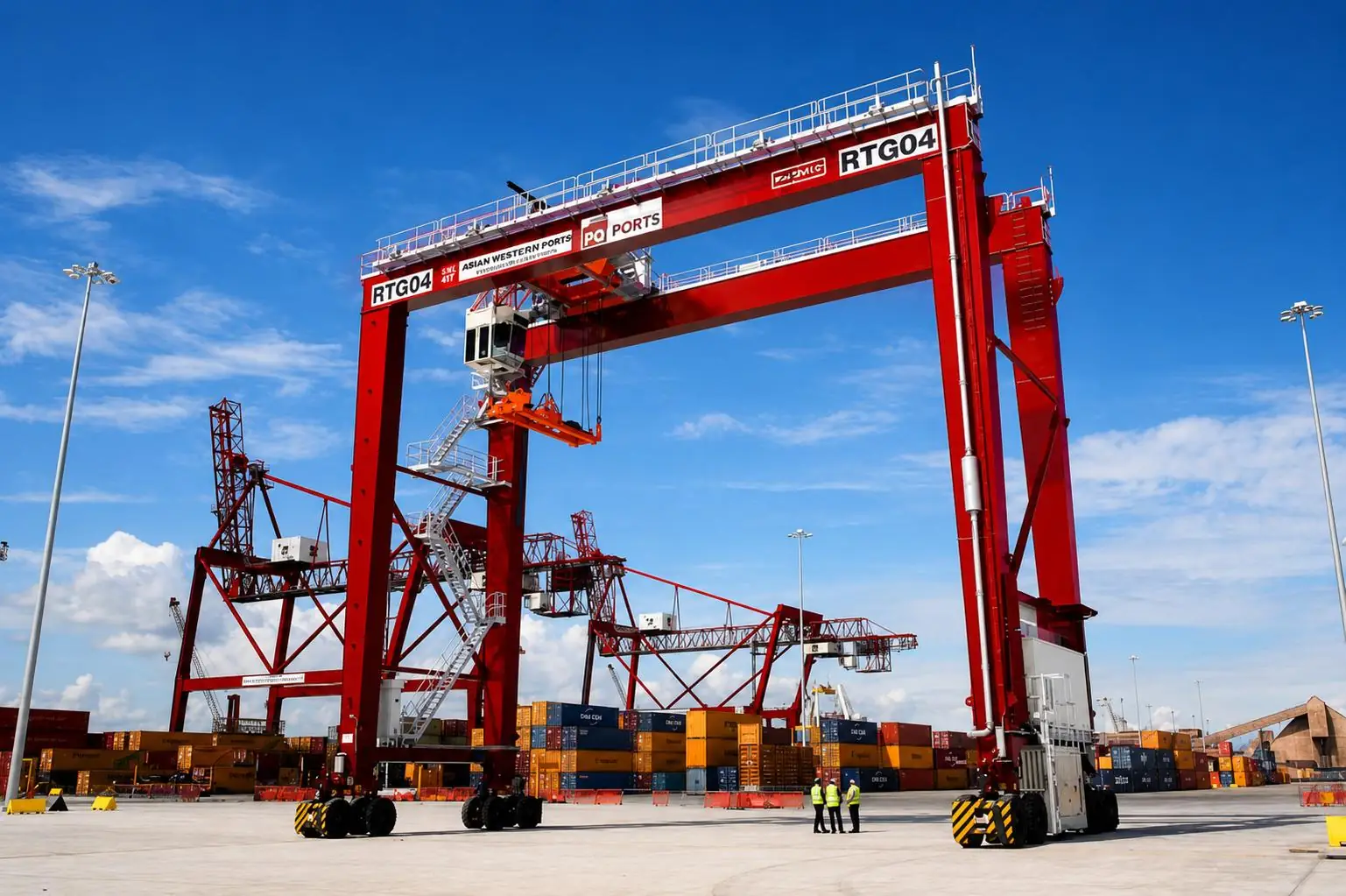
The rubber-tyred gantry crane (RTG) uses rubber tires to walk without tracks, and is suitable for heavy-duty loading and unloading on outdoor hardened sites. The 100-ton RTG has a rated lifting capacity of 100 tons, which is the main lifting equipment for heavy-duty outdoor industrial operations.
The rated lifting weight of 100 tons is the maximum total load that the spreader can withstand under standard working conditions, including the weight of the hanging beam and other accessories. During operation, the weight of the accessories should be deducted to calculate the net weight of the goods. Overloading is strictly prohibited to ensure the safe operation of the equipment.
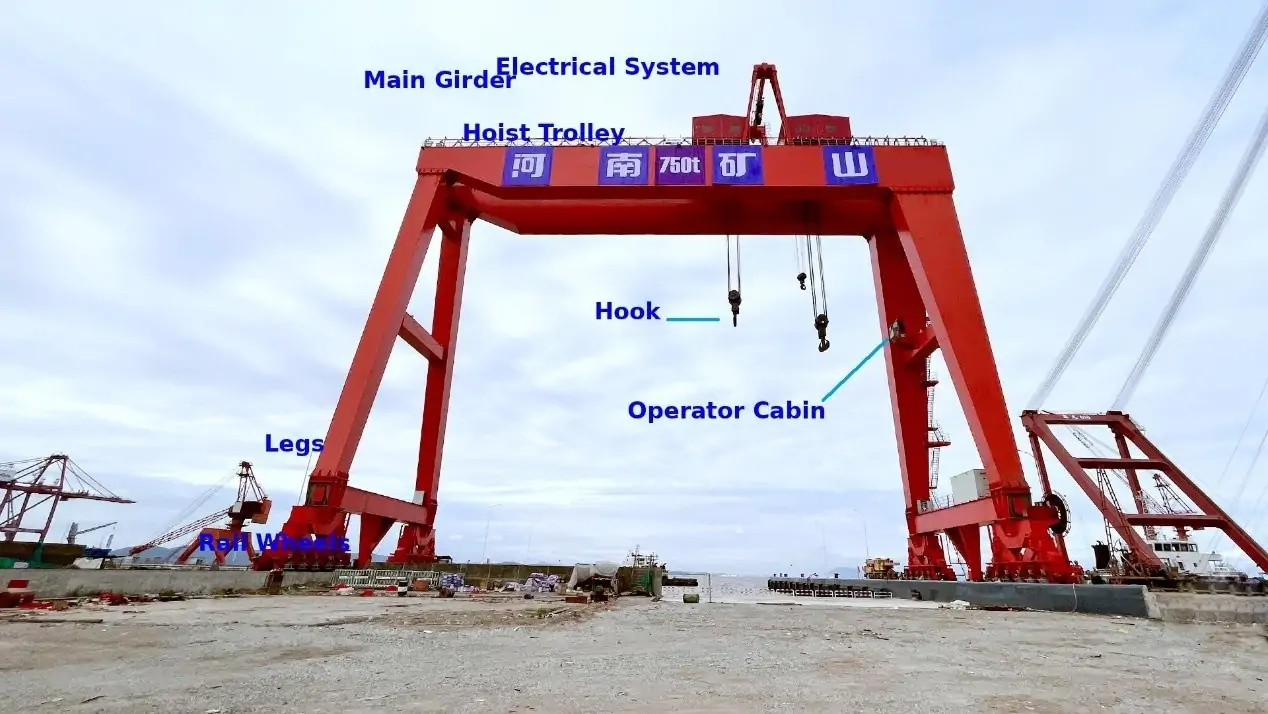
The overall structure of the 100-ton tire gantry crane is precise, and the various systems operate in concert. The core components and functions are as follows:
- Gantry frame: welded and formed of high-strength alloy steel, it consists of the main beam, outriggers, and end beams. It has a stable structure and strong load-bearing capacity. It can withstand complex working conditions such as outdoor wind and rain, temperature differences, and slight bumps. It can effectively carry 100 tons of dynamic stress generated by heavy-duty operations, and the equipment is extremely durable and stable.
- Lifting mechanism: The core lifting execution components, including winches, wire ropes, hooks, pulley blocks and other components, are responsible for the vertical lifting of goods, and are equipped with multiple cushioning and protective structures to ensure stable and accurate heavy-duty lifting.
- Operating trolley: mounted on the top of the main beam of the gantry, it can walk back and forth laterally along the main beam, and cooperate with the lifting mechanism to complete the lateral displacement of the cargo, so as to achieve precise alignment and fine-tuning positioning of the cargo.
- Rubber tire group: industrial solid rubber tires with wear-resistant and strong pressure-bearing capacity are used, which are suitable for outdoor hardened ground. They have the characteristics of shock absorption, non-slip and anti-rolling. They can adapt to slightly uneven ground to ensure stable equipment walking, no track wear and no ground damage problems.
- Walking steering system: equipped with intelligent drive and global steering mechanism, it supports a variety of operating modes such as straight, in-situ steering, and oblique walking. The steering radius is reasonable, and it can be flexibly adapted to the spatial layout of various large and small depots to achieve multi-area free switching operations.
- Electrical control system: adopts PLC intelligent integrated control system, equipped with frequency conversion speed control module, accurate operation and stable operation, with basic functions such as overload protection, limit early warning, and fault self-inspection. It is the core center for safe and efficient operation of equipment.
- Operating terminal: equipped with a closed operating cab and a wireless remote control dual operating system, the cab has a wide field of view, sound insulation and heat insulation, and is suitable for outdoor all-weather operations; the remote control mode can realize long-distance precise control and avoid high-risk operations.
Relying on the tire walking and intelligent steering system as a whole, the equipment can move freely in a wide range of outdoor operating areas such as ports, factories, and construction sites independently, without manual assistance in shifting, and quickly switch operating points to adapt to the operation needs of multi-point and multi-area alternating construction.
Key Specifications to Consider When Selecting a 100t RTG Crane
Rated lifting capacity
The rated load of 100 tons is the core performance index of this model, which represents the ultimate safety lifting standard of the equipment.When selecting the type, it is necessary to strictly distinguish between the rated load and the actual operating load, and overloading operation is strictly prohibited.In actual operations, ancillary accessories such as hanging beams, spreaders, fixtures, etc. all have their own weight.
The weight of the accessories needs to be deducted from the rated load of 100 tons to calculate the net weight that the goods can carry.At the same time, it is necessary to take into account the position of the center of gravity of the cargo, the spacing of the lifting points, and the eccentricity of the load in a comprehensive manner to avoid uneven force on the equipment due to the offset of the load, causing safety risks, and ensuring long-term stable operation.
Span and lifting height
The span of the gantry crane is the distance between the centers of the two legs, which determines the width of the operation coverage, and selects the type according to the layout of the yard and the traffic requirements. The lifting height defines the maximum lifting distance of the cargo to meet the height requirements of loading, unloading, stacking and hoisting of large components.
The selection of models needs to take into account the current working conditions and reserve the parameter margin to match the long-term planning of the plant and reduce the cost of later transformation. The mainstream 100-ton RTG supports personalized customization with a span of 10-40 meters and a lifting height of 6-30 meters.。
Movement and steering performance
Mobility is the core advantage of the 100-ton tire gantry crane. The rubber tire walking structure is free of track restrictions and can move freely in all directions.The equipment supports straight, fixed-point steering, and multi-angle fine-tuning walking, and is suitable for the displacement needs of various small and medium-sized depots and narrow operating areas.
When selecting the type, it is necessary to pay attention to the turning radius of the equipment, the minimum operating spacing, the walking speed and other parameters, combined with the space size of the work site, the width of the channel, and the distribution of the work site, to match the adapted steering and walking configuration, to ensure efficient equipment displacement, accurate positioning, and avoid site space restrictions.
Power supply and drive system
The 100-ton RTG is mainly divided into three power configurations: diesel-electric, pure electric, and oil-electric hybrid, which are adapted to different operating environments and energy consumption requirements.
- The pure electric motor type relies on the cable reel or the power grid of the plant for power supply, with low energy consumption, zero emissions and low noise, and is suitable for normalized and fixed plant operations.;
- The diesel-electric motor type is equipped with an on-board generator set, which does not require an external power supply and provides independent power supply. It is suitable for temporary construction scenarios without power grid coverage and in the field.;
- The oil-electric hybrid engine type takes into account energy saving and flexibility, and can automatically switch the power mode according to working conditions, which is suitable for high-frequency, all-weather outdoor operations.
When selecting the type, it is necessary to combine the power supply conditions of the operation site, the frequency of operation, environmental protection requirements, and the comprehensive selection of operating costs, while considering the energy consumption efficiency and power stability of the equipment to ensure the reliability of long-term high-frequency operations.
How a 100t RTG Crane Handles Heavy Loads Outdoors
The 100-ton tire-type gantry crane cooperates with the three major systems of lifting, trolley walking, and machine walking to complete the whole process of handling outdoor heavy-duty cargo. The operation process is standardized, the operation is stable, and the positioning is accurate.
Docking in place
After the equipment is driven to the designated operating station, the operator controls the hook and spreader through the lifting hoist mechanism, accurately aligns with the lifting and completes reliable locking; then starts the lifting action to lift the cargo smoothly and lift it to a preset safe operating height, fully avoiding ground pipelines, components and other obstacles.
Precise shift
Flexibly switch the transfer mode according to the needs of on-site operations: the main beam trolley can be used to walk horizontally and accurately to complete the fine alignment and calibration of the goods to ensure the accuracy of hoisting; the tire walking system of the whole machine can also be activated to carry the load smoothly and efficiently complete the longitudinal transfer of large-span and long-distance sites.
Blanking operation
After the hoisting cargo is transferred to the target operating area as a whole, the electronic control system of the equipment finely regulates the unloading rate in real time, keeping the hoisting stable and impact-free throughout the process, so that the cargo can fall smoothly to the predetermined location, and efficiently complete various hoisting processes such as heavy material handling, cargo stacking, or installation of large prefabricated components.
Stable load control
The whole machine is equipped with a high-performance frequency conversion stepless speed regulation system, which can realize the smooth and smooth start-stop, acceleration, and deceleration process, and eliminate heavy-duty shocks.At the same time, it is equipped with a professional anti-sway device to effectively suppress the shaking and offset of the cargo during the hoisting process, and greatly improve the positioning accuracy, operating stability and overall operating safety level of 100-ton heavy-duty operations.
Outdoor Applications for 100t Rubber-Tyred Mobile Gantry Cranes
Port container operations
In ports and container hub terminals, 100-ton RTG is the core loading and unloading equipment of the yard. It is mainly used for the stacking, transshipment, and loading and unloading of heavy containers and large freight boxes, and completes the cargo transfer between the yard and cargo trucks, the yard and the storage area.
The equipment can flexibly shuttle between container depots, not limited by fixed tracks, adapt to the changeable cargo stacking layout of the terminal and the rhythm of ship loading and unloading, and greatly improve the efficiency of port cargo turnover. It is the core supporting equipment of modern port logistics.
Shipbuilding and offshore manufacturing
The operation area of shipbuilding and offshore engineering equipment is open, the operation points are scattered, and most of them are for the handling of super-heavy components.The 100-ton tire gantry crane can easily complete the transfer and hoisting of prefabricated hull sections, large steel structures, heavy machinery supporting ships, drive shafts, and marine platform components.
The equipment can be moved in the whole area of a large open-air shipyard without the need for fixed infrastructure. It is adapted to the multi-station and multi-regional alternating construction mode of the shipyard, which perfectly matches the heavy-duty and large-scale operation needs of the shipbuilding industry.
Material transfer in heavy industry plant area
In heavy machinery, steel structure, electric power equipment, and heavy industry equipment manufacturing plants, 100 tons of RTG are widely used in material transfer in production lines and storage areas, and can be hoisted and transported large steel structure parts, transformers, industrial presses, heavy machinery and equipment and other bulk workpieces.
One equipment can cover multiple production and storage areas in the factory area, without the need to configure fixed lifting equipment separately for each station, which greatly reduces the input cost of infrastructure and equipment in the factory area and improves the efficiency of production and circulation.
Hoisting and construction of infrastructure projects
In outdoor projects such as bridge construction, municipal infrastructure, wind power engineering, and large-scale venue construction, 100-ton tire-type gantry cranes play an important role in hoisting prefabricated bridge box girders, large steel structure components, wind power tower accessories, heavy infrastructure materials, etc.
As the construction progress advances, the equipment can be shifted and adjusted at any time, without the need to build a temporary fixed lifting base, which adapts to the characteristics of strong mobility of infrastructure projects and changeable operating scenarios, and effectively shortens the construction cycle.
Heavy-duty logistics warehouse yard
Large-scale industrial logistics parks and heavy-duty storage depots mainly store oversized machinery, engineering equipment, large steel structures, and heavy-duty cargo for projects. Such cargo has a large tonnage, high handling frequency, and flexible stacking layout.
The 100-ton RTG can efficiently complete the loading, unloading, storage, and transshipment of large cargo, get rid of the site restrictions of fixed lifting equipment, and adapt to the layout adjustment of the yard and the renewal of cargo categories without the need to transform the yard infrastructure, greatly reducing the yard's dependence on fixed lifting infrastructure.
Why Choose Rubber Tires for a 100t Mobile Gantry Crane?
Compared with rail-type gantry cranes and fixed gantry cranes, the rubber tire walking structure is the core differentiated advantage of 100-ton RTG, and it is also the key to its adaptation to outdoor changeable working conditions. The core advantages are as follows:
More maneuverable
The equipment abandons the operating limitations of traditional orbital equipment, completely gets rid of the constraints of the track, supports free walking in the whole field and flexible steering from multiple angles, and can quickly switch operating areas and adjust operating positions according to on-site construction needs.
Compared with traditional gantry cranes that can only run linearly along a fixed track, the equipment has a stronger dynamic operation ability, which effectively solves the problems of large blind spots and difficult transitions in fixed-point operations, and greatly improves the flexibility and adaptability of on-site hoisting operations.
No infrastructure investment
The whole machine adopts a tire-type walking structure, and there is no need to lay a special walking track in advance, and there is no need to pour a fixed equipment foundation base, which will not cause damage to the original ground structure of the factory and yard.
Fundamentally, a series of infrastructure processes such as track laying, foundation construction, and site restoration are eliminated, and the infrastructure costs in the early stage of the project and the site renovation and maintenance costs in the later stage are greatly reduced, effectively saving the overall investment in the project.
Multi-regional universal
A single 100-ton tire gantry crane can cover multiple operating stations and yard areas in the factory in all directions, without the need to configure lifting equipment separately for different operating areas.According to changes in construction progress and hoisting tasks, it can flexibly transition and freely allocate work sites, adapt to the production mode of multi-station alternating construction and zoning rotation operations, and greatly improve the utilization rate of equipment and reduce the cost of idle equipment.
High site adaptability
The equipment has lower requirements for the work site. It is not only suitable for standard hardened and flat ground, but also for slightly undulating outdoor complex sites, and is compatible with all kinds of open-air depots, factory sites and other operating environments.It can cooperate with enterprises to adjust the layout of the yard and optimize the arrangement of stations at any time, and flexibly adapt to various changeable working conditions such as temporary expedited construction, phased project operations, and dynamic production scheduling.
Wider application scenarios
The comprehensive operation performance of the equipment is outstanding. It can not only meet the normalized and continuous production line material transfer and hoisting operations of the factory, but also adapt to the heavy-duty construction scenarios of various temporary engineering projects such as outdoor infrastructure, wind power, bridges, shipyards, etc., taking into account fixed plant operations and outdoor mobile construction, the scene adaptation range far exceeds that of traditional fixed lifting equipment, and the comprehensive practicality and versatility are stronger.
Safety Considerations for 100t Outdoor RTG Crane Operations
The operation risk of 100-ton heavy-duty equipment is higher, and the outdoor open-air environment has increased uncertainties such as wind, weather, and site. Standardizing safe operation and implementing protective measures are the core of the stable operation of equipment and avoiding accidents. The key safety points are as follows:
- Overload protection and control: The equipment is equipped with an intelligent overload detection system, which monitors the weight of the load in real time, and automatically alarms and locks the machine when the rated load exceeds 100 tons to prevent overload operations.The total weight of the goods and spreader must be accurately calculated before operation, and lucky operation is strictly prohibited.
- Load stability control: confirm the position of the center of gravity of the cargo before operation, ensure the symmetrical force of the lifting point, and eliminate eccentric hoisting and cable-stayed oblique hoisting; rely on the anti-swing system to control the shaking of the cargo, heavy-duty lifting and shifting at low speed and smoothly throughout the process.
- Site and tire inspection: check the tire pressure, wear degree, and surface integrity before daily operation to avoid tire damage and air leakage causing the equipment to tilt; confirm that the operation ground is flat, the bearing capacity is sufficient, and there are no collapses or obstacles.
- Meteorological environment monitoring: outdoor operations pay real-time attention to wind, rain and snow, high temperature and low temperature weather, and stop in time in severe weather such as high winds, heavy rains, and snowstorms to avoid equipment overturning and cargo falling; coastal high-salt spray environments need to do a good job of anti-corrosion protection of equipment.
- Safety braking and limit protection: The equipment is equipped with an emergency braking system, a travel limit switch, and a safety interlock device. The effectiveness of the function is tested before operation. It can be stopped urgently under over-travel and sudden working conditions to avoid the risk of collision and over-limit.
- Personnel operation specifications: operators need to hold a certificate to take the job and be familiar with the equipment operation process and emergency response plan; keep a clear vision during the operation, be on-site alert, and prevent personnel from approaching the operating radius.
- Regular safety inspections: Normalize equipment safety inspections, conduct regular special inspections of lifting systems, braking systems, electrical systems, and safety protection devices, and promptly investigate hidden dangers.
How to Design a 100t RTG Crane for a Specific Project
The site conditions, operating conditions, and cargo types of different projects vary greatly, and it is difficult for standardized equipment to be fully adapted to individual needs. It needs to be customized in combination with the actual project design. The core design process is as follows:
- Clarify the load parameters: count the maximum heavy load and conventional operating load of the project, based on the peak load of 100 tons, and combine the average daily operating frequency and working level to match the structural strength of the equipment, motor power and working level.
- Matching site parameters: according to the yard size, channel width, and working radius, customize the equipment span, lifting height, and turning radius to adapt to the site space layout and eliminate blind spots in the operation.
- Evaluate the working conditions of the site: detect the flatness of the ground and the bearing capacity of the foundation, and combine the environmental characteristics of outdoor wind and rain, temperature difference, corrosion, etc. To optimize the anti-corrosion, shock absorption, and wear-resistant configuration of the equipment in a targeted manner.
- Determine the control and power plan: according to the site's power supply conditions and environmental protection requirements, choose pure electric, diesel-electric or hybrid power modes; according to the requirements of operating accuracy, it is equipped with manual, semi-automatic, and fully automatic control systems.
- Add intelligent optional functions: anti-swing, automatic alignment, path planning, and obstacle recognition systems can be installed in high-precision operation scenarios; high-frequency operation scenarios can be equipped with remote monitoring and fault self-inspection functions.
- Optimize maintenance design: adopt a modular structure design, reserve maintenance operation space, and match standardized accessories to reduce the difficulty and cost of late maintenance, and ensure the long-term stable operation of the equipment.
Improving Heavy Load Transport Efficiency with a 100t RTG Crane
To maximize the operating value of the 100-ton tire gantry crane, in addition to the performance of the equipment itself, scientific operation control and optimization of working conditions are essential, which can improve operating efficiency from the following dimensions:
- Optimize the overall hoisting operation process, streamline redundant processes, effectively avoid inefficient operations such as secondary cargo transfer and repeated alignment, and realize the operation effect of single hoisting and precise placement of goods, greatly shorten the duration of a single operation, efficiently compress the overall operation cycle, and significantly improve the efficiency of heavy-duty hoisting operations.
- Scientifically plan the optimal driving path based on the overall layout of the on-site yard, standardize and fix the operation movement line, effectively avoid invalid equipment displacement, detour driving and redundant positioning actions, reduce redundant loss of operations, and significantly improve the efficiency of cargo transfer and the overall speed of operation.
- Relying on a high-performance intelligent control system, the hoisting positioning accuracy can be significantly improved, and the time-consuming manual alignment and fine-tuning on-site can be greatly reduced. Even under heavy-duty conditions of 100 tons, fast, stable and accurate hoisting alignment can still be achieved, reducing errors caused by human operation.
- It can realize collaborative linkage with various material handling equipment such as trucks, forklifts, and on-site transshipment vehicles, synchronously match the operating beats of various supporting equipment, eliminate waiting gaps between processes, avoid the problem of convergence faults in the material transfer link, and ensure the continuous and smooth operation of the entire material transfer link.
- The equipment is equipped with frequency conversion stepless speed regulation technology, which deeply optimizes the operation logic of the whole machine to start, stop, accelerate and decelerate. Under the premise of ensuring the smooth and impact-free lifting process of 100-ton heavy-duty, the coherence of the action response is further improved, and the entire lifting operation is smoother and smoother.
- The equipment is equipped with an integrated system of remote monitoring and intelligent operation and maintenance, which can collect and monitor the operating parameters of the whole machine in real time around the clock, identify and predict potential hidden faults in advance, implement preventive maintenance, minimize sudden downtime, and avoid on-site missed work losses caused by equipment failures.
- The parameters of the equipment can be customized in combination with the actual operating frequency and conventional lifting load on the site, which can not only prevent the waste of costs caused by over-design of the equipment, but also avoid the performance shortcomings caused by insufficient parameter configuration, and fully adapt to long-term continuous, high-intensity and efficient heavy-duty operating conditions.
Maintenance Requirements for a 100t Rubber-Tyred Gantry Crane
Normalized preventive maintenance is the core of extending the service life of equipment, ensuring operation safety, and reducing operation and maintenance costs. For the characteristics of 100-ton RTG heavy-duty operations, the core maintenance items are as follows:
- Maintenance of tire walking system: regularly check tire pressure, tread wear, and cracking, check the operating status of wheels and bearings, and replace severely worn tires in time to ensure that the equipment walks smoothly and has uniform load-bearing.
- Maintenance of lifting system: daily inspection of wire rope wear, corrosion, and broken wire, regular lubrication and maintenance; inspection of hook deformation, cracks, and effectiveness of anti-release devices to prevent sick operations of lifting parts.
- Brake and transmission system maintenance: regularly check the sensitivity of the brake and the degree of wear of the brake pads, check the oil level and oil quality of the lubricating oil of the gearbox and transmission mechanism, change the oil in time, and fasten the accessories to ensure reliable braking and smooth transmission.
- Electrical system maintenance: clean up the control cabinet, circuit dust and stagnant water, check the aging of cables and loose wiring, test the functions of the control system, alarm system, and limit device to ensure the stable operation of the electrical system.
- Maintenance of structural parts: regularly check the main beam, outriggers, and welds of the gantry for deformation, cracking, and corrosion. Outdoor equipment should be painted and anticorrosive in time to strengthen loose connectors.
- Hydraulic and steering system maintenance: check whether the hydraulic pipeline is leaking and the status of the hydraulic oil, test the flexibility of the steering system, and regularly lubricate the steering accessories to ensure accurate and smooth shifting and steering.
- Safety system testing: regularly carry out load tests and functional tests of safety devices to ensure the normal operation of overload protection, emergency braking, anti-swing, and limit systems.
Conclusion
The 100-ton tire-type mobile gantry crane (RTG) can be used in outdoor scenes such as ports, shipyards, heavy industries, infrastructure and heavy-duty depots.Compared with rail and fixed cranes, it does not need to lay tracks, has strong mobility, and can flexibly transition to complete the hoisting and stacking of large-tonnage materials.
The selection of the project needs to configure the equipment according to the parameters of lifting weight, span, site, transition requirements, operation frequency, etc., taking into account the driving, safety protection and operation and maintenance requirements.Customized design can improve the adaptability of working conditions and control operation and maintenance costs.Henan Mine Crane can customize the production of 100 tons of RTG for ports, heavy industries, and infrastructure projects, and provide outdoor heavy-duty hoisting solutions.