
Steel Mill Crane Selection Guide · Henan Mine Crane
How to Select Cranes for Each Steel Mill Process
Steel mill crane selection should begin with the production process and the complete suspended load—not tonnage alone. Raw materials, scrap, molten metal, hot slabs, coils, plates and maintenance assemblies require different crane structures, lifting attachments, duty classifications, controls and protection systems.
Method: Process–Load–Duty–Environment
Reviewed: September 2026
Direct Answer
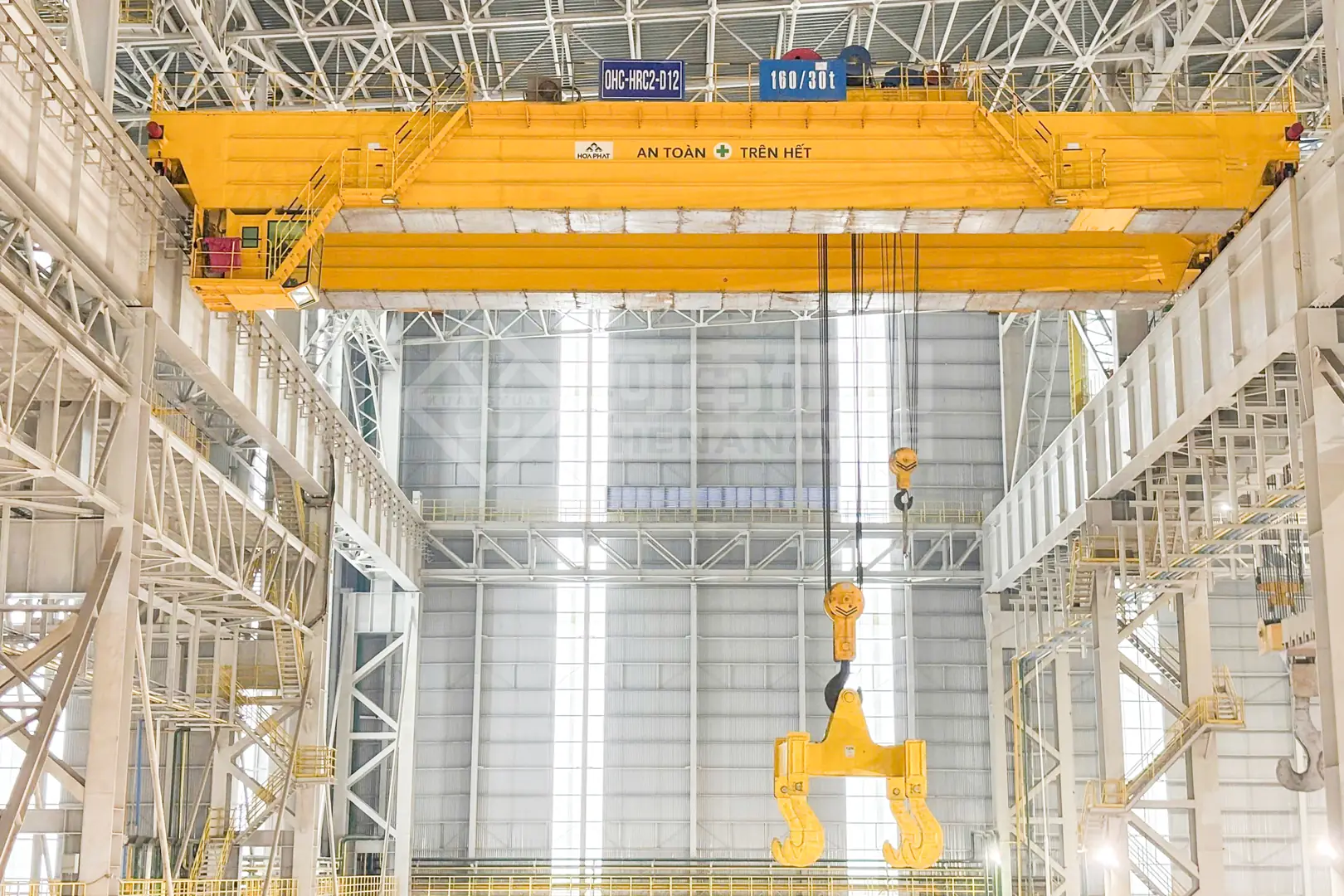
Match each crane to the material state and production task in its own bay. Use grab cranes for suitable bulk materials; magnetic or grab systems for defined scrap; dedicated casting or ladle cranes for molten metal; slab or billet handling cranes after continuous casting; process cranes with C-hooks, tongs, clamps or magnetic beams for rolled products; and general-purpose cranes only for lower-risk maintenance duties. Final capacity and classification must be calculated from the complete suspended system, load spectrum, movement frequency and selected design standard.
Start With
Process flow and material form
Calculate From
Loads, cycles and movement profile
Separate Clearly
Molten-metal and general duties
Define in RFQ
Crane, runway and service boundaries
A steelworks is not one lifting environment. A raw-material yard emphasizes bulk throughput; a melt shop adds radiant heat and the consequence of a suspended ladle; continuous casting introduces hot slabs, billets and production synchronization; a coil warehouse prioritizes surface protection, orientation and traceability. Specifying one “heavy-duty overhead crane” for all these areas conceals the differences that determine structural fatigue, attachment safety, operating speed, electrical protection and maintainability.
The process-first method below can be used for a new plant, an expansion or a crane replacement. It supports early equipment planning, but it does not replace site measurements, runway verification, load-path review or engineering under the project’s applicable national and contractual requirements. The complete steel mill crane system should be reviewed as one material-flow network, even when individual cranes are procured in separate packages.
Process Selection Matrix
Which Crane Fits Each Steel Mill Process?
The table identifies the normal starting configuration for each process. It is not a universal model schedule: the final crane depends on the plant route, material range, temperatures, operating cycle, building geometry, local rules and the consequences of a single failure.
| Steel Mill Process | Material / Task | Typical Crane and Attachment | Primary Specification Inputs |
|---|---|---|---|
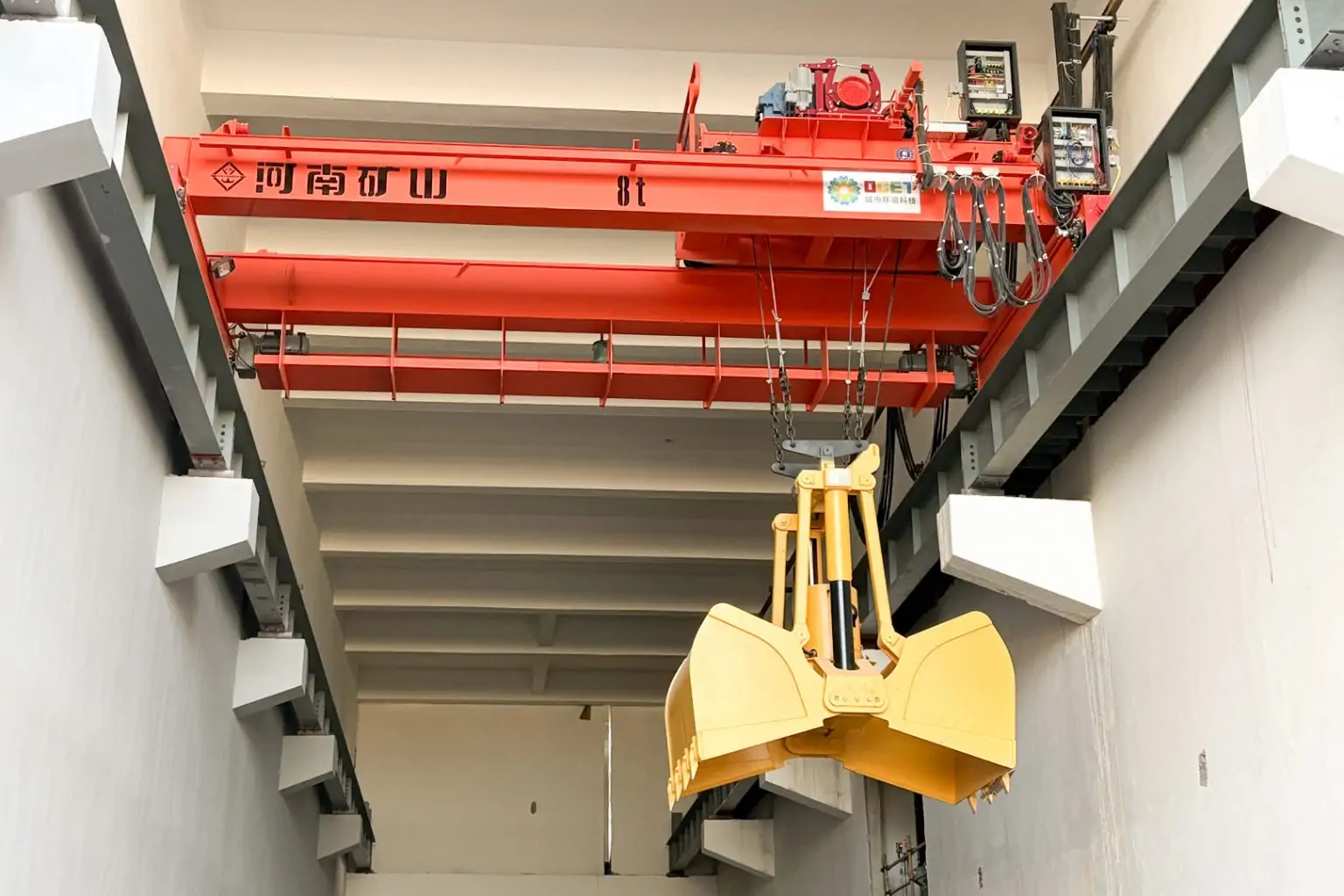
| Ore, coke and flux handling | Unloading, reclaiming and feeding loose bulk material | Grab overhead crane or grab gantry crane; four-rope or project-specific grab | Bulk density, particle size, moisture, required t/h, grab mass and volume, bunker geometry, dust and corrosion |
| Scrap receiving and preparation | Unloading, sorting, stockpiling and charging-basket preparation | Electromagnetic crane, grab crane or a validated dual-purpose system | Scrap composition, piece size, bulk density, residual heat, cycle rate, magnet duty, power-loss strategy and exclusion zones |
| Furnace charging | Scrap baskets, charging boxes or process vessels moved to BOF/EAF equipment | Dedicated charging crane or process crane with engineered beam, hooks or vessel interface | Complete basket/vessel mass, pickup geometry, furnace interface, heat exposure, positioning sequence, clearance and failure consequence |
| Molten-metal transfer | Hot-metal or steel ladles between furnace, refining and casting stations | Casting / ladle crane with project-defined main and auxiliary hoisting arrangement | Filled ladle system, trunnion interface, pouring or tipping duty, load path, redundancy, braking, heat shielding and emergency response |
| Continuous casting | Ladle and tundish positioning; mold, segment and caster maintenance; hot product transfer | Casting/ladle crane, tundish or maintenance crane, followed by slab handling crane | Each load case and path, hot-product temperature, pickup device, caster uptime, maintenance access and interlocks |
| Slab, bloom and billet transfer | Cooling-bed transfer, stacking, reheating-furnace feed and yard logistics | Slab/billet crane with clamp, tong or approved magnetic beam | Product size matrix, maximum temperature, stack layout, orientation, surface limits, cycle time and pickup verification |
| Rolling mill and roll shop | Mill feed, product transfer, work-roll and backup-roll change, equipment maintenance | Double-girder process crane; roll-handling or maintenance attachment where required | Heaviest roll assembly, lifting points, removal route, precision speed, production window, heat and mill-equipment clearances |
| Coil, plate and long-product storage | Stacking, order picking, line feeding and truck/rail loading | Coil crane with C-hook/tong; plate crane with clamp/magnet; rotating magnetic crane for approved long steel | Product mass and dimensions, temperature, eye orientation, surface protection, stack coordinates, loading sequence and traceability |
| Maintenance workshop | Motors, gearboxes, pumps, rolls and plant assemblies during planned maintenance | Single- or double-girder overhead crane selected for the actual maintenance envelope | Heaviest maintainable component, lift path, service frequency, hook approach, low-speed positioning and future equipment replacement |
The process name is only the first filter
Two cranes in the same process can require different classifications and controls when their load spectra, travel distances, shift patterns or outage consequences differ. The RFQ should therefore describe the movement sequence rather than listing only capacity, span and lift.
Upstream Material Handling
Raw Materials, Scrap and Furnace Charging
Bulk raw materials and scrap are both “loose materials,” but they should not automatically use the same lifting device. Ore, coke, coal and limestone are normally specified from bulk density, particle size, moisture, bunker geometry and required hourly throughput. Ferrous scrap adds irregular shapes, variable packing density, possible residual heat and a different dropped-load risk. Furnace charging then introduces a defined process vessel and a high-consequence interface with the furnace.
Grab crane for bulk feedstock
Select the grab and hoist together. Material density and grab fill determine the lifted material mass; the grab’s own mass consumes hoisting capacity. Required throughput must be checked against pickup, hoist, travel, discharge and return times—not against grab volume alone.
Magnet or grab for scrap
A magnet is appropriate only for compatible ferromagnetic scrap and validated material conditions. Mixed or bulky scrap may require a grab. Define the largest pieces, expected packing density, temperature, magnet duty cycle, retention strategy after power loss and the controlled drop area.
Dedicated furnace charging duty
A charging basket or process vessel should be treated as an engineered load case. State its empty and full mass, lifting points, required rotation or tipping, approach to the furnace, heat exposure, clearance envelope and interlocks with furnace equipment.
Specification note
For a grab or magnetic crane, “lifting capacity” must be defined on a common basis. Clarify whether the quoted rating includes the grab, magnet, beam, cables and other below-hook equipment; otherwise two technically different offers may appear to have the same tonnage.
High-Consequence Lifting
Molten-Metal Cranes for Steelmaking and Casting Bays
A crane that lifts a filled hot-metal or steel ladle is not interchangeable with a general double-girder crane of the same nominal capacity. The specification must address the complete ladle system, operating sequence and consequences of loss of control. The project’s applicable safety rules determine the required braking, redundancy, limiting, monitoring and inspection provisions.
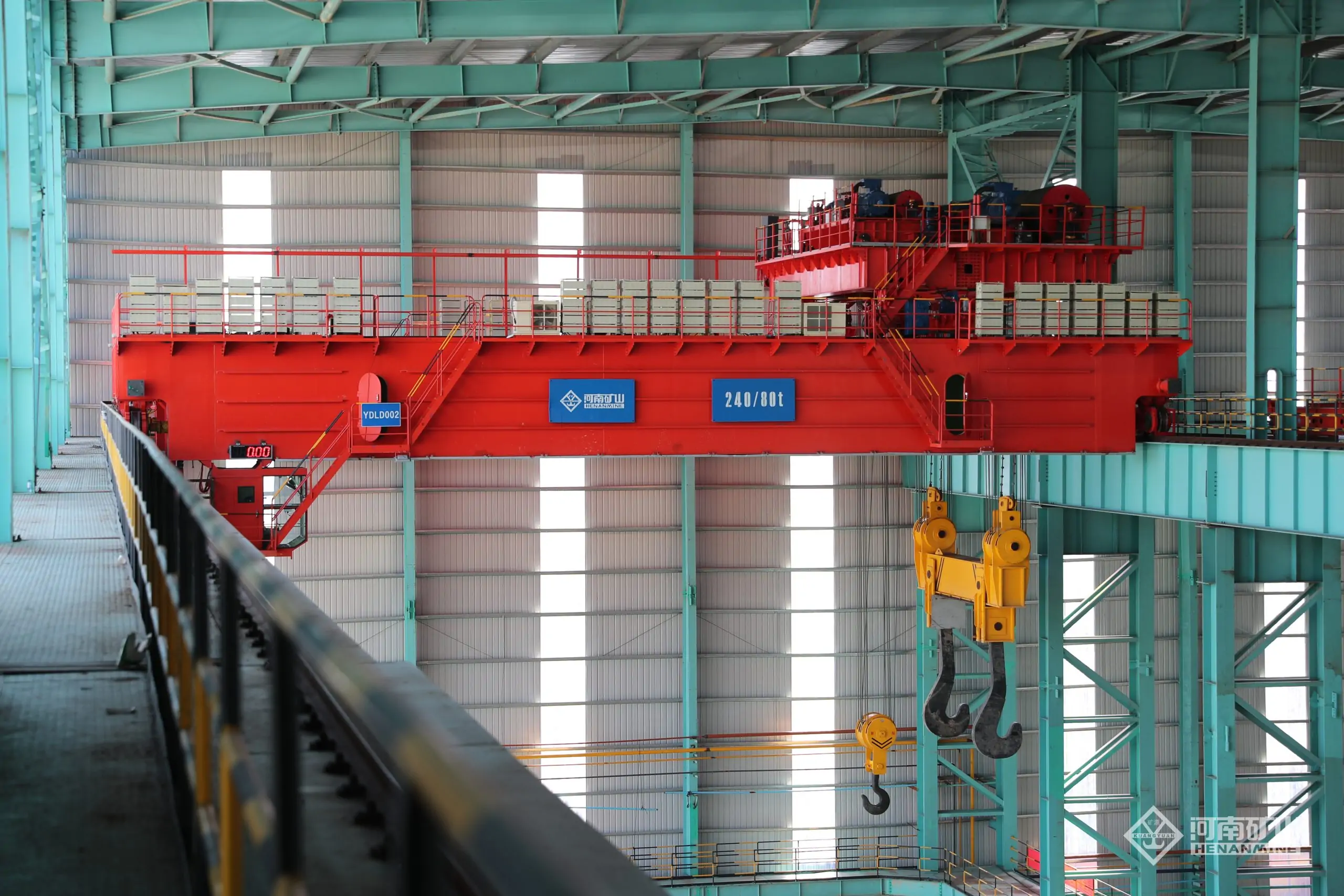
The published Henan Mine Crane double-girder casting crane is positioned for ladle transfer and metallurgical duty, with a published A7 working class for that product range. Larger or more demanding projects may require another structural and trolley arrangement. A class designation should never be copied into a tender without the corresponding cycles, load spectrum and mechanism classifications.
Define every operating load case
Include the filled ladle, empty ladle, lifting beam or gantry, hooks, auxiliary handling, slag or charging tasks and any tipping or pouring operation. State the center of gravity and permitted load combinations.
Map the load path and occupied areas
Show pickup and discharge stations, travel corridors, personnel restrictions, obstructions, furnace and caster interfaces, safe parking positions and recovery paths after an interruption.
Specify safety functions by requirement
Define holding brakes, overspeed and overload protection, upper limits, emergency operation, power-supply behavior, operator visibility, communications and monitoring according to the governing local and project rules.
Semi-Finished and Finished Steel
Continuous Casting, Rolling, Coil and Plate Handling
After casting, the principal selection variables shift from the containment of molten metal to product geometry, temperature, surface condition, orientation and production rhythm. A slab crane may work around hot products and a reheating furnace; a roll-shop crane must support precise removal and replacement of mill rolls; a cold-coil warehouse may prioritize damage prevention, accurate positioning and automatic inventory control.
| Product / Task | Common Lifting Method | Suitable When | Checks Before Selection |
|---|---|---|---|
| Hot slab, bloom or billet | Mechanical clamp or tong; approved magnetic system where material and temperature permit | Transfer, stacking and furnace feeding require a dedicated pickup method and heat-aware design | Maximum temperature, thickness/section range, stack gap, pickup face, scale, surface condition and positive gripping confirmation |
| Coils | C-hook, mechanical tong or engineered magnetic pickup | C-hooks suit accessible bores and defined orientation; tongs support powered engagement; magnets require validated coil conditions | Mass, OD, ID, width, eye orientation, temperature, banding, telescoping risk, contact marks and storage saddles |
| Plates and sheets | Magnetic beam or mechanical/hydraulic clamp | Magnetic handling suits approved ferromagnetic products; clamps suit defined thickness and edge/contact conditions | Plate length, width, thickness, number per lift, flatness, air gaps, surface finish, temperature and power-loss behavior |
| Billets, bars and sections | Fixed or rotating magnetic beam; mechanical beam and slings for defined loads | Long products require controlled orientation, balanced pickup and adequate aisle/stack clearances | Bundle composition, length range, sag, rotation angle, pickup spacing, stack arrangement and travel corridor |
| Work and backup rolls | Hook/beam or dedicated roll-handling attachment | Roll changes require controlled low-speed positioning and a verified extraction route | Roll assembly mass, lifting points, chocks, center of gravity, maintenance stand, headroom and outage duration |
For plate logistics, compare an automatic steel plate handling crane with a manually controlled process crane only after defining throughput, product identification, stack mapping and exception handling. Automation is most effective when pickup conditions and storage locations are controlled; it does not remove the need for a safe manual recovery mode.
Engineering Definition
Six Inputs That Convert a Process Map into a Crane Specification
A process map identifies the crane family. The following inputs determine the actual structure, mechanisms, speeds, controls, protection and commercial scope.
01
Complete suspended load
List the product or process vessel together with the beam, magnet, clamp, tong, C-hook, rigging and every approved load combination. State clearly how the rated capacity is defined.
02
Load spectrum and cycles
Provide lifts per hour, shifts per day, days per year, expected design life, percentage of lifts in each load band and average travel distances. ISO 4301-1 classifies cranes and mechanisms from service conditions including cycles, load spectrum and movement.
03
Heat, dust and corrosive exposure
Record ambient temperature at crane level, radiant sources, hot-load temperature, exposure duration, dust type and concentration, fumes, moisture and corrosive agents. “High temperature” without locations and values is not a design input.
04
Pickup and release verification
Define how the control system confirms that a clamp, tong, magnet or other device is correctly engaged before travel. Include load detection, permissives, interlocks and the response to incomplete pickup or loss of power.
05
Speed, positioning and automation
Derive motion speeds from travel distance and target cycle time, then define low-speed control, stopping accuracy and sway limits. For automatic operation, add coordinates, traffic rules, safety zones, MES/WMS interfaces and recovery logic.
06
Runway, building and supply boundary
Confirm span, rail elevation, lift, approaches, clearances, runway condition and allowable reactions. State who supplies rails, conductors, access platforms, installation, commissioning, load-test weights and local approvals.
Do not translate duty-class names by assumption
ISO, FEM, CMAA and GB-based classifications use different structures and terminology. A tender should identify the governing standard, crane and mechanism classes, calculation inputs and required design life. A label such as “heavy duty” is not a substitute for the load spectrum.
Project Evidence
100+ Crane Fleet for a Southeast Asian Steel Mill
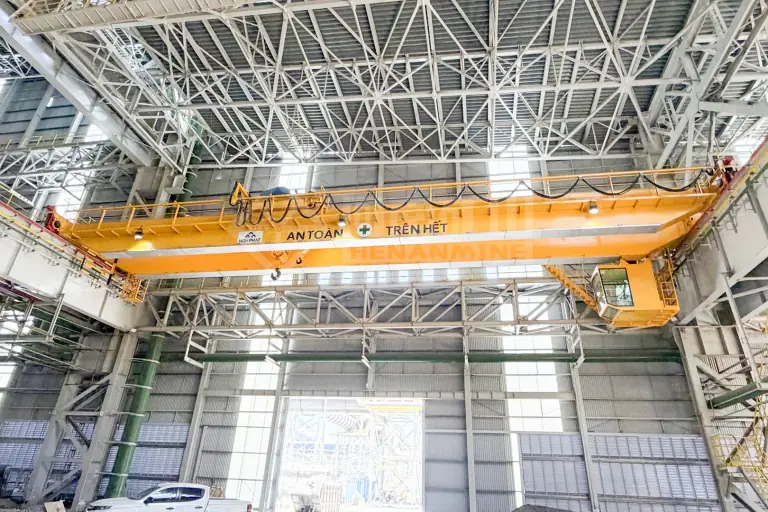
Why the fleet approach matters
Henan Mine Crane’s published project record reports more than 100 lifting units for a large steel mill in Southeast Asia. The disclosed scope includes a 160-ton double-girder overhead crane, slab clamping cranes, lower-rotating electromagnetic hanging-beam cranes and double-girder double-trolley gantry cranes for the plant’s harbor waste yard.
- Different load forms were assigned to different lifting attachments.
- Indoor production duties and outdoor yard duties used different crane platforms.
- Fleet planning connected production transfer, material storage and waste handling.
This reference demonstrates configuration coverage, not a ready-made specification. A new project still requires its own load matrix, process routes, building data and local compliance review.
Technical Enquiry
Steel Mill Crane RFQ Checklist
A useful enquiry describes each crane position separately and provides one plant-level material-flow drawing. This allows suppliers to align capacity, attachment, classification, runway reactions, controls and supply scope before quotations are compared.
Process and Load Matrix
Crane number and bay; pickup and discharge stations; load types; minimum/maximum mass; dimensions; temperature; center of gravity; attachment; permitted load combinations; drawings and photographs.
Operating and Availability Data
Lifts per hour; shifts and annual hours; load-band distribution; travel distances; target cycle; production interlocks; outage consequence; maintenance windows; required standby or recovery arrangement.
Building and Environment
Span, rail length/elevation/section, lift, hook approaches, clearances, runway drawings and reaction limits; ambient and radiant heat; load temperature; dust, fumes, corrosion, wind and installation access.
Controls, Compliance and Scope
Cab, remote or automatic control; positioning and sway targets; MES/WMS protocols; power supply; governing standards; destination; language; Incoterm; rails, conductors, installation, testing, training and documents.
Frequently Asked Questions
Can one crane serve both molten-metal handling and general maintenance?
Only when every intended load case, path and operating mode is included in the approved design and risk assessment. A general maintenance crane must not be assumed suitable for a filled ladle because its capacity appears adequate.
How is steel mill crane capacity determined?
Start with the heaviest approved suspended system and define what the rating includes. Check all attachments, vessels, rigging and permitted combined loads, then apply the governing design rules, dynamic effects and load combinations.
Does every steel mill crane need A7 or A8 duty?
No. Classification must follow the selected standard and actual service conditions. A ladle crane and a maintenance-bay crane in the same plant may have very different utilization and load spectra.
Is an electromagnet better than a clamp or C-hook?
Not universally. Magnetic suitability depends on material, geometry, temperature, contact conditions and retention strategy. Clamps, tongs and C-hooks have different access, engagement, surface and product-range constraints.
When is an automatic steel mill crane justified?
Automation is strongest where load identity, pickup geometry, coordinates and traffic rules are controlled and repeatable. Evaluate throughput, labor exposure, inventory accuracy, interface reliability and recovery from sensor or network faults.
Can an existing runway be reused for a new process crane?
Only after the rails, beams, brackets, columns, connections and foundations are surveyed and checked against the new vertical, horizontal and fatigue demands. Remaining clearances and installation access must also be verified.
Technically reviewed by: Henan Mine Crane Metallurgical Crane Engineering Team
Last reviewed: September 2026
Technical basis: Henan Mine Crane’s published casting-crane, slab-handling, magnetic-crane, grab-crane and steel-mill project information was reviewed for this guide. Crane classification principles were cross-checked against ISO 4301-1, and the inspection context against ISO 9927-1 and ISO 9927-5. Final capacity, classification, safety functions, compliance and performance are governed by the approved project specification, applicable local rules and contract.
Request a Process-Based Steel Mill Crane Proposal
Submit the plant process flow, crane list, load and attachment matrix, operating cycles, temperatures, span and lift, runway drawings, control requirements, power supply, destination and supply boundary. Henan Mine Crane will develop a bay-by-bay crane configuration and a coordinated technical and commercial scope.