
Top Running vs. Underhung Overhead Cranes: Which Suits Your Facility?
Bridge cranes are the core hoisting equipment in industrial scenes such as factories, warehouses, workshops, etc., which are directly related to production efficiency, operation safety and site utilization.The mainstream models on the market are divided into two categories: Top Running Overhead Crane and Underhung Overhead Crane.
The core difference between the two types of equipment lies in the assembly structure of the end beam and the track beam. This key design difference directly determines the load capacity, headroom height, site adaptability and overall cost of the equipment.Deviations in the selection of most plant equipment will cause various problems such as insufficient hoisting performance, poor site adaptation, and surge in late-stage transformation costs.
This article will carry out a comprehensive analysis from the structure definition, configuration characteristics, comparison of advantages and disadvantages, applicable working conditions, selection process and pit avoidance points, to help enterprises accurately match high-adaptability and cost-effective bridge cranes based on the actual working conditions of the plant.
What Is a Top Running Overhead Crane?
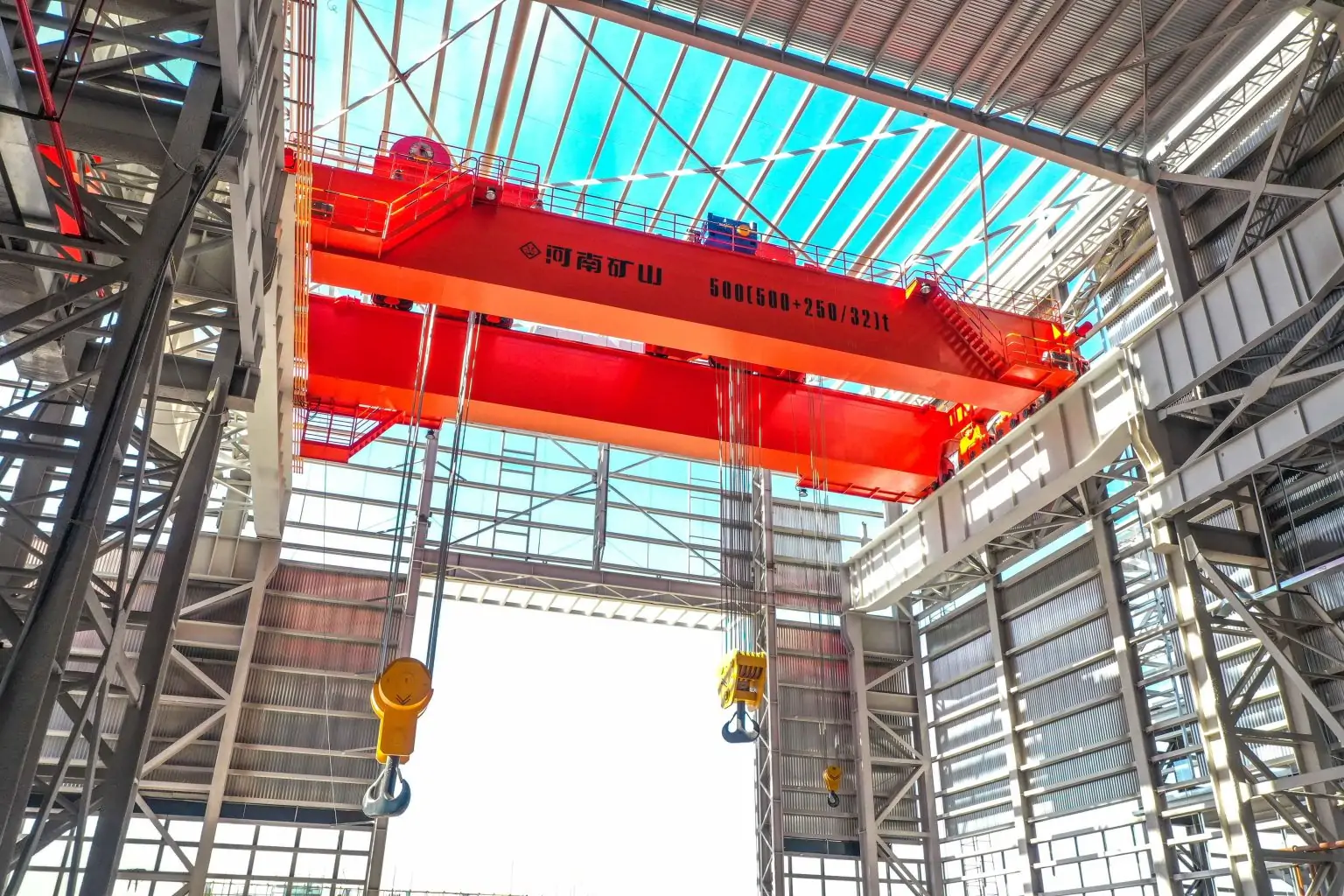
Top running overhead crane, also known as top-row bridge crane, is a standard equipment for heavy-duty industrial scenes. It is widely used in large and medium-sized manufacturing plants, steel mills, large storage bases and other scenes with high requirements for hoisting capacity and equipment stability.
Its core structural characteristics are: the crane end beam walking wheel walks on a fixed track on the top surface of the track beam, and the main beam, the running trolley and the crane move vertically along the track as a whole, forming an essential difference from the structure of the bottom suspension walking under the suspension type.
Core structure and configuration characteristics
- Track support form: The track is fixed to the top surface of the track beam, and the overall load of the equipment is transmitted to the ground column, independent support structure or wall leg through the track beam. It does not depend on the load-bearing of the roof of the plant, which can effectively reduce the force load of the roof truss.
- Optional configuration of double main beam: it is divided into two mainstream structures, single beam and double beam.The single-beam model has a simple structure and outstanding cost performance. It is suitable for light-duty hoisting conditions within 15 tons, and is mostly equipped with a lower-hanging hoist; the double-beam model has stronger structural stiffness, can carry hundreds of tons of heavy loads, and is suitable for long-span operations. The hoist is operated on the top, which can maximize the use of the vertical clearance of the plant.
- Three-dimensional operation: The equipment can realize the three-dimensional linkage of vertical walking of the track, horizontal movement of the trolley, and vertical lifting of the hoist, covering the whole area of the operation interval and meeting the needs of all-round material hoisting.
Core advantage
- Sufficient vertical lifting height: the main beam is installed on the top. Under the same floor height conditions of the plant, the effective lifting height is 3-6 feet higher than that of the lower suspension crane, especially suitable for working conditions where the floor height is limited but high-stroke hoisting is required.
- Excellent performance for heavy-duty and long-span hoisting: designed for heavy-duty hoisting, the conventional load can reach more than 20 tons, and the maximum can be adapted to hundreds of tons of working conditions. At the same time, it supports the layout of large-span tracks and is suitable for the global operation of large-area factories.
- Strong structure, suitable for high-frequency heavy loads: the whole machine has strong rigidity and balanced force, and can be adapted to high-level and high-intensity continuous operation for a long time. It is not easy to deform, has a low failure rate, and has a longer service life of the equipment.
- Convenient and efficient maintenance and maintenance: core components such as walking wheels, rails, and trolleys are exposed, and can be operated directly through the maintenance platform. Maintenance and replacement can be completed without disassembling the whole machine, greatly reducing long-term operation and maintenance costs.
- Wide range of structural adaptability: the load is transmitted on the ground, and there is no need to rely on the roof of the plant to withstand the force. The new plant can be flexibly planned and laid out without additional reinforcement of the roof steel structure.
limitations
- High clearance requirements for vertical installation: The top layout of the track will occupy part of the vertical floor height, which is poor for low-rise factories and low-clearance operation scenarios.
- Limited operation coverage: due to the constraints of the end beam structure, the hoist cannot be operated close to the wall and the end of the track, and the corners of the workshop are easy to form blind spots for hoisting, and the site utilization rate is slightly discounted.
- The initial input cost is high: the steel structure of the equipment is larger in volume, and it needs to be equipped with an independent ground column support system. The total cost of equipment procurement, steel structure supporting and installation is higher than that of light-duty under-suspension cranes.
- There are blind spots in the operation coverage: due to the limitations of the end beam structure, the hoist cannot be close to the wall and the end of the track. There are a small number of blind spots for hoisting in the corner area of the workshop, and the site utilization rate is slightly limited.
- Weak flexibility of multi-machine linkage: the design of the end beam structure is fixed, and the adaptability of multiple cranes to connect in alignment and cross-zone linkage transfer is poor.
- Poor adaptability of multi-machine linkage: The unique end beam structure is not conducive to the alignment and connection of multiple cranes, and the flexibility of cross-machine material transfer and linkage industry is low.
What Is an Underhung Overhead Crane?
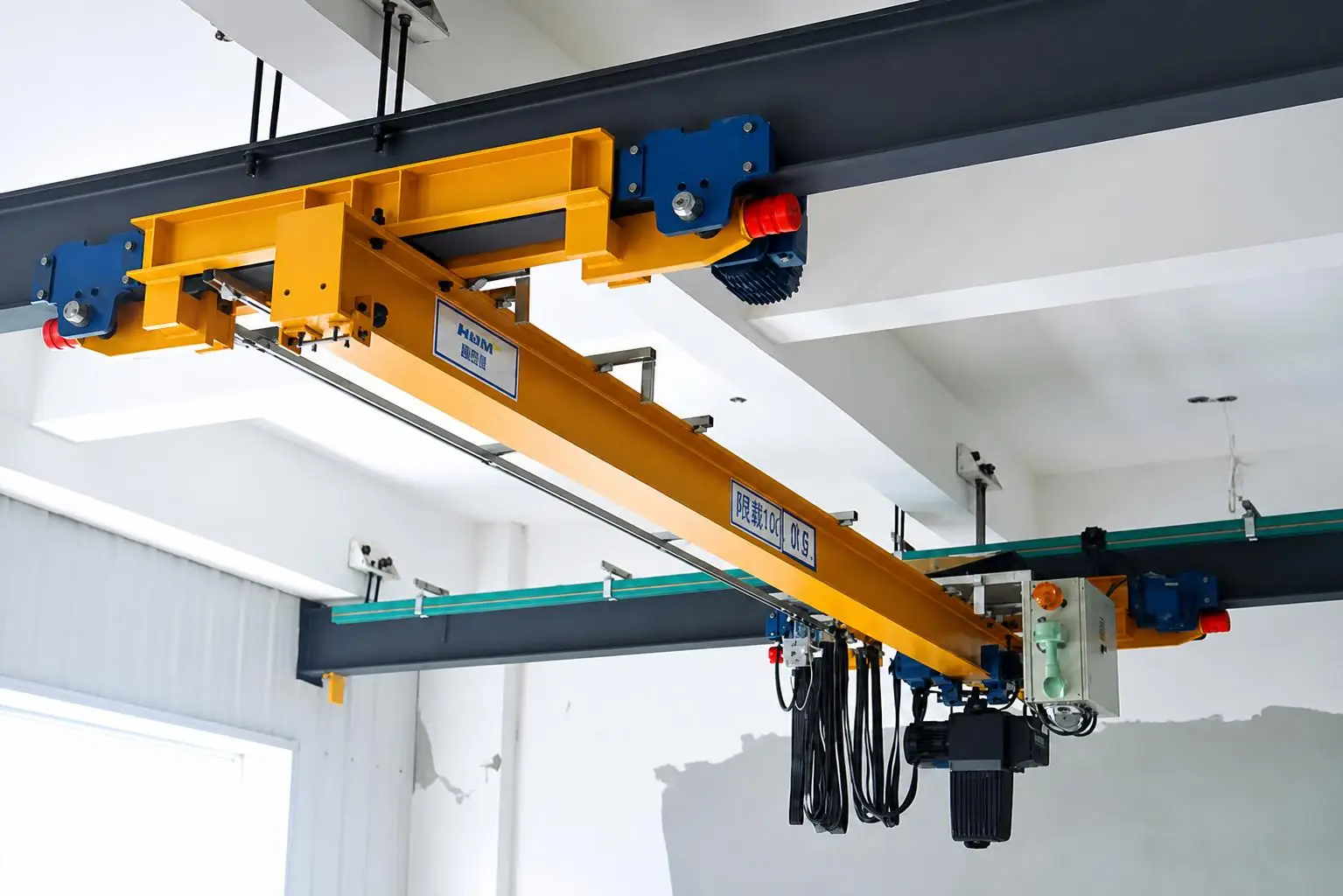
Underhung overhead cranes, also known as bottom-row suspension cranes, are the mainstream equipment in light-duty industrial scenes.Its core structure is that the end beam walking wheel is suspended and mounted on the lower flange of the track beam, and the entire system of main beam, trolley, and hoist is all suspended and operated under the track; the track beam is directly fixed to the roof structure of the plant without the need for ground column support.
Core structure and configuration characteristics
- Roof suspension support: The track beam is fixed to the truss or ceiling structure of the workshop, and all equipment loads are transmitted to the roof, without the need for ground support columns, completely freeing up the workshop ground working space.
- Mainstream single-beam lightweight design: with single-beam structure as the core mainstream, it is suitable for light lifting and short-span operations within 10-15 tons; double-beam models are less used and are only used for some medium-load and special-height customized working conditions.
- Adaptation to transformation scenarios: the whole machine is lightweight, runs smoothly and has low noise, and does not need to significantly change the original plant structure. It is the preferred solution for installing lifting equipment in old plants.
Core advantage
- The ultimate release of ground space: there is no floor-to-ceiling support column throughout the process, which completely eliminates the problem of the column blocking material stacking and forklift traffic, effectively revitalizes the limited space in the workshop, and greatly improves the site utilization rate of compact factories and the flexibility of operation and passage.
- Excellent adaptability to plant transformation: relying on the suspension and installation of the original plant roof structure, there is no need to dig the foundation and add load-bearing columns. The construction process is streamlined and the transformation cycle is short. It can be perfectly adapted to all kinds of old factories and stock workshops. Equipment upgrade and transformation projects.
- Light-duty working conditions are cost-effective: the overall structure is simple and the materials are streamlined. In light-duty hoisting conditions of 15 tons and below, the comprehensive cost of equipment procurement and supporting installation is much lower than that of upper rail cranes, which is the preferred solution for light-duty lifting scenarios with high economy.
- No dead ends in operation coverage: The unique suspension structure design allows the crane to run as close to the wall and the end of the track as possible, greatly reducing the blind area of the operation, and perfectly adapting to special site conditions such as special-shaped workshops and narrow stations.
- The fuselage is lightweight and the structural load is low: The lightweight design of the whole machine requires lower load-bearing load on the roof of the plant and the main body of the building. It can be adapted to old factories with limited roof load-bearing capacity without significantly strengthening the structure.
Limitations
- Limited vertical lifting height: The whole machine is suspended under the track beam. Compared with the upper rail crane with the same conditions, the effective vertical lifting stroke is reduced by 3-6 feet, which cannot meet the needs of ultra-high-stroke hoisting.
- There is an upper limit on load and span: the maximum load of the standard model is only 10-15 tons, and it only supports short-span track layout, which is completely unsuitable for heavy-duty, long-span, and high-frequency continuous operation scenarios.
- Highly dependent on the strength of the roof structure: the entire load of the equipment is borne by the roof. The old plant needs to do structural verification and roof reinforcement in advance, and additional investment in transformation is increased.
- Operation and maintenance are more difficult and risky: the whole machine is suspended in the air, and special climbing equipment is required for the maintenance and replacement of core components. The maintenance operation is cumbersome and the operation safety risk is higher.
- Weak durability: the lightweight structure design has limited rigidity and cannot be adapted to long-term continuous heavy-duty operations. Under high-frequency operating conditions, equipment loss is faster and service life is shorter.
Top Running vs. Underhung Overhead Cranes: Key Differences
In order to help quickly identify the adaptation boundaries of the two models, the following are accurately benchmarked from the core dimensions of structure, carrying performance, space adaptation, cost operation and maintenance, and visually present the differences between the two.:
| Contrast dimension | Top Running Overhead Crane
|
Underhung Overhead Crane
|
| Track support structure | The track is topped, the ground column/independent structure is supported, and the load is landed | Track bottom hanging, roof truss support, load upload |
| Rated carrying capacity | 20 tons-hundreds of tons, suitable for heavy-duty working conditions | Conventional ≤15 tons, only suitable for light-duty working conditions |
| Lifting height | Higher, 3-6 feet more vertical travel | Low, limited vertical working space |
| Track span | Support large-span layout, suitable for large-area factories | Only suitable for short-span scenes |
| Ground space occupied | Requires column support and takes up a small amount of ground space | No columns, completely free up ground space |
| Installation adaptation scenario | Newly built factories, heavy-duty workshops, and large-span sites | Renovation of old factories, light workshops, compact sites |
| Initial cost | High, large investment in equipment and supporting structure | Low cost, extremely cost-effective in light-duty working conditions |
| Operation and maintenance difficulty | Low, easy maintenance and easy maintenance of parts | High, the floating structure requires special equipment for operation and maintenance |
| Intensity of operating conditions | Suitable for 24-hour high-frequency heavy-duty operations | Only suitable for intermittent light operations |
How to Choose Between Top Running and Underhung Cranes?
There are no absolute advantages and disadvantages between the upper rail type and the lower suspension type crane, only the working conditions are adapted differently.Combined with the plant structure, hoisting load, operating headroom, budget and expansion requirements, the optimal model can be accurately matched. The specific selection criteria are as follows:
Hoisting load and operating span
Load and span are the core basis for selection.When the working conditions meet the load of 15-20 tons, the span exceeds 60 meters, or the 24-hour high-frequency heavy-duty operation, the upper rail crane is preferred.Its structure has strong rigidity, sufficient bearing capacity, fatigue resistance, and can be stably adapted to long-term high-intensity heavy-duty operations.
Load ≤15 tons, small span, intermittent light load operation, suitable for underhanging cranes.The model has a streamlined structure and low input cost, which can meet the needs of light handling and effectively control the input and idle costs of equipment.
Consider Your Lifting Requirements
Combining the selection of plant floor height and process lifting requirements, the headroom for vertical operations can be efficiently utilized.If the floor height of the plant is sufficient and the production requires high-stroke and high-drop hoisting, the upper rail crane is preferred.This model has a larger effective hook distance and can be fully adapted to large-stroke vertical hoisting operations.
If the floor height of the plant is limited, the vertical clearance is limited, and there is no requirement for ultra-high and ultra-stroke hoisting technology, only the conventional height material hoisting and handling operations need to be completed, and the lower suspension crane can fully cover the operation requirements, adapt to the space constraints of the low-rise plant, and do not waste site space resources.
Evaluate Your Facility Structure
Combined with the selection of the bearing capacity of the plant structure, the cost of transformation can be reduced and safety can be guaranteed.For factories with weak roof load-bearing but ground columns can be installed, upper rail cranes are preferred. The load is transmitted to the ground and the safety is high. There is no need to strengthen the roof.
When the old factory building cannot be installed with uprights, but the bearing capacity of the roof is up to standard, the lower suspension crane is preferred.The suspension installation relies on the original roof, without the need for new civil engineering transformation, and the construction volume is small and the landing is fast.
Analyze Available Space
Combined with the site layout and traffic demand selection, it is adapted to the production line of the workshop.When the workshop space is small, the traffic is frequent, and the high site utilization rate is pursued, the lower suspension crane is preferred.It has no column blocking and no blind spots for operation, which can ensure smooth passage and maximize the use of site space.
If the plant site is open and the ground space is sufficient, the core requirements are the heavy-duty stability of the equipment and the safety of operation, and the upper rail crane with column support is preferred.The column support structure greatly improves the overall stability of the equipment, has stronger anti-shaking and anti-overturning capabilities, and can be adapted to high-precision and high-load hoisting operation scenarios.
Budget and long-term operation and maintenance
Combine budget and long-term capacity planning and selection.Short-term light-load operations, strict control of procurement costs, priority is given to the selection of under-suspension cranes, low investment and high cost performance, which can meet the needs of basic operations.
Long-term high-frequency operation, the pursuit of low operation and maintenance costs and equipment stability, the upper rail crane is preferred.Its structure is durable, has a low failure rate, has a longer life span, and supports load and capacity expansion, and is suitable for long-term production upgrades.
Top Running vs. Underhung Overhead Crane: Application Comparison
The hoisting load, operating frequency, and site conditions of different industries vary significantly. The adaptation of the model directly determines the production efficiency and operating safety. The preferred solutions for each industry are as follows:
- Heavy industry, steel mills, and large–scale equipment manufacturing: Most of these scenarios are 50-500 tons of oversized heavy-duty hoisting and 24-hour continuous high-intensity operations. The bearing capacity, structural stability and fatigue resistance of the equipment are extremely demanding, and they are uniformly adapted to top running overhead crane The upper limit of the load-bearing capacity of the lower suspension model cannot meet the needs of such extreme heavy-duty working conditions.
- Automobile and aviation manufacturing: The zoning adaptation scheme is adopted, and the heavy-duty assembly stations of the main production line are selected, and the double-beam upper rail cranes with strong rigidity and high stability are selected to ensure high-precision heavy-duty hoisting operations; auxiliary areas such as light parts assembly and equipment maintenance can be used with lower suspension cranes, taking into account flexibility and economy.
- Large-scale warehousing and logistics centers: for large-span sites and heavy-duty cargo storage scenarios, upper rail cranes are preferred, which are suitable for large-span and heavy-duty normalized transshipment; small zoned warehousing and old-fashioned transformation warehouse areas, subject to site and structure restrictions, lower suspension cranes are preferred to make efficient use of limited site space.
- Machining and maintenance workshops: The workshop focuses on sporadic and intermittent light-duty material hoisting and equipment disassembly and assembly operations. There is no heavy-duty and high-frequency demand. Priority is given to lower-suspension cranes, which can effectively save ground space, high operational flexibility, and adapt to the pace of lightweight operations in the workshop.
- Food and pharmaceutical clean workshops: clean production scenarios have strict requirements for site cleanliness, and lower suspension cranes are preferred.The equipment is not obscured by ground columns, and there are no clean dead ends in the workshop. It can realize global killing operations and is perfectly adapted to the production specifications and hygiene standards of the clean workshop.
- Renovation projects of old factories: old factories that are restricted by the original building structure and cannot add ground columns are adapted to the lower suspension suspension installation plan; factories that can be retrofitted with additional columns and have long-term capacity expansion plans are recommended to use upper rail cranes to take into account stability and late upgrade space.
Common Mistakes When Selecting an Overhead Crane
Most of the problems of crane selection failure and transformation cost are due to the neglect of site parameters, working condition adaptation and structural verification in the early stage.The following nine high-frequency selection misunderstandings and streamlined avoidance schemes can help enterprises accurately avoid pits and ensure the safe and stable landing of equipment.
Myth 1: Judging the load-bearing capacity of the plant based on experience, lack of professional structural verification: Some projects only estimate the load-bearing capacity of the plant and roof based on experience, and directly purchase and install without carrying out professional load verification. Problems such as insufficient roof bearing capacity and unbalanced column force not only leave behind structural safety hazards, but also additional late reinforcement costs.
Avoidance plan: In the early stage of equipment selection, it is necessary to complete the site survey and structural verification, clarify the load transmission path of the equipment, strictly match the actual load-bearing conditions of the plant, and avoid the risk of structural adaptation from the source.
Misunderstanding 2: The model is mismatched with the actual working conditions: the selection is out of the on-site working conditions, and the heavy-duty upper-rail model is blindly selected for light-duty hoisting scenarios, resulting in redundant equipment performance and waste of funds; heavy-duty and high-frequency operation scenarios misuse the lower-suspension light-duty equipment, which can easily lead to equipment overload operation, frequent failures, and significant reduction in service life.
Avoidance plan: Based on the actual lifting weight, track span, operating frequency and intensity of working conditions on the site as the core basis, accurately match and adapt the model to eliminate the problem of misalignment in the selection.
Myth 3: The selection of equipment parameters is unreasonable: only the maximum lifting weight of a single time is used as the selection standard, ignoring the daily continuous load, operating frequency and industry service level requirements, it is prone to premature failure of equipment due to insufficient parameters, or excessive parameters cause waste of resources and low cost performance.
Circumvention plan: Carry out load analysis based on the real working conditions of the workshop, synthesize a number of core parameters, and match the corresponding equipment specifications and industry service levels.
Myth 4: Ignoring the effective lifting safety margin: Only refer to the theoretical lifting parameters of the equipment, and the vertical space occupied by the fuselage, spreader and materials is not accounted for, resulting in insufficient actual effective lifting height after the installation of the equipment, which cannot meet the requirements of the production hoisting process.
Avoidance plan: Accurately measure the headroom height of the plant on the spot, accurately calculate the effective lifting range of the equipment, and reserve sufficient safety margin to ensure the normal development of actual hoisting operations.
Myth 5: Only compare prices and purchase, ignoring the whole life cycle cost: one-sided pursuit of low-cost equipment procurement, only focusing on the initial input cost, ignoring hidden expenses such as late operation and maintenance, parts replacement, failure and shutdown, energy consumption and consumption, resulting in high long-term equipment use costs.
Avoidance plan: Comprehensively calculate the cost of the whole life cycle of the equipment, and give priority to high-adaptable models with stable operation, low failure rate, and convenient maintenance, taking into account the initial investment and long-term use benefits.
Myth 6: The margin for capacity expansion is not reserved: The equipment selection is only adapted to the current production conditions, and the requirements for later capacity upgrades, lifting load increases, and operating range expansion are not considered. The equipment can only be replaced as a whole when the working conditions are updated in the later stage, and the cost of transformation is extremely high.
Avoidance plan: Plan the long-term production capacity in advance during the selection stage, reserve 20%-50% of the load margin and lifting height margin, and calmly adapt to future production capacity upgrades and operating conditions expansion.
Myth 7: Ignoring operation and maintenance conditions and safety specifications: The selection plan does not plan a standardized maintenance space and supporting safety protection devices. The late maintenance operation of the equipment is difficult and the safety risk is high, and it does not meet the industry's safety operation standards.
Circumvention plan: Strictly follow industry safety regulations, reserve standardized maintenance channels and protective devices during the design phase of the plan, taking into account the safety of equipment operation and the convenience of later operation and maintenance.
Myth 8: The support system scheme is customized at will: The support scheme is not customized in accordance with the actual situation of the plant structure, and the column support or roof suspension form is blindly selected. It is easy to have problems that the equipment does not match the building structure and cannot be installed and put into operation normally.
Design plan: Combining the architectural drawings of the plant with the measured data on the site, tailor-made and adapted track layout and support system plan to ensure that the equipment is perfectly adapted to the site structure.
Myth 9: Relying on empirical selection, lack of professional survey and calculation: Relying only on industry experience to roughly select the plan, no on-site survey and structural load verification have been carried out, resulting in insufficient adaptability of the plan and frequent landing problems, which affect the normal use of the equipment.
Solution: Connect with professional lifting equipment manufacturers, complete site survey, structural modeling and load verification, and customize personalized and highly adaptable complete lifting solutions.
Conclusion
The two cranes have their own strengths, and the key to the selection is to adapt to the plant conditions and operating conditions.For heavy-duty, long-span and high-frequency operation scenarios, the upper rail type is preferred, which is stable, durable and has strong bearing capacity; for light-duty operations, restricted sites or the renovation of old factories, the lower suspension type is suitable for selection, and the space utilization rate and cost performance are higher.
Enterprise procurement selection should not have a single reference to tonnage and price. It needs to comprehensively evaluate the load-bearing, lifting height, operating frequency, equipment level and long-term expansion needs of the plant, relying on professional surveys and customized engineering solutions to achieve the optimal configuration of safe, efficient and high-return equipment.
As a professional lifting equipment manufacturer, Henan Mine Crane provides top running overhead cranes, lower suspension bridge cranes, gantry cranes and intelligent lifting solutions.With rich engineering experience, customized design capabilities and a perfect technical service system, we help customers choose the most suitable lifting system according to different plant conditions and production needs to achieve safe, efficient and stable long-term operation.