
Complete Buying Guide for 50-Ton Heavy-Duty Gantry Cranes
50-ton heavy-duty gantry cranes are widely used in heavy industry, ports, shipyards, warehousing and other heavy-duty scenarios. With the advantages of strong bearing capacity, stable operation, wide adaptability and high cost performance, they are the core equipment for industrial heavy-duty operations.As a large fixed asset, improper selection and mismatched parameters and configuration working conditions will directly reduce production efficiency, bury safety risks, and increase operation and maintenance costs.
This article comprehensively combs the purchase points of 50-ton gantry cranes from the nine dimensions of equipment definition, model classification, core parameters, core accessories, price factors, manufacturer screening, safety configuration, operation and maintenance, and equipment comparison to help enterprises avoid procurement misunderstandings and accurately match highly adaptable and cost-effective equipment solutions.
What Is a 50-Ton Gantry Crane?
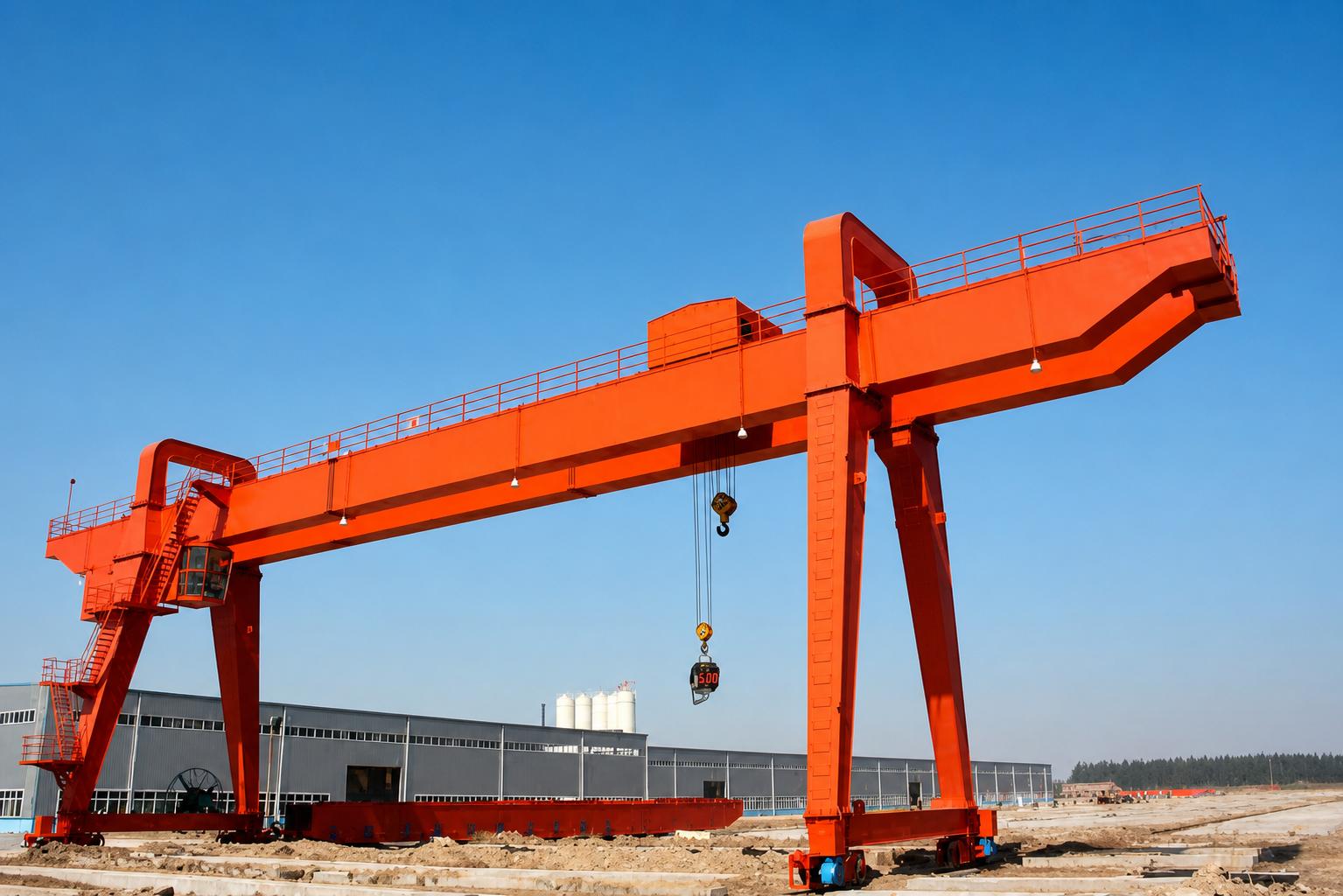
The 50-ton gantry crane is a high-strength and high-stability industrial heavy-duty lifting equipment, which belongs to the derivative category of bridge cranes.The equipment as a whole has a gated structure. The main beam spans the working area and is supported by floor-to-ceiling outriggers. There is no need to rely on the factory building. It can run independently on the ground track or tires. It is specially used for lifting, transshipment, and stacking of heavy goods with a rated load of 50 tons and below.
The 50-ton rated load marked by the equipment represents the maximum load weight that can be safely hoisted under the premise of standard design conditions, compliance operation, and standard spreader, including the comprehensive weight of the cargo body, spreader, and accessories. Long-term overload operations are strictly prohibited.
The complete set of equipment relies on the coordinated operation of the five core systems to achieve accurate and stable lifting operations:
- Bridge structure: The core load-bearing body is divided into two mainstream structures, box-shaped and truss, including the main beam and the end beam. It mainly carries the full weight of the lifting trolley, the hoist mechanism and the cargo. It is the key to ensure the carrying capacity and structural stability of the equipment.
- Support outriggers: Common A-shaped and box-shaped outriggers connect the bridge frame and the walking mechanism to evenly transmit the weight of the equipment and the weight of the load to the ground, resist shaking and external shocks during operation, and ensure the stability of the whole machine.
- Lifting mechanism: it consists of a wire rope electric hoist, a lifting trolley, a motor, a reducer, a reel, a hook, and a braking system. It is responsible for the vertical lifting of goods and is the core execution unit to realize the lifting function.
- Walking mechanism: it is divided into two types: orbital type and tire type. It consists of a walking wheel set, a drive motor, and a frequency conversion control system. It can realize the longitudinal movement of the whole machine along the working area and cover a wide range of working space.
- Electrical control system: With PLC programmable controller as the core, it integrates the operation terminal, safety interlock, monitoring and early warning system, and co-ordinates the control of all actions such as lifting, walking, and trolley translation of the equipment to ensure accurate operation and safe operation.
Main Types of 50-Ton Gantry Cranes
According to the different structural forms, support methods, and walking configurations, 50-ton gantry cranes can be divided into four mainstream models, which are adapted to different sites, working conditions, and operating needs.:
Full gantry crane
Both sides are equipped with floor-to-ceiling outriggers, which run along the ground track throughout the process, and the whole machine is independently supported without relying on any building structure.It has a stable structure, strong carrying capacity and large operating range. It is suitable for outdoor large-scale heavy-duty hoisting scenarios and is widely used in shipyards, large steel depots, outdoor construction sites, and large storage bases.
Semi-gantry crane
The asymmetric structure of “single-sided outrigger landing + single-sided plant track beam support” is adopted, cleverly using the existing plant building, without the need to lay the track on the whole site, greatly saving installation space and infrastructure costs.It is suitable for indoor and outdoor connection operations in existing factories and workshops. It is the preferred model for the transformation of old factories and heavy-duty operations in limited space.
Tire gantry crane (RTG
Abandoning the traditional track structure, high-strength rubber tires are used as walking parts. There is no need to lay a fixed track, and they can be freely turned and flexibly shifted without being restricted by the track of the site.It is extremely mobile and suitable for scenarios such as container depots, logistics parks, temporary construction sites, etc. that require frequent switching of operating areas. The only shortcoming is that the equipment manufacturing cost is relatively higher.
Double girder gantry crane
It is the recommended standard model for 50-ton heavy-duty conditions.Compared with single-beam models, the double-beam structure has more uniform force and stronger structural rigidity. It has higher operating stability, greater lifting height and stronger load dispersion capacity. It can carry a rated load of 50 tons at high frequencies for a long time, and is perfectly adapted to high-strength and high-load heavy-duty operation scenarios such as steel mills, heavy industry workshops, and large prefabricated component factories.
Key Specifications to Consider When Buying a 50-Ton Gantry Crane
Rated lifting weight
The rated lifting weight of 50 tons is the core parameter of the equipment. Two core points need to be clarified when purchasing: first, confirm whether 50 tons is a pure cargo load or the total load of ancillary accessories such as hoisting beams, grab buckets, electromagnetic suction cups, etc., to avoid insufficient actual available hoisting weight; second, take into account the current operating needs and future capacity expansion, and try to reserve a reasonable load margin.
At the same time, it is strictly prohibited to select critical load equipment. If the equipment runs at full load and ultra-close to the rated load for a long time, it will accelerate the wear and tear of steel structures, braking systems, and motors, greatly shorten the service life of the equipment, reduce safety redundancy, and bury safety hazards such as equipment deformation and brake failure.
Span
Span refers to the distance between the centers of the walking tracks on both sides of the equipment, which directly determines the operating coverage, structural design standards and procurement costs of the equipment, and is the key spatial parameter for selection.
- Small-span model (10-20 meters): the structure design is simple, the weight is lighter, and the infrastructure and procurement costs are lower, but the operation coverage area is limited, which is suitable for fixed-point hoisting operations in small workshops and narrow areas.
- Large-span models (more than 20 meters): can cover large-scale work areas and are suitable for large-scale yard, shipyard, and construction site operations, but the strength, bending resistance, and foundation bearing capacity of steel structures are required to be higher, and the cost of equipment and infrastructure are increased simultaneously.
The selection of span needs to be strictly combined with the layout of the factory area, the size of the work site, the material handling route, and the planning of equipment placement. Under the premise of meeting the full coverage of the operation, the cost waste caused by excessive selection should be avoided.
Lifting height
The lifting height determines the maximum vertical height that the cargo can be lifted. The selection needs to integrate four scenario factors: the dimensions of the cargo itself, the height of the material stacking, the height of the production line equipment, and the clearance requirements of ground vehicles and equipment.
Conventional 50-ton gantry cranes have a lifting height of 6-30 meters, and small and medium-height models can be selected in the indoor workshop to meet the needs of production assembly and equipment maintenance; outdoor depots, shipyards, and construction sites need to reserve sufficient height margin to adapt to cargo stacking, hoisting of large components, and vehicle traffic requirements to avoid insufficient height affecting the operation.
Work level
The working level represents the crane's operating frequency, load cycle strength and durability level. It directly matches the strength of the working conditions and is divided into four levels: light, medium, heavy and overweight. It is the core parameter to avoid premature equipment aging and frequent failures.
- Light grade (A1-A3): low frequency of operations, length of daily work hours, intermittent operations, only suitable for equipment maintenance and sporadic hoisting scenarios.
- Intermediate (A4-A5): medium operating frequency, stable load, suitable for ordinary manufacturing workshops, conventional warehousing and transshipment operations.
- Heavy grade (A6-A7): high-frequency operations, frequent proximity to rated loads, suitable for high-intensity working conditions such as steel mills, shipyards, and prefabricated component factories.
- Super-heavy (A8): 24-hour continuous operation, full load cycle, suitable for large-scale assembly lines, port heavy-duty continuous operation scenarios.
When purchasing, the work level needs to be accurately matched according to the daily operating time, the number of hoisting per hour, and the annual operating load. Low-level equipment used in high-intensity working conditions will be quickly damaged, and high-level equipment used in light-load working conditions will cause cost waste.
Important Components of a Heavy-Duty 50-Ton Gantry Crane
- The main body of the steel structure: As the core skeleton of the whole machine, it consists of the main beam, outriggers, and end beams, which directly determine the safety, service life, and operation and maintenance costs of the equipment.The high-quality models are made of high-strength steel, with standard welding technology, anti-fatigue structure and multi-layer anti-corrosion treatment. The key welds are tested by non-destructive flaw detection, which can effectively prevent rust, deformation and cracking, and greatly reduce the cost of late maintenance.
- Lifting mechanism: The core operating unit consists of an electric hoist, a lifting trolley, a motor, a reducer, and a braking system, which are related to lifting efficiency and safety.The procurement focuses on matching the lifting speed required for working conditions, optimizing the brand's core accessories, and confirming that the equipment is equipped with overload protection and dual braking system as standard, which can effectively avoid safety risks such as overload, slip hooks, and cargo falling.
- Walking mechanism: it consists of walking track, wheel set, drive motor and VFD frequency conversion system, which is responsible for the longitudinal movement of the whole machine.Compared with traditional fixed-speed systems, VFD frequency conversion control can achieve smooth start-stop and stepless speed regulation, reduce mechanical impact and wear of accessories, improve cargo positioning accuracy, and adapt to high-precision, high-frequency and heavy-duty operations.
- Electrical control system: with PLC controller as the core, it supports two operating modes: cab and wireless remote control.Integrated intelligent functions such as load monitoring, anti-swing, and remote fault diagnosis can avoid hoisting shaking, quickly investigate faults, and reduce downtime losses. Electrical accessories are waterproof, dustproof and anti-interference, and are suitable for all kinds of complex indoor and outdoor working conditions.
How Much Does a 50-Ton Gantry Crane Cost?
Overall price range
The 50-ton gantry crane is a non-standard customized heavy-duty equipment. There is no fixed unified selling price. The market price span is very large. The core depends on the equipment configuration, working condition adaptation plan, and customization requirements.
The price of rail-type 50-ton gantry cranes with standard conventional configuration is relatively affordable, while the price of large-span, high-lifting height, outdoor explosion-proof, intelligent automation, and tire-type models will be greatly increased. The cost of special RTG tire-type models for ports is much higher than that of ordinary industrial models.Therefore, quotations without complete parameters and working condition requirements do not have reference value.
Core price influencing factors
- Equipment design plan: double-beam models have stronger bearing capacity and higher configuration, and the price is higher than that of single-beam models; non-standard customized span, lifting height, cantilever structure, and special shape design will increase structural research and development and manufacturing costs, and increase equipment prices.
- Material and manufacturing process: equipment using Q345B high-strength steel, high-standard non-destructive flaw detection welding, and thickened anticorrosive coating, the cost is much higher than that of ordinary steel and low-end equipment with simple welding technology; imported, first-line brand motors, brakes, and electrical accessories, the price is better than that of ordinary accessories, and the overall cost of equipment has increased synchronously.
- Optional intelligent and safety functions: wireless remote control, intelligent anti-collision, outdoor wind and lightning protection, intelligent monitoring, explosion-proof system, remote diagnosis and other value-added configurations will increase equipment procurement costs, but can greatly improve the level of operation safety and automation.
- Installation and transportation services: site foundation construction, track laying, transportation of the whole machine, on-site installation and commissioning, acceptance reporting, and localized after-sales supporting services for large-scale equipment will all be included in the overall procurement cost, and the service cost of off-site construction and complex site installation is higher.
How to Select the Right 50-Ton Gantry Crane Manufacturer?
Manufacturing experience
Priority is given to manufacturers who have been deeply engaged in the lifting equipment industry for many years and have mature heavy crane production experience.Focus on verifying the landing project cases of manufacturers of heavy-duty gantry cranes of 50 tons and above, large-scale factory/shipyard/port cooperation experience, equipment export qualifications and overseas project experience.
Mature manufacturers have perfect production processes and quality control systems, which can accurately match the needs of various complex working conditions, and avoid the problems of immature technology, rough workmanship, and unsecured after-sales service in small factories.
Qualification and quality standards
Regular manufacturers must have complete production qualifications and international certifications, core inspections: ISO quality management system certification, CE EU safety certification, national special equipment production license, and equipment must meet industry lifting equipment safety standards.Complete qualifications are the core guarantee of equipment quality, safety performance, and compliance, which can ensure that the equipment passes the local safety supervision and acceptance, and is put into use legally and in compliance.
Evaluate customization capabilities
The demand for 50-ton gantry cranes in different industries, sites, and working conditions varies greatly. High-quality manufacturers have perfect customized service capabilities.
They can customize the span and lifting height according to the size of the customer's site, and provide exclusive anti-corrosion, explosion-proof, and windproof protection solutions for special working conditions such as outdoor wind and rain, seaside salt spray, flammable and explosive, low temperature and high temperature. At the same time, it supports OEM customized services and adapts to various personalized procurement needs.
After-sales service system
Heavy-duty cranes are long-term industrial equipment, and perfect after-sales service is the key to ensuring the stable operation of the equipment.Before purchasing, it is necessary to confirm that the manufacturer can provide: full installation technical guidance, commissioning and acceptance of the whole machine, normalized maintenance services, rapid supply of original parts, 24-hour technical support and troubleshooting.Localized after-sales teams can significantly shorten the response time to failures, reduce equipment downtime losses, and extend equipment service life.
Indoor vs Outdoor 50-Ton Gantry Crane Selection
Indoor application scenarios
Core advantage
- Low corrosion and high stability: suitable for indoor closed operation scenarios, it can avoid external erosion such as wind, rain, ultraviolet rays, and sand, greatly reduce the loss of fuselage structure and electrical components, effectively reduce the probability of equipment failure, and ensure long-term stable operation.
- Simple operation and maintenance, cost reduction and efficiency enhancement: the operating environment is clean and stable, and the daily maintenance and cleaning and maintenance process of equipment is simple, which greatly reduces manual operation and maintenance investment and effectively compresses later operation and maintenance costs.
- Delay aging and extend life: Stable working conditions can reduce external interference, slow down the aging and loss of equipment components, significantly extend the service life of the whole machine, and improve the cost performance of the equipment.
Suitable for industries: machinery manufacturing workshops, equipment assembly plants, hardware processing plant areas, indoor storage centers and other indoor heavy-duty operation scenarios.
Outdoor application scenarios
The outdoor open-air operating environment is complex and requires higher equipment protection performance. Special upgrades are required on the basis of standard models: the whole machine is thickened with anticorrosive coating, waterproof and dustproof electrical components, intelligent windproof braking system, lightning and rain protection devices, and some seaside and chemical scenes also need to be specially treated for salt spray and corrosion prevention.
Suitable for industries: shipbuilding, steel yards, outdoor construction sites, port logistics, wind power engineering, large-scale prefabricated component factories and other outdoor operation scenarios.
Maintenance Tips to Extend Gantry Crane Service Life
Scientific daily inspection and regular maintenance can greatly extend the service life of the crane, reduce the probability of failure, and ensure operation safety. It is the core means to reduce the cost of the whole cycle of equipment.
Daily pre-shift inspection
Operators must complete a comprehensive basic inspection before daily operations. It is strictly prohibited for equipment to operate with diseases. The core inspection items are as follows:
- Wire rope: Regularly check the status of the wire rope, focusing on investigating defects such as broken wire, distortion, severe wear, etc., to ensure that the rope body is intact and the force is normal.
- Electrical and safety devices: Thoroughly inspect the electrical components such as operation buttons, indicator lights, sound and light alarms to ensure that the functions are intact and the operation is normal, and to ensure that the equipment safety interlock mechanism is effective.
- Hook assembly: Check the hook body for no cracking, deformation and other damage, confirm that the safety lock is sensitive to opening and closing, and the locking is reliable, and verify that the braking system has strong braking and no slippage failure problems.
Regular special maintenance
According to the frequency of equipment operation and the level of working conditions, hierarchical and regular maintenance work is carried out weekly, monthly, and quarterly. The specific contents are as follows:
- Regularly fill various moving parts such as wire ropes, bearings, gears, and walking wheels with lubricating grease to reduce component wear and ensure the smooth operation of the equipment.
- Check and tighten the structural bolts and track fixing bolts of the whole machine one by one to prevent safety hazards such as abnormal noise and offset caused by loose bolts.
- Normalize the oil level and oil status of the lubricating oil of the reducer, replenish the oil volume in time, replace the deteriorated oil stains, and ensure the stable operation of the transmission system.
- Comprehensively investigate the welds and paint surface conditions of the steel structure of the equipment, repair the rusted, cracked, and painted parts in a timely manner, and protect the structural integrity of the equipment.
Professional annual inspection
Every year, third-party professional institutions are invited to carry out safety testing and load testing to verify the rated load performance of the equipment, the sensitivity of the safety device, and the structural stability; establish a replacement ledger for wearing parts, and plan the replacement in advance according to the service life of the parts to avoid sudden failures caused by the aging of the parts.When the equipment is idle, it is necessary to lock the windproof device, cut off the power supply, and protect the whole machine.
50-Ton Gantry Crane vs Other Heavy Lifting Equipment
50-Ton Gantry Crane vs Overhead Crane
| Contrast dimension | 50 ton gantry crane | Overhead Crane |
| Installation method | Ground track/tire support, independent floor installation | Relying on the track beam at the top of the plant, the building structure needs to be supported |
| Scene flexibility | The outdoor adaptability is extremely strong, it can be flexibly shifted, and it can be adapted to open-air venues. | Only suitable for indoor fixed factories, with large scene limitations |
| Infrastructure transformation | No need to retrofit the factory building, low infrastructure cost and short construction cycle | The structure of the plant needs to be strengthened and the top track needs to be erected, and the cost of transformation is high. |
| Core application scenarios | Outdoor depots, construction sites, shipyards, and open-air operations without factories | Indoor fixed workshop, normalized indoor assembly and hoisting |
50-Ton Gantry Crane vs Mobile Crane
- Cost of use: gantry cranes are put into operation at one time and reused for a long time, and the cost of a single crane for repeated operations on a fixed site is extremely low; car cranes need to continue to pay for fuel, leasing, and labor costs, and the cost of long-term high-frequency operations is higher.
- Operating stability: The gantry crane has a fixed rigid track, stable structure, low shaking, and high safety; the car crane relies on outrigger support, which is greatly affected by the ground terrain, and the stability of heavy-duty operations is weak.
- Long-term production capacity: Gantry cranes are designed for high-frequency cyclic operations on fixed sites, which can operate continuously all year round and have stable production capacity; automobile cranes are suitable for temporary, short-distance, and multi-site scattered hoisting, and the efficiency of long-term fixed operations is much lower than that of gantry cranes.
- Operating efficiency: In the scene of repeated hoisting in a fixed area, the gantry crane starts and stops smoothly, the positioning is accurate, the circulation speed is fast, and the operating efficiency is far superior to that of a car crane; the car crane is more flexible and suitable for temporary construction in non-fixed operating areas.
Conclusion
The procurement of 50-ton gantry cranes needs to be based on the comprehensive consideration of working condition adaptation, equipment reliability and long-term use value. Don't just value the price. It should be selected in combination with equipment parameters, operating environment and future expansion needs to ensure that the equipment is adapted to production scenarios.
High-quality 50-ton gantry cranes need to have a stable structure, reliable accessories and complete safety protection. Relying on customized design and strict quality control by professional manufacturers, they can effectively reduce failure and operation and maintenance costs, and ensure the safe and efficient long-term operation of equipment.
Henan Mine Crane focuses on all kinds of heavy-duty lifting equipment and intelligent solutions. Relying on mature engineering experience, strict manufacturing standards and customization capabilities, it can provide customers with a one-stop full set of services from program design, manufacturing to floor-to-ceiling installation.