
Casting Crane vs Metallurgical Crane: Which Is Better for Molten Metal?
In Henan Mine Crane do metallurgical crane sales for more than ten years, I meet customers every day to ask the same question: casting crane (casting crane) and metallurgical cranes (metallurgical crane) in the end what is the difference? Lifting molten metal, which one is more suitable?
Molten metal lifting is one of the most risky scenarios in crane operation. Thousands of degrees Celsius steel, molten iron, once because of the improper selection of equipment leakage, fall, will not only cause equipment damage, workshop production, but also may cause serious safety accidents, and even endanger the lives of personnel.
The reason why many customers are entangled, the core of the two cranes can not distinguish between the definition and application of the scene, mistakenly thought that “as long as the metallurgical industry with the crane, can transport molten metal”. There are also some customers in order to save costs, with ordinary metallurgical cranes instead of casting cranes, and later either be required by the regulatory authorities to rectify, or frequent failures, but spent more money in vain.
Today I put aside the stack of terminology, with the perspective of a line of engineers, the difference between the two types of cranes, applicable scenarios, one by one to dismantle the understanding.
What Is a Casting Crane?
Definition
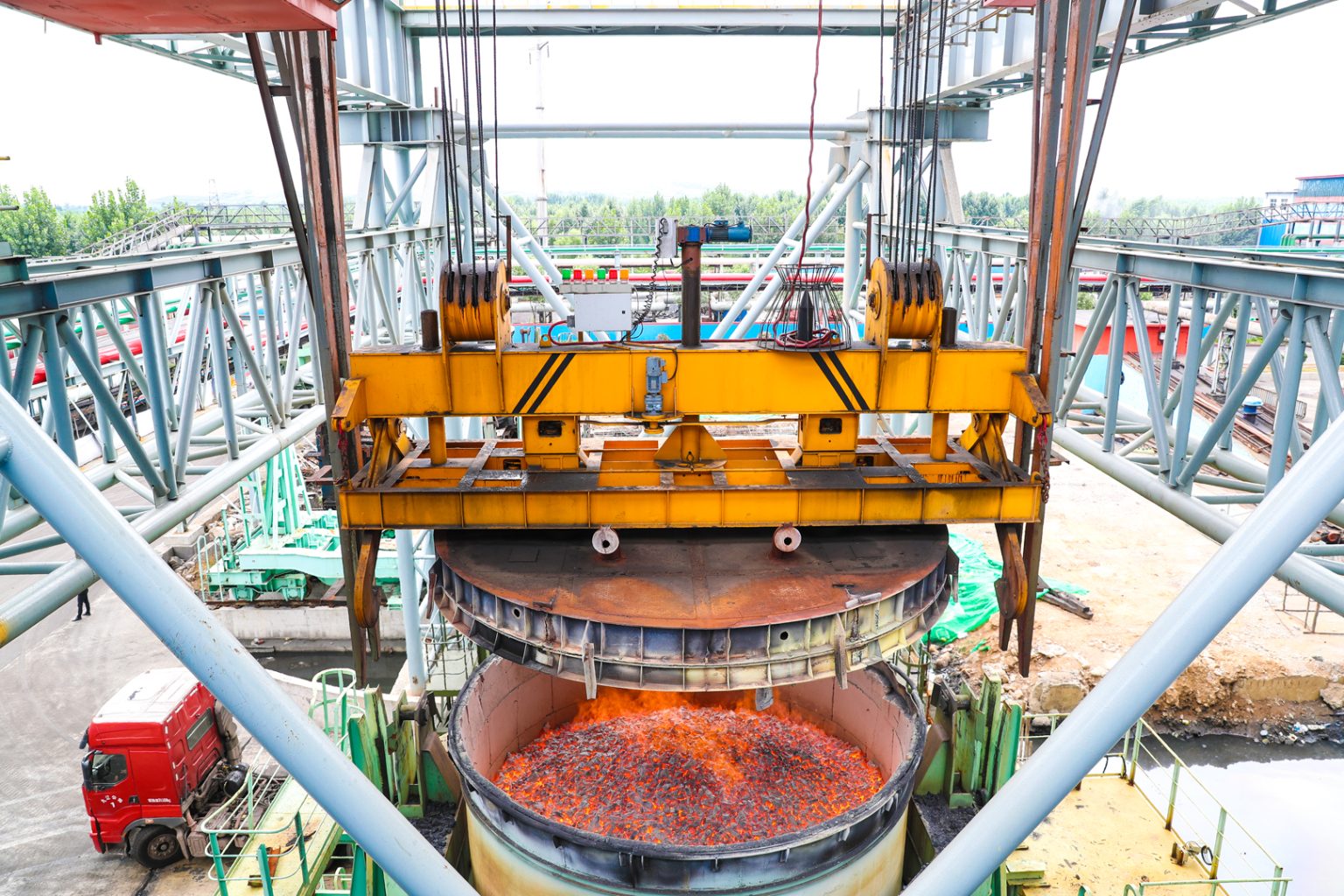
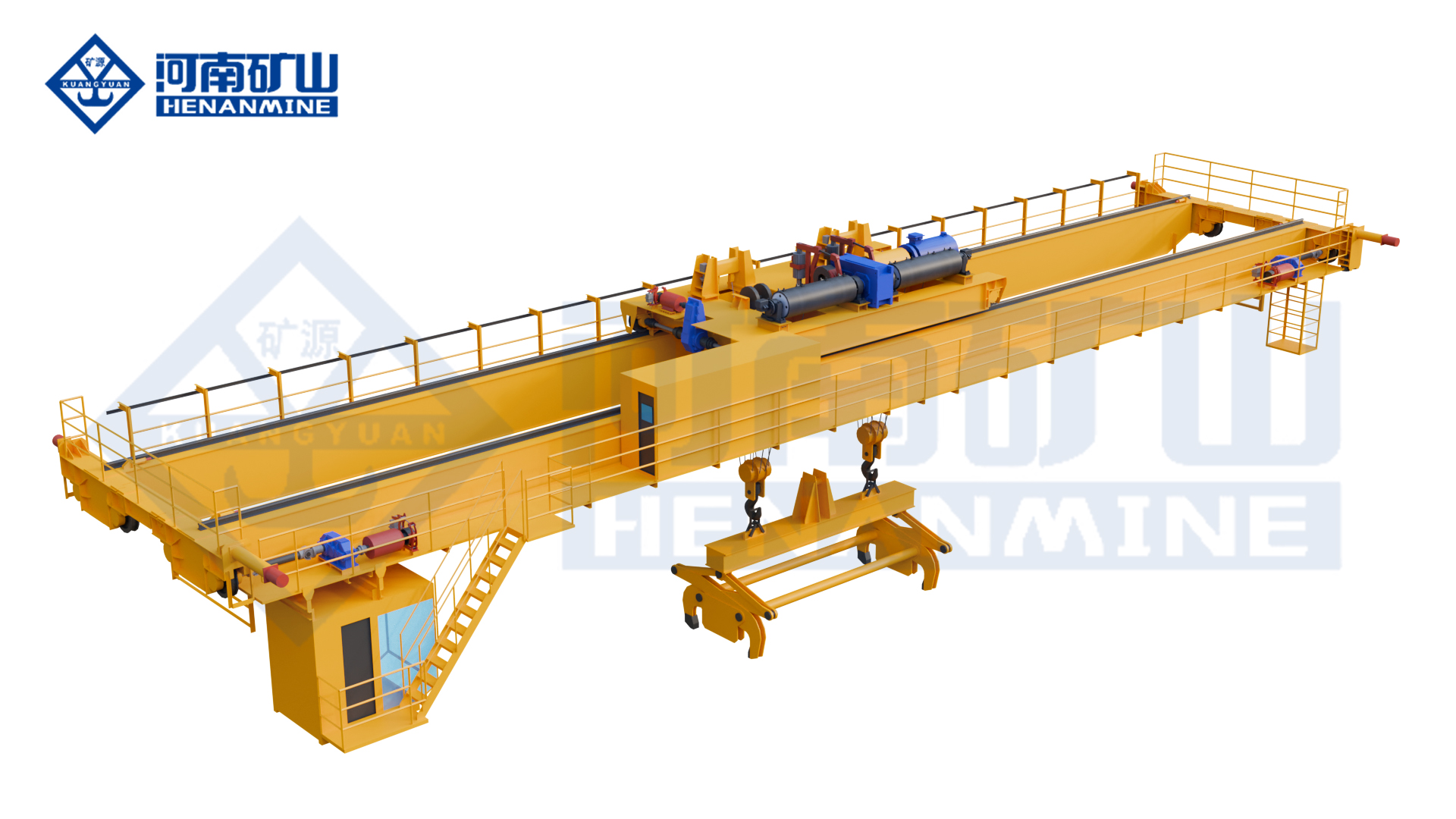
Casting crane (casting crane), the industry is also often called ladle crane (ladle crane), is designed specifically for steel mills molten metal lifting heavy-duty overhead cranes. The biggest difference between it and ordinary cranes is that all the components are tailored around the “safe lifting of molten metal”, there is no unnecessary design, every detail is designed to cope with high temperature, high-risk working conditions.
I have been involved in many large-scale steel projects in Henan Mine Crane, and the casting cranes we produce, from design to production, strictly follow the special requirements of molten metal lifting. It is not like ordinary cranes as the pursuit of universal, but precisely focus on the core task of ladle transfer, error tolerance rate is almost zero.
Simply put, casting crane is “specialized in dangerous work” equipment, as long as it involves the lifting of molten metal ladle, it is the first choice, which is also the most essential difference between it and general metallurgical cranes.
Typical Applications
Casting crane application scenes are very focused, mainly around the molten metal treatment of steel mills, each scene has very high requirements for the safety and stability of the equipment.
The core application is the steel transfer in the steelmaking workshop of the converter (BOF) and electric furnace (EAF). From the converter out of steel, the steel will be lifted to the refining furnace, and then transferred to the continuous casting machine, the whole process needs casting cranes to complete. During this process, the temperature of the ladle is extremely high, and there can not be the slightest shaking during the lifting process, otherwise the molten steel will be easily spilled, causing safety accidents.
In the continuous casting production line, the casting crane also has to cooperate with the steel casting operation, the ladle will be accurately positioned to the continuous casting machine above the crystallizer, injecting steel at a uniform speed, to ensure the production quality of slabs and billets. In addition, it will also be used for steel slag, slag transfer, as well as ladle maintenance, storage and other auxiliary operations.
Whether it is 24-hour continuous production in large steel mills or batch production in small and medium-sized steel mills, casting cranes are indispensable as long as there is a need for molten metal ladle transportation.
Core Characteristics
The core features of casting cranes are all designed to adapt to the high-risk working conditions of molten metal lifting, and each feature is indispensable, which is also the key to distinguish it from ordinary metallurgical cranes.
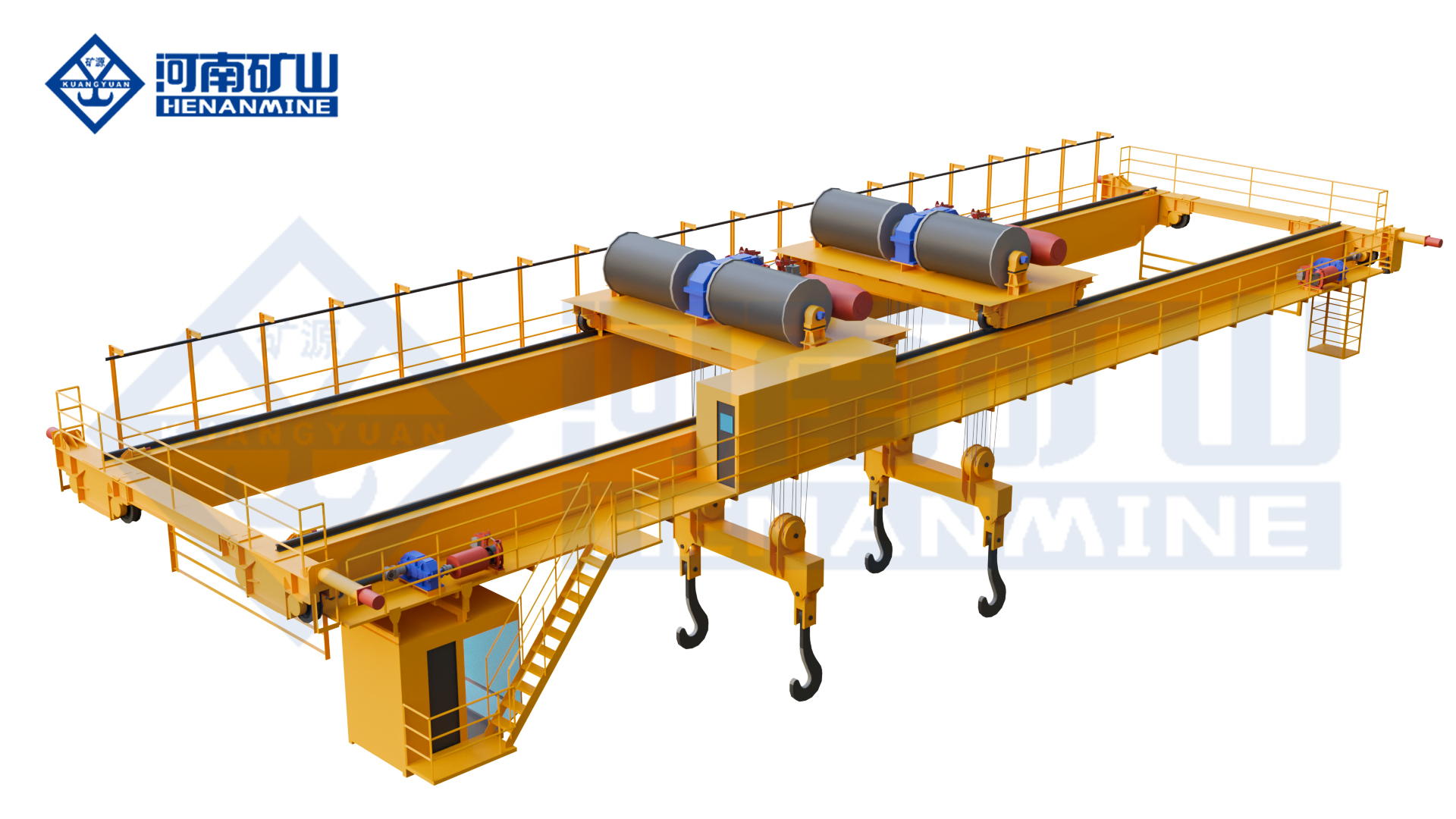
It adopts double girder design with strong rigidity, which can effectively reduce the deflection of the main girder during the lifting process and avoid the shaking of the ladle. Henan Mine Crane produces casting cranes, the main girder adopts heavy-duty welding process and selects high-strength steel, even if it is operated under full load for a long period of time, there will be no obvious deformation.
Dual braking system is a necessary configuration, a set of mechanical braking, a set of electromagnetic braking, both independent of each other. Even if one of them fails, the other one can brake the equipment in time to ensure that the ladle will not fall, which is also a mandatory requirement for molten metal lifting cranes in the T/SXJP 001-2022 standard.
The working class must reach FEM A7-A8, ISO M7-M8 or CMAA Class E-F, which can withstand high frequency and high load continuous operation. At the same time, it is also equipped with a complete heat protection system to block the high temperature radiation of steel and splash slag to protect the equipment components from damage.
What Is a Metallurgical Crane?
Definition
Metallurgical crane (metallurgical crane) is a broader category, which covers all cranes used in the metallurgical industry, not limited to molten metal lifting. Simply put, as long as the steel mills, non-ferrous metal smelters and other metallurgical scenes used in the crane, are metallurgical cranes.
This category contains many models, in addition to the casting cranes we just mentioned, there are also charging cranes, de- ingotting cranes, slab handling cranes and so on. The use of different models varies greatly, and the design standards are also different.
I often tell customers, metallurgical cranes are like the metallurgical industry, “equipment family”, casting cranes are only members of the family is responsible for “the most dangerous tasks”, other members are responsible for different auxiliary operations.
Application Scope
Metallurgical cranes have a very wide range of applications, covering the whole process of metallurgical production, from raw materials to the finished product out of the warehouse, almost every link can see its figure.
In addition to molten metal lifting, it is also used for scrap charging operations, lifting scrap to the converter, electric furnace, to ensure the supply of smelting raw materials; in the slab, billet production is completed, used for slab, billet handling, stacking; can also be used for maintenance of the furnace, equipment maintenance and other auxiliary operations.
For example, charging cranes, mainly used to add scrap, ore and other raw materials to the furnace, do not need to withstand high-temperature radiation, the requirements for heat protection is very low; slab handling cranes, mainly handling cooled slabs, the risk level is much lower than the molten metal lifting, the design standard is also relatively loose.
Metallurgical cranes for different purposes have very different designs, specifications and safety configurations, and the core is to adapt to their respective operating scenarios and risk levels.
Key Distinction
Here is a key point that must be made clear to everyone, but also many customers are most likely to be confused: all casting cranes are metallurgical cranes, but not all metallurgical cranes are casting cranes.
A simple understanding is that casting cranes are a “subset” of metallurgical cranes, which belong to metallurgical cranes, but because of the special purpose, there are higher design standards and safety requirements. Other metallurgical cranes, such as slab handling cranes, charging cranes, although also used in the metallurgical industry, but can not be used for molten metal lifting.
For example, like cars and buggies, buggies belong to the car, but not all cars are buggies, buggies can cope with complex road conditions, while ordinary cars can not. Casting cranes are equivalent to “off-road vehicles”, which can cope with the high-risk conditions of molten metal lifting, while ordinary metallurgical cranes are equivalent to “ordinary cars”, which can only cope with conventional metallurgical operations.
Technical Comparison: Casting Crane vs Metallurgical Crane
It's not enough to talk about the concept, I combined with Henan Mine Crane's production experience and actual project cases, from the five core dimensions, to give you a detailed technical comparison, to help you more intuitively see the difference between the two, but also a better understanding of the core points of the molten metal crane comparison.
1. Application Focus
The application focus of the two is very different, one focuses on high-risk molten metal lifting, and the other covers a wider range of metallurgical operations, the specific comparison is as follows:
| Factor | Casting Crane | Metallurgical Crane |
| Primary Use | Molten metal ladle transport | Broader metallurgical tasks |
| Risk Level | Extremely high | Medium to high |
| Operational Criticality | Mission-critical | Varies by function |
Casting cranes have only one core use: the lifting and transferring of molten metal ladles, with a very high risk level, which may lead to catastrophic accidents in case of failure, and belong to the core key equipment of steel mills.
Metallurgical cranes, on the other hand, have a wide range of uses, and the risk level ranges from medium to high. For example, the risk of slab handling is low, the risk of charging operations is medium, only the metallurgical cranes involved in molten metal lifting (that is, casting cranes), the risk level is extremely high.
Its importance also varies according to the use, casting cranes are the “lifeline” of steel production, once the shutdown, the entire smelting production line will come to a standstill; and ordinary metallurgical crane shutdown, will only affect the local operation, will not lead to the whole plant shutdown.
2. Duty Classification
Duty Classification directly determines the fatigue life and design strength of the crane, and is the key parameter most easily ignored when selecting the type, especially in the molten metal lifting scenario.
The duty class of casting cranes is very demanding and must reach FEM A7-A8, ISO M7-M8 or CMAA Class E-F. This is because it needs to withstand high frequency for a long time. This is because it needs to withstand high-frequency, high-load continuous operation for a long time, such as the converter shop of a large steel mill, which has to complete dozens of times of steel lifting every day, and the fatigue strength of the equipment is extremely high.
Henan Mine Crane produces casting cranes, all of which are designed according to the FEM A8 level standard, and can withstand 24-hour continuous operation to avoid premature structural fatigue and component wear of the equipment.
The working level of ordinary metallurgical cranes varies according to the use, ranging from A5 to A8. For example, slab handling cranes, operating frequency is low, the working level is usually in the A5-A6 level; charging crane operating frequency is medium, the working level in the A6-A7 level.
The lower the working level, the lower the design strength and fatigue life of the equipment. If an ordinary metallurgical crane of class A5 is used to transport molten metal, wear and tear of the gear box and deformation of the main girder will occur within a few years, which will not only result in high maintenance costs, but also pose hidden safety risks.
3. Safety and Redundancy
Safety and redundancy is the core requirement of molten metal transportation, which is also one of the core differences between casting cranes and ordinary metallurgical cranes.
Casting cranes must be equipped with a complete safety redundancy system, which is a mandatory requirement and cannot be omitted. Dual independent braking system is the foundation, two sets of brakes are independent of each other, even if one set of failure, the other set can brake the equipment in time to ensure the safety of the ladle.
At the same time, also need to be equipped with redundant lifting mechanism, such as dual motor, dual gear box, even if one of the set of failure, the equipment can continue to run, to avoid downtime affect production. Emergency safety descent system is also indispensable, in the case of sudden power failure, brake failure, can be ladle smoothly descending to a safe position, to avoid the expansion of the accident.
As for ordinary metallurgical cranes, complete safety redundancy is not necessarily required according to the operational risk level. For example, slab handling cranes, low risk, usually only need a set of braking system, do not need redundant hoisting mechanism, can also meet the safety requirements.
4. Heat Protection Level
High temperatures are a central feature of molten metal lifting scenarios, so the heat protection level is also an important difference between the two, compared as follows:
| Feature | Casting Crane | Other Metallurgical Cranes |
| Heat shielding | Essential | Application dependent |
| Insulated electrical cabinet | Required | Optional in some cases |
| High-temp cable protection | Mandatory | Depends on environment |
Heat protection is a must for casting cranes and cannot be compromised. The heat-resistant shield will be installed under the main beam to block the high temperature of steel splashing and slag erosion; the electrical control cabinet will be insulated and equipped with a cooling device to avoid high temperatures leading to the aging and failure of electrical components.
The cables are made of high temperature resistant special cables, which can work stably for a long time under the high temperature environment of more than 150℃, and at the same time, the cables are well protected to avoid being damaged by slag and dust. All these configurations are to ensure that the equipment can operate stably for a long time in a high temperature environment.
The heat-resistant protection of ordinary metallurgical cranes depends on the operating environment. If it is working in high-temperature areas, such as charging cranes close to the furnace, it will be equipped with basic heat protection; if it is working in room temperature areas, such as handling cranes in slab warehouses, there is no need for specialized heat protection, and ordinary cables and electrical components can meet the needs.
5. Structural Design
The structural design of the two, are to adapt to their respective operational needs, the difference is mainly reflected in the structural strength and design focus.
The casting crane adopts a heavy-duty double girder box structure, which is extremely rigid and can effectively control the deflection of the main girder to avoid shaking when lifting ladles. Core components are made of materials with high safety coefficients, for example, the main girder is made of high-strength steel of Q355B and above grade, and key parts are made of alloy steel to enhance fatigue and high-temperature resistance.
Henan Mine Crane will also optimize the span of the main beam and the height of the outriggers according to the layout of the customer's workshop to ensure that the equipment can be perfectly adapted to the workshop space and avoid interfering with the converter, continuous casting machine and other equipment.
The structural design of ordinary metallurgical cranes varies according to the purpose. For example, slab handling cranes do not need to withstand high temperatures and large loads, so the structure is relatively lightweight; charging cranes need to frequently lift bins, so the structural design pays more attention to flexibility and accuracy.
Risk Analysis - Which Crane Is Safer for Molten Metal?
After talking about the technical comparison, let's talk about the most critical question: which crane is safer for molten metal? The answer is clear: casting cranes, no exceptions.
Failure Consequences
Molten metal lifting, once the equipment failure, the consequences are unimaginable. The most serious is steel leakage. Thousands of degrees Celsius of steel spilled in the workshop can burn the equipment, melt the ground, cause fires, and even jeopardize the lives of the operators.
In addition, equipment failure will also lead to a complete shutdown of the steel plant. Impact on the normal production and operation of the enterprise.
I have seen many cases in the industry, the customer in order to save costs, with ordinary metallurgical cranes lifting steel, and ultimately because of the failure of the braking system, heat protection is not enough, resulting in steel leakage, not only caused huge economic losses, but also almost caused safety accidents, it is not worth the loss.
Why Casting Cranes Are Typically Recommended
The core reason why casting cranes are the first choice for molten metal lifting is that they are “tailor-made” for this high-risk scenario, and every aspect of their design is centered around safety.
Its safety redundancy system minimizes single-point failures, and even if one component fails, the redundant configuration ensures safe operation of the equipment and prevents accidents from occurring. Dual braking, redundant lifting, emergency lowering and other configurations are all designed to cope with the unexpected situation of molten metal lifting.
At the same time, its heat-resistant protection and structural strength can meet the requirements of high-temperature, high-load operations, and long-term operation can also maintain stability and reduce the probability of failure. Moreover, the design and production of casting cranes strictly follow the relevant standards for molten metal lifting, which can meet the safety compliance requirements and avoid being penalized by the regulatory authorities.
Simply put, using casting cranes to lift molten metal is to use professional equipment to do professional things, which can minimize safety risks and protect personnel and equipment safety.
Lifecycle Cost Comparison
Many customers in the selection of models, will be entangled in cost issues: casting crane upfront cost than ordinary metallurgical cranes, is not cost-effective? In fact, the selection of equipment can not only look at the initial investment, but also look at the long-term life cycle costs, to calculate the “total account”.
Initial Investment
From the initial investment point of view, casting crane costs are indeed higher. Because of its higher design standards, need to be equipped with double braking, redundant lifting, heat protection and other special configurations, the choice of materials and components are also higher quality, manufacturing costs are naturally higher.
General metallurgical cranes have a lower initial investment, especially models not involving molten metal lifting, do not require special safety and heat-resistant configurations, the structure is relatively simple, the cost is also lower.
But here to remind you, do not choose ordinary metallurgical cranes to lift molten metal because of the low initial investment. It may seem to save money, but the later risk costs and maintenance costs, will far exceed the initial savings.
Operational Risk Cost
Operational risk cost is a part that many customers tend to ignore, but also the biggest difference between the two.
If an ordinary metallurgical crane is used to transport molten metal, once a failure occurs, it will not only lead to downtime losses, but also may lead to safety accidents, incurring high compensation for accidents, equipment maintenance costs, and even affect the credibility of the enterprise. At the same time, it may also face penalties from regulatory authorities, adding additional costs.
As for casting cranes, although the initial investment is high, the safety redundancy and heat protection are perfect, and the failure rate is low, which can effectively reduce the downtime loss and the risk of safety accidents. Moreover, it has a longer service life and lower maintenance costs, effectively controlling operating costs in the long run.
In addition, the insurance rate of the insurance company for molten metal lifting equipment will be based on the safety level of the equipment. Casting cranes with high safety ratings have lower insurance rates, which can further reduce the operating costs of the enterprise.
Long-Term ROI
From the perspective of long-term return on investment (ROI), casting cranes have very obvious advantages. Investment in a standard casting crane, although the initial investment is high, but can effectively reduce the frequency of maintenance, to avoid accidental failures and safety incidents, to extend the service life of the equipment.
Henan Mine Crane casting cranes, in the case of standardized maintenance, the service life can reach 20-30 years, while ordinary metallurgical cranes, if used for molten metal lifting, the service life is usually only 10-15 years, and the maintenance frequency is extremely high, and the annual maintenance costs are also very high.
For steel mills, stable production is the core, casting cranes can maximize production continuity and reduce downtime losses, which is the core reason for its higher long-term ROI.
Standards and Compliance Considerations
Lifting molten metal requires not only choosing the right equipment, but also complying with relevant industry standards and local regulations, otherwise you will not be able to pass acceptance and may face safety regulatory penalties. Especially for export projects, standards and compliance are of paramount importance.
FEM Standards
FEM (Federation of European Material Handling) standards, is the global metallurgical crane industry's common standards, but also the core basis for the design and production of casting cranes. Among them, FEM A7-A8 class is the common working level of casting cranes, which clearly specifies the fatigue design, structural strength and safety requirements of the equipment.
FEM standards for casting cranes have clear requirements for safety redundancy, heat protection, structural design, to ensure that the equipment can be used in high-frequency, high-load working conditions for long-term stable operation. Henan Mine Crane's casting cranes are all designed and produced according to the FEM standard to ensure that they meet the international general requirements.
ISO 4301 & Related Standards
Among the ISO standards, ISO 4301 mainly regulates the classification of the crane's working level, and specifies the equipment design requirements corresponding to different working levels; ISO 9927 specifies the inspection requirements for cranes, and specifies the inspection standards for the equipment after leaving the factory and installation to ensure the safety and reliability of the equipment.
For projects exported to Europe, Southeast Asia and other regions, they must comply with ISO standards, otherwise they cannot pass the local safety acceptance. Henan Mine Crane will customize the equipment to meet the local ISO standard according to the export destination of the customer and provide the corresponding certification documents.
CMAA Heavy-Duty Classifications
CMAA (Crane Manufacturers Association of America) standards, mainly applicable to crane projects in North America, of which CMAA Class E-F, corresponding to the high working level requirements of casting cranes, regulating the design, manufacture and inspection of heavy-duty cranes.
If the customer's project is exported to North America, the specification of the casting crane must comply with the CMAA standard, especially the working level, braking system, safety protection, etc., to ensure that the equipment can be adapted to the regulatory requirements in North America.
Local Molten Metal Safety Regulations
Metallurgical safety regulations in different countries and regions have different requirements for molten metal lifting cranes. For example, China's T/SXJP 001-2022 group standard clearly stipulates that cranes lifting heavy tanks of molten metal must be equipped with double independent braking, redundant lifting and other safety features.
The European Union's CE certification requires that equipment must pass strict safety performance tests before being put into use; the U.S. OSHA standards, also on the molten metal lifting equipment, safety redundancy, heat protection has clear requirements.
Molten metal lifting is a high-risk operation, so regulations in almost all countries and regions require that this type of equipment meets the highest safety and operating levels, in order to maximize operational safety and avoid accidents.
When Should You Choose a Casting Crane?
Combined with Henan Mine Crane's project experience, as long as any of the following conditions are met, you must choose a casting crane, and can not be replaced by an ordinary metallurgical crane.
If your operation is specialized in molten metal ladle lifting, whether it is a converter out of steel, refining furnace feed, or continuous casting machine casting, you must choose a casting crane. These types of operations are extremely risky, and only the safety redundancy and heat protection of a foundry crane can meet the demand.
If your workshop is a continuous high-temperature operating environment, such as a converter or electric furnace workshop, where the equipment needs to run continuously 24 hours a day with high-frequency lifting of ladles, you must also choose a casting crane. With its FEM A7-A8 working class, it can withstand the intensity of high-frequency and high-load operation to avoid premature equipment damage.
For large steel production lines, or high-capacity ladle systems (e.g., ladles with a lifting capacity of 50t or more), casting cranes must also be chosen. This type of scene on the stability of the equipment, safety requirements are extremely high, casting cranes can be better adapted to protect the production of continuous operation.
When Is a General Metallurgical Crane Sufficient?
Not all metallurgical scenarios require casting cranes, as long as it does not involve molten metal lifting, a general metallurgical crane is sufficient and can save costs.
If your operation is scrap charging, such as lifting scrap into converters and electric furnaces, and you do not need to be exposed to high-temperature radiation and the risk of molten metal, choosing an ordinary charging crane (which is a metallurgical crane) will be fine, and you do not need to be equipped with additional heat-resistant protection and redundant safety systems.
In the handling and stacking scenarios of slabs and billets, such as the handling operations in the slab warehouse, the temperature of the cooled slabs is low and the risk level is low, the choice of slab handling cranes (belonging to the metallurgical cranes) will be sufficient, with a lightweight structure, lower cost, and also meet the operational requirements.
Workshop equipment maintenance, furnace overhaul and other auxiliary operations, also do not need casting cranes. Ordinary metallurgical maintenance cranes can meet the needs of small parts, maintenance tools lifting, more cost-effective.
There are also some low-risk material transfer, such as metallurgical raw materials, finished product handling, as long as it does not involve high temperature, high-risk, ordinary metallurgical cranes can meet the demand, there is no need to spend a high price to choose casting cranes.
Common Buyer Mistakes
Combined with so many years of industry experience, I summarized the most common 4 misunderstandings in the selection of customers, many customers have stepped on these pits, I hope you can avoid.
The most common misconception is that all metallurgical cranes are suitable for molten metal lifting. Many customers see the name “metallurgical crane”, think it can be used in all metallurgical scenarios, including molten metal lifting, and as a result, they can not pass the acceptance after buying back, or frequent failures, and can only be re-procured, wasting time and costs.
Underestimating the working level requirements is also a common problem for many customers. Some customers only look at the lifting capacity, ignoring the working level, selected A5-A6 level of ordinary metallurgical cranes lifting steel, the result is that the equipment frequently structural fatigue, wear and tear of components, high maintenance costs, and even potential safety hazards.
Neglect the safety redundancy requirements, in order to save costs, omit the double braking, redundant lifting and other configurations, it seems to save money, but actually buried a serious safety hazard. Once there is a failure, the consequences are unimaginable, and the cost of rectification in the later stage is far more than the money saved in the first place.
Only look at the initial price, ignoring the long-term life cycle costs, is also undesirable. Low-priced ordinary metallurgical cranes, although the initial investment is low, but the later failure, high maintenance costs, downtime losses, but in the long run, more expensive than casting cranes.
Decision-Making Checklist
In order to facilitate your quick judgment, I have compiled a decision-making checklist, against the check, you can quickly determine whether you need to choose casting cranes or ordinary metallurgical cranes, to avoid selection errors.
- Do you need to lift molten metal ladles? If so, choose a casting crane directly; if not, consider a general metallurgical crane.
- What working level does your operation need to reach? If you need 24-hour continuous high-frequency operation, you need to choose FEM A7-A8 class, and give priority to casting cranes.
- Are safety redundancy systems required by local regulations? If molten metal is to be lifted, it is usually required and cast cranes are preferred.
- What is the ambient temperature of the operating environment? If the ambient temperature is high (near furnaces, molten steel), choose a foundry crane with complete heat protection.
- What standards does your operation need to meet? If it is an export project, you need to confirm the requirements of FEM, ISO, CMAA and other standards, casting cranes are more likely to meet the high standards.
Frequently Asked Questions
Q1: Is a casting crane the same as a metallurgical crane?
No, it is not. A casting crane is a type of metallurgical crane, but it is a special type dedicated to molten metal lifting. All casting cranes are metallurgical cranes, but not all metallurgical cranes can be used for molten metal transportation, most of the ordinary metallurgical cranes can only be used for low-risk metallurgical operations.
Q2: Can a standard metallurgical crane lift molten metal?
Only if it meets all the requirements for molten metal lifting. Specifically, it must be of FEM class A7-A8 operating level, equipped with double independent brakes, redundant lifting, complete heat protection, etc., as well as complying with local safety regulations and industry standards. Otherwise, ordinary metallurgical cranes should never be used to transport molten metal.
Q3: Why is dual braking important for casting cranes?
Because molten metal lifting is extremely risky, and if the braking system fails, a falling ladle can cause a catastrophic accident. Dual independent braking system ensures that in case of failure of one set of brakes, the other set can stop the equipment in time, locking the ladle firmly and avoiding accidents, which is a mandatory safety requirement for molten metal lifting.
Q4: Which is more expensive?
The initial investment in a casting crane is usually higher because it has higher design standards and special configurations. However, in the long run, it has a higher long-term ROI due to lower maintenance costs, longer service life, lower failure rates, and reduced downtime losses and safety risks. Common metallurgical cranes have low initial investment, but if used for molten metal lifting, the cost will increase significantly in the later stage.
Q5: How long do casting cranes last?
Under the premise of standardized maintenance, the service life of casting cranes usually reaches 20-30 years. Henan Mine Crane casting cranes are made of high-strength steel and high-quality components, coupled with scientific structural design, as long as the regular maintenance is done, they can operate stably for a long time, saving the cost of replacing the equipment for the steel mills.
Conclusion
Talking about this, I believe you are already clear about the difference between casting cranes and metallurgical cranes, and also know how to choose to lift molten metal.
The core conclusion is very simple: casting cranes are “tailor-made” special equipment for molten metal lifting, metallurgical cranes are a broad category covering all metallurgical scenarios, suitable for low-risk routine operations, can not replace the casting crane for molten metal lifting.
Henan Mine Crane Factory Custom
Henan Mine Crane has been focusing on the design, production and service of heavy metallurgical cranes for more than 20 years, and has participated in the projects of many large-scale steel mills at home and abroad, and has accumulated rich experience in selection and operation. We will accurately recommend the right equipment for you according to your operational scenarios, risk level, and compliance requirements, and help you avoid selection mistakes, not only to ensure safety and compliance, but also to control long-term operating costs.
Choosing a suitable crane is not only a purchase investment, but also an investment in the production safety and long-term development of the enterprise. Only by choosing the right equipment can we make production smoother and safer and realize higher long-term returns.