
STS Crane vs RTG Crane: Which is Better for Container Handling?
Global container trade keeps growing, and every terminal expansion project runs into the same bottleneck: equipment selection. Container handling efficiency is no longer a back-office concern, it directly determines whether a port wins premium vessel calls or loses them to a faster competitor down the coast.
Two machines sit at the center of that equation, the STS crane and the RTG crane . Together they form the backbone of the full container flow chain, vessel unloading, yard stacking, and truck or rail dispatch. Get the balance wrong, and the consequences show up fast: berth congestion, inflated operating costs, and falling productivity per crane hour.
This guide breaks down STS crane vs RTG crane in full technical, operational, and financial detail, and gives terminal planners a practical framework for choosing, and combining, the right container handling equipment.
Overview of Container Handling Systems in Modern Ports
The Full Container Flow, Step by Step
A container's journey through a terminal follows a consistent sequence: ship → STS crane → yard transfer → RTG crane → truck or rail. Each handoff point is a potential bottleneck, which is why equipment selection at every stage matters as much as the individual machine's specifications.
Key Equipment Categories
- Quay cranes (STS):vessel-to-shore transfer
- Yard cranes (RTG, RMG):container stacking and storage
- Straddle carriers:short-distance direct transfer
- Reach stackers:flexible, lower-volume yard handling
Why STS and RTG Dominate Global Ports
STS and RTG cranes remain the default combination at container terminals worldwide because they deliver the highest efficiency for the lowest operational complexity, scale cleanly from mid-size to mega terminals, and integrate readily with modern automation and terminal operating systems (TOS).
What Is a Ship-to-Shore (STS) Crane?
Definition and Role
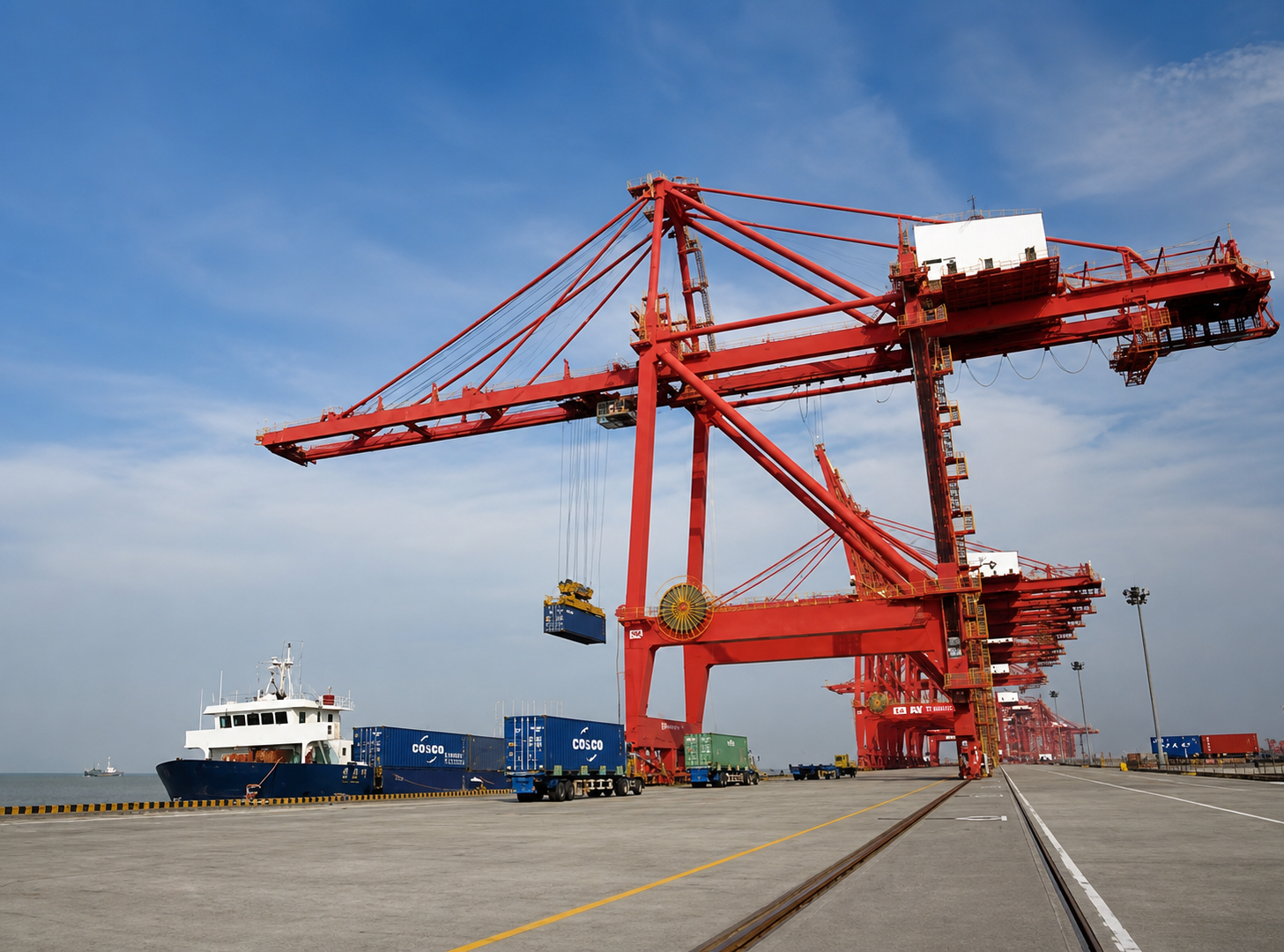
Henan Mine Crane manufactured STS crane is a large, quay-mounted gantry crane purpose-built to transfer containers between a vessel and the terminal. It is the single piece of equipment that determines how fast a ship can be turned around — and therefore how much revenue a berth can generate per day.
Structural System
The STS crane's structure consists of:
- A steel portal frameanchored to the quay
- A long outreach boom, extending up to 70+ meters over the vessel
- A trolley systemthat travels horizontally along the boom
- A hoist systemthat raises and lowers the spreader
- A spreader with automatic twist-lock mechanismthat grips the container's corner castings
Typical Technical Specifications
| Specification | Typical Range |
| Lifting capacity | 40–100 tons (up to 200 tons for tandem/heavy-lift models) |
| Outreach | 30–70 meters |
| Rail gauge | 10–30 meters |
| Lifting height | 20–50 meters |
Types of STS Cranes
STS cranes are classified by the vessel size they're built to service:
- Panamax:fits the original Panama Canal locks
- Post-Panamax:wider reach for larger vessels
- Super Post-Panamax:built for ultra-large container ships (ULCS)
- Megamax:the largest class, servicing 24,000+ TEU vessels
The STS Automation Trend
Modern STS cranes increasingly rely on semi-automated operation, remote-control cabins located away from the crane itself, and AI-assisted vessel loading optimization that sequences lifts to minimize cycle time and avoid stack collisions.
Twin-Lift and Tandem-Lift Spreaders
One of the most significant productivity upgrades in recent STS crane generations is the shift toward twin-lift and tandem-lift spreaders, which can grip and move two 20-foot containers simultaneously instead of one at a time. On paper, this doubles theoretical lift capacity per cycle, though realized gains depend heavily on vessel bay layout, container mix, and how well the yard-side equipment can keep pace with the faster unloading rate. This is a recurring theme in crane selection: a faster STS crane only improves overall terminal performance if the rest of the chain, especially the RTG fleet, can absorb the extra volume.
What Is a Rubber-Tired Gantry Crane (RTG)? Full System Analysis
Definition and Working Principle
Henan Mine Crane manufactured RTG crane is a mobile gantry crane mounted on rubber tires, purpose-built for stacking and retrieving containers inside the storage yard. Unlike the STS crane, it never touches the vessel, its entire job happens on land, between the yard block and the trucks or rail cars that move containers in and out of the terminal.
Core Components
- Gantry framespanning the width of a yard block
- Rubber tire travel systemfor omnidirectional movement between blocks
- Hoisting trolleyfor vertical lift and stacking
- Power system— diesel, hybrid, or fully electric
- Spreader system, typically adjustable between 20-foot and 40-foot containers
Typical Specifications
| Specification | Typical Range |
| Lifting capacity | 30–65 tons |
| Stack height | 1-over-5, 1-over-6, or 1-over-7 |
| Span | 18–30 meters |
| Travel speed | 100–200 m/min |
RTG Power Systems Evolution
RTG power sources have shifted significantly over the past decade:
- Diesel RTG:the traditional standard, now being phased out at many ports
- Electric cable-powered RTG:connected to a fixed power grid, zero local emissions
- Hybrid RTG:currently the most widely deployed configuration, balancing flexibility and efficiency
- Fully electric RTG (e-RTG):the leading edge of the green port trend, cutting fuel costs sharply and eliminating exhaust emissions entirely
Why Fleet Size Matters More Than Individual Crane Specs
Because a single RTG only manages one yard block at a time, terminal yard capacity is really a function of fleet size and block layout, not any one crane's specifications. This is a key operational difference from STS cranes, where a small number of very large machines carry the entire vessel-side workload. Planners sizing an RTG fleet need to think in terms of blocks-per-hour throughput and tractor-trailer turnaround time, not just individual crane lift capacity.
STS Crane vs RTG Crane — Functional Role Difference in Container Flow
STS Crane Role
Henan Mine Crane manufactured STS crane handles vessel loading and unloading, operating as the direct interface between ship and shore. Because vessel time at berth is the terminal's most expensive resource, the STS crane runs under constant pressure to hit high-speed cycle targets.
RTG Crane Role
Henan Mine Crane manufactured RTG crane handles yard stacking, storage optimization, and container sorting and retrieval. It functions as the buffer between the fast-paced vessel operation and the comparatively slower, more variable landside logistics of trucks and rail.
Key Insight
STS and RTG cranes aren't competing solutions, they're sequential links in the same chain:
- STS = the ocean interface machine
- RTG = the landside logistics optimizer
Asking "which is better" is really asking two different questions about two different jobs. A terminal doesn't choose one over the other; it decides how much capacity to deploy in each role.
Engineering and Structural Differences
Foundation and Installation
The STS crane requires a fixed rail system on a deep quay foundation engineered to handle enormous static and dynamic loads at the waterside edge. The RTG crane, by contrast, operates on a ground-based, flexible yard surface with no comparable foundation demands, which makes it far cheaper and faster to deploy or relocate.
Mobility System
Henan Mine Crane Factory supply STS cranes move in a single dimension, linear rail-mounted travel along the quay. RTG cranes move in multiple dimensions, offering rubber-tire omnidirectional mobility across yard blocks, which is what makes them adaptable to changing yard layouts.
Structural Load Characteristics
STS cranes are engineered around extreme wind-load resistance, since their tall, exposed boom structure is highly vulnerable to storm conditions at the waterfront. RTG cranes are engineered around dynamic load balancing, since they're constantly in motion across uneven yard surfaces while carrying heavy loads.
Durability Requirements
STS cranes require marine corrosion protection for steel components exposed to salt air. RTG cranes require tire and chassis fatigue resistance, since tires and axles absorb continuous mechanical stress from yard travel.
Operational Efficiency Comparison
Cycle Time Performance
Advanced STS cranes typically achieve 25–40 gross moves per hour (GMPH), with the most modern tandem-lift systems pushing beyond that range. RTG cranes don't have a directly comparable metric, their contribution is measured as support cycle efficiency, since their throughput depends on how quickly trucks and rail assets can move containers in and out of the yard.
Container Throughput Capacity
- STS crane performance determines berth productivity:the primary metric port authorities use to price and prioritize vessel calls.
- RTG crane performance determines yard bottleneck elimination:how quickly the yard can absorb inbound containers and release outbound ones without stalling.
Port Congestion Impact
The two machines fail differently, and the consequences aren't symmetrical:
- An STS bottleneck causes vessel delay, which is immediately visible and costly,ships pay demurrage, and shipping lines reroute future calls.
- An RTG bottleneck causes yard congestion, which is often less visible in the short term but compounds into gate delays and truck queuing over time.
Coordination Efficiency
A high-performing STS crane that regularly waits on yard transport vehicles is effectively operating at the yard's speed, not its own rated capacity. Closing that gap is usually a scheduling and equipment-allocation problem rather than a hardware problem, which is one reason TOS investment often delivers faster returns than incremental crane purchases.
Cost Comparison — CAPEX vs OPEX Breakdown
Initial Investment
Henan Mine Crane Factory supply STS cranes represent an extremely high capital investment, combining the crane's own cost with the quay infrastructure, rail systems, and deep foundation work required to support it. RTG cranes require moderate, scalable investment, terminals can add units incrementally as yard volume grows, without major civil works.
Operating Cost
- RTG operating costis driven primarily by fuel or electricity consumption, which varies significantly depending on whether the fleet is diesel, hybrid, or fully electric.
- STS operating costcombines maintenance, skilled labor, and peak-demand energy consumption tied to lifting cycles.
Maintenance Cost Structure
STS maintenance centers on heavy structural systems, cable management, and trolley mechanisms, repairs that often require specialized contractors and extended downtime. RTG maintenance is dominated by tire wear, engine service, and hydraulic system upkeep, which is generally less specialized but more frequent.
Long-Term ROI
STS cranes deliver high ROI at mega ports, where vessel call volume and berth productivity justify the capital outlay. RTG cranes deliver flexible ROI for scalable terminals, where the ability to add capacity incrementally matters more than maximizing any single unit's output.
Total Cost of Ownership Beyond the Purchase Price
Procurement teams often anchor on purchase price alone, but total cost of ownership (TCO) tells a more complete story. An STS crane's lifespan typically spans several decades, which means financing structure, spare-parts availability, and manufacturer support agreements matter as much as the sticker price. For RTG fleets, TCO is more sensitive to power source: a diesel fleet carries ongoing fuel-price exposure that an electrified fleet largely avoids, even though the electrified units usually cost more upfront. Terminals evaluating STS crane vs RTG crane investment should model TCO over a 15–20 year horizon rather than comparing capex figures in isolation.
Productivity Impact on Container Terminal Design
High-Volume Mega Ports
At mega ports, an STS crane fleet becomes mandatory infrastructure, without sufficient quay cranes, berth productivity collapses regardless of yard efficiency. RTG fleets support this by enabling high-density stacking, maximizing storage capacity within a constrained yard footprint.
Medium Ports
Mid-size terminals generally need a balanced STS and RTG system design, sized proportionally to expected vessel calls and cargo dwell time rather than maximized for peak throughput.
Inland Terminals
Inland container depots and dry ports have no vessel interface at all, so RTG cranes dominate, their mobility and lower infrastructure requirements make them the practical default for pure yard and rail operations.
Automation and Smart Port Integration
STS Automation Systems
Automated STS operations now commonly include remote-control operation from centralized control rooms, AI-driven vessel stowage planning, and digital twin quay simulation used to test loading sequences before they run on the real crane.
RTG Automation Evolution
RTG automation has progressed toward automatic stacking (ARTG), GPS-based yard navigation, and increasingly, fully driverless yard operations at leading automated terminals.
Integrated Terminal Systems
None of this automation works in isolation. It depends on:
- TOS (Terminal Operating System)coordinating every equipment movement in real time
- IoT-based crane coordinationsynchronizing STS and RTG schedules
- Real-time container trackingfeeding data back into planning and exception handling
Energy Efficiency and Green Port Development
STS Energy Consumption Profile
STS cranes draw high peak electrical loads during lifting cycles, but many modern units offset this with regenerative braking systems that recover energy during lowering and deceleration.
RTG Green Transformation
Henan Mine Crane Factory supply RTG fleet is where the biggest sustainability shift is happening. Hybrid RTG adoption has become the mainstream transition step, while fully electric RTG systems represent the endpoint most green-port strategies are targeting.
Carbon Reduction Strategies
Terminals pursuing decarbonization typically combine shore power integration for docked vessels, fully electrified yard equipment, and smart energy scheduling that shifts crane power draw to off-peak periods.
Safety Systems Comparison
STS Crane Safety Systems
- Anti-sway controlto stabilize suspended loads during high-speed trolley movement
- Wind-load protection systemsthat limit or halt operations above safe wind thresholds
- Collision avoidance systemspreventing contact with vessel structures or adjacent cranes
RTG Crane Safety Systems
- Anti-collision sensorsbetween RTG units operating in the same yard block
- Tire pressure monitoringto catch mechanical failures before they cause instability
- Automatic braking systemsfor safe stops during yard travel
Advantages and Disadvantages Summary
STS Crane Strengths
STS cranes deliver maximum vessel throughput, are essential for deep-sea port compatibility with the largest container ships, and offer high automation potential as terminals modernize.
STS Crane Limitations
Their core weaknesses are high infrastructure dependency, a fixed rail and quay foundation that can't easily be relocated, and low mobility flexibility once installed.
RTG Crane Strengths
Henan Mine Crane Factory supply RTG cranes offer flexible yard operations, a lower investment barrier than rail-mounted alternatives, and the ability to scale easily as terminal volume grows.
RTG Crane Limitations
Their main constraints are limited lifting height compared to STS cranes and, in non-electrified fleets, ongoing energy dependence on diesel supply and pricing.
Which Is Better? A Decision-Making Framework
Port Type-Based Selection
- Mega hub ports:a full STS and RTG system is non-negotiable
- Regional ports:a balanced deployment of both, sized to actual vessel and yard volume
- Inland logistics centers:RTG-focused, since there's no vessel interface to serve
Cargo Volume Factor
Terminals with high throughput should prioritize STS crane capacity, since berth productivity is the binding constraint. Terminals with medium throughput get more value from optimizing RTG yard efficiency first, since yard congestion is more likely to be the actual bottleneck.
Budget Constraints
A high budget supports a fully automated STS and RTG system built for maximum long-term efficiency. A medium budget points toward a hybrid deployment — selective automation on the highest-impact equipment, with conventional operation elsewhere.
Future Expansion Planning
Whichever configuration a terminal chooses, scalability and modular design should be built in from the start. Yard layouts and quay infrastructure are expensive to retrofit, so planning for future volume growth up front is far cheaper than expanding after the fact.
A Practical Sizing Example
Consider a mid-size terminal handling 800,000 TEU annually across two berths. A common mistake is over-investing in STS capacity, adding a third quay crane, while the yard remains under-resourced. If average vessel dwell time is already within target range but truck turnaround times at the gate are climbing, the bottleneck is almost certainly on the yard side. In that scenario, adding RTG units or improving RTG-to-tractor coordination through the TOS will typically deliver more terminal-wide throughput improvement per dollar spent than another quay crane. The lesson generalizes: diagnose the actual bottleneck before specifying new equipment, rather than defaulting to STS crane upgrades because they're the more visible investment.
Future Trends in Container Handling Equipment
The next decade of terminal equipment development is converging around a few clear directions:
- Fully autonomous STS cranesoperating with minimal human oversight
- AI-driven RTG fleetsthat dynamically reallocate yard capacity in real time
- 5G-enabled crane coordinationreducing latency between TOS and equipment
- Hydrogen-powered yard equipmentas an alternative to battery-electric RTGs
- Digital twin port management systemssimulating entire terminal operations before changes go live
Frequently Asked Questions
Can an RTG crane load a ship directly?
No. RTG cranes are yard-based equipment and cannot reach a vessel. Only STS cranes, mounted on quay-side rails with sufficient outreach, can load or unload containers directly from a ship.
Which crane is more expensive to install: STS or RTG?
STS cranes require significantly higher capital investment, since the cost includes not just the crane but also deep quay foundations and rail infrastructure. RTG cranes are comparatively lower-cost and scale more easily.
What is the difference between RTG and RMG cranes?
RTG cranes move on rubber tires and offer flexible, omnidirectional yard mobility. RMG (Rail-Mounted Gantry) cranes run on fixed rails, trading mobility for higher stacking precision and automation potential.
Are electric RTG cranes now standard at ports?
Electric and hybrid RTG cranes have become the mainstream choice for new installations at ports pursuing decarbonization targets, though fully diesel fleets are still common at older or lower-budget terminals.
How do STS and RTG cranes work together in a terminal?
The STS crane unloads containers from the vessel onto yard transport equipment, which delivers them to the yard block. The RTG crane then stacks, sorts, and retrieves containers for onward truck or rail dispatch. Their coordination through the terminal operating system (TOS) determines overall terminal speed.
Henan Mine Crane Factory Custom
STS cranes and RTG cranes solve two different problems inside the same container flow chain. The STS crane is the ocean interface, the machine that determines how fast a vessel turns around and how much berth revenue a terminal can generate. The RTG crane is the landside optimizer, the machine that keeps the yard moving and prevents the bottleneck from simply shifting from the quay to the storage blocks.
The real decision for terminal planners is not choosing between STS and RTG, but designing a system where both work in sync, correctly sized, properly automated, and fully aligned with port type, cargo volume, and long-term expansion goals. That is where overall terminal performance is truly won or lost.
With years of experience in designing and manufacturing STS and RTG crane systems for global container terminals, Henan Mine Crane Factory supports end-to-end project planning. If you are planning a new terminal or upgrading an existing yard, we can help you build a more efficient, scalable, and cost-optimized container handling solution tailored to your operation.