
How to Choose an MG Double Girder Crane for Port Terminals
Port terminals move some of the heaviest, most awkwardly shaped cargo in any industry containers, bulk commodities, project cargo, steel coils often in salt air, high wind, and around-the-clock schedules. Choosing the wrong crane doesn't just slow down throughput; it creates a maintenance and safety liability that compounds for the next 15–20 years.
The MG double girder crane is the workhorse of choice for this environment: a box-girder gantry crane built for high capacity, wide spans, and outdoor durability. But "MG" covers a huge range from a 5-ton yard crane to a 500-ton bulk handler and picking the right one means working through capacity, span, duty class, corrosion protection, and control systems in the right order.
This guide walks through that selection process step by step, so you can specify a crane that matches your actual operation instead of overpaying for capability you don't need or underbuying a crane that wears out in three years.
What Is an MG Double Girder Crane?
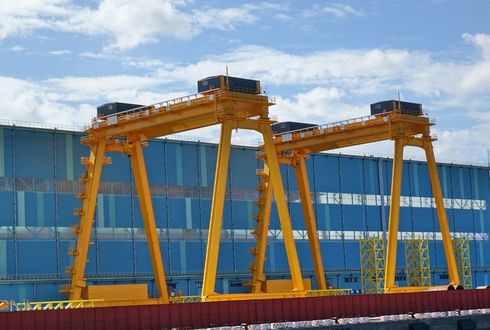
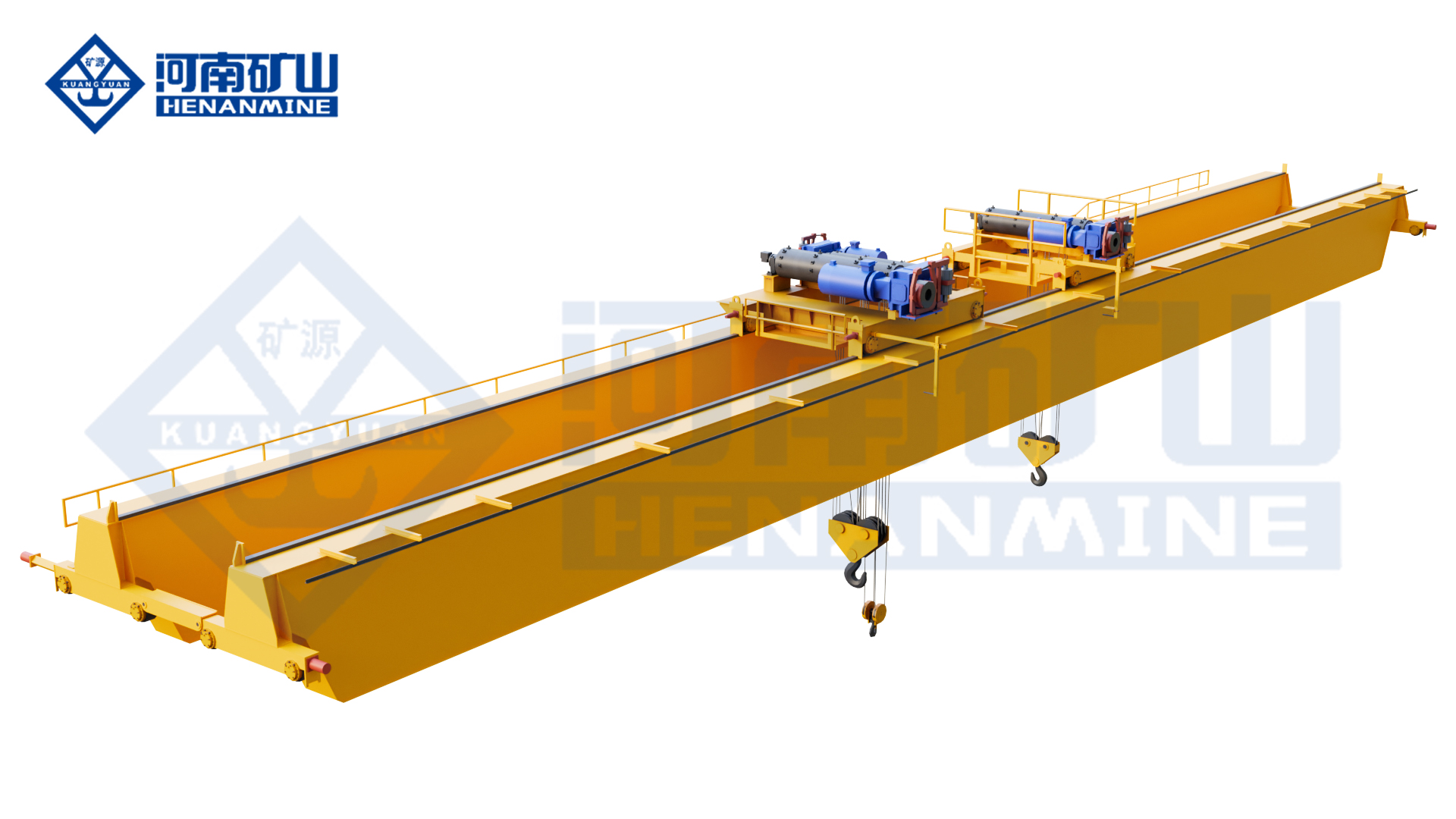
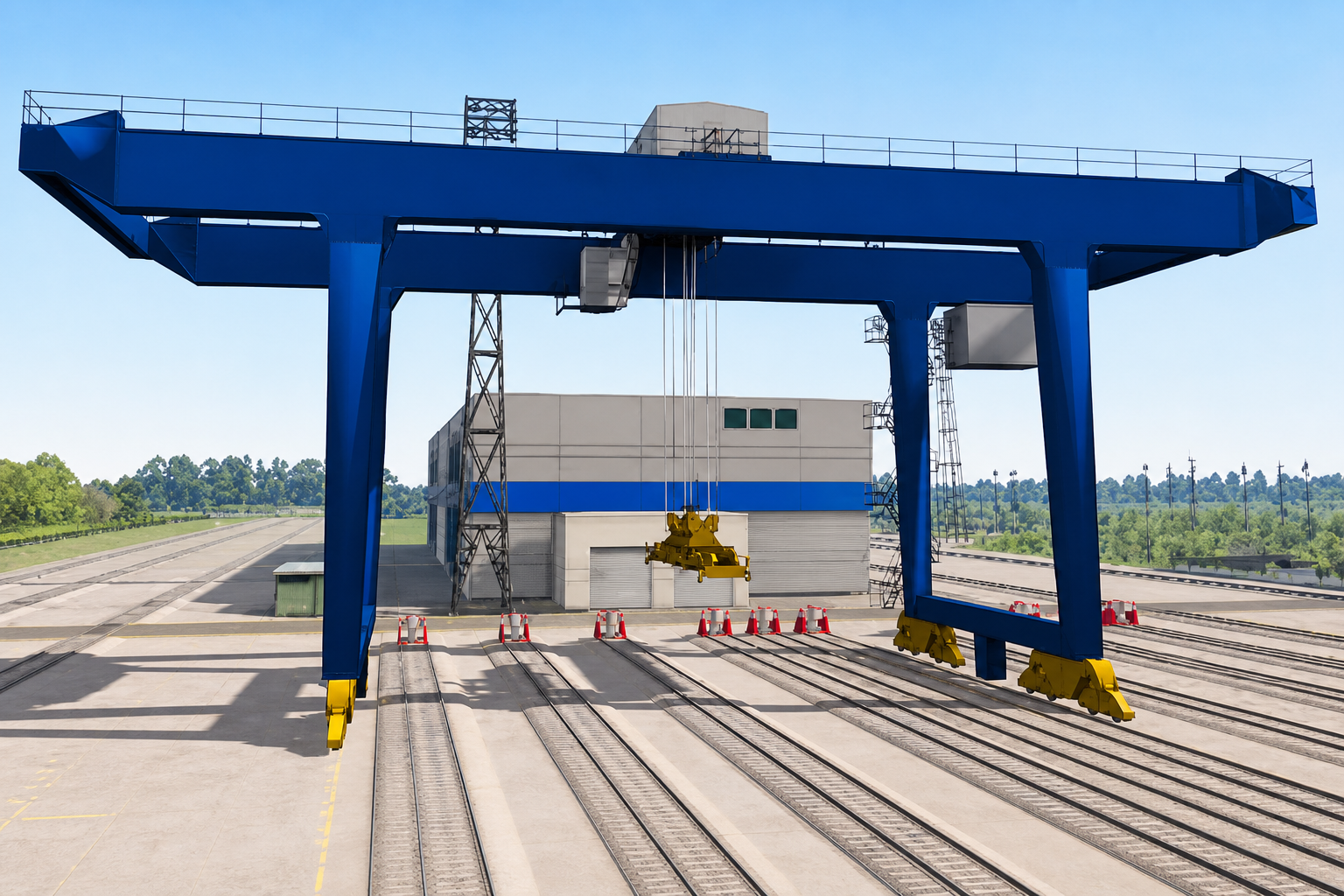
An MG double girder crane is a full-gantry crane built with two parallel box-type girder beams spanning between vertical support legs, which travel on ground-level rail tracks. The "MG" designation specifically denotes the double-girder, box-girder-frame gantry configuration, as distinct from single-girder (MH) or semi-gantry designs.
The double-girder box structure matters because it distributes load across two beams instead of one, which increases stiffness, allows a wider span, and reduces beam deflection under heavy or off-center loads. Main parts of an MG double girder gantry crane include the main girder, support legs, a crane traveling mechanism, and a trolley system.
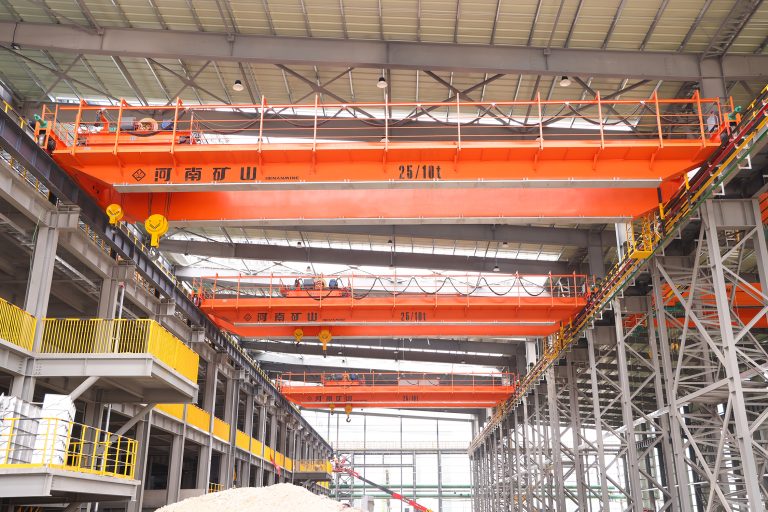
While MG double girder gantry cranes are widely used for outdoor cargo handling and heavy lifting, many port terminals also deploy RTG cranes, rail-mounted gantry cranes (RMG), overhead cranes, and electric hoists to meet different material handling requirements across container yards, warehouses, and maintenance facilities.
MG Crane vs. Other Port Crane Types
Before locking in an MG gantry crane, confirm it's actually the right category for your terminal. Ports commonly use four crane types, and confusing them leads to over- or under-specification.
- MG double girder gantry crane:general-purpose, ground-rail-mounted, used for mixed cargo, bulk, break-bulk, and lower-density container yards. Most flexible and typically the most cost-effective for mixed operations.
- RMG (rail-mounted gantry) crane:a purpose-built variant of the double girder gantry crane, optimized specifically for high-density container stacking in dedicated container terminals, usually with taller legs and automation-ready controls.
- RTG (rubber-tyred gantry) crane:similar footprint to an MG/RMG crane but mounted on rubber tires instead of rails, trading some stability for mobility across a yard without fixed rail infrastructure.
- STS (ship-to-shore) crane:a much larger, quay-mounted crane used specifically to load/unload containers directly from vessels; this is a different equipment category entirely and not a substitute for a yard-level MG crane.
If your terminal handles standardized containers at high density with tight stacking requirements, an RMG variant may outperform a general MG crane. If you need to move equipment around the yard without rail infrastructure, an RTG may fit better. If your operation is mixed cargo bulk, breakbulk, occasional containers a standard MG double girder gantry crane is usually the right and most economical choice.
Step 1: Define Your Load Profile
Start with what you're actually lifting, not a round number. <cite index="11-1">Load capacity is a critical specification defining how much weight the crane can safely lift, and capacities typically range from 5 tons to over 500 tons</cite> across the MG product line.
Key questions to answer before you spec capacity:
- What is your heaviest single lift?Not the average load, the maximum. Container spreaders, grabs, and hook attachments each add dead weight that eats into usable capacity.
- What cargo mix are you handling?Standard ISO containers, bulk commodities via grab, breakbulk via hook, or a mix that requires interchangeable attachments.
- What's your growth margin?Specifying exactly to today's heaviest lift leaves no room if cargo mix shifts. Most terminals build in a 10–20% capacity buffer.
Rate the crane to your worst-case lift plus margin, not your typical-day average undersizing here is the single most expensive mistake to fix after installation.
Step 2: Determine Span and Lifting Height
Span and lifting height are dictated by your yard geometry, not by the crane catalog. Span refers to the distance between the two vertical legs of the crane, and common spans for double girder gantry cranes range from 5 meters to 35 meters</cite>, though custom spans are available for specific operational layouts.
To size this correctly:
- Measure yard width:including rail gauge, plus clearance for trucks or vehicles passing beneath the crane legs.
- Account for stacking height:container yards stacking 3–5 high need more lifting height clearance than single-layer bulk storage.
- Consider leg configuration:U-type legs create more clearance underneath for large loads and vehicle passage, which matters heavily for container and heavy equipment terminals, while A-type legs are simpler and lower-cost for straightforward yard use.
Undersizing span forces awkward truck routing around the crane footprint; oversizing span adds unnecessary steel weight, foundation cost, and wind load exposure.
Step 3: Select the Right Duty/Working Class
Duty class (also called working class or service class) determines how much wear and stress the crane's mechanisms are engineered to absorb over its design life and it is the single most commonly under-specified factor in port crane procurement.
Duty class in three systems (FEM / ISO / CMAA):
| Intensity | China (A-class) | Europe (FEM) | USA (CMAA) |
| Light duty | A1–A4 | 1Dm/1Cm | Class A–B |
| Moderate duty | A5–A6 | 1Bm | Class C |
| Heavy duty | A7 | 2m | Class D |
| Severe/continuous duty | A8 | 3m | Class E–F |
A1 to A4 are considered light duty, A5 and A6 fall into the medium duty category, A7 is classified as heavy duty, and A8 represents extremely heavy duty under the Chinese classification system commonly used by MG crane manufacturers.
For port terminals specifically, most operations land in A6 or A7: higher duty classifications are typically applied in harsh environments or where automation and continuous production are prioritized, both of which describe standard port operating conditions. A yard crane used only occasionally for overflow storage might justify A5, but a terminal crane running multiple shifts with frequent lifts should be specified at A6 or above.
Duty class isn't just a paperwork classification it directly drives maintenance load. A5 cranes might require routine maintenance monthly or quarterly, while A6 cranes need more frequent inspections, often weekly, along with faster wear-out of critical components like wire ropes and brakes. Factor this into staffing and maintenance budgets before you commit to a duty class, not after.
Step 4: Plan for the Marine Environment
Port cranes operate in one of the harshest corrosion environments in industrial equipment salt spray, humidity, and temperature swings accelerate steel degradation far faster than an indoor or inland industrial crane experiences.
Specify these protections up front rather than retrofitting them later:
- Structural coating system:hot-dip galvanizing or multi-layer epoxy coatings are standard for outdoor port structures; marine-grade high-strength steel with a defined corrosion allowance is preferable for splash-zone exposure.
- Electrical enclosure rating:offshore and marine equipment typically adopts IP56/IP67 protection grades</cite> for enclosures exposed to spray and washdown; inland equipment can often use a lower rating, but ports generally should not.
- Cab and control environment:sealed, climate-controlled operator cabs extend both operator comfort and electronics lifespan in humid, salty air.
- Inspection cadence:corrosion-prone environments need shorter coating inspection intervals than the manufacturer's default schedule; budget for this as an operating cost, not a one-time spec item.
Skipping marine-grade protection to save on upfront cost is one of the most common false economies in port crane procurement steel replacement and unplanned downtime almost always cost more than the coating premium.
Step 5: Choose Trolley, Hoist, and Lifting Attachment
The trolley and hoist configuration determines what the crane can actually pick up, and it should match your cargo mix from Step 1, not be an afterthought.
- Open winch trolley: an open winch is a common lifting mechanism in double girder gantry cranes, consisting of a winch drum, motor, and gearbox housed in an open frame, which allows easy maintenance and inspection of components. This design suits heavy-duty applications requiring frequent maintenance access.
- Hoist trolley (crab): a more compact, enclosed alternative better suited to standardized, repetitive lifts with less need for open-frame servicing.
- Attachment type:hook for general and breakbulk cargo, grab bucket for bulk commodities, container spreader for standardized ISO containers, and electromagnetic lifters for suitable ferrous cargo.Versatility is a key advantage of the MG type crane, as it can be equipped with a variety of lifting devices such as electric hoists, grabs, and disks to meet different operating needs.
If your terminal genuinely handles mixed cargo types, specify quick-change attachment capability up front retrofitting a single-purpose crane for a second cargo type later is far more expensive than building in flexibility at purchase.
Step 6: Evaluate Control, Automation, and Safety Systems
Modern MG port cranes are no longer just structural steel and a motor control and safety systems are now a major differentiator in both productivity and risk management.
Look for these systems as standard on any port-grade specification:
- Equipped with variable frequency drive system (VFD), it can realize smooth acceleration and deceleration of equipment, effectively reduce wear and tear of mechanical structure, and greatly improve energy saving efficiency of equipment operation.
- Equipped with cab local control and remote control dual mode, it can combine the operation vision conditions and site layout, flexibly select the control mode, and adapt to the operation requirements of multiple scenarios.
- Equipped with anti-collision and anti-swing intelligent system, effectively avoid the risk of damage caused by cargo collision and shaking, and at the same time relieve the workload of high-frequency repeated operation of operators and improve the stability of operation.
- Standard overload protection device, lifting height limiter and rail clamp, all-round to meet the terminal open air, windy complex conditions of crane foundation safety operation standards, to build a solid line of operation safety.
- Equipped with intelligent fault diagnosis and remote monitoring function, it is the mainstream standard configuration of A6/A7 cranes, which can monitor the operation status of equipment in real time, predict maintenance requirements in advance, effectively avoid shutdown problems caused by equipment failure, and ensure operation continuity.
None of these systems are optional extras for a serious port operation they should be treated as baseline requirements in your procurement specification, not upsell items.
Cost Factors and Total Cost of Ownership
Sticker price is a poor way to compare MG crane quotes, because capacity, span, duty class, and attachment type all move price independently and the ongoing maintenance burden of a higher duty class can outweigh the upfront cost difference over the crane's operating life.
When comparing quotes, evaluate:
- Main structure cost: The main structure cost of equipment is determined by rated load and span.Increasing the size of the box main beam and increasing the height of the outriggers will increase the amount of steel used and directly increase the overall manufacturing cost of the equipment.
- High-level operating mode configuration cost: equipment adopts A6/A7 high-level working level supporting parts, including brakes, wire ropes, drive systems and other core accessories.This configuration has a higher initial purchase cost, but is designed for the wear characteristics of port high-frequency and high-intensity operations, and is suitable for port heavy load conditions.
- Anti-corrosion protection configuration cost: equipment equipped with marine-grade anti-corrosion protection scheme, through high-end marine coating, sealing protection structure, high-quality special steel configuration to strengthen anti-corrosion performance.Although the initial investment is increased, the high steel maintenance and renovation costs in the medium term of equipment use can be effectively avoided.
- Maintenance inspection costs: high-level cranes need to perform higher-frequency inspection maintenance processes, resulting in continuous manual operation and maintenance costs.Cost accounting shall cover the full cycle of 5 to 10 years, and it is not allowed to calculate the single cost of equipment purchase.
- Intelligent control and automation configuration cost: inverter drive, remote diagnosis, anti-swing and other intelligent systems have high investment in the early stage, but they can shorten the operation cycle, reduce downtime, and achieve efficiency and cost reduction throughout the life cycle of the equipment.
The lowest quote is rarely the lowest total cost once duty class mismatch, corrosion retrofit, or capacity undersizing show up three to five years into operation.
Common Buyer Mistakes to Avoid
- The model is selected according to average load instead of maximum operation load, which leads to no safety redundancy and insufficient operation safety under heavy load condition.
- In order to reduce the initial cost and reduce the working level of equipment, it will accelerate the wear of parts, improve the failure shutdown rate, and significantly increase the full-cycle maintenance cost.
- Under high salinity and splash corrosion conditions, marine grade corrosion prevention scheme is not configured, which is easy to cause premature corrosion of the structure and cause early maintenance and rectification.
- The goods category is complicated, but the fixed single accessory is selected, and the adaptability is poor. In the later stage, additional cost shall be invested for transformation and upgrading.
- The automation and safety system is regarded as optional configuration, which is not included in the basic standard of continuous operation port, and cannot meet the requirements of high-frequency and high-intensity operation.
- The model category is not confirmed according to the operation scenario, and the high-density container yard is mismatched with the general gantry crane (MG) or the rail-mounted gantry crane (RMG), resulting in insufficient matching degree of equipment working conditions and limited operation efficiency.
Conclusion
Port MG double beam gantry crane selection can not only refer to load parameters, but also combine with model working conditions, structural parameters, corrosion protection and electric control system comprehensive customization optimization.Scientific selection can improve quality and efficiency, reduce cost and prolong life, effectively reduce downtime loss and improve yard capacity by relying on the whole life cycle value of equipment.
Henan mine crane can customize all kinds of port lifting equipment and intelligent lifting system, adapt to port, logistics, shipyard, heavy industry and other scenarios, provide load analysis, working condition accounting, structure design and other one-stop technical services, accurately adapt to various operating environments.