
Straddle Carrier Manufacturer | Diesel, Hybrid & Electric Solutions
Container terminal and yard selection straddle carrier, many buyers first reaction is to compare equipment procurement quotation. However, in actual operation, it will be found that fuel, maintenance, downtime losses, compliance costs and other long-term expenses are the largest proportion. Especially now that fuel prices fluctuate and environmental emission requirements are tightened, more and more operators are beginning to calculate the full life cycle accounts, struggling with which is more cost-effective between diesel and electric models.
As a manufacturer of port handling equipment, Henan Mine Crane has been exposed to many storage yard projects of different scales, and the conclusion is actually very clear: diesel straddle carrier has lower initial investment and flexible deployment; electric straddle carrier has more obvious long-term TCO advantage under the scenario of high load and multi-shift system. The specific selection shall be comprehensively judged in combination with operation time, energy price, infrastructure conditions and emission requirements.
What exactly is included in the TCO of straddle carriers
TCO is also the total cost of ownership, which refers to the sum of all related expenses during the whole service life of a straddle carrier from purchase to retirement, not just the price of buying equipment.
The general accounting logic is: straddle carrier TCO = procurement cost + energy cost + maintenance cost + infrastructure cost + tire loss + labor cost + downtime loss + power system replacement cost-equipment residual value.
Many people step on the pit is only staring at the initial quotation, diesel straddle transport seems cheap, a few years of oil money and maintenance costs down, the total expenditure is higher instead. From the project data that has been landed in the industry, although the initial investment of battery-powered straddle carriers is high, the energy consumption and maintenance savings can completely cover the price difference in the whole cycle of equipment, and even achieve a lower total cost of ownership.
Cost structure of diesel straddle carrier
The biggest advantage of diesel straddle carriers is their low initial investment. No supporting battery pack and charging infrastructure are needed. The equipment itself has mature structure and can be put into operation after commissioning. There is almost no additional requirement for site supporting facilities.
Fuel costs are the bulk of daily expenses, and the specific amount is directly related to local diesel prices, annual operating hours, load rates, driving distances, and idling ratios. The heavier and longer the operation, the higher the fuel expenditure, and the fluctuation of oil price will directly affect the stability of operating costs.
Maintenance projects are relatively more. Diesel engine, fuel system, exhaust gas after-treatment, three-filter oil, cooling system, hydraulic transmission should be regularly maintained, components have many fault points, and long-term maintenance costs are not low. The maintenance and replacement of aftertreatment systems is also an expense, especially as emission requirements are tightened.
There are also easily overlooked emission compliance costs. More and more ports and Urban area impose strict emission restrictions on non-road mobile machinery, old diesel engine models may face the risk of retrofitting, limiting or even early elimination, and there may be additional carbon tax-related expenses in the future.
This type of equipment is more suitable for remote ports with unstable power grids, storage yards with small operations, sites without charging conditions, or projects with limited budgets and priority control of initial investment.
Cost structure of electric straddle carrier
The initial investment of electric straddle carrier is obviously higher, power battery, electric drive system, power electronic device and charging interface all push up the equipment cost, usually the purchase price of single unit is about 30% higher than diesel model of the same specification. If charging piles, substation expansion, distribution line reconstruction and charging area planning are included, the initial investment will be higher.
But its energy cost advantage is obvious. In areas where electricity prices are stable, the electricity cost per hour is much lower than diesel consumption. With peak-valley electricity price and valley charging strategy, the cost can be further reduced. According to industry data, the annual energy expenditure of electric models is usually much lower than that of diesel models.
Maintenance costs are also lower. The diesel engine and exhaust gas aftertreatment system are removed, and the wearing parts are greatly reduced. The daily maintenance is mainly battery inspection, electrical system inspection and routine maintenance of hydraulic parts. The overall maintenance workload and cost are about 20% lower than those of diesel models.
Infrastructure construction is a one-time investment that cannot be ignored. Charging piles, power grid upgrades, cable laying, and charging management systems should all be included in the total investment. Megawatt fast charging technology can reduce the recharge time to 45-50 minutes, reducing the impact of charging on operations, but the cost of fast charging equipment will also be higher.
This kind of equipment is more suitable for multi-shift terminals with sufficient operation time, green ports with emission reduction targets, areas with high oil prices and ports around Urban area with noise requirements. The cost advantage will gradually appear after long-term operation.
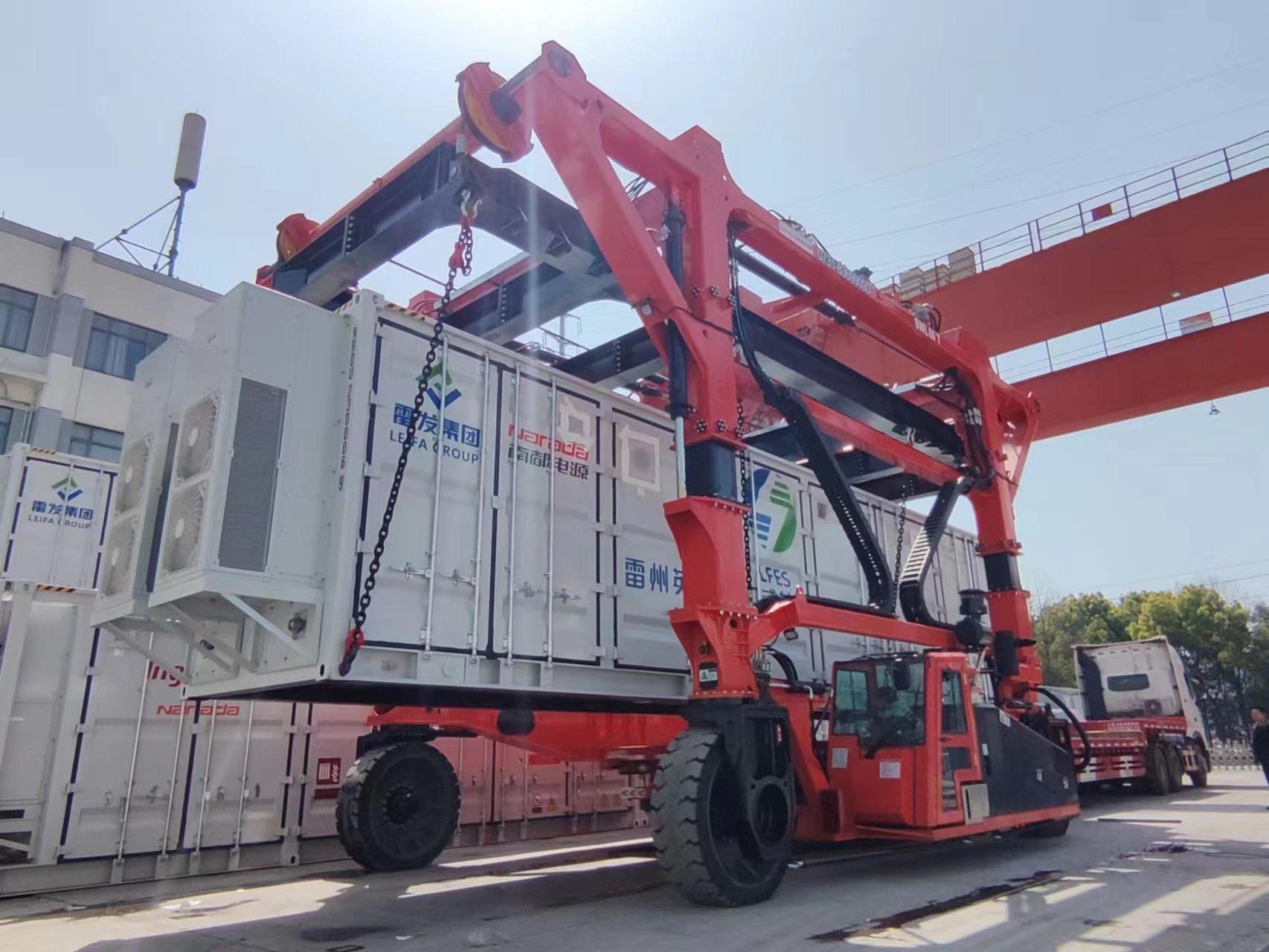
Diesel vs Electric Straddle Carrier TCO Comparison
| Cost Factor | Diesel Straddle Carrier | Electric Straddle Carrier |
| Initial Purchase Cost | Usually lower | Usually higher (~30% premium) |
| Energy Cost | Volatile, depends on diesel price | Lower with stable electricity tariff |
| Maintenance Cost | Higher (engine & aftertreatment) | Lower (fewer moving parts) |
| Infrastructure Cost | Low (fueling facility only) | Higher (chargers & grid upgrade) |
| Local Emissions | Higher tailpipe emissions | Zero tailpipe emissions |
| Noise Level | Higher | Significantly lower |
| Refuel/Recharge Speed | Fast, familiar process | Depends on charging strategy |
| Best Fit | Low-infrastructure / remote sites | High-utilization & low-carbon terminals |
| Long-Term TCO | Higher with high fuel prices | Lower over full lifecycle |
| Core Risk | Fuel price volatility & emission rules | Battery lifecycle & grid dependency |
What factors determine who has a lower TCO
The first core factor is the length of the year. The more hours the equipment works per year, the more significant the energy and maintenance savings are, and the easier it is for electric straddle carriers to recover the difference. For terminals with 24-hour multi-shift operation, the TCO advantage of electric models is usually outstanding; if the annual operation time is very short, the cost savings may not cover the initial price difference.
The second is the difference between diesel and electricity prices. The higher the local oil price and the more stable the electricity price, the more cost-effective the electric model will be; if the electricity price is high or the cost of grid transformation is too high, diesel or hybrid is more pragmatic.
The third is the charging strategy. Reasonable planning of opportunity charging, energy supplement between shifts and low valley charging can not only reduce the impact of charging on operations, but also reduce the cost of electricity. A poor charging strategy will not only reduce equipment availability, but may also push up peak electricity bills and offset energy consumption advantages.
The fourth is fleet size. If there are only one or two devices, it is difficult to dilute the cost of charging infrastructure; the larger the fleet size, the lower the infrastructure cost shared by a single device, and the better the economy of the electric solution.
There are also factors such as maintenance capability, battery life and emission policies. Diesel and electric require different maintenance technical capabilities, battery attenuation and replacement costs should also be included in the calculation in advance, and increasingly stringent carbon emission reduction requirements will also increase the long-term compliance costs of diesel equipment.
Select boundaries for applicable scenarios
Not all projects are suitable for electric. If the power grid of remote ports is unstable and there is no condition to install charging facilities, diesel is still a more pragmatic choice; for small storage yards with short annual operation time, the energy-saving benefits of electric vehicles cannot cover the price difference; in the case of continuous operation without charging window and no standby equipment, the energy supplement efficiency of diesel is more advantageous; for projects with tight short-term budget, diesel can also be selected first for transition.
The advantage scenario of electric model is very clear: the dock with high load and multi-shift production industry saves considerable oil money and maintenance money after long-term operation; Green port with clear carbon emission reduction target, electric straddle carrier is the core equipment of zero emission yard; In areas where oil prices continue to be high, the cost advantage of electric models will be more obvious; Close to the Urban area, the port with noise limit, the operation noise of electric equipment is lower, and it is easier to meet the environmental protection requirements. Electric is also a more consistent long-term trend option for 5-to 10-year fleet renewal planning.
If there is no condition for full electrification, hybrid straddle transport is a very practical transition program. It saves about 40% more fuel than pure diesel models, reduces emissions and does not have to rely entirely on charging infrastructure, making it suitable for terminals in transition.
A few points to note when calculating TCO
When analyzing the total cost of ownership of straddle transport vehicles, do not only calculate the accounts of one year, but suggest to calculate them according to three cycles of 5 years, 8 years and 10 years respectively. The investment in the first year of electric models is definitely higher, but as the years lengthen, the savings in operating costs will gradually be reflected, and the longer the cycle, the more obvious the advantages.
Also include hidden costs. The hidden costs of diesel models include oil price fluctuation risk, engine overhaul cost, after-treatment maintenance, idle fuel consumption and future carbon cost; the hidden costs of electric models include charging pile construction, power grid modification, peak electricity price, battery replacement expectation, high-voltage maintenance personnel training and charging downtime.
If these hidden expenses are omitted, the actual cost will be much different from the expectation.
epilogue
To make a comparison between diesel vs electric straddle carrier, we should not only focus on the purchase quotation to draw conclusions, but also pull through the accounts of the whole life cycle. Diesel straddle carriers are suitable for scenarios with limited infrastructure conditions and small workload, and the deployment flexibility threshold is low; electric straddle carriers perform better in TCO performance under high load and long-term operation scenarios, which is more in line with the direction of low-carbon transformation of ports; hybrid vehicles are transitional options that give consideration to cost and emission reduction.
Customize your own solution
As a professional straddle carrier manufacturer, Henan Mine Crane can provide customized solutions for diesel, hybrid and electric full series of container straddle carriers, supporting flexible selection of different configurations. We can also help customers do straddle TCO calculation services, combined with local energy prices, operating conditions, fleet size, give real cost comparison and selection recommendations. If you are doing fleet renewal or yard electrification planning, you can send us the annual operation time, oil and electricity price, processing tank quantity, shift system arrangement, and the engineering team will issue a suitable plan for you.