
How to Choose a QZ Grab Crane for Coal Power Plants
Coal-fired stacking and transportation in thermal power plants are under severe working conditions. The type selection of QZ grab crane directly affects production efficiency, operation and maintenance cost and operation safety.Improper type selection is easy to cause equipment failure, low efficiency of operation, dust prevention is not up to standard and other problems, increasing additional operation and maintenance and transformation costs.
This paper focuses on the thermal power plant scenario, explains in detail the core points of QZ grab crane such as specification selection, grab type, working level, dust prevention safety, etc., and is equipped with procurement list to assist enterprises in scientific selection, avoid misunderstandings, eliminate cost loss and potential safety hazards, and ensure stable production compliance.
What Is a QZ Grab Crane?
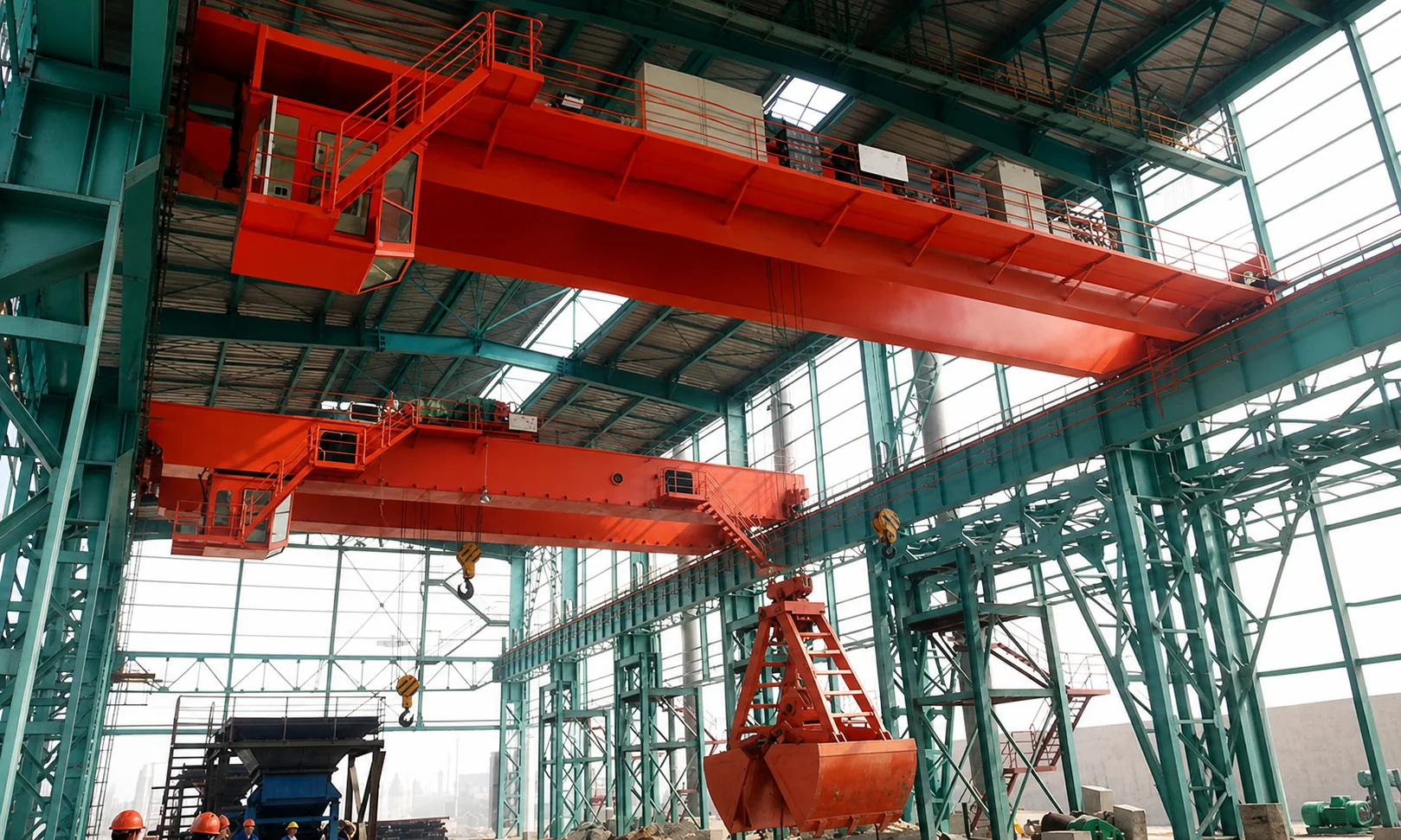
A QZ grab crane is a double-girder overhead traveling crane equipped with a specialized grab bucket instead of a standard hook. It works by lowering an open clamshell or orange peel bucket into a pile of loose material, closing the jaws to capture a load, lifting it, and releasing it at a discharge point. The "QZ" designation is a standard Chinese crane classification indicating a double-girder bridge crane built specifically for grab-bucket operation, distinct from general-purpose QD (hook) cranes.
QZ cranes matter in coal power plants because they solve a problem hook cranes can't: coal doesn't come in discrete units that can be slung or hooked. It arrives as loose, free-flowing bulk material that has to be scooped, not lifted. The grab mechanism is what makes continuous, unattended handling of thousands of tons of coal per day possible.
Why Coal Power Plants Use QZ Cranes
Coal moves through a power plant in a defined sequence, and the QZ crane typically operates at two to three points in that chain:
- Coal yard to bunker.Incoming coal is stockpiled in an open or covered yard. A QZ crane grabs coal from the pile and transfers it into intermediate storage bunkers that feed the boiler.
- Bunker to feeder.In some plant layouts, an indoor QZ crane moves coal from bunkers directly toward the crushing and pulverizing stage.
- Ash and slag removal.The same crane class, often with a different grab, handles bottom ash or slag removal from the boiler area.
This is why the crane is usually specified for round-the-clock, high-duty-cycle operation rather than occasional lifting it is effectively part of the plant's fuel supply chain, and downtime translates directly into constrained boiler feed.
Key Specifications to Match to Your Plant
Before comparing suppliers, four numbers define whether a QZ crane will actually fit your operation:
- lifting capacity: thermal power plant QZ grab crane conventional tonnage of 5 - 20 tons, large high-throughput power plants can choose larger tonnage.The core error of type selection is that only coal load is calculated, and rated lifting weight must include grab weight.
- Span:The standard QZ crane span is 16.5 - 31.5 meters, which needs to strictly match the width of coal bunker and yard.Non-standard span can adapt to special sites, but it will increase procurement costs and prolong delivery cycle.
- Lifting height: The normal lifting height under coal-fired conditions is 20 - 30 meters.The calculation standard shall not be based on the distance from the ground to the roof, but shall be calculated according to the actual distance from the lowest operating point of the equipment to the highest point of the hook in combination with the height of the coal pile, the depth of the coal bunker and the safety margin.
- work level: for the selection of the most error-prone key parameters.According to FEM and ISO 4301 standards, thermal power plant equipment needs continuous operation and supply, and A6/A7 working level must be selected, and ordinary industrial A4/A5 level is prohibited.Low-level selection will cause structural fatigue, premature aging of equipment and greatly shorten service life.
Sizing the Grab to Your Coal Handling Needs
Most procurement teams are prone to high-cost selection errors: only based on volume selection grab, ignoring weight load and material density.The paper parameters compliance grab, after taking into account the coal stacking density and grab weight, easily lead to crane overload operation.
Standard selection calculation steps
- The rated safe working load (SWL) of the crane is the only core calculation benchmark. This value is the standard rated load calibrated by the equipment manufacturer. It is the upper limit standard to ensure the safe operation of the crane structure, traveling mechanism and lifting mechanism. All grab selection calculations shall not exceed the parameter range.
- Accurately deduct the self-weight of the supporting grab. The self-weight of the grab is greatly affected by the material, structure form and size size. The self-weight of the small light grab is only several hundred kilograms, and the self-weight of the large grab dedicated to the heavy load of the thermal power plant can reach several tons. It is a core load variable that is easily ignored.
- By subtracting the grab weight from the rated load, the maximum effective load of coal materials that the equipment can carry can be accurately calculated. This value is the maximum weight of materials allowed to be loaded in actual operation, which is the core basic data for subsequent volume calculation.
- combined with the actual bulk density of coal grab volume conversion, thermal power coal bulk density conventional range of 0.7 - 0.9 t/m³, will be due to coal type, dry and wet moisture content, particle size dynamic changes, need to combine the actual coal parameters of the plant accurate calculation, get the grab theoretical maximum operating volume.
- Reserve 10%-15% safety margin on the basis of theoretical volume, which can offset load deviation caused by uneven material taking, fluctuation of material density and cyclic wear of equipment, avoid overload risk and ensure safe and stable operation of equipment.
Worked example: A crane with a 10-ton SWL fitted with a grab weighing 1.5 tons leaves 8.5 tons of usable payload. At a coal bulk density of 0.85 t/m³, that translates to a maximum grab capacity of roughly 10 m³. Applying a 10–15% safety margin brings the practical working capacity down to approximately 8.5–9 m³ per cycle.
The takeaway for procurement: never give a supplier a target grab volume alone. Give them your crane's SWL, your coal's bulk density range, and your required safety margin. Volume is an output of that calculation, not an input to it.
Choosing the Right Grab Type for Coal
Coal is a loose, free-flowing, relatively low-density bulk material, which narrows the grab selection considerably compared to handling scrap metal or ore.
Bucket Type Selection
Shell grab is the mainstream choice of coal handling operation in thermal power plants.Symmetrical hinged hopper body opens and closes smoothly, can smoothly cut into coal pile, airtight lock material, effectively reduce material leakage, adapt to the characteristics of strong loose coal fluidity, suitable for stacking and reclaiming operation of coal yard and coal bunker of power plant.
Plum blossom grab is mostly used for scrap steel, construction waste and other hard irregular materials, relying on multi-petal claw body puncture grab.Coal operation only needs to shovel the stored material, without piercing and biting, so the plum blossom grab has poor adaptability, low operation efficiency and insufficient economy, which is not suitable for coal conveying conditions in thermal power plants.
Shell Structure Selection
For coal-burning conditions, the high-sealing closed shell grab with overlapping edge structure is preferred.The enclosed hopper body is specially designed for fluidized fine materials such as pulverized coal and loose coal, which can effectively reduce the material spillage during transportation, inhibit dust overflow, and meet the operation requirements of environmental protection, dust prevention, loss reduction and consumption reduction of power plants.
The open grab is more suitable for heavy wear-resistant materials such as sand and ore, and the bucket body has poor sealing performance, large operation leakage and serious dust diffusion. It cannot take into account the environmental protection compliance and material loss control requirements of thermal power plants, and is not suitable for coal loading and unloading.
Drive Mode Selection
- Mechanical rope grab: simple structure, high cost performance, is a general selection of conventional coal-fired operations.It relies on crane winch mechanism to realize opening and closing, without independent power source, convenient operation and maintenance, low failure rate, and is suitable for conventional extensive stacking and reclaiming operation of power plant.
- Electro-hydraulic grab bucket: bucket body integrated motor and hydraulic pump, only need a single lifting wire rope to work, accurate opening and closing, strong unloading controllability, suitable for power plant automation, semi-automatic coal bunker loading conditions, suitable for refined operation scenarios.
- Electric grab: performance between mechanical and electro-hydraulic, control accuracy is better than pure mechanical grab, at the same time do not have to bear the complex operation and maintenance costs of hydraulic system, moderate cost performance.
closed shell grab is preferred for coal-fired operation in thermal power plant.Mechanical rope type is selected for conventional general scenarios, and electro-hydraulic type is preferred for automatic coal bunker feeding scenarios, which can be flexibly matched according to the automation degree of the plant area.
Coal Dust and Explosion-Proofing Requirements
This is the single most commonly overlooked safety requirement in QZ crane procurement for coal service, and it's specific to this application in a way that generic crane buying guides don't address.
Coal dust is a combustible dust. When airborne in sufficient concentration and exposed to an ignition source, it presents a genuine explosion hazard a risk that doesn't exist in the same way for cranes handling ore, sand, or scrap metal. This has direct implications for how a QZ crane should be specified for coal service:
- Electrical explosion-proof configuration: electrical parts such as motors, control cabinets, junction boxes and cable drums in pulverized coal area shall be equipped with dust explosion-proof specifications according to the hazard level of the plant, and shall comply with NFPA and IEC/ATEX standards to prevent dust ignition and explosion risks.
- Dust suppression protection measures: dust suppression devices are equipped at the grab material taking and unloading points, which can effectively reduce the risk of dust explosion and reduce the dust on the surface area of the equipment structure.Dust accumulation not only affects the clean operation and maintenance of equipment, but also forms secondary fire hazards. Dust suppression design can avoid safety risks doubly.
- Closedgrab advantage: the closed grab structure mentioned above has a double protective effect, not only can reduce the leakage of coal-fired materials, but also can greatly reduce the amount of fine pulverized coal dust, control dust diffusion from the source, adapt to the dust prevention and control of thermal power plants and safety production requirements.
Buyers should raise hazard classification explicitly with suppliers rather than assuming standard industrial-grade electricals are adequate. A crane quoted without this consideration may be materially cheaper and non-compliant with plant safety requirements the moment it's installed.
Throughput and Duty Cycle Planning
Even if the crane rated load selection compliance, if the throughput does not match the actual coal consumption of the unit, there will still be insufficient coal bunker supply, boiler can not be stable combustion problems.
The model selection shall take the hourly coal consumption of boiler as the core benchmark, reverse calculate the number of operation cycles required by crane per hour, and comprehensively consider three key factors: rated loading capacity of single grab, complete operation cycle time (lowering, closing, lifting, walking, unloading and resetting), effective operation time of equipment and standby redundancy capacity of coal bunker.
Some crane load parameters meet the standard, but the operation cycle frequency is low, and the feeding speed cannot keep up with the boiler consumption speed, which will form the upstream feeding bottleneck of the combustion system.This problem is extremely costly to investigate and rectify after equipment installation and must be avoided in advance at the selection stage.
At the same time, the A6/A7 high-level work level mentioned earlier is directly linked to device throughput.High-frequency continuous cycle operation crane, need to match the corresponding structure and mechanical performance level, can effectively avoid high-intensity operation of equipment accelerated wear, early aging failure.
Safety Systems and Standards to Require
Beyond dust-specific protections, a coal-service QZ crane should include the safety systems standard to heavy-duty grab operation:
- Overload protection device: It can effectively limit the operation of equipment exceeding rated load, eliminate structural damage, equipment failure and safety accident caused by overload operation from the source, and ensure the compliance and safety of lifting operation.
- Full-stroke limit switch: equipped with lifting, cart and trolley operation limit device, accurately limit the equipment operation stroke, prevent over-stroke collision, derailment and other mechanical failures, and ensure the stability of the whole machine operation.
- laser height measurement configuration: suitable for automatic, semi-automatic coal bunker feeding conditions, can accurately control the discharge height, ensure the height of the operation is uniform, improve the accuracy of automatic operation and operation standardization.
- electrical safety protection: integrated low voltage, phase sequence protection function, and configuration of emergency stop device, can deal with abnormal voltage, phase sequence fault and other electrical problems, emergency conditions can be quickly shut down to avoid electrical safety risks.
- Remote control system: It has become the mainstream configuration of coal conveying operation in thermal power plants, which can avoid long-term exposure of operators to dust and noise, and greatly improve operation safety and operation convenience.
On the standards side, ask suppliers to confirm compliance with recognized frameworks commonly FEM (European crane design standards) and ISO 4301 for duty classification and request documentation, not just a verbal assurance. If your plant operates under an insurer-mandated inspection regime, confirm the crane's duty class rating is compatible with what your inspection authority requires; a mismatch can affect operating certification at annual inspection.
Conclusion
QZ grab crane selection in thermal power plant should comprehensively consider coal characteristics, grab volume, working grade, explosion-proof standard, operation frequency and other indicators, rather than a single lifting capacity, so as to ensure safe and efficient operation of coal conveying system.Complete working condition parameters shall be provided when purchasing, so as to facilitate the manufacturer to customize the equipment.
Henan mine crane can customize all kinds of lifting and intelligent handling equipment, adapt to power plants, mines, ports and other bulk material conditions, provide one-stop services such as selection, design, working condition analysis, etc., to ensure safe and long-term operation of equipment.