
How to Choose a Ship-to-Shore (STS) Crane for Your Container Terminal
A ship-to-shore crane is a 25-to-30-year commitment. Get the outreach wrong, underestimate throughput needs, or skip the total cost of ownership math, and the consequences show up on every vessel call for the life of the asset. Yet many terminals still approach STS crane selection the way they'd buy a piece of yard equipment, spec sheet in hand, price as the deciding factor.
That approach breaks down fast. An STS crane is the single largest driver of a terminal's berth productivity, and its specification locks in decisions about vessel size, automation strategy, and quay infrastructure that are extremely expensive to reverse. This guide walks through a structured, six-step framework for choosing the right STS crane, covering vessel profiling, throughput matching, automation level, infrastructure compatibility, total cost of ownership, and manufacturer qualification , so your terminal ends up with a crane that fits both today's vessels and tomorrow's.
What Is a Ship-to-Shore Crane and Why the Choice Matters
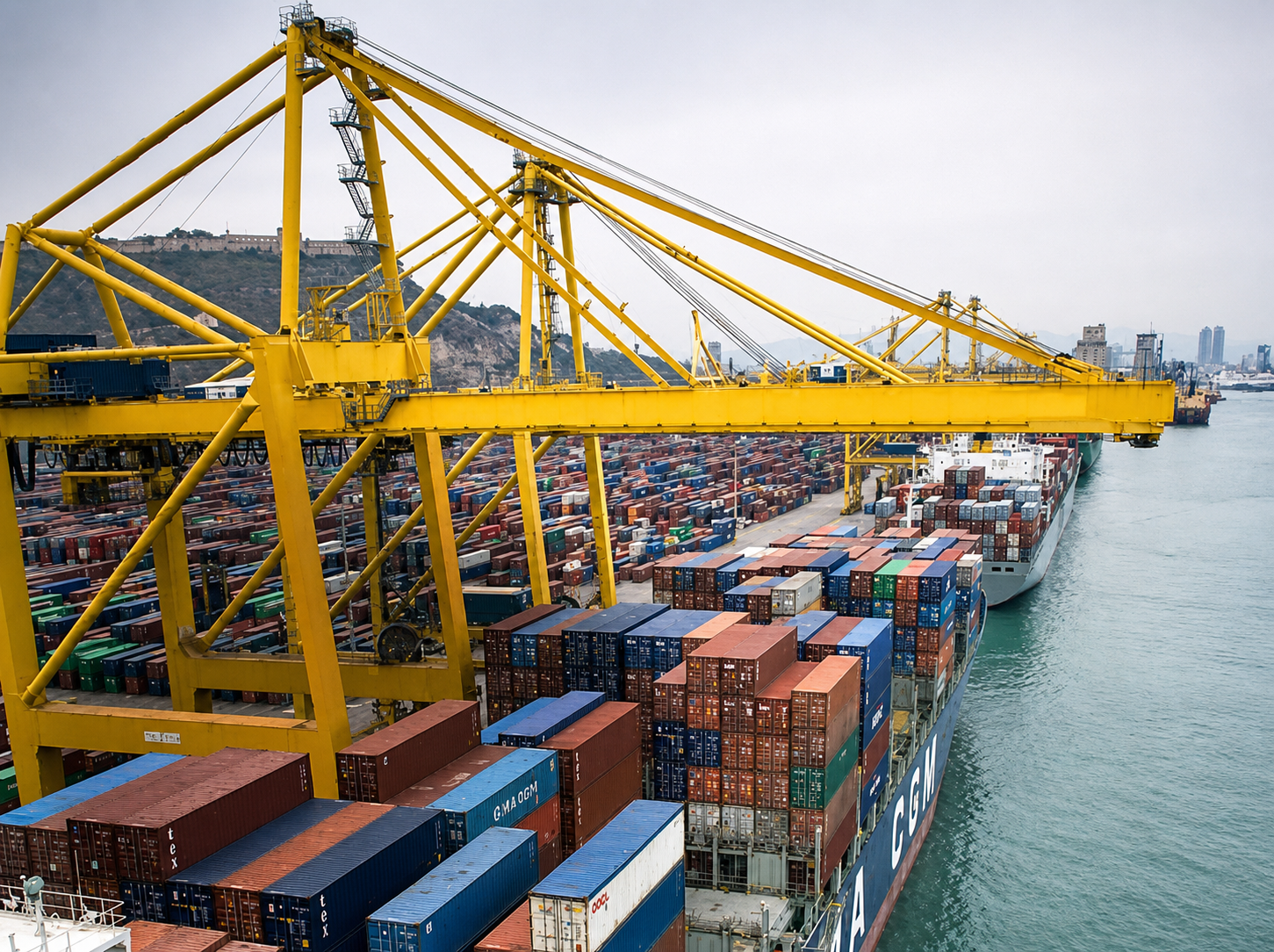
Henan Mine Crane manufactured ship-to-shore (STS) crane, also called a quay crane or portainer, is a large rail-mounted gantry crane installed along a container terminal's berth. Its job is simple to describe and hard to execute at scale: lift containers off a vessel and place them on yard transport equipment, or reverse the sequence during loading. A modern crane repeats this cycle dozens of times per hour, every hour a vessel is alongside.
Because STS cranes are structurally fixed to the quay and rated for a specific vessel envelope, the specification decision is largely irreversible. A crane with too little outreach cannot be stretched later without a major (and costly) boom replacement. A quay designed for a lighter crane class can't simply absorb a heavier one without civil works. That's why the selection process has to start with vessel and traffic forecasting, not a manufacturer's catalog.
The financial stakes reinforce this. Vessel turnaround time is one of the most expensive variables in container shipping economics, every extra hour at berth is an hour of lost capacity for both the carrier and the terminal. A well-specified crane fleet directly shortens that time; a poorly specified one becomes a permanent bottleneck that no amount of yard-side efficiency can fix.
Key STS Crane Specifications Explained
Before working through the selection framework, it helps to have a shared vocabulary. These are the specifications that appear on every STS crane data sheet and drive both performance and cost:
| Specification | What It Means | Typical Range (Modern Cranes) |
| Waterside outreach | Distance the boom extends over the vessel from the waterside rail | 40–70+ meters |
| Lift height (above rail) | Maximum height the spreader can reach, covering deck stacking | Up to 40+ meters |
| Safe working load (SWL) | Maximum rated lifting capacity, single or twin-lift | 40–100+ tonnes |
| Trolley/hoist speed | Speed of horizontal and vertical container movement | Varies by automation level |
| Backreach | Distance the girder extends landward of the portal frame | 15–25 meters |
| Rail gauge | Distance between waterside and landside rails | 30–100+ feet depending on crane generation |
Two of these, outreach and lift height, are non-negotiable once fixed, which is why Step 1 below is dedicated entirely to getting them right.
Step 1: Define Your Design Vessel and Outreach Requirement
Start with the largest vessel your terminal expects to serve over the crane's operating life, not just today's calling fleet. This "design vessel" sets the floor for outreach and lift height requirements.
Outreach calculation. A commonly used formula is:
Required outreach = (vessel beam ÷ 2) + (quay face-to-waterside-rail distance) + safety margin (2–3 meters)
For example, a 60-meter-beam ultra-large container vessel (ULCV) with an 8-meter quay setback needs roughly 40.5 meters of outreach from the waterside rail — which typically translates to a 65–70 meter boom-tip outreach once structural offsets are included.
Match Henan Mine Crane manufactured STS crane class to vessel class. Use this as a starting reference point, then confirm against your specific design vessel's dimensions:
- Panamax:fits vessels through the original Panama Canal locks; roughly 13 container rows across; moderate outreach and lift height.
- Post-Panamax:built for beam widths beyond the original locks; roughly 18 rows across; greater outreach and taller structure.
- Super-Post-Panamax:designed for the largest vessels in service, 22–24+ rows, with ultra-long outreach and higher lift capacity.
- ULCV-class:latest generation for mega-ships exceeding 24 rows, typically paired with tandem or twin-lift spreaders.
Plan for a 20-year vessel outlook, not just current calls. Vessel sizes have grown steadily for decades, and a crane specified only for today's largest ship risks becoming obsolete well before the end of its structural life. Underspecifying outreach is one of the most common and costly mistakes in STS procurement, it's a permanent structural constraint that can't be corrected after commissioning.
Step 2: Match Crane Class to Terminal Throughput Targets
Reach defines what vessels the Henan Mine Crane manufactured STS crane can serve. Throughput capacity defines how quickly it can serve them. This step is about matching a crane’s productivity measured in gross moves per hour (GMPH) to your terminal’s business objectives.
- Medium-scale terminalsgenerally need standard efficiency levels and can operate effectively with single-lift cranes at moderate hoist speeds.
- High-volume terminals(roughly 5 million TEU or more annually) typically require 25–40 moves per crane hour, which usually means tandem or twin-lift spreader technology capable of handling two 20-foot containers simultaneously.
- Multi-crane gangsare standard at major hub terminals, with combined gang productivity of 100–150 GMPH across three to five cranes working a single vessel simultaneously.
Trolley and hoist speed are the mechanical levers behind these numbers, but faster movement also means higher energy draw, a trade-off worth weighing against your terminal's actual throughput requirement rather than defaulting to the fastest available option.
Step 3: Evaluate Automation Level
Automation is the point at which STS crane selection most directly addresses labor strategy, safety objectives, and capital budget. There are four major levels:
- Manual operation an operator in the crane cab (fully automated movement). Lower capital investment, increase longer-term dependence on labor.
- Semi-automated the trolley move and the container positioning over the ship are semi-automated; a remote operator is used to safely perform the final lowering and twist-lock connection.
- Remote/remote-assist operators are in a control-room on the deck instead of the crane cab, which results in a better working environment and a single operator is able to operate a number of cranes.
- Fully automated systems which involve very little human involvement throughout the cycle and are co-related with the use of automated stacking cranes and AGVS in the yard.
Two real-world reference points illustrate where terminals land on this spectrum. Shanghai International Port Group's Yangshan Phase 4 terminal operates as a largely automated deep-sea facility, combining automated STS cranes with AGVs and automated stacking cranes. APM Terminals' Maasvlakte II facility in Rotterdam, by contrast, runs semi-automated STS cranes with remote cabin operation from a shore-based control room, a middle-ground approach that many terminals find more operationally practical than full automation.
The decision should follow from your business case, not from an appetite for the newest technology. Full automation delivers the biggest efficiency gains at high-volume hub and transshipment terminals where consistent, round-the-clock throughput is the competitive differentiator. Mid-size terminals, or those with variable trade patterns, often get better returns from semi-automated or remote-assist configurations that improve safety and consistency without the full infrastructure investment automation demands.
Step 4: Confirm Quay and Site Infrastructure Readiness
Henan Mine Crane Factory supply STS crane is only as reliable as the infrastructure that supports it. Prior to specification closure, check:
- Rail system:Confirm rail gauge, alignment, and condition, proper spacing and leveling are critical for safe, smooth crane travel along the berth.
- Ground-bearing capacity: The quay foundation must be capable of bearing the total weight of the crane (which can be anywhere between 800-2500 tonnes, depending on class)and the dynamic loads from working and wind. A ground survey and review of the structural engineer calculations should be undertaken prior to selecting a crane class.
- Electrical supply:Electric and hybrid cranes need voltage, phase, and connection specifications confirmed against terminal power infrastructure; shore power voltage for modern cranes commonly runs in the 4,000–13,200-volt range.
- Clearance and obstructions:Check overhead clearance restrictions (for example, near airports), private utility corridors, and existing crane rail spacing if you're adding to an existing fleet.
Retrofitting an existing quay for a heavier or longer-reach crane class is possible but often involves substantial civil works, reinforcing rails, upgrading electrical capacity, or even widening the quay apron. It's far cheaper to confirm compatibility before signing a purchase order than to discover a mismatch during commissioning.
Step 5: Build Your Total Cost of Ownership Model
Purchase price is the most visible number in an STS crane deal, but it's rarely the number that determines whether the investment pays off. A complete TCO model should include:
- Initial purchase price:New Post-Panamax and Super-Post-Panamax cranes commonly range from roughly 8 to 15 million dollars per unit, with fully automated ULCV-class cranes trending higher depending on scope, region, and customization.
- Automation premium:Semi-automated or fully automated configurations — with remote control, anti-sway systems, and intelligent positioning, can add 20–40% to total investment compared with manual cranes.
- Financing structure:Outright purchase, structured financing, and operating leases all shift the cash-flow profile differently; leasing can preserve capital for yard-side investment but typically costs more over the crane's full life.
- Operating and maintenance costs:Factor in electricity or fuel consumption, scheduled maintenance, spare parts availability, and expected downtime, regenerative drive systems, for instance, can recover energy during load lowering and cut power consumption by 20–30%.
- Expected service life:Most STS cranes are engineered for 25–30 years of service; amortize the investment against that horizon rather than a shorter planning window.
Running these numbers side by side for two or three shortlisted configurations, rather than comparing sticker price alone, is usually what separates a crane investment that pays for itself from one that quietly erodes terminal margins for a decade.
Step 6: Qualify and Compare Manufacturers
With specifications and budget defined, the final step is vetting suppliers. Qualified means more than brand recognition. Look for:
- Reference installations:at terminals with a similar vessel profile and throughput target to yours, ideally ones you can visit or contact directly.
- Component quality and sourcing:Electrical system components from established suppliers (Henan Mine Factory) tend to improve long-term reliability, though they also affect price.
- Standards compliance:Confirm the manufacturer designs to relevant international standards, including ISO 4301-1 for crane classification, FEM 1.001 for hoisting appliance design, and EN 13135 for safety design requirements.
- Warranty, spares, and service support:Long-term parts availability and local service capability matter more over a 25-year asset life than a marginally lower upfront quote.
- Customization capability:Terminals in high-wind, seismic, or extreme-temperature regions need engineering adjustments that not every manufacturer handles equally well.
Sustainability and Energy Efficiency Considerations
Energy efficiency has moved from a nice-to-have to a standard evaluation criterion in Henan Mine Crane Factory supply STS crane procurement. A few features are worth specifying explicitly:
- Regenerative braking/drive systems, which recapture energy during container lowering and can meaningfully cut overall power consumption.
- Connectivity to shore power, removing the need for onboard diesel generation and reducing direct emissions at the quay.
- Variable speed drives are used to increase energy efficiency and allow more flexible control of the hoist and trolley speeds.
- Hybrid Power configurations where the power system can be switched from shore power or on board generation, as for terminals with weak grid infrastructure.
These features increase the capital cost but generally pay back in the form of lower energy bills plus, more and more, in premiums attached to meeting port sustainability targets which will be a consideration for carriers in selecting terminals.
Common Mistakes in STS Crane Procurement
A few recurring errors show up across terminal projects:
- Only defining outreach for the present fleet, as no account is taken of increasing vessel size during the crane’s life.
- Treatment of quay infrastructure as an afterthought only learning ground bearing or power restrictions when the crane has been ordered.
- This definition is overly reliant on full automation without any throughput or labor-cost business case to justify the premium.
- Comparing purchase price alone, ignoring financing structure, energy costs, and maintenance over a 25–30 year horizon.
- Underweighting manufacturer track recordin favor of the lowest quoted price, then absorbing the cost of poor spares availability or slower service response later.
Frequently Asked Questions
What outreach does an STS crane need to cover a ULCV?
Most terminals serving ultra-large container vessels need a waterside outreach of roughly 65 to 70 meters, calculated from half the vessel's beam plus the quay setback and a safety margin.
What is the difference between an STS crane and an RTG crane?
An STS crane is a fixed, rail-mounted crane that moves containers between a vessel and the quay, while an RTG crane is a mobile, rubber-tired crane that stacks and moves containers within the storage yard. The two work as complementary parts of the same handling chain rather than substitutes for each other.
Is full automation worth it for a mid-size container terminal?
Full automation is usually justified only at high-volume hub terminals; mid-size terminals often get a better return from semi-automated or remote-operated cranes that improve safety and consistency without the full infrastructure cost.
Can an existing quay be upgraded to support a larger STS crane?
Yes, but it requires engineering review of rail gauge, ground-bearing capacity, and power supply, and may involve significant civil works if the existing quay was not designed for the new crane's weight and reach.
Henan Mine Crane Factory Custom
Selecting the appropriate ship to shore crane is simply about designing a dependable container handling package that shall meet the needs of today and tomorrow. From vessel size and handling capacity, to automation needs, infrastructure conditions and life-cycle costs, each factor will influence the long-term efficiency and ROI of the system. A sound STS crane system maximizes a terminal‘s productivity for many years to come by helping minimize vessel.
Backed by rich experience of producing heavy duty cranes and providing equipment customization, our engineering team specializes in offering STS cranes designed for specific terminal needs, ship conditions and working environments to various customers. From technical consultation and equipment design, manufacturing, installation support to after sales service, Henan Mine Crane Factory is committed to becoming a dedicated partner of your safe, productive and reliable container handling projects for dependable and cost-effective investments.