
Overhead Crane Components Explained: Parts and Functions Guide
For warehouse managers, equipment operation and maintenance personnel, industrial purchasers and production operation teams, understanding the structure and function of bridge cranes not only improves the safety of daily operation and reduces equipment failures, but also improves the efficiency of maintenance, and makes more accurate decisions when selecting and purchasing equipment.
Overhead crane (overhead crane/EOT crane) is the core lifting equipment in factories, warehouses and ports, responsible for the transfer of heavy loads for loading and unloading, and its stable operation relies on the cooperation of various components.
In this article, we will comprehensively disassemble the major systems and subdivided components of overhead cranes, explain the role of each part, combine the differences in the components of different models, and synchronize with the additional safety specifications and selection techniques, to help you master the core knowledge of overhead cranes.
Types of Overhead Cranes and Their Key Features
Different models of overhead travelling cranes have obvious differences in core component configuration and structural design. Understanding the characteristics of the models in advance will enable you to better understand the subsequent detailed explanation of the components.
Single Girder Overhead Crane
Mainly light and medium load lifting operations, widely used in machining workshop, warehousing and logistics warehouse, light industrial production line and other conventional sites, the overall single girder integrated structural design, light weight, compact and simple structure, short installation and commissioning cycle, low difficulty in the later operation and maintenance, the standard single girder with a steel wire rope/chain hoist, flexible and non-redundant operation, both high security and cost-effective, is the first choice for small and medium tonnage, It is the preferred model for small and medium tonnage, short span lifting scenarios.
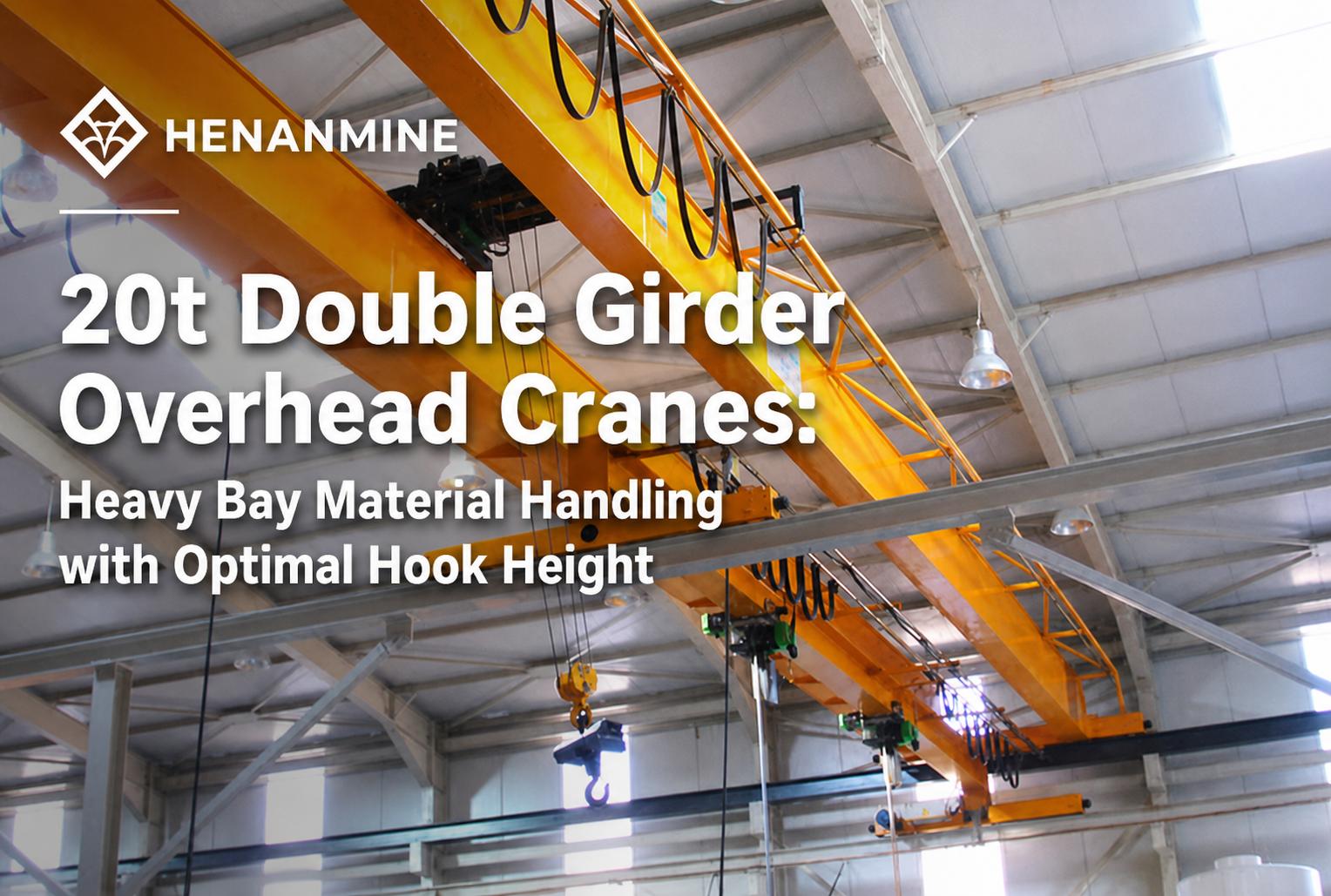
Double Girder Overhead Crane
Specially designed for heavy-duty, large-span and high-intensity operations, it adopts double main girder parallel structure, and the main girder is mostly made of box-type or truss-type high-strength steel, with sufficient overall rigidity and excellent load-bearing performance, which can easily meet the needs of large-tonnage lifting of heavy loads。
And it is suitable for the harsh working conditions and high-load operating environments such as metallurgy and smelting, heavy manufacturing, and port loading and unloading, and it is capable of coping with the continuous heavy-duty lifting task for a long period of time with strong operating smoothness and long service life.
Electric Overhead Traveling Crane (EOT)
Fully electrically driven standardized lifting equipment, relying on electric motors to provide power throughout the entire process, supporting the cab centralized control, wireless remote control of the two mainstream modes of operation, can quickly and accurately complete the lifting and panning of heavy loads, the operational efficiency far exceeds that of the manual model, while having a large span, strong load-bearing capacity, easy to operate, low cost of operation and maintenance, is the mainstream standard model for all types of manufacturing factories, industrial workshops, material handling.
Grab Bridge Crane
Designed for bulk material handling, the whole machine consists of bridge, trolley, grapple mechanism, electrical system and cab, relying on the trolley, trolley linkage shift, with the grapple to complete the whole process of grabbing, transferring and unloading of bulk materials, high operating efficiency, practicality, good operational stability, safety coefficient of full, can be efficiently loading and unloading of various types of bulk materials, such as coal, grain, industrial waste, ore, etc., and is widely used in ports, terminals, thermal power stations, bulk material handling plants and industrial workshops.
Overhead Crane Frame
Structural components are the “skeleton” of the bridge crane, bearing the weight of the whole machine and lifting load, determining the stability of the equipment and the upper limit of load-bearing, mainly including the main girder, end girder, the operating room of the three core parts.
Main Girder
Main girder is the core load-bearing component of the bridge crane, usually made of high-strength rolled steel, the mainstream structure is divided into two categories of box structure and truss structure.
Its core role is to carry the lifting trolley and hoisting mechanism, to provide a smooth track for the lateral operation of the trolley, and at the same time to resist the bending and torsion stresses in the lifting operation, to ensure the stability of the structure under heavy-duty working conditions.
Single girder cranes are equipped with only a single main girder, while double girder cranes are designed with two main girders in parallel, which realizes a qualitative improvement in the overall load-bearing performance.
End Girder
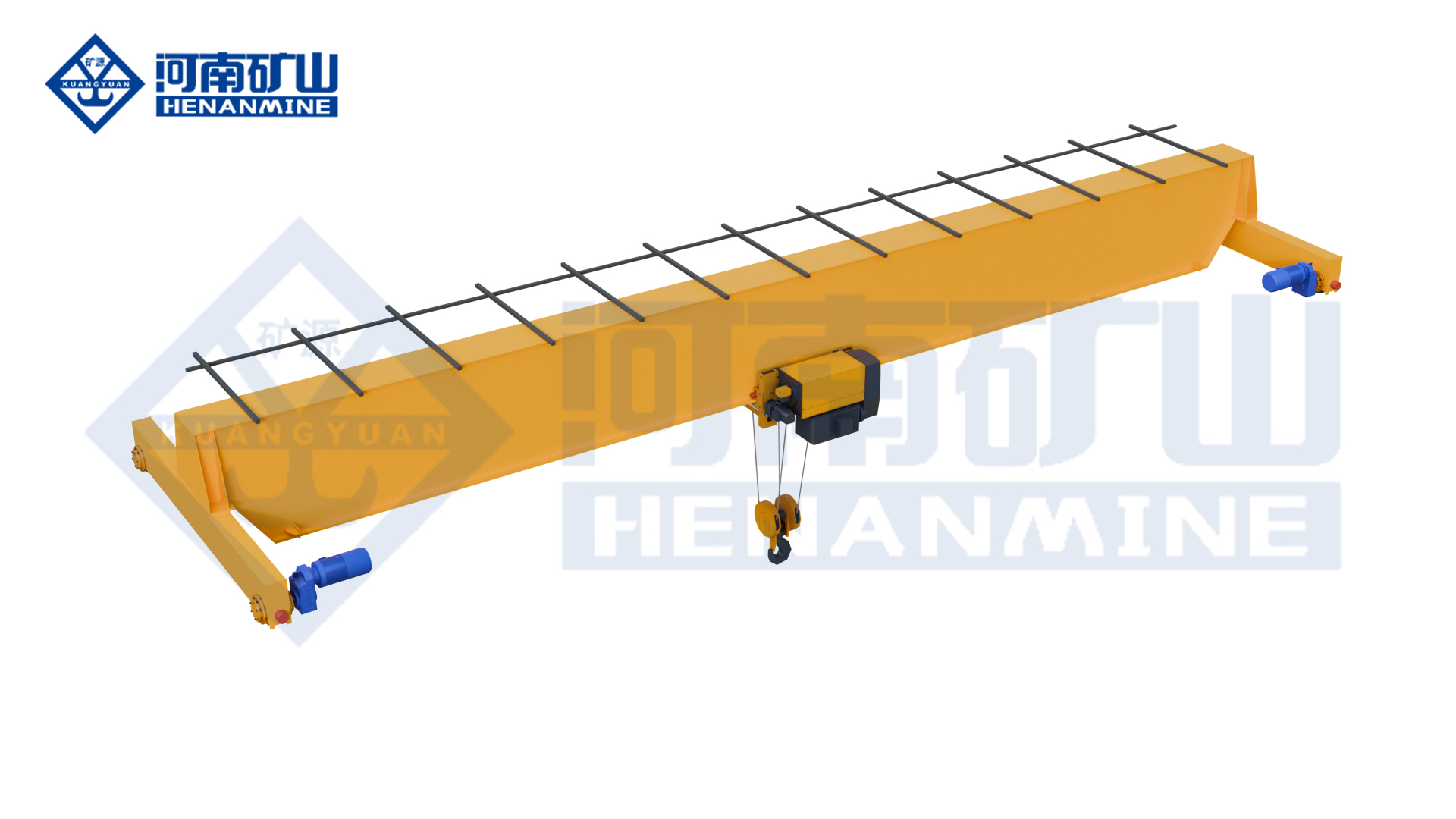
The end girder is connected to both ends of the main girder and spliced with the main girder to form a complete bridge, with running wheels assembled at the bottom, which is not only the load-bearing support of the bridge, but also the core carrier of the whole machine movement.
The end girder not only has to connect the main girder, carry the machine’s self-weight and lifting load, but also has to drive the bridge to move along the track smoothly and horizontally, so the design emphasizes both structural strength and durability to ensure that the machine’s attitude is stable and free of deflection when moving under heavy loads.
Operation Room
The operation room is the exclusive control space for crane operators, which is mostly hung under the main beam or in the position with the best view of the operation, and is equipped with a control desk and cam controller, which can accurately realize a full set of actions such as lifting and panning.
In order to take into account the operator’s comfort and operational safety, the operating room is equipped with open view, ventilation and air conditioning system, with ergonomic seats and rationalized layout, which can effectively alleviate the fatigue of prolonged operation; operators can enter and exit the operating room through vertical or inclined ladders, which can take into account the convenience of access and safety of working at height.
Overhead Crane Traveling Mechanism
The truck running mechanism mainly drives the whole machine bridge to walk horizontally along the track, which is operated by transmission, braking and other components to ensure the smooth movement and accurate positioning of the whole machine, and the core components are explained as follows.
Wheel
Crane wheels are assembled at the bottom of the end beams, divided into two categories of active wheels (driving wheels) and driven wheels, all of which are forged from high-strength alloy steel, with excellent wear-resistant, impact-resistant properties.
The active wheel provides traction to drive the whole machine along the track; the driven wheel assists in smooth traveling and reduces the wear and tear of the track, and after precision processing and debugging, it has low noise and long service life, and bears the whole weight of the whole machine and the load at the same time.
Running Motor
The running motor is the core power source for the horizontal movement of the trolley, which can efficiently convert electric energy into mechanical energy and provide abundant power for the movement of the bridge and trolley; with the speed reducer precisely regulating the rotational speed, it ensures the smooth running of the whole machine and strong traction force.
Reducer (Gearbox)
As the core transmission hub between the motor and the wheel, the gearbox can convert the high-speed rotation of the motor into low-speed, high-torque power output, and accurately adapt to the crane’s smooth start-stop, stable operation requirements.
Brake
Brake is a key safety component of the crane, mostly installed at the end of the motor output shaft, divided into two forms of mechanical brake and electromagnetic brake.
The brake can quickly hold the brake when stopping, overcome the inertia to realize precise parking, and eliminate the risk of equipment skidding and loss of control; the main body is made of wear-resistant material, equipped with overheating protection and automatic adjustment, which can be adapted to the heavy-duty operation scenarios of frequent starting and stopping.
Coupling
The coupling is mainly used to connect the motor and reducer, reducer and wheels, which can efficiently transmit torque and compensate for the small coaxial deviation between the shafts, buffer buffer buffer buffer buffer buffer vibration and impact during operation, protect the transmission parts, and ensure the smooth transmission of power without any loss. Loss-free, no loss, no loss, no loss.
Hoisting Mechanism
Hoisting mechanism is the core working part of overhead crane, specializing in vertical lifting and lowering of heavy loads, single girder cranes are equipped with electric hoists, double girder cranes can choose electric hoists or winch trolleys, and the whole set of mechanism contains several subdivided parts.
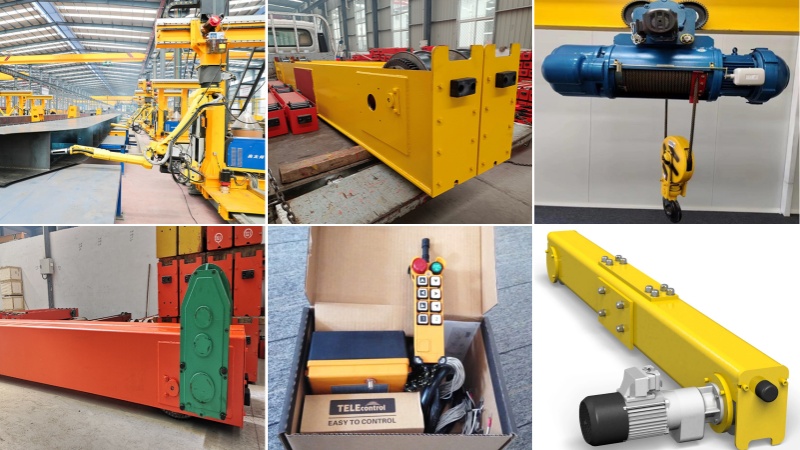
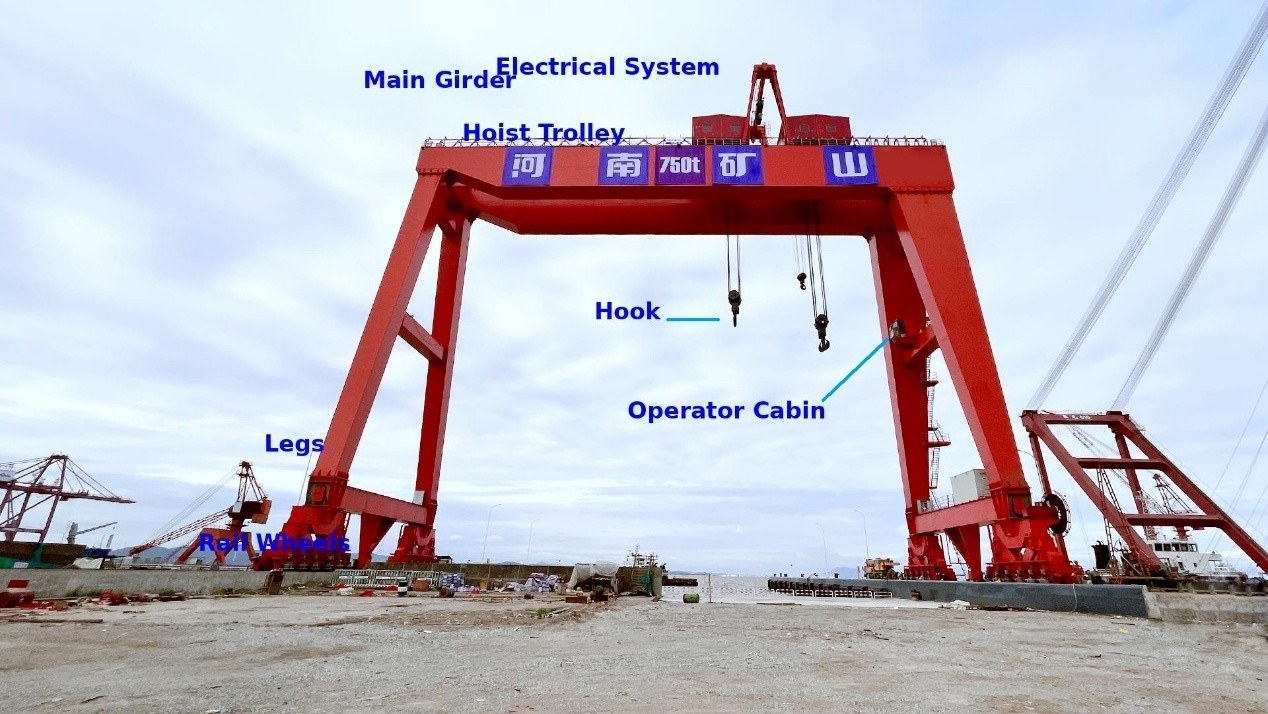
Detailed Diagram of MH Single-Girder Gantry Crane Manufactured by Henan Mine
Hoist and Trolley
Lifting trolley carrying hoist mounted on the main beam, can drive the hoist horizontal movement, with the realization of the space transfer of heavy loads; common types of hoists, including wire rope electric hoist, electric chain hoist, large tonnage double girder cranes are equipped with winch trolley.
Among them, the wire rope electric hoist speed, smooth operation, suitable for more than 10 tons of heavy load; electric chain hoist chain durable, small space occupation, cost-effective, mostly used for 5 tons of light load scenarios.
Pulley Block
Pulley set is divided into fixed pulley and movable pulley, with grooves on the edge, which is used to guide the direction of the wire rope, change the direction of force, and at the same time, disperse the lifting load and enhance the lifting capacity of the equipment.
The fixed pulley is fixed and only changes the direction of the wire rope; the dynamic pulley lifts and lowers with the load, which reduces the pulling force required for lifting, and the combination of multiple sets of pulleys can greatly increase the upper limit of the load capacity.
Hook
As the core load bearing component for direct loading of heavy loads, the hook is made of high strength alloy steel and forged as a whole, equipped with anti-dislodgement safety tongue as standard, which can effectively eliminate the risk of heavy loads slipping off during the lifting process.
The single hook is suitable for light and medium load lifting, while the double hook can evenly share the pressure of heavy loads and provide better operational stability; the hook supports 360° rotation, which facilitates loading and unloading of heavy loads at multiple angles and greatly enhances operational flexibility.
In addition to the standard hooks, it can also be equipped with grapples, electromagnetic suction cups and other special lifting tools according to the working conditions. The single hook is suitable for light and medium load lifting, while the double hook can evenly share the pressure of heavy loads for better operational stability;
Lifting Motor
Lifting motor provides the core power for vertical lifting and lowering, focusing on high torque and low rotational speed, with large starting torque, which can be started smoothly with load, and with frequency conversion system to realize accurate speed regulation; reducer converts high speed of the motor into high torque output, which ensures smooth lifting; brake is responsible for locking the load, preventing the heavy load from falling down from the height, and locking it immediately after the shutdown, which ensures the safety of lifting.
Wire Ropes
Reel is a part of winding wire rope, the surface with regular grooves, to prevent wire rope slippage, overlap, and extend the service life of the wire rope; wire rope connects the hook, pulley set and reel, through the reel to realize the heavy lifting and lowering, the use of different diameters, tensile strength of the wire rope, which can be adapted to the indoor and outdoor, anticorrosive, and other different scenarios.
Specialized Spreader
Specialized spreaders can be adapted for special materials: grab overhead cranes are equipped with grabs to efficiently complete bulk material loading and unloading operations; electromagnetic suction cups are specially used for steel, iron and other magnetic materials handling, to meet the needs of diversified lifting scenarios in an all-round way.
Electrical and Control Systems
The electrical and control system provides power for the crane, realizes the transmission of operation instructions, and is the “nerve” and “brain” of the equipment, which is divided into two major parts: the power supply components and the control system.
Power Supply Components
Mainly includes sliding contact line and power supply cable: sliding contact line is installed on one side of the track, consisting of copper/aluminum conductive rail, collector and insulated bracket, providing continuous power supply for the moving crane; power supply cable is arranged with cable trolley and drag chain, which is moved along with the bridge and trolley to avoid tugging and damaging, and provides stable power transmission for the hoisting and operating mechanism.
Detailed Diagram of MH Single-Girder Gantry Crane Manufactured by Henan Mine
This crane meets the core lifting equipment needs of small and medium-sized factories, logistics parks, construction sites, and similar scenarios. It offers cost-effectiveness, user-friendly operation, strong adaptability, and low maintenance costs.
Control
- Driver’s cab control: the operator completes all the actions through the console in the operation room, with a wide field of vision and precise control, suitable for heavy loads and complex lifting scenarios.
- Remote control: with wireless signal transmission, the operator can control from the ground, high flexibility and strong safety, suitable for poor vision and risky operating environment.
- Hand control: Wired hand-held control box, button operation is simple and convenient, suitable for short distance, simple lifting tasks, the operator can observe the load in close proximity to realize precise fine-tuning.
Rail System
Rail and running beam is the “walking roadbed” of the crane, providing support and guidance for the movement of the whole machine, which directly affects the stability of operation.
Rails
The rail is fixedly installed on top of the load bearing beam of the building, and is made of high-strength steel with excellent wear and impact resistance, and the commonly used types include profiled steel rails and I-beam rails. Installation stage needs to strictly control the level and parallelism, to avoid the crane running off, shaking; daily need to regularly check the wear and tear, firmware loosening, lubrication and maintenance, so as to extend the service life of the track.
Running Beam
Running beam is the core foundation component to support the track, mostly installed in the building column or independent bracket, need to have sufficient structural strength and rigidity, can smoothly withstand the crane’s dead weight, lifting loads and running impact.
The material is mostly high-strength steel or concrete, the installation must ensure that the level of straight, to prevent foundation settlement, beam bending triggered by operational failures.
Safety Protection Devices
Safety protection device is the key configuration to prevent accidents and guarantee the safety of man and machine, which is a standard component of overhead travelling crane and is indispensable.
- Overload limiter: automatic warning when the load reaches 90% of the rated load, and cut off the power immediately when the overload reaches 105%, forbidding illegal overload operation.
- Limiter: divided into rising limit and travel limit, it can prevent the hook from overtopping and the bridge/trolley from over-traveling to avoid the risk of collision.
- Emergency power-off switch: set up in the power distribution cabinet, it can quickly cut off the total power supply under sudden working condition and stop the whole machine action immediately.
- Buffer: installed at the end of the bridge, effectively absorbing the impact of the collision, reducing the degree of damage to the equipment and building structure.
- Warning device and lighting: the warning bell reminds the site personnel to avoid in real time, and the working lighting ensures the working vision and operation safety under the dim working condition.
How to Select the Right Overhead Crane System for Your Business?
The core of selecting a bridge crane is to match the component configuration with the operational requirements, focusing on the following points:
Assess Your Business Needs
First of all, accurately calculate the maximum load weight of daily lifting, light and medium-sized, small tonnage load priority selection of single girder cranes with electric hoists, low cost of the whole machine, small footprint, easy operation and maintenance; large tonnage, large span operation scenarios, need to choose double girder cranes, with winch trolley to enhance the load-bearing and stability to eliminate overloading operation risks, and to protect the safety of heavy-duty operations.
Evaluate Working Conditions
Indoor conventional dust-free, no special risk of the workshop warehouse, the choice of standard bridge cranes can meet the needs; outdoor open air, wet corrosion, flammable and explosive, dust-free clean and other special scenes, you must choose the corresponding protection level of the special models, such as explosion-proof, anti-corrosion, clean crane, to adapt to the harsh working conditions, to extend the service life of the equipment.
Safety and Compliance
Three shifts, continuous operation of high-frequency use of the scene, you need to use high-strength wear-resistant, anti-fatigue core components, the machine with solid materials, harsh technology, to protect the long-term stable operation of high-load; occasional lifting, low-frequency operation of the scene, you can prioritize the cost-effective, choose the basic model to meet the needs of the use of the same time to control the cost of procurement.
Convenience of Maintenance
Focus on the selection of component versatility, prioritize the use of adequate spare parts on the market, replacement of simple models, to avoid niche non-standard parts lead to maintenance difficulties, high costs; at the same time, choose the maintenance process is simple, fast after-sales response brand, reduce equipment downtime, reduce long-term operating costs.
Conclusion
Every part of the bridge crane has its own function and synergistic power, from load-bearing skeleton to power components, from the control system to safety devices, all of which are indispensable.
Reading and understanding the functions and characteristics of the components can not only improve the efficiency of daily operation and maintenance, but also accurately match the needs when selecting the model to avoid the waste of resources.