
100t Bridge Cranes High-Tonnage Crane Solutions for Heavy Engineering Bays
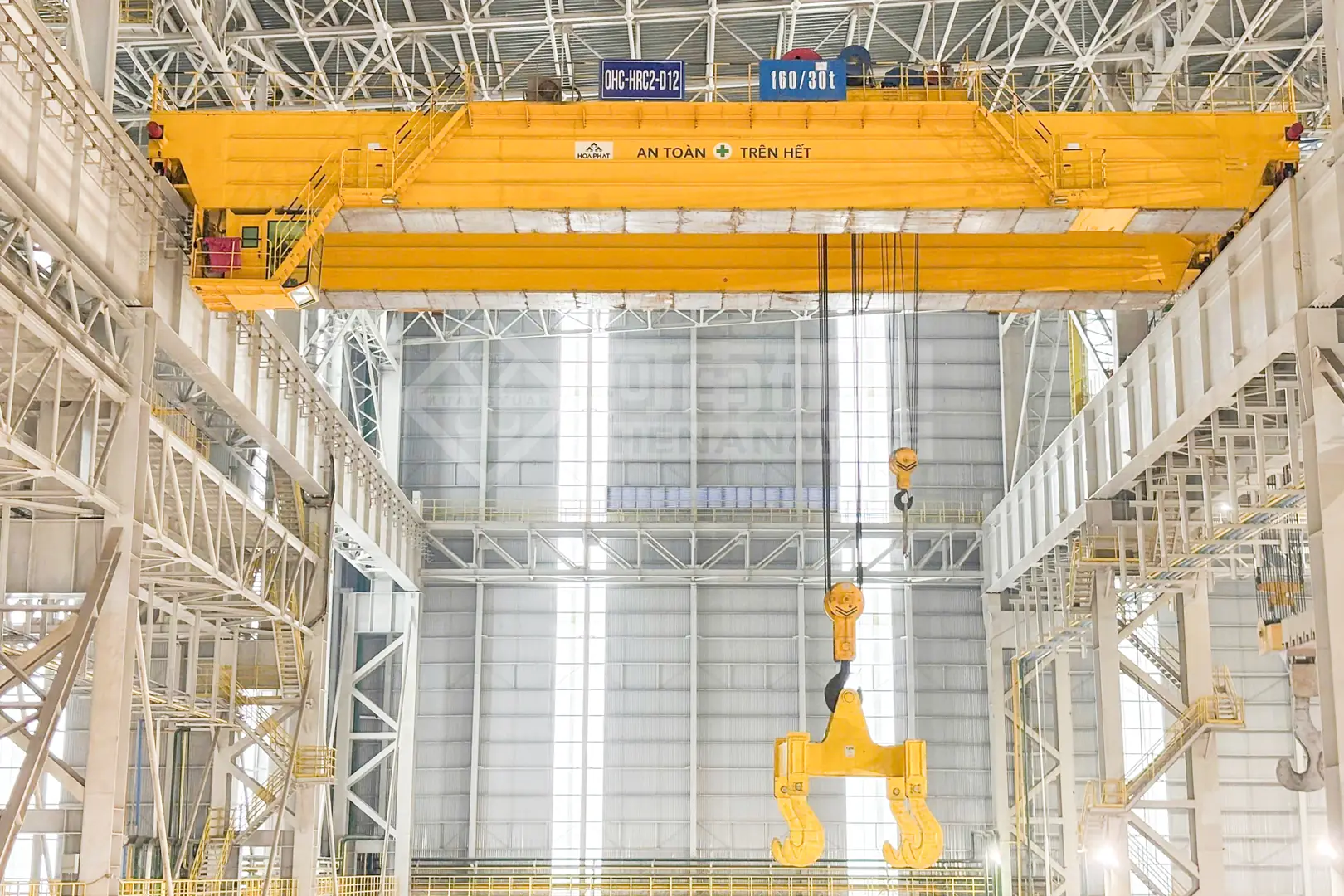
In heavy industry scenarios such as heavy engineering, metallurgical processing, and ship construction, there are widespread requirements for high-intensity operations such as 100-ton bulk transshipment, equipment assembly, and component hoisting. Traditional small and medium-tonnage cranes have insufficient carrying capacity and adaptability to working conditions, making it difficult to adapt to strict production standards.Relying on a high-strength double-main beam structure, a stable electronic control system and multiple safety protection design, the 100t bridge crane has strong carrying capacity and high operating stability. It can be adapted to large-span, high-frequency, and heavy-duty workshop operation scenarios. It is the core heavy-duty hoisting solution for modern heavy-duty engineering workshops.
Where Are 100t Overhead Cranes Used?
Heavy engineering plants
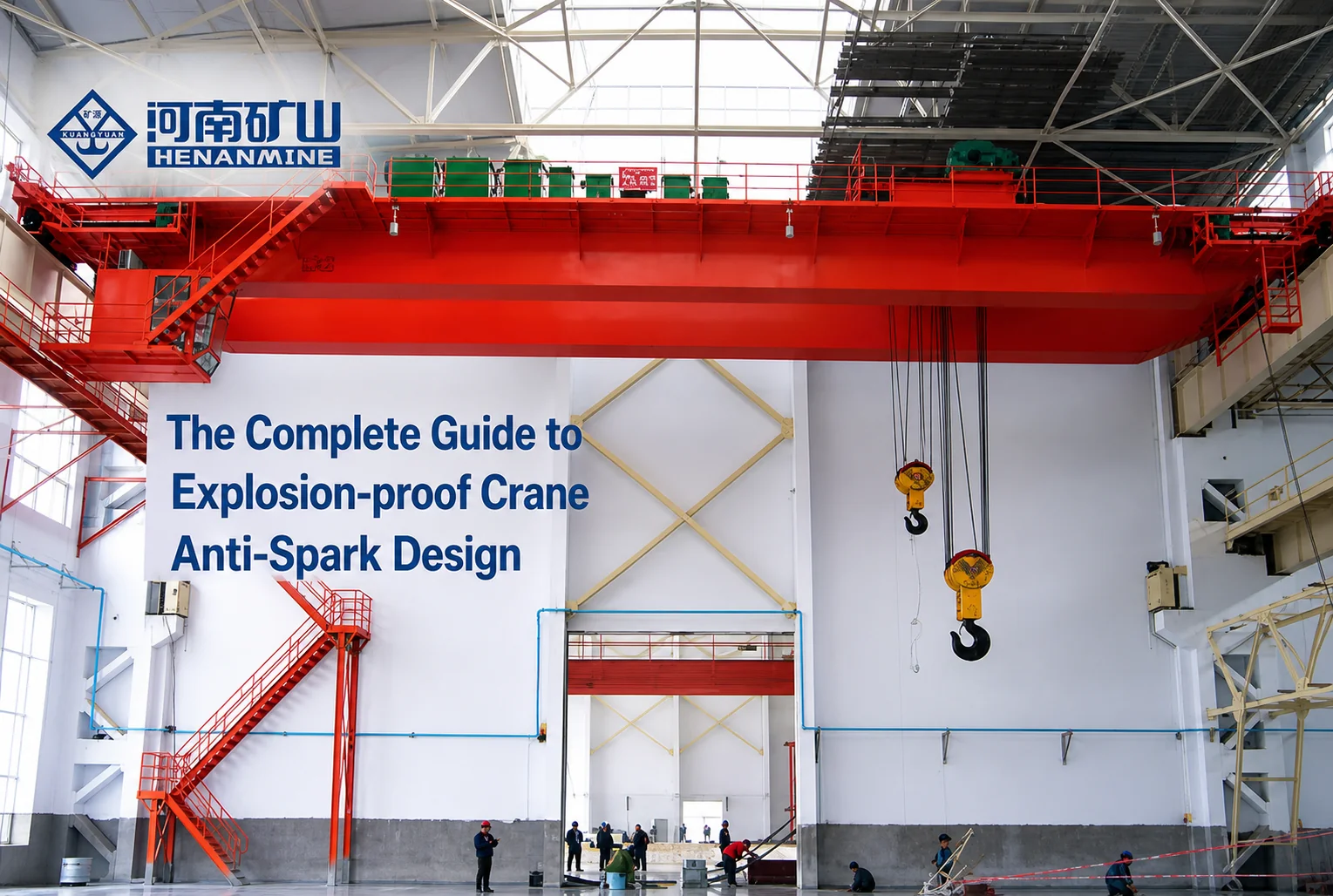
The heavy-duty engineering workshop is the core application scenario of Henan Mine Crane manufactured100t bridge crane.Such workshops mainly undertake the processing, assembly, transportation and maintenance of large-scale construction machinery, heavy-industry equipment, and large-scale structural parts. The daily hoisting load generally reaches the level of tens of tons to hundreds of tons, and the load-bearing capacity, smooth operation and operating span of the crane are extremely demanding.The 100t bridge crane can cover the entire working space of the workshop, accurately complete the precise alignment, vertical lifting and horizontal transfer of large racks, heavy-duty bases, and complete tooling molds, and effectively solve the pain points of difficult lifting, low efficiency, and high safety risks in heavy industry workshops.At the same time, the equipment can be adapted to the normal continuous operation mode of the workshop, greatly improving the production coherence of the heavy engineering assembly line, and it is the standard equipment for the standardized production of heavy industry workshops.
Steel and metal processing
The steel and metal processing industry has harsh working conditions, concentrated loads, and high operating frequency. It is the core application field of large-tonnage cranes.In the processes of steel smelting, rolling, profile processing, and non-ferrous metal forging, heavy-duty materials such as steel ingots, thick steel plates, large steel coils, and smelting equipment components need to be hoisted frequently. The weight of a single group of materials is generally close to or reaches the level of 100 tons.With its super heavy-duty performance, the 100t bridge crane can stably complete heavy-duty hoisting operations under high temperature and dust conditions, and is suitable for the full-process operation needs of smelting workshops, hot-rolling workshops, and finished product storage workshops.The equipment adopts customized accessories with wear-resistant and high temperature resistance, which can withstand the harsh operating environment of the metallurgical industry, reduce equipment losses, and ensure the uninterrupted and stable operation of the steel processing production line for 24 hours.
Shipbuilding facilities
Shipbuilding belongs to the ultra-large component assembly industry. The core components such as hull segments, large marine engines, propellers, deck equipment, and cabin structural parts are heavy in weight, large in size, and high in hoisting accuracy. It relies on large-tonnage bridge cranes to complete the core process operations.In the ship's workshop, the 100t bridge crane can realize the precise hoisting, alignment and splicing of the segments of the oversized hull, as well as the installation, maintenance and disassembly of large-scale marine equipment.Compared with mobile lifting equipment, the fixed track operation mode of bridge cranes has stronger operating stability and wider coverage, which can effectively avoid the shaking and offset problems of large-scale component hoisting, and greatly improve the accuracy of ship assembly and construction safety. It is the core lifting equipment of modern ship manufacturing buildings.
Heavy equipment manufacturing
In the manufacturing fields of heavy equipment such as construction machinery, power generation equipment, mining machinery, and rail transit equipment, the core components and the assembly links of the whole machine require the support of large-tonnage lifting equipment.Large excavator fuselage, wind power tower accessories, hydroelectric generator sets, mining heavy equipment and other products, a single piece can weigh up to 100 tons, the assembly process requires accurate and stable heavy-duty hoisting cooperation.The 100t bridge crane can be perfectly adapted to such scenarios, completing the whole process of heavy-duty parts transfer, assembly of the whole machine, equipment pressure test, and finished product out of the warehouse.The equipment can match the beat of the production line, adapt to the production needs of high frequency, high precision and large loads, effectively improve the production efficiency and assembly accuracy of heavy equipment, and help heavy equipment enterprises to mass produce on a large scale.
Key Specifications of a 100t Overhead Crane
Lifting height and span
Lifting height and span are the core parameters that determine the adaptability of the 100t bridge crane site, and directly determine the operating coverage of the equipment.Under industry standard working conditions, the conventional lifting height of 100t bridge cranes covers mainstream specifications such as 12m, 16m, 18m, and 20m, which can meet the vertical hoisting needs of most heavy-duty workshops. At the same time, non-standard customization can be made according to the height of the plant floor, the height of the equipment stacking, and the limit height of the workpiece hoisting.The span of the equipment is extremely adaptable, with a standard span range of 10.5m to 31.5m, which can be adapted to heavy industry workshops, metallurgical workshops, and ship workshops of different widths.The combination of reasonable span and lifting height can maximize the use of workshop space and avoid blind spots in operations. At the same time, it ensures that heavy workpieces are lifted vertically and move horizontally without blocking, and it is suitable for all kinds of large-scale hoisting scenarios.
Hoist and travel speeds
The three speed parameters of the lifting speed of the lifting trolley, the operating speed of the cart, and the operating speed of the trolley directly affect the operating efficiency and hoisting stability of the equipment.The 100t large-tonnage crane is different from the small and medium-tonnage equipment. It adopts a low-speed stable crane and a speed design with adjustable speed, taking into account efficiency and safety.In the no-load state, the speed can be appropriately accelerated to improve the efficiency of material transfer.Automatic low-speed operation under heavy-duty 100-ton working conditions, effectively suppressing the shaking and offset of heavy objects, and ensuring the accuracy of hoisting.Under the standard configuration, the lifting speed is adapted to the requirements of heavy-duty and low-speed, and the walking speed of large and small vehicles is uniform and stable. With a frequency conversion speed control system, it can achieve no impact on start and stop and no shaking in operation. It is perfectly adapted to the operation requirements of precise alignment and precision assembly of heavy-duty components, and eliminates safety hazards caused by high-speed heavy loads.
Working class
The working level is the core index that measures the adaptability of Henan Mine Crane manufactured100t bridge crane to working conditions, which represents the load status of the equipment and the operating frequency adaptation level.The mainstream 100t bridge crane in the industry has working levels of A5 and A6, which are suitable for industrial operation scenarios of different intensities.Among them, the A5 level is suitable for medium-frequency and intermittent operation scenarios, and is suitable for conventional heavy industry workshops, equipment maintenance, and low-frequency material transfer conditions.The A6 level is a heavy-duty work level, which is suitable for harsh scenarios of steel metallurgy, batch heavy industry production, and high-frequency continuous operations. It can withstand heavy-duty and high-frequency start-stop operations for a long time, and has higher structural fatigue strength and stronger durability.Customers can choose the corresponding work level according to the frequency and load time of their own production line to avoid equipment overload loss or performance waste.
Duty cycle
The working cycle parameters determine the continuous operating capacity and service life of the 100t bridge crane, and the core reflects the load continuity rate and tolerance performance of the equipment.Large-tonnage lifting equipment has extremely high requirements for the working cycle. The 100t bridge crane adopts an optimized motor and electronic control system, and the standard load continuity rate can reach 25%~40%, which can meet the needs of normalized continuous operation in industrial workshops.In high-frequency operation scenarios such as steel processing and batch equipment manufacturing, the equipment can achieve long-term, uninterrupted heavy-duty operation without motor overheating, system overload, structural fatigue and other problems.Stable work cycle performance can be effectively adapted to the two-shift and three-shift production modes of heavy industry enterprises, greatly reducing the probability of equipment downtime and ensuring the continuous and stable operation of the production line.
How to Choose the Right 100t Overhead Crane
Girder configuration
The main beam structure is the core load-bearing structure of a 100t bridge crane, which directly determines the bearing capacity, stability and service life of the equipment. When selecting the type, priority should be given to matching the requirements of the working conditions.Under heavy-duty conditions with a large tonnage of 100 tons, the double main beam structure is the preferred configuration. Compared with the single main beam, the double main beam has more uniform force, greater structural stiffness, and stronger deformation resistance. It can withstand heavy loads of 100 tons for a long time, effectively avoiding problems such as bending and structural fatigue of the main beam.The double-main beam structure is equipped with high-strength alloy steel, and the overall load-bearing performance and impact resistance are greatly improved, and it is suitable for high-frequency, heavy-duty and long-span operation scenarios.For some lightweight and intermittent operation scenarios, the cross-section specifications of the main beam can be optimized according to the actual load requirements, and the equipment cost can be controlled under the premise of ensuring safety, so as to achieve a balance between performance and cost performance.
Top-running vs. under-running
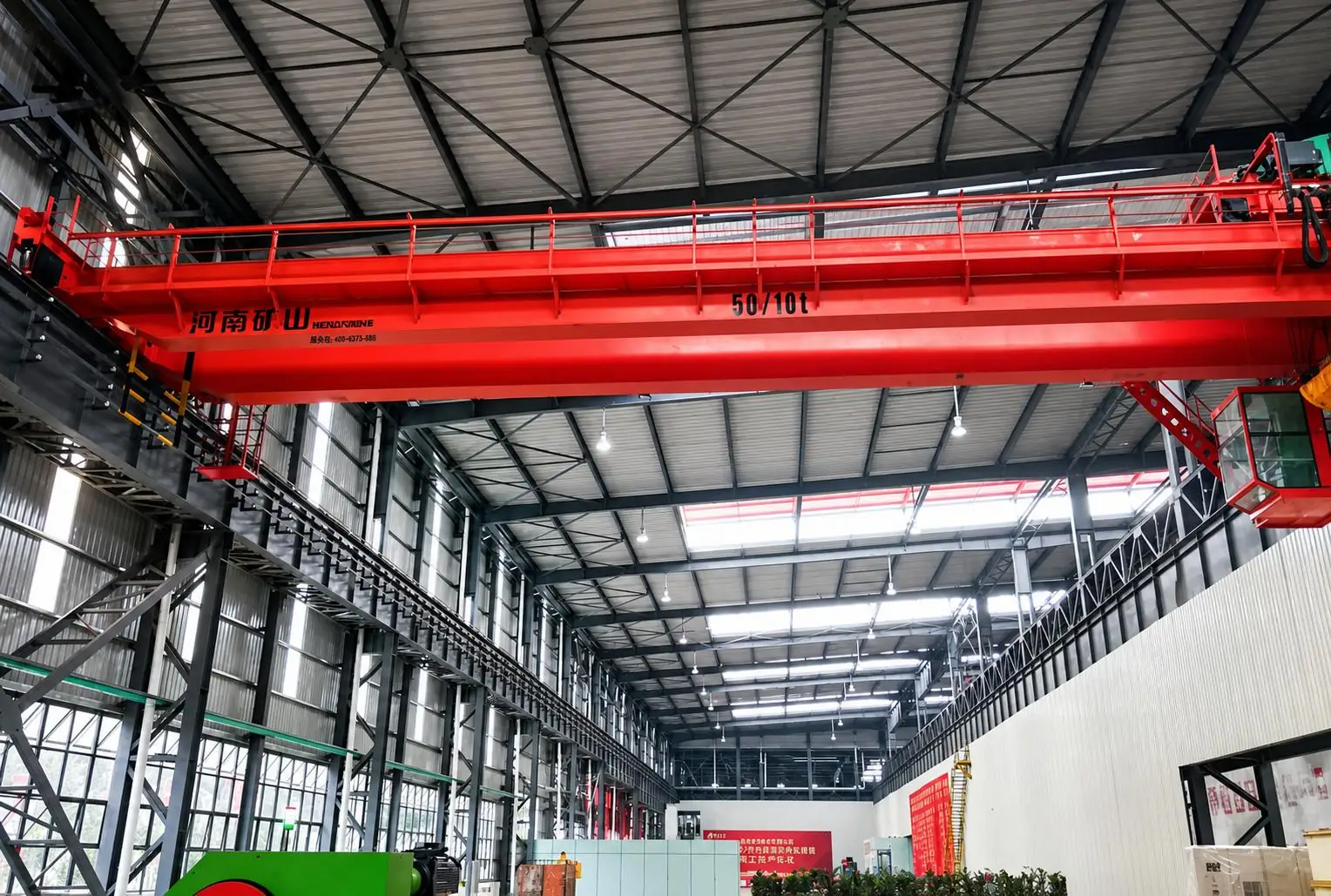
Overhead and suspended installation methods are the key points in the selection of 100t bridge cranes, and the core is adapted to different plant structures and space conditions.The overhead crane track is installed on the top of the column leg or roof beam of the plant. It has a strong load-bearing capacity and high operating stability. It is the mainstream choice for 100t large-tonnage equipment. It is suitable for standard heavy industry plants, large-span, and high-load operation scenarios. It is convenient for late maintenance and has a longer service life of the equipment.The suspended crane track is suspended under the roof of the plant, which takes up less space as a whole. It is suitable for low-rise, old factories, and space-restricted operation scenarios, but the upper load-bearing limit and operating stability are slightly lower than that of the overhead type.When selecting the type, it is necessary to combine the load-bearing structure, floor height conditions, and operating load of the plant, and give priority to the appropriate installation form to eliminate structural safety hazards.
Workshop space
The spatial parameters of the plant are the basic prerequisites for crane selection, which directly determine the span, lifting height, overall size and installation plan of the equipment.Before selecting the type, it is necessary to accurately measure the core data such as the headroom height of the plant, the spacing of the track columns, the effective operating width of the plant, and the layout of the ground equipment.For the standard new heavy industry plant, it can directly match the standard span and standard lifting height of the 100t bridge crane, which has strong adaptability, low installation cost and fast delivery speed.For special scenarios where old factories, non-standard factories, and equipment are densely laid out, it is necessary to customize and optimize the dimensions of the equipment, track installation location, and end size in combination with on-site space constraints, so as to avoid interference between the equipment and the plant structure and on-site equipment, maximize the use of limited workshop space, and ensure that there are no blind spots in the operation.
Load requirements
Load requirements are the core basis for the selection of Henan Mine Crane manufactured cranes. It is strictly forbidden to blindly select the crane based on the maximum lifting weight.When selecting the type, it is necessary to comprehensively consider the four core elements of maximum rated load, conventional operating load, hoisting workpiece size, and hoisting working condition complexity.The conventional configuration of the 100t bridge crane is 100 tons of main hook, which can be used with 10 tons and 20 tons of auxiliary hooks to take into account the heavy-duty lifting of large pieces and the transfer of light-load small pieces to improve operational flexibility.At the same time, it is necessary to reserve 10%~20% of the safety load margin to avoid long-term full load and overload operation of the equipment, and effectively avoid safety issues such as deformation of the main beam, motor overload, and structural fatigue.For special working conditions such as high temperature, outdoor, and high dust, additional load loss needs to be considered, and the corresponding heavy-duty protection configuration needs to be adapted to ensure the long-term stable carrying of equipment.
100t Overhead Crane Safety and Performance
Overload protection
Overload protection is the core safety line of defense of 100t bridge cranes, which prevents major safety accidents such as equipment damage, collapse, and heavy objects falling due to overload operations.All Henan Mine Crane manufactured100t bridge cranes come standard with an intelligent overload protection system and are equipped with high-precision weight sensors, which can accurately monitor the lifting load in real time.When the hoisting weight is close to the rated load threshold, the system automatically issues a sound and light warning to remind the operator to standardize the operation.When the load exceeds the rated load of 100 tons, the system immediately automatically cuts off the lifting power supply, locks the lifting action, and prohibits the equipment from continuing operation.At the same time, the system has a data recording function, which can retain load operation data throughout the process to facilitate later traceability and investigation, eliminate overloading and illegal operations from the root cause, and ensure the safety of equipment and on-site construction.
Braking systems
Large-tonnage heavy-duty hoisting requires extremely high braking performance, and a reliable braking system is the key to smooth start and stop of equipment, precise positioning, and anti-slip vehicles.The 100t bridge crane adopts a multi-brake protection design, and the lifting mechanism, cart operating mechanism, and trolley operating mechanism are all equipped with independent braking devices, and the dual protection modes of electromagnetic braking and mechanical braking are adopted.During normal operation, electromagnetic braking achieves smooth deceleration, start and stop, no impact and no shaking.In emergency working conditions or power failure, the mechanical brake locks instantly to prevent heavy objects from slipping, equipment from slipping, and position offset.The braking system has been strengthened and optimized for heavy loads, with strong wear resistance, fast response speed and low failure rate. It can be adapted to high-frequency and large-load start-stop operations to ensure the stability and safety of hoisting for a long time.
Load control
The ability of precise control of heavy loads directly determines the accuracy and construction efficiency of hoisting operations, and is the core guarantee for the assembly of heavy equipment and the hoisting of precision components.The 100t bridge crane is equipped with a frequency conversion intelligent load control system, which can realize stepless speed regulation and smooth start and stop, completely solving the pain points of heavy-duty start and stop shaking and offset of traditional cranes.The system can automatically match the operating speed according to the load weight, stable lifting of heavy loads at low speeds, and efficient transportation of light loads. It is suitable for complex scenarios such as precise alignment of large components, precise installation of equipment, and operation in small spaces.At the same time, it is equipped with anti-swing control function, which can effectively suppress the swing amplitude of heavy objects, greatly reduce the difficulty of hoisting and alignment, improve operating accuracy, reduce workpiece bumps, installation deviations and other problems, and adapt to the needs of high-end heavy industry precision operations.
Inspection and maintenance
Standardized inspection and maintenance are the core keys to extend the service life of Henan Mine Crane manufactured100t bridge crane, avoid the risk of failure, and ensure long-term stable operation.Standardized processes need to be established for daily operation and maintenance: daily inspection of the brake system, limit device, early warning equipment, and wire rope wear status, and timely troubleshooting of simple faults.Weekly inspection of the main beam structure, track flatness, motor operating status, and sensitivity of the electronic control system.Lubricate, overhaul and replace vulnerable parts such as reducers, bearings, brake pads, etc. every month.A comprehensive inspection of the whole machine is carried out every year, including special work such as structural flaw detection, load verification, and system debugging.Regular maintenance can effectively avoid structural fatigue, component aging, system failure and other problems, greatly reduce the equipment failure rate, extend the service life of the equipment, and ensure the long-term safe and efficient operation of the production line.
Why Choose a Customized 100t Overhead Crane?
Workshop-specific design
It is difficult for standardized cranes to adapt to all non-standard factories and special working conditions, while customized 100t bridge cranes can achieve one-to-one workshop exclusive adaptation.There are obvious differences in the plant structure, column spacing, equipment layout, operating procedures, and types of hoisting workpieces of different enterprises. Standardized equipment is prone to problems such as poor space adaptation, many blind spots in operation, and redundant or insufficient functions.Customized services can optimize the span, dimensions, operating range, and functional configuration of the equipment in a targeted manner based on the measured data, production process flow, and operating habits of the customer's workshop, so that the equipment can fully fit the working conditions of the workshop and can be perfectly adapted without retrofitting the workshop, maximizing the workshop space utilization rate and operating efficiency, and adapting to all kinds of new, old, and non-standard heavy industry workshops.
Limited headroom solutions
A large number of old heavy industry factories, low-rise workshops, and factories with dense top pipelines have problems such as insufficient floor height and limited headroom, and standardized large-tonnage cranes cannot be installed and used.Henan Mine Crane manufactured customized 100t bridge crane can provide exclusive low-headroom solutions. By optimizing the trolley structure, compressing the headspace of the equipment, and adjusting the layout of the lifting mechanism, the overall height of the equipment can be greatly reduced without reducing the rated load and losing operating performance, and it can be adapted to the installation conditions of low-rise factories.The solution does not need to change the main structure of the plant and does not need to dismantle the top pipeline equipment. It can realize 100-ton heavy-duty hoisting operations, perfectly solving the problem of large-tonnage hoisting in restricted-floor workshops, and providing low-cost and high-efficiency solutions for the upgrading and upgrading of old workshops and the improvement of production capacity.
Customized lifting parameters
The hoisting requirements of different industries and different workpieces vary greatly, and the customized parameter configuration can accurately match the individual operation requirements.Customers can flexibly customize core parameters such as lifting height, equipment span, operating speed, working level, and load ratio according to their own working conditions. At the same time, they can match exclusive functions such as double hook linkage, synchronous hoisting, intelligent remote control, and precise positioning as needed.According to the high-temperature working conditions of the steel industry, the high-temperature protection configuration can be customized.For precision hoisting of shipbuilding, the anti-swing and precise alignment system can be optimized.For high-frequency continuous operation, the heavy-duty working level and enhanced motor configuration can be upgraded.Personalized parameter customization, completely avoid the problem of waste of standardized equipment performance or insufficient adaptation of working conditions, and achieve accurate matching of equipment performance and production requirements.
Long-term operating efficiency
The core advantage of customized 100t bridge cranes is that they can maximize the long-term operating efficiency of enterprises and reduce comprehensive production costs.The exclusive customized equipment fully fits the operation beat of the production line and adapts to all hoisting scenarios in the workshop, effectively reducing the blind spots of the operation, reducing the time-consuming hoisting, and improving the efficiency of production flow.At the same time, targeted operating condition configuration can greatly reduce the probability of no-load operation, overload loss, failure and shutdown of equipment, and reduce late maintenance costs and equipment losses.With intelligent electronic control, energy-saving motors, and wear-resistant reinforced accessories, the equipment has lower energy consumption, stronger stability, and longer service life for long-term operation.From the perspective of long-term operation, customized equipment can greatly increase production capacity, reduce operation and maintenance costs, avoid downtime losses, and create higher long-term economic benefits for enterprises.
Henan Mine Crane Factory Custom
As the core lifting equipment in the field of heavy engineering, 100t bridge cranes cover the needs of heavy-duty operations in all scenarios such as iron and steel metallurgy, shipbuilding, heavy industry equipment, and large-scale engineering workshops.Scientific parameter selection, standardized safe operation and maintenance, and exclusive customized design are the keys to ensure the efficient, stable and safe operation of equipment.As a professional large-scale crane manufacturer, Henan Mine Crane Factory can provide a complete set of standardized and customized 100t bridge crane solutions, from site survey, program design, equipment production, installation and commissioning to after-sales maintenance, to provide one-stop full-process services, accurately adapt to various heavy-duty and heavy-duty working conditions, and help enterprises produce efficiently and safely.