
Metallurgical Overhead Crane Cost Guide: High-Temperature Specs & Pricing
The price difference of metallurgical bridge cranes often comes from actual working conditions, not just lifting weight and span.Lifting molten metals such as molten steel and ladles has different requirements for heat-resistant protection, braking system and safety protection than handling heated steel.When selecting models, only by clarifying the lifting object, working frequency, thermal radiation conditions and scope of supply can the quotation of metallurgical bridge cranes be reasonably evaluated, so as to avoid underestimating the cost in the early stage and increasing the cost of transformation due to insufficient safety configuration in the later stage.
How Much Does a Metallurgical Overhead Crane Cost?
Capacity and cost differences
The increase in tonnage usually changes the lifting mechanism, bridge cross-section, wheel load and drive configuration, but the price of metallurgical bridge cranes will not simply increase in proportion to the number of tons.Under the same rated load, the cost of equipment with larger spans, higher hoisting, or auxiliary hooks may still be significantly different.Ladle cranes also need to consider the weight of the ladle, the spreader and the process action; if the type is only selected according to the net weight of the metal, the load will be underestimated and the price comparison of different suppliers will lose its basis.
Customization cost factors
The additions in the customized quotation of metallurgical bridge cranes often come from double-lifting synergy, special hanging beams, space-restricted layout, thermal insulation and fault recovery solutions.The higher the degree of customization, the more design verification, manufacturing, and commissioning work is usually done, and the delivery cycle may also change.Quotation splitting should distinguish between standard equipment, necessary configuration for working conditions and optional functions, and clarify whether the renovation of the plant will be charged separately; otherwise, the lower initial price may just miss the items that must be purchased in the end.
Which High-Temperature Specifications Affect Crane Pricing?
Heat-resistant lifting mechanisms
The selection of high-temperature lifting mechanism involves wire ropes, hook sets, pulleys, reels and lubrication conditions, and cannot be done only by replacing a heat-resistant rope.Thermal radiation will change the temperature and lubrication state of the parts, and the lifting of molten metal will put forward higher requirements for the maintenance of the load after failure.The cost of metallurgical bridge cranes therefore includes structural and institutional verification, applicable materials and necessary protection.The specific temperature resistance range needs to be implemented into the components and exposure methods, and cannot be directly replaced by the material temperature.
High-temperature motors and brakes
The high-temperature motor needs to be selected in combination with the insulation system, temperature rise, ambient temperature and working system. The insulation level is not equal to the ambient temperature at which the motor can operate at the same value.The brake must also check the braking energy, operating frequency and thermal influence.The Kony ladle crane information lists the configurations of H-class insulated motors, temperature protection, and reel backup braking; these are specific product plans and cannot be regarded as a unified list of all equipment, but they illustrate the technical differences in the quotation of metallurgical cranes.
Thermal insulation and shielding
Heat shields are usually arranged under the main beam, near the spreader, or in key electrical locations to reduce the impact of radiant heat on the equipment.The effect depends on the direction, spacing, coverage and maintenance status of the heat source. Simply increasing the thickness of the heat insulation layer may not solve all the problems.The price of a pyrometallurgical crane may also include heat insulation brackets, replaceable panels, and heat dissipation arrangements.The design must avoid shielding structures that hinder maintenance, accumulate dust, or hinder the heat dissipation of components, so that heat-proof measures can form a complete plan.
Heat-resistant cables and controls
Heat-resistant cables need to meet the actual temperature, bending frequency, mechanical wear and possible splash exposure at the same time. The high temperature resistance of the sheath does not mean that the entire power supply system is suitable.The heat insulation, air conditioning, routing path and connecting parts of the control cabinet also affect the reliability.The quotation for Henan Mine Crane Factory supply metallurgical bridge cranes should indicate the cable specifications, laying method and configuration of the electric control room separately; removing key control components from the heat source is sometimes more effective than raising the cable level separately, but the overall thermal conditions still need to be verified.
Radiation protection for operators
The radiation protection here mainly refers to the thermal radiation generated by the furnace mouth and molten metal, not nuclear radiation shielding.The cab may require heat insulation, applicable glass, air conditioning and reasonable line of sight design; remote operation involves camera, communication, operation interface and safety control.The cost of metallurgical bridge cranes should be compared with a complete man-machine system, rather than just the presence or absence of a cab.Remoting can change the exposed location of personnel, but it cannot automatically replace the heat protection and safety measures of the equipment itself.
Key Factors That Determine Metallurgical Overhead Crane Costs
Lifting capacity and span
The rated load and span jointly affect the bridge frame, operating mechanism and plant carrying conditions, which are an important basis for the cost of metallurgical bridge cranes.An increase in span not only means an increase in steel, but may also change stiffness requirements, wheel pressure, and installation options.When the main and auxiliary hooks are involved in turning the package or workpiece operation at the same time, it is also necessary to clarify the combined load of each working condition.When comparing the quotation of metallurgical cranes, the tonnage, span, lifting height and weight of the spreader should be the same, otherwise the unit price of the equipment is not directly comparable.
Working class and duty cycle
The work level needs to be determined in combination with the load spectrum, the number of cycles, and the expected usage. It cannot be judged only by the number of working hours per day.Frequent full-load lifting and long-term light-load operation have different requirements for structural fatigue and mechanism life, which will also affect the configuration of motors, reducers and brakes.The quotation for metallurgical bridge cranes should specify the classification standards and institutional requirements used, so as to avoid mixing the level of the whole machine with the level of a single institution, or directly equating the levels under different standards.
Operating temperature and exposure time
The temperature in the furnace, the temperature of the hoisting material, the ambient temperature of the equipment and the actual temperature of the components are different parameters.Close to the furnace mouth for a short time and in the hot zone for a long time, even if the material temperature is the same, the heat accumulation and cooling requirements may be different.The price of pyrometallurgical cranes should be formed based on the measured or clearly agreed environmental conditions, distance and residence time.Only filling in the maximum material temperature will cause suppliers to adopt different assumptions about thermal insulation and electrical cooling, resulting in quotation deviations or insufficient protection.
Material and component selection
The choice of materials should be based on force, fatigue, temperature and manufacturing requirements, rather than the general use of “heat-resistant steel” or high-priced brands.Wire ropes, bearings, lubricants and seals all have their own applicable conditions, and local upgrades cannot make up for the mismatch of the entire mechanism.The cost comparison of metallurgical bridge cranes needs to be implemented in terms of material certification, key component models, spare parts channels and maintainability; whether the parts with higher purchase prices are cost-effective should be judged in combination with the replacement cycle and the impact of downtime.
Automation and safety systems
Positioning, anti-shake, weighing and process interlocking can improve operation consistency, but the degree of automation is not equal to the level of safety.Safety functions need to be determined based on risk assessment, and the complete links of sensors, control logic, actuators, and fault response need to be clarified.The automation costs in the quotation of metallurgical bridge cranes may include software, on-site integration and verification, and cannot be compared only by the hardware of the control cabinet.The protection required for the lifting of molten metal cannot be used as an optional item that can be deleted at will.
Metallurgical Overhead Crane Types and Their Applications
Ladle handling cranes
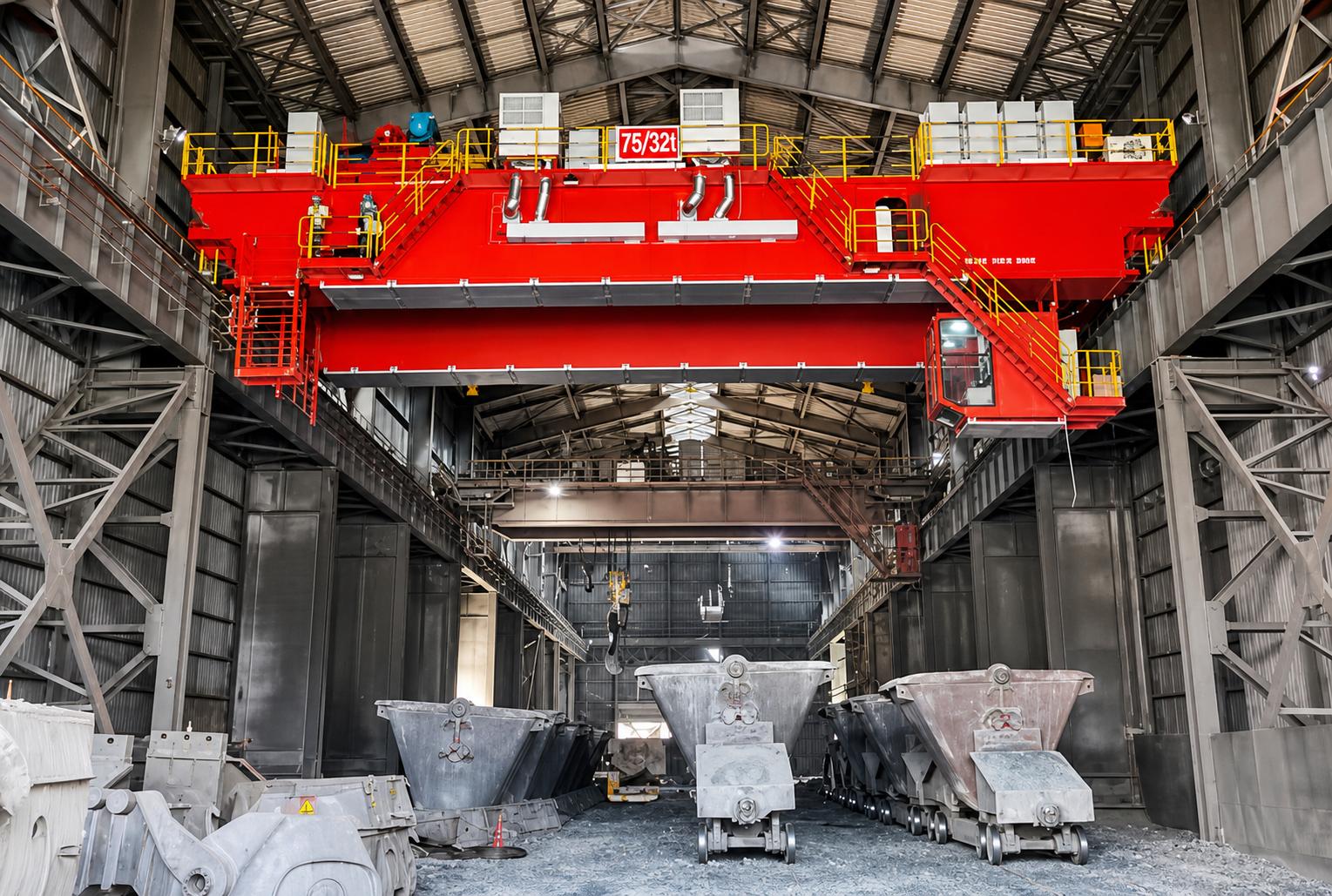
Ladle cranes undertake the transfer of molten metal and related pouring processes. The configuration focuses not only on lifting weight, but also on load control after the failure of key systems.The design of redundant transmission, spare braking, thermal insulation and protected electrical room can be seen in the manufacturer's plan. The specific combination depends on the project.Therefore, the price of ladle cranes cannot be directly compared with ordinary bridge cranes of the same tonnage; the size of the ladle, the lifting point, the turning action and the disposal path under abnormal circumstances should all enter the technical conditions.[2]
Foundry overhead cranes
There may be ladle transfer, sand box handling and cold material hoisting in the foundry at the same time, and the heat exposure and risk of different tasks are obviously different.The equipment cannot be determined to be suitable for all processes by the name of “casting crane” alone.The quotation of metallurgical bridge cranes needs to distinguish whether to lift molten metal, load and operating frequency; if a smaller tonnage metallurgical hoist scheme is used, the manufacturer's allowable range and applicable requirements must also be checked, and ordinary hoists and heat insulation panels cannot be regarded as equivalent alternatives.
Charging and forging cranes
Feeding cranes and forging cranes serve different processes: the former may be close to the furnace mouth and participate in dumping, while the latter is more concerned about hot billet handling, flipping and process impact.Neither of them can be configured only according to the static lifting weight.Customized quotations for metallurgical bridge cranes should specify the requirements for spreaders, auxiliary mechanisms, synchronous control and cushioning separately, so as to avoid combining different uses and hedging prices.The degree of clarity of process action and impact load will directly affect the design verification and mechanism selection.
Heat treatment workshop cranes
The crane in the heat treatment workshop may undertake the transportation of furnace loading, baking and quenching. The key conditions include exposure of hot workpieces, beat, positioning and media splashing.Not all tasks involve molten metal, so the safety plan should be determined based on the actual use.The price of high-temperature Henan Mine Crane Factory supply metallurgical cranes needs to reflect the workpiece spreader, transfer speed and control requirements; too slow may affect the process, and the blind pursuit of high speed will increase the driving and control costs. Matching should be made after the production cycle is clear.
How to Reduce Metallurgical Overhead Crane Costs Without Compromising Safety
Match specifications to actual conditions
An effective starting point for reducing the cost of metallurgical bridge cranes is to clearly describe the load, heat source location, working cycle and equipment operating area.Different areas may require different thermal insulation and cooling measures, and there is no need to apply the harshest local conditions to all components without distinction.Optimization must be proved applicable through engineering evaluation, not to reduce safety functions.Accurate working conditions can not only reduce the uncertainty reserved by suppliers, but also avoid repeated additional retrofits due to insufficient protection after the equipment is put into operation.
Avoid unnecessary overdesign
Unnecessary large-capacity, excessive speed, and process-independent complex functions may increase the burden on the bridge, power supply, installation, and maintenance.However, the safety margin, redundancy and statutory protection required for molten metal hoisting cannot be classified as “over-design” that can be deleted.The quotation optimization of metallurgical cranes should distinguish between necessary items and optional convenience items for working conditions, and record the basis for trade-off.Only under the premise of maintaining applicable standards and risk control requirements, streamlined configuration has practical value.
Compare lifecycle operating costs
Life cycle costs include purchase, installation, electricity consumption, inspection, wearing parts, cooling system maintenance and downtime losses, not just the price of the first metallurgical bridge crane.When comparing plans, it is necessary to adopt consistent service life, cycle assumptions, and maintenance scope to avoid including unproven energy-saving or life-saving commitments in the benefits.Whether functions such as regenerative braking are economical is also related to the actual operating conditions; listing the costs and assumptions separately makes it easier to see the differences than just comparing equipment discounts.
Plan preventive maintenance
Preventive maintenance requires inspection tasks to be set around wire ropes, hooks, brakes, thermal insulation parts, and key electrical systems, and the cycle is adjusted in combination with the strength of use and the manufacturer's requirements.Reachability, maintenance space and spare parts supply will all affect maintenance efficiency, so it should be considered during the design phase.The cost budget of metallurgical bridge cranes should also include necessary spare parts and personnel training to avoid the lack of maintenance resources after the equipment is delivered at a low price; the maintenance plan cannot replace the timely repair of known defects.
What Is Included in a Metallurgical Overhead Crane Quote?
Main crane equipment
The scope of the main equipment usually involves the bridge, end beam, trolley, lifting and operating mechanism and basic control system, but whether the track, sliding contact line, spreader and support structure are included needs to be agreed one by one.The quotation of metallurgical bridge cranes should also clarify the main and auxiliary hook parameters, working level, power supply conditions and control methods.The whole machine package with the same name may contain different accessories, and the list should be unified before comparison; otherwise, missing items will be converted into additional procurement and coordination costs during the installation or production phase.
High-temperature protection systems
High temperature protection may include heat insulation panels, heat-resistant cables, motor temperature monitoring, cab cooling and electrical room air conditioning. The configuration of different projects is different.The price of pyrometallurgical cranes needs to indicate the installation location, applicable conditions and supply boundaries of each protection.Whether air-conditioning consumables, spare cooling, or alarm interlock are included should also be written clearly.Generally labeling “high temperature resistant design” without giving boundaries will make it difficult for acceptance to determine whether the equipment meets the originally agreed thermal conditions.
Installation and commissioning
The cost of installation and commissioning is related to on-site conditions, hoisting equipment, personnel arrangements and shutdown windows. The supplier's sending engineers to guide is not equivalent to providing complete installation services.The quotation for metallurgical bridge cranes should distinguish between mechanical installation, electrical wiring, track inspection, process linkage and training, and clarify who will bear the travel and hoisting resources.If the plant still needs to be reinforced or the track rectified, the relevant projects should also be listed separately to avoid mistaking these necessary expenditures for what is already included in the equipment price.
Testing and certification
The scope of testing and certification depends on the location of the project, the purpose of the equipment and the contract requirements. Factory inspection cannot automatically replace on-site acceptance or legal procedures.The quotation of metallurgical cranes needs to specify the test items, applicable standards, witnesses, reports and cost-bearing methods, especially the safety functions and load test conditions.Third-party inspections are not necessarily equivalent to full compliance. Any test load or acceptance threshold should be determined in accordance with applicable regulations, and other project values cannot be directly applied.
Shipping and after-sales support
Transportation costs depend on the equipment segment, weight, size, route and delivery terms. Insurance, taxes and destination unloading may also be charged separately.The quotation for metallurgical bridge cranes should indicate the currency, validity period, designated delivery location and liability boundary.The after-sales part needs to distinguish between warranty, on-site service, remote support and spare parts supply, and agree on response and cost conditions.Incoterms mainly assign delivery responsibilities and risks, and cannot replace contractual agreements on matters such as installation or transfer of property rights.
How to Get an Accurate Custom Metallurgical Overhead Crane Quote
Confirm load and lifting height
Accurate inquiry requires clarifying the maximum working load, the weight of the container and spreader, the spacing of the lifting points, and the task of the main and auxiliary hooks, rather than only submitting the net weight of the metal.The lifting height should also correspond to the top of the rail, the highest and lowest position of the hook, and the headroom required by the process.The customized quotation for metallurgical bridge cranes is based on these dimensional relationships, and the action of turning the workpiece or turning the package also needs to be explained.Providing drawings of spreaders and containers in advance will help to find interference or insufficient space, and reduce rework and price adjustments after the design is completed.
Specify temperature and heat exposure
The temperature data should indicate the material, environment and key site conditions separately, and mark the direction of the heat source, the nearest distance, the single residence time and the cumulative exposure.The price of pyrometallurgical cranes depends on this information and cannot be determined only based on the furnace temperature or a maximum temperature.When there is no actual measured data, process records and layout drawings can be provided, and it is clear which data needs to be verified; the heat insulation or cooling plan proposed by the supplier accordingly should also be accompanied by assumptions to facilitate follow-up on-site confirmation and technical clarification.
Provide workshop dimensions
The plant information should include span, rail top elevation, operating length, column spacing, maintenance space and obstacle location, and provide available track and bearing information.There may be differences between the completion plan of the existing plant and the actual size, so the key conditions need to be reviewed on-site.Customized quotations for metallurgical bridge cranes should also specify installation channels and hoisting restrictions, because these conditions will change equipment segmentation and construction plans.Accurate size can reduce the risk of structural changes and on-site installation.
Define operating frequency and safety requirements
The operating data needs to cover the daily cycle, load distribution, full load ratio, process beat and abnormal recovery requirements, and at the same time clarify whether to lift molten metal and applicable specifications.The quotation of metallurgical bridge cranes should also agree on the operation method, interlock interface and safety function verification scope.If certain conditions have not been determined, the supplier can be required to list assumptions and alternatives, and explain the price impact separately; after entering the conditions uniformly, the quotation can be compared to see the real configuration and service differences.
Henan Mine Crane Factory Custom
The procurement cost of metallurgical bridge cranes is not only the price of the equipment itself, but also depends on the lifting weight, span, working level, operating conditions of molten metal or high-temperature materials, and the configuration of thermal insulation, protection and safety systems.For foundries, steel mills and metallurgical production lines, the temperature range, thermal radiation intensity, operating frequency and acceptance requirements must be clarified in the early stage so that quotations that are more suitable for actual working conditions can be obtained, and subsequent retrofits and downtime losses caused by insufficient configuration can be avoided.
Henan Mine Crane Factory can customize metallurgical bridge cranes, casting cranes and ladle lifting equipment according to the actual needs of metallurgical production sites.The reference parameters of metallurgical bridge cranes cover 5-200 tons lifting weight, 10-35 meters span and A6–A8 working level, and the specific configuration can be adjusted according to project requirements.For high-temperature radiation, heavy-duty and high-frequency operating conditions, thermal insulation protection, high-temperature motors, braking systems and safety protection devices can be considered comprehensively, and project support from program design, equipment manufacturing to commissioning and delivery can be provided.Submit information such as lifting weight, plant span, working temperature and operating process to further evaluate the equipment configuration and quotation suitable for your working conditions.