
RMG vs RTG Crane: Which Is Better for Your Container Yard?
Henan Mine Crane has been engaged in container crane sales for more than ten years, I have received customers from ports and container yards all over the world, and almost every customer will ask the same question: RMG (rail-mounted gantry cranes) and RTG (tire-mounted gantry cranes) , which one is better for your yard?
Container yard operation efficiency, depends largely on the selection of cranes. Choose the right equipment, can greatly enhance the efficiency of container stacking, transfer, control operating costs; choose the wrong, will not only cause a waste of funds, but also drag the throughput of the entire yard, affecting the long-term revenue.
RMG (rail-mounted gantry cranes) and RTG (tire-mounted gantry cranes) are currently the two most mainstream stacking equipment in container yards. There is no absolute “good” and “bad”, only ‘fit’ and “not fit”.
Today I put aside the hard technical parameters stack, with the perspective of a front-line engineers, combined with Henan Mine Crane services to customers around the world, the differences between the two types of cranes, applicable scenarios dismantled to make it clear. Whether you are a large container terminal, or medium-sized yard, or in the expansion phase, you can find the answer to their own selection, but also to help you make sense of the core comparison points of RMG vs RTG crane.
What Is an RMG Crane?
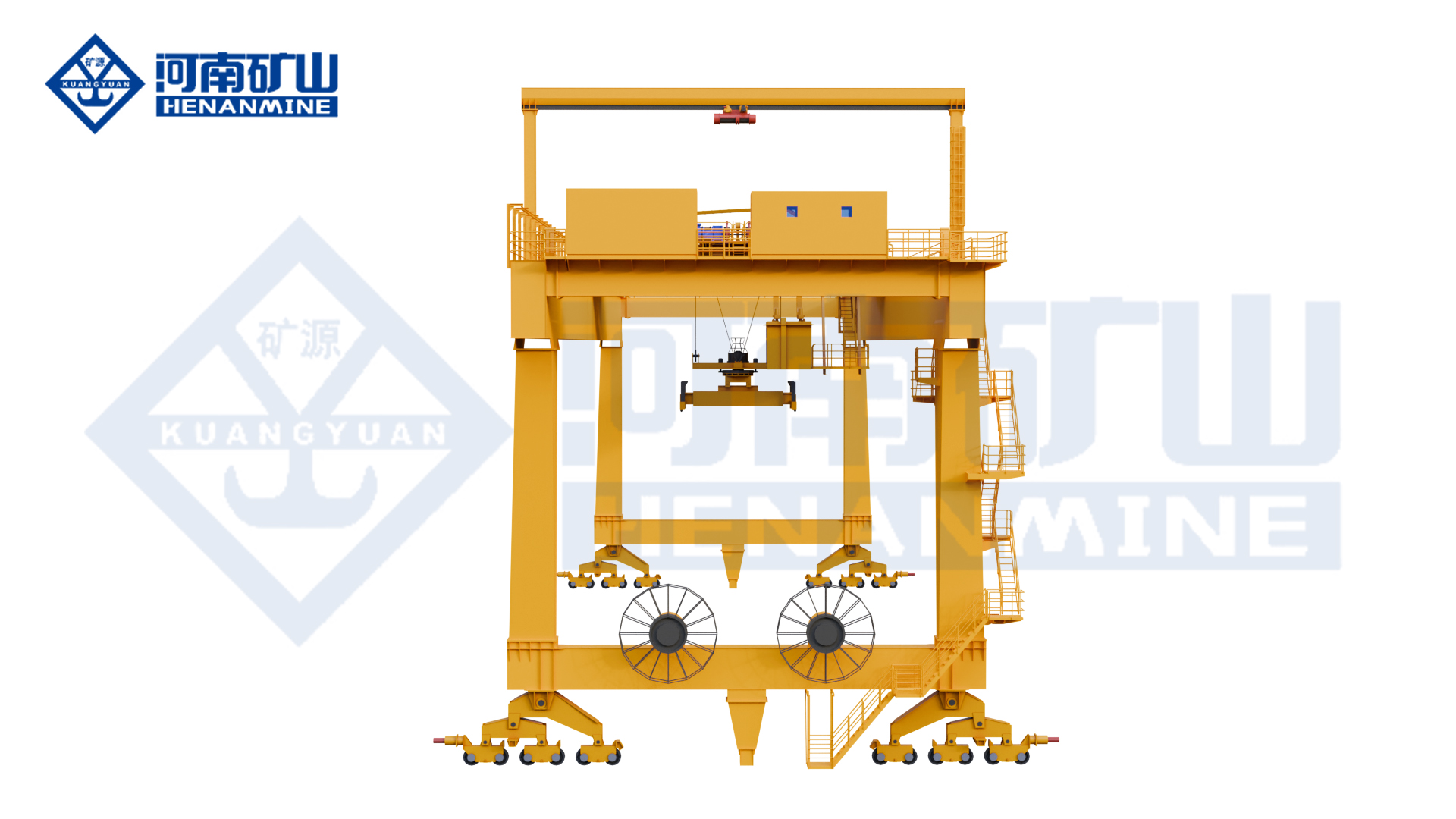
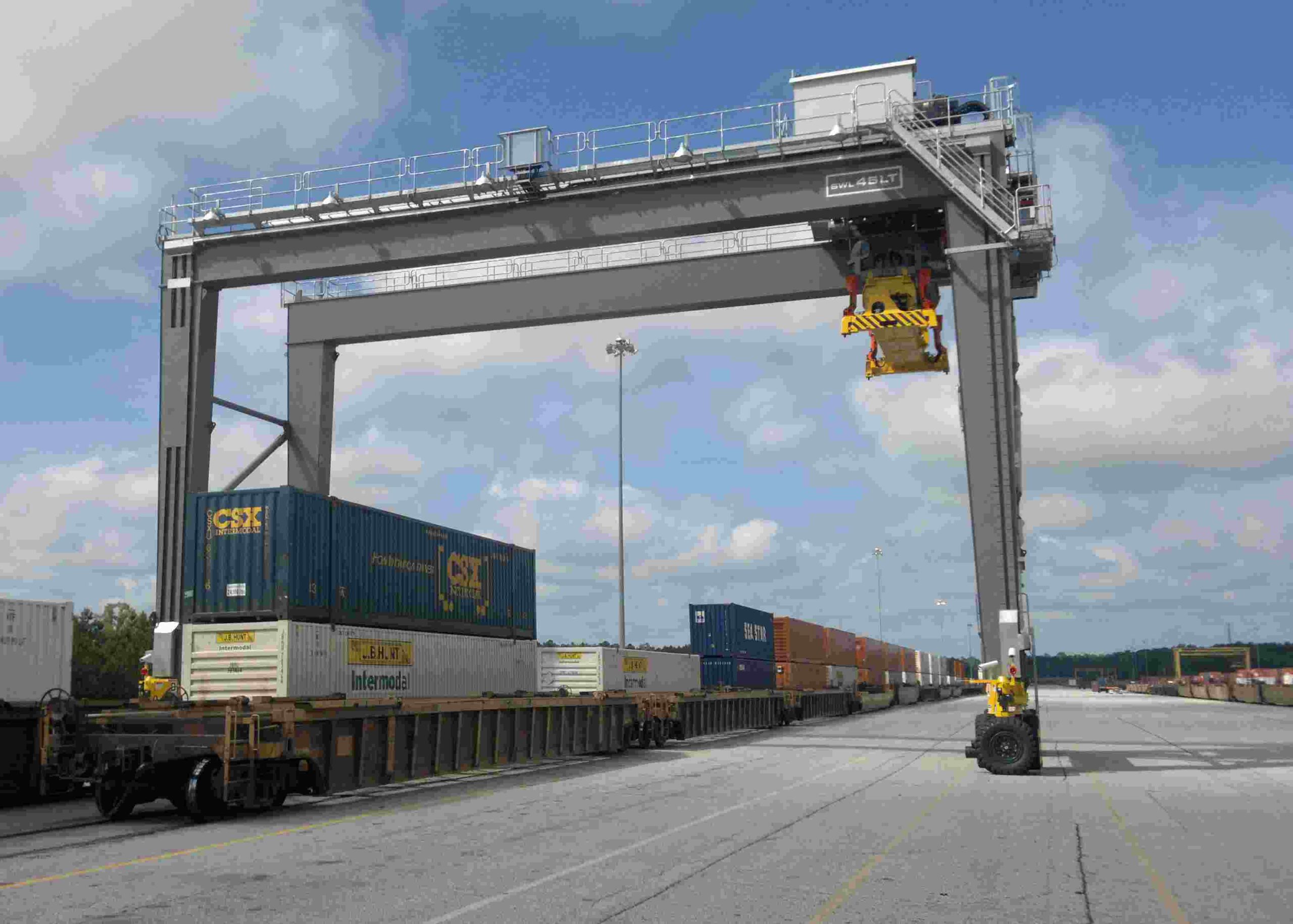
Henan Mine Crane rail-mounted container gantry crane
Definition
RMG crane, full name Rail Mounted Gantry Crane (Rail Mounted Gantry Crane), is a kind of container stacking crane running on a fixed track. Its running track is determined by the rail and cannot be moved at will, but because of this fixity, it can realize higher precision stacking operation.
Henan Mine Crane produces RMG cranes, all of which are designed with all-electric drive, adapting to different standard rail specifications around the world, whether it is large-scale automated terminals or rail intermodal terminals, all of which can be flexibly adapted. Its core advantages are high stability and high throughput, especially suitable for long-term fixed layout of large yards.
Typical Applications
The application of RMG cranes mainly focuses on large sites with high requirements for throughput and stacking density.
Large container terminals are its main application scenarios, such as the world's major ports of the main yard, every day need to handle thousands or even tens of thousands of standard containers, RMG's high throughput and high stacking accuracy, can be perfectly adapted to the needs of this high-intensity operations.
RMG cranes are also indispensable for automated stacking yards. Its fixed rail design makes it easier to dock with the automation control system to realize unmanned operation and reduce labor costs, which is also the mainstream direction of the current global smart port development.
In addition, rail intermodal terminals (rail intermodal terminals) also often use RMG cranes, which can accurately docking rail containers for transshipment needs, to achieve the container “rail - yard” seamless connection, to enhance intermodal efficiency.
Core Characteristics
Fixed rail system is the core characteristic of RMG cranes. The track is usually laid on the yard floor, the crane runs horizontally along the track and moves longitudinally through the trolley, the running track is fixed, there will be no deviation, which is also the key to its high stacking accuracy.
All-electric operation is another major feature, compared with RTG's diesel-electric drive, RMG's energy consumption is lower, no noise and no exhaust emission during operation, which is more in line with the development trend of global green port.
Its stacking precision is extremely high, and it can realize multi-layer precise stacking of containers, maximizing the use of yard space. At the same time, RMG has strong automation compatibility and can be easily connected to the terminal operating system (TOS) to realize remote operation, unattended automation functions, etc., which is suitable for the upgrading of automated RMG system.
What Is an RTG Crane?
RTG Crane, known as Rubber Tyred Gantry Crane (RTG Crane), is a kind of container stacking crane that relies on tires to move. It does not have a fixed running track, and can move freely within the yard, with great flexibility.
Henan Mine Crane's RTG cranes are mainly driven by diesel-electric or hybrid power, which can be adapted to different types of yard floors without complicated infrastructure modifications, and have short installation and commissioning cycles, which is very suitable for yards that need to be put into use quickly.
Typical Applications
The application of RTG cranes is more focused on flexibility and adaptability, especially for medium-sized or expansion stage of the yard.
Medium-sized port yards are its main application scenarios, the throughput of such yards is moderate, do not need to RMG as high throughput, but the layout of the higher flexibility requirements, RTG can be freely adjusted to the operating area, adapted to different stacking needs.
Expanding yards are also very suitable for the selection of RTG cranes. Many yards in the initial stage of development, limited funds, can not invest a lot of costs to build track infrastructure, RTG does not need track, can be quickly put into use, and later with the expansion of the yard scale, but also the flexibility to adjust the operating range.
For terminals without rail infrastructure, RTG is the first choice. It can work directly on the existing ground without complex civil engineering, which greatly reduces the initial investment cost of the project.
Core Characteristics
Tire mobility is the core feature of RTG cranes, it uses large engineering tires, can move freely on the yard floor, not restricted by the track, the operating range is flexible, according to the changes in the layout of the yard, can be adjusted at any time to the operating area.
The power form is mainly diesel-electric or hybrid, diesel-electric drive can take into account the power and energy consumption, hybrid is more environmentally friendly, can reduce exhaust emissions, to adapt to the environmental requirements of some regions.
Its biggest advantage is its adaptability to the layout of the yard, without the need for a fixed track, it can be quickly adapted to different yard planning, whether it is a temporary yard, or a long-term use of medium-sized yards, can be flexible to cope with.
RMG vs RTG - Technical Comparison
Just talking about the concept is not enough, I combine Henan Mine Crane's experience in serving global customers, from 7 core technical dimensions, to give you a detailed comparison, to help you more intuitively see the difference between the two, to facilitate the subsequent selection.
1. Infrastructure Requirements
Infrastructure requirements, is one of the most core differences between the two, but also directly affects the initial investment cost of the project. Specific comparison is as follows:
| Factor | RMG | RTG |
| Rail foundation | Required | Not required |
| Civil work cost | Higher | Lower |
| Installation complexity | Higher | Moderate |
RMG requires the laying of specialized tracks, and the laying of tracks requires professional civil engineering, including foundation treatment, track installation, fixing, etc., which is not only costly, but also has a long installation period and higher complexity.
RTG, on the other hand, does not need tracks, as long as the yard floor is level and the load bearing is up to standard, it can be directly installed and used. The civil engineering is very simple, mainly consisting of ground compaction and leveling, which is of low cost, and the cycle of installation and commissioning is short, and it can be put into use in a few weeks usually.
Many global customers give priority to RTG in the initial investment stage, just because it can save a lot of civil construction costs and quickly realize the production. However, in the case of a large yard with a long-term fixed layout, although the civil construction cost of RMG is high, the stability and efficiency of long-term operation can offset the initial investment.
2. Mobility and Flexibility
Mobility and flexibility, directly affecting the operating range of the crane and the adaptability of the layout of the yard, specific comparisons are as follows:
| Factor | RMG | RTG |
| Movement | Fixed rail | Free movement |
| Yard layout change | Limited | Flexible |
| Repositioning | Difficult | Easy |
RMG's running track is fixed by the track, can only move horizontally along the track, longitudinal adjustment through the trolley, the operating range is fixed, can not move at will. If the yard layout needs to be adjusted at a later stage, the track is difficult and costly to modify, and the flexibility is very limited.
RTG relies on tires to move freely within the yard, whether transverse, longitudinal, or turning, U-turn, are very flexible. Even if the layout of the yard is adjusted at a later stage, RTG can quickly adapt and re-plan the operation area without any infrastructure modification.
In short, if your yard layout is fixed and will not be changed for a long time, the fixed operation of RMG can ensure the accuracy of operation; if your yard is in the stage of expansion or the layout needs to be adjusted frequently, the flexibility of RTG will be more advantageous.
3. Stacking Density and Space Utilization
Stacking Density and Space Utilization directly determines the container storage capacity of the yard, especially for port yards with tight land resources, this is crucial.
RMG can achieve higher stacking density because it is guided by a fixed track with very high running accuracy, and the containers can be accurately aligned without offset when stacked. Normally, RMG can stack 6-8 layers of containers, and some large RMG can even stack more than 10 layers.
RTG, because it is moved by tires, will have slight shaking during operation, the stacking accuracy is not as good as RMG, and in order to ensure the safety of turning and moving, it is necessary to reserve a certain turning clearance, so the stacking density will be a little lower, and usually can stack 5-7 layers of containers.
In terms of TEU (standard container) storage capacity per hectare of yard, RMG can be 15%-25% higher than RTG. For large ports with expensive land resources, the space utilization advantage of RMG is very obvious, which can store more containers on limited land and increase the throughput of the yard.
4. Automation Readiness
With the development of global smart ports, automation has become the development trend of container yards, the two cranes' automation readiness varies greatly, the specific comparison is as follows:
| Factor | RMG | RTG |
| Full automation | Highly suitable | Limited |
| TOS integration | Strong | Moderate |
| Remote operation | Common | Increasing |
The fixed rail design of RMG can accurately locate the running position of the crane, and it is easier to interface with the automation control system and terminal operating system (TOS) to realize fully automated operation. At present, most of the automated container terminals in the world choose RMG cranes, which can realize unattended and remote operation and significantly reduce labor costs.
RTG's automation adaptability is relatively limited. Because of its moving trajectory is not fixed, accurate positioning is more difficult, although there are some RTG to achieve semi-automation or remote operation, but the technical difficulty and cost of full automation is higher, not as mature as RMG.
If you have a clear automation strategy and want to build a smart port or automated yard, RMG is definitely a better choice; if your yard does not require high automation and pays more attention to flexibility, RTG can meet the demand.
5. Energy Efficiency
Energy efficiency directly affects the long-term operating costs of cranes, especially for high-frequency operation of the yard, the difference in energy consumption will bring significant cost differences.
RMG adopts all-electric operation, the source of energy is electricity, energy consumption is lower, and there is no exhaust emission during operation, more environmentally friendly. According to the actual project data of Henan Mine Crane, under the same operation volume, the energy consumption of RMG is 30%-40% lower than RTG, which can save a lot of energy costs in long-term operation.
RTG mainly adopts diesel electric drive, the energy source is diesel, energy consumption is higher, and diesel combustion will produce exhaust emissions, environmental protection is not as good as RMG. although there are hybrid RTG, which can reduce energy consumption to a certain extent, but the overall energy saving is still not as good as RMG.
For areas with high energy costs, or ports that emphasize environmental protection, the energy-saving advantage of RMG is very obvious. Moreover, with the tightening of global environmental policies, all-electric RMGs are more in line with the future development trend and can help customers avoid environmental compliance risks.
6. Wheel Load and Ground Pressure
Wheel load and ground pressure directly affect the design and maintenance cost of the yard floor, which is also a point easily neglected by many customers.
The load of RMG is evenly distributed to the ground through the track beams, the ground pressure is small, the load bearing requirement on the yard floor is relatively low, and the maintenance cost of the ground is also low. Moreover, the track protects the ground, reduces the wear and tear of the ground, and extends the service life of the ground.
The load of RTG is transferred to the ground through tires, the ground pressure is larger, the load-bearing requirement for the yard floor is higher, and a thicker and stronger ground needs to be laid, and the initial ground construction cost is higher. At the same time, the friction between the tires and the ground will cause ground wear, and the maintenance cost of the ground will increase in the long run.
Many customers only focus on the cost of the crane itself when selecting the model, ignoring the ground design and maintenance costs. In fact, RTG although the initial cost of equipment is low, but the ground construction and long-term maintenance costs are higher, while RMG although the initial cost of civil engineering is high, but the ground maintenance costs are lower, and in the long run more cost-effective.
7. Lifecycle Cost Comparison
Selection should not only look at the initial investment, but also calculate the entire life cycle cost, which can truly reflect the cost-effectiveness of the equipment.
In terms of initial investment, RMG is more costly, mainly because of the investment in track and civil engineering; RTG's initial investment is lower, without the need for track and complex civil engineering, and the cost of the equipment itself is also relatively low.
In terms of operation cost, RMG has a very obvious advantage. It has low energy consumption, which can save a lot of energy costs; and strong automation adaptability, which can reduce labor costs, especially for large yards, the savings in labor costs are very significant.
RTG has higher operating costs, high diesel consumption and high energy costs; and it needs to be equipped with professional operators, and the labor cost is also higher.
In terms of maintenance cost, RMG mainly needs to maintain the track and electrical system, the maintenance cycle of the track is long and the cost is low, and the maintenance of the electrical system is relatively simple; RTG mainly needs to maintain the tires and the diesel engine, the tires are worn out faster and need to be replaced periodically, and the maintenance cost of the diesel engine is higher, so in the long run, the maintenance cost is much higher than that of the RMG.
Operational Workflow Comparison
In addition to technical parameters, the two cranes' operational workflow differences will also affect the overall efficiency of the yard, combined with the actual operational scenarios, to give you a simple comparison.
Vessel Discharge Phase
In the vessel unloading phase, both cranes can work with shore side container cranes (STS) to complete the container transfer operation. Both RMG and RTG can quickly receive the containers unloaded by shore-side cranes and transfer them to the designated area in the yard without affecting the efficiency of ship unloading.
The difference between the two is mainly reflected in the flexibility of transshipment, RTG can be more flexible to adjust the transshipment route, adapted to different ship unloading rhythm; RMG is more stable, higher transshipment accuracy, suitable for high-frequency, large-volume transshipment operations.
Yard Stacking Phase
Yard stacking phase is the most obvious difference between the two, RMG relies on fixed track operation, can realize precise stacking of containers, suitable for large-scale, high-density stacking operations, especially automated yard, can realize unmanned stacking, high efficiency.
RTG, on the other hand, is more flexible and can adjust the stacking area according to the actual situation of the yard, which is suitable for the flexible operation of small and medium-sized yards, especially for the containers that need to be temporarily stacked and quickly turned over, the advantages of RTG are more obvious.
Intermodal Integration
In the intermodal transportation scenario, the advantages of RMG are more prominent. It can accurately match the transshipment needs of railroad containers and realize the seamless connection of container “railroad - yard”, especially in railroad intermodal terminals, RMG can greatly improve the intermodal efficiency and reduce the transshipment time of containers.
Although RTG can also participate in intermodal transportation, but the flexibility is more than enough, the accuracy is not enough, when docking railroads, highways and other modes of transportation, the efficiency is not as good as RMG, more suitable for small and medium-sized intermodal yards.
Standards and Classification
Both RMG and RTG cranes need to comply with global industry standards to ensure the safety and reliability of the equipment, especially for export projects, standards compliance is the most important.
FEM Classification (Often A7-A8)
FEM (Federation of European Material Handling) standard, is the global container crane industry common standards, RMG and RTG cranes working level, usually in the FEM A7-A8 class. This level of cranes can withstand high-frequency, high-load continuous operation, in line with the high-intensity operational needs of container yards.
Henan Mine Crane's RMG and RTG cranes are all designed and produced according to the FEM A7-A8 class standard, which ensures that the equipment can maintain stability in long-term high-frequency operations and reduce the incidence of failure.
ISO 4301 Classification
ISO 4301 standard mainly regulates the classification of cranes in terms of working level, and specifies the design requirements, safety requirements and inspection standards of equipment corresponding to different working levels.RMG and RTG cranes need to comply with the requirements of ISO 4301 standard to ensure the safety and reliability of the equipment.
For projects exported to Europe, Southeast Asia and other regions, the ISO standard is a necessary compliance requirement. Henan Mine Crane will provide ISO-compliant equipment and certification documents according to customers' export destinations.
CMAA Duty Classes
CMAA (Crane Manufacturers Association of America) standards, mainly applicable to crane projects in North America, RMG and RTG cranes work class, usually corresponds to the heavy duty class of CMAA, to meet the demand for high-intensity operations in container yards in North America.
If the customer's project is exported to North America, the equipment needs to comply with the CMAA standard. Henan Mine Crane will optimize the design and production of the equipment according to the CMAA standard to ensure that the equipment can adapt to the regulatory requirements of the North American region.
Port Authority Compliance Requirements
Port authorities in different countries and regions have different requirements for container cranes, mainly focusing on safety, environmental protection, efficiency and other aspects. For example, ports in the EU have higher environmental requirements for cranes, which need to meet the standards of exhaust emissions, noise control, etc. Ports in North America have higher safety redundancy requirements for equipment.
When Henan Mine Crane undertakes global projects, it will understand the compliance requirements of the local port authorities in advance to ensure that the design and production of equipment meets the local standards, so as to avoid compliance problems and delays in project progress.
When Should You Choose an RMG?
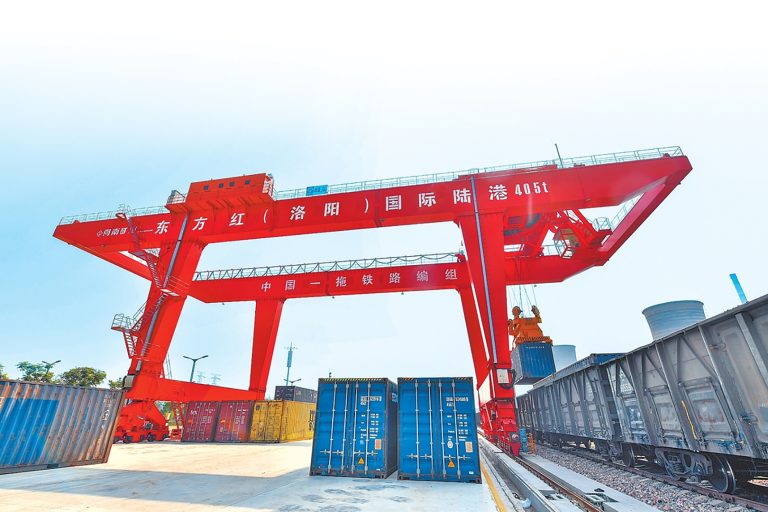
Henan Mine Crane rail-mounted container gantry crane
Combined with Henan Mine Crane's global project experience, choosing an RMG crane can maximize long-term benefits as long as any of the following situations are met.
If your yard is a large container terminal with high throughput, handling a large number of containers every day, with high requirements for operational efficiency and stacking density, RMG is the first choice. Its high throughput and high stacking accuracy can perfectly match the operational needs of large yards and improve the overall operational efficiency.
If the layout of your yard is fixed for a long time without major adjustments, the fixed track design of RMG can ensure the stability and precision of the operation, while reducing the cost of later adjustments.
If your company has a clear automation strategy and wants to build an automated and intelligent yard, RMG's strong automation adaptability can easily interface with the automation control system to realize unmanned operation, reduce labor costs, and adapt to the needs of smart port development.
If your yard involves intermodal transportation by rail, and you need to realize seamless connection of container “railroad - yard”, RMG's accurate positioning ability can greatly improve intermodal transportation efficiency and reduce transit time.
If your company pays more attention to long-term operation cost and is willing to invest higher initial cost, RMG's low energy consumption and low maintenance cost can save a lot of money in long-term operation and improve ROI.
When Should You Choose an RTG?
Not all yards are suitable for RMG, the following scenarios, choose RTG cranes, more cost-effective, more adaptable to the needs.
If your yard is a medium-sized terminal with moderate throughput, does not need high throughput like RMG, and has limited capital to invest a lot of cost to build tracks and civil works, RTG is a better choice. It has low initial investment and can be put into use quickly to meet the operational needs of medium-sized yards.
If your yard is in the expansion stage, the layout may be adjusted at any time. RTG is flexible and can quickly adapt to different yard layouts without any infrastructure modification, reducing the cost and trouble caused by expansion.
If your yard does not have track infrastructure and there is no plan to build track in the short term, RTG does not require track and can operate directly on the existing ground, significantly reducing the initial investment cost of the project.
If your yard is unstable, sometimes busy, sometimes idle, RTG has the flexibility to adjust the operation area and operation rhythm according to the change of operation volume, avoiding idle equipment and improving the utilization rate of equipment.
Common Procurement Mistakes
Combined with so many years of global procurement consulting experience, I summarized the most common 4 misunderstandings in the selection of customers, many customers have stepped on these pits, I hope you can avoid.
The most common misunderstanding is to ignore the future automation plan. Many customers in the selection, only consider the current operational needs, did not consider the future automation upgrades, choose RTG, later want to realize automation, not only the technical difficulties, the cost is also very high, the loss is not worth it.
Underestimating the ground cost of RTG is also a common problem for many customers. Some customers only see the low initial equipment cost of RTG, ignoring its requirements for the ground load-bearing, later need to invest a lot of money to remodel the ground, or even because the ground is not up to standard, resulting in the equipment can not run normally.
It is most undesirable to only look at the initial purchase price and ignore the life cycle cost. RTG's initial price is low, but the long-term operating cost and maintenance cost is high; RMG's initial price is high, but the long-term operating cost is low, which is more cost-effective in the long run. Many customers choose RTG because they are greedy for the initial cheapness, but later they spend more money instead.
Not calculating the life cycle cost is also a common misconception. When selecting the equipment, you should not only look at the price of the equipment itself, but also calculate the cost of energy, maintenance costs, labor costs, construction costs, etc., and comprehensively calculate the life cycle cost, in order to select the most cost-effective equipment.
RMG vs RTG Decision Checklist
In order to facilitate your quick judgment, I have compiled a decision checklist, check against, you can quickly determine whether you need to choose RMG or RTG cranes, to avoid selection errors.
1. What is the annual TEU throughput of your yard? High throughput (more than 1 million TEU) prioritize RMG, medium and low throughput (less than 1 million TEU) can consider RTG.
2. Is your yard layout fixed? RMG is preferred for long-term fixed layout, and RTG is preferred for flexible adjustment. 3.
3. How much available land area do you have? RMG is preferred if land resources are tight and high stacking density is pursued; RTG is preferred if land is sufficient and density is not required. 4.
4. What is the energy cost in your area? With high energy cost, RMG with all-electric is preferred; with low energy cost, RTG can be considered.
5. Do you have a clear roadmap for automation upgrade? If you have automation plan, prefer RMG; if there is no need for automation, you can consider RTG. 6.
6. What is your capital budget? With limited short-term budget, RTG is preferred; focusing on long-term ROI and willing to invest initial cost, RMG is preferred.
Frequently Asked Questions
Q1: Which is cheaper: RMG or RTG?
In terms of initial purchase price, RTG is cheaper because it does not require tracks and complex civil works, and the cost of the equipment itself is relatively low. However, in terms of life cycle cost, RMG is cheaper because of its low energy consumption, low maintenance cost and low labor cost, which can save a lot of money in the long run.
Q2: Which is better for automated terminals?
RMG is usually better for automated terminals, its fixed rail design, can be accurately positioned, easier to interface with the automation control system, terminal operating system, to achieve fully automated operations, at present most of the world's automated container terminals, the use of RMG cranes.
Q3: Can RTG cranes be electrified?
Yes, it can. At present, RTG cranes can be electrified by cable reel, slip wire or bus system, after the transformation of RTG, the energy consumption will be greatly reduced, environmental protection will be improved, to meet the environmental requirements of some regions. Henan Mine Crane can also provide customers with RTG electrification transformation services.
Q4: Which crane provides higher stacking density?
RMG provides higher stacking density. Because it is guided by a fixed track, it operates with high precision, the containers can be accurately aligned when stacked, and there is no need to reserve too much gap, usually 6-8 layers can be stacked, and some of the large RMGs can even be stacked more than 10 layers, which makes the space utilization rate higher.
Q5: Which crane is easier to relocate?
RTG is easier to relocate, it does not have fixed rails, it relies on tires to move, it can be directly transported to the new yard by trailer, the installation and debugging cycle is short, and it can be put into use quickly; whereas RMG needs to dismantle the rails and equipments, it is difficult to transport and install, and the cost of relocation is high and the cycle is long.
Conclusion
Talking about this, I believe you are already clear about the core differences between RMG and RTG cranes, and also know how to choose for their own container yard.
In fact, there is no absolute “better”, only “more suitable”. RMG's core advantage is high density, high throughput, strong automation adaptability, suitable for large, fixed layout, the pursuit of long-term efficiency of the yard; RTG's core advantage is flexibility, RTG's core advantages are high flexibility, low initial investment, and short installation cycle, suitable for medium-sized, expansion-stage yards with limited budgets.
The core of selection is to combine your yard size, throughput, layout planning, automation needs and capital budget to make a comprehensive judgment. Don't just look at the initial price, but calculate the long-term life cycle cost, in order to select the most cost-effective equipment, to achieve the maximization of yard efficiency and revenue.
Henan Mine Crane Factory Custom
Henan Mine Crane has been focusing on the design, production and service of heavy-duty cranes for more than 20 years, and has provided RMG and RTG crane solutions for ports and yards in more than 50 countries and regions around the world, accumulating a wealth of experience in selection and operation.
Whether you need highly automated RMG, or flexible and efficient RTG, we can customize the equipment to meet global standards according to your specific needs, from selection consulting, design and production, to installation and commissioning, after-sales maintenance, the whole process to provide professional support, to help you avoid selection errors and reduce operating costs.
Choosing a suitable container crane is not only a purchase investment, but also an investment in the long-term development of the yard. Only by choosing the right equipment, can we make the yard operation smoother and more efficient, and take advantage of the competition in the global port.