
50 Ton Double Girder Overhead Crane: Full Specification Sheet & Key Parameters
A 50 ton double girder overhead crane sits at the boundary between medium-duty material handling and true heavy-industrial lifting. Get the specification wrong undersized span, the wrong duty class, an underrated runway and you're looking at premature wear, structural risk, or a crane that simply can't do the job it was bought for. This guide breaks down every parameter that belongs on a real 50 ton double girder overhead crane spec sheet, explains what each number actually means for your operation, and gives you a practical framework for choosing the right configuration.
Whether you're specifying a new crane for a steel mill, fabrication shop, or warehouse, the goal here is the same: understand the spec sheet well enough to ask your supplier the right questions before you sign a purchase order.
What Is a 50 Ton Double Girder Overhead Crane?
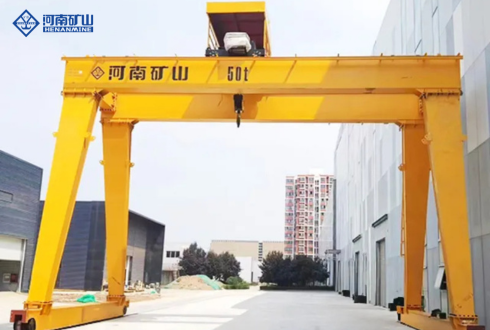
A double girder overhead crane uses two parallel bridge girders, with the trolley and hoist running on top of (or between) them, rather than the single beam used in lighter-duty cranes. At 50 tons, this two-girder design is essentially mandatory a single girder can't carry that load over an industrial span without excessive deflection.
The "overhead" part means the crane bridge travels on elevated runway rails mounted to the building's columns or an independent steel structure, moving the full length of the workshop while the trolley moves crosswise along the bridge. This combination gives the crane access to virtually the entire floor area beneath it.
Double girder cranes at 50 tons are almost always top-running, meaning the crane wheels sit on top of the runway rail. Underhung designs, where the crane hangs from rails fixed to the underside of the roof structure, are reserved for much lighter capacities because the supporting structure can't economically handle 50 tons of suspended load.
Span and Lifting Height
Span isn't a number you pick freely it's dictated by your building's column spacing or the runway structure's design width, measured between the centerlines of the rail at each end of the bridge. Most 50 ton double girder cranes fall between 10.5m and 31.5m, but the wider the span, the more the girder has to resist deflection under load, which means heavier steel sections and, often, a camber built into the girder to offset sag at full load.
Lifting height is the vertical travel of the hook from its lowest working position to its highest. For a 50 ton crane, this typically runs 6m to 30m, constrained by:
- Building clearance height below the runway beam: the vertical clearance between the bottom of the crane runway beam and the ground, equipment and other obstacles, which is the core parameter of equipment selection, installation and operation, and can effectively avoid the problem of workspace interference.
- Height of hook assembly under rated load: the overall vertical height of the hook assembly under the rated load condition of the crane. The larger the tonnage of the equipment, the larger the size of the hook and pulley assembly, the higher the height of the hook assembly, which will take up the effective lifting space and is an important basis for lifting height calculation.
- Low headroom plant hook across the main beam adaptation requirements: for plant floor height, the top of the headroom is limited scenarios, can be used to hook across the main beam through the structure. Utilizing the gap between the main beams to complete the hook lifting and lowering can reduce the occupation of the upper space and greatly increase the effective lifting height, which is suitable for the operation conditions in the restricted space.
If your building has limited headroom, ask your supplier specifically about reduced-headroom trolley designs this is a configuration choice, not a fixed limitation of double girder cranes.
Working Duty Classification Explained
The working duty class (also called duty cycle or service class) is one of the most misunderstood fields on a crane spec sheet, yet it has a direct impact on component sizing, motor selection, and bearing life.
Two systems are commonly referenced:
- European FEM Classification Standard:According to the spectrum of load conditions and cumulative working hours of the equipment, it is divided into 1Bm ~ 5m working levels, which is suitable for different frequency and load lifting scenarios.
- Chinese national standard A classification standard: follow the domestic lifting equipment standards, the equipment is divided into A1 ~ A8 eight working levels, complete coverage from light duty light work to heavy duty heavy duty work of the full range of working conditions to meet the needs of use.
For a 50 ton double girder crane in genuine industrial use, the relevant range is A5 to A7 (roughly FEM 3m–5m):
- A5 (medium-heavy level): medium frequency of operation, daily lifting load mixed light and heavy, moderate fluctuations in working conditions, applicable to general mechanical processing, general assembly workshop and other conventional production occasions.
- A6 (heavy grade): high frequency operation, frequent full-load lifting under normal conditions, stable and high working load, mostly used in steel processing, foundry and other high-intensity work conditions.
- A7 (extra heavy grade): close to uninterrupted full-load cyclic operation, the equipment continues to run at high loads, harsh working conditions, mainly used in iron and steel mills, bulk metal raw materials transfer and other heavy-duty continuous operation scenarios.
Choosing too light a duty class for your actual usage shortens component life dramatically; choosing too heavy adds unnecessary cost. This is a parameter worth discussing honestly with your supplier based on actual cycles-per-shift, not aspirational future use.
Speed Parameters: Lifting, Crane Travel, and Trolley Travel
Three independent motion speeds define how a double girder crane performs:
- Lifting speed: the vertical speed of the hook at rated motor speed. For a 50 ton main hook, expect roughly 3–8 m/min; auxiliary hooks move faster since they carry lighter loads.
- Crane travel speed:how fast the entire bridge moves along the runway, typically 50–90 m/min for this capacity class.
- Trolley travel speed:how fast the trolley moves across the bridge, generally 20–45 m/min.
Higher speeds increase throughput but also increase dynamic loading on the structure and braking demands another reason speed specifications and structural design need to be reviewed together, not picked independently.
Wheel Pressure and Structural Loading
Wheel pressure is the maximum vertical force a single crane wheel transmits to the runway rail. It's calculated from the combined dead weight of the bridge and trolley plus the rated lifting load, taken at the trolley's most unfavorable position generally at the end of its travel, closest to one rail.
This number matters because it's the figure your structural engineer uses to size:
- Runway beams
- Supporting columns
- Rail sections and rail clips
- Foundation loading, in some installations
A 50 ton crane's wheel pressure is not simply "50 tons divided by the number of wheels" the crane's own dead weight, the trolley's position, and dynamic factors during acceleration and braking all factor in. Always request the calculated wheel pressure figure from your supplier rather than estimating it yourself; getting this wrong is one of the more common causes of premature runway beam failure.
Main Components and Mechanisms
A 50 ton double girder overhead crane is built from five core systems:
- Bridge (double girder):The two parallel main girders, end-connected to the end carriages, forming the structure the trolley travels on.
- Trolley and hoist:Carries the lifting mechanism either a wire rope hoist or an open winch/drum system at this capacity and travels along the top of the girders.
- End carriages:Connect the bridge girders to the wheel assemblies that ride on the runway rails.
- Crane travel mechanism:Motors, gearboxes, and wheels that move the entire bridge along the runway.
- Electrical control system:Power supply, control panel, and either cab, pendant, or radio remote control for the operator.
At 50 tons, the hoist mechanism is typically a wire-rope-and-drum system rather than a chain hoist, given the load involved, and many configurations use an open winch trolley for the heaviest-duty applications.
Main Hook vs. Auxiliary Hook Configurations
Many 50 ton double girder cranes are specified with a dual-hook arrangement commonly written as "50/10" or "50/15" ton where:
- The main hook is rated for the full 50 tons and handles primary heavy lifts.
- Theauxiliary hook is rated lower (often 10–15 tons) and is used for lighter loads, faster cycle work, or to assist the main hook in tilting and repositioning large workpieces.
The critical safety rule here: the two hooks are never used to lift two separate loads simultaneously, and when working together to maneuver one piece, the combined load can never exceed the main hook's rated capacity. If your application regularly involves turning or rotating heavy molds, coils, or fabrications, a dual-hook setup is worth specifying upfront rather than retrofitting later.
How to Choose the Right Spec for Your Application
Before requesting quotes, work through this checklist:
- Accurate measurement of the actual span requirements: based on the centerline of the existing columns in the plant or the planned runway structure measured values, strictly prohibited by experience prediction, estimation of dimensions, to ensure that the span of the equipment to adapt to the site installation conditions.
- Verify the real operation cycle frequency: Combined with the daily lifting operation intensity, work frequency accounting for the real working conditions, accurate matching of equipment working level, A5 to A7 different levels of equipment procurement costs, service life differences are significant, need to adapt to the actual working conditions of the selection of models, to avoid the selection of excess or insufficient.
- Confirmation of plant headroom constraints: Comprehensive verification of the site vertical headroom dimensions, top space constraints, to determine the need for low headroom trolley, maximize the adaptability of the restricted space operating scenarios, to ensure the effective lifting height.
- Evaluating whether to equip the auxiliary hook device: according to the operational needs of the lifted workpiece, if the operation requires the rotation, fine-tuning alignment, attitude reorientation and other operations of the heavy object, the auxiliary hook must be set up as a supporting device.
- Written implementation of wheel pressure calculation parameters: complete the professional accounting of crane wheel pressure and issue written calculation documents, which will be submitted to the structural engineer before the runway structure is finalized and the drawings are finalized, and serve as the core basis for civil and steel structure design.
- Match the technical parameters of on-site power supply: check the actual power supply infrastructure of the plant to ensure that the electrical parameters such as voltage, frequency, number of phases, etc. of the equipment and the on-site power supply system are fully matched to avoid electrical adaptation problems caused by the equipment.
- Select the equipment control mode according to the needs: Combining with the operator's field of vision, site operating environment and safety control requirements, reasonably select the cab control, handle suspension control, wireless control, and other controlmodes to meet the needs of the operator.
Every facility has different lifting requirements, building layouts, and duty cycles. Choosing the right crane configuration requires more than comparing specifications, it requires matching the crane to your actual operating conditions.
Henan Mine Crane provides customized engineering support, including crane selection, structural design, wheel load calculations, electrical control options, and project consultation. Contact our team to receive a tailored solution and an accurate quotation based on your specific application requirements.
Installation and Safety Considerations
Installation of a 50 ton double girder crane carries real structural stakes, given the loads involved:
- Runway alignment:must be precise; misaligned rails create uneven wheel loading and accelerate wear.
- Test loading:should be performed and documented before the crane is released for production use, typically at and above rated capacity per applicable standards.
- Overload protection, limit switches, and emergency stop systems:should be standard, not optional, at this capacity.
- Periodic inspection schedules:should be established for wire ropes, brakes, and structural welds, given the consequences of failure at heavy loads.
Work with a qualified crane installer and have your structural engineer sign off on runway and column loading before commissioning this isn't a step to shortcut on equipment handling 50 tons.
Conclusion
50 tons double girder overhead travelling crane is a long-lasting industrial equipment, the performance, efficiency, life and safety of the whole machine depends on many parameters such as working level, span, lifting height, wheel pressure, running speed, hook and electric control system, not only on the rated lifting capacity.
Selection should be based on the complete project parameters, not just on simple samples. Customers need to clarify the lifting requirements, plant size, headroom conditions, frequency of operation and production planning, so that manufacturers can customize the exclusive equipment program to suit the working conditions.
Henan Mine Crane specializes in manufacturing 50-ton double girder overhead travelling crane, which can be adapted to steel mills, factories, warehouses, power stations and other heavy-duty working conditions. Relying on a professional team, we can provide one-stop services such as working condition analysis, structural accounting, customized design, etc. We can provide standard or customized equipment solutions according to the needs to ensure that the equipment is safe, stable and durable.