
Container Yard Equipment Buying Guide
To do container yard planning, equipment selection is a link that affects the whole body.
If you choose the right equipment combination, the land utilization rate, truck turnover speed, and long-term operating costs can all be within a reasonable range; if you choose the wrong one, either the storage capacity cannot keep up with business growth, or the on-site congestion and container dumping are frequent, and subsequent renovation and expansion will cost you a lot of wasted money.
When many purchasers make planning for the first time, they tend to focus only on the quotation of single equipment for comparison, ignoring the more critical factors such as yard layout, throughput rhythm, box structure and future expansion. As a manufacturer of deep-ploughing port loading and unloading equipment, Henan Mine Crane has been exposed to hundreds of yard projects, large and small. This guide clearly explains the adaptation scenarios, selection logic and pit avoidance points of mainstream equipment, and helps you build a yard equipment combination suitable for your own needs.
Quick Selection Reference
First, give a direct judgment conclusion to facilitate quick scene matching.
Small inland storage yard and logistics park, container front crane plus dock tractor is a combination of high flexibility and low input threshold; high-density large container storage yard, RTG tire gantry crane or RMG rail gantry crane is preferred, stacking density and operation efficiency are more advantageous; the terminal that needs full-field flexible transfer and stacking, clearing quay crane waiting, container straddle carrier adaptability is stronger; The storage yard with high empty container ratio, equipped with special empty container stacker, is more cost-effective than heavy equipment to deal with empty containers.
Core characteristics of mainstream yard equipment
RTG rubber-tyred gantry crane
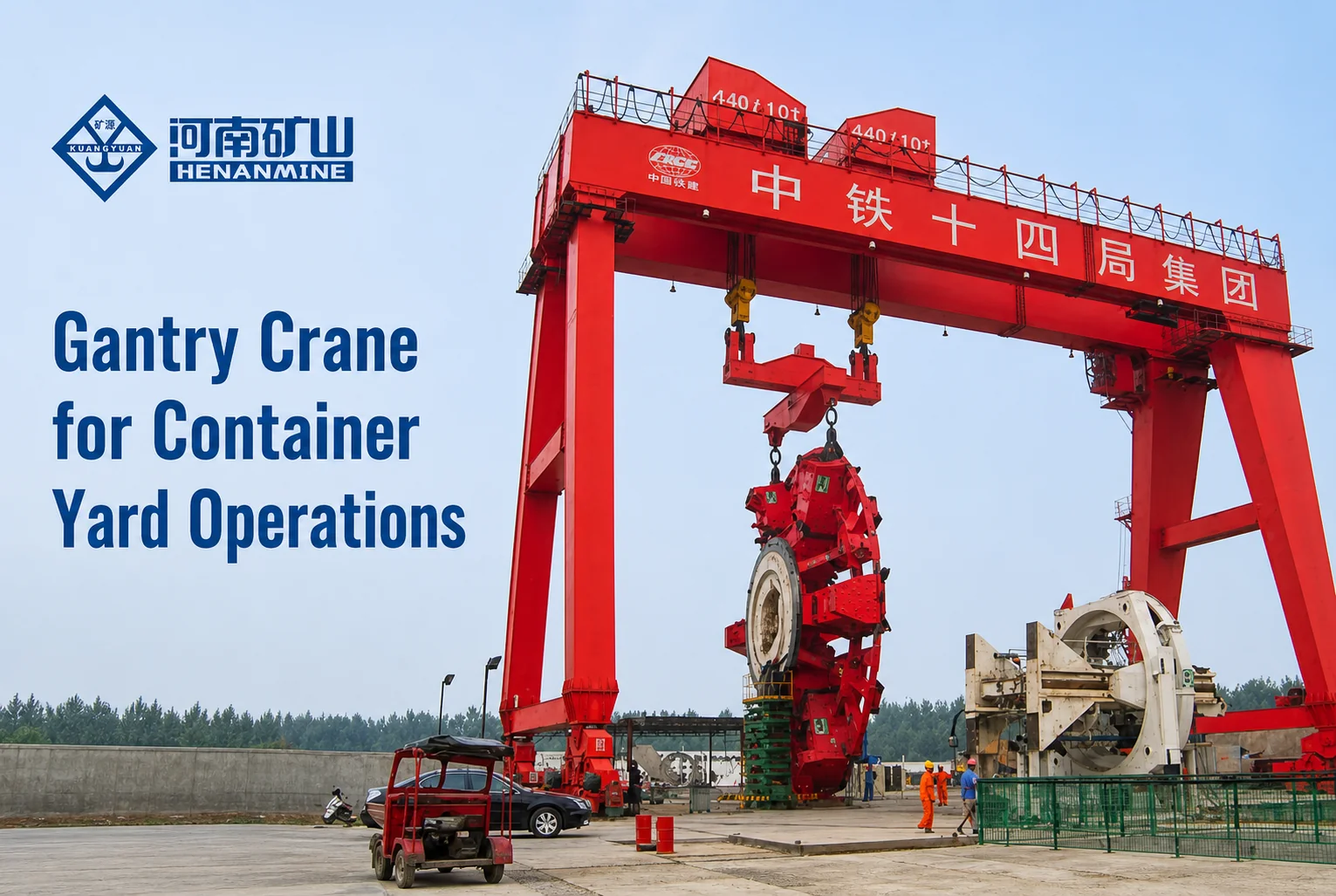
RTG is a door-type lifting equipment that runs on rubber tires. It mainly focuses on container stacking operations in the FCL area. The conventional model span can cover 6 to 8 rows of containers plus a collection truck lane, and the stacking height varies from 1-over-3 to 1-over-6. It is the core equipment for improving the land utilization rate of medium and large storage yards. There are diesel, hybrid and pure electric power options.
It is suitable for medium and large container yards, inland ports with expansion plans, and sites seeking high storage density. The advantages are high stacking density, regular box area, large automatic transformation space, and lower single box operation cost under large throughput scenario.
The limitation is that the initial investment is higher than that of the front crane, the storage yard needs to make regular box area planning in advance, and the flexibility of long-distance horizontal transfer is general, usually with dock tractor for horizontal transfer.
Before purchasing, check clearly: span requirements, stacking layers, power type, automation level, rated load, anti-sway and alignment configuration, box lane width.
RMG rail-mounted gantry crane
RMG runs along fixed tracks and is mostly used for high-density stacking operations in ports, railway stations and automated storage yards. It can customize different spans and stacking heights according to needs. The electrified operation cost is low. It is the mainstream selection of automated storage yards.
It is most suitable for railway container center station, multimodal transport yard, automatic container terminal and other fixed layout scenarios. The advantages are extremely high stacking density, high stability and accuracy of operation, and the greatest potential for automatic upgrading.
The limitation is that there is no flexibility in track fixation, high requirements for infrastructure construction, higher planning and installation costs in the early stage, and almost no space for adjustment in the box area in the later stage.
When purchasing, confirm: track span, stack height requirements, cantilever configuration, track foundation conditions, power supply mode, automation level, docking size with railway cars/collection trucks.
container reach
Front sling telescopic boom and special sling, is a very versatile mobile loading and unloading equipment, rated lifting capacity of about 45 tons, in addition to standard containers, replacement of accessories can also handle special containers and miscellaneous Kalmar
It is the preferred main equipment for small storage yards, inland container yards (ICD), railway stations, logistics parks, and is also suitable as an auxiliary supplement for large storage yards. The advantage is that it is extremely flexible, almost no additional infrastructure is needed, it can be used on approach, the initial investment is low, the narrow space can also be operated, and loading and unloading and short-distance transshipment can be considered.
The limitation is that the dumping rate is high in high density stacking, the operation efficiency is not as good as that of gantry crane in large throughput scenarios, and the tire loss and fuel cost ratio are not low.
Purchase to check: heavy load/empty container operation positioning, rated lifting weight, stacking layers, operation depth, site load, adaptation box type, power type, equipment requirements.
straddle carriers
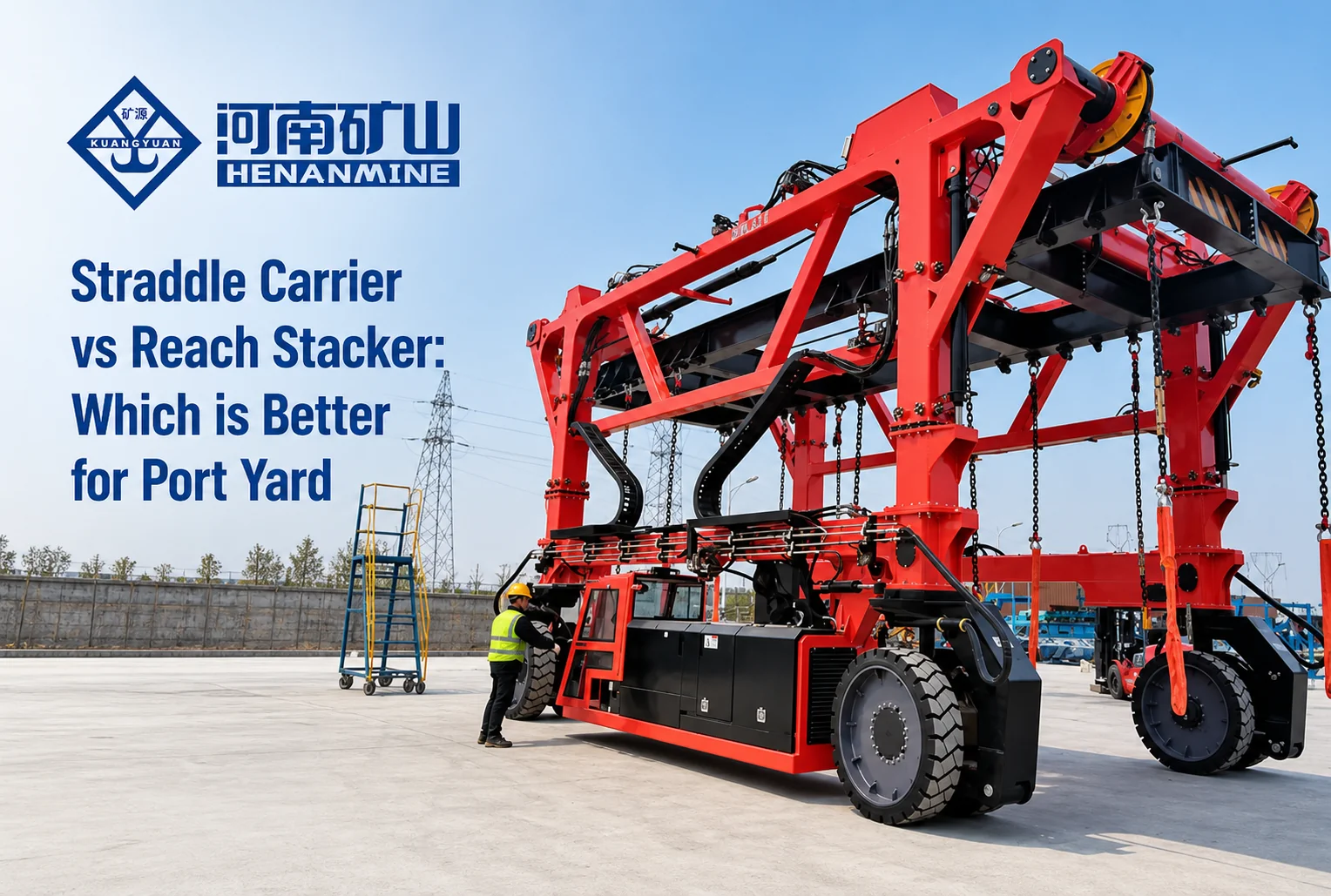
Straddle carrier is a door-type self-propelled equipment, which can lift containers under the frame. Single equipment can independently complete the whole process of taking containers, transferring and stacking without additional lifting equipment. The stacking height is usually 1-over-2 to 1-over-3Konecranes.
It is suitable for medium-sized terminals with complex moving lines and flexible transshipment throughout the site, as well as scenarios where you want to eliminate the waiting time for the connection between the shore crane and the yard. The advantage is that it integrates hoisting and horizontal transfer, flexible scheduling in the whole field, can reduce the waiting loss of different equipment connection, and can adapt to irregular sites.
The limitation is that the whole team procurement investment is not low, the traffic management in the field is more complex, the storage density is not as good as the gantry crane system, and the requirements for operators are higher.
Procurement shall confirm: stacking height, power type, automation level, average haul distance per trip, number of equipment required to match quay crane efficiency, lane planning, maintenance team capacity.
Wharf tractor and empty container stacker
Wharf tractor is mainly used for towing chassis within the yard for short distance, and it is necessary for most regular yards to complete horizontal transfer with gantry crane. It has low cost and flexible deployment.
Empty container stacking machine is specially designed for empty container stacking, with strong stacking capacity, high operation efficiency, procurement and operation costs much lower than heavy load front crane, suitable for leasing stations and container repair areas with large empty containers.
Container Yard Equipment Selection Matrix
| Buyer Scenario | Recommended Equipment |
| New small inland container depot | Reach stacker + terminal tractor |
| Large high-density container yard | RTG crane |
| Rail intermodal terminal | RMG crane + reach stacker |
| High empty container volume | Empty container handler |
| Flexible container transport across yard | Straddle carrier |
| Limited initial budget | Reach stacker |
| Limited land area | RTG or RMG crane |
| Fast trailer shunting | Terminal tractor |
| Future automation plan | RMG / automated RTG / electric tractor |
| Mixed cargo & container handling | Reach stacker |
| Low-emission port project | Electric RTG / electric tractor |
| High truck congestion | Optimized tractor fleet + RTG/RMG system |
Core logic of selection
The type and size of the storage yard shall be clarified first. The optimal equipment combination is completely different for different scales and attributes of storage yard. For small inland storage yard and dry port logistics park, the combination of front crane and tractor with high flexibility and low infrastructure requirements shall be preferred; medium storage yard can be upgraded to RTG according to the container volume; large hub port, railway central station, RMG or RTG plus tractor combination can exert scale effect.
Calculate the true throughput requirements. Do not only look at the total annual container volume, but also dismantle the daily average volume, peak container volume, import and export ratio, average storage period, and the law of truck collection to port. The dynamic storage capacity is directly related to the storage period. The shorter the storage period, the larger the annual throughput supported by the same static capacity. Equipment selection should match the peak operation demand, not only according to the daily average quantity.
Match the objective conditions of the site.
For sites with tight land, RTG or RMG shall be given priority, and capacity shall be changed by high stacking; for sites with irregular shape and frequent adjustment of box area, flexible equipment such as front crane and straddle carrier shall be selected; for storage yards with railway access, RMG or front crane shall be given priority to meet railway loading and unloading requirements.
Calculate the full cycle cost, not just the purchase price. Single unit purchase price from low to high is roughly: dock tractor, empty container stacker, front crane, straddle carrier, RTG, RMG and automation system. However, the capital construction cost and operation cost vary greatly. To analyze the total cost of ownership of storage yard equipment, the purchase, capital construction, energy consumption, maintenance, labor and shutdown losses should be included, and the real cost comparison can be obtained only if they are calculated according to the 10-year cycle.
It is also necessary to select the appropriate energy type, check the safety compliance requirements, examine the supplier's after-sales and spare parts support, and reserve room for future upgrades. The downtime loss of yard equipment is much higher than the maintenance cost, and reliable after-sales and spare parts supply is more valuable than small discounts at the time of purchase.
Common purchasing mistakes
Staring only at the purchase price is the most common pit. Low-cost equipment often consumes high energy, has many failures, and has a slow supply of spare parts. The total expenditure is higher in the long run.
It is also common to overlook site suitability. For example, no matter the size of the site, RTG is hard, and the box area planning is not open, and the equipment cannot be used; or the ground bearing is not considered, and the site settlement deformation is caused after heavy equipment is installed.
There are also blind pursuit of high stacking, only to see the theoretical capacity, ignoring the higher the stack, the more the box, the actual efficiency of the operation will decline.
Do not value after-sales support, until the equipment failure can not find repair, only to find that the downtime loss is much greater than the original purchase price difference.
FAQ
What equipment is most suitable for small storage yard?
Small inland storage yard or logistics park, front crane and dock tractor is the most practical combination, low investment, fast deployment, flexibility, can meet the needs of loading and unloading and short-distance transfer at the same time.
What equipment should be selected for high density storage?
RTG and RMG gantry cranes are more suitable for high density storage, regular container area, high land utilization, suitable for medium and large fixed storage.
What is the difference between RTG and RMG?
RTG runs on rubber tires and has a more flexible layout;RMG runs along fixed tracks with higher stacking density and more stable operation, suitable for fixed layout storage yards and railway stations.
epilogue
In general, there is no absolute best equipment, only the combination that best suits its own scene. The model selection shall be based on the comprehensive judgment of yard scale, throughput demand, site conditions, budget planning and long-term development, and the account shall be calculated to the whole life cycle, instead of only focusing on the initial purchase price.
Customize Your Solution
Henan Mine Crane, as a professional custom manufacturer of storage yard equipment, can provide all kinds of container storage yard equipment, support customized configuration, and provide full-process services from scheme planning, production and manufacturing to installation and commissioning and lifetime maintenance. If you are planning yard or updating equipment, you can send us yard area, annual TEU container volume, container structure, stacking height requirements, storage period and budget range. The engineering team will help you compare the advantages and disadvantages of different equipment combinations and issue appropriate configuration schemes and cost estimates.