
How to Choose a Dedicated Crane for Automated Production
Manufacturers moving toward Industry 4.0 face a common bottleneck: production lines that run on robots, AGVs, and synchronized control systems still depend on a crane that was specified like it's 1995. A dedicated crane for automated production is engineered from the ground up around your load profile, cycle frequency, and control architecture not adapted after the fact. Choosing the wrong one doesn't just waste capital; it caps your line's throughput permanently.
This guide walks through the six-step process used by automation integrators and crane engineers to specify the right automated crane system, plus the FEM/CMAA classification math, accuracy benchmarks, and vendor evaluation criteria most buying guides skip.
What Is a Dedicated Crane for Automated Production?
A dedicated crane for automated production is a crane system engineered for one specific application a fixed load range, a defined duty cycle, and a known production sequence rather than a general-purpose lifting tool. It integrates directly with PLC logic, sensors, and often a warehouse or manufacturing execution system (WMS/MES) to execute repeatable lift-transport-place cycles with minimal or no operator input.
It matters because automated production lines are only as fast and reliable as their slowest material-handling link. A crane sized and controlled correctly removes that bottleneck; one selected like a generic hoist becomes the line's weakest point.
Why Standard Cranes Fail in Automated Lines
Off-the-shelf cranes are built for flexibility across applications, not for the repeatability automated lines demand. Three failure points show up repeatedly:
- Duty cycle mismatch.A crane rated for occasional lifts (FEM Class A/B) breaks down fast under continuous automated cycling (FEM Class D/E).
- No control interface.Standard hoists often lack the encoder feedback, VFD compatibility, or I/O architecture needed for PLC-driven positioning.
- Insufficient positioning accuracy.Manual cranes tolerate inches of error; automated cells often need millimeter-level repeatability to hand off to a robot or fixture.
Each of these gaps forces costly retrofits or production stoppages after installation. Crane projects in older factories often run smoothly at commissioning but encounter problems three to five years later when the crane becomes overloaded daily or stations become unreachable, ultimately requiring a costly second crane purchase.
Step 1: Define Load, Duty Cycle & FEM/CMAA Class
Before comparing crane types, quantify three numbers:
- Maximum load weight, including the heaviest lifting attachment or fixture.
- Lift frequencycycles per hour, and hours of operation per day.
- Duty classFEM (European) or CMAA (North American) classification, which rates cranes from light/intermittent duty up to continuous heavy-duty cycling.
Crane systems built for Industry 4.0 facilities maintain FEM Class D duty cycles while using high-strength steel to reduce weight. If your automated line runs near-continuous cycles, specifying anything below Class D/E duty rating guarantees premature bearing, motor, and structural wear.
Why this matters for automation specifically: automated cranes run far more cycles per shift than manually operated ones, because there's no operator fatigue limiting throughput. Undersizing the duty class is the single most common reason automated crane installations fail early.
Step 2: Match Crane Type to Layout
Crane geometry must fit your floor plan, structural support, and production flow before automation features even enter the conversation.
| Crane Type | Best Fit for Automation | Typical Capacity |
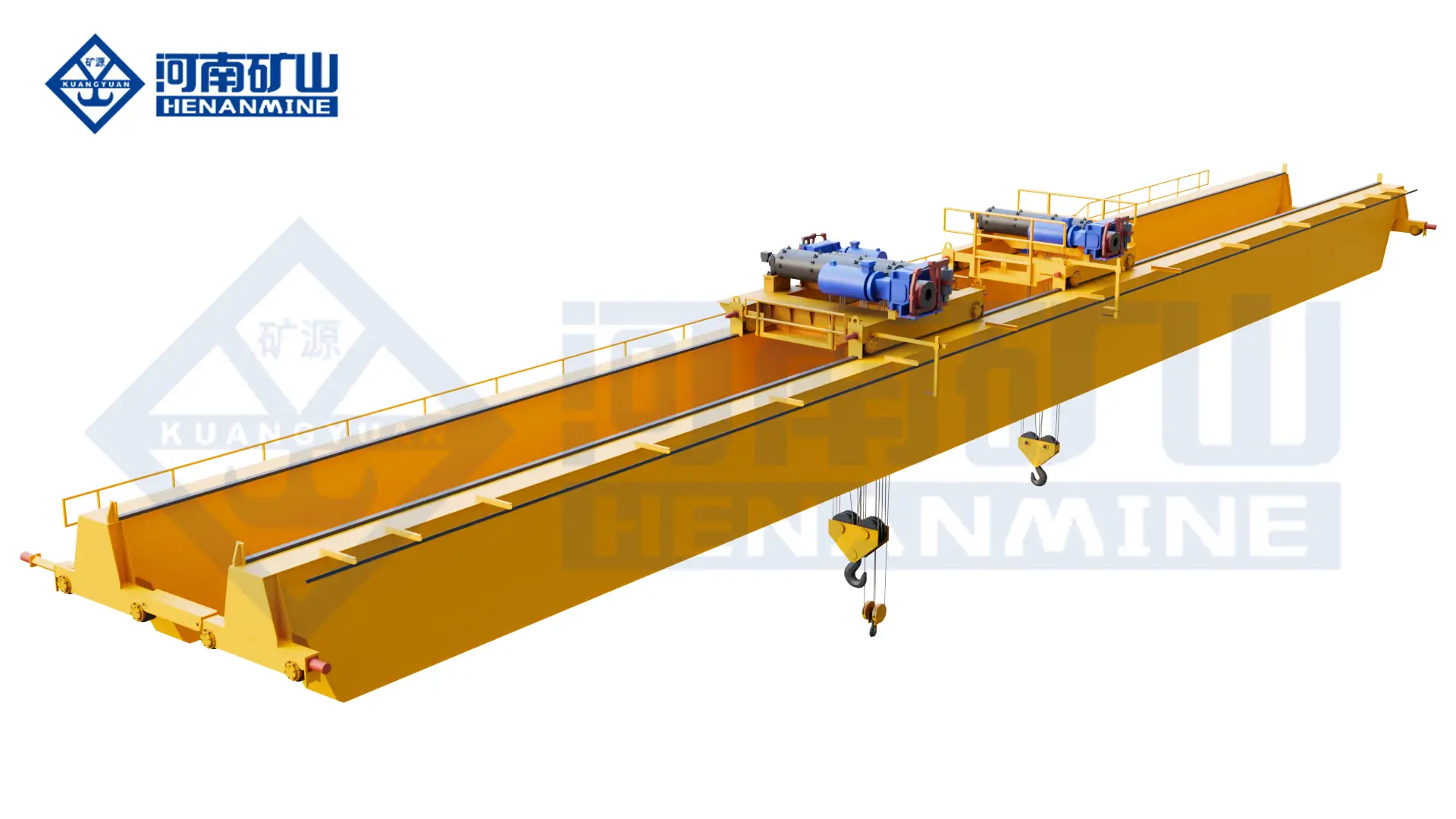
| Bridge/Overhead Crane | Long-span lines needing full-bay coverage | Several tons to 80+ tons |
| Gantry Crane | Facilities without runway support, indoor/outdoor | Medium to heavy |
| Monorail Crane | Linear, repetitive assembly-line moves | Light to medium |
| Stacker/Multi-Axis Crane | Automated storage, retrieval, precision placement | Light to heavy |
| Jib/Workstation Crane | Localized, repetitive station-level lifts | Light duty (≤2 tons) |
Monorail cranes typically move in a straight line, with the trolley and hoist mounted on an I-beam, making them ideal for production and assembly line applications that can be custom configured for automated assembly line requirements. For multi-directional, high-precision handling, some manufacturers offer automated bridge crane systems designed to emulate 5-axis stacker cranes, enabling precise, multi-directional motion for heavy-duty load handling.
If your application is light-duty and confined to a single station, don't over-engineer it: workstation crane systems are typically selected when lifting tasks are repetitive, loads are moderate, and movement is confined to a predictable path, with capacity commonly under 2 tons. If load capacity exceeds light-to-medium duty, or the application requires long-span coverage, outdoor use, or precision hoisting beyond the system's capability, a gantry or overhead crane is the more appropriate choice.
Step 3: Set Positioning Accuracy & Repeatability Targets
Automation tier dictates accuracy requirements:
- Manual-assisted crane: applicable to conventional auxiliary lifting scenarios, positioning tolerance control in ±5-10cm, can meet the needs of ordinary precision, non-precision lifting operations.
- Semi-automatic crane: equipped with basic encoder position feedback device, positioning accuracy of ±1-3cm, can be adapted to medium precision standardized, repetitive lifting operation scenarios.
- Fully-automatic crane: equipped with closed-loop servo control system and professional load anti-swing compensation algorithms, with sub-centimeter to millimeter-level ultra-high repetitive positioning accuracy, to meet the requirements of robots, fixtures and fixtures for accurate docking and other high-precision automation operations.
Automation integration industry common benchmark requirements: automated crane positioning downtime error should be controlled within 5%, as the basis for acceptance criteria, the equipment needs to be commissioned through simulation debugging to optimize the anti-swing performance and walking track accuracy.
Anti-sway and skew correction are standard functions for automated cranes: skew correction guarantees straight-line accuracy and trajectory stability, anti-sway control suppresses load swing, improves operational safety and positioning accuracy, and with multi-axis linkage control, multi-dimensional synchronous operation of the equipment can be realized to adapt to complex lifting conditions.
Match the accuracy spec to the downstream process a crane feeding a robotic weld cell needs tighter repeatability than one simply staging pallets for a forklift.
Step 4: Plan Automation Tier & Controls Integration
Automated cranes typically fall into two categories. Semi-automatic cranes retain greater manual control but include features that assist the operator, while fully automatic cranes can execute repetitive or complex tasks with only operator setup required.
Before selecting a tier, define the controls stack:
- PLC and VFD integrationPLCs handle logic and inputs, while VFDs manage motor speed control, and together they form the backbone of crane automation integration.
- HMI modernizationgives a single interface for drive configurations and dynamic crane feedback to both production and maintenance teams.
- WMS/MES connectivityneeded if the crane must coordinate with inventory or scheduling systems; some vendors note their automation systems are compatible with Level 2 WMS software even without replacing the existing platform.
- AGV/robotics handoffincreasingly common in Industry 4.0 lines, where cranes stop being lone devices and become smart points that interact with robotics, AGVs, and ERP systems.
Don't select automation tier based on budget alone a fully automated crane bolted onto a facility with no PLC infrastructure or network backbone will underperform regardless of crane quality.
Step 5: Build In Safety Systems for Unmanned Operation
Removing the operator from the lift cycle raises the bar on built-in safety, not lowers it. Core systems to specify:
- Personnel and obstacle collision avoidance system: real-time detection of personnel and equipment obstacles in the crane's running path through sensors to realize active obstacle avoidance and eliminate collision safety accidents.
- Redundant braking and emergency stopping logic: Redundant braking mechanism and emergency stopping program are configured for heavy-duty and high-altitude lifting conditions, which greatly improves operational safety and fault tolerance under extreme working conditions.
- Zone automation control: For high-risk processes such as electroplating, pickling, etc., the crane is restricted from ineffective operation through zone control, which reduces the exposure range of high-risk operations and effectively reduces operational safety risks.
- Software no-fly/restricted area control: Relying on the software program to lock the equipment prohibited, restricted areas, and with the structure of the interlocking mechanism of double protection, to prevent violations of cross-area operation.
Eliminating human error and removing people from dangerous environments makes workplaces both safer and more efficient but only if the automation layer itself includes redundancy. Look for vendors who build in obstacle detection and synchronized multi-axis movement as standard, not optional, features.
Step 6: Evaluate Vendors & Custom Engineering Capability
Not every crane manufacturer can deliver true automation engineering. Use this checklist when comparing vendors:
- Self-developed control adaptability: the internal engineering team can be compatible with Rockwell, Siemens and existing SCADA platforms, support customized system integration, abandon the universal automation suite, to ensure that the equipment and the existing production system is stable linkage, highly compatible.
- Empowerment of simulation and digital twin technology: Before equipment production and manufacturing, relying on the digital twin model to carry out anti-swing control, operation path simulation simulation, in advance to check the design defects and operation of the hidden problems, effectively avoiding the later construction rework problems, and significantly reduce the cost of rectification and transformation.
- Factory Acceptance Test (FAT) validation mechanism: Before the project is officially put into use, a prototype proof-of-concept test is completed based on the real bridge crane equipment to comprehensively verify the equipment performance, control logic and operation stability, to avoid the risk of on-site commissioning in advance, and to ensure the efficient and smooth landing of the on-site commissioning work.
- On-site technical support and hands-on training services: After the automated crane is put into use, it is necessary to provide supporting human-machine interface (HMI) hands-on training and rapid troubleshooting on-site services, rather than only providing remote parts sales services, to ensure that all-round equipment for daily stable operation and maintenance, and rapid disposal of faults.
- Modular scalable design, adaptable capacity upgrade: crane main beam, end beam, trolley, hoisting mechanism and other core components support step-by-step upgrades and individual replacement, without the need to dismantle the entire machine. Iterative expansion on demand, phased investment, effectively reducing the pressure of the initial investment, to protect the long-term value of the equipment.
Henan Mine Crane has extensive experience delivering customized lifting solutions for manufacturing, logistics, steel processing, and intelligent factory applications.
Get in touch with our team for technical consultation, project evaluation, and customized crane recommendations.
Calculating ROI and Total Cost of Ownership
Don't evaluate an automated crane purchase on price tag alone. When evaluating investment, factor in labor savings, safety improvements, and throughput gains, not just equipment price and account for hidden ROI such as avoided structural rework and production downtime.
Key TCO inputs:
- The one-time fixed asset investment of the project mainly includes the procurement of main equipment for automated cranes, the development and integration of intelligent control system packages, on-site wiring installation, equipment commissioning and acceptance and delivery of a full set of engineering costs, covering the hardware, software and construction service costs required for the project landing.
- By eliminating the manual operation positions in each production shift, streamlining the on-site manpower configuration, completely getting rid of the dependence on manual guarding, continuously reducing the operating costs such as manpower salary, scheduling management, personnel training, etc., and realizing the long-term savings in production operation and maintenance costs.
- After the completion of the system automation transformation, the manual duty operation positions in each production team can be eliminated, significantly reducing the manpower allocation of front-line operators, effectively reducing long-term scheduling, labor payroll, personnel management and other ongoing operating costs, and realizing the optimization of the manpower structure and the long-term reduction of production costs.
- Clearly define the assessment standards for equipment operation and maintenance and crop rate, establish a quantitative KPI index system, and require that the overall equipment efficiency (OEE) ≥ 85% and the average time between failures (MTBF) ≥ 2,000 hours, which is used to monitor the operational performance of equipment on a regular basis.
- Reserving expansion capacity in advance to avoid transformation costs: Reserving track expansion interface and power redundancy capacity in advance of the project can effectively avoid the high rework and rectification costs incurred in the later transformation.
Most facilities that plan for expandability from day one report lower five-year costs than those that "buy big once" oversizing without modularity increases both upfront cost and installation risk.
Common Mistakes When Specifying Automated Cranes
- Equipment selection is based only on the current operating load of the approved parameters, without taking into account the later capacity enhancement, workpiece specifications expansion of the working conditions of the changes in the amount of load redundancy is not reserved, do not meet the needs of long-term production iteration.
- No special approval of equipment working system and working condition level is carried out, and the equipment is in automated continuous cycle running state for a long time, which is very easy to produce mechanical fatigue, leading to premature failure of the equipment, higher failure rate and other problems.
- The automation control system is retrofitted at a later stage, and the integration and integration planning is not completed at the initial design stage of the project, resulting in shortcomings in the overall adaptability, compatibility and stability of the system.
- Neglecting the constraints of the existing civil structure at the site, the key structural parameters such as operating headroom height, column spacing, track bearing capacity and other key structural parameters were not comprehensively verified and validated for compliance before installing the automation equipment.
- After the substantial reduction of on-site manual supervision, there is no supporting optimization and upgrading of the safety protection system, which seriously underestimates the safety system configuration standards and protection needs under the working conditions of low manual guarding and automated operation.
Conclusion
Automated production line crane selection is a systematic project, need to comprehensively consider the load, working system, accuracy, automation configuration, safety and expansion of key parameters, to ensure long-term stable and efficient operation of the equipment. Improper selection of parameters will cause production bottlenecks, increased operation and maintenance costs, limiting the subsequent capacity upgrade of the plant.
Quality crane automation transformation, need to accurately match the load conditions, capacity requirements, integration standards and safety specifications. The selection of suppliers should focus on their engineering capabilities, integration experience, automation technology and full life cycle services, rather than only comparing the initial purchase cost of the equipment.
Henan Mine Crane can provide customized lifting solutions for intelligent factories, automated production lines, industrial warehouses and other scenarios, covering the whole process of program design, system integration, FAT testing and operation and maintenance, to build an intelligent and efficient material handling system, help enterprises reduce costs and increase efficiency, and empower long-term intelligent production upgrade.