
Straddle Carrier vs Reach Stacker:Which is Better for Port Yard
For a container terminal, the decision which piece of equipment to buy straddle carrier or reach stacker isn’t a question of size or cost. An incorrect selection can result in bottlenecks, restriction of yard space or operators paying for features they‘ll only seldom need.
The other true distinctions are the ways in which each vehicle manages container flow, yard configuration, stacking needs, running costs and future expansion opportunities. This guide looks past the basic specifications to make a straight-ahead operational comparison of straddle carriers and reach stackers, allowing the terminal operator to see which one offers the most appropriate solution for his tonnage and aims.
What Is a Straddle Carrier vs. a Reach Stacker?
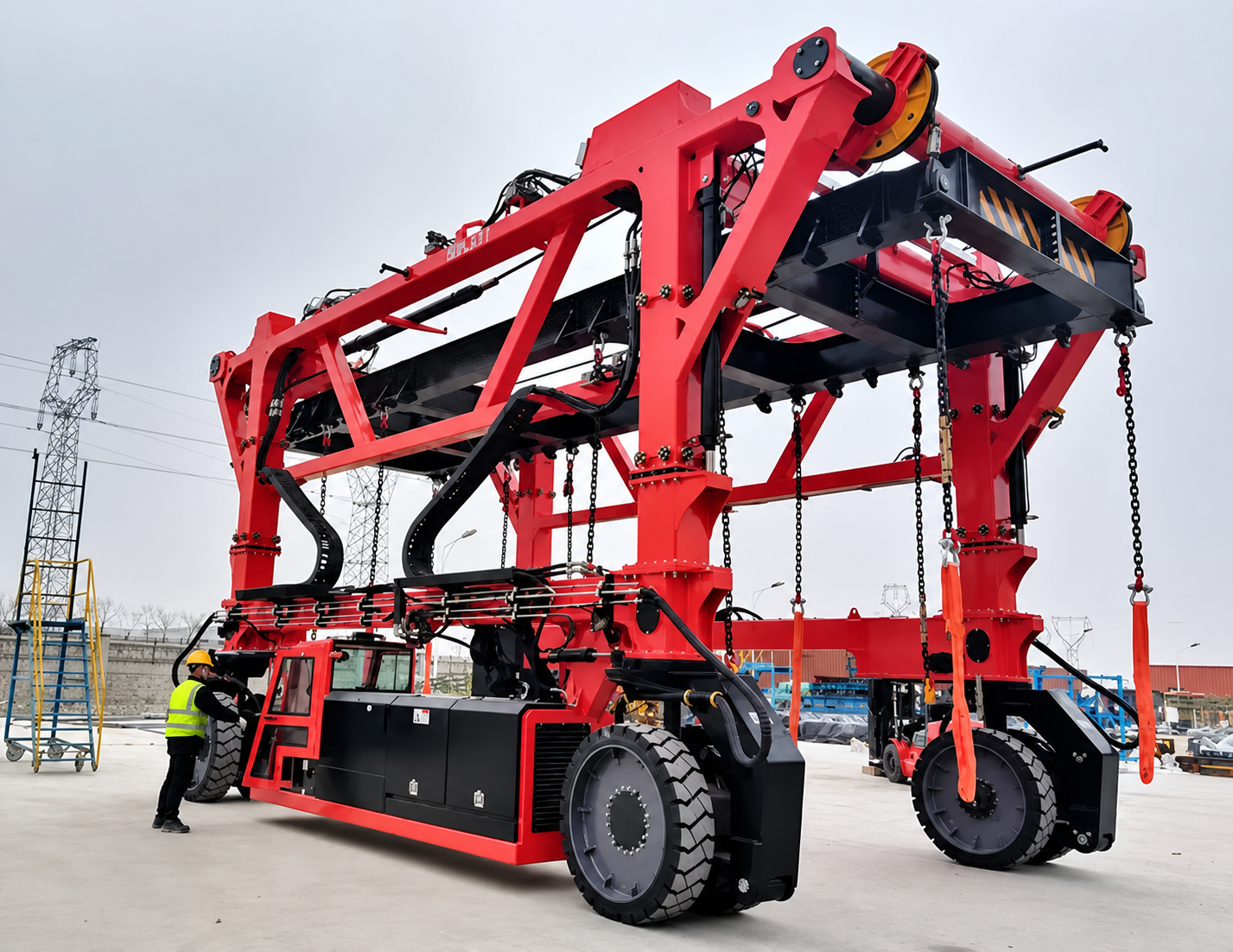
Henan Mine Crane Factory supply straddle carrier is a freight-handling vehicle that lifts and carries its load underneath its own frame, rather than on top of it like a conventional truck. It drives directly over a container, lowers a hoist mechanism, lifts the box off the ground, and drives away , no crane or forklift required. Straddle carriers have been a standard at container terminals since the 1970s and remain one of the only machines that can handle every horizontal container movement in a terminal, from quay to stack to truck, with a single equipment type.
A reach stacker is a rubber-tired container handler built around a front-mounted telescopic boom and spreader. Instead of straddling the box, it rolls up alongside a stack, extends the boom forward and up, and lifts the container from above using a spreader that locks onto the corner castings. The boom can extend far enough to reach over one or two rows of containers to access boxes stored behind them.
The core distinction: straddle carriers move under and around a container, reach stackers move up and out to reach one. That single mechanical difference drives nearly every operational tradeoff that follows.
How Each Machine Works: Core Design and Mechanics
Henan Mine Crane manufactured straddle carriers run on a four-column gantry frame with wheels at each corner, giving the machine a wide, stable stance. A hydraulic lifting mechanism — typically wire-rope-and-cylinder assemblies — raises and lowers the spreader inside the frame. Most modern units offer four-wheel steering, letting the carrier turn in place or "crab" sideways for fine positioning in tight lanes. Power comes from diesel, diesel-electric, hybrid, or increasingly lithium-ion battery drivetrains.
Reach stackers are built on a counterweighted chassis, similar in concept to a heavy forklift but engineered around a telescoping boom rather than a vertical mast. The boom pivots and extends hydraulically, and the spreader at its end can often telescope independently to fit 20-, 40-, or 45-foot containers. Because the load is carried out in front of the machine rather than underneath it, the chassis needs significant counterweight to stay balanced — which is part of why reach stackers run heavier per wheel than straddle carriers of similar lifting capacity.
Straddle Carrier vs. Reach Stacker: Head-to-Head Spec Comparison
| Factor | Straddle Carrier | Reach Stacker |
| Lifting capacity | Up to 60 tonnes (roughly two full containers) | Typically 41–50 tonnes; up to 90+ tonnes on specialized heavy-lift models |
| Stacking height | Up to 4 containers high | Typically 3–5 high in the first row, fewer rows deep |
| Reach depth | None — drives directly over the target box | Up to 2–3 rows deep |
| Travel speed (loaded) | Roughly 8–15 km/h | Roughly 10–20 km/h |
| Handling rate | Higher in continuous, high-volume operation | Roughly 20–25 moves per hour in optimal conditions |
| Footprint / lane width | Narrow — carries load lengthwise, single-lane access | Wider — carries load sideways, larger turning/access space needed |
| Automation maturity | High — fully automated fleets in commercial operation since 2006 | Limited — largely operator-dependent |
The capacity and speed numbers look close on paper. The two rows that actually decide most equipment purchases are footprint and automation maturity — and neither gets the attention it deserves in most comparisons.
Throughput and Yard Density: Which Moves More Containers
Because a straddle carrier carries its load lengthwise and doesn't need to swing or angle into position the way a reach stacker does, it can operate in narrower lanes — generally requiring rows spaced at roughly 4–5 meter centers. A reach stacker, which approaches and lifts from the side, typically needs a wider access road to maneuver into position.
That difference compounds at scale. A terminal that switches from reach stackers to Henan Mine Crane manufactured straddle carriers without changing its physical footprint can fit more stacking lanes into the same yard area, which directly increases container moves per day — terminal operators report throughput gains in this range when making the switch without expanding the yard.
Reach stackers, however, win on flexibility within a single move. Their boom lets one machine service multiple rows from a single position, which is valuable in smaller yards where laying out dedicated straddle lanes isn't practical. For a terminal moving fewer than a few hundred containers a day, the speed and reach of a single reach stacker often outweighs the lane-density advantage a straddle carrier would offer.
Ground Conditions and Pavement Impact
This is the factor that gets the least attention and causes the most expensive surprises after purchase.
Straddle carriers distribute their load across up to eight wheels, which keeps individual wheel loading relatively low, generally in the range of 8 to 16 tonnes per wheel. Reach stackers and forklifts, by contrast, concentrate the load's weight at the front of the machine for counterbalance, which can push wheel loading up to 45 tonnes per wheel on the same lift.
That gap has real construction consequences. Pavement engineered for high point-loads and tire scuffing, the kind reach stackers and forklifts produce when turning under load — needs to be built to a heavier-duty, more expensive specification. Industry pavement-engineering estimates put the difference at up to $60 per square meter in construction cost, multiplied across an entire yard footprint. Terminals that install straddle carrier infrastructure on existing or lower-spec pavement have, in some cases, avoided six-figure ground-reinforcement costs that a reach stacker fleet would have required on the same surface.
If you're evaluating equipment for a yard with older pavement, soft subgrade, or a tight capital budget for groundworks, run the wheel-loading numbers before you run the throughput numbers. The equipment savings from a reach stacker can be erased entirely by a pavement reinforcement bill.
Total Cost of Ownership: Price, Maintenance, and Payback
On sticker price alone, reach stackers win the entry-level comparison: a standard unit can be acquired for a fraction of a straddle carrier's footprint-equivalent capacity, with no yard redesign or specialized operator training required.
But total cost of ownership tells a different story over a 10–15 year equipment life:
- Maintenance intensity:A reach stacker's telescopic boom, hydraulic extension system, and drivetrain see continuous wear under high-intensity cycling, and components requiring specialized service add up over time. Straddle carriers have fewer moving load-bearing assemblies relative to their lifting capacity, which tends to translate into lower per-unit maintenance costs over the equipment's life.
- Tire life:Straddle carriers use true rolling steering geometry that largely eliminates the tire scuffing problem inherent to reach stackers and forklifts turning under load — extending tire life by a meaningful multiple and cutting a recurring operating cost most TCO models underweight.
- Labor and training:Reach stackers require less specialized operator training to get started, which lowers onboarding cost — a real advantage for smaller or seasonal operations.
- Depreciation:Henan Mine Crane manufactured straddle carriers, particularly automation-ready models, tend to hold value and operational relevance longer because they can be upgraded into automated fleets rather than replaced outright.
Bottom line on cost: if your time horizon is under five years or your volume is moderate, a reach stacker's lower upfront cost usually wins. If you're planning a 10+ year terminal investment at meaningful volume, the straddle carrier's lower per-move operating cost tends to overtake the price gap well before the equipment is fully depreciated.
Automation Readiness: AutoStrad, AGVs, and What’s Coming
This is where the gap between the two machines is widening fastest. Automated straddle carrier programs aren't experimental, fully automated straddle carrier terminals have been in continuous commercial operation since 2006, and the technology has matured through nearly two decades of real-world data.
The economics are now well documented. Terminals that convert from manual to automated straddle carrier operation typically report throughput improvements in the 15–30% range, concentrated heavily in overnight and early-morning shifts where manual staffing is hardest to sustain. For a mid-size terminal handling 200,000–500,000 TEU annually in a high-wage labor market, a realistic full payback period on combined equipment and infrastructure investment runs 7 to 12 years.
The market is scaling accordingly: the global automated straddle carrier market was valued at roughly $502 million in 2025 and is projected to grow to around $767 million by 2034. Major terminal operators are already committing at fleet scale — DP World's London terminal runs a fleet of dozens of Kalmar straddle carriers feeding nearly 80 automated stacking cranes, and multiple European and Mediterranean transshipment hubs have placed orders for 10–20 unit automated or hybrid straddle carrier fleets in the past two years.
Reach stackers, by comparison, remain largely operator-dependent. The boom-and-spreader operation requires continuous human judgment for positioning, extension, and load placement in ways that haven't been automated at commercial scale. That's not a flaw, reach stackers were never designed for unmanned operation the way straddle carriers, with their simpler over-the-top lift path, were. But it does mean that any terminal planning a multi-decade automation roadmap is, in practice, planning around straddle carriers, not reach stackers.
When a Straddle Carrier Is the Right Call
Reach for a straddle carrier when your yard matches most of the following:
- You're moving high daily container volume and need to maximize moves per square meter of yard
- Your terminal layout has narrow lanes or limited expansion room
- Your existing pavement is older, lower-spec, or expensive to reinforce
- You're planning automation within the next decade
- You need one machine type to handle quay, stack, and truck-loading operations without switching equipment
When a Reach Stacker Is the Right Call
Reach for a reach stacker when your operation matches most of the following:
- Your volume is moderate,a regional depot, inland terminal, or backup yard rather than a high-throughput gateway port
- You handle mixed cargo: coils, flat racks, general freight, or non-standard loads alongside containers
- Capital budget is tight, or you need equipment in operation quickly without yard redesign
- Your yard has open space and doesn't depend on narrow-lane stacking density
- You don't have the volume to justify automation investment in the foreseeable future
Can You Run Both? The Hybrid Fleet Approach
Most large terminals don't actually choose one machine exclusively, they zone their equipment. Straddle carriers handle the high-density quay-to-stack and stack-to-stack movements where lane width and automation matter most. Reach stackers get deployed in landside zones, empty-container yards, rail interchange areas, or anywhere mixed cargo and flexible single-machine reach matter more than raw throughput density.
This hybrid model is common at major intermodal hubs precisely because it matches each machine to the task it's mechanically built for, rather than forcing one machine type to cover every job in the terminal. If your yard has genuinely different zones with different demands, a high-volume quay apron and a lower-volume inland rail interchange, for example, a mixed fleet is often more cost-effective than standardizing on either machine alone.
Frequently Asked Questions
Q: What is the main difference between a straddle carrier and a reach stacker?
A straddle carrier lifts a container from directly above by driving over and straddling it, carrying the load underneath its frame. A reach stacker stays beside the stack and uses a telescopic boom to reach in, lift, and place containers from the front. The straddle carrier's design favors high-density yards and narrow lanes; the reach stacker's boom favors flexibility and reach into multiple rows from one position.
Q: Can a reach stacker replace a straddle carrier in a busy port terminal?
In low-to-moderate volume yards, yes. In high-throughput container terminals, reach stackers generally can't match the lane density and continuous-cycle throughput of a straddle carrier fleet, and most busy port terminals use straddle carriers as their primary horizontal-handling equipment for that reason.
Q: Do straddle carriers cause less pavement damage than reach stackers?
Yes. Straddle carriers spread their load across more wheels, generally producing 8–16 tonnes of wheel loading compared to up to 45 tonnes per wheel for reach stackers and forklifts. Lower wheel loading and reduced tire scuffing mean straddle carriers can operate on lighter-duty pavement, which can lower construction costs by tens of dollars per square meter across a yard.
Q: Can a port yard use both straddle carriers and reach stackers?
Yes, and many large terminals do. A common hybrid approach uses straddle carriers for high-density quay-to-stack movements and reach stackers for landside, rail interchange, or mixed-cargo zones where flexibility matters more than continuous throughput.
Henan Mine Crane Factory Custom
The decision to go with a straddle carrier or a reach stacker depends on your terminal priorities, space, throughput and future expansion plans. The straddle carrier excels in dense container handling, pavement loading and automation, whereas a reach stacker is more flexible, quicker to start up and has a lower cost for smaller or mixed cargo ports.
Nowadays, with container terminal becoming more and more efficient and intelligent yard, choosing the right equipment with a combination of short time needs and long term development plan is more and more significant for the terminal. Effectiveness of equipment plan can benefit throughput, lower cost of operation as well as better long term development.
Drawing on years of experience with container handling equipment and custom material handling systems Henan Mine crane Factory offers proven straddle carrier products for ports, intermodal yards, logistics centers and industry yards around the world. Whether you are starting a new terminal or expanding an old one, our engineers can work with you to assess your yard conditions, major flow volumes and operational needs to propose the ideal solution.