
Bridge Crane for Steel Mill Workshop: Types, Specifications & Selection Guide
In Henan Mine Crane do metallurgical lifting equipment sales and technical support these years, I have run through the world's large and small steel mills, from small and medium-sized steel mills in Southeast Asia, to Europe, America and the Middle East, the large-scale joint-steel enterprises, I have seen too many production interruptions and safety hazards due to the selection of the wrong type.
The production environment of steel mills, and ordinary industrial workshop is completely different, perennial extreme high temperatures, heavy loads, dust, iron oxide wrapped, coupled with 24 hours of continuous operation mode, the lifting equipment requirements are almost harsh.
As the core equipment for steel mill material transfer and process connection, the selection of bridge crane for steel mill workshop is directly related to the continuity of production, worker safety, equipment reliability, and determines the long-term operating costs.Many steel mills in the expansion or equipment upgrading stage, easy to fall into the “only look at the tonnage, only than the price” of the misunderstanding, ignoring the adaptability of the conditions and safety redundancy, the late frequent parts aging, failure and downtime, but increased additional investment.
Today I will combine Henan Mine Crane manufactured more than twenty years of metallurgical equipment experience, with a common engineer's point of view, the type of steel mill bridge crane, core parameters, compliance standards and selection points to make it clear, to help the global steel purchasing and equipment management personnel to avoid pits, and choose the equipment that meets the actual needs.
Why Steel Mills Require Specialized Bridge Cranes
Many of my customers have asked me if a common industrial bridge crane can be used in a steel mill. The answer is clear: absolutely not.
The special working conditions in steel mills dictate the use of customized metallurgical bridge cranes, which can be explained in two dimensions: environment and safety.
Harsh Working Environment
The harsh environment of steel mill workshop is unbearable for ordinary cranes. The most intuitive is the high temperature, converter, continuous casting area of the radiant heat, can easily reach dozens or even hundreds of degrees, long-term baking will accelerate the aging of electrical components, metal structure deformation.
Molten metal operation, the splash of steel slag, steel will directly erode the surface of the equipment, and a large number of dust floating in the workshop, iron oxide, will be drilled into the motors, control cabinets, walking mechanism of the gap, resulting in parts jamming, wear and tear.
More critical is the continuous production mode of steel mills, cranes almost year-round, high-frequency heavy-duty starting and stopping, repeated start and stop, will continue to aggravate the mechanical fatigue of the equipment.
The structural design, material selection and protection configuration of ordinary industrial cranes are all designed for regular working conditions, and in such extreme environments as steel mills, short-term failures will occur, and simply can not meet the long-term production requirements.
High Safety Risk
Lifting operations in steel mills carry a high safety risk, especially in the handling of molten metal, where any equipment failure can lead to catastrophic consequences.
I have seen a steel plant in Tangshan, due to the crane brake wheel material is not up to standard, there are cracks, in the handling of empty steel ladle brake wheel chipping accident, resulting in casualties and equipment damage, direct economic losses, but also interrupt the production process.
Steel ladle, heavy slab, billet transfer, multi-process cross operation is frequent, multiple cranes operating in concert with the scene is very common, once the collision, brake failure, the consequences are unimaginable.
This is the core reason why steel mill overhead cranes must be equipped with redundant safety systems - the single safety protection of ordinary cranes simply cannot cope with the high-risk operation scenarios in steel mills.
Types of Bridge Cranes Used in Steel Mill Workshops
Different smelting processes in steel mills require completely different bridge cranes, each of which has its own design focus and is indispensable. Just like the “special tools” of the production line, each one has its own function to ensure the smooth running of the steel mill.
Ladle Crane (Casting Crane)
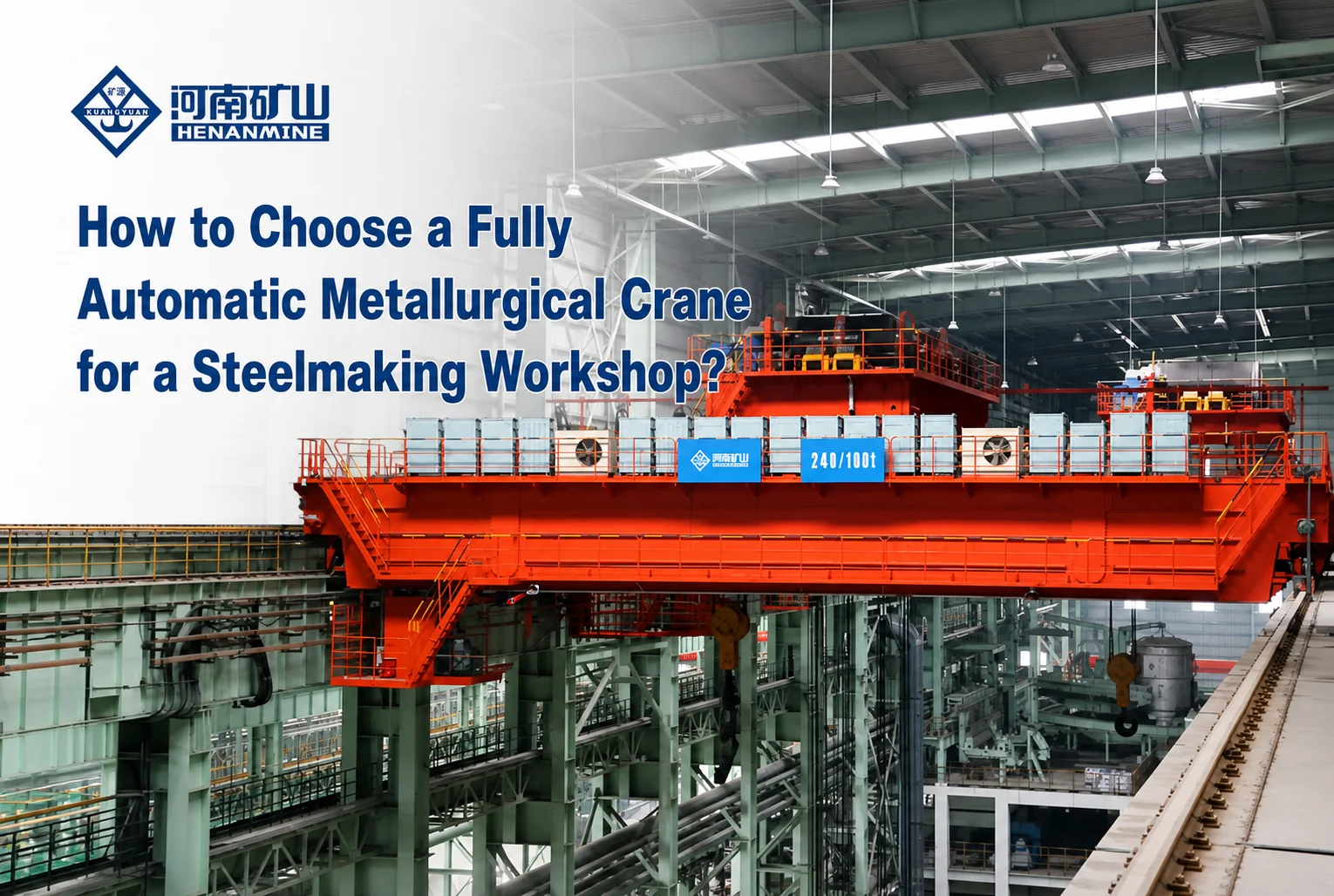
As the core and most critical lifting equipment in the steel plant, ladle crane for steel plant is mainly responsible for lifting, transferring and pouring of ladle, which is centrally deployed in the converter shop and continuous casting operation area.
Its core design is the double lifting mechanism, the main winch is responsible for lifting the ladle, and the auxiliary winch cooperates with the ladle to complete the tilting and alignment of the ladle, and the two work together to ensure the smooth and accurate transfer of molten steel.
Considering the high risk of molten metal, the equipment must be equipped with a redundant braking system, even if one set of brakes fails, another set can take over in time to avoid steel leakage.
The key components of the entire vehicle are made of high-temperature-resistant alloy to resist the erosion of radiant heat from molten steel, and the working level is up to the high grade standards of FEM A7-A8 and ISO M7-M8, which is suitable for 24-hour uninterrupted heavy-duty cyclic operation.
It can be said that the safety and stability of steel ladle cranes directly determines the success or failure of the steelmaking process in steel mills, and any slight negligence may cause irreparable losses.
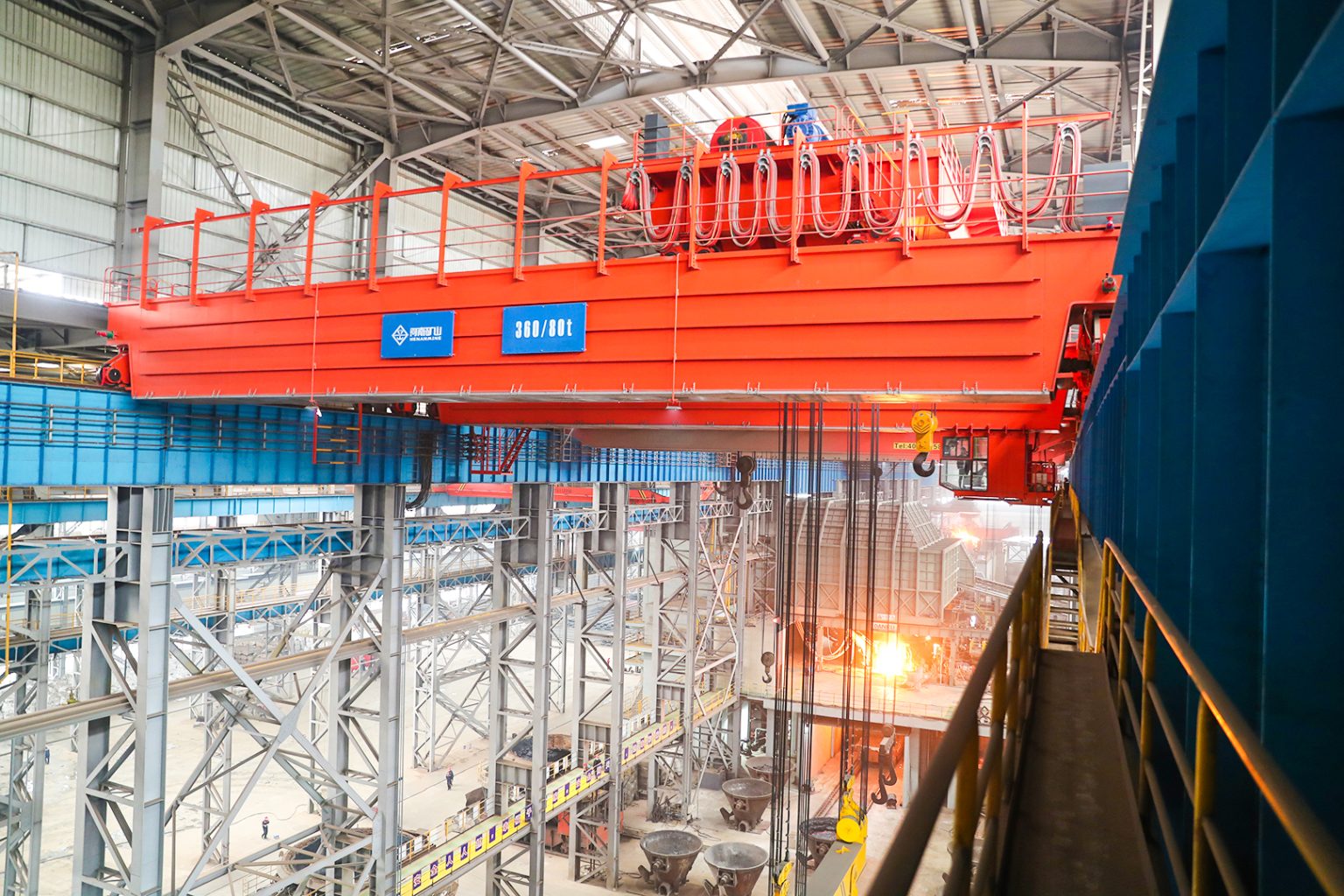
Steel Mill Casting Specialized Crane Manufactured by Henan Mine
Charging Crane
Charging crane steel mill is mainly used in the electric arc furnace smelting section, the core task is to lift the scrap hopper to the electric furnace to complete the loading of raw materials.
Scrap will generate huge impact load when it is put into the furnace, so the frame and traveling mechanism of the equipment are all thickened and reinforced, with strong impact and vibration resistance.
Its rated load is generally large, can match the feeding needs of different specifications of electric arc furnace, whether it is a small electric furnace of small and medium-sized steel mills, or a large electric furnace of large-scale joint iron and steel enterprises, you can find a suitable model.
Many customers will ignore its anti-impact design, and as a result, after being put into use, there are frequent problems of loosening of the traveling mechanism and deformation of the machine body, which affect the feeding efficiency.
Billet Handling Crane
Billet handling crane is the “main equipment” of hot rolling and cold rolling workshop, specialized in transferring hot billets and mill feeding connection, and it has to complete hundreds of cycle operations every day.
Long-term contact with high-temperature red billet, equipment hook group, wire rope, motor shell are installed with a special heat protection layer, can effectively isolate high-temperature radiation, to avoid parts due to high-temperature aging.
Its running rhythm is very compact, walking and lifting speed has been specially tuned, in the continuous operation mode, can still maintain stable operation, there will be no jamming, delay.
For the steel rolling workshop, the operation efficiency of the billet crane directly affects the production rhythm of the mill, the right equipment can effectively reduce the waiting time of the process.
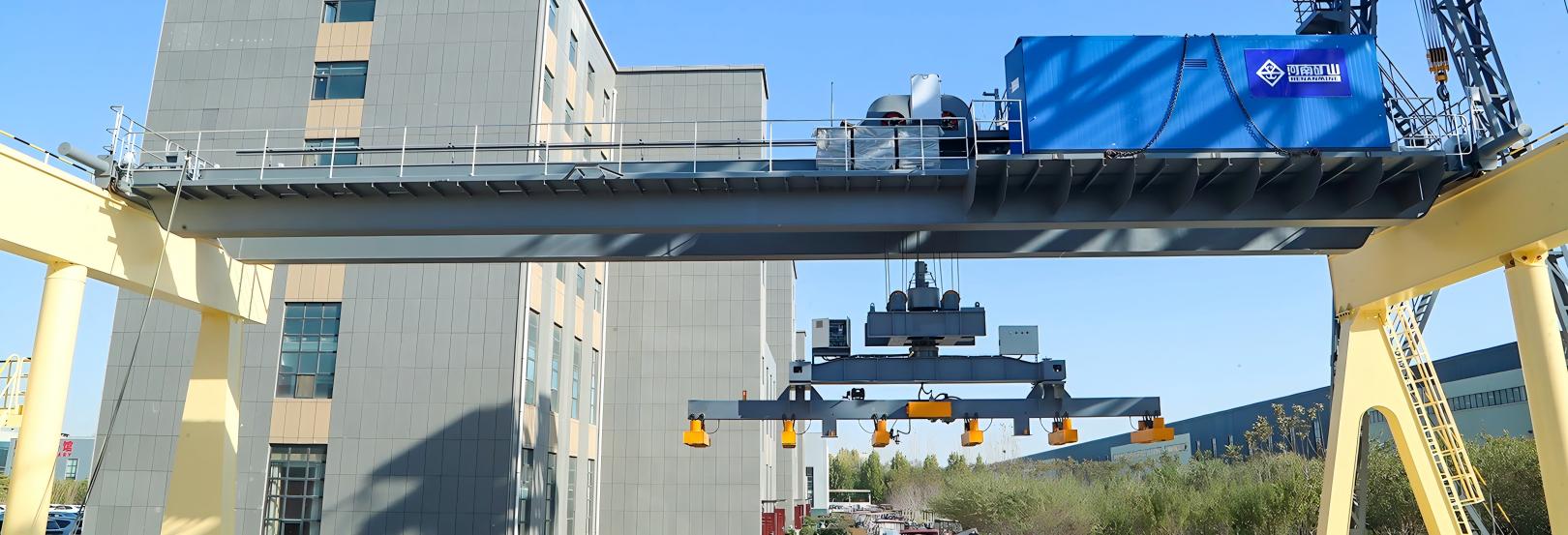
Automatic Steel Plate Handling Crane Manufactured by Henan Mine
Slab Handling Crane
Slab handling overhead crane is mainly used for inter-area transfer of wide and thick slabs, medium and thick plates, which is widely used between continuous casting workshop and finished product yard, and is the core equipment for transferring finished products in steel mills.
The biggest feature of this kind of equipment is the large span design, which can be adapted to the layout of large area finished product yard in steel mills, and the rated load covers the handling demand of large tonnage heavy plates.
The transfer of long-size heavy slabs requires high stability of the equipment, so the body structure has been optimized for balance, which can effectively reduce the load shaking during long-distance handling, avoid collision and deformation of slabs, and at the same time reduce the twisting loss of the equipment structure.
Many large steel mills are equipped with multiple billet cranes working together in the finished product yard, which requires good anti-collision performance of the equipment to avoid interference during operation.
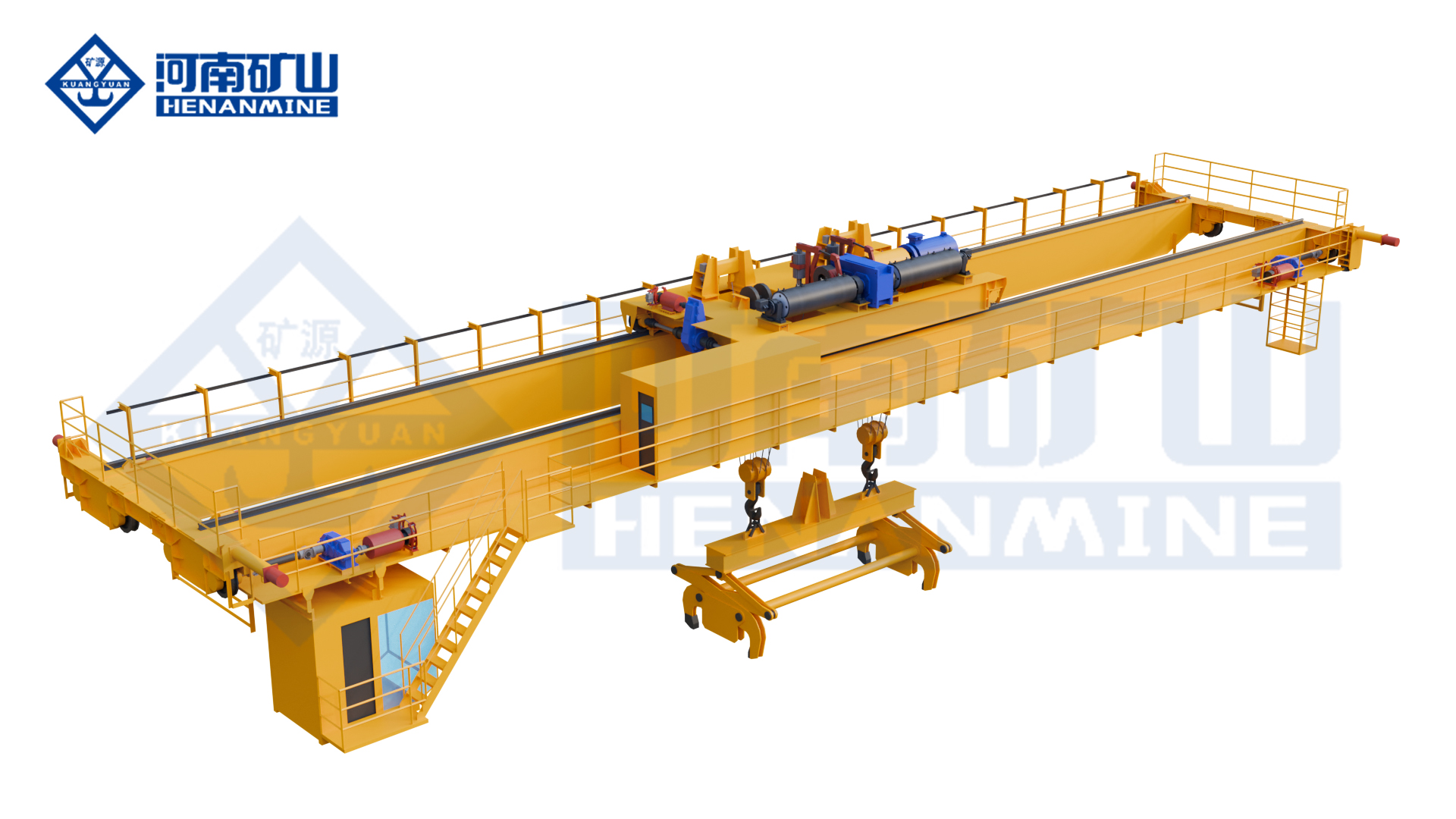
Slab Handling Crane
Key Technical Specifications to Consider
Selection of steel mill overhead cranes, can not just look at the tonnage and span, the five core technical parameters, directly determines the service life of the equipment, operational stability and safety, even if you ignore one, may leave hidden dangers.
Duty Classification
Duty Classification, equivalent to the crane's “endurance level”, is the core indicator to distinguish between ordinary cranes and metallurgical cranes, but also the most easily ignored selection points.
The continuous production mode of steel mills requires lifting equipment to have high-intensity, long-time operation ability, so the duty class must meet specific standards.
The international standard is very clear: ISO 4301 standard M7-M8 level, FEM specification A7-A8 grade, North America CMAA standard E or F class, which CMAA F class corresponds to the continuous operation mode, more than 20 times an hour cycle, fully adapted to the working conditions of steel mills.
I have seen many customers use M5 or M6 grade equipment instead of M7-M8 grade in order to save cost. As a result, in less than a year, there are problems of fatigue cracking of the main beam and serious wear and tear of the winch mechanism, which cost more for repair and replacement.
Lifting Capacity
Lifting capacity should be selected in accordance with the furnace specifications, material weight and production scale of the steel plant, and should not blindly pursue large tonnage, nor should it be reluctantly adapted.
Different types of cranes, load range has a clear industry standard: ladle crane load range is generally in the 50 tons to 500 tons, can cover from small converter to large continuous casting production line needs; billet, slab transfer cranes, the conventional tonnage is concentrated in the 20 tons to 150 tons, to meet the conventional rolling production line material turnover.
Selection, it is recommended to reserve 10% -20% of the load margin, to avoid long-term full-load operation of the equipment, which can effectively lengthen the overall life cycle of the equipment and reduce component loss.
For example, if a steel mill has a large converter volume and the ladle full load weight is close to 200 tons, we suggest using a 250-ton ladle crane, with enough safety margin to avoid overload operation.
Heat Resistance & Protection
High-temperature protection is the “life-saving configuration” of steel mill overhead travelling crane, without perfect high-temperature protection, the equipment simply can't run for a long time in the steel workshop.
The electrical control cabinet must be equipped with heat insulation protection panel to isolate the external high temperature radiation and prevent the internal electrical components from aging and short-circuiting; the operator's cab should be sealed and heat-insulated to improve the working environment and protect the operator's safety.
The entire cable should be used for high temperature resistant special models, motor, reducer equipped with an independent cooling system, timely dissipation of heat generated during the work, to avoid damage to components due to high temperature.
Many small steel mills in order to save costs, omitted these protective configurations, the result is that the motor frequently burned, cable aging fracture, but affect the production schedule, the loss is not worth it.
Structural Reinforcement
Steel mill cranes are subjected to heavy loads, high-frequency start and stop for a long time, coupled with the thermal expansion and contraction in the high-temperature environment, the fatigue damage of the metal structure will be very fast, so structural reinforcement is crucial.
As a professional heavy duty bridge crane metallurgy manufacturer, our Henan Mine Crane adopts anti-fatigue steel structure for the main girder, and the weld seams and stress nodes are strengthened to effectively resist the stress impact brought by long-term heavy load.
End beams, traveling wheels, connecting base and other wear parts, have been thickened and reinforced, the overall structural rigidity is higher, can be adapted to the complexity of the steel plant, the harsh operating conditions.
The rationality of the structural design directly determines the service life of the equipment, and the high quality structural design enables the crane to reduce the number of overhauls within the 15-20 year service life.
Redundancy & Safety Systems
Redundancy & Safety Systems is a mandatory requirement for steel mill cranes, especially in the section involving molten metal handling.
Dual brake independent system is the basic configuration, two sets of brake systems are independent of each other, a single component failure, the backup device can take over the operation in a timely manner, to avoid brake failure, which is also one of the key measures to avoid accidents similar to the Tangshan steel mill brake wheel chipping.
The dual-motor lifting structure ensures the stability of the lifting mechanism, so that even if one motor fails, the other motor can maintain the operation of the equipment to avoid load falling.
In addition, real-time load monitoring devices, trolley and cart collision avoidance devices, emergency backup power supplies, and other protective features must be in place to form a complete safety protection system, which is the core acceptance item of the safety compliance review of steel mills around the world.
Safety Standards & Compliance
Steel overhead travelling crane belongs to special industrial equipment, which is exported to all regions of the world, and must strictly follow the corresponding international standards, not only to meet the requirements of local safety supervision, but also to ensure production safety.
International Standards
The global mainstream common standards, is our Henan Mine Crane factory design basis, but also the core reference of the global steel plant procurement equipment.
ISO 4301 crane classification standards, clear requirements for metallurgical crane work level; FEM European Material Handling Federation specifications, the structural design of the equipment, safety and protection of the detailed provisions; CMAA North American crane industry standards, mainly adapted to the operational needs of the North American steel mills; EN series of metallurgical equipment special standards, is the threshold of entry in the European region.
Steel mills in different countries and regions, according to local regulations, require equipment to meet the corresponding standards, such as the export of equipment in Europe, must meet the EN standard for metallurgical cranes, otherwise it can not pass the safety inspection and acceptance, can not be put into use.
Molten Metal Safety Requirements
The handling of molten materials such as molten steel and steel slag has uncompromising mandatory safety provisions, and any slight negligence may cause catastrophic accidents.
Dual brake independent braking structure, dual sets of lifting actuators, emergency stop interlocking logic, these three are the necessary configuration of the molten metal handling crane, you can't have one without the other.
Emergency stop protocol should be clear, once an abnormal situation occurs, the operator can quickly trigger the emergency stop, the equipment can immediately stop running to avoid the expansion of the accident.
I have seen a steel plant to omit the double lifting mechanism, the result of the lifting motor failure, the ladle can not fall smoothly, almost causing steel leakage, but fortunately timely emergency measures to avoid major accidents.
Lifecycle Cost Considerations
The lifecycle of steel mill cranes is generally 15 to 20 years, the procurement should not only look at the initial price, but also combined with a comprehensive assessment of the whole life cycle cost, otherwise you will face high operation and maintenance costs and downtime losses.
CAPEX Components
The initial investment mainly includes five parts: crane main girder structure, hoisting and winching system, a complete set of electrical control modules, exclusive safety guards, as well as on-site installation and commissioning, survey and docking supporting costs.
Metallurgical customized model equipment procurement costs, will be higher than the same tonnage of ordinary cranes, this is because of its structural materials, protective configurations, safety levels, are higher than ordinary cranes a grade.
Many customers will choose low-priced ordinary cranes in order to save the initial investment, and as a result, frequent failures in the late stage, but spent more on maintenance and replacement costs, which is not worth the loss.
OPEX Components
Post-operating expenses, mainly composed of daily energy consumption, regular maintenance, replacement of original spare parts, wear parts loss, the accumulation of these costs, is also a considerable amount of expenditure.
As the working conditions in steel plant are harsh, the replacement frequency of wearing parts such as bearings, brake pads, steel wire ropes and filtration elements is much higher than that in ordinary industrial scenarios.
Establishing a reasonable regular maintenance program can significantly reduce the expenditure on major maintenance and extend the service life of the equipment, such as regular cleaning of equipment dust, checking the braking system, and replacing aging parts, all of which can effectively reduce operating costs.
Downtime Risk Cost
The steel production line is a continuous flow operation, once the crane failure and shutdown, the entire production line will come to a standstill, the loss is very huge.
I have contacted many large steel mills, an hour of downtime losses can reach hundreds of thousands or even millions of dollars, far more than the purchase price of the equipment itself.
Therefore, the reliability of the equipment, often more important than the initial purchase price. A crane with high stability and perfect protection, although the purchase price is a little higher, but can reduce the number of breakdowns and downtimes, but in the long run, it can save a lot of money.
15-20 Year Lifecycle Perspective
At the selection stage, we must have a long-term vision, focusing on three aspects: anti-fatigue design of the structure, durability of the core components, and the compatibility of the later transformation and upgrading space.
A good quality metallurgical overhead crane system can maintain stable performance under long-term high-temperature and heavy-duty environments, reduce the number of overhauls, and be suitable for multi-stage capacity upgrades of steel mills.
For example, some steel mills will consider the needs of later automation upgrades when purchasing, and reserve corresponding interfaces and installation space, so that when upgrading later, there is no need to replace the entire equipment, thus saving upgrade costs.
Automation & Intelligent Upgrade Options
With the upgrading of the global steel industry, more and more large-scale steel mills have started to promote the automation transformation of their workshops, and metallurgical overhead travelling crane is also gradually adapting to the digitalized control mode, which is also the development trend of the industry.
Remote control of bridge cranes is the most widely used upgrade option. Operators can complete all crane operations in the control room far away from high temperature and high-risk operation areas, which can reduce personnel safety risks and improve the operating environment.
The addition of intelligent anti-shaking system and precise positioning module can make heavy material handling smoother, reduce material collision and structural wear and tear, as well as improve operational efficiency.
With the equipment condition monitoring system, it can collect real-time operating data of the crane, pre-judge the loss of components, formulate planned maintenance, avoid sudden downtime problems, and reduce production losses.
Many cranes in old steel mills can also be modularized to gradually realize semi-automated operation, without replacing the entire equipment, can be adapted to the workshop automation upgrade requirements, saving investment costs.
Common Mistakes When Purchasing Steel Mill Bridge Cranes
Visiting steel mill projects around the world, I summarized the industry's most common types of selection misunderstandings, many customers have stepped on these pits, not only increased costs, but also affect production.
The most common is to choose ordinary industrial cranes, put into metallurgical workshop use. Neglecting the differences in working conditions of high temperature, dust, and heavy loads, problems such as motor burnout, structural deformation, and electrical failures will occur in a short time, and the maintenance cost will remain high in the later stage.
Neglecting the working level, deliberately depressing the grade, and replacing the metallurgical special model with low-grade equipment. For example, replacing M7-M8 level with M6 level, the equipment will be overloaded for a long time, which will quickly appear the aging of parts and shorten the service life.
Underestimate the destructive power of high-temperature radiation and omit heat insulation, heat dissipation, and dustproof protection configurations. Especially electrical components, long-term operation in a high-temperature environment is prone to short-circuiting, aging, triggering safety hazards.
Procurement stage only compare the unit price, do not verify the structure of the material, safety redundancy, material standards. Some low-priced equipment, with poor-quality steel and accessories, seem to save the initial investment, but the later frequent failures and downtime, but increased the overall cost.
In the section that handles high-risk materials such as molten steel, the omission of dual-lift and dual-brake redundancy systems violates the metallurgical industry's safety norms, and not only fails to pass the safety inspection and acceptance, but also sows major safety hazards.
Selection Checklist for Steel Plant Procurement Managers
Combined with many years of experience in project matching, I have compiled a simple checklist for steel plant procurement managers to check against when selecting a model, you can avoid most of the pits, to ensure that the selection is accurate.
1. Combine the smelting process with your own, define the rated load and the ultimate operating span required by the equipment, and reserve a reasonable load margin.
2. Match the furnace volume and ladle specifications to confirm the lifting tonnage to avoid insufficient tonnage or excessive waste.
3. Verify the working level of the equipment, and lock the M7-M8 / A7-A8 metallurgical grade to meet the continuous operation requirements.
4. For equipment involved in molten metal operations, verify that the dual brake and dual lift redundancy configurations are complete and meet safety specifications.
5. Verify that the entire vehicle is equipped with special protection against high temperature, dust, and heat to ensure that it is suitable for the harsh environment of the steel plant.
6. Confirm that the equipment complies with ISO, FEM, CMAA and other international standards in accordance with local regulations to ensure compliance.
Frequently Asked Questions
What is the difference between a ladle crane and a standard overhead crane?
The core difference between a ladle crane and a standard overhead crane lies in the design purpose and safety configuration. ladle crane for steel plant is designed exclusively for metallurgical high-risk scenarios, equipped with a full set of redundant safety structures, high-temperature protection, impact-resistant structures, and can be adapted to molten metal handling.
Ordinary standard cranes do not have high-temperature protection and multiple braking design, the structural strength and working level can not meet the requirements of metallurgical working conditions, can not withstand the risk of molten metal handling, and are strictly prohibited from mixing.
How long does a steel mill bridge crane last?
Under the premise of standardized maintenance and compliant selection, the service life of a steel mill bridge crane can reach 15-25 years.
Daily dust cleanup, overhaul of high-temperature components, and structural flaw detection are the keys to extending the service life of the equipment. For example, regular inspection of the brake wheel material and condition, to avoid cracks and other safety hazards, can effectively extend the life of the equipment.
What duty class is required for steel mills?
The common standard for metallurgical workshops in steel mills around the world is ISO M7-M8 or FEM A7-A8, while in North America, it corresponds to CMAA E class and F class, of which the F class is suitable for continuous and high-intensity operation scenarios.
Only light-duty intermittent auxiliary workstations, such as warehouse material transfer, can be downgraded as appropriate, but the core smelting section must be strictly enforced with high grade standards without compromise.
Can steel mill cranes be automated?
Absolutely. Remote control, automatic positioning, material anti-shaking, online monitoring and other upgraded programs are now widely used in Europe, America, the Middle East, Southeast Asia, major steel mills.
Older equipment can also be modularized to achieve semi-automated operation, without having to replace the entire equipment, it can be adapted to the workshop automation upgrade needs, saving investment costs.
Is redundancy mandatory for molten metal cranes?
It is mandatory for the global metallurgical industry without exception. Dual brakes and redundant lifting mechanisms are the basic safety guarantee for molten metal cranes, and are mandatory for safety audits, so they cannot be omitted.
As the Tangshan steel plant accident showed, the lack of redundant safety features can lead to injuries, fatalities and production accidents with unimaginable consequences in the event of a brake or other component failure.
Conclusion
The bridge crane for steel mill workshop is never an ordinary lifting equipment, it is an irreplaceable core equipment in the steel production system, carrying the heavy responsibility of continuous production and safe operation of the steel mill.
Its core value does not lie in basic lifting and handling, but in adapting to the extreme working conditions, high-risk environments and continuous production modes of the metallurgical industry - high-temperature-resistant structure, high-grade working level, complete safety redundancy, professional dustproof and heat-insulating design, all of which are indispensable.
Whether it is ladle crane for steel ladle transfer, or billet handling crane for billet conveying, or slab handling overhead crane, the core of the selection should be adapted to the needs of the process, the plant environment and long-term compliance requirements, and should not only look at the tonnage and compare the price.
Henan Mine Crane Factory Custom
Henan Mine Crane manufactured more than 20 years of metallurgical lifting equipment, familiar with the different regions of the world's steel mills and safety standards, can be customized for the world's steel companies in various regions, a full range of heavy duty bridge crane metallurgy and complete workshop lifting solutions.
From the preliminary survey of working conditions, parameter customization, to on-site installation and commissioning, maintenance and upgrading, we provide a full range of technical support, to adapt to the industrial safety standards of different countries, to help steel mills to stabilize production and control long-term operating costs.
Whether you are a new steel mill, plant expansion, or equipment renewal and upgrading, you can contact our engineering team, we will be combined with your actual needs, do a free condition survey and program planning, to help you choose the right equipment, less detour.