
Best Practices for Using Explosion Proof Electric Hoists
Standard electrical equipment is one of the most common ignition sources in industrial fires and explosions. According to the U.S. Chemical Safety and Hazard Investigation Board (CSB), 281 combustible dust incidents occurred in American industry between 1980 and 2005, killing 119 workers and injuring 718 more. That single statistic explains why facilities in oil and gas, chemical processing, mining, and grain handling don't use ordinary lifting equipment.
An explosion proof electric hoist is built specifically to operate in these environments without becoming the spark that starts the next incident. But owning certified equipment is only half the job, using it correctly, every shift, is what actually keeps people safe. This guide covers the engineering behind explosion protection, the classification systems you need to understand, and the operational best practices that keep your hoist's certification valid and your crew protected.
What Is an Explosion Proof Electric Hoist?
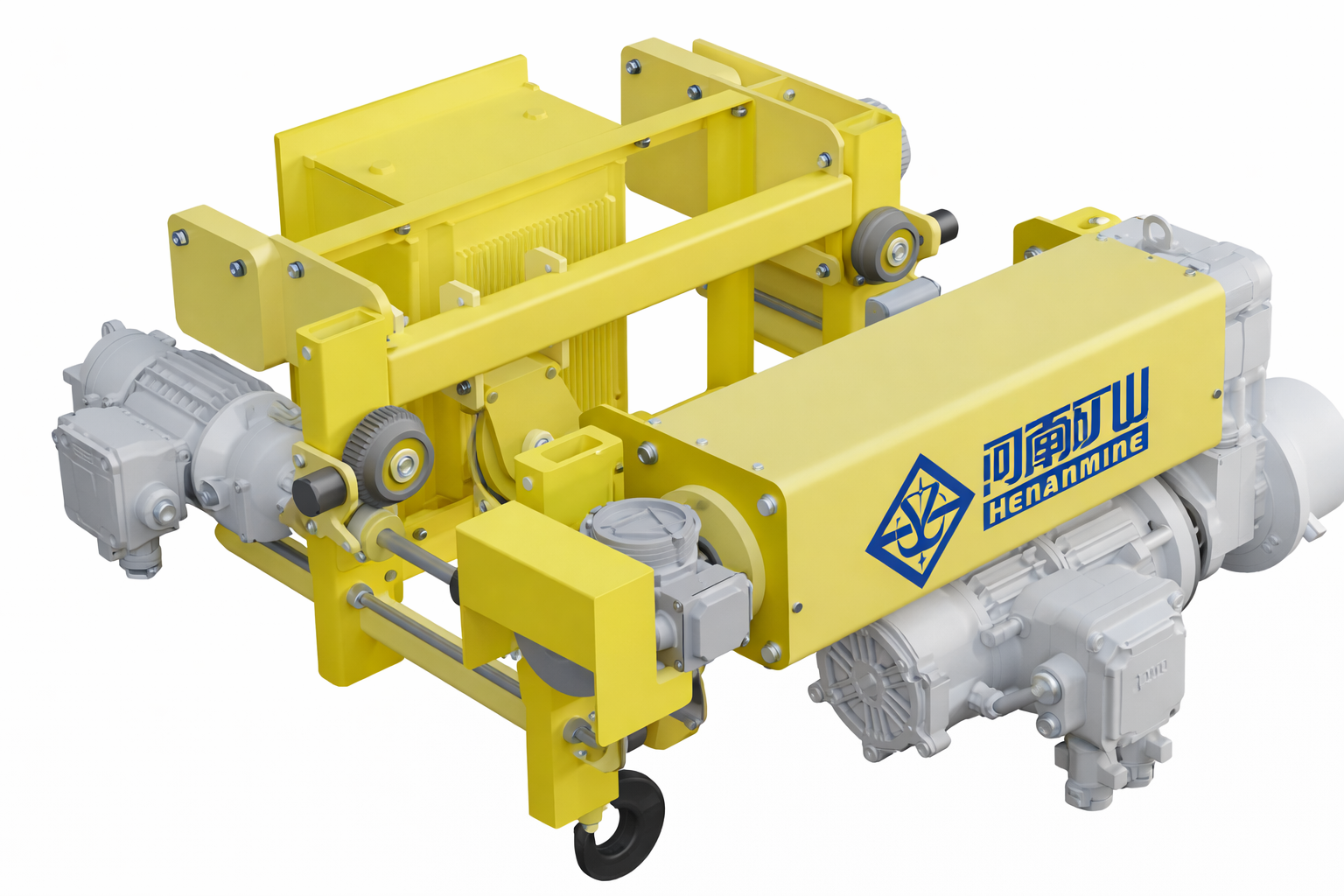
Henan Mine Crane Factory supply explosion proof electric hoist is a lifting device engineered and certified to operate safely in locations where flammable gases, vapors, or combustible dust may be present in the air. It works by containing, limiting, or isolating any internal spark, arc, or hot surface so it can never reach the surrounding atmosphere. It matters because in a classified hazardous area, an ordinary hoist motor is a legitimate ignition risk, not a theoretical one.
It's worth clearing up a common misconception early: explosion proof does not mean blast resistant. The hoist isn't designed to survive an external explosion. It's designed so that it never causes one.
Standard hoists fail this job in a few predictable ways: brush-type motors generate continuous sparking at the commutator, relay contacts arc every time they open or close, and surface temperatures on a hardworking motor can easily exceed the ignition temperature of common solvents or dusts. None of that matters in an open warehouse. All of it matters the moment flammable vapor or dust is in the air.
These hoists typically use:
- A flameproof or explosion-proof motor enclosure
- An intrinsically safe or flameproof control box and pendant
- Spark-free hardware on moving parts (wheels, hooks, trolleys)
- Sealed cable entries and rigid conduit with seal fittings
The 3 Engineering Principles Behind Explosion Protection
Every certified explosion proof hoist relies on one or more of three core protection principles. Understanding them helps you evaluate whether a hoist actually fits your application — not just whether its spec sheet uses the right buzzwords.
| Principle | How It Works | Typical Component |
| Confinement | Contains an internal spark or explosion inside a flameproof enclosure so it can't ignite the outside atmosphere | Cast iron or aluminum flameproof motor and control box housings |
| Energy Limitation | Restricts electrical and thermal energy in the circuit below the level needed to ignite the atmosphere | Intrinsically safe circuits and barriers |
| Isolation | Physically prevents hazardous gas or dust from reaching a potential ignition source | Pressurization, purging, encapsulation, or sealed enclosures |
A well-built hoist often layers more than one principle. A flameproof motor (confinement) paired with an intrinsically safe remote control (energy limitation) is a common combination on modern units.
It helps to see how this plays out in practice. A flameproof motor housing is machined with tight, specific clearances along every joint, if gas inside ever ignites, the flame front cools and loses energy passing through that narrow gap, so it never reaches open air. An intrinsically safe pendant, by contrast, doesn't rely on a heavy enclosure at all. The circuit itself is designed so the maximum possible spark energy sits below what's needed to ignite the specified gas group, even under a fault condition like a short circuit. Isolation methods show up less often on hoists themselves but are common on associated control panels, where purging the enclosure with clean air or nitrogen keeps hazardous atmosphere out entirely.
Hazardous Area Classifications: ATEX, IECEx, NEC/CEC and GB3836
Before you can apply any best practice, you need to know which classification system governs your facility. The four systems below cover most of the world, and they don't always speak the same language.
| Standard | Region | Hazard Categories | Example Marking |
| ATEX (2014/34/EU) | European Union | Zones 0/1/2 (gas), Zones 20/21/22 (dust) | Ex d IIB T4 Gb |
| IECEx | International | Same zone system as ATEX | Ex d IIC T4 Gb |
| NEC/CEC | United States/Canada | Class I (gas) & Class II (dust), Division 1 or 2 | Class I, Div 1, Group C |
| GB3836 | China | Similar zone system, IEC-aligned with local requirements | Ex d IIB T4 |
A few terms you'll see repeatedly on a hoist nameplate:
- Gas Group (IIA/IIB/IIC):How easily the specific gas ignites. IIC is the most restrictive, covering gases like hydrogen.
- Temperature Class (T1–T6):The maximum surface temperature the equipment is allowed to reach. T4, for example, caps surface temperature at 135°C.
- Zone vs. Division:Zones (0/1/2) describe how often a hazardous atmosphere is present; Divisions (1/2) under NEC do the same with slightly different criteria.
Beyond gas group and temperature class, the nameplate also specifies the protection method, the actual engineering technique used to prevent ignition. These appear as a letter code right after "Ex":
| Code | Protection Method | How It Works |
| Ex d | Flameproof enclosure | Contains any internal explosion; flame can't escape through enclosure joints |
| Ex e | Increased safety | Extra design margin against overheating and arcing, typically used on terminal boxes |
| Ex i | Intrinsic safety | Limits electrical energy so a spark can never carry enough energy to ignite |
| Ex p | Pressurization | Keeps a protective gas inside the enclosure at higher pressure than the surroundings |
| Ex m | Encapsulation | Embeds electrical parts in a solid compound so gas or dust can't reach them |
| Ex n | Non-sparking | Built so normal operation produces no sparks; used in lower-risk Zone 2 areas |
Most explosion proof hoists combine Ex d on the motor and brake housing with Ex i on the control circuit, confinement for the high-power components, energy limitation for the low-power ones. Knowing this combination helps when you're comparing two hoists with similar nameplate summaries but different underlying engineering.
Explosion Proof vs. Weatherproof vs. Corrosion-Resistant: Don’t Confuse Your Ratings
Procurement teams sometimes treat rugged industrial hoist specs as interchangeable, and that's where mistakes start. These ratings solve completely different problems:
- IP ratings (e.g., IP65, IP66)describe protection against dust and water ingress. A hoist can be IP66-rated and still have zero explosion protection, IP ratings say nothing about ignition prevention.
- NEMA enclosure ratingsdescribe similar environmental protection in North American terms, again unrelated to hazardous-atmosphere certification.
- Corrosion-resistant coatings or stainless constructionaddress chemical exposure and longevity, not spark or heat containment.
- Ex/ATEX/IECEx/NEC hazardous-location ratingsare the only ones that actually address ignition risk in classified zones.
A hoist can legitimately carry several of these ratings at once, for example, an offshore platform unit might need both an Ex d rating for the hazardous zone and a high IP rating for saltwater spray exposure. The mistake is assuming one substitutes for the other. If a spec sheet emphasizes rugged or weatherproof language without an explicit Ex/ATEX/IECEx marking and certificate number, it almost certainly isn't rated for hazardous-area use.
Industries That Require Explosion Proof Hoists
Combustible dust and flammable gas hazards show up in more industries than most people expect. OSHA's hazard guidance lists agriculture, chemicals, food production, grain handling, pharmaceuticals, metal processing, and fossil fuel power generation among the sectors at risk for dust-related fires and explosions.
In practice, Henan Mine Crane Factory supply explosion proof hoists are standard equipment in:
- Oil & gas and petrochemical facilities:Refineries, offshore platforms, and tank farms routinely classify entire process areas as Zone 1 or Zone 2 because of volatile hydrocarbon vapors.
- Chemical manufacturing plants:Solvent handling, reactor loading, and drum transfer operations where flammable vapors can accumulate around fixed equipment.
- Mining operations:Underground coal mines carry ongoing methane risk, while both underground and surface operations can see coal dust accumulate in confined areas.
- Grain elevators and food processing:Flour, sugar, and grain dust create some of the most severe deflagration hazards in industry, since fine organic particulates ignite easily once suspended in air.
- Pharmaceutical manufacturing:Flammable solvents used in tablet coating, extraction, and equipment cleaning processes.
- Paint and coating lines:Spray booths can reach the lower explosive limit for airborne VOCs quickly in an enclosed space.
If your facility has a documented hazardous area classification study covering any zone of your plant, that zone needs explosion proof lifting equipment, full stop.
Best Practice 1: Select the Right Hoist for the Zone
Selection mistakes are the root cause of most explosion-protection failures, because everything downstream depends on getting this step right. Use this checklist:
- Match zone, gas group, and temperature class exactly,don't round up or assume a more protected rating automatically covers your application.
- Verify third-party certification documents, not just the marketing claim. The nameplate marking must match the certificate.
- Size for duty cycle, using FEM or CMAA duty classifications, not just maximum load capacity.
- Choose the right control method.A radio remote keeps the operator physically outside the hazardous zone, a pendant control needs to be rated for the same zone as the hoist itself.
- Never upgrade a standard hoistwith aftermarket explosion-proof parts. Certification applies to the complete assembly as tested, not to a kit bolted onto a non-rated unit.
A quick reference for duty cycle classification:
| Classification System | Light Duty | Medium Duty | Heavy Duty |
| FEM | 1Bm | 2m | 3m–4m |
| CMAA | Class A/B | Class C | Class D–F |
Choosing too light a duty class for actual usage shortens motor life and increases the chance of overheating, a real concern in a hazardous area, since surface temperature is part of what the certification depends on.
New vs. Retrofitted Hoists: What the Standards Actually Allow
Facilities under budget pressure sometimes ask whether an existing standard hoist can be converted for hazardous-area use instead of buying new. The honest answer: rarely, and not the way most people imagine it.
Certification under ATEX, IECEx, or NEC applies to the complete assembly as tested in a lab, motor, enclosure, wiring, control box, and seals together. Swapping a standard hoist's motor for a flameproof one doesn't transfer the certificate, because the rest of the assembly, gearbox housing, terminal box, cable entries, was never tested as part of that protection system.
What's legitimate:
- Buying a factory-built Henan Mine Crane manufacturedexplosion proof hoist from a manufacturer that holds the actual ATEX, IECEx, or NEC certificate for that specific model.
- Retrofitting through the original manufacturer, if they offer an engineered retrofit kit that carries its own certification covering the modified assembly.
- De-rating an existing hoist's duty cycleto extend service life. This doesn't change its hazard rating, but it's a legitimate way to reduce thermal stress in borderline applications.
What's not legitimate, no matter how it's marketed: bolting an explosion-proof motor onto a standard hoist frame and calling the result certified. If the paperwork doesn't name your exact hoist model and serial range, the certification doesn't apply to it.
Best Practice 2: Install It to the Hazardous Area Drawing
Installation in a classified area isn't a general electrician's job, it requires someone qualified in hazardous location wiring methods.
- Install strictly according to your facility's hazardous area classification drawing, not a generic layout.
- Use rigid conduit with seal fittings at the required distance from the enclosure, per code, to prevent gas or flame propagation through the conduit run.
- Bond and ground every component; static discharge is its own ignition risk independent of the electrical system.
- Confirm ambient temperature and altitude derating,a hoist certified at sea level may need a different rating at higher elevation or temperature.
- Run a full commissioning inspection before energizing the unit for the first time, and document it.
Best Practice 3: Operate Within Strict Limits, Every Time
Certified hardware doesn't protect anyone if operating habits undermine it.
- Run a pre-use visual and functional check before every shift,limit switches, hook, chain or rope condition, and unusual smells or discoloration.
- Keep routine working loads at or below roughly 80% of rated capacity. This preserves thermal margin in the motor and reduces overheating risk.
- Never bypass, wire around, or disable an overload limiter or limit switch, even temporarily. These devices exist specifically to prevent the shock loads and friction events that can generate sparks.
- If the hoist shows abnormal heat, noise, or smell, stop operation immediately. Do not resume use until a qualified person identifies and corrects the cause.
- Where possible, keep the operator outside the classified zone using a remote control rated for that purpose.
Best Practice 4: Maintain and Inspect on a Documented Schedule
Maintenance on explosion proof equipment carries a higher bar than standard hoists, because small errors here are what actually void certification.
| Frequency | What to Check |
| Daily (pre-shift) | Visual inspection, functional test of brakes and limit switches, listen for abnormal sounds |
| Monthly | Hook and chain/rope wear, brake function, electrical connections, seal integrity |
| Annual (qualified person) | Flameproof joint surfaces, enclosure gaskets and IP ratings, torque specs on enclosure fasteners, full load test |
A few maintenance rules specific to hazardous-area equipment:
- Only use OEM-certified replacement parts. Substitutions,even ones that look identical, can change clearances on flameproof joints by fractions of a millimeter, which is enough to void protection.
- Never repaint, re-machine, or sand a flameproof joint surface without manufacturer guidance.
- Keep written maintenance records. If certification is ever questioned, documentation is your proof of compliance.
Documentation to keep on file for every unit:
| Document | Purpose |
| Original test certificate (ATEX/IECEx/NEC) | Proves the as-built unit meets its claimed rating |
| Installation commissioning report | Confirms correct setup against the hazardous area drawing |
| Inspection log (daily/monthly/annual) | Demonstrates ongoing compliance and catches developing issues early |
| Repair/parts replacement record | Shows which parts were used and confirms they were OEM-certified |
| Operator training records | Confirms personnel were qualified to use the equipment |
In an audit, or after an incident, this paperwork is what separates a defensible safety program from a liability problem.
Operator Training and Certification Requirements
A hoist can be perfectly selected, installed, and maintained, and still cause an incident if the person operating it doesn't understand why hazardous-area rules exist.
Training should cover, at minimum:
- How to read the hoist's load chart and rated capacity, including why exceeding it even briefly compromises the thermal margins the certification relies on.
- Pre-use inspection procedure and what to do if it fails,specifically, who to notify and how the unit gets tagged out of service.
- Emergency stop procedures and lockout/tagout before any service work, including isolating power at the source rather than relying on the hoist's own controls.
- Why standard repair parts and field modifications are prohibited, framed around the actual mechanism (voided clearances, altered energy limits) rather than just company policy.
- How to recognize signs of atmosphere changes,gas alarms, dust accumulation, unusual odors, relevant to the specific work area.
Many facilities align refresher training with their annual equipment inspection cycle, so operators are re-evaluated on the same schedule the equipment is. This also gives new hires a natural touchpoint: pairing initial training with a walkthrough of the actual inspection log helps operators see how the daily checks they perform connect to the facility's broader compliance record.
Common Mistakes That Compromise Explosion Protection
These are the failure points that show up again and again in field audits:
- Substituting non-certified hardware:Bolts, cable glands, or switches that aren't part of the original certified assembly. Even a visually identical bolt can have different thread engagement that changes a flameproof joint's tested clearance.
- Damaging flameproof joint surfaces:During cleaning, repainting, or repair. A scratch or extra coat of paint across a machined joint face can be enough to widen the gap beyond its certified tolerance.
- Mismatching gas group or temperature class:Using a T3-rated hoist where the area requires T4. This is most common when a hoist is moved from one part of a facility to another without re-checking the local classification.
- Skipping certificate verification at purchase:Trusting a marketing claim instead of the actual test certificate. "Explosion proof" on a product page isn't the same as a certificate number you can verify with the issuing body.
- Letting untrained staff perform field fixes:On hazardous-area equipment. A well-intentioned quick repair by someone unfamiliar with hazardous-location rules is one of the most common ways certification gets quietly voided.
- Deferring maintenance:To cut costs or downtime, which is the single most common precursor to certification failure. Worn seals and degraded gaskets don't announce themselves until they've already compromised protection.
Why This Matters: The Cost of Getting It Wrong
The numbers behind hazardous-area incidents make the case better than any sales pitch. The CSB's review of U.S. industry found 281 combustible dust incidents between 1980 and 2005, with 119 deaths, 718 injuries, and extensive facility damage. OSHA's own hazard communication guidance repeats this same data point because it remains the most cited baseline for the scale of the risk.
OSHA's hazardous locations standard (29 CFR 1910.307) and the National Electrical Code (NFPA 70) both exist because uncertified electrical equipment in a classified area isn't a minor compliance gap, it's a documented cause of fatal industrial accidents. Following the best practices above isn't about checking a regulatory box. It's about keeping your facility off that list.
Beyond the human cost, the practical consequences compound quickly. An OSHA citation for using or maintaining uncertified equipment in a classified location can trigger a broader facility-wide audit, not just a fine for the one piece of equipment in question. Insurance carriers frequently treat documented hazardous-area compliance as a condition of coverage, so a voided certification discovered after an incident can affect a claim. And unplanned downtime to replace or re-certify equipment after the fact almost always costs more than the original price difference between standard and certified hoists would have.
Frequently Asked Questions
Q: What does "explosion proof" actually mean on a hoist nameplate?
It means the hoist has been independently tested and certified to prevent internal sparks, arcs, or excess heat from igniting the flammable gases, vapors, or combustible dust in the area where it's installed. The nameplate marking (e.g., Ex d IIB T4) specifies the exact protection method, gas group, and temperature class it's rated for.
Q: What's the difference between ATEX and IECEx certification?
ATEX is a European Union directive (2014/34/EU) that's legally mandatory for equipment sold or used in the EU. IECEx is a global certification scheme administered by the International Electrotechnical Commission, used to simplify cross-border trade outside Europe. Both use similar zone, gas group, and temperature class systems, but they are separate certifications with separate paperwork.
Q: Can I use a Class I Division 1 rated hoist in a Class II (dust) location?
No. Class I covers flammable gases and vapors, while Class II covers combustible dust, and the protection methods differ. A hoist rated only for Class I gas groups has not been tested or certified for dust ignition risks, so using it in a dust environment voids its protection and creates a real hazard.
Q: How often should an explosion proof hoist be inspected?
Most facilities run a daily pre-shift visual and functional check, a documented monthly inspection of wear items like hooks, brakes, and limit switches, and a thorough annual inspection by a qualified person that includes checking flameproof joint surfaces and enclosure seals. Always follow the manufacturer's specific schedule, since it can be stricter than general industry practice.
Q: What voids the explosion-proof certification of a hoist?
Common causes include installing non-certified replacement parts, damaging or re-machining flameproof joint surfaces during repair, painting over enclosure gaps, drilling unauthorized holes, or making any modification not covered by the original certificate. Once voided, the hoist must be re-certified before returning to service in a hazardous area.
Q: Do explosion proof hoists cost more than standard hoists?
Yes, typically more upfront due to specialized motors, flameproof enclosures, and third-party certification testing. However, the higher initial cost is generally offset over time by reduced accident risk, lower insurance and liability exposure, and avoidance of regulatory penalties for using uncertified equipment in a classified area.
Q: How long do explosion proof hoists typically last?
With proper maintenance, most explosion proof hoists run 15-20 years or more, similar to standard industrial hoists. The certified components don't inherently wear out faster than standard equivalents, what shortens service life is usually deferred maintenance or running the unit consistently above its rated duty cycle, not the explosion-proof rating itself.
Q: Who is qualified to repair or service an explosion proof hoist?
Repairs should be performed by technicians trained specifically in hazardous-area equipment, ideally through the original manufacturer or an authorized service partner. A general industrial electrician without hazardous-location training can unintentionally void certification, even while performing what looks like routine maintenance.
Henan Mine Crane Factory Custom
Safe explosion protection begins well before the first lift. Selecting an explosion proof electric hoist that is suitable to your hazardous area rating, duty cycle and operating environment minimizes the compliance issues, increases plant safety and ultimately provides a satisfactory return on investment for many years of service. In conjunction with proper installation, periodic inspections and preventative maintenance, an optimal piece of equipment will provide a dependable service life in a harsh industrial environment.
As a long trusted manufacturer of explosion proof lifting equipment, we can offer of tailored solutions for oil and gas, chemical industries, storage, mining, offshore and many other hazardous industries.Whether you are starting a new project, replacing an existing hoist, or upgrading inefficient rigging equipment, our team of engineers can assist you select the perfect explosion proof electric hoist to meet your lifting capacity, application environment and duty cycle-and ensure a safe, reliable and economically built-piece of equipment for years to come.