
Which Port Crane Features Actually Improve Loading and Unloading Efficiency
In the operation of ports and terminals, the efficiency of loading and unloading is directly related to terminal throughput, operating costs and market competitiveness.In the procurement and upgrading of port crane equipment, many ports only pay attention to the basic parameters of the crane, ignoring the core configuration that truly determines the operation accuracy, operating speed and continuous production capacity.Modern port cranes are intelligent operating systems that integrate multiple core technologies. The lifting performance of port cranes, the precise positioning of port cranes, the intelligent automation of port cranes, the adaptation design and equipment stability affect the container loading and unloading cycle speed and the overall operation beat in all directions. It is the key to the efficient operation, cost reduction and efficiency of the terminal.
How Lifting Performance Affects Loading Speed
Lifting performance is the basic core ability of Henan Mine Crane manufactured port cranes, and it is also the core factor that directly determines the basic speed of port crane loading and unloading operations.Different from ordinary lifting equipment, port shore bridges and field bridges need to be adapted to high-frequency, continuous, and large-load operation scenarios. The three parameters of lifting speed, rated load, and trolley operation cooperate with each other to directly determine the efficiency of the single-box cycle operation of the port crane, which is the core guarantee of the basic throughput of the terminal.
Hoisting speed
The lifting speed of port cranes is the core dynamic parameter that affects the beat of container loading and unloading, and directly determines the time-consuming lifting and unloading of goods.The lifting speed parameters of traditional ordinary cranes are conservative, with low-speed operation at full load and limited speed-up at no load. In high-frequency batch operations, a lot of time loss will occur, which greatly reduces the overall operating efficiency of port cranes.
Modern and efficient port cranes adopt hierarchical frequency conversion and speed regulation technology to accurately distinguish between no-load, light-load, and full-load operating conditions, and realize intelligent speed adaptation.The lifting speed of the equipment at full load can reach 50-70m/min, and the no-load speed-up effect is more significant. At the same time, it is equipped with a smooth buffer control system to completely eliminate the jitter and impact problems caused by high-speed start and stop.This speed adaptation design can not only ensure the safety of heavy-duty container operations of port cranes, but also minimize the length of invalid operations and shorten the cycle of single-box operations. Compared with traditional equipment, it can effectively increase the amount of stand-alone operations by more than 20%, which is perfectly adapted to the needs of high-intensity continuous operations in large terminals.
Lifting capacity
The rated lifting weight of a port crane is not simply the upper limit of the load, but the key index that determines the upper limit of the adaptability and efficiency of the crane operation.Port operations cover 20-foot and 40-foot standard containers, overweight and heavy-duty containers and special cargo. Insufficient lifting capacity will not only limit the scope of operations, but also frequent load-limiting and diversion operations, which will seriously slow down the overall loading and unloading progress.
Professional port cranes strictly follow international port operating standards. The rated lifting weight under the spreader covers the mainstream range of 35t-65t. Large and ultra-heavy models can achieve heavy-duty operations of 80t and above, and are fully adapted to high-frequency operation scenarios such as 40-foot ultra-heavy containers and double-box stacking cranes.It is worth noting that the lifting performance of the equipment has been optimized by the professional load curve, and the rated load can still be maintained at a stable load under the condition of large extension distance, and the load will not plummet due to the increase of the operating radius. There is no need to repeatedly adjust the operating position and split the cargo operation, which greatly reduces the loss of adaptation to working conditions and ensures efficient and stable operation throughout the process.
Trolley movement
Trolley operation is the core action of container horizontal alignment, translation and drop-off. The speed, stability and accuracy of trolley operation directly affect the efficiency of loading and unloading alignment.Traditional crane trolleys mostly run at uniform speed, with large start-stop impact and high alignment deviation. They require repeated manual fine-tuning and consume a lot of alignment time. It is an invisible pain point that restricts the speed of the operation.
The new generation of Henan Mine Crane manufactured port cranes is equipped with an intelligent frequency conversion trolley operation system to achieve three-stage smooth operation of acceleration, uniform speed and deceleration. The operating speed is controllable and adjustable, taking into account the translation efficiency and operating stability.High-speed translation can quickly complete the horizontal transfer of container ships between the shore and the yard, precise deceleration and buffering can avoid the shaking and offset of the cargo, and greatly reduce the time cost of manual correction and secondary alignment.In batch container loading and unloading operations, stable and efficient trolley operation performance can effectively compress the alignment time of each round of operations and continuously improve the overall operation beat.
How Positioning Systems Improve Handling Accuracy
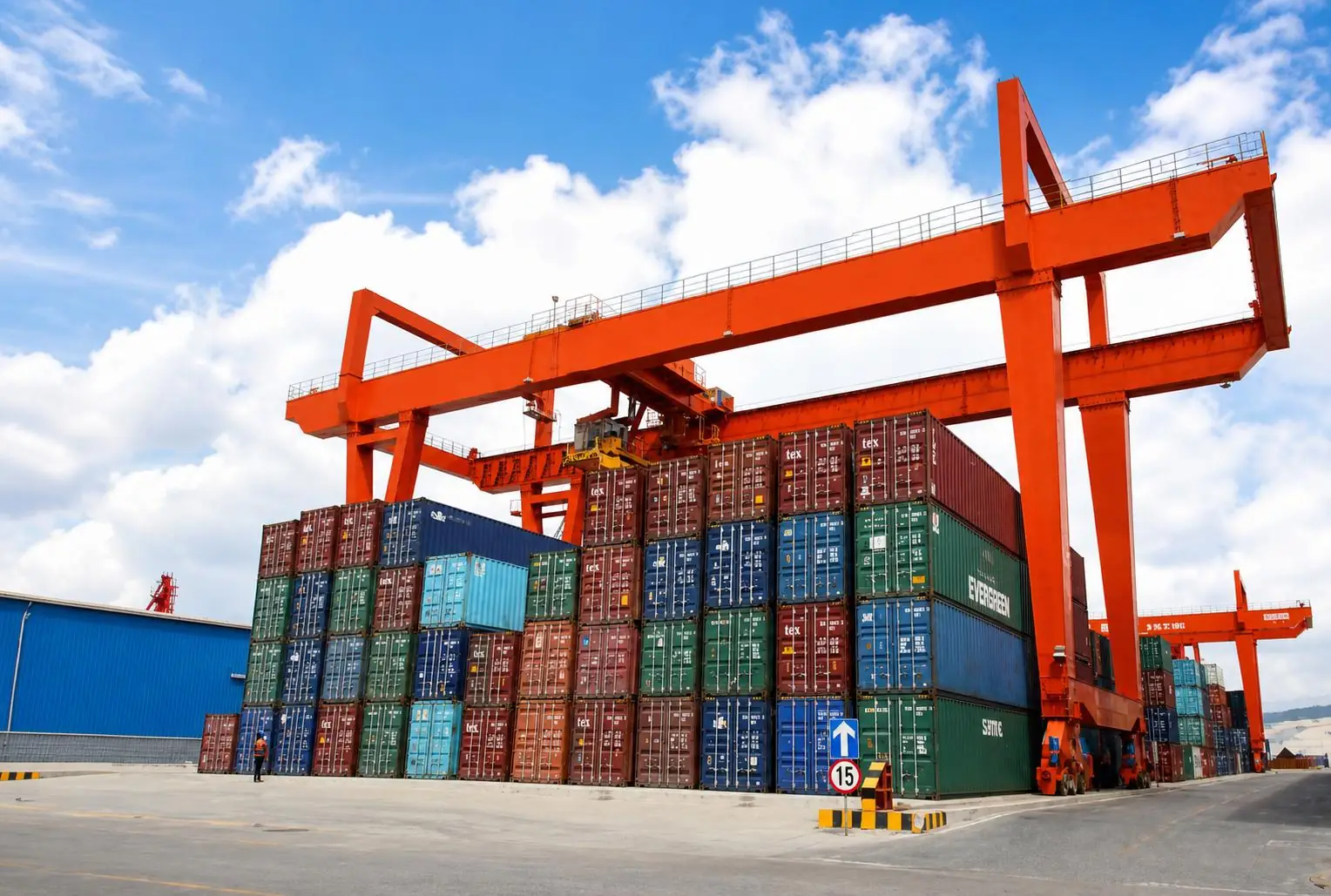
The core of loading and unloading efficiency lies not only in speed, but also in accuracy.Many terminal equipment has excellent speed parameters, but due to insufficient positioning accuracy, problems such as alignment deviation, box bumps, and misalignment of boxes frequently occur, which not only requires rework adjustment and slows down the pace of operation, but also increases the risk of cargo loss and equipment failure.Through intelligent technology, the precision positioning system completely solves the problem of alignment accuracy, realizes one-time precise alignment and drop-off, and accelerates efficiency from the details.
Anti-sway technology
Cargo shaking is a common pain point in port lifting operations. During crane lifting, trolley translation, and cart travel, the box body can easily swing due to inertia. In traditional operations, you can only wait for the shaking to subside naturally. A single operation takes a few seconds or even tens of seconds to stabilize the box. The efficiency loss is great under high-frequency operations. At the same time, there are safety risks of the box colliding with the hull, yard, and adjacent cargo.
Professional port cranes are equipped with intelligent dual-closed-loop anti-shake technology, which collects the amplitude, angle and frequency of cargo swing in real time through high-precision sensors, and dynamically corrects the operating parameters of lifting and trolley with algorithms to actively offset inertial shaking.This technology can control the swing amplitude of the box body within ±3cm, without manual box stabilization and passive waiting, and the operating stability is greatly improved.It not only completely eliminates the safety hazards and cargo loss caused by shaking, but also greatly shortens the waiting time for the stable box, making the continuous operation cycle smoother, which is the basic guarantee for efficient automated operations.
Precision positioning
Precise positioning technology relies on the integration of multiple technologies such as satellite positioning, laser ranging, and encoder real-time monitoring to achieve millimeter-level precise control of crane operating position and spreader landing point.In the traditional manual operation mode, the operator relies on experience to visually align, which is greatly affected by light, field of vision, weather, and operation proficiency. The alignment deviation is large, it takes a long time, and the accuracy of the operation is uneven.
The modern intelligent positioning system can automatically calibrate the operation coordinates and correct the operating position of carts, trolleys, and spreaders in real time. The accuracy of the drop point can reach the millimeter level, which fully meets the high-precision requirements of high-density container stacking, precise loading and unloading of ships, and small space operations.Precise positioning does not require repeated manual fine-tuning, which greatly reduces the difficulty of operation, while avoiding box-dropping errors and stacking misalignment caused by alignment deviations, and reducing rework. In high-density depots and large-scale ship loading and unloading scenarios, the efficiency improvement effect is particularly significant.
Automatic container alignment
Automatic container alignment technology is the core configuration of efficient operation of intelligent ports, completely subverting the traditional manual visual alignment operation mode.The system can automatically identify container box corners, keyholes, ship space and yard positioning signs, match operating coordinates in real time, and independently complete the precise docking of spreaders and containers.The technology can be adapted to complex weather scenarios such as day and night operations, rain, snow and fog, and is not limited by light and field of vision, and maintains high-precision alignment around the clock.Compared with manual alignment, automatic alignment takes more than 60% less time, completely solves the efficiency fluctuations caused by manual operation fatigue and proficiency differences, and guarantees the stable output of terminal operation efficiency. It is the standard core function of large-scale automated unmanned terminals and high-throughput terminals.
How Automation Improves Crane Productivity
Rising labor costs, low upper limits on manual operation efficiency, and poor operation stability are the core bottlenecks restricting the increase in the production capacity of traditional port operations.The landing application of automation technology has completely broken the limitations of manual operations, realized the standardized, continuous and efficient operation of lifting operations, greatly improved the production capacity of stand-alone machines and the overall operating efficiency of the terminal, while reducing the risk of human operation failure.
Automated handling
The automated loading and unloading operating system can realize the fully automatic flow of containers from the ship, the collection card, and the yard, without manual control throughout the process, and independently complete the whole process of lifting, translation, unloading, locking, and unlocking.The system is equipped with standardized operating procedures, and all operating processes are unified, standardized, and accurate, completely avoiding the arbitrariness, lag, and error rate of manual operations.
In batch operation scenarios, automation equipment can maintain uninterrupted and stable operation for 24 hours, without efficiency loss such as manual rest, shift changes, and fatigue operations.Taking the domestic automated benchmark terminal as an example, the shore bridge equipped with a fully automatic loading and unloading system can stably reach 35-40 boxes per hour of natural box operation by a single machine, which far exceeds the production capacity of traditional manual operation equipment, and greatly improves the overall daily and monthly throughput of the terminal.
Intelligent path planning
Traditional crane operations rely on manual planning of the operating path, and there are problems such as redundant paths, repetitive positions, and untimely avoidance. There are too many invalid trips, which is a serious waste of operating time.Relying on big data algorithms and real-time operation scenario modeling, the intelligent path planning system can independently plan the optimal operation path based on the ship's docking location, container stacking location, peripheral equipment operation status, and traffic movement lines.
The system can avoid operating obstacles in real time, actively avoid adjacent equipment, dynamically optimize the trajectory of carts, trolleys, and hoists, and minimize invalid position and waiting time.At the same time, it can realize the optimization of the collaborative operation path of multiple cranes, avoid mutual interference with equipment and operation congestion, greatly improve the overall operation efficiency of the terminal, and maximize the operational value of each equipment operation.
Remote operation
Remote control technology has completely changed the on-site high-altitude operation mode of the crane. The operator can remotely complete the equipment control in the central control room to get rid of the limitations of the on-site environment and high-altitude operation.This function not only improves the operating environment, reduces the intensity of manual labor, and improves the safety of operations, but also realizes a significant upgrade from the efficiency level.Remote control with high-definition video real-time return, multi-angle monitoring, and accurate sensor feedback, the operation field of view is more comprehensive and the response is more timely, and the operation lag and errors caused by the blind spot of the field of view are eliminated.At the same time, remote control can realize one-person and multiple-machine control, reduce labor configuration costs, and respond faster to equipment start-stop and working condition switching, smoother operation convergence, and effectively improve equipment utilization and overall operating efficiency. It is the core configuration of the smart port upgrade.
How Crane Design Supports Different Port Operations
The port operation scenarios are complex and diverse, covering standard containers, special heavy-duty cargo, boxes of different sizes, berths and yard operations under different working conditions.The structural design and adaptability design of the crane directly determine the adaptability of the equipment to working conditions. The universal, modular and flexible design can avoid the stagnation of operations and idle equipment caused by the limitations of the equipment's working conditions, and ensure efficient operation in multiple scenarios.
Spreader compatibility
The spreader is the core component of the crane docking container, and the compatibility of the spreader directly determines the type of cargo and adaptation scenarios that the equipment can operate.Traditional fixed spreaders can only be adapted to single-size containers, and manual replacement of spreaders is required when operating boxes of different specifications, which is time-consuming and laborious, which seriously affects the continuity of operations.The modern port crane is equipped with a modular universal spreader system, which supports fast and adaptive switching of 20-foot, 40-foot, and 45-foot standard containers, and is compatible with a variety of box types such as ordinary containers, reefers, and open-top boxes. Some models support simultaneous operation of double-box spreaders, which can complete double-box loading and unloading in a single time, doubling the operating efficiency.The spreader is equipped with automatic locking and fault self-inspection functions. There is no need for manual assistance for switching, and the adaptation of working conditions is completed in seconds to ensure the fluency of alternating operations of multiple types of goods.
Working range
The operating range covers core parameters such as crane lifting height, trolley track gauge, and trolley extension distance. Insufficient operating range is an important reason for the low efficiency of many old terminal equipment.Limited operating radius will cause large ships to be unable to dock, high-rise containers cannot be stacked, and the corner areas of the yard cannot be covered. Frequent adjustment of ship berths and splitting of operating areas will greatly reduce operating efficiency.
Henan Mine Crane manufactured professional port crane has been designed with optimized structure, and the outer extension distance can cover mainstream large-scale berth specifications such as 48m and 65m. The lifting height is adapted to the needs of multi-layer container stacking and large-scale ship loading and unloading, and the ability to cover a wide range of operations can complete the entire ship and the entire yard at once, without repeated shifting and adjustment.Sufficient operating range allows the equipment to be adapted to the operation scenarios of large-tonnage and large-size ships, greatly increasing the coverage of a single operation, and improving the overall throughput efficiency from the dimension of operation coverage.
Container size flexibility
At present, port cargo transportation is showing a diversified trend. In addition to conventional standard containers, the proportion of special-shaped size, ultra-heavy weight, and non-standard box cargo continues to increase. The flexibility of equipment size adaptation directly determines the adaptability of terminal operations and the efficiency of customs clearance.The new type of port crane adopts a flexible adaptation design, combined with adjustable spreaders and intelligent size recognition system, which can be independently adapted to container cargo of different lengths, heights and widths, without the need to retrofit equipment and replace accessories in advance.At the same time, the equipment supports the stable lifting of eccentric loads and irregular cargo, which is perfectly adapted to the needs of bulk collection, special boxes, and overrun boxes.The flexible size adaptation ability allows a single equipment to cover all types of container operations, avoiding idle equipment and short-term adaptation of working conditions, and ensuring efficient customs clearance of all kinds of goods at the terminal.
How Reliability Affects Loading and Unloading Efficiency
For continuous port operation scenarios, equipment reliability is the bottom line to ensure long-term efficient operation.No matter how excellent the speed, intelligence, and adaptability of the configuration, once the equipment fails frequently and stops for maintenance, it will lead to interruption of operations, ship stagnation, and yard congestion, resulting in economic losses that far exceed the benefits of operation speed-up.High-reliability design, long-term protection, and intelligent maintenance are the core guarantees for the continuous and efficient output of port equipment.
Equipment durability
The port terminal belongs to a harsh working environment with high dust, high humidity, high salt spray, and strong wind. The equipment runs continuously at high frequencies and large loads for a long time, and the structural strength and durability of the accessories are extremely demanding.Ordinary equipment with insufficient durability is prone to structural corrosion, component wear, hydraulic leakage and other problems, which frequently cause minor failures and interfere with the rhythm of operations.The port crane adopts a high-strength alloy steel structure and has undergone special treatment for anti-corrosion, anti-rust and anti-salt spray to adapt to the harsh working conditions of coastal ports.The core transmission, hydraulic, and electrical components are all equipped with high-end configurations in the industry. After millions of fatigue tests, they can withstand 24 hours of uninterrupted heavy-duty operation. The working level of the whole machine reaches the A7-A8 high-level standard, and there is no performance attenuation in long-term operation. Ensure the stability of the operation from the hardware level and avoid frequent minor failures that drag down the efficiency of the operation.
Preventive maintenance
Traditional equipment relies on post-failure maintenance and belongs to a passive maintenance mode. Not only does the operation stagnate after the failure, but the maintenance cycle is long and the cost is high, which seriously affects the terminal's production capacity.Modern and efficient port cranes are equipped with intelligent preventive maintenance systems, which completely transform the maintenance mode and realize early prediction and early maintenance.The system can monitor the core operating data of equipment current, voltage, temperature, vibration, wear and other core operating data in real time 24 hours a day, analyze the loss status of equipment components through big data algorithms, accurately predict potential hidden faults, and automatically generate maintenance lists and maintenance cycles.Operation and maintenance personnel can complete the maintenance and replacement of components before the failure occurs, completely eliminate the problem of sudden failure and shutdown, so that the equipment can always maintain the best operating condition, and ensure the continuous and stable operation efficiency.
Reduced downtime
The length of downtime is the core index to measure the comprehensive operating efficiency of port equipment. The shorter the non-operating downtime of the equipment, the longer the effective operating time, and the higher the terminal's production capacity.Relying on highly durable hardware configuration and intelligent preventive maintenance system, the equipment failure and shutdown rate is greatly reduced. At the same time, the equipment adopts a modular disassembly and assembly design, even if parts replacement and equipment overhaul are required, disassembly and assembly maintenance can be completed quickly, greatly shortening the maintenance time.
The comprehensive utilization rate of high-quality port crane equipment can reach more than 95%, and the effective operation time throughout the year can exceed ordinary equipment to maximize the value of equipment production capacity.Reduce sudden downtime, shorten maintenance downtime, avoid chain problems such as ship stagnation, yard congestion, and operation delays, and continuously improve the overall loading and unloading efficiency and operating income of the terminal from the perspective of long-term operation.
Henan Mine Crane Factory Custom
The efficiency enhancement of loading and unloading of port cranes relies on the all-round collaborative optimization of the performance of the whole machine, positioning accuracy, intelligent automation, adaptation of working conditions and stable operation and maintenance. It is difficult to achieve substantial production capacity improvement with a single parameter upgrade.High-quality port lifting equipment can be adapted to various terminal operation scenarios, reduce operation deviations and equipment downtime losses, continuously optimize operation beats and reduce operating costs.As a professional crane manufacturer, Henan Mine Crane Factory can customize and adapt high-efficiency intelligent port equipment according to different terminal berths, freight specifications and operating capacity requirements to help major terminals achieve stable efficiency, improve quality and reduce costs.