
When Does Remote Control Make Sense for an Overhead Crane?
In industrial plants, steel structure processing, equipment assembly, warehousing and logistics scenarios, the control method of bridge cranes (driving, EOT cranes) is directly related to operation safety, hoisting accuracy and production efficiency.
The mainstream control methods in the industry are divided into wired handle control and wireless remote control control. Many companies will struggle with whether they need to install a remote control system when purchasing, retrofitting and upgrading cranes, and under what working conditions. The practicality and cost performance of the remote control system are optimal.
This article will comprehensively analyze the principle, core advantages, applicable scenarios, comparative advantages and disadvantages of the wireless remote control system of bridge cranes, selection points, safety configuration and cost details, to help enterprises quickly determine whether their own working conditions are suitable for remote control, and accurately avoid selection misunderstandings.
What Is Remote Control for an Overhead Crane?
The remote control system of bridge crane is an intelligent control system that relies on radio frequency technology to transmit operating instructions to the crane receiving terminal through handheld transmitting equipment to get rid of the shackles of wired cables.Unlike the wired handle control of traditional fixed cables, the wireless remote control allows the operator to freely adjust the operating position, which is one of the core configurations of modern industrial crane upgrades.
Wireless remote control VS wired handle control
The wired handle is standard for traditional control. The advantage is that the connection is stable, there is no signal interference, no need to charge, and the cost is low. It is suitable for simple and low-frequency hoisting operations; the disadvantage is that the scope of operation is limited by the cable, there are hidden dangers of cable wear, fracture, and personnel stumbling, and the flexibility is poor.
The wireless remote control relies on radio frequency signal control to get rid of the shackles of cables. The operator can freely choose the best operating station, with a better field of vision, greater safety and flexibility, and adaptability to complex working conditions.The shortcoming is the need to maintain the battery regularly, avoid radio frequency interference, and the initial purchase cost is higher.At present, the dual-control scheme of "remote control as the main and wired handle as the backup" is generally adopted in high-end industrial scenarios, taking into account high efficiency and safety.
Core operating functions
The industrial-grade crane remote control system has full coverage of functions, and can accurately control all the core actions of the crane, adapting to the needs of various hoisting operations.:
- Lifting control: accurately control the lifting and lowering of the hoist, support multi-speed speed regulation and frequency conversion to start and stop smoothly, effectively eliminate the problem of heavy objects shaking and shifting
- Vertical operation of the cart: control the entire crane to walk back and forth along the track of the plant to complete a wide range of longitudinal displacement hoisting operations
- Horizontal operation of the trolley: control the movement of the crane and the trolley left and right along the main beam to achieve precise fine-tuning of the lifting point
- Emergency shutdown: equipped with an eye-catching red emergency stop button, in case of sudden failure or danger, the power of the whole machine can be cut off instantly, all operating actions can be terminated, and safety accidents can be avoided.
At the same time, the system comes with a safety self-locking function that stops when you let go to prevent misoperation. Some customized models also support auxiliary functions such as horn warning, light reminder, and magnetic suction cup control.
Core components
A complete set of wireless remote control system for industrial bridge cranes, with streamlined structure and strong stability, the core contains five components:
- Handheld transmitter: divided into handheld button-type and waist-mounted control boxes, integrated buttons, joysticks, batteries, coding chips, and antennas, responsible for sending operation instructions
- On-board receiver: fixed near the crane electrical cabinet, receives wireless signals and decodes them into operating instructions that can be recognized by the equipment
- Signal antenna: Strengthen the stability of radio frequency signal transmission and avoid blocking interference. The mainstream frequency bands include 433MHz, 915MHz, and 2.4GHz frequency hopping frequency bands.
- Relay output module: docking crane contactor, frequency conversion drive, PLC system, precise control of motor start and stop, speed regulation
- Safety interlock power supply module: stable power supply for transmitter and receiver, equipped with fault self-locking and signal loss protection circuit to ensure operation safety
When Does Remote Control Make Sense?
Wireless remote control does not just need to be configured, but in complex industrial conditions, it can greatly improve the safety factor and operating efficiency. The following five types of scenarios are the best applicable scenarios for remote control systems.
Limited field of vision for work
Traditional wired control is limited by station position, and operators cannot move flexibly. When encountering scenes with dense plant equipment, complex hoisting paths, and obstructed obstacles, blind spots in the field of vision can easily appear, resulting in hoisting offset and collision accidents.
After being equipped with wireless remote control, the operator can freely move to the best observation point, observe the lifting, moving, and landing status of heavy objects at close range, maintain a safe distance throughout the process, completely solve the problem of blind spots in the field of vision, and adapt to complex path hoisting operations.
Precision hoisting operation
In scenarios such as the installation of machinery and equipment, the construction of production lines, the alignment of molds, and the precise splicing of steel structures, the accuracy of hoisting is extremely high, and millimeter-level offsets may cause equipment damage and construction rework.
The wireless remote control supports the operator to look directly at the trajectory of heavy objects throughout the process, and can fine-tune the hoisting position and operating speed in real time, without the need for special personnel to assist in observation, greatly improving the alignment accuracy, and perfectly adapting to the precise hoisting needs of various precision components and heavy equipment.
Harsh operating environment
Scenes such as metallurgical casting, chemical workshops, dust workshops, high-temperature material handling, high-noise factories, and restricted operating areas have safety hazards such as high temperature, dust, chemical corrosion, and noise pollution. Long-term close-range operations by operators can easily cause occupational injuries.
Wireless remote control allows operators to stay away from high-risk areas for hoisting and operate in a safe location to reduce personal risks.Note: Remote control is only an auxiliary means of risk control and cannot replace basic safety facilities such as overload protection, limit devices, and labor insurance protection. It needs to be used in conjunction.
Large working area
Large-scale steel structure workshops, multi-span factories, and large storage areas have large crane operation spans and wide operation coverage.The cable length of the traditional wired handle is limited, and the operator cannot follow the movement of heavy objects throughout the process, resulting in large blind spots and inconvenient operation.
The wireless remote control has no operating range limit, and the operator can follow the movement of heavy objects throughout the control process, which is suitable for large-span and large-range hoisting operations, and completely solves the problem of space limitations of wired control.
Hoisting point dispersion
The hoisting points in some workshops are not fixed, and operators need to frequently switch operating positions and travel to and from multiple stations.The fixed wired control mode is cumbersome and inefficient to operate, and it is also easy to cause cable entanglement and wear problems.
The high flexibility of wireless remote control can be adapted to multi-point and mobile hoisting operations, without the need for fixed control stations, reducing the configuration of auxiliary personnel, simplifying the operation process and improving construction efficiency.
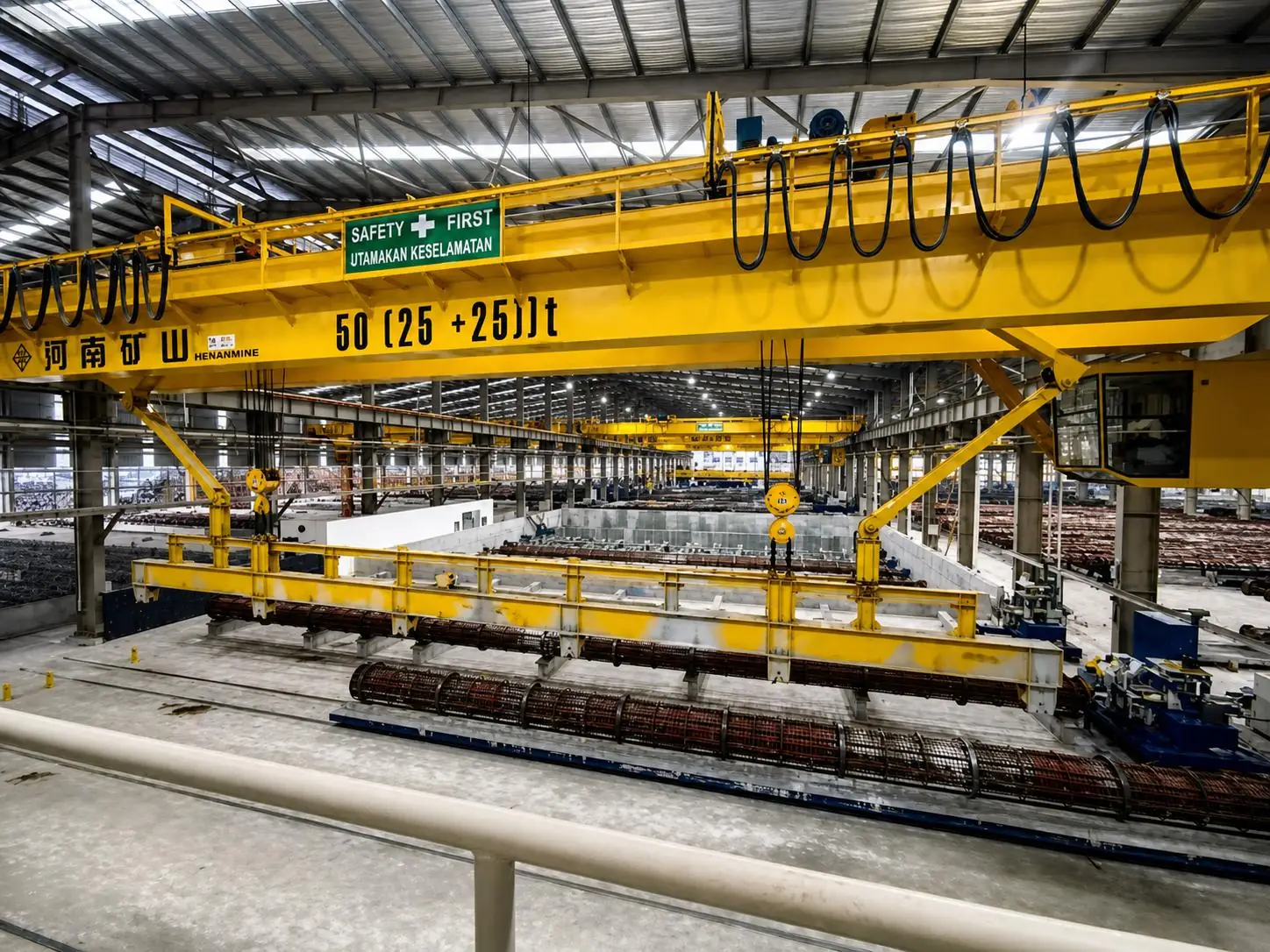
When a Pendant Control May Still Be the Better Choice
Wireless remote control has outstanding advantages, but not all scenarios are suitable. In some simple working conditions, the traditional wired handle control is more cost-effective and practical.:
- Suitable for small enclosed workshop operation scenarios, the operation area is narrow, the hoisting operation path is organized and simple, there is no high-altitude cross-operation, large-scale rotation and complex positioning operation requirements, the operation process is single, and the traditional control method is fully adapted to the on-site operating conditions.
- The overall operating utilization rate of the crane is low, and it is only used for temporary and short-term hoisting operations such as equipment maintenance and material transfer. There is no need to install a wireless remote control system to improve operating efficiency.
- There are no obstructions such as equipment, walls, materials, etc. on the job site, and the field of vision of the job is transparent and there are no blind spots. The operator can clearly observe the whole process of lifting, translation, and positioning of heavy objects in real time at a fixed and safe station, and the equipment can be accurately controlled and the hidden dangers of the operation can be dealt with in a timely manner, without the need for remote control and long-distance operation.
- The overall operation and maintenance budget of the project and equipment transformation are limited, and the basic control operation plan with simple structure, convenient operation, zero maintenance and low cost is preferred. The purchase and maintenance costs of wireless remote control equipment are high, and there is no need to install it.
- The on-site hoisting operation mode has a single structure, mostly simple hoisting operations with fixed points, short distances, and repeatability. The operation process has not changed and the operation difficulty is low. The advantages of intelligence and convenience of the wireless remote control system cannot be used, and the efficiency-enhancing effect is minimal.
The wired handle does not require charging, no signal interference, zero maintenance costs, and extremely low failure rate. It can fully meet the needs of simple low-frequency hoisting operations without additional upgrades to the remote control system.
Remote Control vs. Pendant Control: What Should Buyers Compare?
In order to facilitate the rapid selection of models by enterprises, organize the core differences between the two control modes, covering key dimensions such as operational flexibility, applicability, cost, and risk.:
| Comparison Factor | Remote Control | Wired Pendant Control |
| Operator Mobility | High freedom, no space restrictions | Limited, restricted by cable length |
| Load Visibility | Flexible positioning, zero visual blind spots | Fixed operating position, prone to blind spots |
| Large Workshop Adaptability | Excellent, allows full load-following operation | Inconvenient with obvious limitations |
| Simple Lifting Tasks | Overqualified with low cost performance | Fully sufficient and well-matched |
| Initial Purchase Cost | Relatively high | Low and cost-effective |
| Positioning Flexibility | Extremely high, ideal for complex working conditions | Moderate, only for basic operations |
| Potential Safety Hazards | No cable tripping or abrasion risks | Cable aging, tripping and breakage risks exist |
| Daily Maintenance Requirements | Battery management and anti-interference handling required | Maintenance-free with stable performance |
Key Factors to Consider Before Choosing Remote Control
After it is determined that the remote control system needs to be installed, it cannot be purchased blindly. It needs to be combined with the working conditions of the equipment and the environment of the factory to avoid adaptation failures and safety risks.:
- Crane parameters: reasonable selection based on equipment tonnage, working level and operating frequency, heavy-duty work system, large-tonnage bridge crane, it is recommended to give priority to adapting to high-specification industrial remote control systems to ensure the stability of high-intensity operations
- Scope of operation: combine the span of the plant and the total length of the crane cart to match the corresponding remote control transmission radius to eliminate problems such as incomplete signal coverage and long-distance control failure.
- Heavy object characteristics: For precision components, special-shaped workpieces, and large-size heavy-duty materials, a remote control system with high fine-tuning accuracy and stable frequency conversion start and stop is preferred to effectively avoid lifting shaking and alignment deviation.
- Operating environment: distinguish between indoor and outdoor operating scenarios, outdoor, dusty, high humidity, and corrosive working conditions. High-protection remote control models need to be selected to adapt to complex environments and extend the service life of equipment.
- Signal anti-interference ability: In scenes where the radio frequency equipment in the factory is dense and the steel structure is severely obscured, a frequency hopping anti-interference remote control system must be installed to avoid the risk of signal serial frequency, interruption, and loss of control.
- Safety configuration: Be sure to verify that the core safety functions are complete, including emergency shutdown, signal loss self-locking, overload linkage protection, etc., to ensure the safety and compliance of hoisting operations in all directions.
- Comprehensive cost of use: comprehensively consider the battery life of the equipment, the convenience of charging, the cost of replacement of accessories and the difficulty of late maintenance, taking into account the cost performance of initial investment and long-term operation and maintenance.
- Equipment compatibility: Ensure that the remote control system is perfectly adapted to the existing hoist, drive motor, frequency conversion drive, electrical control cabinet, and stroke limit device on the site, without the need to significantly transform the original equipment and reduce the cost of transformation.
Safety Features to Look for in a Remote-Controlled Overhead Crane
Safety is the core criterion of bridge crane operation.For a high-quality remote-controlled crane system, it needs to be equipped with a complete safety protection mechanism as standard to avoid operational risks and ensure construction safety in all directions. The core safety configuration is as follows:
- Redundant emergency shutdown system: equipped with a dual safety circuit, the shutdown response is rapid and the operation is stable, and the power of the equipment can be cut off instantly in case of emergency.
- Communication failure self-protection mechanism: real-time monitoring of wireless signals, once the signal is interrupted, beyond the control range, etc., the equipment will automatically stop and lock
- Let go of the self-locking safety function: The design of letting go and stopping is adopted, and the action is automatically locked when there is no continuous operation instruction, completely eliminating the hidden danger of misoperation and loss of control.
- Anti-collision and stroke limit protection: equipped with stroke limit and anti-collision protection, it can be adapted to multi-machine parallel operation scenarios to avoid collisions and over-range accidents.
- Sound and light linkage early warning device: lights and beeps are automatically triggered when the equipment is running, and surrounding personnel are reminded to avoid in a timely manner to ensure the order of on-site operations.
- Multi-level authority control: support multiple authentication methods such as key switch, password unlocking, RFID authorization, etc., effectively prevent unauthorized personnel from misoperation
- Overload and limit linkage protection: integrated overload protection, lifting and operating limit linkage functions to accurately avoid the risks of illegal operations such as overload and over-range.
- Encrypted radio frequency transmission technology: independent equipment coding and encryption frequency hopping transmission mode are used to eliminate signal serial frequency, interference, and theft.
- Single-action interlocking protection: intelligent avoidance of multi-instruction synchronization conflicts, prevent equipment failure due to incorrect instructions, and ensure operational stability
Conclusion
The wireless remote control is flexible and safe, and is suitable for large-scale factories and complex precision hoisting conditions; the simple wired handle is more suitable for small workshops, low-frequency, and simple short-distance hoisting operations.
Henan Mine Crane can provide wireless remote control system configuration and overall integration solutions for bridge cranes according to crane type, operating environment and control requirements to help users build hoisting control systems that better match actual working conditions.