
45t Cleanroom Bridge Cranes for Food & Pharma
The material handling standards of food and pharmaceutical clean workshops are much higher than that of ordinary factories.When conventional bridge cranes lift heavy equipment such as reactors and freeze-drying units, they are prone to chip loss, oil leakage, and metal dust problems, which cause product pollution and excessive microorganisms, and do not comply with GMP, HACCP, and ISO14644 specifications.
Large-scale API, sterile preparations and food fermentation workshops require a 45-ton clean bridge crane.The equipment is specially built for a high-clean environment, taking into account the heavy-duty capacity of 45 tons and the anti-pollution structure, and controlling particles through the design of material, sealing, lubrication, etc. It is the preferred equipment for heavy-duty hoisting of large and medium-sized clean plants.
Why Food & Pharma Facilities Need Specialized 45t Bridge Cranes
In the food and pharmaceutical production process, a large number of core equipment belongs to heavy equipment: large reaction tanks, fermentation tanks, freeze-drying machine modules, and API containers in the pharmaceutical industry; large-capacity fermentation equipment, sterilization units, raw material storage tanks, etc. in the food industry, the weight of a single piece can reach tens of tons, which cannot be carried by ordinary light clean vehicles.
However, the standard 45-ton double-girder bridge crane cannot be directly selected in the clean workshop.There are several major pain points for conventional cranes:
- Ordinary carbon steel components are prone to rust and peeling debris, dust and dirt are easy to accumulate in the gaps in the equipment structure, and there are many dead corners on the surface, making it difficult to carry out flushing and killing operations, which continue to bring pollution hazards to the clean environment.;
- There are hidden dangers of lubricating oil dripping during the operation of the reducer and the lifting hoist. Once the oil drips to the production area, it will directly pollute the product. When the situation is serious, it will cause the entire batch of products to be scrapped, causing huge economic losses.;
- The friction of the operation of the traditional transmission mechanism will continue to generate metal particles, increase the concentration of suspended particles in the workshop, destroy the ISO cleanliness level, and fail to maintain the controlled environmental standards of the clean workshop.;
- Conventional crane structures have a large number of grooves and exposed bolts, which can easily accumulate pollutants and hide microorganisms. It is difficult to clean, and it is difficult to meet GMP's rigid requirements for equipment surface cleaning and hygiene control.
The 45-ton clean room bridge crane, on the basis of retaining the high-strength carrying capacity of the heavy-duty double-girder crane, has undergone a full set of clean upgrading and transformation, which not only meets the needs of 45-ton large-tonnage hoisting, but also eliminates the risk of pollution from the source, adapts to the ISO5~ISO8 cleanliness level, and meets the requirements of food HACCP and pharmaceutical GMP audits.
Key Design Features of a 45t Cleanroom Bridge Crane
Low dust and corrosion resistance
The main beam, end beam, and trolley frame of the whole machine are made of smooth and low precipitation materials, and the key contact surfaces are made of 304/316L stainless steel. The surface is electrolytic polished to reduce surface roughness and avoid dust accumulation.The welds are polished and passivated, and the exposed fasteners adopt a hidden design to reduce the gaps in the dirt.
It can withstand the rinsing and wiping of alcohol, hydrogen peroxide, and food-grade disinfectant. It is suitable for regular sterilization operations in clean workshops, and will not produce particulate matter due to peeling, paint, and rust.
Fully sealed transmission
The lifting hoist, motor, and reducer adopt IP54~IP65 high-grade fully sealed housings to isolate the overflow of friction dust.NSF H1 food and pharmaceutical certified special lubricating grease is used internally, and it is equipped with a lubricating oil recovery and collection structure to eliminate the risk of oil dripping.The chain is made of nickel-plated stainless steel chain, with a closed chain shield to prevent debris from the chain from falling into the production area below.
Low-dust walking mechanism
The operating mechanism of the cart and trolley adopts a dust-proof closed track design to reduce the friction of the wheel and rail and produce metal dust.Choose low-dust wheel materials to reduce wear and debris.The whole machine's variable frequency speed regulation (VVVF) control system, the lifting, cart, and trolley operation start and stop softly, reduces shock and vibration, avoids vibration and causes dust on the surface of the equipment to fall off, realizes smooth lifting of heavy loads, and has high positioning accuracy.
Complete safety protection system
The 45-ton clean bridge crane comes standard with overload protection, upper and lower limit limits, buffer devices, emergency stops, fault alarms and other safety functions.Support dual operation modes of wireless remote control + wired handle, and the cab can also be configured according to the needs of the workshop.
All electrical components are dust-proof and sealed, and the surface of the electrical cabinet is smooth and easy to clean.The structure of the whole machine is simplified, the maintenance points are reduced, and the interference to the clean environment during equipment maintenance is reduced.
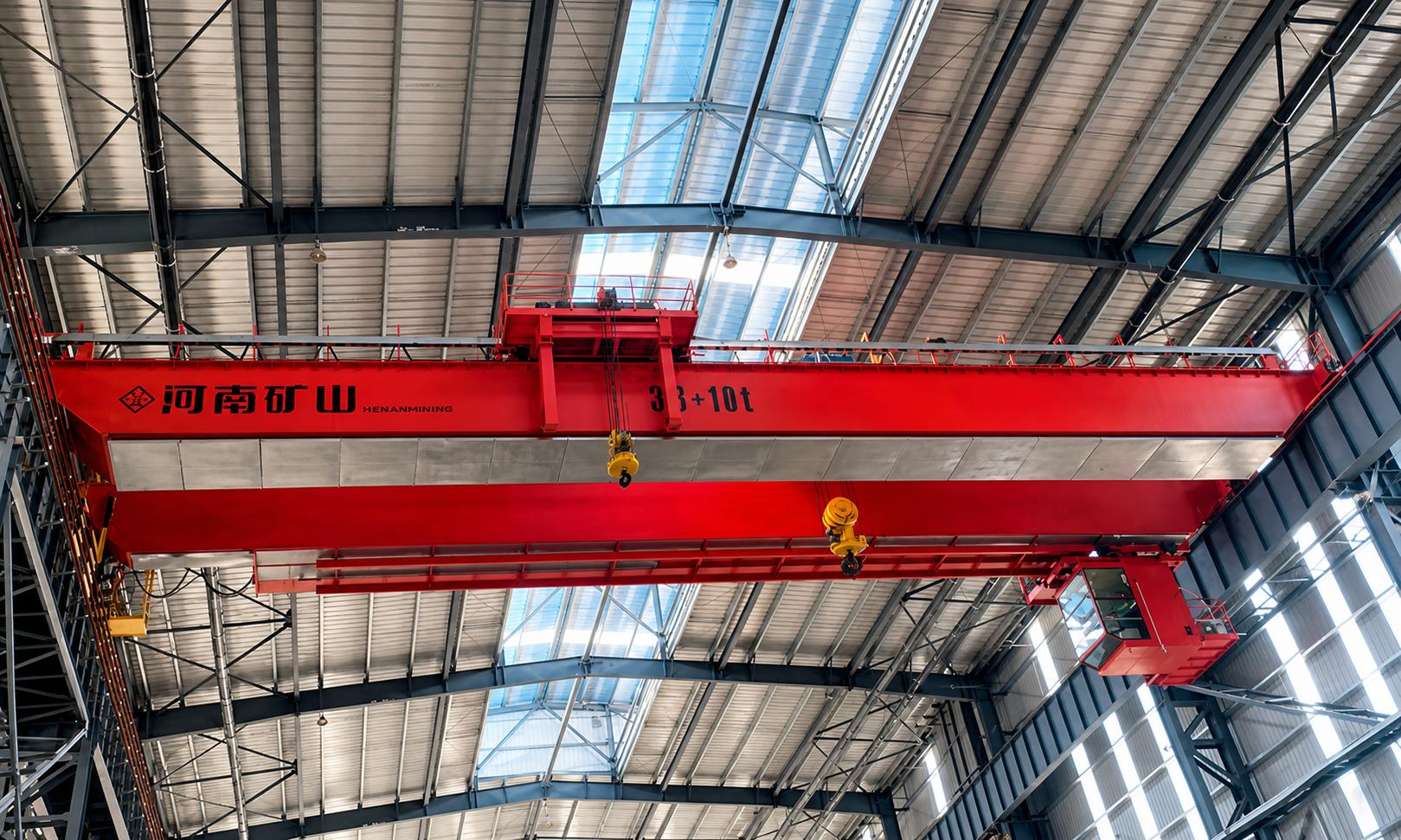
HowDoes a 45t Crane Handle Cleanroom Washdown?
Clean room flushing conditions are common in pharmaceutical, biotechnology, food and beverage, as well as some semiconductor and medical device workshops. High-pressure water, steam or chemical disinfectants are used for cleaning.
Ordinary cranes are prone to rust, friction, grease and chips, dirt and dirt in gaps, and water inlet failure of electrical components in this environment; special models for clean rooms solve these problems through the following designs:
- The material and surface treatment are mainly made of 304 or 316/316L stainless steel for load-bearing and exposed components (main beam, trolley, hook, fastener), which are resistant to acid, alkali, moisture and corrosion of various cleaning agents.Surface polishing treatment (some require roughness Ra ≤0.5 µm), or use a non-chip epoxy powder coating (such as RAL 9016 white); anodized aluminum can be used for lightweight parts.The wheels and guide parts are made of scratch-free polymer materials, stainless steel or nylon to avoid residual pollutants.All welds are polished and polished to eliminate dirt-hiding gaps.
- Sealing and protection level The sealing level of key components such as motors, deceleration transmission mechanisms, bearings, electrical components, cables, etc. reaches IP65 and IP67, and food-grade models can reach up to IP69K to resist high-pressure water spray and chemical erosion.The shell of the whole machine is closed, the track is sealed, the bearing adopts a permanent lubrication and maintenance-free sealing structure, and the external oil injection point is eliminated.Equipped with an oil pan and a ventilation respirator to trap lubricating oil or particulate matter that may leak; the motor can be equipped with a HEPA filter shield.
- Hygienic structure, easy to clean, smooth surface, rounded transition, minimize bumps, seams and openings, with quick drainage structure to prevent water and dust accumulation.Moving parts (chains, wire ropes, transmission belts) are equipped with telescopic dust covers, bellows or fully enclosed shields.The modular structure is easy to overhaul and clean, and will not produce debris; the surface material is resistant to all kinds of commonly used disinfectants, and some use NSF H1 food grade grease.
- Low-dust operation requires that the trolley and the transmission mechanism are fully enclosed, non-chip-free materials are selected, and special lifting parts are used: stainless steel chain, Dali horse synthetic fiber sling /sling (almost no chip-free) or sealed wire rope to reduce pollution during operation.The surface is sprayed with an antistatic coating to reduce dust adsorption.Supporting frequency conversion drive (VFD), to achieve soft start, soft stop, precise positioning, reduce vibration, wear and dust production; the cable uses low precipitation, special cables for clean rooms, and is stored in stainless steel trunks.
Typical Application Scenarios of 45t Cleanroom Bridge Crane
Raw materials (API) clean plant
In the B/C-level clean area, it undertakes the hoisting of heavy-duty process equipment such as large reactors, crystallization tanks, and filtration equipment, covering the entry and installation of new equipment, regular maintenance of in-service equipment, and material transfer of bulk raw material containers.The precipitation of dust and oil pollution is strictly controlled throughout the hoisting process to avoid pollution to the API production environment and ensure that the cleanliness of API production meets the requirements of the specification.
Sterile preparation workshop
It is mainly used for hoisting core aseptic equipment such as freeze-drying machines, liquid dispensing systems, and large-capacity liquid tanks, and supports equipment relocation, demolition of old equipment and replacement of new equipment during production line upgrades.The equipment runs with low dust and no dripping, and is adapted to a high-level clean environment for sterile preparations, reducing the risk of pollution caused by hoisting operations and ensuring the continuity of sterile production.
Large fermented food factory
For brewing, dairy products and other fermented food production lines, complete the on-site installation and daily maintenance of heavy equipment such as large-capacity fermentation tanks, sterilization systems, and raw material storage tanks.Clean driving can withstand conventional sterilization in the workshop, prevent metal debris and oil pollution from contaminating food raw materials, and meet food production hygiene control standards.
Clean supporting project
It is used in clean workshop renovation and expansion projects, and is responsible for the entry and hoisting of large-scale process equipment during the construction period of the project.Compared with ordinary lifting equipment, clean bridge cranes can reduce dust pollution during the construction phase, reduce the amount of subsequent cleaning work in the workshop, and shorten the production and verification cycle of the clean workshop.
How to Specify a 45t Cleanroom Bridge Crane for Your Facility
- Rated load: The rated lifting capacity is 45 tons. The main body of the equipment is based on a double-beam bridge structure. It can be designed for non-standard customization based on the span of the plant on the project site, the actual lifting height, operating conditions, etc., to adapt to the hoisting needs of different clean workshops.
- Clean compliance: The whole machine is designed to comply with GMP, HACCP, and ISO14644 international clean standards, and can be adapted to ISO5, ISO6, ISO7, and ISO8 workshops with various clean levels, and can be configured according to the cleanliness requirements of the production area.
- Material scheme: It supports partial or complete use of 304/316L stainless steel, and the metal surface is polished. At the same time, a washable version is optional, which can withstand the wiping and flushing of conventional disinfectants in the workshop, and it is not easy to accumulate dust and dirt.
- Protection level: The basic protection level of the motor and lifting mechanism can reach IP54. For areas that need to be flushed and killed regularly, it can be upgraded to IP65 protection level, which greatly improves the dust-proof and waterproof capabilities to prevent water vapor and dust from invading the interior of the equipment.
- Lubrication requirements: NSF H1 food and pharmaceutical certified grease is used, and the anti-drip structure and lubricating oil collection device are matched to effectively avoid grease dripping, eliminate the risk of oil pollution and contaminate the product, and meet the hygiene requirements of a clean environment.
- Control scheme: It is equipped with a frequency conversion speed control system to realize the smooth start and stop of the lifting and walking mechanism, reducing vibration and dust; it can also be equipped with a remote monitoring system and high-precision positioning function as needed to improve the operating accuracy and safety of heavy-duty hoisting.
- Space conditions: In the selection stage, it is necessary to comprehensively evaluate the parameters such as the span of the plant, the height of the rail roof, the size of the site clearance, and the wheel pressure limit. The carrying capacity of the clean room floor is particularly critical. It must be calculated in advance to avoid that the installation conditions are not met in the later civil construction.
- Compliance and acceptance: can assist in the completion of special equipment forensic evidence and clean verification work, and can provide a full set of technical documents such as equipment material certification and lubricating material certification to facilitate enterprises to successfully pass GMP audit and verification
45t Cleanroom Bridge Crane Maintenance
The maintenance idea of clean driving is different from that of ordinary cranes. The core principle is to minimize pollution from maintenance.
- Core maintenance principles: The maintenance ideas of clean bridge cranes are significantly different from conventional industrial cranes. The core principle of the complete maintenance plan is to minimize pollutants generated during maintenance operations and avoid interference with the controlled environment of the clean workshop.
- Sealing and chain inspection: It is necessary to regularly inspect the integrity of the equipment seals and the degree of wear of the stainless steel chain. Once aging and wear are found, it is predicted to be replaced in advance.Maintenance and disassembly operations should be arranged as far as possible outside the clean area to reduce disassembly operations in the clean room and prevent debris and dust from falling to the production area during maintenance.
- Lubricating grease replacement: When performing grease replacement operations, special greases for food and medicine with NSF H1 certification must be selected, and ordinary industrial lubricants must never be used.Eliminate the risk of grease leakage from the source, prevent oil products from contaminating products, and ensure the hygiene standards of clean workshops.
- Equipment surface cleaning: To clean the surface of the crane, only disinfectant approved by the workshop can be used to wipe it.Tools such as wire brushes and hard scrapers are prohibited from scraping and polishing metal surfaces to prevent scratches on the paint surface or the surface of stainless steel, and to avoid scratches and dirt and metal particles from scratches.
- Operation and maintenance file management: Establish a complete and standardized equipment operation and maintenance ledger, and record all information such as equipment maintenance, parts replacement, cleaning and killing in detail.The complete set of operation and maintenance data needs to be properly archived and kept. During GMP audit and inspection, it can be submitted directly for inspection by auditors.
Conclusion
The 45-ton clean room bridge crane is suitable for hoisting heavy equipment in clean production environments such as pharmaceuticals and food. It can be combined with double-beam heavy-duty structure, dust-proof and antifouling design, easy-to-clean surface and corresponding safety configuration to meet the handling needs of large tanks and process equipment.The equipment design should also be evaluated in a targeted manner according to the cleanliness level, pollution control requirements and applicable standards.
Henan Mine Crane can provide customized design and manufacturing solutions for 45-ton clean room bridge cranes based on workshop drawings, cleanliness levels, hoisting loads and on-site working conditions to assist customers in matching structure, protection and control configurations.During project consultation, relevant technical parameters and layout information can be provided in order to further evaluate the equipment plan and budget.