
How to Choose a Container Straddle Carrier Manufacturer: A Practical Guide for Ports, Terminals, and Logistics Yards
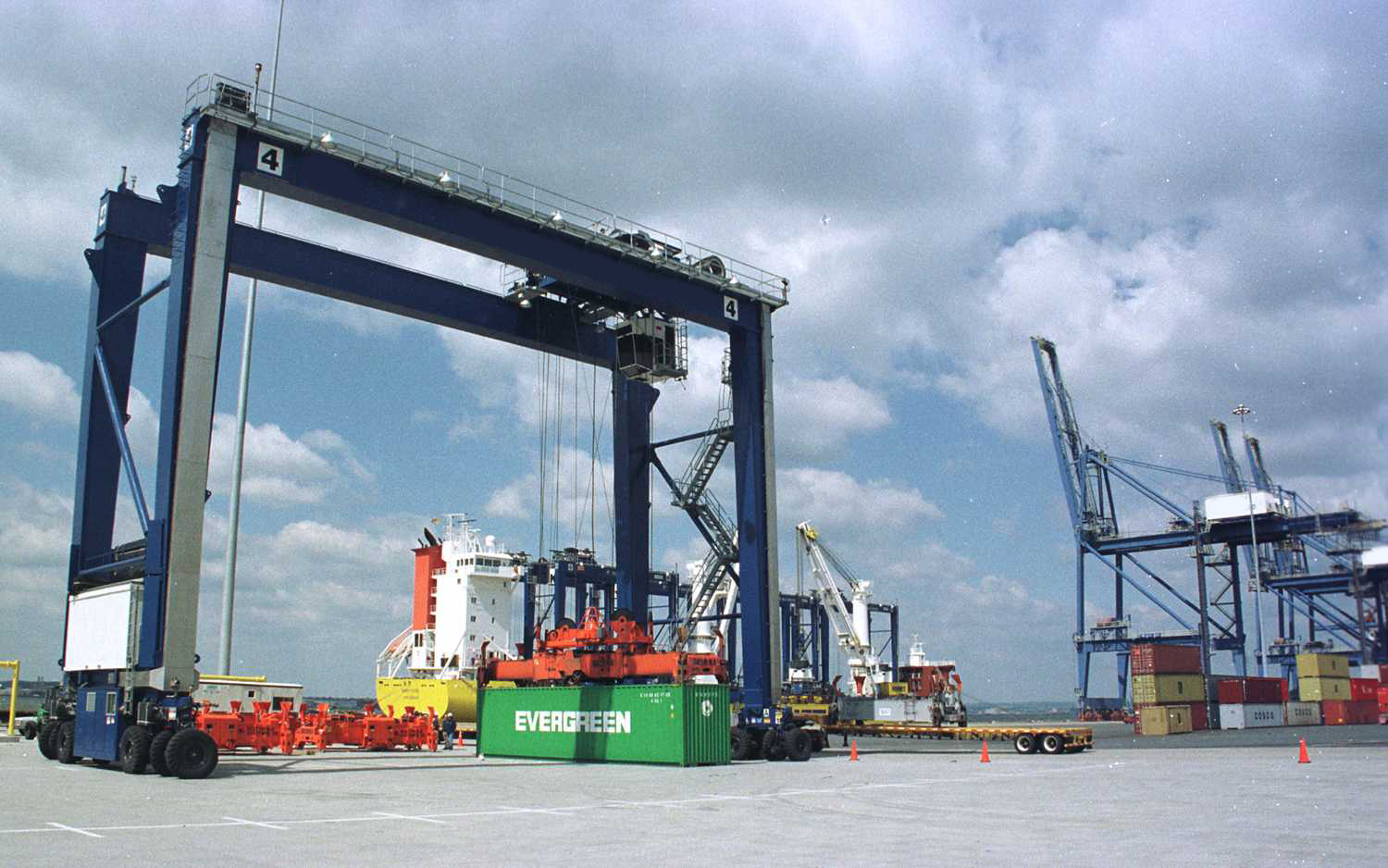
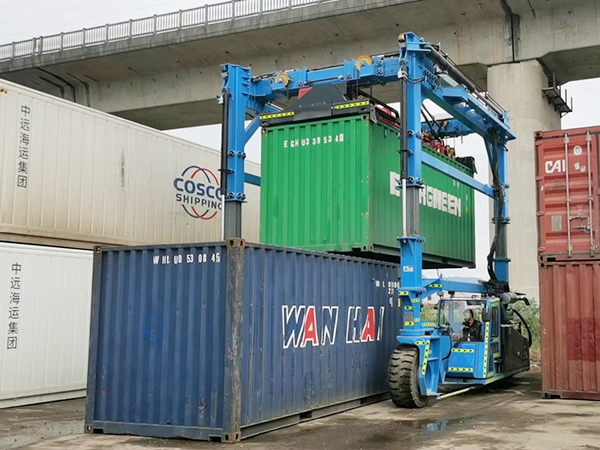
Container transporter is the core mobile operation equipment for port terminals, logistics yards and inland freight stations. Different from rail lifting equipment, container transporter does not need fixed rail constraints, and can flexibly shuttle in all areas of the yard to complete the container handling, stacking, alignment transfer work.
Selection of professional container transporter manufacturers, need to be combined with the layout of the yard, operational traffic, stacking needs, and later upgrade planning comprehensive judgment.Equipment technology, engineering adaptability, factory testing standards and global after-sales guarantee are more important core indicators than a single quotation.
Mainstream application scenarios of cross-traffic container trucks
The flexible trackless operation characteristics of straddle car make it suitable for a variety of container operation scenes, whether it is a large seaport terminal, or inland small logistics yard, can play a practical value. There are obvious differences in equipment configuration, stacking capacity and power type for different scenarios.
Large Container Terminal
The main coastal container terminal has a complex operation chain, and needs to frequently complete the container transfer work between the shore bridge and the yard, and between the yard and the truck channel. Cross-traffic vehicles can replace part of the rail equipment to fill the operational gap of flexible transfer.
The high frequency of operation and the shift operation of the equipment in this type of scenario require higher durability, continuous operation capability and braking stability of the port straddle carrier.
Port Logistics Yard
Independent port yards are mainly responsible for temporary stacking of containers, organizing and categorizing, and temporary storage of turnover. The layout is flexible and there is no fixed operation track or assembly line constraints.
The trans-carrier can freely adjust the operation route to complete the basic work of container stacking, shifting, sorting, etc., which is suitable for the dynamic operation demand of the yard, and is the core equipment for the lightweight operation of the yard.
Inland Multimodal Transportation Terminal
The inland container distribution center connecting railroads and highways has messy working conditions, irregular container entry and exit frequency, and limited space for site reconstruction.
The trackless transporter, which does not require civil engineering transformation, can quickly adapt to the changing operational layout and meet the demand for scattered and high-frequency container transshipment under multimodal transportation scenarios.
Automated and Semi-Automated Terminal Projects
In the intelligent terminal renovation project, automated straddle car is the core supporting equipment of unmanned yard. It can be docked to the terminal intelligent control system to complete autonomous walking, precise alignment, automatic stacking and other operations.
This type of project requires manufacturers to have intelligent equipment development, system debugging, program adaptation capabilities, ordinary general equipment manufacturers can not meet the demand for customized intelligent transformation.
High Throughput Independent Yard
Some small and medium-sized yards do not rely on RTG, RMG and other large-scale rail equipment, relying entirely on cross-traffic vehicles to complete all container operations. The operational pressure of the yard is concentrated and the equipment utilization rate is extremely high.
These scenarios require highly adaptable and durable specialized straddle carriers to ensure all-weather stable operation of the yards and avoid equipment failures that may lead to operational stagnation.
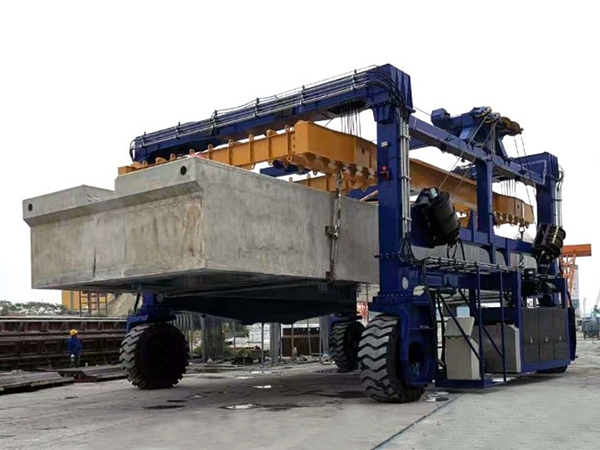
The core demand of straddle car in port and logistics yards
The core demand of yard operation is stable, flexible and low-cost operation. As a high-frequency equipment, the procurement standard of straddle car needs to be adapted to the actual working conditions of the site instead of simply benchmarking the parameters of the equipment.
Stable on-site operation rhythm
The cargo turnover rhythm of the container yard is not fixed, and the equipment is required to operate continuously and uninterruptedly during the peak period. Equipment start and stop smoothly, no lag, in order to protect the rapid flow of containers, shorten the vehicle and cargo detention time.
All-weather operation stability
Most of the yards implement shift system operation, and the cross-traffic trucks are in the state of high-frequency starting and stopping, repeated traveling, and weight lifting and lowering for a long period of time. The durability of the core components of the equipment and the anti-fatigue performance of the whole machine directly determine the overall operational stability of the yard.
Site operation flexibility
The container placement position, operation channel and transfer route of the conventional yard will be adjusted with the change of cargo flow. The transporter needs to have good steering performance and mobility to adapt to the logic of changing yard operations.
No need to rely on the characteristics of the fixed track, can maximize the release of yard space, suitable for all kinds of non-standard site layout.
Safe and smooth lifting performance
Containers have a large self-weight, and shaking and deflection during lifting will bring about cargo damage and safety hazards. The equipment needs to have good anti-shaking effect, precise braking ability and wide operation vision.
Perfect safety protection design can effectively reduce the risk of manual operation errors.
Low Failure, Easy Maintenance Equipment Attributes
The time cost of yard equipment downtime is extremely high, and equipment with frequent breakdowns and difficult-to-purchase spare parts will continue to increase the operational burden. The structure of the equipment needs to be designed for easy daily maintenance, and the core parts have the characteristics of universal and easy procurement.
Suitable for late automation upgrade
Many traditional yards are mainly manual operation, but there are plans for intelligent upgrading in the future. The transporter with automation interface can be upgraded to remote control, semi-automatic or fully automatic function without replacing the whole machine.
Types of straddle car equipment suitable for different yards
There are many types of yard straddle car on the market, and different models have different stacking capacity, traveling speed, and operational positioning, so the selection of the type is based on the need to meet the capacity requirements of the site.
Standard Container Handling Vehicle
It is suitable for daily transfer and single or double stacking operation in conventional small and medium-sized yards. With mature structure and low failure rate, it is suitable for the basic operation needs of most traditional terminals and logistics yards.
With outstanding cost performance, it is suitable for regular projects with stable work flow and no need for high-intensity stacking.
High-stacking type transporter
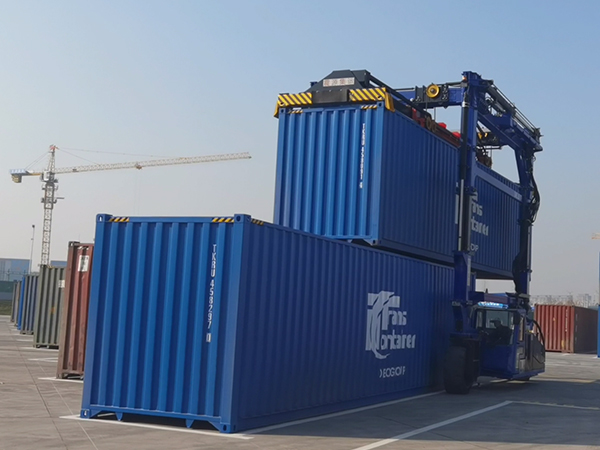
Designed for yards with limited land resources and the need to increase storage density, it supports multi-layer container stacking operation. It can greatly enhance the container storage capacity per unit site and improve the utilization rate of yard space.
It is the preferred model for urban core yards and harbor areas where land is scarce.
Specialized transshipment truck for yard
The main high-speed walking, fast alignment function, specially used for long-distance container transfer between quay front and yard, yard and freight channel. The equipment travels faster and has higher alignment efficiency.
It can effectively shorten the turnover time of containers, which is suitable for the high-flow and fast-paced port operation scenarios.
Automated/semi-automated trans-shipment vehicle
Equipped with intelligent control system, autonomous navigation module and accurate positioning system, it can realize unmanned or less manned operation. It is suitable for the upgrade project of smart port and smart yard, which can reduce the dependence on labor and unify the operation standard.
Automated transporter manufacturers need to have integrated hardware and software research and development capabilities, not ordinary equipment manufacturers can produce.
Customized cross-truck solutions
Customized models for non-standard sites, special operating processes, and extreme environmental conditions. Manufacturers can adjust the equipment span, height, power and control system according to the width of the yard channel, the direction of cargo flow, wind and temperature environment, special container specifications.
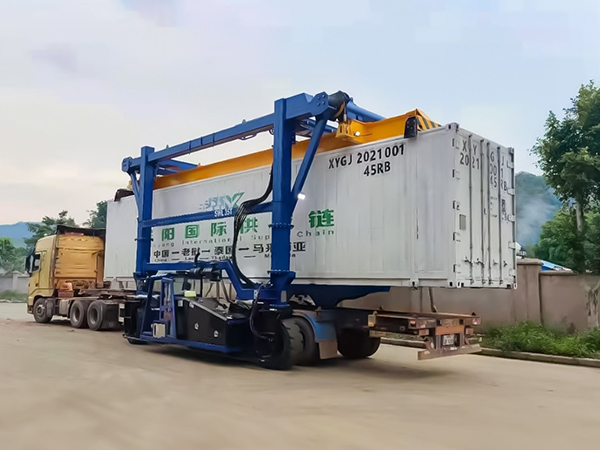
Core technical parameters that must be confirmed for procurement
The parameters of the transporter directly determine whether the equipment is suitable for the working conditions of the yard, and if the parameters are not matched correctly, there will be problems such as insufficient stacking of containers, inaccessible channels, and substandard efficiency, which need to be checked one by one during the purchasing stage.
Rated load
According to the yard mainstream container specifications, spreader weight, whether the need for heavy-duty operations to determine the load standard. It is necessary to cover the maximum weight of fully loaded containers and reserve a reasonable margin to avoid long-term full-load operation and loss of equipment.
Stacking height
Directly affect the storage density of the yard. The cost and structural design of double, triple and multi-layer stacking equipment varies greatly, which needs to be combined with the storage planning of the yard and the site area to determine the appropriate height.
Equipment Span and Clearance
The span of the equipment needs to match the width of standard containers, and at the same time match the layout of the yard access. The clearance needs to meet the operational safety distance, to avoid collision with the box, fence and peripheral equipment in the process of walking.
Traveling speed
Equipment empty, heavy walking speed, determines the efficiency of container transfer. Long-distance transit scenes give priority to high-speed models, narrow and dense yard can be adapted to conventional speed, to ensure operational safety.
Lifting speed
Box lifting speed directly affects the length of a single operation cycle. Too slow lifting speed will drag down the overall turnover efficiency, too fast is easy to cause the box shaking, need to balance the speed and stability.
Wheel configuration and steering system
Multi-wheel set, multi-angle steering design can enhance the flexibility of the equipment site, suitable for narrow aisles, right-angle turns, dense yard operations. The accuracy of the steering system directly affects the alignment efficiency and operational safety.
Power type
Currently, the mainstream is divided into three types: diesel, electric and hybrid. The diesel type is suitable for non-electricity supporting, high-intensity continuous operation scenarios; the electric motor type has lower energy consumption and less noise, and is suitable for yards with strict environmental control; the hybrid power combines the advantages of range and energy saving.
Control System
Manual cab control, remote control, semi-automatic and full-automatic control can be selected according to project requirements. Newly built smart yards can be directly equipped with automation systems, and traditional yards can be reserved for upgrading interfaces.
Full set of safety protection system
Must be equipped with anti-collision sensing, emergency braking, load monitoring, speed limit control, panoramic vision assistance and other safety features. All-round avoidance of equipment collision, overloading, speeding brought about by safety accidents.
Environmental suitability parameters
Coastal yards need to focus on verifying the equipment's anti-corrosion, anti-salt spray and wind resistance; inland dusty yards need to confirm the equipment's dustproof sealing design; high temperature and low temperature areas need to be matched with the appropriate power and hydraulic systems.
Professional transporter manufacturers screening criteria
The suppliers of straddle carrier on the market are uneven, traders do not have R & D production capacity, equipment suitability and after-sales service can not be guaranteed, screening manufacturers can focus on the following dimensions.
Verify the entity's R&D production capacity
High-quality manufacturers must have a full set of production capacity for independent design, structural research and development, machine welding, assembly and commissioning. Can independently optimize the structure of the equipment according to the working conditions, rather than simply assembling common parts.
Avoid trading businesses that only do resale distribution in order to guarantee the quality of equipment and customization capabilities.
Verification of similar yard landing cases
Focus on checking the manufacturer's real landing projects in container terminals, inland yards, and multimodal transportation terminals. Mature project experience represents the manufacturer's familiarity with the operating logic and pain points of various yards.
Manufacturers with rich overseas project experience are more suitable for port operation standards in different regions of the world.
Evaluate professional engineering adaptability
Reliable manufacturers will not directly promote fixed models, but will take the initiative to match the yard drawings, cargo flow planning, stacking targets, and site dimensions. Combined with the on-site working conditions, they will give exclusive selection plan and optimize the equipment parameters to meet the needs of the site.
Verification of a full set of formal technical data
Regular manufacturers can provide a full set of information such as equipment assembly drawings, performance parameter statements, electrical schematic diagrams, control logic descriptions, list of core accessories, etc., to meet the needs of project acceptance, filing, and later maintenance.
Confirm the brand and quality of core parts
Core accessories such as engine, motor, reducer, brake, PLC control system, spreader, tires, steering components, etc. determine the stability and service life of the equipment. When purchasing, you need to clarify the brand, specification and warranty standard of the parts.
Strict factory inspection system
Before the equipment leaves the factory, it needs to complete a number of tests, such as assembly verification, no-load test run, heavy load test, steering debugging, full-function testing, etc., and keep complete testing records to eliminate potential equipment failures from the source.
Clear commissioning and personnel training services
Confirm the service scope of the manufacturer in advance, including factory commissioning, on-site installation and docking, machine commissioning, operator training, operation and maintenance guidance, etc., so as to ensure that the equipment can be quickly put into operation after entering the site.
Verification of global after-sales service and spare parts guarantee
The core demand of overseas landfill projects is fast after-sales response and spare parts supply. Manufacturers need to have an overseas after-sales team, spare parts inventory, and remote technical support capabilities to minimize equipment downtime.
Comprehensive assessment of the whole life cycle value
Low-priced equipment is often characterized by shrinking parts, simplified processes, high energy consumption, and no room for upgrading. Procurement should be based on a comprehensive judgment of equipment cost, energy cost, maintenance cost, service life, and upgrade potential, not limited to the initial offer.
Common Misconceptions in Procurement
Many of the problems of yard equipment adaptation stem from the cognitive bias in the procurement stage, and the seemingly money-saving choices will bring long-term operational troubles.
Simply selecting the manufacturer with the lowest price, ignoring the equipment configuration, process standards and after-sales system, will lead to frequent failures and soaring operation and maintenance costs in the later stage.
The equipment parameters do not match the operation process of the yard, and the traveling span and stacking height do not match the site planning, resulting in the equipment not being able to operate at full capacity.
Only focus on single operation efficiency, ignoring the stacking height, the storage density of the yard is insufficient, wasting site resources.
Neglecting the long-term energy consumption and maintenance loss of equipment, the average annual operating cost of low-priced and low-matched equipment is far more than the difference in the price of high-matched equipment.
Failure to consider the demand for later intelligent upgrading, procurement of pure manual old models, can not be adapted to the future transformation of the smart yard.
The scope of the offer is vague, no clear accessories, commissioning, training, after-sales range, later produce a large number of invisible incremental costs.
Not verifying the manufacturers' similar project cases, blindly choosing manufacturers with no experience in yard equipment, and poor equipment adaptability.
Incomplete site drawings and operational data provided at the inquiry stage, low fit of the manufacturer's program, and insufficient adaptability of the equipment after landing.
Frequently Asked Questions
What is the core purpose of the Container Handling Vehicle?
Container transporter is a trackless mobile container operation equipment, which is mainly used for container transfer, stacking, shifting and organizing operations in ports, yards and inland stations. With the advantage of flexible walking, it can make up for the operational limitations of rail equipment and adapt to various dynamic yard conditions.
Which scenarios are more suitable for straddle carriers rather than RTG and RMG equipment?
Yards with irregular site, changing cargo flow, flexible adjustment of operation routes, and inability to do track construction modification are preferred to use straddle carriers. For small and medium-sized yards, temporary operation yards and inland intermodal terminals, straddle carriers are more cost-effective and practical.
What is the conventional stacking height of straddle car?
Conventional yards use 2-3 layers of stacked models, while high-density storage yards can use 4 layers or more high stacked models. The specific height needs to be combined with the site area, the total amount of storage, cargo turnover frequency comprehensively determined.
How to choose diesel, electric, hybrid transporter?
No power support, 24-hour continuous operation of large ports to choose diesel models; strict environmental control, daytime normal operation of the yard to choose electric models; taking into account the range and energy-saving needs of the project, you can choose a hybrid model.
What technical information do I need to request from the manufacturer before signing the contract?
A full set of technical and after-sales information such as equipment assembly drawings, performance parameter tables, electrical schematics, control system descriptions, core parts lists, factory inspection reports, operation and maintenance manuals, warranty details, and so on.
Is automation capability important for the yard to be upgraded later?
Very important. Intellectualization is the development trend of global port yards. Equipment with reserved automation interface can be upgraded with remote control and semi-automatic operation at low cost later without replacing the whole equipment, which saves the transformation cost significantly.
In addition to the price of the equipment, procurement also need to focus on what?
Manufacturer's project experience, equipment process standards, core parts quality, environmental adaptability, automation upgrade space, factory inspection standards, overseas after-sales response speed and spare parts supply capacity.
Summarize
High-quality container yard equipment manufacturers can not only provide standardized and customized cross-truck equipment, but also rely on their own port engineering experience to provide customers with pre-condition assessment, program optimization, technical docking, commissioning, long-term operation and maintenance of the whole process services.
For global ports, terminals and logistics yards, choosing a supplier with R&D strength, on-site experience and overseas after-sales capability can effectively reduce the equipment failure rate, control long-term operating costs and adapt to future intelligent upgrades.
Henan Mine Crane has been deeply engaged in the R&D and manufacturing of port logistics equipment for many years, and can provide a full series of customized container straddle carriers and ancillary services, which are suitable for all kinds of domestic and overseas ports, stockyards, and inland terminal projects.
If you are not sure about the model and parameters of the yard, you can provide the site layout, cargo flow requirements, stacking height and operational objectives, and our engineering team will provide you with an exclusive straddle carrier solution.