
STS Crane for Container Terminal Operations
These numbers are critical for a container terminal to survive or thrive: the critical metric is largely how quickly a vessel is discharged, transloaded, and sent back to sea. In the heart of the process lays the STS -- the ship-to-shore -- the machinery that moves every single container on or off of the vessel deck. Choose the best STS equipment, optimize its utilization, and maintain it well, and a terminal will enjoy premium vessel calling. Fail to do so, and congested berths, schedule delays, and higher cost will necessarily result.
This article discusses the function of STS cranes, the most important specifications, current industry standards, automation and electrification direction in 2026, safety compliance needs, cost of ownership and a guideline for choosing the right STS crane supplier for container terminal operations.
What Is an STS Crane?
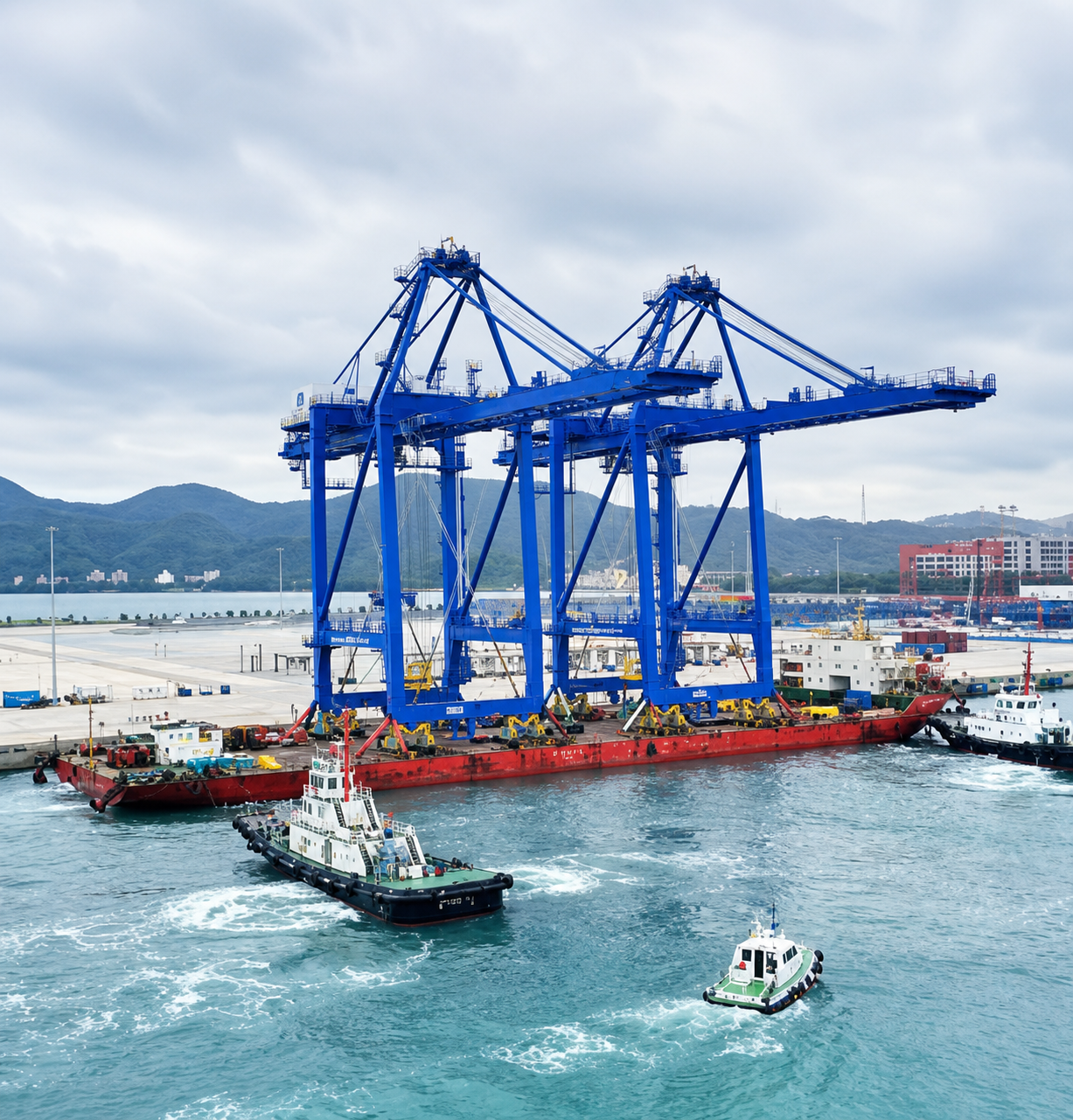
An STS (ship-to-shore) crane, also known as a quay crane or container crane, is a ship-to-shore rail-mounted gantry crane positioned on the quay of a container terminal. It loads and unloads containers directly to and from a vessel‘s cargo hold or decks, by means of a spreader that latches onto the ISO standard container corner castings.
STS cranes are the key pieces of equipment that will determine port productivity. Being at the front end of the ship/shore interface their quayside speed directly influences vessel turnaround time the key factor that the shipping lines and port authorities focus on when selecting a terminal to win a call.
All STS crane is controlled by the landside handling systems, i.e. RTG and RMG cranes in storage yard, and AGV and terminal trucks that carry the containers between the crane and storage yard.
How STS Cranes Work: The Lift Cycle
The quayside container crane is equipped with three sets of motion mechanisms that can work together. The whole set of equipment relies on programmable logic controller (PLC) or frequency conversion control system to realize accurate synchronous operation of the three.
- Cart travel: the whole crane moves along the dock track, adjusts the position, and aligns with the berth of the ship.
- Trolley walking: the crane trolley moves back and forth along the cantilever and the girder, and accurately stops the spreader right above the target container slot.
- Lifting mechanism: with the help of wire rope and drum to drive the spreader and container vertical lifting action.
Conventional container lifting operations have a standardized cycle:
- Crane alignment berthing vessel, operator or automated system check container number;
- The lifting appliance is lowered, and the container is clamped and fixed through the rotary lock structure;
- The lifting mechanism lifts the container off the deck of the ship;
- The trolley carries the cargo across the bridge and eventually lands the container on a pallet truck, AGV or yard stack.
This process is repeated throughout the ship's loading and unloading operations. Small losses occur in any link in a single operation, and after hundreds of cycles of operation, the overall efficiency loss will continue to stack.
Anti-sway control is an indispensable component of modern cranes. This function can actively suppress the shaking of goods during the process of lifting and trolley high-speed operation, which can not only reduce the time of single lifting, but also greatly reduce the workload of manual correction of deviation by operators.
Key Technical Specifications
The technical specifications determined by the terminal at the equipment procurement stage directly lock in the upper limit of its operational efficiency for decades to come. Crane selection should focus on evaluating the following core parameters:
- Outward reach: horizontal working coverage distance of crane dock track outward. The equipment suitable for very large container ships (ULCVs) has an outreach of 50 - 70 meters, which can meet the container loading and unloading operations of ships with 24 rows and more.
- Lifting rated load: Conventional spreaders have a rated lifting capacity of 40 to 65 metric tons and are suitable for lifting all standard fully loaded International Organization for Standardization (ISO) containers, including heavy 45-foot containers.
- Lifting height and rear extension: Lifting height shall meet the lifting clearance requirements of the highest container stacking layer on the ship deck; rear extension standard shall be 15 to 25 meters, which can cover the buffer area on the land side of the wharf and ensure the smooth handover of containers and automatic guided vehicles (AGVs).
- Lifting and trolley running speed: lifting speed of lifting mechanism and trolley walking speed are core dynamic performance indexes, which directly determine the cycle period of single box operation, directly affect the crane's hourly operation volume and the overall loading and unloading operation efficiency of the terminal, and are key parameters to ensure the high throughput capacity of the terminal.
- Gauge and structural load: crane gauge and structural load bearing parameters must be accurately matched with the civil design standards of the wharf. Since retrofitting after completion is extremely costly and infeasible, relevant parameters must be identified at the procurement stage in one go.
At present, the top quayside container crane suitable for very large container ships can generally reach a total height of 80 to 120 meters when the cantilever is fully lifted.
Types of STS Cranes
Quayside container cranes (STS) are generally classified according to the tonnage and ship type specifications of the ship to be adapted to the loading and unloading needs of different routes and ship types, and the mainstream models are divided as follows:
- Panama/ultra-Panama type: the operation extension is small, suitable for small and medium-sized feeder ships, old container ships, mostly used for regional short-distance route terminal operations.
- Super Panamax: Optimize and upgrade the extension distance and lifting height, adapt to large ocean-going container ships, and can meet the loading and unloading requirements of mainstream ocean-going trunk ships.
- Special type of ultra-large container ship (ULCV): the extension distance can reach more than 60 meters, the operation coverage is wide, and it can be adapted to ultra-large ships with 24 rows or more of containers wide, and it is suitable for the operation scene of deep-water big port trunk line.
Each level of model can be matched with different spreader operation scheme, adapt to the needs of differentiated loading and unloading efficiency, the industry mainstream configuration is divided into three types:
- Single-box operation mode: only one 20-foot or 40-foot standard container is hoisted in a single operation cycle, with high operation stability and wide adaptation scenarios, which is the basic general operation mode.
- Dual -666.66cm synchronous operation mode (double lifting): It supports lifting two 20-foot containers at the same time, which can effectively improve the single-cycle operation volume, and is the general mainstream configuration for improving the throughput efficiency of the terminal at this stage.
- Series double-box operation mode: high-end intelligent operation configuration can realize double-box crane for about 80% of 40-foot containers of super-large ships, greatly improve the berthing and loading and unloading efficiency of large ships, and adapt to high-throughput deep-water terminals.
STS Crane Productivity: Benchmarks and KPIs
Operation efficiency is the core assessment index of terminal operators, and the relevant data should be based on the measured value, not the publicity data.
Total Operation Box Per Hour (GMPH) is a standard assessment indicator for a single STS quay, covering all delays throughout the operation. The efficiency of conventional quay bridge is 25-40 boxes/hour, and the performance of high-performance and double spreader equipment is better. After more than 20 shore bridges of a large wharf in Asia have been remotely controlled and modified, the average efficiency of waiting delays including collecting cards is 29 boxes/hour, with a peak value of 44 boxes/hour.
The comprehensive efficiency of berths is the overall index for the operation of multiple shore bridges on the same ship. The industry standard is 100-150 boxes/hour, and the automatic wharf is also applicable. When the working condition is good, the efficiency of a single shore bridge is about 35 boxes/hour.
In addition to GMPH, the terminal core monitoring three auxiliary key indicators:
- Operation cycle: the whole cycle of single-box operation is time-consuming, covering the lifting mechanism action, equipment operation and the whole process waiting time-consuming.
- Quay bridge standby time: invalid standby time of equipment due to factors such as not in place of collection card, occupation of storage yard box, lag of binding operation, team handover, etc.
- Equipment availability rate: the proportion of the normal operation time of the equipment to the total planned operation time, and the high throughput capacity terminal usually requires this index to reach more than 95%.
The bottleneck of terminal operation is not equipment hardware problems, but various standby delays. Even if the equipment is in good condition, it will be limited due to supporting process problems. Only increasing the operating speed of the equipment cannot solve the process card point.
Automation and Electrification Trends in 2026
Two forces are reshaping STS crane procurement decisions this year: automation and electrification.
Electrification is now the default
Not the exception. In 2024, 82% of newly delivered STS cranes had electric drives supplied by electricity instead of diesel gensets and electrically powered units emitted about 34% less greenhouse gases over a working cycle, with noise production close to 75 dB(A) - an important factor for terminals subject to tight environmental restrictions such as California‘s At-Berth Rule and Europe‘s Fit for 55.
Modern units utilize regenerative braking, returning 15–25% of operating energy during each cycle due to typical levels of 150–400 kWh consumed per hour of operation. The Port of Los Angeles has over 30 electric STS cranes in operation, reducing crane-related emissions by about 70%, while the Port of Hamburg‘s hybrid fleet has improved energy efficiency by around 30%.
Remote and semi-automated operation is now standard
Not experimental. The adoption of remote and semi-automated controls is commonplace in most of new STS cranes, and the digital twin technology used for more than 310 STS cranes around the world in 2023-2024 is improving predictive maintenance systems to reduce unplanned downtime by an estimated 28%, and increase lifespan of assets by about 17%.
Full automation is few and far between. Instead, the majority of so-called “automated” ports employ semi-automated or remote-controlled straddle carriers, because human oversight still needs to be a regulatory and safety requirement at just about every large terminal in the world. At the few fully automated terminals (Rotterdam, Qingdao, Tuas Port in Singapore), the productivity improvements are significant, with some fully automated terminals achieving around 40% higher productivity and a drastic reduction in operating costs.
What this means for procurement
Define electric drive as early as possible. The incremental cost over diesel can usually be repaid through fuel/maintenance savings within 4 6 years (per most operating models) and automation ready electrical & control architecture avoids pricey retrofit down the road.
Safety and Compliance Standards
The design and operation of the Quayside Container Crane (STS) shall follow the exclusive specification system, and the procurement and operation team shall incorporate the relevant standards into the technical specifications of the equipment at the beginning of the project:
- ISO 8686: General criteria for specifying crane design loads, providing a core basis for the design of equipment load-bearing structures
- EN 13001 / EN 13135: EU official standard, specifying rigid specifications and compliance requirements for structural safety and equipment design of quay bridges
- FEM 1.001: Industry-wide standard, widely adopted by major equipment manufacturers for equipment grading and full-cycle maintenance management.
Modern quay bridges come standard with a full set of safety protection systems. The core includes: equipment anti-collision system, automatic wind speed monitoring and over 25 m/s automatic shutdown device, seismic limit device adapted to working conditions, load torque limiter, emergency shutdown system, and constant temperature control cab.
The automation control system shall obtain EN/IEC 61508 functional safety certification, and shall be accompanied by OSHA or CE compliance documents according to territorial requirements.
The above configurations and certifications are mandatory requirements. CE, GL, ABS and local equivalent compliance certification, is a necessary provision for quay bridge procurement, not optional configuration.
Maintenance and Total Cost of Ownership
The purchase price of the equipment is only the initial input cost, and the true full life cycle cost (TCO) of the equipment requires a comprehensive accounting of a number of expenses, including the following dimensions:
- Capital expenditure (CAPEX): covers the cost of purchasing, site installation and commissioning of shore bridge equipment. As of 2025, the cost of a new shore bridge is about $5 million to more than $25 million per unit, and the average market price is about $11 million per unit due to the extension distance, rated load and automation level.
- Operational expenditure (OPEX): includes equipment energy consumption, labor operation and maintenance, daily maintenance and other expenses. The annual maintenance cost is usually 2%-4% of the initial investment in the equipment, equivalent to 200000 to 800000 US dollars per year, covering all operations such as equipment inspection, lubrication and maintenance, wire rope replacement, structural repair and electrical system maintenance.
- Automation upgrade premium: an additional investment of US $2 million to US $5 million is required to install an automation system for equipment, but a 25%-35% increase in operating efficiency can be achieved while reducing labor costs by 40%-50%. The payback period is generally 5 to 8 years, with significant economic benefits.
- Equipment renovation cost: A major overhaul and renovation is required for 15 to 20 years of service of the quay bridge. The cost of a single renovation is about 2 million to 5 million US dollars, which can extend the overall service life of the equipment to 25 to 30 years and above.
In the whole life cycle cost planning, the quality of the shore bridge track is easily ignored, but it has a great impact on the operational efficiency. Poor track condition will force the trolley to slow down and cause equipment shutdown failure. Taking the standard berth with 3 shore bridges and a total length of 300 meters as an example, the loss of operating efficiency caused by the aging and damaged track can reach $100000 per day, which is often underestimated by the procurement team.
How to Select an STS Crane Supplier
For this large-scale procurement project, the structured evaluation framework can effectively reduce procurement risks. The specific evaluation criteria are as follows:
- Adapt to long-term ship operating conditions: Equipment parameters should match the ship type and operation demand expected to dock in the next 10 - 15 years, and work coverage and carrying capacity standards should be formulated based on long-term ship configuration to avoid only adapting to current operating conditions, and eliminate the high cost and practical operation problems of equipment transformation and expansion in the later stage.
- Calculation of full life cycle cost: procurement evaluation is not limited to equipment unit price, but needs to calculate the full life cycle cost as a whole, horizontally compare the input cost, operation energy consumption, maintenance expenditure, renovation cycle and other core indicators of each supplier's equipment, and comprehensively evaluate the long-term cost performance of equipment.
- Verification of compliance qualification certification: check the full set of compliance qualifications of equipment in advance to ensure that the equipment meets ISO 8686, EN 13001, EN 13135 and other international standards, and at the same time have compliance documents from local port authorities to avoid compliance risks from the source.
- Assessment of automation upgrade potential: there is no need to pursue full automatic configuration at this stage, but it is necessary to check the upgradability of equipment electrical and control systems, reserve space for iterative transformation of automation, and avoid the problems of incompatibility and high transformation cost of subsequent system architecture.
- Compared with the surface purchase price:the perfect warranty service of core components for 1 to 2 years or more and the operation and maintenance performance of the whole life cycle of equipment possessed by suppliers for 25 to 30 years are more critical evaluation indicators, which can effectively guarantee the long-term stable operation of equipment.
- Evaluate MOQ and delivery flexibility:For single-berth expansion scenarios, prioritize suppliers that support MOQ per unit. This mode can avoid excessive investment of funds at one time, effectively reduce the risk of capital occupation, and enhance the flexibility of procurement funds.
- Consider supply chain security and system risk control capability: strictly control equipment supply chain and control system security, focus on verifying supplier firmware transparency, vulnerability repair and patch management capabilities, avoid remote access and firmware traceability risks, and adapt to high security control port requirements.
Conclusion
The shore bridge is a long-term core asset that determines the efficiency of terminal operations, ship turnover and long-term expansion capacity. In the 25-30 year service cycle, equipment operation coverage, automation expansion, energy efficiency, structural reliability, full-cycle operation and maintenance and full life cycle cost are the core criteria for measuring the comprehensive value of equipment, rather than simply lifting parameters.
Along with the ship's large-scale and intelligent port upgrade, with scalable architecture and intelligent control system of the shore bridge, can effectively lock the investment value of equipment, avoid the later high investment in transformation, while taking into account the current operational efficiency and future throughput, technology iteration needs.
Henan mine crane focus on heavy lifting equipment manufacturing, can provide quayside, all kinds of gantry crane, intelligent lifting system and other customized port handling solutions. Relying on professional engineering technology, full-process technical support and long-term operation and maintenance services, we can provide complete equipment solutions for port, EPC and logistics enterprises to meet the needs of the project.