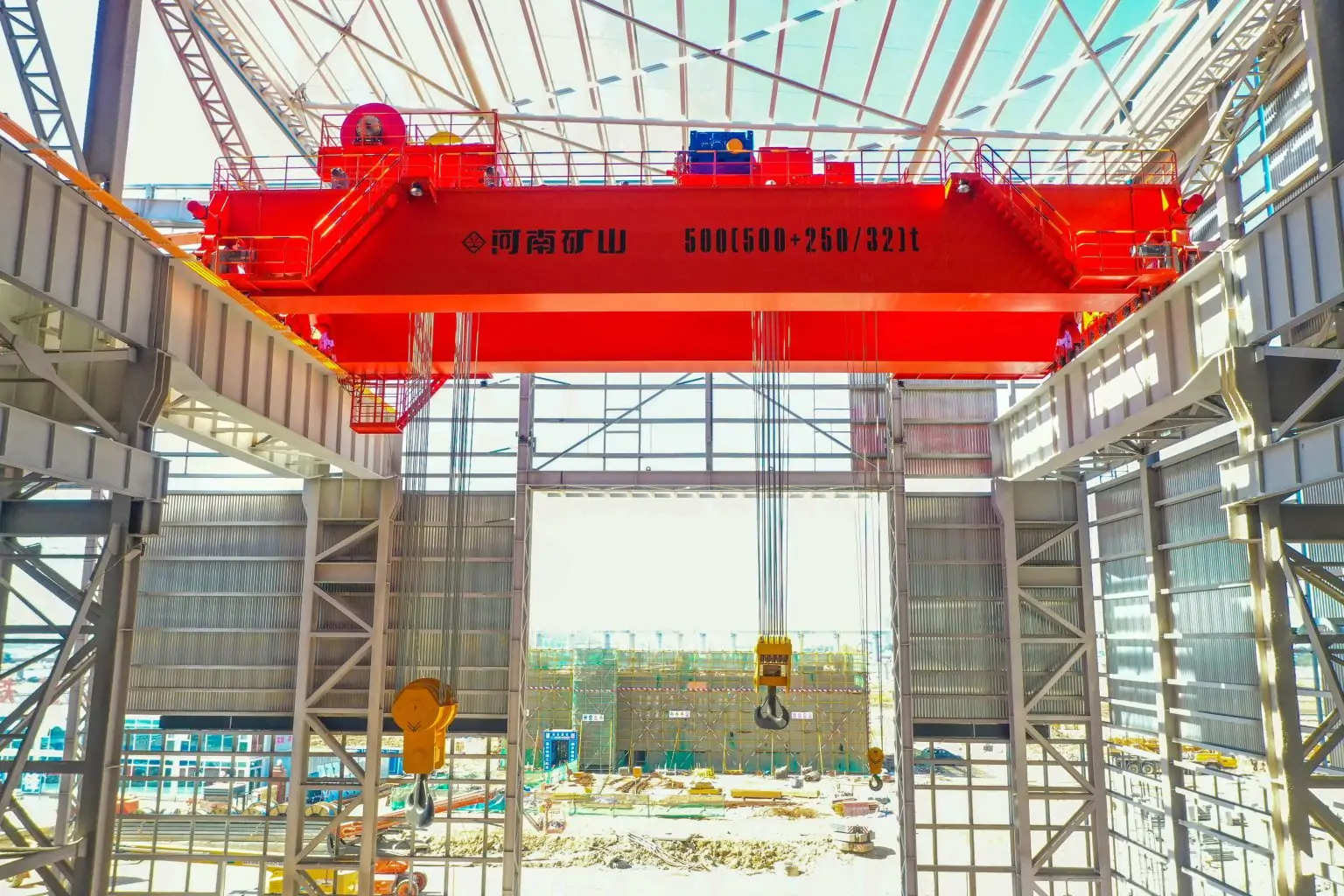

Multi-Point Lifting Crane for Aircraft | Hangar Maintenance & Assembly
The lifting operation in the aviation field is fundamentally different from the lifting operation in ordinary factories. Ordinary industrial Cranes only need to complete the stable lifting and shifting of heavy loads, and there is relatively large room for error. But the aircraft fuselage, wings, engines, landing gear and other core components, most of which are thin-walled precision structure, special materials, force uniformity requirements are extremely high.
Conventional single-point lifting method, it is easy to let the aircraft local stress concentration, triggering fuselage deformation, paint cracking, structural misalignment and other irreversible problems. This is also the aviation maintenance, aircraft assembly project, will give priority to the aircraft multi-point suspension Crane core reasons. Multi-point balanced force, synchronized and smooth operation characteristics, to maximize the protection of the integrity of high-value aviation components.
Mainstream application scenarios of aircraft multi-point suspension cranes
Aviation multi-point suspension cranes are designed for aircraft precision lifting conditions, covering the aircraft production assembly, daily operation and maintenance, core component maintenance and other full-process scenarios, different scenarios have different lifting focus.
Aircraft maintenance hangar
The operation environment of civil aviation and through flight aircraft maintenance hangar is closed and regular, mainly carrying out large fuselage parts replacement, aircraft alignment calibration, large-scale tooling erection, supporting maintenance equipment transfer and other operations.
This kind of scene does not allow the equipment to run shaking, impact, offset, multi-point suspension system can be balanced through the multi-point force, suitable for the whole aircraft large size, high precision maintenance lifting needs, to avoid local pressure and deformation of the fuselage.
Aircraft assembly workshop
Aircraft fuselage segment splicing, wing assembly, tail docking and other assembly processes are the highest precision requirements in aviation production. Single-point lifting cannot fit the long-span and irregular fuselage structure, and docking misalignment is very easy to occur.
The multi-point lifting equipment for aviation assembly with synchronous control system can realize synchronous lifting and fine-tuning of multiple lifting points to ensure the precise fit of each segmented structure and meet the micron-level assembly standard of aircraft assembly.
Engine disassembly and assembly operation area
Aircraft engines, fairings and supporting frames are high-precision core components with concentrated self-weight and precise structure, which cannot be tilted, shaken or bumped during disassembly.
The multi-point suspension Crane can adjust the lifting point position according to the engine structure layout, disperse the local load, and with the micro-speed control function, it can smoothly complete the engine dismantling, shifting and installation operations.
Landing gear and heavy parts maintenance area
Aircraft landing gear and large airborne assembly parts have large self-weight and special structural stress points, so single-point lifting is prone to load offset, resulting in tilting of parts and installation alignment deviation.
Multi-point support lifting can evenly disperse the pressure of components and keep the assembly in a horizontal state, providing stable operating conditions for landing gear maintenance, replacement and debugging.
Aerospace Manufacturing Plant
Aerospace production workshop involves the transportation and assembly of a large number of large thin-walled components, composite fuselage fittings and shaped precision structures. These parts have low hardness and poor toughness, and cannot withstand concentrated pressure and vibration impact.
The suitable aviation lifting Crane can effectively protect the structural integrity of precision aviation components by dispersing the force at multiple points and weakening the lifting pressure, so that the whole process is smooth and impact-free.
Specialized Tooling and Equipment Testing Area
The erection and debugging of aviation maintenance tooling, test rigs and calibration equipment require equipment with synchronized lifting and precise leveling capabilities. Multi-point suspension system can realize multi-point coordinated operation, which is suitable for delicate processes such as tooling alignment, equipment calibration and precision testing.
Core Industry Requirements for Aircraft Lifting Projects
The core of aircraft lifting is not “lifting heavy objects”, but “protecting the aviation structure safely, smoothly and accurately”. All equipment design and selection criteria are centered around the protection of precision components.
Balanced force lifting with multiple lifting points
There is no independent high-strength single-point stress point for core structures such as airplane fuselage and wings. Conventional single-point lifting equipment can overload the local structure and cause deformation damage.
Multi-point lifting mode can spread the total load to multiple pre-set points, which is in line with the mechanical design of the aircraft structure and avoids the risk of structural stress damage from the root.
Smooth operation and precise positioning
Aviation assembly and maintenance operations eliminate start-stop shocks, load shaking, alignment shifts and other problems. Even millimeter-level displacement deviation may lead to assembly failure and component damage.
Qualified aircraft maintenance suspension Crane, support for soft start-stop, frequency speed control, anti-sway control, can realize low-speed micro-adjustment position, suitable for all kinds of precision operation scenes.
Exclusive protection for precise and high-priced structures
Modern aircraft use a lot of composite materials, thin-walled alloys and other lightweight precision materials, impact resistance, pressure resistance is weak, and the cost of equipment is extremely high.
Slight vibration, tilting and localized pressure during the lifting process may result in the scrapping of components, which is the core reason why aviation lifting must adopt special multi-point equipment.
Adaptation to hangar space and architectural constraints
The floor heights, opening spans, top structures and channel layouts of different hangars vary greatly. Some of the old hangars have the problems of insufficient floor height, dense pipelines on the top and narrow operation space.
Multi-point suspension Cranes can be customized according to the site building conditions, track layout, suspension height and equipment size, perfectly adapted to the space constraints of various types of hangars, without occupying the ground operating channel.
Flexible and adjustable lifting configuration
Different parts of the aircraft have different shapes, centers of gravity, and stress points, so the fixed lifting point mode cannot be adapted to the whole process.
The multi-point suspension system can flexibly adjust the distance between lifting points and the proportion of force distribution to meet the lifting needs of different components such as fuselage, wing, engine, landing gear, etc., which is more adaptable.
Highly Stable Synchronized Control System
The core difficulty of multi-point lifting is the coordinated operation of multiple hoists and lifting points. Unsynchronized lifting and lowering of each point will directly lead to tilting of components and imbalance of force, which will cause safety accidents.
Professional aviation lifting equipment is equipped with an exclusive synchronization control system, which can realize the precise coordination of multiple lifting points and maintain the horizontal and stable operation of the components throughout the whole process.
Types of multi-point lifting cranes suitable for aviation scenarios
Combined with different hangar conditions, lifting loads and operational precision requirements, there are a variety of mature multi-point lifting models in the industry, which can be matched to the corresponding aviation scenarios as needed.
Multi-point Suspension Crane
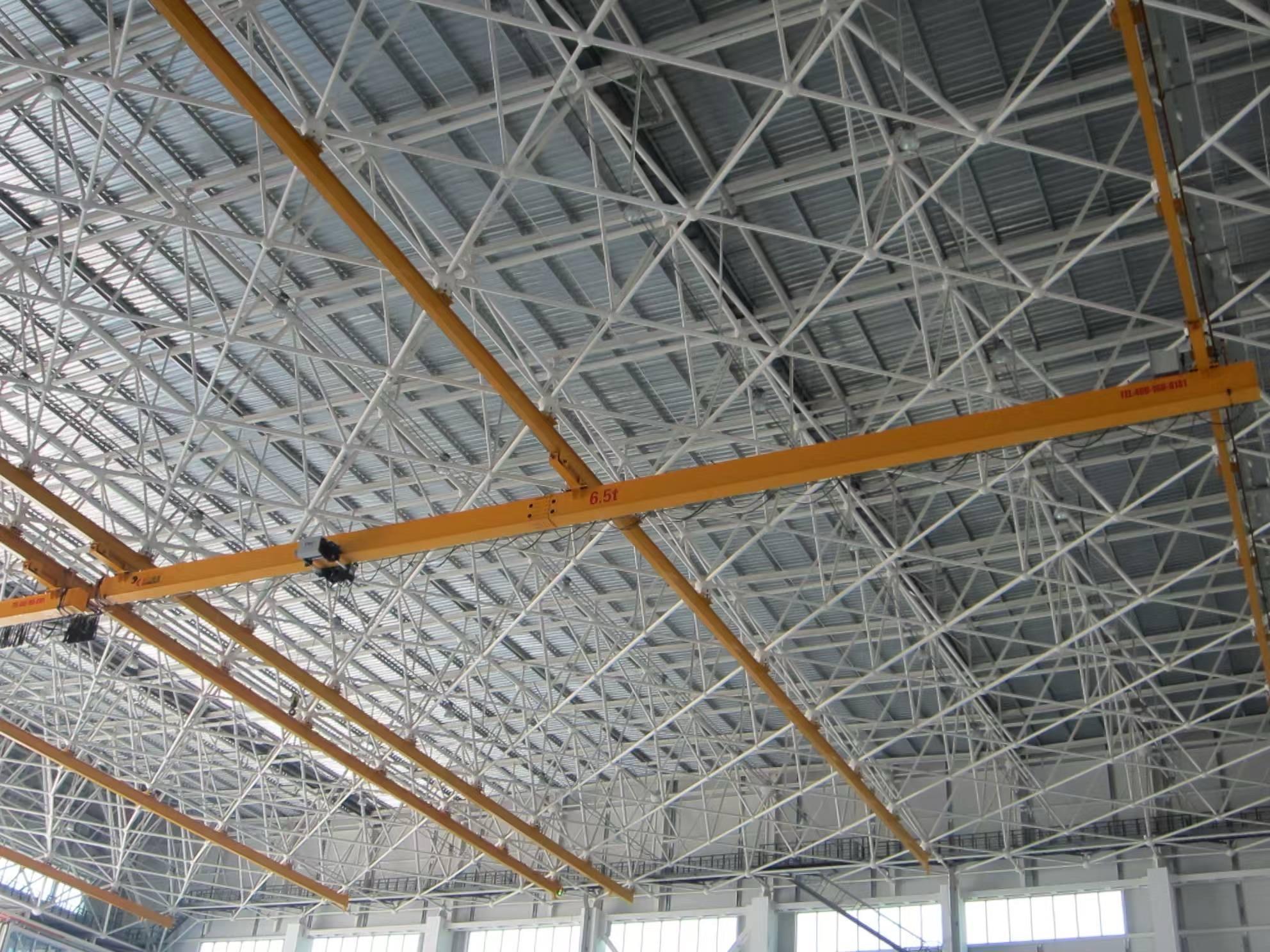
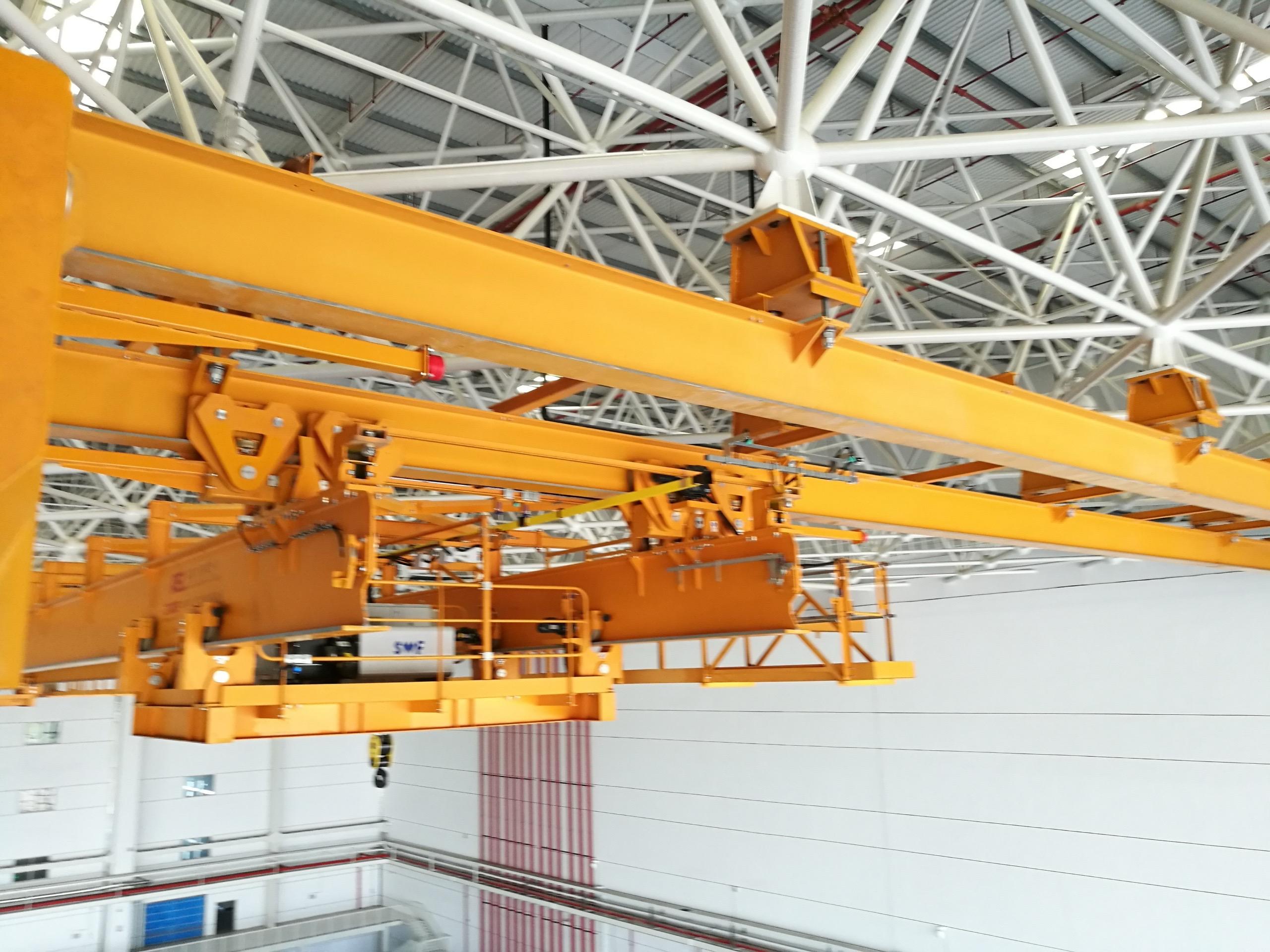
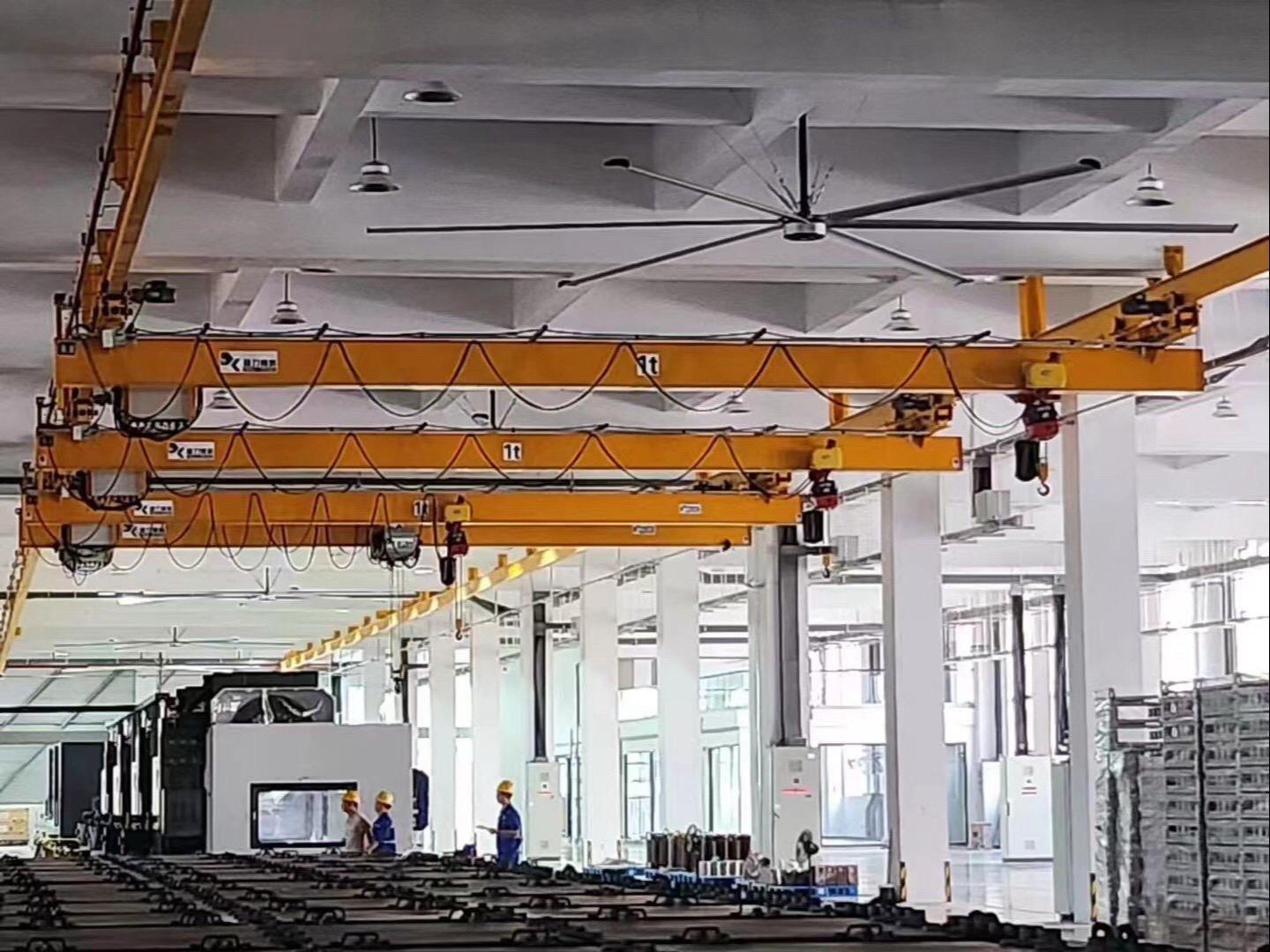
This is the most commonly used core model for aviation maintenance and aircraft assembly. Equipment through the top suspension track with multiple sets of electric hoist, composed of multi-point lifting system, can realize synchronous lifting and panning of multiple lifting points.
The overall self-weight is light, small space occupation, flexible operation coverage, suitable for indoor closed hangar precision lifting operations, is the mainstream choice of multi-point hangar Crane.
Synchronized Hoist Suspension Crane
Designed for old hangars and small maintenance workshops with restricted floor heights, it adopts an under-hanging structure and does not need to occupy the top floor space.
Equipped with frequency synchronization control system, multiple hoists work together precisely to achieve high-precision multi-point lifting in limited space, which is suitable for small and medium-sized aircraft parts overhaul operations.
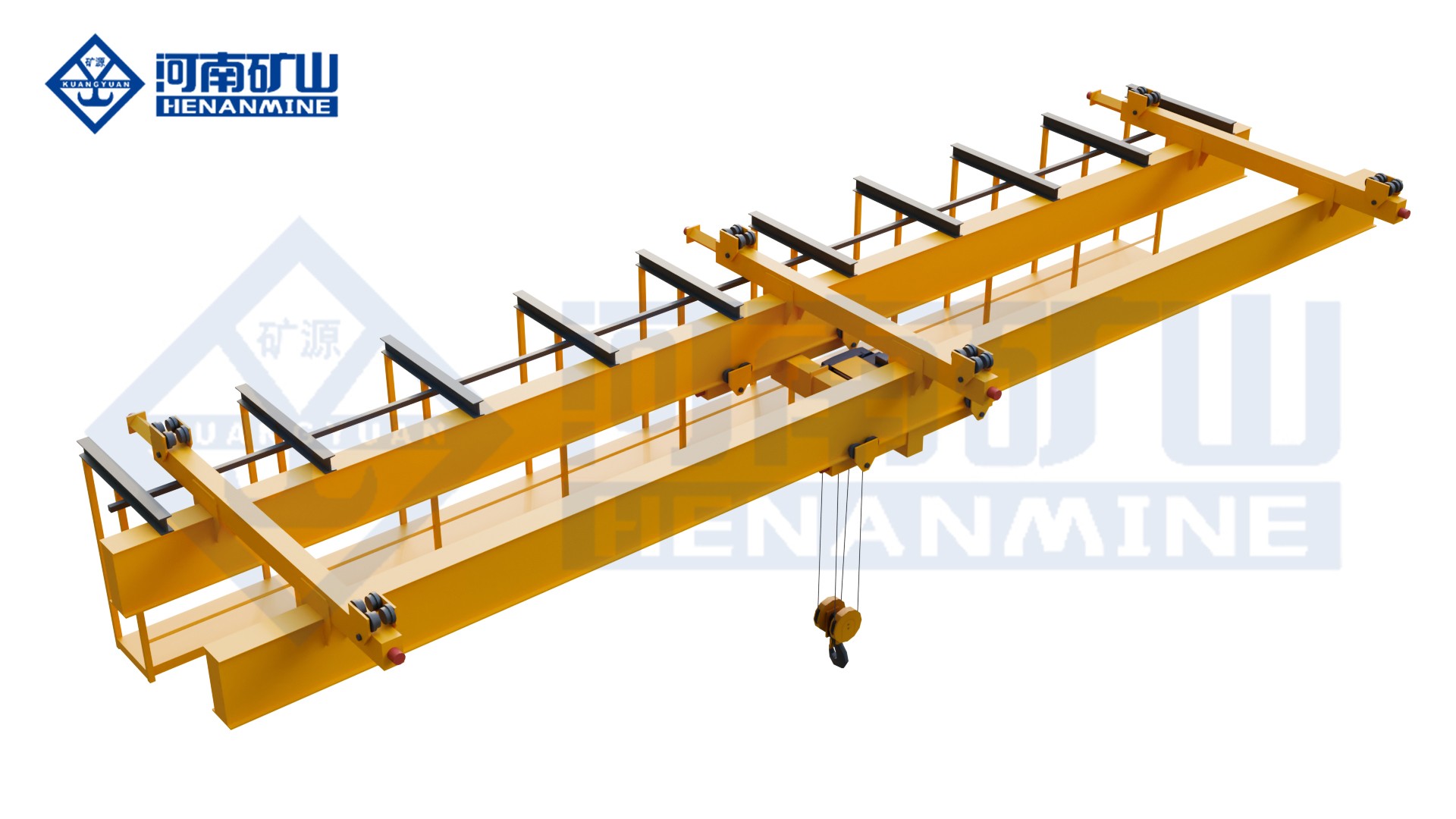
Overhead Crane with Multi-Hoist Configuration
Suitable for heavy-duty precision lifting in large-size aircraft final assembly plants and large-span hangars. The double girder bridge structure has stronger load bearing capacity and can carry multiple independent hoists, which can be combined in multi-point lifting mode as required.
With large span and wide coverage, the equipment can meet the overall lifting and alignment assembly requirements of large-size aircraft body segments and oversized wing structures.
Monorail with multi-point lifting system
Suitable for repetitive lifting operations in fixed processes, such as standardized disassembling and assembling of aircraft engines, and transferring of components at fixed points.
The fixed rail ensures accurate alignment, and with the special multi-point spreader, it can form a standardized lifting process and improve the operational efficiency of aviation assembly line maintenance and assembly.
Aviation Customized Multi-point Lifting Crane
Customized for special models, shaped components, non-standard hangar conditions. According to the aircraft structure force data, customized exclusive lifting point layout, load distribution scheme and synchronous control logic.
At the same time, it integrates exclusive functions such as anti-sway, micro-speed fine-tuning, emergency synchronized braking, etc., which is suitable for all kinds of high-end aviation precision lifting non-standard requirements.
The core reason for prioritizing the use of multi-point suspension cranes for aircraft hoisting
Compared with the traditional single-point Overhead Crane, multi-point suspension equipment in the aviation scene has irreplaceable advantages, fully adapted to the lifting characteristics of the aircraft structure.
More reasonable load distribution, avoiding structural damage
Aircraft do not have high-strength centralized stress points, and single-point lifting will make the local structure bear all the loads, which is very easy to produce deformation. Multi-point lifting can evenly distribute the weight to multiple compliant stress points, which is in line with the original structural mechanics design of the aircraft.
Stress concentration, component deformation, paint damage and other problems are eliminated at the source, maximizing the protection of the original value of aviation equipment.
Lifting stability is greatly improved
The synchronized and coordinated operation of multiple lifting points can effectively inhibit component tilting, twisting, shaking and other problems. Especially for long-span wings, fuselage segments and other shaped parts, the multi-point support can maintain horizontal stability throughout the whole process.
Whether it is static hovering alignment, or dynamic panning and transferring, the equipment runs more smoothly, which is suitable for the demand of precision assembly.
Suitable for long-size and irregular aeronautical components
Aircraft wings, fuselage, tail and other components are long in size, irregular in shape and have a dispersed center of gravity, making it difficult to accurately control the balance of forces in traditional lifting methods.
The multi-point suspension system can adjust the position of the lifting point according to the shape of the component to form an all-round support, which is perfectly suitable for the lifting operation of all kinds of large and irregular aviation components.
Safer and Controllable Operation in Narrow Hangar
Dense equipment inside the hangar, limited operating space, the traditional Crane running inertia, easy to shake, easy to bump accidents.
Multi-point suspension Crane running inertia is small, controllable, with anti-collision, soft braking design, in the narrow indoor space operation is safer.
Meet the needs of high-precision fine-tuning operations
Aircraft assembly, component replacement, tooling calibration and other processes are not just simple lifting and carrying, but also require millimeter-level positional fine-tuning.
Multi-point suspension system supports single-point fine-tuning, overall synchronous adjustment, can accurately complete the component alignment, gap calibration and other fine-tuning operations, which is a function that can not be realized by ordinary industrial Cranes.
Procurement must verify the core technical parameters
The precision of the parameters of the aviation multi-point lifting equipment directly determines the operational safety and assembly quality, and the procurement stage needs to be verified accurately one by one to avoid the adaptability problems caused by the inconsistency of the parameters.
Total lifting tonnage of equipment
Calculate the total load according to the self-weight of the aircraft components, the weight of the special spreader, the weight of the workpiece accessories, while reserving sufficient safety margin.
Strictly prohibit extreme load operation to ensure the stability of heavy-duty lifting and to meet the needs of long-term high-frequency aviation operations.
Single point lifting capacity
The total tonnage does not mean that the equipment is suitable for aviation working conditions, the load capacity of each suspension point and single hoist must be matched with the actual load distribution scheme.
According to the structural stress data of the aircraft, the upper limit of the load capacity of each point is individually approved, so as to avoid local structural damage caused by overloading at a single point.
Number of lifting points
Determine the number of lifting points according to the size, shape, center of gravity distribution, and structural stress criteria of the lifted components. Small precision components are suitable for 2-4 points of lifting, while large fuselage and wing assemblies need 6 or more points of coordinated lifting.
Track Span and Layout
The track span and layout should strictly match the width of hangar, airplane parking position and operation coverage.
Reasonable track layout can maximize the coverage of the operation area, and at the same time avoid the interfering factors, such as plant columns, top obstacles, and maintenance passages.
Effective lifting height
Combined with the hangar height, top structural limitations, aircraft height, maintenance equipment erection height comprehensively approved. It guarantees no collision and no space interference during the lifting and shifting of components.
Multi-point synchronization accuracy
This is the core parameter of aviation multi-point lifting equipment. Multi-point lifting deviation needs to be controlled in a very small range to avoid component tilting and force imbalance.
High-quality aviation equipment can achieve millimeter-level synchronization error, the whole process to ensure that the level of the component is stable, to meet the standards of precision assembly.
Equipment running length
Determined according to the total operating length of the workshop and the transfer distance of the components, the equipment can cover all the assembly and maintenance stations to meet the demand for multi-point operation of the whole machine.
Equipment control mode
Handle control, wireless remote control, centralized synchronized console, precision electronic control and other modes are available. Precision alignment work gives priority to wireless micro-speed remote control, which is convenient for technicians to fine-tune in real time; centralized console control is used for synchronized work of the whole machine.
Operation speed and micro-speed control ability
Aviation lifting does not pursue high-speed operation, but more importantly low-speed stability. The equipment needs to have multi-level frequency conversion speed control function, the regular transit can run at a constant speed, precision alignment can be switched to micro-speed mode, fast and slow switching without impact.
Full set of safety protection configuration
It must be equipped with a full set of safety functions such as overload protection, intelligent anti-swing, soft start and stop, synchronization monitoring, emergency braking, travel limit and so on. Multiple protection mechanisms, all-round avoidance of lifting offset, overload, collision and other types of safety risks.
Aviation multi-point Crane supplier selection criteria
Aviation-specific lifting equipment technology threshold is extremely high, ordinary Crane manufacturers lack experience in aviation conditions, can not meet the demand for precision lifting, selection of suppliers need to focus on verification of the following dimensions.
Verification of aviation-specific lifting experience
Priority is given to manufacturers who are deeply engaged in the field of aerospace, familiar with the structural characteristics of aircraft, aviation lifting specifications, precision operating standards. Distinguish from manufacturers who only produce ordinary industrial cranes, able to accurately match the special needs of aviation scenarios.
Verification of similar aviation project landing cases
Focus on checking the manufacturer in the aircraft assembly, aviation hangar operation and maintenance, engine lifting, aerospace component processing and other areas of real project cases. The more landed cases, the more the adaptability and stability of the equipment has been verified in real life.
Evaluation of professional engineering customization capabilities
High-quality suppliers can independently design exclusive multi-point lifting solutions according to hangar drawings, aircraft models, component stress parameters, and operating procedures, and customize lifting point layouts, synchronized control logic, and equipment parameters, rather than applying common models.
Verification of a full set of professional and technical documents
Regular manufacturers can provide a full set of technical documents such as general drawing of the equipment, synchronization control description, load distribution scheme, electrical schematic diagram, list of core accessories, test report, etc., to meet the needs of acceptance, filing and overseas customs clearance of aviation projects.
Confirm the quality and brand of core parts
Focus on verifying the brand and qualification of core accessories such as motor, reducer, brake, electric hoist, synchronization control system, traveling end beam and so on. High-end compliant parts are the basis for equipment synchronization accuracy, operational stability, and long-lasting durability.
Strict factory inspection system
Before the equipment leaves the factory, it needs to complete no-load test run, full-load load test, multi-point synchronization accuracy test, full-function test, and keep complete testing records to ensure that the accuracy and safety of each piece of equipment meets the standard.
Clearly define the scope of installation and commissioning services
Confirm the manufacturer's service mode in advance, including equipment supply, on-site installation guidance, machine commissioning, synchronization accuracy calibration, personnel operation training, etc., to ensure that the equipment can be put into precision operation directly after entering the site.
Verification of long-term after-sales service and spare parts guarantee
Aviation project downtime loss is very great, manufacturers need to have a fast after-sales response, original spare parts are always available, remote troubleshooting, regular precision calibration capabilities, to ensure that the equipment long-term stable operation.
Prioritize adaptability, not just price comparison
Low-priced general-purpose equipment often lacks precise synchronization, micro-speed adjustment, anti-sway and other aviation-specific features, and cannot meet the demand for precision lifting. Selection needs to prioritize equipment suitability for working conditions, safety stability and control accuracy, taking into account the long-term value of use.
Procurement and selection of high-frequency misunderstanding
A lot of aviation lifting equipment adaptation problems, all from the procurement stage of cognitive bias, these misunderstandings will directly affect the operational safety and equipment life.
Focusing only on the total lifting tonnage of the equipment, ignoring the single-point load distribution and synchronization accuracy, resulting in local stress exceeding the standard and deformation of the components.
The aircraft precision lifting is equivalent to ordinary industrial lifting, direct application of general-purpose Crane equipment, adaptability is seriously inadequate.
Neglecting the synchronization precision parameters of multiple lifting points, the equipment runs out of synchronization, resulting in component tilting and assembly misalignment.
Failure to verify the height of the basement, the top obstacles, resulting in insufficient space after the installation of equipment, running interference.
Failure to specify the form of lifting tooling and lifting point program in advance, the equipment could not match the lifting demand of aircraft components after arrival.
Choosing suppliers with no experience in aviation projects, the program copied the general design, which does not meet the aviation precision operation standards.
Selecting a model purely on the basis of price, sacrificing synchronization accuracy, safety configuration and equipment stability, leaving long-term safety hazards.
Frequently Asked Questions
What is an aircraft multi-point suspension crane?
Aircraft multi-point suspension Crane is a special lifting equipment designed for aviation precision lifting, through the multi-group suspension hoist, multi-point synergistic force structure, with the exclusive synchronization control system, to achieve a balanced, smooth, accurate lifting of aircraft components, mainly used for aircraft maintenance, general assembly, core components transfer operations.
Why must aviation lifting adopt multi-point lifting mode?
Aircraft fuselage, wings and other components are thin-walled precision structures without high-strength single-point stress points. Single-point lifting is easy to cause stress concentration and structural deformation. Multi-point lifting can disperse the load, balance the force, ensure the integrity of the components, and at the same time improve the stability of lifting to meet the demand for high-precision assembly in aviation.
How many lifting points are generally required for aircraft lifting?
There is no fixed standard for the number of lifting points, which is determined by the size, weight, shape and force characteristics of the lifted components. Small parts and engines are commonly used with 2-4 lifting points; large parts, such as large aircraft body segments and wing assemblies, need to be lifted with 6 or more points.
Which is better for aviation operations, a Suspension Crane or an Overhead Crane?
Limited floor height, small hangars, precision fine-tuning scenarios, suspension multi-point cranes are more suitable, occupy less space, flexible operation; large span, heavy load, large-scale complete aircraft lifting scenarios, multi-hoist configuration Overhead Crane has a stronger load carrying capacity and wider coverage, and can be selected and matched as needed.
Besides load capacity, what are the most important equipment parameters?
Multi-point synchronization accuracy is the core parameter of aerial lifting, which directly determines the force balance and assembly accuracy of components. Next are single-point load carrying capacity, micro-speed control precision and anti-sway performance, which are far more important than mere total tonnage.
What technical information do I need to request from the manufacturer before placing an order?
You can ask for a full set of information such as equipment assembly drawings, track layout diagrams, multi-point load distribution scheme, synchronized control instructions, electrical schematic diagrams, list of core accessories, factory inspection reports, safety configuration instructions, etc., for project design docking and acceptance record.
Can the same supplier provide both Crane and specialized lifting equipment?
Professional aerial lifting equipment manufacturers can provide one-stop multi-point suspension cranes, customized aerial lifting gear, special lifting tooling, synchronous control system for a complete set of solutions, equipment and tooling adaptability is higher, and the after-sales system is more unified.
Summarize
The core value of the aircraft multi-point suspension Crane, not in the greater load capacity, but in the precise synchronization control, balanced force distribution and ultimate operational stability, specially adapted to the aviation precision components of the lifting protection needs.
Procurement selection, you need to abandon the selection of ordinary industrial cranes thinking, focusing on the lifting point layout, synchronization accuracy, hangar space adaptability and manufacturers of aviation special engineering capabilities, rather than simply focusing on the tonnage of equipment and procurement price.
Reliable aviation lifting equipment suppliers can not only provide compliant hardware equipment, but also combined with the aircraft model, working conditions require the provision of customized solutions, a full set of technical documents, installation and calibration and long-lasting after-sales support, all-round to protect the safety of aviation lifting operations.
Henan Mine Crane is deeply engaged in the field of aviation-specific lifting equipment, with a wealth of experience in aircraft maintenance, assembly projects, and can be customized to various types of multi-point suspension crane systems, to meet the needs of various types of hangars and aviation manufacturing workshops around the world for precision lifting.
Unsure of the project suitable for multi-point lifting program? Provide the lifting load, lifting point requirements, hangar dimensions and project drawings, and our engineering team will customize the solution for you.