
RTG Crane vs RMG Crane: Which One Actually Fits Your Project?
A single yard crane decision can lock a terminal into the wrong operating model for 20 years. That's the real stakes behind the RTG crane vs RMG crane question, and it's why "just compare the specs" isn't a good enough strategy.
Both cranes lift, move, and stack ISO containers in the yard. Both come in similar capacity ranges. But a rubber-tyred gantry (RTG) crane and a rail-mounted gantry (RMG) crane solve different operational problems, and choosing based on price sheets alone is how terminals end up rebuilding foundations or replacing equipment years ahead of schedule.
This guide breaks down the structural differences, the real cost picture over a full lifecycle, and, more usefully, which crane type actually fits different project profiles, from small inland depots to fully automated mega-hubs.
What Are RTG and RMG Cranes?
Before comparing them, it helps to define each one clearly, since the names get used loosely in procurement conversations.
RTG Crane Definition
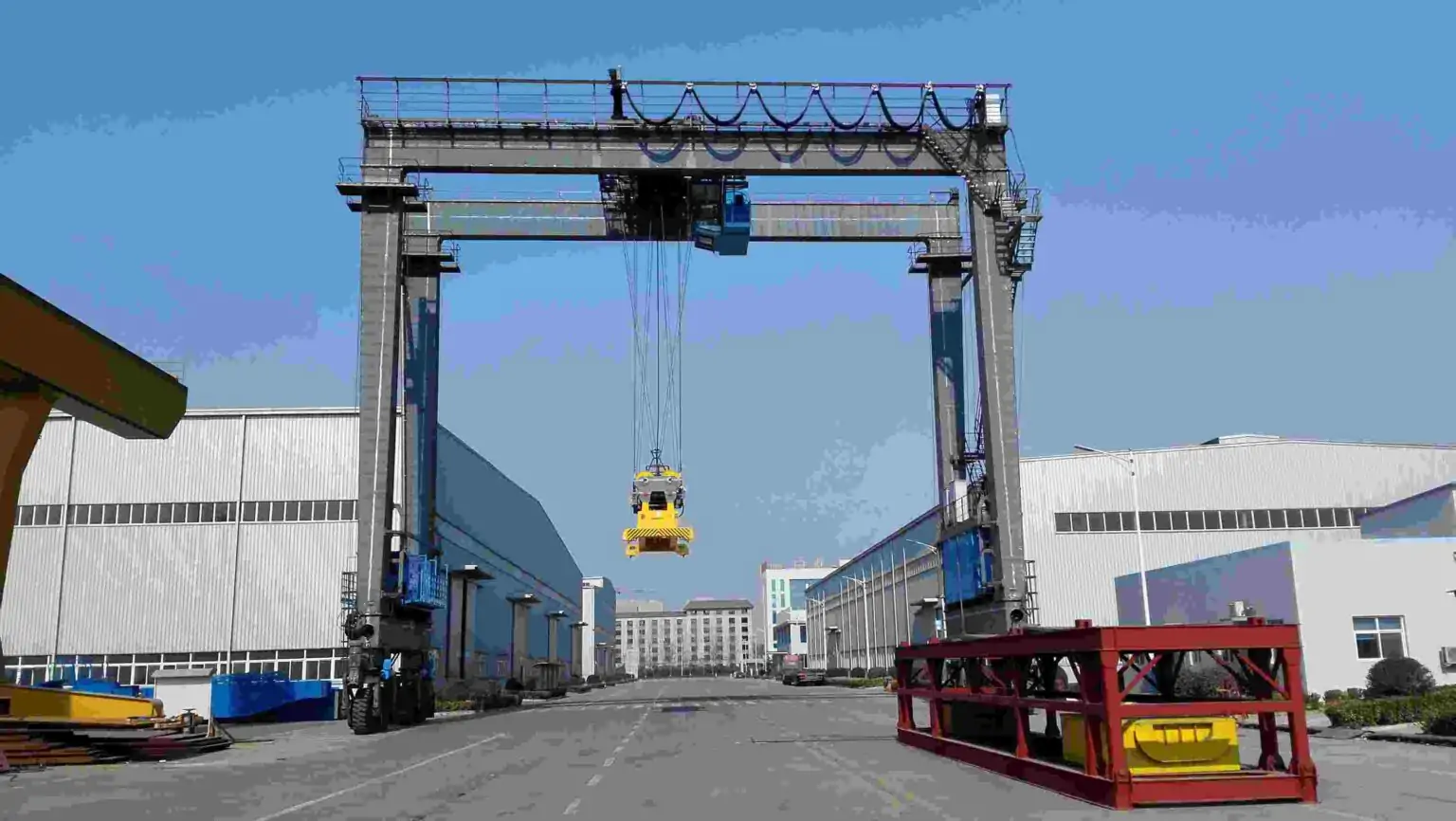
Henan Mine Crane manufactured RTG crane (Rubber-Tyred Gantry crane) is a container yard crane that travels on rubber tires across a paved surface. It straddles a block of container rows, lifts with a spreader-equipped trolley, and can reposition between blocks without any fixed track. RTGs are typically diesel-electric or fully electric, and they remain the default choice for terminals that need to shift yard layout without major civil rework.
RMG Crane Definition
An RMG crane (Rail-Mounted Gantry crane) performs the same lifting and stacking function but runs on steel rails set into a concrete foundation. The fixed path gives it precise, repeatable positioning, which is why RMGs are the standard equipment for automated container yards, rail intermodal terminals, and high-density stacking operations.
Why This Decision Carries 20-Year Consequences
Yard cranes aren't a five-year purchase. Civil works, rail foundations, and even paved yard surfaces are built to last two decades or more, and retrofitting a yard from one crane type to the other mid-life is expensive and disruptive.
That means the RTG vs RMG decision has to account for where the terminal will be in 10–15 years, not just its current throughput. A terminal that buys based purely on today's volume — and ignores its automation roadmap or growth trajectory — often ends up paying twice: once for the wrong equipment, and again for the correction.
Structural and Mechanical Differences
The core distinction between these two crane types comes down to one thing: how they travel.
Travel Mechanism
An RTG crane rides on multiple rubber tires (commonly 8 or 16, depending on configuration) across a flat, load-rated yard surface. This lets it reposition freely between container blocks with no track constraint. An RMG crane runs on precision steel rails anchored in a concrete subbase, which restricts it to a single lane but delivers a far more stable and repeatable travel path.
Drive and Power Systems
RTGs are commonly diesel-electric, though fully electric and hybrid models are increasingly common as terminals work to cut fuel costs and emissions. RMGs are almost always grid-connected, drawing power directly from the terminal's electrical infrastructure rather than an onboard engine. This single difference is the main driver behind the operating-cost gap covered later in this article.
Both crane types share comparable lifting mechanisms: a trolley-mounted spreader, variable-frequency drives for smooth acceleration, and anti-sway control systems to reduce container swing during high cycles.
Span and Stacking Configuration
Span — the distance between the crane's legs — has to clear the full width of the container block plus the truck lane(s) running beneath it, with safety margin on both sides. Stacking configuration is usually described in industry shorthand like "1-over-5" or "1-over-6," meaning the spreader can pass over five or six tiers of stacked containers to reach the top box. Higher stacking density increases yard capacity per acre, but it also raises the bar for anti-sway performance and structural stability — a factor that affects both RTG and RMG specifications, though RMG's rail-guided stability generally tolerates higher stacks more easily.
RTG vs RMG Crane: Full Comparison Table
| Decision Factor | RTG Crane | RMG Crane |
| Travel surface | Rubber tires on paved yard | Steel rails on concrete foundation |
| Yard flexibility | High — relocate between blocks | Fixed — committed to its lane |
| Civil infrastructure cost | Lower — no rail foundation needed | Higher — rail bed, drainage, subbase required |
| Typical travel speed | Slower (tire friction limited) | Faster (steel-on-rail efficiency) |
| Crane moves per hour | Roughly 20–28 moves/hr | Roughly 28–40+ moves/hr with automation |
| Automation ceiling | Semi-automated; full auto needs DGPS/laser positioning | Full automation is standard and easier to integrate |
| Power source | Diesel-electric, hybrid, or electric | Grid-connected electric |
| Lifting capacity | Roughly 35–70 tons | Roughly 30–100+ tons (wider range available) |
| Stacking height | Typically 5- or 6-high | Up to 7- or 8-high on deep-stack models |
| Energy cost per move | Higher on diesel; closer to RMG on electric | Lower — grid power, regenerative braking |
| Best terminal scale | Small to mid-size, evolving layouts | Large, fixed-layout, high-density yards |
| Upfront investment | Lower | Higher |
These figures are industry-representative ranges. Actual performance depends on stack density, truck arrival rate, and terminal operating system (TOS) efficiency.
Cost Comparison: Civil Infrastructure, Capex, and Lifecycle TCO
Cost is where the RTG vs RMG comparison gets misleading if you only look at the purchase price.
Upfront Capital Cost
RTG installations typically cost 40–60% less per lane than RMG, simply because they skip rail foundations and dedicated drainage works — a flat, properly load-rated yard surface is enough. RMG installations require precision rail-bed construction, which raises both the civil engineering bill and the project timeline before the crane ever arrives on site.
Operating Cost Over Time
The picture flips once the cranes are running. Grid-powered Henan Mine Crane Factory supply RMGs typically cost 30–45% less per container move in energy alone compared with diesel-electric RTGs, and rail-guided travel produces less mechanical wear than tire systems, which lowers maintenance frequency.
Most lifecycle cost models show RMG reaching total cost parity with RTG somewhere around 5–6 years of continuous operation — after that point, RMG's lower running costs start outweighing its higher upfront investment. Terminals with throughput below roughly 400,000–500,000 TEU/year rarely reach that crossover fast enough to justify RMG; terminals above 700,000–1,000,000 TEU/year almost always do.
Key takeaway: RTG wins on day-one capital efficiency. RMG wins on long-run cost per move. The right answer depends on how long the terminal expects to operate at scale.
Throughput and Automation Capability
Throughput capacity and automation readiness move together, because automation is what unlocks an RMG's full speed advantage.
Moves Per Hour
Henan Mine Crane Factory supply RTGs typically handle 20–28 moves per hour in manual or semi-automated operation. RMGs, especially in automated configurations, can reach 28–40+ moves per hour, since rail-guided travel removes the positioning uncertainty that slows tire-based systems during high-stack cycles.
Automation Readiness
RMG cranes reach full automation more reliably because rail guidance provides absolute position accuracy without relying on GPS or laser-positioning workarounds. This is why virtually every fully automated container terminal in operation today uses RMG as its yard stacking equipment, integrated directly with the terminal operating system (TOS).
RTG automation is achievable — DGPS and laser positioning systems can bring an RTG close to full automation — but it adds system complexity and cost that often erases the crane's natural cost advantage. For many mid-tier terminals, semi-automated RTG remains a mature, cost-effective middle ground rather than a stepping stone to full automation.
Safety Systems Behind Automated Operation
Whichever crane type a terminal automates, the safety layer looks similar: obstacle-detection radar to identify trucks and personnel under the gantry, gantry skew-correction systems that keep both sides of the structure synchronized to prevent rail or surface gouging, and spreader anti-sway control to keep containers steady during high-speed cycles. These systems matter more as automation level increases, since there's no operator in the cab to catch an edge case visually.
Which Project Type Fits Each Crane?
This is the question most comparison guides skip, and it's the one that actually determines the right purchase.
Seaport Hub Terminals (500,000+ TEU/year)
Large hub ports with high, stable volume and a fixed yard layout are the clearest case for RMG. The combination of high-density stacking, automation compatibility, and lower per-move energy cost compounds in RMG's favor at this scale.
Mid-Size and Regional Ports
Terminals in the 100,000–800,000 TEU/year range, particularly those whose yard layout might still change, generally fit RTG better. Lower civil cost and the ability to reposition blocks without rail rework matter more here than the throughput ceiling RMG offers.
Inland Container Depots and Rail Intermodal Yards
Inland depots with frequent layout adjustments — and facilities handling irregular volumes — favor RTG for its mobility and lower entry cost. Dedicated rail intermodal yards, on the other hand, often lean toward RMG, since they need to align directly with fixed rail tracks for train-to-truck transfers.
Terminals Planning Phased Growth
For terminals expecting to scale from regional to hub status over 5–10 years, the honest answer is often "start with RTG, design for RMG later." That phased approach is detailed in the next section.
The RTG-to-RMG Conversion Path: A Hybrid Strategy
One option most comparison articles leave out entirely: terminals don't have to pick one crane type permanently on day one.
A growing number of mid-tier ports start with RTG cranes and convert specific lanes to RMG once throughput justifies the rail investment. This works when the original RTG lane spacing is specified with future RMG rail gauge in mind — concrete rail foundations can then be added later without relocating existing container blocks.
This hybrid approach lets a terminal:
- Deploy at lower upfront cost while volume is still building.
- Avoid over-investing in automation infrastructure before it's needed.
- Convert individual lanes to RMG incrementally as specific blocks justify the throughput.
- Preserve capital for other terminal investments during the growth phase.
If phased growth is part of the plan, it's worth raising RMG-conversion geometry with your crane supplier before specifying the first RTG units — retrofitting spacing after the fact is far more expensive than designing for it upfront.
Common Procurement Mistakes to Avoid
Terminals that get the Henan Mine Crane manufactured RTG vs RMG decision wrong usually make one of these five mistakes:
- Underestimating wheel pressure.Miscalculated wheel loads on RMG rail foundations can mean six- and seven-figure civil rework bills after installation.
- Ignoring automation compatibility.Even terminals with no current automation plans should reserve positioning and control-system headroom — retrofitting later costs far more than designing for it upfront.
- Skipping future expansion planning.Selecting capacity, stacking height, or duty class for today's volume only, with no margin for 3–5 years of growth.
- Underestimating wind load.Coastal terminals especially need storm anchoring, rail clamps, and wind-speed monitoring built into the spec, not added afterward.
- Choosing on price alone.Underspecified steel, electrical components, or duty class shows up as frequent breakdowns within 3–5 years — and the resulting downtime costs typically exceed the initial savings.
Pre-RFQ Decision Checklist
Before requesting quotes from crane suppliers, confirm you have answers to each of these:
- Annual TEU throughput, including peak-season demand (not just the yearly average)
- Yard block configuration: rows, columns, and truck lane width
- Required stacking height and lifting capacity (including reefer and oversized containers)
- Current and planned automation level (manual, semi-automated, fully automated)
- Terminal operating system (TOS) integration requirements
- Site soil conditions and civil engineering constraints
- Local wind load and corrosion-protection requirements
- Required duty classification (ISO 4301 / FEM working level) for 24-hour operation
- Growth horizon: expected throughput in 5 and 10 years
- Required certifications: CE Declaration of Conformity, ISO 9001:2015, ISO 4301 duty class documentation, and factory load test certificates
Bringing this checklist to your first supplier conversation usually shortens the proposal cycle significantly, since it removes the back-and-forth needed to pin down basic specs.
Frequently Asked Questions
What is the main difference between an RTG crane and an RMG crane?
An RTG crane travels on rubber tires across a paved yard, giving it the flexibility to reposition between container blocks. An RMG crane runs on fixed steel rails, giving it higher positioning accuracy, faster cycle speed, and easier automation, at the cost of yard layout flexibility.
Which is cheaper: RTG or RMG?
RTG is cheaper to install, typically 40–60% lower in civil cost per lane, because it skips rail foundation work. RMG is usually cheaper to operate over time, with 30–45% lower energy cost per move on grid power. Which one is "cheaper" overall depends on throughput and how long the terminal expects to run at scale.
What throughput level justifies switching from RTG to RMG?
Most terminal planners treat 500,000–700,000 TEU/year as the crossover range where RMG's automation and energy savings outweigh its higher civil investment. Below roughly 400,000 TEU/year, RTG flexibility usually delivers the better return.
Can a terminal start with RTG and convert to RMG later?
Yes, if planned in advance. When RTG lane spacing is specified to match a future RMG rail gauge, concrete rail foundations can be added later without relocating existing container blocks.
Which crane type is better for automated container terminals?
RMG is the standard choice for fully automated terminals because rail guidance delivers absolute position accuracy without relying on GPS or laser-positioning workarounds. RTG can reach high levels of automation too, but it requires additional positioning systems that add cost and complexity.
How long do RTG and RMG cranes typically last?
With standard duty-class specification and regular maintenance, both crane types are generally built for a 20–25 year service life. Actual lifespan depends heavily on steel structure design, duty classification, and how consistently preventive maintenance is followed.
Henan Mine Crane Factory Custom
There's no single winner in the RTG crane vs RMG crane debate.What you need depends on your throughput requirements, layout, automation plans and future investment strategies. Selecting the right crane for your operation today will can help you meet your performance metrics, lower lifetime costs and scale for future capacity without requiring a costly upgrade.
Over 20 years in Crane manufacturing experience, Henan Mine Crane offers tailor-made RTG and RMG crane solutions worldwide for all types of ports, rail terminal and container yards. Our experienced engineering team guides you through the complete range of services from project planning, equipment design to manufacturing and technical support.
Thinking of designing a new container yard or refurbishing your existing facilities? Get in touch with us today for professional advice and a tailored crane package to suit your project.