
Wall-Traveling Jib Cranes vs. Pillar Jib Cranes: Layout & Footprint Guide
In industrial scenarios such as workshops, warehouses, and production lines, site space directly determines production efficiency and operating costs.When most companies purchase cantilever cranes, they only pay attention to parameters such as load and lifting speed, ignoring the adaptability of the site, which can easily cause problems such as channel blockage, equipment interference, and inefficient handling.
Wall-mounted and column-mounted cantilever cranes are mainstream station hoisting equipment, which can meet the needs of refined material handling, but the two differ significantly in structure, floor area, installation conditions, operation coverage and adaptation scenarios, which directly affect the space utilization rate of the plant and the rationality of the layout.
This article compares the two types of equipment from the dimensions of floor area layout, installation conditions, operating scope, adaptation scenarios and cost to help companies quickly select types: wall-mounted and column-mounted cantilever cranes. Which one is more suitable for your plant space and production layout?
What Is a Wall-Traveling Jib Crane
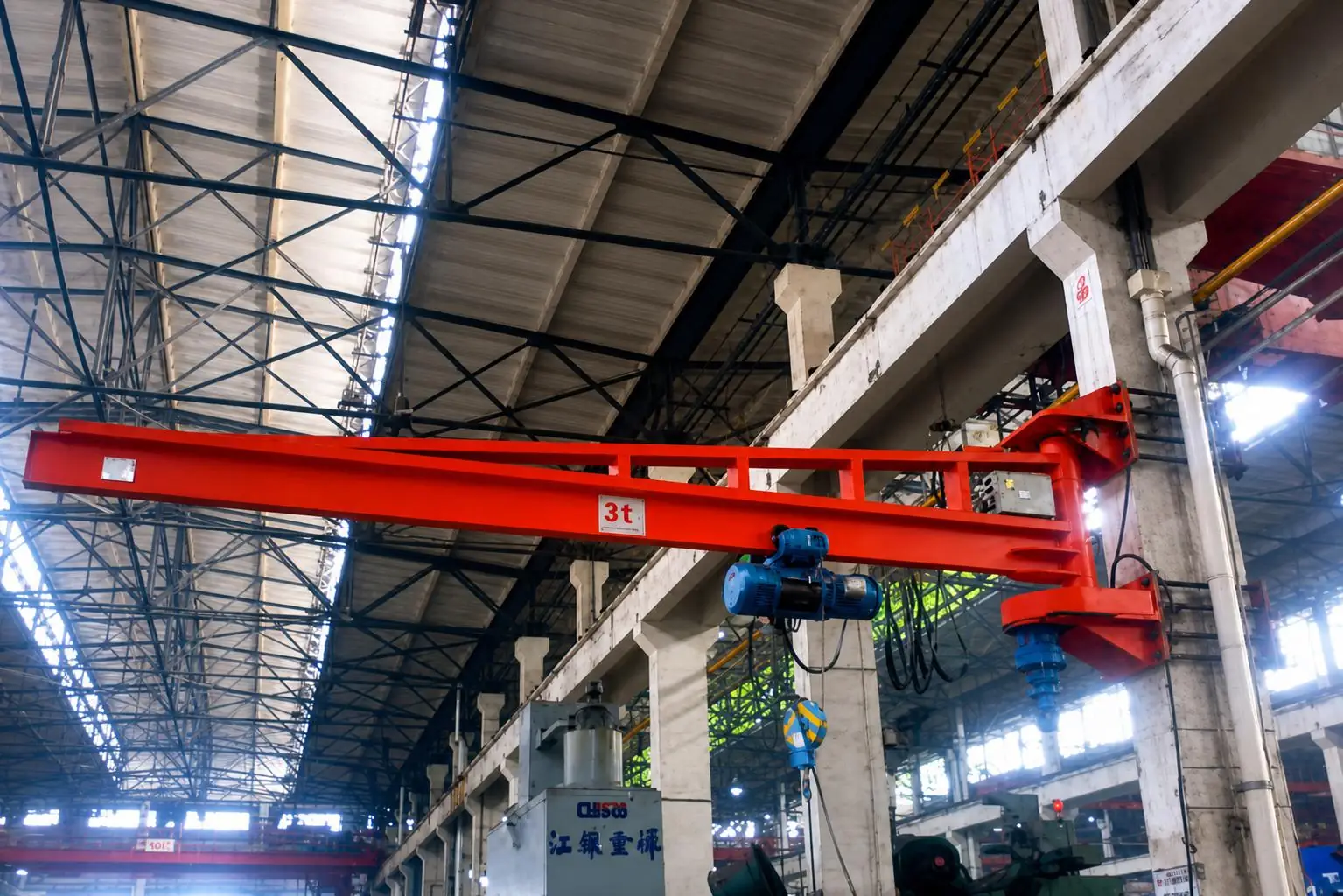
Wall-Traveling Jib Cranes , also known as wall-mounted mobile cantilever crane, is a lightweight space-saving hoisting equipment built on building walls and structural columns. The core advantage is that it does not occupy the effective ground space of the plant at all. It is designed for continuous material handling scenarios along walls and long strip production lines.
The equipment does not require a floor-to-ceiling foundation, relying on rails and brackets for wall-mounted installation, and supports three-dimensional operations of vertical walking, horizontal movement, and vertical lifting.Compared with the traditional fixed cantilever crane, it has a wider operating range, can cover the entire production line and storage area, and is suitable for long-distance, multi-station continuous material transfer.
The overall structure is lightweight and runs smoothly. There is no need to transform the ground foundation, and the original passage and production space of the workshop are preserved to the greatest extent, especially for industrial scenes with compact space and dense workstations.
Standard layout structure
The structure of the Wall-Traveling Jib Cranes is simple and regular, and the various components work together to form a stable and continuous modular operating system. The core composition and functions are as follows:
- Wall/column-type running track: the core walking base of the equipment is fixed to the load-bearing structure of the plant to provide smooth guidance for the longitudinal movement of the whole machine. The length of the track can be customized according to the actual length of the production line.;
- Mobile trolley assembly: integrated cantilever boom and electric hoist structure, can move smoothly along the track, stable carrying performance, can stably carry the operating load of the whole machine, and ensure the long-term smooth operation of the equipment;
- Horizontal cantilever boom: extends outward to expand the scope of operation, provides a horizontal operation channel for the electric hoist, and accurately delineates the coverage area of one-sided operations to effectively improve the coverage of operations.;
- Electric hoist and operating trolley: As the core lifting execution components, it can complete the dual operations of vertical lifting and horizontal precise shifting of materials, with stable operation, accurate positioning, and excellent operating stability.;
- Linear working area: relying on the wall track to build a long strip of continuous working space, it fully covers the production stations along the line, and is perfectly adapted to the uninterrupted material transfer operation scene of the assembly line.
Core application scenarios
With the core advantages of not occupying ground space and supporting long-distance continuous operation, Wall-Traveling Jib Cranes are highly adapted to various industrial scenarios with compact space and stations arranged along the wall. Typical applications are as follows:
- Long automated production lines and assembly lines: it can fully cover multiple stations along the longitudinal direction of the production line, stably complete batch loading and unloading and parts transfer, and efficiently adapt to large-scale continuous production operations.;
- Machining and hardware workshops: suitable for machine tools and various processing equipment arranged against the wall, which can accurately complete the loading and unloading, reclaiming and discharging of workpieces at high frequencies, and adapt to the high-intensity operation needs of the workshop.;
- Space-limited storage workshop: there is no ground occupation throughout the whole process, which does not affect the passage of forklifts and material stacking. It can efficiently complete the lifting, shifting, and regularization of storage materials, and revitalize the small storage space.;
- Wall maintenance and precision assembly stations: support precise fixed-point hoisting, adapt to fine operation scenarios such as equipment maintenance and precision parts assembly, and effectively improve operation accuracy and operation safety;
- Low-rise factory buildings and narrow working passages: relying on wall-mounted installation in the top space, it avoids site restrictions such as the height of the factory building and narrow passages, efficiently activates idle overhead resources and maximizes the use of site space.
What Is a Pillar Jib Crane
Pillar Jib Cranes are independent floor-standing lifting equipment. They do not need to rely on building carriers such as plant walls and steel structures. They rely on independent columns and special concrete foundations to be fixed to the ground. They are completely autonomous localized hoisting equipment.
The core of the equipment consists of a vertical load-bearing column and a rotatable horizontal boom. The whole machine is fixed to the ground, and the hoisting operation is completed through the rotation of the boom, the horizontal movement of the electric hoist and the vertical lifting of the material.The equipment supports 270° or 360° rotation, forming a fan-shaped or circular operating interval around the column, and is specially adapted to the high-frequency hoisting conditions of fixed single-point stations.
Since there is no need to rely on the bearing capacity of the building structure, the installation location of the equipment is not limited by the layout of walls and columns, and can be flexibly arranged in any open area of the plant. It is extremely independent and adaptable. It is the preferred hoisting equipment for open workshops and independent stations.
Standard layout structure
The column-type cantilever crane adopts an integrated floor-to-ceiling structure, with a regular overall layout and strong independence, without the need to attach to the building walls and beams and columns.Its core components and functions are as follows:
-Reinforced concrete independent foundation: the core base for the stable operation of the equipment can effectively carry the weight of the whole machine, offset the overturning torque generated by the boom operation, prevent the equipment from shaking and tilting, and ensure the stable and reliable operation of the whole machine.;
- Vertical load-bearing steel column: The core load-bearing support structure of the whole machine has high rigidity and strength, which can stably carry all the loads of the boom, electric hoist and hoisting materials, and provide structural protection for the safe operation of the equipment.;
- Rotatable cantilever boom: supports multi-angle rotation adjustment, effectively expands the operating radius, covers the surrounding global operating range, and adapts to diverse fixed-point hoisting conditions;
- Electric hoist and walking trolley: the core operation execution unit, accurately complete the vertical lifting and horizontal alignment and positioning of materials, to achieve high-precision and high-efficiency hoisting operations;
- Circular/fan-shaped work area: A fixed and closed dedicated work area is formed with the column as the center, and independent workstations are served in a targeted manner to meet the needs of single-point centralized material handling.
- Rotation angle and equipment parameters
Conventional column cantilever cranes are divided into two rotation modes:
- 270° limit rotation: designed for single-sided operation scenarios such as leaning against the wall and facing the passage, it effectively avoids interference between the boom and the wall and peripheral equipment, adapts to narrow boundary working conditions, and is safe and controllable for operation.;
- 360° global rotation: it is suitable for the open center station of the workshop, supports all-round rotation operations without dead ends, covers a wider range, and flexibly meets the lifting and transportation needs of multi-directional and multi-station.
The mainstream VS-type column cantilever crane has a maximum boom length of up to 10 meters and a rated lifting load of up to 6.3 tons. It fully meets the needs of material hoisting, equipment maintenance, component assembly and other operations in small and medium-sized industrial stations, and is suitable for most conventional workshop working conditions.
Core application scenarios
- Single-point machine tools and assembly stations: suitable for independent machine tool loading and unloading, exclusive assembly station scenarios, can cope with high-frequency single-point hoisting operations, effectively improve station operation efficiency and production beat;
- Equipment maintenance and maintenance scenarios: suitable for maintenance workshops and various maintenance stations, it can accurately complete the disassembly, assembly and hoisting of large parts and equipment, and the maintenance operations are more efficient and accurate.;
- The open central area of the plant: it is adapted to an open station in the center of the plant without wall shelter, not limited by the wall structure, flexible working space and strong scene adaptability.;
- Weak structure plant scenario: For the workshop environment with insufficient wall bearing capacity and no reliable load-bearing structure, it can effectively avoid the limitations of the building structure and carry out hoisting operations smoothly.;
- Collaborative operation of large cranes: it can be linked with bridge carts to assist in the completion of local refined and high-precision hoisting processes, improve the overall hoisting process, and improve the degree of operation refinement.
Wall-Traveling Jib Cranes vs. Pillar Jib Cranes: Key Layout Differences
Difference in ground floor area
The floor area is the core difference between the two types of equipment that affect the layout of the workshop.The Wall-Traveling Jib Cranes adopts a wall-mounted design, with zero ground occupation throughout the process, does not squeeze the passage, station and material stacking space, and only uses the wall and upper space to operate. It is an excellent choice for compact factories and can efficiently activate ground production resources.
Pillar Jib Cranes need to be poured and fixed with a dedicated reinforced concrete foundation. In order to offset the overturning torque generated by the boom operation, the foundation size is usually more than 3 times the diameter of the column, which is much larger than the cross-section of the column body.The foundation will permanently occupy ground space, and it is impassable to pass, stack materials or place equipment in the area. It is only suitable for open operation scenes with sufficient ground space.
Wall and building structure requirements
Wall-Traveling Jib Cranes need to rely on reliable building load-bearing structures such as load-bearing walls and steel columns. The bearing capacity must be verified before installation. It is strictly prohibited to install on lightweight, hollow non-load-bearing walls. Insufficient wall bearing capacity needs to be reinforced in advance to avoid safety risks such as structural deformation and equipment shedding.
The column-type cantilever crane is completely independent and does not need to be attached to any building structure. It can be installed by relying only on ground carrying and customized foundations. It is suitable for ordinary concrete floors. It is a safe and optimal choice for factories with old structures and no load-bearing walls, and the site has a wider range of adaptations.
Differences in job coverage
The operating forms and adaptation scenarios of the two equipment are significantly different.The Wall-Traveling Jib Cranes can walk along the track and rotate with the boom to form a linear long working area. The coverage can be extended as needed. There are no blind spots and no breakpoints on the whole line, and it is suitable for continuous operation of multiple stations on long-term production lines.
Pillar Jib Cranes rely on fixed column rotation operations to form a circular/fan-shaped point-shaped operation area with a fixed and limited coverage. They are only suitable for local single-point and independent station hoisting operations, and do not support long-distance continuous transportation.
Headroom height and vertical space requirements
The Wall-Traveling Jib Cranes can be installed in the upper part of the plant, with low requirements for floor height and suitable for low-rise plants.The installation height of the equipment is adjustable, which can avoid all kinds of top obstacles, make full use of vertical space, and increase the effective lifting height.
The vertical space planning of Pillar Jib Cranes is more complicated. It is necessary to comprehensively consider the total height of the column, the height of the boom and the spacing between the tops, and reserve sufficient vertical headroom to avoid equipment interference. The height of the plant floor and the regularity of the top space are more demanding.
Footprint Comparison: How Much Space Does Each Crane Need?
Wall-Traveling Jib Cranes
The wall-mounted model has no physical ground area, and the core space consumption is concentrated in the wall and the upper air area, which has no interference with ground operations and traffic.The equipment track can be customized according to the length of the production line, with a maximum load of up to 5 tons and a maximum boom length of 10 meters. There is no hard limit on the length of the track, which can be adapted to the layout of the ultra-long production line.
The only space that needs to be reserved is the operation safety gap: it is necessary to ensure that there is a safe distance between the end of the boom and the opposite wall, equipment, and shelves to prevent collisions during operation, and the overall space utilization rate far exceeds that of floor-standing equipment.At the same time, the equipment can be superimposed with the bridge crane up and down, without interfering with each other, and the space of the plant can be used in a double layer.
Pillar Jib Cranes
The actual footprint of the column-type model is much larger than the size of the column visible to the naked eye, and the core contains two major sections:
- The reinforced concrete foundation occupies a permanent area, and the foundation needs to be deeply buried and reinforced, occupying a fixed ground area and cannot be reused.;
- In the safe area of rotary operation, all equipment, materials, and obstacles need to be emptied within the rotation range of the boom to form an exclusive no-occupation operation area.
If the foundation construction is not up to standard and the floor area is insufficient, the equipment will shake violently during operation, and there will even be a risk of overturning. Therefore, the foundation size and rotation gap must be reserved in strict accordance with the equipment parameters during planning, and the cost of occupying ground space is higher.
Safe working interval and material path
The physical footprint of the equipment is equal to the space required for actual operation. The layout planning of both types of cranes needs to consider the dynamic operating space.In actual operations, it is necessary to reserve the safety clearance of the material swing, the operating space of the operator, and the range of activities of the electronic control handle, while avoiding pedestrian passages, forklift routes, safety exits, peripheral machinery and equipment, and shelves.
Especially for Pillar Jib Cranes, the material swing range is large during 360° rotation operations, and safety gaps must be reserved in all directions; wall-mounted models have regular linear operation trajectories, controllable material swing, and higher dynamic space utilization.
Coverage Comparison: Linear Travel vs. Fixed-Point Rotation
In order to more intuitively distinguish the operating characteristics of the two types of equipment, the following table of core parameters is used for a comprehensive comparison:
| Contrast dimension | Wall-Traveling Jib Cranes | Pillar Jib Cranes |
| Core exercise method | Track longitudinal walking + boom rotation | Fixed-point rotation of boom only |
| Job coverage form | Long linear rectangular area, can extend infinitely | Circular/fan-shaped fixed area, limited range |
| Floor area | Extremely low, zero ground occupation | Medium, requires exclusive basic land area |
| Wall structure dependence | Extremely high, must rely on load-bearing structure | Extremely low, completely independent landing |
| Basic construction requirements | No ground foundation is required, only the wall is fixed | Reinforced concrete must be made to strengthen the foundation |
| Rotation angle | ≤180°, single-sided operation | 270°/360° global rotation |
| Adapt to the scene | Multi-station against the wall, continuous operation of long production lines | Independent stations, fixed-point operations in the central area |
| Relocation flexibility | Poor, fixed track, difficult to transform | Generally, it can be shifted but the foundation needs to be re-made |
| Adaptability to bridge cranes | Excellent, no interference in upper and lower layered operations | Good, can be adapted to layered operations |
How to Choose Based on Facility Layout
Choose a Wall-Traveling Jib Crane
- Suitable for low-rise factories: The upper installation design adopts a fit-type upper installation design to efficiently use the idle air resources of the factory to maximize the effective lifting height. Without the need to transform the structure of the factory, it can be adapted to restricted work sites such as low-rise and small headroom.
- Suitable for compliance plants: it can be stably installed on walls and steel columns with load-bearing standards and strong structures, with uniform force, stable load-bearing, and high operating safety factor. It can be stably adapted to various standardized industrial plant operating conditions for a long time.
- Suitable for stations along the wall: it is perfectly adapted to the linear arrangement scene of workshop equipment and storage shelves against the wall, relying on the wall track to achieve full-line station coverage, which can meet the needs of multi-point, high-frequency, continuous hoisting and material transfer, and deeply fit the production mode of the assembly line against the wall.
- Support long-distance transfer: break the limitations of traditional cantilever crane fixed-point operations, adapt to long vertical production lines, support continuous material transfer across stations and long distances, smoothly connect various production processes, and greatly improve the efficiency of material flow and production beat of the entire line.
Choose a Pillar Jib Crane
- Single-point independent operation: the equipment is aimed at a single assembly, maintenance, loading and unloading station at a fixed point, without the need for long-distance transfer of materials, the scope of operation is concentrated, and the working conditions are single and clear.
- The wall conditions of the plant are limited: The plant has no load-bearing wall, and the building structure has aging problems. It does not have the conditions for mounting and installing various wall-mounted lifting equipment, and cannot rely on the wall to achieve lifting operations.
- Flexible and controllable station layout: The production site has high requirements for equipment layout flexibility, and independent equipment is required. The position can be freely adjusted according to the production process adjustment and station optimization needs, and it is not subject to the constraints of the wall structure of the plant.
- All-round operation without dead ends: station operations need to achieve 360° global hoisting coverage, which can complete multi-angle hoisting, flipping and turnover of materials, and adapt to the needs of multi-dimensional and full-angle production operations.
Common Layout Planning Mistakes to Avoid
- Most enterprise equipment planning only accounts for static land area, ignoring the dynamic space of equipment rotation, material swing, and personnel operation, resulting in restricted production operations and equipment interference.The layout needs to be designed according to the full operating envelope, with a safety margin reserved to adapt to the deformation of equipment and material shaking requirements under full load conditions.
- Ignoring the verification of the bearing capacity of the structure and foundation: The bearing capacity of the wall hanging wall and the construction of the column hanging foundation have not been verified, and there are major safety risks.It is strictly forbidden to install wall hanging on old and lightweight walls, and the foundation of column hanging needs to be standardized reinforcement pouring and standardized maintenance to avoid the risk of equipment overturning and structural damage.
- Underestimate the effective operating coverage of the hook: The selection only refers to the rated operating radius, and it does not fit the actual loading and unloading station, resulting in incomplete coverage of the hook and secondary handling costs.It is necessary to match the parameters of the boom in combination with the layout of the on-site station to ensure full coverage of hoisting and no blind spots in operation.
- Ignore on-site obstacles and interference: obstacles such as roof beams, ventilation ducts, lighting fixtures, shelves, equipment racks, and plant doorways will limit the scope of equipment operation.Before layout, it is necessary to thoroughly investigate on-site obstacles, optimize the installation height, boom length, and rotation angle of the equipment, and avoid interference with operations.
- No equipment maintenance space is reserved: the hoists, electrical systems, bearings, rails, and connection fasteners of the two types of cranes need regular maintenance and maintenance.When planning the layout, it is necessary to reserve exclusive maintenance space to ensure that maintenance personnel can operate normally, so as to avoid difficulties in the later maintenance of the equipment, the accumulation of faults, and the impact on the service life.
Cost and Installation Considerations
Wall-Traveling Jib Cranes
The core costs are concentrated in track customization, structural reinforcement, and electrical system installation.If the original building structure is up to standard, no additional reinforcement is required, and the installation cost is low; if the wall carrying capacity is insufficient, the steel structure reinforcement cost needs to be increased.
The advantage of the equipment is that the expansion cost is low, the track can be directly extended to expand the scope of operation, no need to add a new foundation, and the later transformation is flexible.At the same time, there is no ground foundation maintenance cost, and the long-term operation and maintenance cost is lower.
Pillar Jib Cranes
In addition to the cost of the equipment body, it also includes construction costs such as foundation excavation, steel bar laying, concrete pouring, and maintenance, and the installation cycle is longer.The quality of basic construction directly determines the stability of the equipment. If the construction is not up to standard, the equipment will be prone to shaking, loose bolts and other problems in the later stage, which will increase maintenance costs.In addition, the cost of equipment relocation is extremely high, and the foundation needs to be re-constructed for displacement, and the overall renovation cost is much higher than that of wall-mounted equipment.
Overall, the selection of equipment cannot only look at the initial purchase price. It is necessary to integrate installation costs, operation and maintenance costs, transformation costs, and site adaptation costs to choose the plan with the highest comprehensive price ratio.
Safety and Design Considerations
The installation and operation of the two types of cantilever cranes must strictly abide by industry safety regulations to ensure the stability of equipment operation and the safety of personnel operation in all directions. The core compliance requirements are as follows:
- Standardize load operations: strictly follow the rated load standards of the equipment, and overload and partial load operations are strictly prohibited.The carrying capacity of the equipment will decrease with the increase of the working radius. The load parameters of the corresponding working conditions need to be checked before the operation to prevent illegal operations.
- Regular special inspections: differentiated implementation of equipment maintenance inspections, wall-mounted cranes need to regularly check the fastening status of the wall base, operating track and bracket to prevent hidden dangers of structural loosening; column cranes need to normalize the detection of foundation settlement and the vertical accuracy of the column to ensure the stable operation of the equipment.
- Abide by industry standards: the whole process of equipment design, processing and on-site installation must comply with AISC, OSHA, and ANSI related industry specifications to ensure that the use of equipment is in compliance and controllable throughout the process.
- Perfect safety protection: the equipment is equipped with safety devices such as limit switches, emergency braking, and overload protection as standard to avoid operating risks in all directions; for harsh working conditions such as dust and humidity, it is necessary to do a good job of waterproof and dustproof protection of the electrical system to improve the operating stability of the equipment.
- Reserved safety zones: Sufficient safety operation gaps need to be reserved during equipment layout and operation. It is strictly prohibited for personnel, equipment and materials to be stacked in the operation area of boom rotation and material lifting to eliminate the risk of interference and collision.
Conclusion
There are no absolute advantages and disadvantages between wall-mounted and column-mounted cantilever cranes. The core of the selection is to adapt to plant conditions and operating scenarios.The wall-mounted type relies on the installation of the building structure, saves space, and is suitable for compact factories and assembly lines against the wall; the column-mounted type is independently installed and can be rotated 360°, which is suitable for open workshops and independent stations without load-bearing structures.
Enterprise selection should not only compare single parameters such as price and rated lifting weight. It is necessary to synthesize plant conditions, equipment parameters, operation frequency and future layout, combined with on-site survey and evaluation, to avoid space waste, restricted operations, late transformation and other issues, and achieve the best match between safety, efficiency and cost.
Henan Mine Crane can customize suitable cantilever cranes and material handling solutions according to customer plant structure, station layout and hoisting needs, and provide full-process supporting services to help customers efficiently use the site and build a stable and efficient handling system.