
How to Select a Low Headroom Overhead Crane for Low-Clearance Buildings
The same problem is often encountered in the renovation of old factories, low-rise warehouses, and assembly workshops. The clearance at the top of the plant is insufficient, the standard bridge crane cannot be installed, and the hook cannot reach the operating height. Material hoisting can only rely on manual or simple equipment, which slows down the efficiency of the entire production line.Low headroom overhead crane is specially designed for buildings with restricted floor height. It compresses the vertical space occupied by the equipment itself through a flat structure. Without removing the roof and raising the roof, it can meet the lifting needs under limited headroom conditions.
Why Low Headroom Overhead Crane Are Needed
Limited building clearance
A large number of stock factories, steel structure warehouses and assembly workshops have limited building headroom. Many old factories were not reserved for the installation of lifting equipment when they were built, and various pipelines and trusses under the roof further compressed the vertical available height.The hoist and trolley structure of ordinary bridge cranes are themselves of large height, and the lifting height of the hook limit after installation is insufficient to complete the hoisting of molds, workpieces, and equipment.The cost of rebuilding the plant or raising the roof is extremely high, and the construction period is long, which seriously affects the production plan.As a low-cost renovation solution, Henan Mine Crane Factory supply Low headroom overhead crane does not need to change the main structure of the plant and is directly adapted to the existing low-rise building space. It is a mainstream lifting solution in scenarios with restricted floor height.
Maximizing lifting height
The core value of Low headroom overhead crane is to squeeze out more effective lifting heights in a fixed plant height.The traditional electric hoist for driving is suspended under the main beam, which will take up a lot of vertical space, leaving the stroke of the hook greatly reduced.The low headroom overhead crane embeds the hoist into the main beam or adopts a partial hanging structure to compress the upper part of the whole machine. Under the same plant clearance conditions, the effective lifting height is 0.3-0.5 meters higher than that of ordinary cranes.For mold disassembly and assembly, heavy-duty workpiece stacking, equipment maintenance and other working conditions, the extra lifting height determines whether the lifting task can be successfully completed, helping enterprises to make full use of the vertical space of the plant and release production capacity.
Improving workspace efficiency
If a workshop with a restricted floor height cannot install a suitable vehicle, it can only rely on forklifts, manual hoists or manual handling of materials. The handling route is limited, the operation speed is slow, and there are still personnel safety risks.The Low headroom overhead crane covers the horizontal working area of the workshop, and the materials can be hoisted directly above the station, reducing the passage occupied by ground transportation, and freeing up the floor space of the workshop for equipment and semi-finished products.Stable hoisting capacity simplifies the material flow process, reduces workpiece collision damage, improves the turnover efficiency of the entire production line, while reducing the risk of work-related injuries caused by manual handling, and optimizes the overall operation layout of the workshop.
What Is a Low Headroom Overhead Crane ?
Basic design features
Low headroom overhead crane belongs to a special branch of bridge cranes. The core design idea is to reduce the vertical space occupied by the whole machine.The main optimization focuses on the cross-section of the main beam, the structure of the electric hoist and the arrangement of the trolley. The biased and embedded low headroom hoist is used to compactly arrange the hoist mechanism on the side of the main beam or between the webs of the main beam, which no longer takes up a lot of space under the main beam.Supporting lightweight end beams and ultra-thin trolley structures, the height of the whole machine is lowered under the premise of ensuring structural strength and load safety.The equipment can run vertically along the tracks on both sides of the plant, and the hooks can be raised and lowered. At the same time, it supports standard safety functions such as frequency conversion speed regulation and limit protection, taking into account the compact structure and operational stability.
Low headroom vs. standard cranes
The electric hoist of the standard bridge crane is suspended on the lower side of the main beam. The height of the whole machine is large and the clearance requirements of the plant are high. It is suitable for new factories with sufficient floor height.The Henan Mine Crane Factory supply Low headroom overhead crane re-arranges the position of the hoist and trolley, compresses the height of the equipment itself, and obtains a larger hook stroke at the same building height.The two are consistent in terms of rated load and safety specifications, the difference is the space occupied.The standard crane has a simple structure and low procurement cost, but the short plant cannot be landed.The structural design of the low headroom overhead crane is more precise, which can be adapted to low-rise spaces and is suitable for the renovation of old factories. The disadvantage is that the degree of customization is higher, and the design of the preliminary plan requires accurate survey of the size of the site.
Common crane configurations
Low headroom overhead crane has a variety of mature structural configurations, which can be flexibly selected according to the load-bearing, span, and tonnage requirements of the plant.According to the number of main beams, it is divided into single-beam and double-beam versions.According to the operation mode of the trolley, it is divided into two categories: upper rail type and lower hanging type.The single-beam model has light weight and low load-bearing pressure on the track of the plant, and is mostly used for light-duty operations of small and medium tonnage.The double-beam model has a stronger carrying capacity and better structural rigidity, which is suitable for heavy-duty and high-frequency hoisting.The bottom-mounted crane is directly suspended on the lower flange of the roofing I-beam, and does not require column legs.The walking mechanism of the upper rail crane is placed on the top surface of the track, which is suitable for large-span and large-tonnage working conditions. Each configuration corresponds to a specific headroom and load scenario.
Key Factors When Choosing a Low headroom overhead crane
Available headroom
Available headroom is the first core parameter of selection, and many project failures are due to headroom measurement errors.When measuring, you can't only measure the distance from the ground to the lowest point of the roof. Obstacles such as roof trusses, ventilation ducts, lighting lines, and fire-fighting ducts need to be deducted to obtain the effective vertical height that the crane can use.It is also necessary to reserve a safety gap to avoid collision with the top components when the crane is running.Technical personnel need to record the overall height of the main beam, trolley, and hoist at the upper limit at the same time, calculate the maximum lifting stroke of the hook, and confirm whether it can meet the height requirements of the workpiece hoisting. This step must be measured on-site, and the theoretical data of the plant drawings cannot be directly used.
Lifting capacity
The rated lifting weight needs to be determined according to the maximum lifting weight of the workpiece in the workshop, and a safety margin is reserved, and long-term overload operation is strictly prohibited.The selection of the type should not only look at the maximum single load, but also consider whether the workpiece has a spreader and fixture, and the weight of the spreader should also be included in the total load.Under light load conditions, a 1-20 ton low headroom single girder crane can be selected.Double-beam models are preferred for heavy-duty workpieces and frequent hoisting scenarios.If you often operate close to the rated load, it is recommended to increase the tonnage selection of the first gear to avoid the long-term deflection and deformation of the main beam under high load.At the same time, it is confirmed that the plant track, cow leg or roof steel structure can withstand the wheel pressure load caused by crane operation and meet the load-bearing requirements.
Span and lifting height
Span refers to the distance between the centerline of the crane track on both sides of the plant, which directly determines the design plan and manufacturing cost of the main beam.In small-span working conditions, the main beam has light weight and low difficulty in selection.For large spans, the stiffness of the main beam needs to be checked to prevent excessive deflection under full load.The lifting height is the effective stroke from the lowest position of the hook to the highest position, and it should be calculated comprehensively in combination with the workpiece size, stacking height, and tooling height.When purchasing, there are three concepts: the total height of the building, the height of the crane itself, and the effective lifting height.The larger the span, the more difficult it is to design the structure of the low headroom. The manufacturer needs to combine the comprehensive simulation of span, load, and headroom to issue a customized main beam plan.
Duty cycle and frequency
The working level (working system) represents the frequency of crane use, which is an indicator that cannot be ignored in the selection of types, and cannot only rely on the selection of tonnage.Low-frequency use, small number of hoisting times per day, intermittent operation, you can choose A3 light-grade model.Continuous production workshops, high-frequency hoisting throughout the day, and circular hoisting of workpieces require A5 or even higher working-level equipment.High-level cranes use thickened main beams, wear-resistant wheels, strengthened deceleration mechanisms and motors to withstand repeated start-stop shocks.If low-level equipment is selected for high-frequency working conditions, it will accelerate component wear and frequent failures, greatly shorten the service life of the whole machine, and bring safety risks and high maintenance costs.
Operating environment
The operating environment directly affects the material, protection level and electrical configuration of the Low headroom overhead crane.Standard coating and electrical protection can be used in ordinary dry assembly workshops.There is dust and metal debris in the metal processing workshop, and the motor and electric control box need to be dust-proof and sealed.Anti-corrosion treatment should be done in chemical and humid environments, and anti-rust coatings and moisture-proof electrical components should be selected.Low-temperature workshops require low-temperature special lubricants and cold-resistant cables.At the same time, pay attention to whether there are flammable and explosive media on the scene. This kind of scene requires an explosion-proof low headroom lifting system.Inform the manufacturer of the environmental parameters in advance to avoid problems such as late electrical failures and structural corrosion, and ensure the long-term stable operation of the equipment.
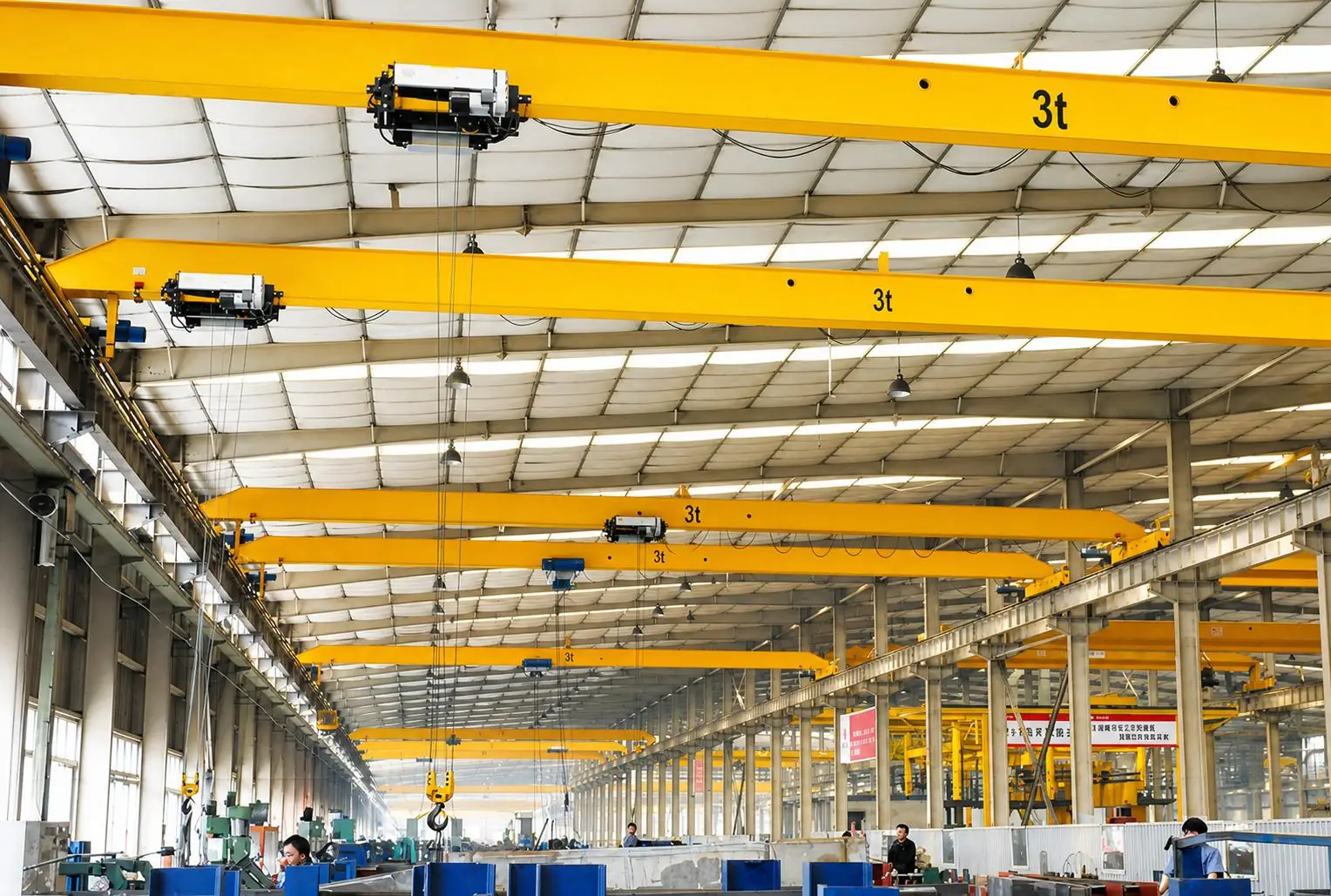
Types of Low headroom overhead cranes
Low headroom single girder cranes
Low headroom single-beam bridge crane is the most commonly used model in low-rise factories. A single box-shaped main beam is matched with a partial-hanging low headroom electric hoist. The overall weight is light, the pressure on the track structure of the plant is low, and the procurement and installation costs are more advantageous.The rated load is mostly 1 ton to 20 tons, which is suitable for intermittent operations of small and medium tonnage such as mold disassembly and assembly, parts handling, and equipment maintenance.The cross-section of the main beam has been optimized for compression height, and the hoist is arranged on one side of the main beam to save vertical space.This model has a short installation period and simple maintenance. It is suitable for renovation projects of old factories with small span and medium hoisting frequency. It is also the most cost-effective basic solution in scenarios with tight headroom.
Low headroom double girder cranes
The low headroom double-girder bridge crane is equipped with two parallel main beams, and the lifting trolley walks on the top track of the main beam, with stronger carrying capacity and better structural rigidity, which can cover medium to large tonnage hoisting needs.Compared with the single-beam model, the double-beam version has stronger stability and allows a higher level of work. It is suitable for hoisting heavy workpieces, castings and forgings, and large-scale equipment, and can withstand high-frequency continuous operations.Although the weight of the whole machine is larger and the load-bearing requirements of the plant foundation and track are higher, the height of the whole machine can still be controlled by the flat main beam design under heavy-duty conditions.It is commonly used in heavy machinery workshops and steel structure processing plants to complete the lifting of large-tonnage materials under limited headroom.
Under-running overhead cranes
The lower-hanging bridge crane (bottom rail driving) walking mechanism is mounted on the lower flange of the track beam, and the entire crane is suspended under the roofing I-beam. There is no need to reserve cow legs for support on the plant column, which greatly saves the upper space.This model further releases the lifting height of the hook, which is suitable for workshops with extremely low floor heights and plant columns that cannot withstand lateral loads.Conventional loads are concentrated in the range of 0.5 tons to 10 tons, which can achieve operations closer to the wall and reduce blind spots in hoisting.Suitable for small parts assembly and warehouse material transfer.The limitation is that the roof steel structure must meet the suspension load requirements, and the structural bearing capacity needs to be verified in advance.
Top-running overhead cranes
The end beam wheels of the upper rail bridge crane run on the top surface of the track, and the track is fixed on the leg of the plant column.The low headroom version optimizes the cross-section of the main beam and the height of the trolley to compress the vertical size of the whole machine, taking into account the large span and large tonnage hoisting capacity.Compared with the lower-mounted model, the upper rail type has a higher upper load limit, which is suitable for production workshops with longer spans and larger loads.The track is installed on the leg of the column, and the load is transmitted to the column, which has little pressure on the roof.The disadvantage is that it will take up more headspace and require a higher basic headroom than the bottom-mounted type.It is mostly used for the construction of new low-rise and heavy-duty factories, as well as the transfer of materials for heavy-duty and long-span production lines.
How to Maximize Lifting Height in Low-Clearance Buildings
Selecting a compact hoist
The selection of compact low headroom gourds is the most direct way to increase the effective lifting height.Traditional CD/MD ordinary gourds are large in size and take up a lot of vertical space after hanging.The compact low headroom hoist adopts a bias reel and a lightweight housing, which can be embedded on the side of the main beam, greatly compressing the height of the hoist body.The European-style low headroom hoist has a compact structure, the wire rope arrangement is optimized, and the limit position on the hook can be closer to the main beam.When selecting the type, it is necessary to check the height of the hoist body and the minimum safe distance of the hook, and simulate the lifting stroke in combination with the on-site clearance parameters.Priority is given to the original supporting hoist to ensure the matching between the hoist, the main beam, and the trolley, and to avoid safety risks caused by non-standard modifications.
Optimizing trolley design
The height of the structure of the lifting trolley directly affects the upper limit of the hook, and optimizing the design of the trolley can further release the lifting space.Henan Mine Crane Factory supply Low headroom overhead crane adopts an ultra-thin frame and a miniaturized wheel set to streamline the ancillary structure of the trolley and reduce the overall thickness of the trolley.Part of the plan integrates the trolley walking mechanism with the hoist mechanism to reduce the superimposed height.Under the premise of meeting the strength, high-strength and lightweight materials are selected to reduce the weight of the trolley and reduce wheel pressure.In the design stage, it is necessary to check the operating stability of the trolley synchronously to prevent the rail from clogging and shaking after the streamlined structure.The original engineer can customize the contour size of the trolley according to the on-site clearance, so as to achieve the ultimate flattening under the premise of structural safety and maximize the hook stroke.
Checking runway and roof clearance
Track and roof clearance survey is an easily overlooked link, and track beams, roof trusses, and pipelines will eat up the available height.During the site survey, mark the distance from the upper surface of the track to the lowest point of the roof, and at the same time check the vertical space occupied by the track mounting brackets and connectors, and reserve a safety gap of more than 100mm to prevent the crane from colliding with the top components when it is running.If the original track size is too large, you can communicate with the manufacturer to replace the lightweight track and reduce the height of the track itself.The renovation project should evaluate the flatness and load-bearing capacity of the original track beam. The deformation of the track will not only cause the trolley to get stuck, but also limit the upward operating space of the crane, and investigate in advance to avoid space conflicts.
Reducing structural interference
Various ancillary structures inside the plant will interfere with the operation of the crane and compress the hoisting space.Roof ventilation ducts, bridges, fire-fighting ducts, and lighting brackets may all interfere with the main beams and hooks of the crane.During the preliminary survey, all the locations and dimensions of all obstacles were marked on the drawings, and the crane operation boundary was planned jointly with the lifting equipment manufacturer.Some pipelines can be shifted slightly.For components that cannot be changed, the height of the main beam of the crane needs to be adjusted or the operating range of the cart limited.By optimizing the travel limit of the cart, avoiding obstacle areas, eliminating structural interference without changing the main building, and making full use of the remaining space to increase the effective lifting height of the hook.
Common Mistakes to Avoid When Selecting a Low Headroom Crane
Measuring clearance incorrectly
Headroom size measurement errors are the most common mistakes in the selection of Low headroom overhead crane.Many purchasers only measure the highest point from the ground to the roof, ignoring the local height reduction caused by pipes and trusses, and using the theoretical height of the drawings instead of the actual measured data on site.When the crane is running, when the hook, main beam, and trolley reach the upper limit, the top obstacles must be avoided.If the measurement data is too large, the equipment will be delivered to the site after the production is completed, only to find that the hook cannot be raised to the target height, and the equipment cannot be put into use, resulting in high rework, return and exchange costs.It is recommended that the crane manufacturer's engineers conduct on-site surveys for the measurement work, record the headroom at multiple points, and reserve a safety margin to ensure that the data is true and reliable.
Overlooking structural loads
When purchasing, only pay attention to the tonnage of the crane and ignore the carrying capacity of the steel structure of the plant, which is a major safety hazard.When the low headroom overhead crane is running, static loads, dynamic wheel pressure, and lateral impact forces will be generated, and these loads will be transmitted to the leg of the cow, the track beam, or the roof.The original steel structure of the old plant did not consider the load of the lifting equipment, and direct installation would cause deformation and cracking of the steel beam, which would cause collapse in severe cases.Whether you choose an upper rail type or a lower hanging type model, you need to verify the bearing capacity of the plant structure in advance.When the structure is insufficient, the legs of cattle and the steel beams of the roof must be reinforced first, and then the crane must be installed. You can't just look at the equipment itself and ignore the upper limit of the carrying capacity of the building structure.
Choosing capacity without duty rating
Many customers only confirm the rated lifting weight when choosing models, ignoring the working level, resulting in rapid damage to the equipment.The two Low headroom overhead cranes of the same tonnage have different working levels, and the configuration of structural strength, motor, and gear box is very different.Intermittent, a small amount of hoisting every day, the A3 level is sufficient.The assembly line is continuously hoisted in cycles, and it must be A5 and above.If low-level equipment is selected for high-frequency working conditions, the motor, wheels, and gears will withstand impact for a long time, the wear rate will be exponentially accelerated, failures will occur frequently, and maintenance costs will continue to increase.When selecting the type, the number of daily hoisting times and the length of a single operation are provided simultaneously, allowing manufacturers to match the corresponding work level, taking into account safety and service life.
Ignoring maintenance access
In the selection stage, only the hoisting performance is valued, and the late maintenance and maintenance space is ignored, which will cause trouble to the operation and maintenance of the equipment.Henan Mine Crane Factory supply Low headroom overhead crane is close to the roof as a whole, and the main beam, hoist, brake system, and electrical components are located high.If there is no reserved space for maintenance and operation, it will be difficult for personnel to get close to the equipment when replacing the wire rope, brake pads, motor maintenance, and troubleshooting in the later stage.At the design stage, it is necessary to confirm that there is room for maintenance above the main beam and on the side of the hoist, and to support the maintenance platform if necessary.At the same time, choose modular components that are easy to disassemble and assemble to reduce the difficulty of high-altitude operations in the later stage.The maintenance space is included in the preliminary plan to reduce the difficulty of subsequent maintenance and the risk of aerial operations.
How to Choose the Right Low headroom overhead crane Manufacturer
Reviewing customization options
Most of the Low headroom overhead crane is non-standard customized equipment. The headroom, span, and load of different factories vary greatly, making it difficult for standardized finished products to be directly adapted.The high-quality original factory has complete customization capabilities, and can optimize the cross-section of the main beam, the layout of the hoist, and the structure of the trolley based on the site survey data, and adjust the height of the whole machine to match the unique space constraints.When inspecting manufacturers, check the cases of similar low-rise plant renovation projects to confirm that manufacturers can provide a full set of program design, three-dimensional simulation, and structural verification services.Avoid middlemen who only make simple modifications. The original factory can adjust the lifting height, limit, and speed control system according to working conditions, and deliver a complete customized plan to meet the special plant space requirements.
Checking safety standards
Lifting equipment is special equipment, and safety qualification is a hard threshold for screening manufacturers.Qualified manufacturers have special equipment production licenses and type test certificates, and their product design and manufacturing meet domestic and international lifting safety standards.The equipment must be equipped with a full set of safety devices such as overload protection, upper and lower limits, buffer devices, emergency stops, and voltage loss protection.Manufacturers are required to provide material inspection reports and load test reports to confirm that the main beam welding and flaw detection processes are in compliance.Don't simply compare low prices. Equipment with incomplete qualifications cannot pass the acceptance of special equipment and cannot be put into production legally. In the event of a load fall accident, the enterprise will bear huge safety and legal risks.
Evaluating technical support
The Low headroom overhead crane project cycle includes program design, site survey, manufacturing, installation and commissioning, annual inspection and maintenance processes, and strong technical support is essential.Reliable manufacturers provide on-site survey, program simulation, installation guidance, and on-site commissioning services, and provide operation training, regular inspections, spare parts supply, and rapid fault response services after delivery.Long-term operation of the crane will have the need to replace wearing parts, and the original spare parts are highly matched and the response speed is faster.Priority is given to manufacturers with local technical service teams to quickly investigate on-site when equipment fails, reduce production line downtime, and ensure the continuous and stable operation of workshop hoisting operations.
Henan Mine Crane Factory Custom
The lifting requirements of factories with limited headroom often need to take into account the lifting height, rated load and operating efficiency in the limited installation space.Henan Mine Crane Factory can provide different configuration options such as low headroom single-beam bridge cranes and suspension cranes according to plant size, span, lifting weight and working level, and adjust the lifting mechanism and the structure of the whole machine according to actual working conditions to help customers make more full use of plant space and reduce unnecessary transformation costs.Whether it is the planning of the lifting system of the new plant or the equipment upgrade of the existing workshop, choosing a crane supplier with independent design and manufacturing capabilities will help reduce the selection risk and make the equipment more suitable for actual production needs.Henan Mine Crane Factory provides customized services from program design, equipment manufacturing to project technical support.