
What Happens If a Port Crane Is Undersized for Future Cargo Growth?
When port cranes cannot adapt to future cargo volume growth, the problem will usually be gradually magnified along the operation chain: first, the loading and unloading time of a single ship is extended, followed by the tightening of the berth window, and the scheduling of personnel and equipment is under pressure, which may eventually force the terminal to retrofit or replace equipment in advance.The World Bank evaluates the performance of container ports based on the time of ships in port, which also shows that the competitiveness of terminals cannot only depend on the number of equipment, but also on how long it takes to complete a port operation.
But the crane's small size is not just that the rated tonnage is low.Heavier cargo, wider ships, higher bins, or the need to complete more loading and unloading within the same time may make the originally suitable equipment no longer applicable.To judge the future capacity gap, the lifting weight, operating range, continuous processing rate and work intensity must be evaluated separately, rather than simply purchasing a crane with a larger tonnage.
What Does It Mean for a Port Crane to Be Undersized?
Insufficient Lifting Capacity
Insufficient lifting capacity refers to the fact that the equipment cannot safely withstand the planned load under the actual hoisting configuration and working position.As the proportion of steel, heavy equipment, or project cargo increases, even if the annual throughput of the terminal does not change much, the original equipment may not be able to cover the new cargo weight range.The basis for judgment should be the load gauge corresponding to the working conditions, not the single maximum tonnage on the promotional materials.The U.S. OSHA 1917.45 expressly requires that the rated load under applicable conditions of use shall not be exceeded.
The caliber of the rated capacity is also very important.Hook operations, grab operations, and different hoisting configurations may correspond to different capacity curves; Liebherr's port mobile crane data lists these working conditions separately.Therefore, when accounting, it is necessary to clarify whether the spreader, grab, hanging beam and rigging are already included in the rated definition, and neither the calculation can be missed nor the deduction can be repeated.
Inadequate Outreach and Lifting Height
Insufficient geometry is another ability gap that can easily be ignored.The shore bridge may be able to lift every container, but it cannot cover the box row on the far side of the wide ship; it may also have sufficient outer extension, but the lifting height is not enough to allow the spreader and the box to safely cross the higher deck box pile.The matching of the equipment with the target ship type therefore involves both horizontal coverage and vertical clearance.
Such problems cannot be solved by increasing the lifting speed.Liftech's technical information on the extension arm of the shore bridge points out that serving larger ships often involves increasing the lifting height and extension distance, and the extension arm also needs to review the stability of the whole machine, wheel pressure and other structural parts.In other words, insufficient coverage is a geometric and structural problem, not a problem of operational proficiency.
Low Handling Speed and Throughput
If the operating capacity is too small, it is manifested as the equipment can complete every lifting, but it cannot complete all tasks within the required time.Lifting, trolley operation, acceleration and deceleration, spreader positioning and anti-shake control will all affect the cycle.Only comparing the maximum operating speed cannot fully reflect the actual processing rate; repeated adjustments in the positioning link may also offset the benefits of high-speed operation.
A hypothetical scenario can be used to understand the difference between the two: a crane can safely lift all planned goods, but a shift can only complete 80% of the required tasks.What is lacking here is the processing power within the time window, not the single carrying capacity.The follow-up should investigate the cycle, waiting and fault records, rather than directly attributing the problem to insufficient tonnage.
What Happens When Port Cranes Cannot Keep Up With Cargo Growth?
Vessel Turnaround Times Increase
When the cargo volume increases and the processing capacity does not increase synchronously, the most direct change is the lengthening of the loading and unloading stage.If the ship continues to occupy the berth, the berthing arrangements of subsequent ships may be squeezed.UNCTAD's port performance data records operating time, berth time and downtime separately; the World Bank also reminds that the time in port data itself does not reveal the root cause of the delay.Therefore, all delays cannot be blamed on the shore bridge.
Deduced from the perspective of scheduling, the problem may also change from insufficient average efficiency to unpredictable completion time.If multiple ships continuously occupy the original buffer time, it will be more difficult for the terminal to leave room for temporary docking, equipment failure, or weather changes.Therefore, when evaluating equipment capabilities, the stable completion of the service window is as important as the short-term peak efficiency.
Terminal Throughput Becomes Constrained
Lifting weight and throughput rate answer different questions: the former is usually expressed in t, while the latter may be expressed in moves/h or t/H.UNCTAD's port performance framework also distinguishes between different cargo categories and operational efficiency indicators.Therefore, the rated tonnage in the procurement parameters cannot be directly converted into how many goods the terminal can handle in a year.
There are still mutual constraints in the entire job chain.The following is a hypothetical diagnosis: if the ship-to-shore link can only continue to output 50 operations per hour, and the yard has the ability to undertake 70 operations, the expansion of the yard will not eliminate the bottleneck of the ship-to-shore; conversely, if the shore bridge frequently waits for card collection, increasing the speed of the shore bridge will not automatically increase the actual throughput.First identify the restricted links, and then decide the direction of equipment investment, which is more valuable than comparing equipment parameters in isolation.
Operating Costs and Labor Pressure Increase
Insufficient capacity may cause tasks that should have been completed in one shift to move into the next shift, forming additional labor, scheduling, and equipment operation requirements.Here it is necessary to distinguish between the increase in working hours and the certain increase in unit costs: different driving methods, energy prices, and maintenance requirements will change the hourly cost of equipment.Konecranes' drive system white paper incorporates procurement, operating hours, energy and maintenance into the total cost of ownership, rather than just comparing the purchase price.
In the operation evaluation, it can be further checked whether the expenditure on overtime, temporary aircraft leasing, repeated handling and emergency spare parts has increased synchronously with the volume of goods.If the new revenue is mainly absorbed by these remedial costs, the increase in cargo volume may not bring the same margin of profit improvement.This is an operating judgment that needs to be verified by the actual accounts of the terminal, and a unified cost increase cannot be applied.
Safety and Equipment Reliability Come Under Pressure
The increase in cargo volume not only increases working hours, but also changes the total number of cycles and load distribution.The classification basis of ISO 4301-1:2016 includes the working cycle, load spectrum and average displacement during the design life.This shows that two cranes with the same rated tonnage should not be regarded as suitable for the same long-term operating tasks based on the tonnage alone.
At the same time, frequent use will consume the fatigue life of the structure, and the fatigue state needs to be judged by combining use history, inspection and engineering calculations.Konecranes' steel structure analysis service uses this information for decision-making on continued use, modernization or replacement.If maintenance is still arranged according to the original plan after the demand increases, it may not accurately reflect the new intensity of use.
Therefore, the failure that has not occurred cannot be regarded as proof that there is still sufficient design margin.However, normal heavy-duty operations within the rated range should not be described as dangerous: the real bottom line is to comply with applicable working conditions, maintenance requirements and load restrictions, rather than to make up for production capacity through overload.
Future Expansion Becomes More Expensive
Later expansion is not always as simple as replacing a lifting mechanism.Liftech's shore bridge renovation research points out that the lifting height and extension distance that can be increased are often first limited by the carrying capacity and cost of the terminal infrastructure; after the elevation, the wind load, wheel pressure and anchoring effects may also be changed.Therefore, equipment transformation and civil construction conditions must be treated as the same engineering problem.
Construction will also consume operating resources.The extension arm scheme may involve large-scale auxiliary lifting equipment, boom disassembly and assembly, steel structure connection and on-site operation organization, affecting the normal operation of the terminal.For investment decisions, the price of the renovation contract is only part of the cost. How to maintain services during the shutdown and whether temporary replacement equipment is required should also be formed in advance.
How Cargo Growth Changes Port Crane Requirements
Container Terminals
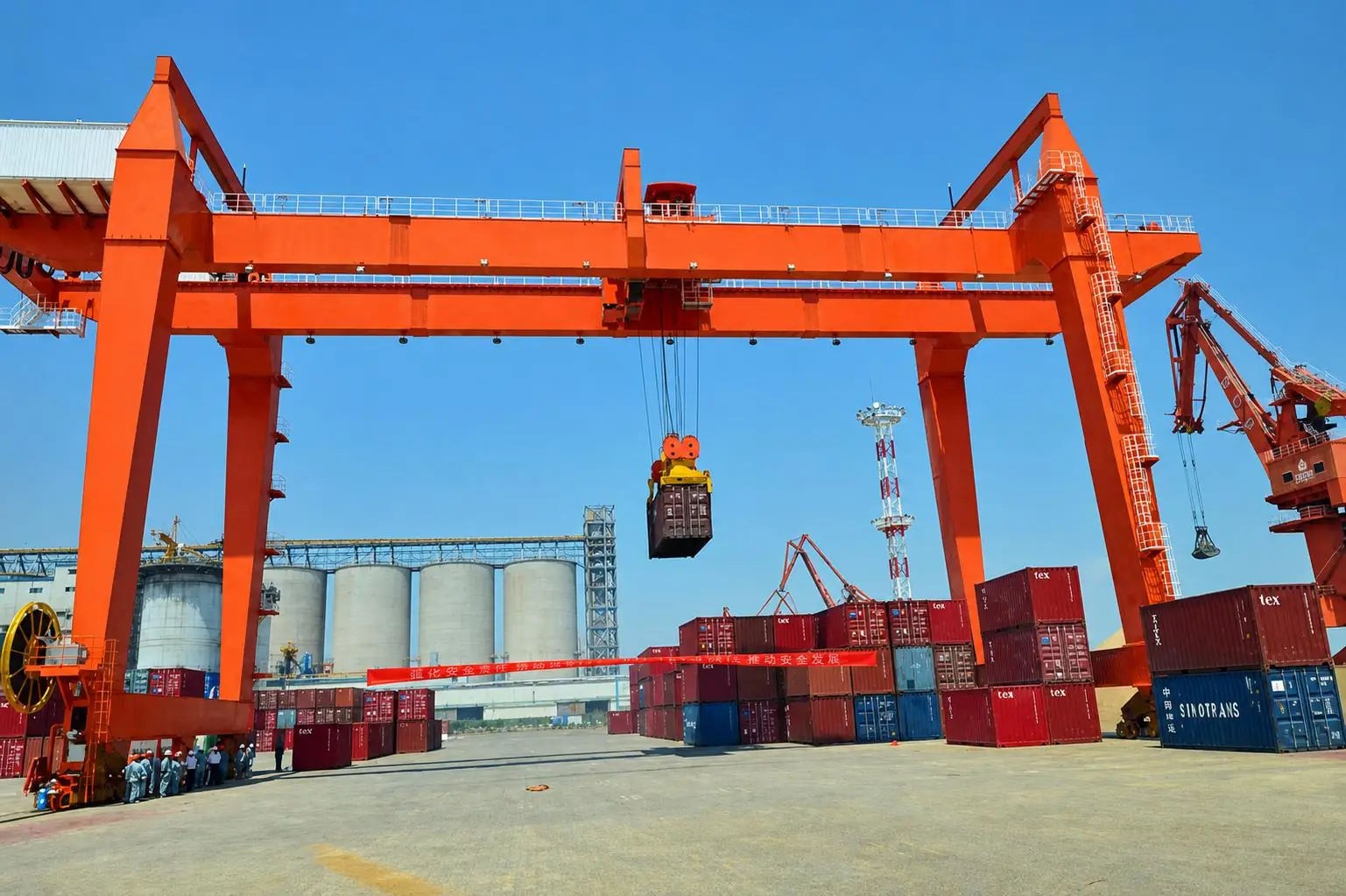
Container terminals are facing common changes in ship type, loading configuration and exchange volume.Liebherr's shore bridge technical data lists the outer extension distance, deck horizontal box row, lifting height, hoisting configuration and operating speed, indicating that these parameters need to be combined and matched, rather than representing all capabilities through a single tonnage index.
Future requirements can be written as clear scenarios: which ship types need services, where is the farthest operating point, how many boxes are exchanged per ship, and how long it is allowed to take.If you consider double-box or other multi-box hoisting configurations, the applicable loading conditions and shore-side pick-up arrangements should also be included in the verification, so as to avoid using the theoretical capabilities of a certain configuration directly as the continuous efficiency throughout the year.
Bulk Cargo Terminals
The bulk terminal cannot judge the ability by the volume of the grab alone.Materials such as coal, ore, grain, etc. have different densities, and grabs of the same size may correspond to different loads; the filling rate will also affect the actual weight of each cycle.Liebherr's bulk cargo data links material characteristics with grab filling control, indicating that changes in cargo types may make the original configuration no longer optimal.
During planning, the system can be disassembled into several links of reclaiming, lifting, unloading, conveying and storage, and the target t/h can be checked one by one.The grab system and the continuous ship unloading system should not only compare the nominal capacity, but also the target material, cabin cleaning, process switching and subsequent conveying interface; the final choice needs to be based on the specific cargo type and operating conditions, rather than preset some form is always more efficient.
General Cargo and Project Cargo Terminals
The growth of groceries and project goods may first be reflected in heavier, longer or more irregular goods, rather than simply increasing the number of hoists.For cranes that vary with the working range, the available carrying capacity of the same equipment at short and long distances may be different; the manufacturer's load gauge will give the scope of application separately, and the maximum capacity of the near range cannot be used for all locations. .
Establish a hoisting list according to representative goods, which helps to clarify the weight, size, center of gravity, hoisting point, accessories and actual pick-and-place location.If part of the task requires joint hoisting, the engineering and operation organization evaluation should also be carried out as separate working conditions. The maximum tonnage of the two cranes cannot be simply regarded as the available capacity after adding up.
How to Determine the Right Port Crane Capacity for Future Demand
Forecast Cargo Growth Over the Crane’s Service Life
Forecasting cannot just multiply the throughput of the previous year by the growth rate.The World Bank's port demand assessment methods include historical cargo volume, macro trends, policy changes, competing ports, as well as benchmarks, upside and downside scenarios, and also require consideration of new cargo types and different ship types.For crane selection, the source of growth is often more explanatory than a final total.
Demand can be further divided into cargo volume, cargo type, ship type and time: the annual cargo volume determines the overall task scale, the cargo structure affects the load, the ship type determines the operating space, and the rhythm of arrival determines the peak processing rate.Only by modeling these conditions separately can we determine whether the shortage is a single load, coverage, number of equipment, or available operating time.
Calculate Required Lifting Capacity
Accounting should start with specific tasks: first find out the heaviest expected cargo and the required hoisting configuration, and then check the actual working range and the definition of rated capacity.For equipment whose capacity varies with amplitude, OSHA requires the load gauge to cover the scope of application specified by the manufacturer, which also shows that the maximum rated tonnage is not enough to complete the working condition verification.
Taking the hypothetical task as an example, a certain cargo weighs 45 t, and the total number of hanging beams and rigging included in the applicable rated definition requirements is 8 t, then the load that needs to be checked is 53 T.However, this does not mean that choosing a nominal 53 t equipment is sufficient: the actual range, hoisting configuration and manufacturer regulations must still be met one by one, and it is not possible to replace the formal engineering accounting with an arbitrary percentage.
Match Crane Dimensions to Future Vessels and Cargo
Geometric matching should use the profile of the target ship type and the layout of the dock, rather than just comparing the captain.The verification content includes the width of the ship, the box row, the hatch, the highest operating point, the water level change, the position of the shore line to the track, and the clearance of the spreader and cargo; the track gauge, wheel pressure and basic load-bearing need to be confirmed simultaneously with the equipment plan.
The key here is to check whether the equipment can achieve these dimensions on the existing dock.Liftech's research shows that increasing the height and extension distance will be mutually restrictive with infrastructure conditions; therefore, the ability to manufacture larger cranes does not mean that the site must be directly accepted.
Evaluate Productivity and Duty Requirements
The continuous processing goal should be determined before the realization method.The technical evaluation can check the lifting, trolley, positioning, anti-shake, field of vision and shore-side connection separately; anti-shake and fine positioning technology can improve part of the cycle, but the specific benefits depend on the equipment configuration and actual operations, and cannot be directly applied. A unified efficiency improvement ratio.
The ability calculation can use the amount of scheduled tasks divided by the time available for the task, and at the same time clearly deduct which downtime, maintenance, and waiting time are deducted.The rated speed, equipment availability rate, effective working time and continuous processing rate should be recorded separately to avoid the same loss being deducted repeatedly or completely missed in the calculation.The working level and load spectrum should also be written independently to the technical input.
Compare Lifecycle Costs Instead of Purchase Prices
The life cycle comparison should cover procurement, energy, maintenance, spare parts, and expected operating hours; the investment and operating cost combinations of different drive systems may be significantly different.Konecranes' white paper emphasizes that even if a certain solution has a low initial investment, it may pay more for long-term energy and maintenance, and vice versa.
For future growth, scenario costs such as phased upgrades, retrofit downtime, temporary replacements, and final replacements can also be added, and compared during the same evaluation period.Both higher-than-forecast and lower-than-forecast demand are worth testing: the former tests the ability to expand, and the latter tests whether excessive funds have been paid for long-term idle capacity.
Should a Port Buy a Larger Crane Now or Upgrade Later?
No strategy applies to all ports.The value of early allocation lies in reducing future capacity gaps, and the value of phased upgrades lies in retaining investment flexibility; however, the former bears the risk of insufficient demand, while the latter bears the risk that the original design cannot be economically transformed.The following is the decision-making framework, not the fixed cost or benefit conclusion.
| Decision factor | Plan for future growth | Upgrade later |
| Initial investment | Usually higher | May be lower initially |
| Future capacity | Matched to forecast demand | Depends on retrofit feasibility |
| Operational disruption | Less capacity-related retrofit work | Potential retrofit downtime |
| Flexibility | Expansion-ready systems possible | Limited by original design |
| Main risk | Paying for unused capacity | Costly upgrades or early replacement |
If the larger ship type has a clear introduction plan, the service window is strict, and the acceptable downtime is very short, priority can be given to evaluating the early configuration.If the demand is uncertain and the business can grow in stages, the staging plan can be compared, but the structural, electrical and on-site conditions required for future expansion must be written in the design task book in advance.
Can an Existing Undersized Port Crane Be Upgraded?
Potential Upgrade Options
It is indeed possible for existing equipment to extend its scope of application through retrofitting.Liftech's public project information includes projects such as shore bridge elevation, extension arm, and gauge adjustment, as well as structural analysis, wheel pressure, stability, and mechanical and electrical reviews.These projects prove that there is a practical path to transformation, but it does not mean that every old crane has the same conditions.
The solutions can be grouped by bottleneck: positioning and control problems prioritize the evaluation of anti-shake, drive, and operation sequence; insufficient geometry evaluates the elevation or extension arm; and the complete bearing chain is checked for changes in load requirements.For the insufficient total throughput, additional cranes or shore-side equipment can also be included in the comparison, rather than the default that all problems should be solved by stand-alone capacity increase.
The status of the equipment before the transformation is also important.Use history, structural defects, remaining fatigue life, and parts that need to be replaced will affect the value of the program; Konecranes uses these inspections and analyses for comparison of continued use, modernization, and procurement of new equipment.
When Replacement Is the Better Choice
In the following situations, the replacement plan is worth focusing on comparison: the existing structure is difficult to meet the new task; the extension distance or height gap is difficult to economically eliminate; the aging of key systems makes the scope of transformation continue to expand; or the impact of construction downtime on the business is unacceptable.The comparison should include the available capacity and remaining life after the renovation, not just the total amount of the renovation contract.
Replacing the high-power motor will not automatically increase the rated capacity of the crane.The increase in capacity must still meet the structural, mechanical and use conditions, and complete the applicable approval and inspection.Taking the United States as an example, OSHA 1917.45(b)(3) stipulates manufacturer approval or applicable engineering analysis requirements for capacity increases that exceed the manufacturer's rated value or the original design limit; other regions should check the local system.
Practical Example: A Port Terminal Outgrows Its Original Crane
The following are hypothetical examples and do not represent the true terminal performance, equipment guaranteed value or investment return commitment.
A container terminal was initially equipped with two shore bridges, with an exchange volume of 800 moves per ship.Assuming that both devices can continuously reach 25 moves/h, tasks can be evenly distributed and work in parallel, the pure loading and unloading time is:
800 ÷(2×25) = 16 H.
After the business grew, the exchange volume per ship increased to 1,200 moves, while the number of equipment and continuous efficiency remained the same, and the pure loading and unloading time became:
1,200 ÷(2×25) = 24 H.
In this simplified model, the exchange volume increases by 50%, and the pure loading and unloading time also increases by 50%.However, this is not a complete forecast of the time in port, because the berthing, hatch cover, operation waiting and other times have not yet been included, and there is no simulation of the fluctuations of the ship's arrival in port.
If the terminal hopes to continue to complete 1,200 moves within 16 h, the total continuous processing rate must reach at least 75 moves/h.Management can compare three paths: add a third shore bridge, increase the effective processing rate of the two existing equipment to 37.5 moves/h, or adopt replacement equipment that meets the new task.These are only capability goals and do not mean that any plan is already technically feasible.
The next step is to check the restrictions.If the ship's cargo is concentrated in a few operating areas, the third equipment may not be able to obtain a balanced task; if the main loss comes from waiting for the card collection, increasing the operating speed may not achieve the goal.If the far-side box column of the future ship type exceeds the coverage of the equipment, then even if it reaches 75 moves/h, there will still be a problem that some locations cannot be served.
This case shows that growth planning contains at least two independent questions: whether each job can be completed, and whether all jobs can be completed within the target time.Examples are used to clarify gaps, and the final plan still needs to be verified by ship type matching, on-site data, and engineering review.
Port Crane Selection Checklist for Long-Term Capacity Planning
- The following list is suitable as input for procurement or retrofit reviews, and does not replace the manufacturer's load gauge, engineering accounting, and compliance review of the project location.
- Accurately predict the annual cargo volume and peak demand during the equipment planning period, establish low-growth, benchmark and high-growth scenarios, and record key assumptions such as routes, customers, and competing ports.
- In order to confirm the future target ship type and typical cargo, organize the ship width, box row, stacking height, maximum weight, size and lifting point information, and avoid using only the average cargo weight for selection.
- The rated capacity should be checked according to the actual range and hoisting configuration, and the weight and caliber of the spreader, grab, beam and rigging should be clarified to prevent missing accessories or repeated deductions.
- Regularly check the extension distance, lifting height, track gauge and on-site clearance, and simultaneously review the wheel pressure, foundation and terminal structure conditions to confirm that the equipment is compatible with the civil construction plan.
- Then define the continuous processing rate, operation window and work intensity, specify the load spectrum, equipment availability rate and waiting time respectively, and verify the connection between the yard and the transportation system.
- Strictly verify the structure, electrical, automation and safety interfaces, clarify the control logic, protection functions, and commissioning and acceptance content after the transformation, and avoid checking only a single new component.
- By evaluating maintenance channels, overhaul windows, spare parts support, and fault recovery arrangements, long-term equipment availability is included in the comparison, rather than just focusing on performance at the time of delivery.
- It is recommended to compare procurement, operation, maintenance, upgrade and replacement plans during the same evaluation period, while considering construction downtime and replacement equipment, and testing different demand scenarios.
- The company confirms the responsibilities for design, approval, inspection and data update in accordance with the regulations and applicable technical standards of the project location, and clarifies the management methods of delivery documents and final rated information.
Conclusion
The small size of the port crane may mean that it cannot handle heavier cargo and wider ships in the future, or it may mean that the equipment can complete each lifting, but it cannot support the increased pace of operations.Tonnage, geometry, processing rate and work intensity belong to different dimensions, and cannot be replaced by a larger parameter for all assessments.
A more secure investment logic is to first determine future tasks, then identify the limitations of the entire operation chain, and finally compare the early configuration, phased upgrades, additional equipment or replacement plans.If you are planning to purchase or expand capacity, you can first organize the cargo volume scenario, target ship type, representative load, service window and terminal conditions, so that the supplier and the qualified engineering team can propose a verifiable plan based on the same set of inputs.