
How to Improve the Lifting Capacity of an Existing Port Crane
The core of increasing the capacity of port cranes is not to replace high-power motors, but to locate the bottleneck of the entire carrying system and re-approve the rated load with compliance transformation.The transformation can include structural reinforcement, lifting mechanism, electronic control and infrastructure upgrades, but a single upgrade is not equivalent to an increase in the safe working load of the whole machine.
The terminal needs to confirm two points: whether the equipment can be safely increased in capacity, and whether the operating indicators and costs after the increase in capacity are up to standard.The rated lifting weight must be clear whether it contains the weight of the spreader, and the accessories will occupy the cargo capacity.The following describes the landing method of the capacity-increasing project from the load-bearing restriction, evaluation, transformation, and commissioning verification.
What Limits the Lifting Capacity of an Existing Port Crane?
Structural Load-Bearing Capacity
The main beam, door frame, trolley frame and their connections jointly transmit the lifting load.The structural assessment not only focuses on whether it will be damaged immediately, but also includes fatigue damage caused by repeated operations.Corrosion, existing deformation and welding defects in the salt spray environment will also affect the judgment of the remaining carrying capacity; the equipment can still operate normally, but it cannot prove that it retains the structural margin for capacity increase.
Hoisting Mechanism and Drive System
The lifting capacity depends on the matching between the motor, reducer, reel, pulley, wire rope and brake.The ability of the motor to provide a larger output does not mean that the gears, ropes, and braking systems can withstand the corresponding loads.Therefore, the institutional evaluation should also examine the transmission capacity, wear status and on-load operation performance, rather than just comparing the motor nameplate power.For high-frequency operations, heat dissipation, braking heat capacity and continuous work rhythm must also be included in the check, otherwise lifting heavy loads in a short time does not mean that one shift of production tasks can be stably completed.
Runway, Rails, Wheels, and Supporting Foundations
Heavier hoisting will eventually be transmitted to the support structure or foundation through the wheels and tracks.The wheel pressure is also related to the position of the trolley, the wind load and the configuration of the whole machine. The total weight cannot be simply divided by the number of wheels.Even if the lifting mechanism has the conditions for increasing capacity, the carrying restrictions on the track beam, dock foundation or yard surface may still become the decisive constraints of the project.
Electrical, Control, and Safety Systems
Inverter, motor control, load detection and brake control must be coordinated with the new mechanical configuration.The load sensor is responsible for the measurement, and the overload protection is responsible for limiting dangerous movements. Neither can replace the carrying capacity of the physical structure.Whether the safety device is working properly is itself an important part of the inspection of lifting equipment, not an additional option after the transformation is completed.
How to Assess Whether a Port Crane Can Handle a Capacity Upgrade
Review the Original Design Specifications
The original drawings, calculations, load gauges and operating instructions constitute the starting point for evaluation. The rated lifting weight must be understood together with the lifting height, span, extension distance and working level.For equipment whose lifting weight changes with amplitude, the maximum capacity of a certain location cannot be extended to the full operating range; the ratings corresponding to different spreader configurations must also be confirmed separately.
The actual strength of use is also important.Occasional handling of heavy parts and continuous heavy-duty loading and unloading, the consumption of the design work period is not the same.ISO 12482:2014 provides a method for comparing the actual use situation with the original design work tasks. Its scope of application has clear boundaries and cannot be applied to all mobile port cranes without distinction.
Conduct Structural Inspection and Engineering Analysis
The on-site investigation covers key welds, connections, main beams, door frames and trolley structures, and corresponds the problems found to historical maintenance and use records.According to the location and nature of the defect, it can be combined with appropriate non-destructive testing and structural calculations to determine whether the defect affects the feasibility of capacity increase.Only doing visual inspection, or using only the original drawings to build a model, is not enough to describe the current state of the equipment.
It is recommended to organize cracks, cross-section losses, previous welds and replacement parts into the same defect map, and then distinguish between problems that must be repaired, problems that require further testing, and problems that can be continued to be monitored.This allows the follow-up plan to target the actual weak links, rather than listing all old parts as replacement objects.
Calculate the Total Impact of Increased Loads
The calibration object is not the new few tons of cargo, but the revised load combination under working conditions, including lifting dynamic effects, acceleration and deceleration, braking, wind load and load position changes.ISO 8686-1:2012 gives the general design principles of crane load and load combination, and the actual project needs to be combined with the applicable standards of the model and the existing design foundation.
For example, in a simplified static model, the same load moving to the far end of the cantilever will increase the bending moment at the relevant support.Therefore, the evaluation report should clarify the location and configuration applicable to the target capability, and check whether it affects the extension distance, lifting height or operating restrictions, and cannot only give a tonnage that is out of working conditions.
Establish a Feasible Upgrade Target
It is recommended to write the goal as a complete job task: cargo and spreader weight, working position, lifting height, operating frequency and allowable downtime.Then they compared the retention of the status quo, moderate capacity increase and larger-scale transformation, rather than first determining a capacity increase ratio, and then asking engineering analysis to find a basis for it.
If the higher lifting weight can only be achieved within a specific configuration or restricted operating range, these conditions are part of the definition of competence.The ultimate goal should be the capability boundary confirmed by the engineering analysis and corresponding approval procedures, not the single maximum value in the sales quotation.
Five Ways to Improve the Lifting Capacity of an Existing Port Crane
Reinforce the Crane’s Load-Bearing Structure
When the analysis confirms that the restriction comes from certain structural parts, the reinforcement and replacement of the main beam, small frame, connecting node or other bearing components can be studied.The plan must test the strength, stability and fatigue performance at the same time; the improvement of the local carrying capacity does not automatically prove that the whole machine meets the new load requirements.
From the perspective of force transmission, the new reinforcement will change the local stiffness and load distribution, and the original connection and adjacent components therefore need to be re-checked.The focus of reinforcement design is not how much steel is added, but to allow the new material to effectively participate in the force and avoid transferring the weak position to another node.
Structural reinforcement is more suitable for equipment where the defect range is clear, the main body state is still acceptable, and the target capacity increase has a calculated basis.If corrosion, crack or fatigue damage involves multiple key parts, it is necessary to re-compare the repair, capacity increase and replacement of the whole machine; the new reinforcement cannot be regarded as eliminating the use history that the original structure has already experienced.
Upgrade the Hoisting Mechanism
When the structure is qualified and the bottleneck is located in the lifting mechanism, the transformation can involve the motor, reducer, reel, rope system and brake.The upgrade plan should be matched one by one along the power and load transmission path, and the actual status of components such as pulleys, pins, and reels should be checked.Replacing a motor with a higher power will change the driving side conditions at most, and the rated lifting weight of the whole machine cannot be increased independently.
The wear-through magnification is also a design variable that may be studied.In an ideal rope system that ignores friction, increasing the carrying rope branch can reduce the tension of a single rope, but when the reel rope speed remains the same, it will also reduce the hook speed.This motion relationship shows that the magnification adjustment must be evaluated together with the lifting speed and rope arrangement, rather than obtaining greater capacity for free.
Therefore, it is recommended to submit the matching results of load and speed at the same time: what speed can be achieved under the target load, what operating rhythm is allowed during continuous operation, and how to meet the requirements for braking and heat dissipation.For high-frequency loading and unloading terminals, whether they can continue to complete planned operations is more commercially meaningful than occasionally being able to lift a heavier load.
Modernize the Electrical and Control Systems
The transformation of electronic control can incorporate drives, PLCs, motors and sensors into a unified plan to improve speed control, motion coordination and operation information acquisition.The manufacturer's modernization plan also lists drive and PLC upgrades, control optimization, and condition monitoring as different transformation projects, indicating that these functions can serve the upgrade of the whole machine, but not every function will bring rated capacity increase.
It is recommended to form a complete verification list of load measurement, overload action, brake interlocking and limit functions to clarify the expected response in the event of normal operation, power failure, and abnormal signal.Adjusting the load threshold separately only changes the protection settings and will not improve the load-bearing structure, so it cannot be a capacity-increasing solution.
Whether the original control architecture continues to be retained can be evaluated from the four aspects of interface compatibility, spare parts supply, debugging difficulty and maintenance ability.If multiple systems are updated at the same time, it is recommended to determine the boundary of responsibility before purchasing, so as to avoid the mechanical, electrical and control suppliers each completing the acceptance of the stand-alone machine, but no one is responsible for the joint adjustment of the whole machine.
Upgrade Trolley, Wheels, Rails, and Supporting Infrastructure
The trolley, wheels, track and support foundation together form the path of the load to the ground.The capacity increase evaluation must consider not only the lifting, but also the weight and load position of the modified equipment.The manufacturer's wheel pressure data will distinguish between load, wind speed and equipment configuration, which shows that the wheel pressure cannot be estimated in equal proportions based only on the change in lifting weight.
It is recommended to use the complete reaction force result as the input for civil engineering review, cover the relevant operating location and operating conditions, and then study the scope of transformation of the trolley structure, wheel set, track or foundation.If the foundation cannot withstand the revised force, no matter how strong the upper mechanical capacity is, it will not be able to form a usable capacity increase plan for the whole machine.
There are still engineering boundaries for wheel set adjustment.For example, some RTG products reduce the single-wheel load through more wheels, but this does not mean that existing equipment can directly install wheels; existing models still need to re-verify the adaptability of the chassis, equalization mechanism, and walking configuration.
Combine Mechanical Upgrades With Crane Modernization
When capacity increase involves both structure, lifting mechanism and electronic control system, coordinated implementation is more worthy of comparison than isolated replacement of parts.Customized modernization services for port cranes can include lifting weight, institutional upgrades, and operating mode changes, but the specific combination always depends on equipment and project conditions.
It is recommended to incorporate the shared shutdown window, interface design, spare parts list and joint adjustment arrangements into an implementation plan, and then compare the overall transformation with the phased transformation.The former is conducive to centralized coordination, while the latter may be easier to control a single investment; the advantages and disadvantages of the two should be calculated based on downtime losses, technical risks and long-term maintenance costs, rather than the default packaging and transformation must be cheaper.
How Different Port Crane Types Approach Capacity Upgrades
Ship-to-Shore (STS) Container Cranes
The capacity increase goals of STS usually need to be discussed together with the extension distance, lifting height, and container spreader configuration.Manufacturers do have retrofit options to increase the safe working load, increase the height and extension distance, but these are the capability dimensions that need to be evaluated separately, and it cannot be considered that the completion of the boom extension will obtain a higher lifting weight at the same time.
It is recommended to clarify the measurement boundaries of the weight and rating of the spreader in the technical task book, and to include the load of the trolley and the supporting capacity of the dock in the analysis simultaneously.If the same project pursues heavier cargo and farther operating locations at the same time, its load combination and basic review scope should also be clarified.
Rubber-Tired and Rail-Mounted Gantry Cranes
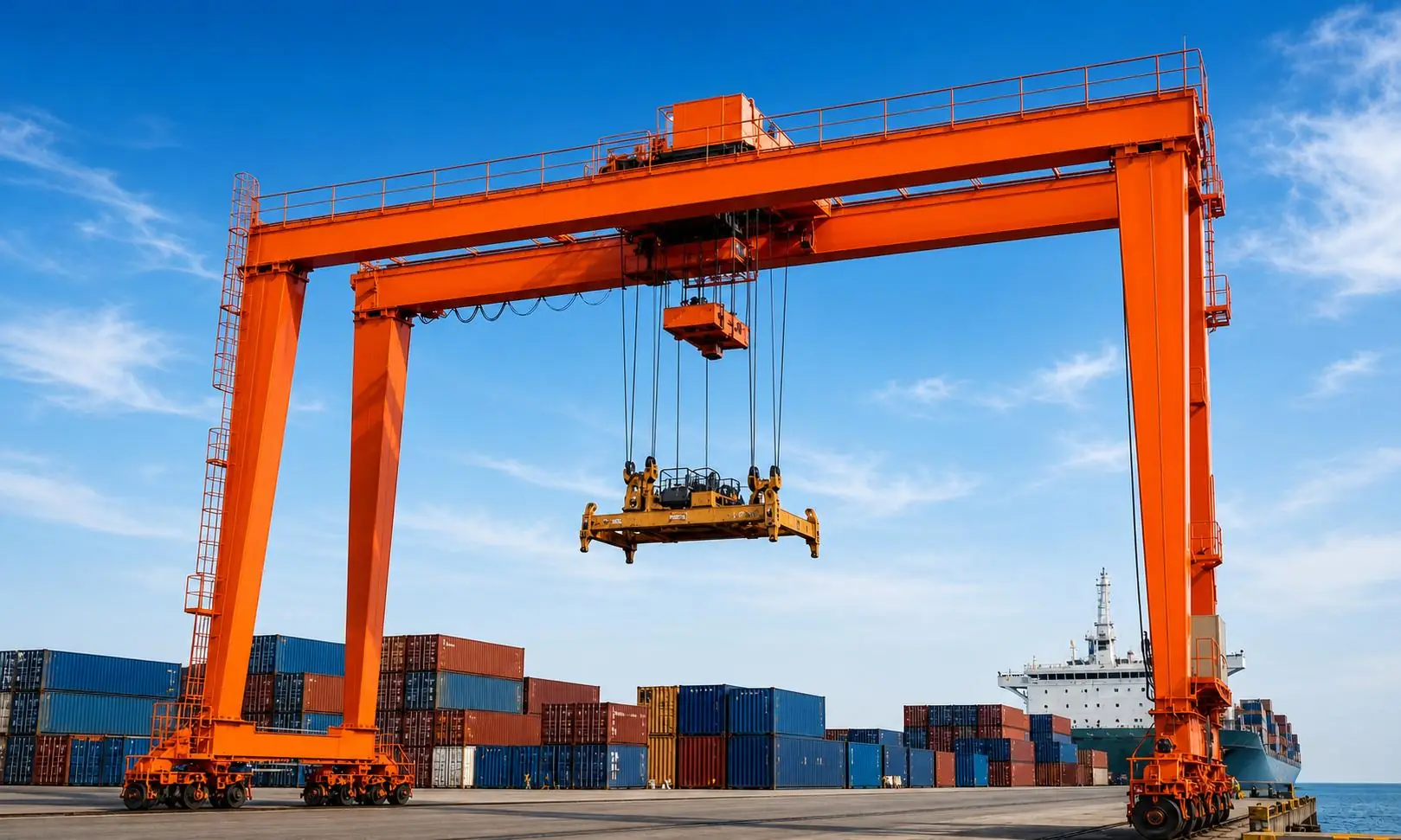
RTG crane needs to focus on comparing tires, wheel sets, walking configurations and yard carrying conditions; RMG also involves steel rails and track support structures.Neither type of equipment can only check the vertical lifting capacity, ignoring the stability and support conditions of the whole machine.The low wheel pressure configuration in the equipment product information is also the design choice of the whole machine, not an accessory independent of the structure.
Bulk Cargo and General Cargo Cranes
Bulk cargo operations must put the weight of the grab and the weight of the material within the same load boundary. The material density and the filling of the grab will affect the actual lifting.For steel and other groceries, sling configuration, center of gravity, and uneven loads must also be considered.The task of hoisting occasional heavy parts is different from that of continuous grapple operations, and the maximum tonnage cannot only be compared.
Safety and Compliance Requirements for Capacity Upgrades
Recalculate and Verify the Revised Rated Capacity
The increase in capacity must form a traceable design basis, and complete the approval and verification in accordance with the requirements of the location of the equipment.Taking the applicable port and terminal equipment in the United States as an example, OSHA 1917.45 and 1919.77 have requirements for the approval and engineering analysis of exceeding the original rating; other regions cannot directly copy this procedure, but should confirm the applicable local regulations and inspection requirements.
Update Overload Protection and Operating Limits
The revised load range must be consistent with the protection settings, limits, alarms, and operating data.The British HSE includes load or amplitude indication devices and devices that cut off related actions when overloaded in the scope of thorough inspection; its significance is to verify the actual safety function, not just to confirm that the control screen shows the new rating.
It is recommended to include the new scope of work, restrictions, abnormal response and daily inspection items in the operation training, and clarify which old documents need to be withdrawn.If the increase in capacity is only applicable to a certain spreader or configuration, the on-site data must allow the operator to identify this boundary.The display of the load gauge, nameplate and control system should also be consistent to avoid on-site personnel operating based on different versions of the capability information.
Complete Testing and Commissioning
The test should be carried out in accordance with applicable requirements and approved plans, rather than the overload ratio selected by the site.OSHA 1919.71 stipulates the relevant test requirements after major retrofits, and adopts different regulations for different types of cranes; the British HSE also makes it clear that a thorough re-inspection may be required after major retrofits or repairs.
It is recommended to use the calculation documents, inspection results, test records, revised load sheets and maintenance plans as delivery packages, and update the identification and put it into use after completing the corresponding authorization procedures.Passing a trial crane does not mean obtaining any additional permits, and it is still not allowed to operate beyond the existing approved capacity before that.
Capacity Upgrade vs. Complete Crane Replacement: Which Is More Cost-Effective?
It is recommended to compare the two paths with the same freight demand and evaluation cycle, rather than just comparing equipment quotations.The following table is used as a decision-making framework and does not represent the cost or duration conclusions of a particular project.
| Evaluation factor | Capacity upgrade | Complete replacement |
| Initial investment | May be lower if the existing structure is suitable | Generally higher |
| Installation downtime | Depends on retrofit scope | Depends on delivery and installation strategy |
| Existing infrastructure | May retain compatible assets | May require new interfaces or modifications |
| Capacity potential | Limited by the existing design and infrastructure | Can be designed around new requirements |
| Remaining service life | Depends on condition and upgrade scope | New equipment baseline; retained assets still need review |
| Technology integration | Depends on existing architecture | Greater design freedom |
When a Retrofit Makes Sense
From the perspective of project decision-making, the transformation is only worthy of further advancement when the status of the subject is acceptable, the engineering analysis supports the target capacity increase, the infrastructure can be matched, and the remaining use value is sufficient to cover the investment.Structural state and fatigue life analysis can help compare modernization and purchase new equipment, but it cannot guarantee in advance that the transformation will be more economical.
It is recommended to include design, testing, construction, shutdown, commissioning, spare parts and follow-up maintenance in the total cost, and then calculate the benefits in combination with the new freight demand.If the goal is only a small number of special hoisting tasks, external hoisting services can also be used as a financial comparison to avoid unnecessary long-term investment for low-frequency needs.
When Replacement May Be the Better Option
If the subject has extensive damage, or the target ability requires the structure, mechanism, control, and basic interface to be redone at the same time, it is recommended to compare the replacement plan to the same depth.The focus of selection is not the age of the equipment itself, but the scope of transformation required to achieve the target operating conditions, the verifiable remaining life, and whether future requirements will still exceed the existing design boundaries.
How to Plan a Port Crane Capacity Upgrade Project
It is recommended to organize the project according to the following stages, so that each step has reviewable input, output, and decision-making conditions.
- Define freight requirements: clarify the weight of goods and spreaders, lifting height, operating location and frequency of use, and record future demand assumptions to avoid starting the design with only the target tonnage.
- Establish equipment files: summarize the original drawings, load sheets, maintenance records and operating data, and mark the missing information separately to enable follow-up investigations and calculations to be based on traceability.
- Complete the feasibility study: jointly review the structure, institution, equipment and infrastructure, identify restricted links, and clarify the prerequisites for the establishment of capacity increase and the operating boundaries that cannot be broken through.
- Compare implementation plans: compare retrofits and replacements under the same demand and evaluation cycle, incorporate downtime losses, remaining life and maintenance inputs, and analyze key uncertainties.
- Implement the approval plan: coordinate design changes, component procurement, construction and commissioning inspections, set up key acceptance nodes, and ensure that the responsibility for the joint adjustment of the whole machine and the delivery documents are clear and complete.
- Verify long-term performance: establish inspection and maintenance arrangements according to revised working conditions, track actual loads and frequency of use, and re-evaluate applicable boundaries when abnormalities or changes in demand are found.
Conclusion
The capacity increase of existing port cranes is not simply to increase the driving power, but to comprehensively evaluate the structural strength, lifting mechanism, control system, and track or support conditions to ensure that the carrying path of the whole machine matches the target working conditions.Any capacity increase and transformation should go through professional engineering evaluation, necessary design approval and safety verification, and confirm that the equipment meets the new load requirements before it can be put into use.
Henan Mine Crane can provide crane capacity increase evaluation, transformation plan and customized design support based on existing equipment parameters, target lifting weight and port operating conditions to help customers take into account equipment safety, operating efficiency and long-term operating needs.