
50t Automated Steel Coil Cranes: Anti-Collision Radar and Smart Automatic Positioning
In the steel coil storage area and rolling workshop of steel mills, heavy-duty steel coil handling has always been a major difficulty in material logistics.Manual operation of cranes has pain points such as limited field of vision, high risk of collision, and low alignment efficiency.The 50-ton automatic steel coil heavy machine integrates anti-collision radar and intelligent positioning system to realize automatic steel coil stacking and reclaiming operations.The following will analyze its structure, intelligent technology advantages and supplier selection recommendations
What Is a 50t Automated Steel Coil Crane?
The 50-ton automatic steel coil lifting machine is a heavy-duty bridge crane designed for modern steel production and processing scenarios. It can safely and accurately complete large-scale steel coil handling operations with very little manual intervention.
The equipment integrates high-strength mechanical structure, PLC control system, multi-type sensors, positioning devices, and anti-collision technology. It can carry up to 50 tons of steel coils and realize steel coil transportation, storage and stacking, production line alignment and other operations.
This kind of crane is widely used in steel mills, steel coil warehouses, rolling production lines, and slitting workshops. It mainly handles large-scale master coils of automotive steel, galvanized steel, stainless steel, etc.The 50-ton lifting capacity takes into account the needs of heavy-duty operations and the flexibility of on-site operation. It is a very mainstream choice in the intelligent transformation of steel enterprises.
Core components
- Main beam and bridge structure: The high-strength box-shaped double main beam welded structure is adopted, with strong bending and torsional resistance, and can be adapted to the span of the plant above 15 to 35 meters.The whole machine has good rigidity, small deformation in the operation of carts and trolleys, and high stability. After flaw detection and anti-corrosion treatment, it is suitable for high-frequency automated operations in steel mills A6-A8.
- Large tonnage lifting mechanism: equipped with wire rope hoist mechanism, equipped with frequency conversion drive, support stepless speed regulation or two-speed lifting.Precise alignment at low speed, high speed to improve the transfer efficiency, small start-stop impact, with brake protection, smooth completion of the steel coil lifting, reduce the steel coil swing and bump.
- Special spreader for steel coil
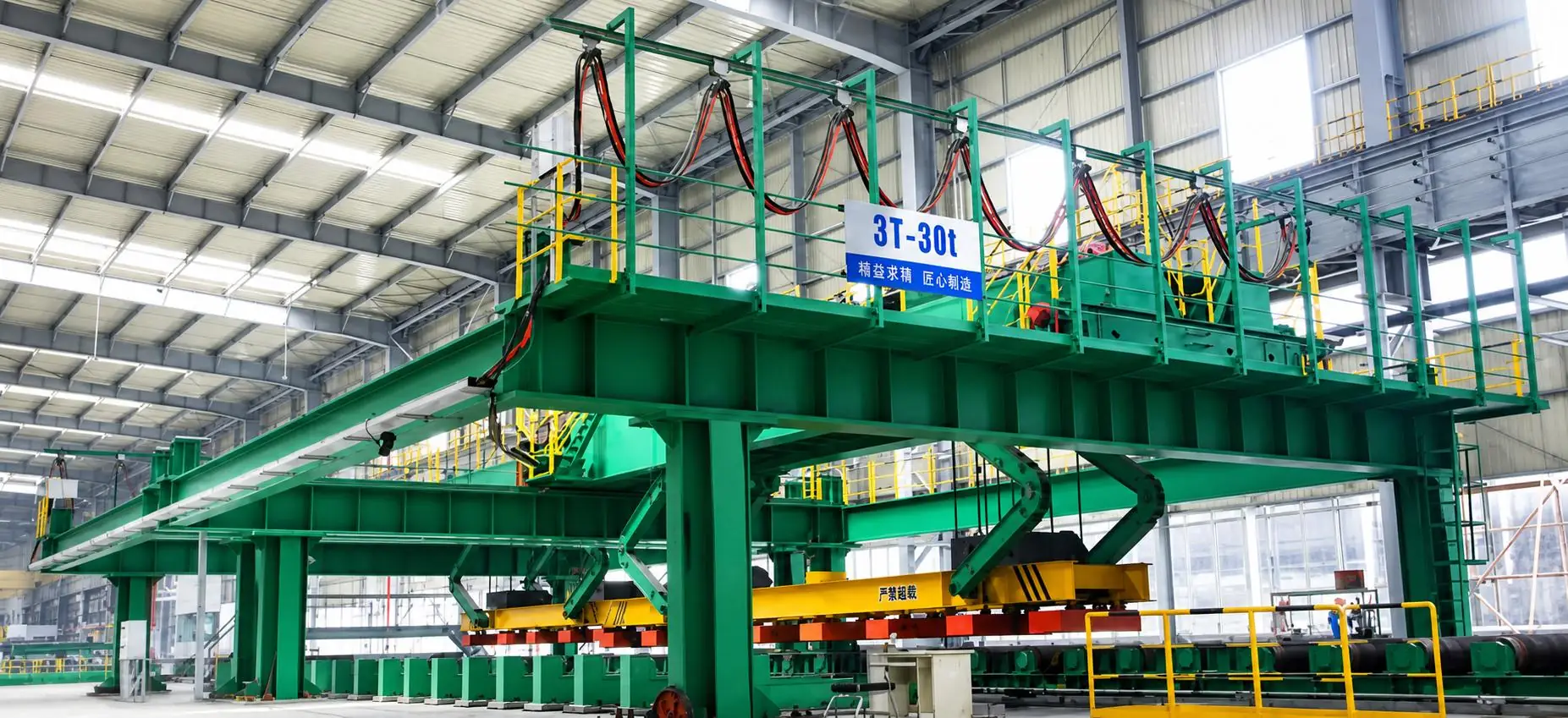
- C-shaped hook: suitable for horizontal inner hole steel coil hoisting, the structure is simple and durable, the hook body penetrates into the inner hole of the steel coil to support, easy maintenance, and can be used with automatic positioning to achieve automatic winding.
- Electromagnetic spreader: quickly absorb and release ferrous metal steel coils, high operating efficiency; it must be equipped with a backup power supply to maintain suction to prevent the steel coils from falling when power is off, and it can be connected to the system to realize automatic suction and discharge.
- Hydraulic steel coil clamp: relying on hydraulic drive to open and close, it can clamp steel coils in a variety of poses, and the structure is compact and suitable for small storage locations; built-in pressure monitoring, easy to connect to the automated PLC system.
- PLC control system: the control core of the crane machine, collects various sensor signals, and performs logical operations to uniformly control the whole process of walking, lifting, spreader action, anti-collision protection, etc., and supports automatic/manual mode switching.
- Sensor and positioning device: integrated laser ranging, absolute encoder, RFID, anti-collision radar, visual sensing and other equipment, using a multi-sensor fusion scheme to sense the position, steel coil shape and surrounding obstacles to ensure high-precision positioning in harsh environments.
- Industrial communication network: wireless or optical fiber industrial communication is used, low latency and anti-interference, through the crane PLC and the factory MES and WMS systems, two-way real-time transmission of task instructions, equipment status and inventory data.
- Optional configuration: anti-swing control system, weighing module, remote monitoring console, while retaining the local manual operation mode, convenient for emergency use.
Why 50 tons is the mainstream tonnage choice
The weight of the master coil of automobile steel, galvanized steel, and stainless steel production lines is generally close to the 50-ton level, and the 50-ton lifting specification can meet the handling needs of such large steel coils.At the same time, the tonnage equipment can also flexibly lift lighter steel coils, and can be used with auxiliary hoists or replaceable spreaders to achieve continuous operation of multi-specification steel coils.
The 50-ton model finds a balance between structural cost, energy consumption, and operational flexibility. It will neither be unable to meet heavy-duty master coil operations due to insufficient tonnage, nor will it be wasteful due to over-design. It is suitable for most steel mills and steel coil warehouses. Working conditions.
Why Steel Coil Handling Requires Intelligent Automation
Among the large steel enterprises pursuing the transformation of smart factories, the traditional manual and semi-manual crane operation modes are prominent, and intelligent automation has become the inevitable direction for the upgrading of steel coil logistics.
Security risks
The operator's field of vision is limited, making it difficult to fully observe the status of steel coils, peripheral equipment and on-site personnel.Steel coils are prone to swing during the start and stop of carts and trolleys, and there is a risk of colliding with other cranes, storage shelves, and production equipment, or squeezing on-site personnel.
Once the hoisting operation is improper, accidents such as steel coil falling and steel coil edge bumping damage will occur, especially in the dusty and high temperature environment of steel mills, which further amplifies the operating risks.
Low efficiency of traditional operations
Manual alignment takes a long time, the accuracy of the operation is highly dependent on the driver's experience level, the operation effect of different operators varies greatly, and the stability of the production process is poor.Under long-term shift work, operator fatigue will further reduce operating efficiency, and it is difficult to continuously and stably guarantee production capacity.
The automation value of smart steel mills
The automated crane can independently complete the loading and unloading of steel coils and the precise management of warehouse locations, seamlessly connect the manufacturing execution system MES and the warehouse management system WMS, and support uninterrupted operations 24 hours a day.The system can automatically plan the walking path, coordinate multiple cranes to work together, and turn the steel coil warehouse area into an intelligent logistics center with low manual intervention.
Anti-Collision Radar Technology for Automated Steel Coil Cranes
In the scenario of multi-crane shared operation span and high-speed automated operation, the anti-collision system is the core configuration to ensure the safe operation of the equipment.
Working principle of anti-collision radar
Industrial-grade radar sensors (common in the 24GHz frequency band) continuously scan the surrounding environment, measure the distance of obstacles in real time and identify the target object. The collected data is directly transmitted to the crane PLC control system, and the system responds instantly based on the distance signal.Radar is a non-contact detection, with a long detection distance and can adapt to the harsh working conditions of steel mills.
Core security features
- Anti-collision between cranes: radar dynamically monitors the operating spacing of multiple cranes across the same span in real time, and is equipped with electrical interlocking protection logic. Once the spacing is lower than the safe value, it will automatically intervene to effectively avoid multi-vehicle collisions. Accidents.
- Limit protection at the end of the track: Set up protective monitoring at both ends of the track of the crane cart to prevent the crane from exceeding the operating boundary of the track and eliminate the risk of collision with the track.
- Automatic deceleration when approaching obstacles: When the radar detects obstacles such as shelves and equipment in front of it, the control system automatically reduces the operating speed of the crane and reserves a safe braking distance.
- Emergency shutdown is triggered when the safety threshold is exceeded: When the distance of the equipment from the obstacle reaches the danger threshold, the system immediately issues an emergency stop command to quickly brake the crane to avoid collision accidents.
- Division of operating areas, restrict cranes from entering hazardous areas and issue early warnings: pre-delineate no-go areas and safe operating areas, trigger sound and light warnings before the cranes enter restricted areas, and restrict equipment from entering hazardous areas at the same time.
Comparative advantages of anti-collision scheme
The traditional limit switch only provides protection at a fixed point, and cannot be continuously monitored throughout the process, and the detection range is limited.The impact and vibration caused by high-frequency reciprocating operations in steel mills can easily cause switch wear and stagnation, reduce reliability, and there is a risk of safety protection failure.
The radar anti-collision system supports continuous dynamic monitoring and is a non-contact detection. It is more stable in the dust and vibration environment of steel mills and does not require frequent calibration.It can be connected to the PLC through relays and Modbus buses, and the integration difficulty is low.
Smart Automatic Positioning System: Achieving Millimeter-Level Handling Accuracy
If you want to safely stack steel coils, accurately feed the rolling production line, and at the same time increase the storage density of the warehouse, high-precision positioning technology is essential.
Positioning technology
Mainstream technologies include laser positioning and ranging, shaft-end absolute encoder, RFID location tag, indoor GNSS positioning scheme, and multi-sensor fusion technology; some equipment is equipped with lidar and visual recognition to complete the steel coil shape recognition.The positioning accuracy of carts and trolleys can reach ±10mm, and the accuracy of the lifting direction is also excellent, and the positioning ability of the millimeter level can be achieved in some working conditions.
Automatic walking and lifting control
The equipment relies on frequency conversion drive + closed-loop feedback to achieve precise horizontal movement of carts and trolleys, and the trolleys automatically travel to the top of the target warehouse; the lifting and descending actions are precise and controllable.The system is equipped with soft start, soft stop algorithms and anti-swing procedures to suppress the swing of the steel coil to the maximum extent possible, while ensuring the operating speed, to avoid the steel coil collision damage.
Intelligent warehouse management
The crane relies on various sensors and the WMS warehouse management system to identify the location of steel coils, collect and synchronize inventory data in real time, and automatically plan the optimal winding and unwinding operation path.The system can dynamically allocate free storage locations, greatly shortening the time-consuming retrieval of steel coils, and effectively improving the space utilization rate of the warehouse area.
PLC Control System: The Brain Behind Automated Coil Crane Operation
The programmable logic controller coordinates all the automated actions of the crane and is the core of the entire intelligent lifting system.
- Intelligent control architecture based on PLC: various sensors collect position, load, operating speed, obstacles and other status data in real time, PLC centrally processes positioning signals and safety interlock signals, outputs commands to control frequency converters, drives motors and braking mechanisms.The anti-swing algorithm, path planning, and safety interlock logic are all run in the PLC, and the supporting man-machine interface (HMI) is used for operation and maintenance personnel to check the status.
- Docking with the factory automation system: PLC can interface with the MES manufacturing execution system to receive production work orders, connect to the WMS warehouse management system to obtain warehouse location information, and synchronize with the production scheduling system.Realize task issuance and status return, and open up the material flow process of the whole factory.
- Remote monitoring and data analysis: The system supports real-time monitoring of equipment operating status, fault alarm diagnosis, predictive maintenance based on operating data, and complete recording of each job data to facilitate traceability and continuous optimization.With SCADA or cloud platform, you can also build a digital twin to achieve remote visual management.
Key Design Considerations for 50t Automated Steel Coil Cranes
Equipment design must give priority to ensuring long-term stable and reliable operation under harsh working conditions.
Load operation reliability
In the calculation stage of structural strength, the concentrated load and partial load hoisting conditions are fully considered. The whole machine adopts an anti-fatigue design, which can adapt to long-term and high-frequency cyclic hoisting operations.The steel coil spreader has a sturdy structure, equipped with steel coil edge protection and reliable locking mechanism; the electromagnetic crane is equipped with a backup battery, and the clamp is equipped with a mechanical lock to ensure the safety of the spreader.
Environmental adaptability design
The working conditions of steel mills are complex, and the equipment is specially designed for harsh environments: high temperature resistant structure (heat insulation protective cover if necessary), dust and metal debris protection, electrical components protection level up to IP55~IP67, strong vibration resistance, support long-term continuous operation.Special coating and sealed electrical structure enhance the durability of the whole machine.
Security system configuration
The whole machine is equipped with overload limiter, anti-swing control system, emergency braking device, lifting and operating limit protection, and radar anti-collision system.The core safety components adopt a redundant architecture, and safety-certified components are selected to build a multi-layer protection system, which significantly reduces the operational risks in the steel coil hoisting process.Pretend to be a job risk.
Benefits of Using Automated Steel Coil Cranes in Steel Plants
The landing of automated steel rolling heavy machinery can bring significant improvements in safety, production capacity, cost, and warehouse management.
Improve job safety
Automated operations can minimize the entry of personnel into the hoisting high-risk operation area, reduce the probability of direct contact between personnel and heavy-duty steel coils from the source, and significantly avoid the risk of major safety accidents such as steel coils falling and equipment colliding and injuring people.
The operation actions of the complete set of lifting equipment are all standardized, and the movement process is highly controllable. With the built-in anti-swing algorithm, the swing amplitude of the steel coil during the lifting process can be greatly reduced, the possibility of alignment operation errors can be reduced, and a more reliable safety guarantee can be built for the handling of steel coils in the warehouse area.
Improve production efficiency
The rhythm of the automated handling cycle is faster, the waiting time for the job is significantly shortened, and the equipment can achieve stable and uninterrupted 24-hour unattended operation with no one or few people on duty, continuously improving the overall material throughput of the warehouse area.
The system supports the collaborative scheduling of multiple cranes, combined with intelligent path planning algorithms, to automatically avoid obstacles and equipment conflicts, further accelerate the efficiency of steel coil logistics in the factory, and ensure the continuous supply of materials in the production line.
Reduce operating costs
The automation system can reduce the dependence on senior crane operators, reduce labor costs, and at the same time reduce equipment bumps and steel coil damage caused by human misoperation, reduce the cost of subsequent maintenance and replacement, and effectively improve the comprehensive utilization rate of cranes.
The supporting predictive maintenance function can collect equipment operation data in real time, identify aging and potential failures of components in advance, extend the service cycle of components, and reduce production losses caused by sudden downtime.
Optimize warehouse management
The system can accurately track the whole process of steel coil information, which can improve the density of warehousing and stacking, optimize the utilization rate of warehouse space, and effectively speed up the delivery speed of orders out of the warehouse.
Relying on real-time inventory data collected to support production scheduling and planning, it avoids problems such as manual search for steel coils and misplaced warehouse locations, reduces the resulting time loss, and makes warehouse management in the warehouse area more orderly and efficient.
Conclusion
The 50-ton automatic steel rolling machine is the core equipment of intelligent material handling in steel enterprises.Relying on heavy-duty structure, radar anti-collision, high-precision positioning, PLC control and system integration, it meets the safe and efficient operation needs of steel coil storage, rolling and deep processing.
When selecting a company, it is necessary to comprehensively consider the steel coil parameters, site layout, automation requirements and system compatibility, and investigate the supplier's manufacturing, electronic control development and project landing capabilities.Henan Mine Crane can customize a 50-ton fully automatic steel lifting machine with automatic positioning and anti-collision system to help enterprises build a safe, efficient and scalable intelligent lifting system.